Indonesia Childrenswear Market Report: Trends, Growth and Forecast (2026-2032)
By Product Type (Apparel (Baby and Toddler Wear, Boys Apparel, Girls Apparel), Footwear (Boys Footwear, Girls Footwear), Accessories (Boys Accessories, Girls Accessories), Others), By Age Group (Infant/Toddler (Below 2 years), Kids/Children (2 - 14 years)), By Price Category (Mass, Premium), By Sales Channel (Retail Offline, Retail Online) ... Read more
|
Major Players
|
Indonesia Childrenswear Market Statistics and Insights, 2026
- Market Size Statistics
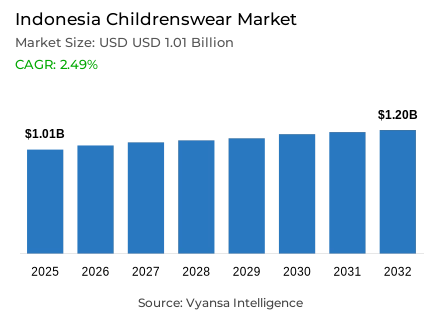
- Childrenswear in Indonesia is estimated at USD 1.01 billion in 2025.
- The market size is expected to grow to USD 1.2 billion by 2032.
- Market to register a cagr of around 2.49% during 2026-32.
- Product Type Shares
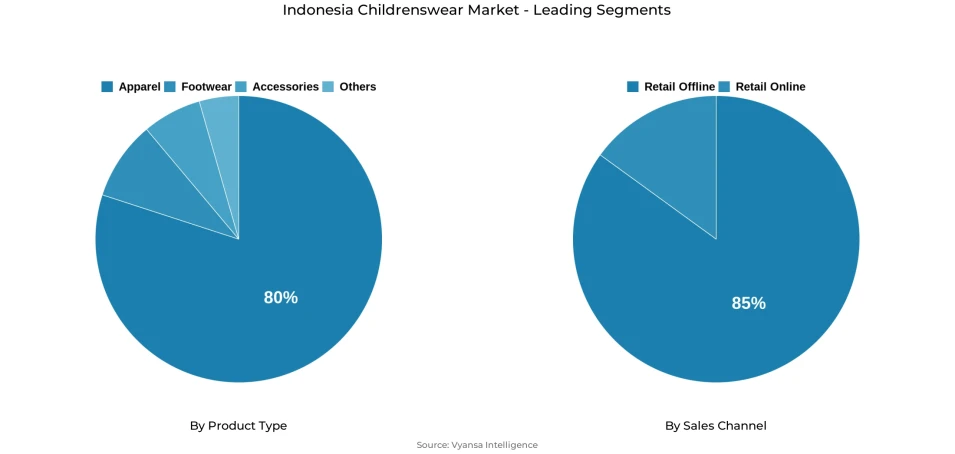
- Apparel grabbed market share of 80%.
- Competition
- More than 10 companies are actively engaged in producing childrenswear in Indonesia.
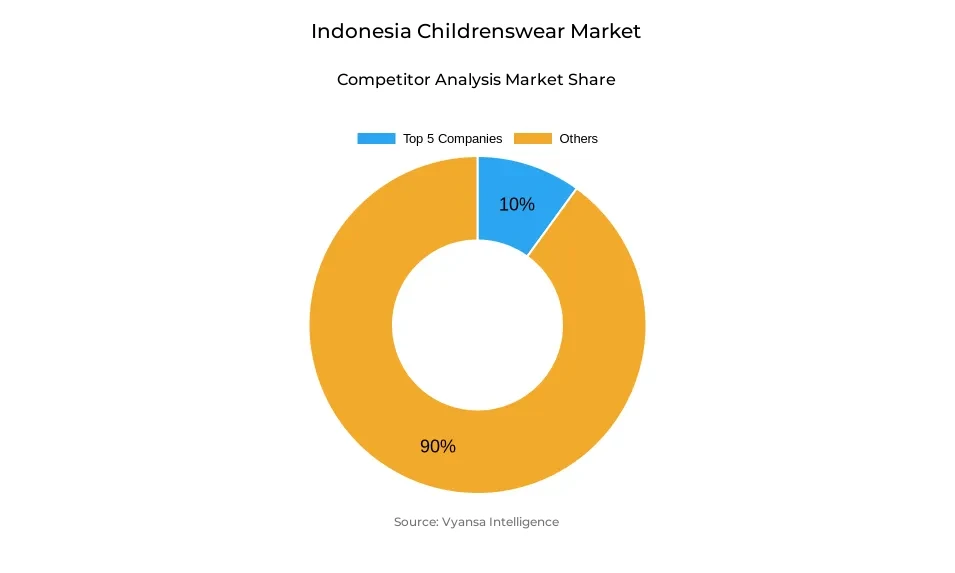
- Top 5 companies acquired around 10% of the market share.
- Carter's Inc; Lea Sanent PT; PT Adidas Indonesia; H&M Hennes & Mauritz AB; Giordano Indonesia PT etc., are few of the top companies.
- Sales Channel
- Retail offline grabbed 85% of the market.
Indonesia Childrenswear Market Outlook
The Indonesia childrenswear market has been valued around USD 1.01 billion in 2025 and is expected to reach USD 1.2 billion by 2032, growing at a CAGR of around 2.49% during 2026–2032. Growth is mainly supported by the natural need to replace children’s clothes frequently since babies and young children are highly active and grow out of garments quickly. Parents still try to give priority to children when household budgets are strained, thus keeping this category stable.
Parents in Indonesia are mostly concerned with comfort and practicality, especially for everyday wear. Lightweight, breathable, and elastic materials are highly sought after. Meanwhile, social media has an effect on how parents shop. Millennial parents, who are very active online, more and more want to make their children stylish since family life is highly exposed through social media on Instagram and TikTok. First-time parents tend to spend more since they enjoy buying new outfits for their babies.
Apparel is the leading category, at around 80% share, as it is the type of goods that is replaced most often in children's wardrobes. Local independent brands have always been in the leading position, since they can provide relatively lower prices with practical designs. Such brands appeal to families who do not want to invest too much in children's clothes due to the frequency of replacement. Promotions such as discounts, gifts, and payday sales reinforce demand.
By distribution, retail offline forms about 85% of sales. Physical stores remain important because parents like to see and touch products before buying. The markets, bazaars, and shopping areas like Tanah Abang continue to attract families looking for affordable options. Even though online sales are growing, retail offline remains the main shopping channel for childrenswear in Indonesia
Indonesia Childrenswear Market Growth Driver
Parenting Lifestyles and Social Media Influence
Indonesia parents continue to drive regular demand for childrenswear, as any type of clothing is seen as a basic need. Children grow fast and are very active, hence their clothes wear out quickly and need to be replaced often. This keeps the purchasing frequency regular, even when families try to control spending in other areas. First-time parents also spend more freely, as they enjoy dressing their children in new outfits during the early months.
Social media strongly supports this demand. Many millennial parents share family life online, and children's appearance becomes part of that image. Influencers and celebrities often post pictures of their children wearing stylish outfits, which shapes what other parents want to buy. This all makes fashion more important in childrenswear, pushing parents to buy not only for comfort but also for style and appeal.
Indonesia Childrenswear Market Challenge
Price Sensitivity and Quality Differences
Heightened price sensitivity among households remains a key constraint on the growth of Indonesia’s childrenswear market. A number of families are not willing to spend much on their children's clothes items, as they need frequent replacement. Low-priced local brands and imported products, therefore, attract most buyers. This puts pressure on brands that try to offer higher-quality or premium products, since many parents are not willing to pay more for short-term use.
Then, there is uneven quality of imports. Though some clothes imported from Thailand or China are quite good, others are made from rough materials and have very poor stitching. This creates trust issues among parents, who are skeptical regarding the durability of the product. Brands must provide a trade-off between low prices and acceptable quality, which is challenging in a market where affordability is the key buying factor.
Unlock Market Intelligence
Explore the market potential with our data-driven report
Indonesia Childrenswear Market Trend
Athleisure and Character-Based Fashion
Athleisure is a visible trend in Indonesia childrenswear market. Inspired by global sports events and lifestyle fashion, brands launch sporty, comfortable designs that combine style with functionality. Parents love how such clothes can enable kids to move freely but still look stylish. The trend of gender-neutral colors and simple design is also getting popular, as these are more flexible for different children.
Character-based clothing is another strong trend. Local brands are using famous cartoon and pop-culture characters to attract children. Collections of well-known characters make the children more excited about the clothes, and parents are bound to purchase them when children take more interest in something. The collaborations with popular franchises become vital strategy points for the local brands.
Indonesia Childrenswear Market Opportunity
Local Brands and Digital Engagement
local independent brands have a great opportunity as they already depict most of what families want: low prices and practical designs. While continuing with cheap clothing, these brands can retain this mammoth clientele base. Discounts, offers of gifts, and payday sales keep them attractive in a competitive market.
There is also a great opportunity in online-offline promotion. The brands that have been using social media, online ads, and influencer partnerships can easily reach millennial parents. At the same time, bazaars and physical events help in attracting bulk buyers. Brands that link digital promotion with physical selling spaces will be better positioned to grow.
Unlock Market Intelligence
Explore the market potential with our data-driven report
Indonesia Childrenswear Market Segmentation Analysis
By Product Type
- Apparel
- Footwear
- Accessories
- Others
The segment with the highest share under Product Type in the Indonesia Childrenswear Market is Apparel, holding around 80% of the market. Apparel dominates because clothing is the most frequently replaced product for children. Babies and young children grow quickly and are very active, which means parents must buy new clothes regularly. This makes apparel the core of childrenswear spending.
Parents mainly look for comfort, such as lightweight and breathable fabrics, especially for daily use. At the same time, fashion influence from social media is making stylish designs more important. This combination of necessity and fashion keeps apparel as the leading product type and ensures it continues to dominate the childrenswear category in Indonesia.
By Sales Channel
- Retail Offline
- Retail Online
The segment with the highest share under Sales Channel in the Indonesia Childrenswear Market is Retail Offline, accounting for around 85% of total sales. Parents prefer buying children’s clothes in physical stores because they can check size, fabric, and quality directly. Markets, shopping areas, and bazaars are especially popular for affordable childrenswear.
Offline stores also benefit from promotions and bulk buying, especially during discount periods. Even though online shopping is growing, many families still trust physical stores more for children’s clothing. As a result, retail offline continues to dominate the sales channel in Indonesia’s childrenswear market.
List of Companies Covered in Indonesia Childrenswear Market
The companies listed below are highly influential in the Indonesia childrenswear market, with a significant market share and a strong impact on industry developments.
- Carter's Inc
- Lea Sanent PT
- PT Adidas Indonesia
- H&M Hennes & Mauritz AB
- Giordano Indonesia PT
- Multitrend Indo PT
- Inditex, Industria de Diseño Textil SA
- Uniqlo Fast Retailing Indonesia PT
- Nike Indonesia PT
- Gap Inc, The
Frequently Asked Questions
Related Report
1. Market Segmentation
1.1. Research Scope
1.2. Research Methodology
1.3. Definitions and Assumptions
2. Executive Summary
3. Indonesia Childrenswear Market Policies, Regulations, and Standards
4. Indonesia Childrenswear Market Dynamics
4.1. Growth Factors
4.2. Challenges
4.3. Trends
4.4. Opportunities
5. Indonesia Childrenswear Market Statistics, 2022-2032F
5.1. Market Size & Growth Outlook
5.1.1.By Revenues in USD Million
5.2. Market Segmentation & Growth Outlook
5.2.1.By Product Type
5.2.1.1. Apparel- Market Insights and Forecast 2022-2032, USD Million
5.2.1.1.1. Baby and Toddler Wear- Market Insights and Forecast 2022-2032, USD Million
5.2.1.1.2. Boys Apparel- Market Insights and Forecast 2022-2032, USD Million
5.2.1.1.3. Girls Apparel- Market Insights and Forecast 2022-2032, USD Million
5.2.1.2. Footwear- Market Insights and Forecast 2022-2032, USD Million
5.2.1.2.1. Boys Footwear- Market Insights and Forecast 2022-2032, USD Million
5.2.1.2.2. Girls Footwear- Market Insights and Forecast 2022-2032, USD Million
5.2.1.3. Accessories- Market Insights and Forecast 2022-2032, USD Million
5.2.1.3.1. Boys Accessories- Market Insights and Forecast 2022-2032, USD Million
5.2.1.3.2. Girls Accessories- Market Insights and Forecast 2022-2032, USD Million
5.2.1.4. Others- Market Insights and Forecast 2022-2032, USD Million
5.2.2.By Age Group
5.2.2.1. Infant/Toddler (Below 2 years)- Market Insights and Forecast 2022-2032, USD Million
5.2.2.2. Kids/Children (2 - 14 years)- Market Insights and Forecast 2022-2032, USD Million
5.2.3.By Price Category
5.2.3.1. Mass- Market Insights and Forecast 2022-2032, USD Million
5.2.3.2. Premium- Market Insights and Forecast 2022-2032, USD Million
5.2.4.By Sales Channel
5.2.4.1. Retail Offline- Market Insights and Forecast 2022-2032, USD Million
5.2.4.2. Retail Online- Market Insights and Forecast 2022-2032, USD Million
5.2.5.By Competitors
5.2.5.1. Competition Characteristics
5.2.5.2. Market Share & Analysis
6. Indonesia Apparel Childrenswear Market Statistics, 2022-2032
6.1. Market Size & Growth Outlook
6.1.1.By Revenues in USD Million
6.2. Market Segmentation & Growth Outlook
6.2.1.By Age Group- Market Insights and Forecast 2022-2032, USD Million
6.2.2.By Price Category- Market Insights and Forecast 2022-2032, USD Million
6.2.3.By Sales Channel- Market Insights and Forecast 2022-2032, USD Million
7. Indonesia Footwear Childrenswear Market Statistics, 2022-2032
7.1. Market Size & Growth Outlook
7.1.1.By Revenues in USD Million
7.2. Market Segmentation & Growth Outlook
7.2.1.By Age Group- Market Insights and Forecast 2022-2032, USD Million
7.2.2.By Price Category- Market Insights and Forecast 2022-2032, USD Million
7.2.3.By Sales Channel- Market Insights and Forecast 2022-2032, USD Million
8. Indonesia Accessories Childrenswear Market Statistics, 2022-2032
8.1. Market Size & Growth Outlook
8.1.1.By Revenues in USD Million
8.2. Market Segmentation & Growth Outlook
8.2.1.By Age Group- Market Insights and Forecast 2022-2032, USD Million
8.2.2.By Price Category- Market Insights and Forecast 2022-2032, USD Million
8.2.3.By Sales Channel- Market Insights and Forecast 2022-2032, USD Million
9. Competitive Outlook
9.1. Company Profiles
9.1.1.H&M Hennes & Mauritz AB
9.1.1.1. Business Description
9.1.1.2. Product Portfolio
9.1.1.3. Collaborations & Alliances
9.1.1.4. Recent Developments
9.1.1.5. Financial Details
9.1.1.6. Others
9.1.2.Giordano Indonesia PT
9.1.2.1. Business Description
9.1.2.2. Product Portfolio
9.1.2.3. Collaborations & Alliances
9.1.2.4. Recent Developments
9.1.2.5. Financial Details
9.1.2.6. Others
9.1.3.Multitrend Indo PT
9.1.3.1. Business Description
9.1.3.2. Product Portfolio
9.1.3.3. Collaborations & Alliances
9.1.3.4. Recent Developments
9.1.3.5. Financial Details
9.1.3.6. Others
9.1.4.Inditex, Industria de Diseño Textil SA
9.1.4.1. Business Description
9.1.4.2. Product Portfolio
9.1.4.3. Collaborations & Alliances
9.1.4.4. Recent Developments
9.1.4.5. Financial Details
9.1.4.6. Others
9.1.5.Uniqlo Fast Retailing Indonesia PT
9.1.5.1. Business Description
9.1.5.2. Product Portfolio
9.1.5.3. Collaborations & Alliances
9.1.5.4. Recent Developments
9.1.5.5. Financial Details
9.1.5.6. Others
9.1.6.Carter's Inc
9.1.6.1. Business Description
9.1.6.2. Product Portfolio
9.1.6.3. Collaborations & Alliances
9.1.6.4. Recent Developments
9.1.6.5. Financial Details
9.1.6.6. Others
9.1.7.Lea Sanent PT
9.1.7.1. Business Description
9.1.7.2. Product Portfolio
9.1.7.3. Collaborations & Alliances
9.1.7.4. Recent Developments
9.1.7.5. Financial Details
9.1.7.6. Others
9.1.8.PT Adidas Indonesia
9.1.8.1. Business Description
9.1.8.2. Product Portfolio
9.1.8.3. Collaborations & Alliances
9.1.8.4. Recent Developments
9.1.8.5. Financial Details
9.1.8.6. Others
9.1.9.Nike Indonesia PT
9.1.9.1. Business Description
9.1.9.2. Product Portfolio
9.1.9.3. Collaborations & Alliances
9.1.9.4. Recent Developments
9.1.9.5. Financial Details
9.1.9.6. Others
9.1.10. Company 10
9.1.10.1. Business Description
9.1.10.2. Product Portfolio
9.1.10.3. Collaborations & Alliances
9.1.10.4. Recent Developments
9.1.10.5. Financial Details
9.1.10.6. Others
10. Disclaimer
| Segment | Sub-Segment |
|---|---|
| By Product Type |
|
| By Age Group |
|
| By Price Category |
|
| By Sales Channel |
|
Research Methodology
This study followed a structured approach comprising four key phases to assess the size and scope of the electro-oxidation market. The process began with thorough secondary research to collect data on the target market, related markets, and broader industry context. These findings, along with preliminary assumptions and estimates, were then validated through extensive primary research involving industry experts from across the value chain. To calculate the overall market size, both top-down and bottom-up methodologies were employed. Finally, market segmentation and data triangulation techniques were applied to refine and validate segment-level estimations.
Secondary Research
The secondary research phase involved gathering data from a wide range of credible and published sources. This step helped in identifying industry trends, defining market segmentation, and understanding the market landscape and value chain.
Sources consulted during this phase included:
- Company annual reports, investor presentations, and press releases
- Industry white papers and certified publications
- Trade directories and market-recognized databases
- Articles from authoritative authors and reputable journals
- Gold and silver standard websites
Secondary research was critical in mapping out the industry's value chain and monetary flow, identifying key market segments, understanding regional variations, and tracking significant industry developments.
Other key sources:
- Financial disclosures
- Industry associations and trade bodies
- News outlets and business magazines
- Academic journals and research studies
- Paid industry databases
Primary Research
To validate secondary data and gain deeper market insights, primary research was conducted with key stakeholders across both the supply and demand sides of the market.
On the demand side, participants included decision-makers and influencers from end-user industries—such as CIOs, CTOs, and CSOs—who provided first-hand perspectives on market needs, product usage, and future expectations.
On the supply side, interviews were conducted with manufacturers, industry associations, and institutional participants to gather insights into current offerings, product pipelines, and market challenges.
Primary interviews provided critical inputs such as:
- Market size and revenue data
- Product and service breakdowns
- Market forecasts
- Regional and application-specific trends
Stakeholders consulted included:
- Leading OEM and solution providers
- Channel and distribution partners
- End users across various applications
- Independent consultants and industry specialists
Market Size Estimation and Data Triangulation
- Identifying Key Market Participants (Secondary Research)
- Goal: To identify the major players or companies in the target market. This typically involves using publicly available data sources such as industry reports, market research publications, and financial statements of companies.
- Tools: Reports from firms like Gartner, Forrester, Euromonitor, Statista, IBISWorld, and others. Public financial statements, news articles, and press releases from top market players.
- Extracting Earnings of Key Market Participants
- Goal: To estimate the earnings generated from the product or service being analyzed. This step helps in understanding the revenue potential of each market player in a specific geography.
- Methods: Earnings data can be gathered from:
- Publicly available financial reports (for listed companies).
- Interviews and primary data sources from professionals, such as Directors, VPs, SVPs, etc. This is especially useful for understanding more nuanced, internal data that isn't publicly disclosed.
- Annual reports and investor presentations of key players.
- Data Collation and Development of a Relevant Data Model
- Goal: To collate inputs from both primary and secondary sources into a structured, data-driven model for market estimation. This model will incorporate key market KPIs and any independent variables relevant to the market.
- Key KPIs: These could include:
- Market size, growth rate, and demand drivers.
- Industry-specific metrics like market share, average revenue per customer (ARPC), or average deal size.
- External variables, such as economic growth rates, inflation rates, or commodity prices, that could affect the market.
- Data Modeling: Based on this data, the market forecasts are developed for the next 5 years. A combination of trend analysis, scenario modeling, and statistical regression might be used to generate projections.
- Scenario Analysis
- Goal: To test different assumptions and validate how sensitive the market is to changes in key variables (e.g., market demand, regulatory changes, technological disruptions).
- Types of Scenarios:
- Base Case: Based on current assumptions and historical data.
- Best-Case Scenario: Assuming favorable market conditions, regulatory environments, and technological advancements.
- Worst-Case Scenario: Accounting for adverse factors, such as economic downturns, stricter regulations, or unexpected disruptions.












