India Skin Care Market Report: Trends, Growth and Forecast (2026-2032)
By Product (Body Care (Firming Body Care, General Purpose Body Care), Facial Care (Acne Treatments, Face Masks, Facial Cleansers (Liquid, Cream, Gel, Bar Cleansers, Facial Cleansing Wipes), Moisturisers and Treatments (Basic Moisturisers, Anti-Agers), Lip Care, Toners), Hand Care, Skin Care Sets/Kits), By Category (Premium, Mass), By Gender (Men, Women, Unisex), By End User (Adults, Teenagers, Children), By Packaging (Tubes, Bottles, Jars, Others), By Sales Channel (Retail Online, Retail Offline) ... Read more
|
Major Players
|
India Skin Care Market Statistics and Insights, 2026
- Market Size Statistics
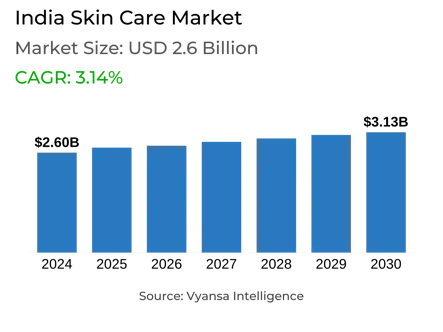
- Skin care market size in India was valued at USD 2.72 billion in 2025 and is estimated at USD 2.98 billion in 2026.
- The market size is expected to grow to USD 5.1 billion by 2032.
- Market to register a CAGR of around 9.4% during 2026-32.
- Product Shares
- Facial care grabbed market share of 85%.
- Competition
- More than 20 companies are actively engaged in producing skin care in India.
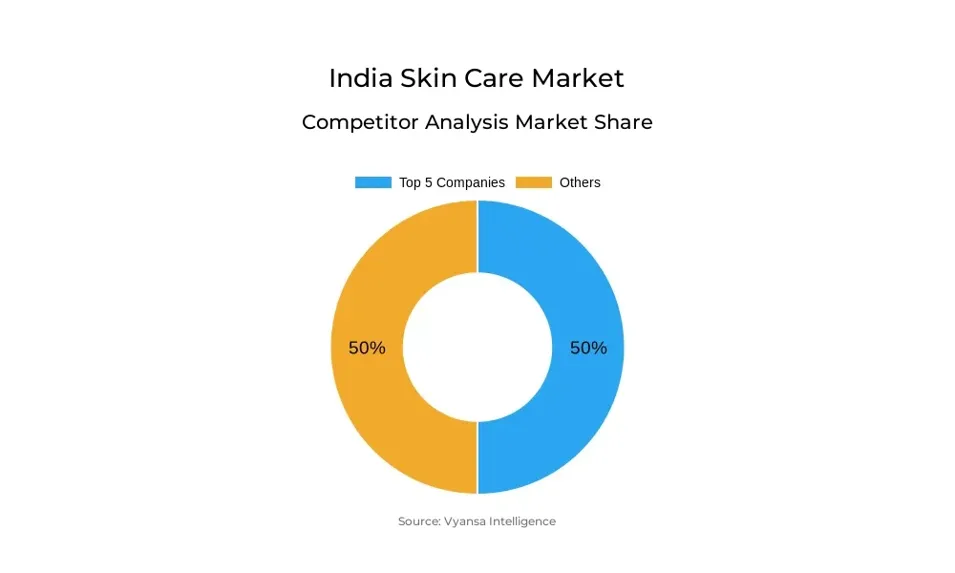
- Top 5 companies acquired around 50% of the market share.
- L'Oréal India Pvt Ltd, Honasa Consumer Pvt Ltd, Nivea India Pvt Ltd, Johnson & Johnson (India) Ltd, , Lotus Herbals Pvt Ltd etc., are few of the top companies.
- Sales Channel
- Retail offline grabbed 75% of the market.
India Skin Care Market Outlook
The India Skin Care market size was valued at USD 2.72 billion in 2025, and is projected to grow from USD 2.98 billion in 2026 to USD 5.1 billion by 2032. Along with this, the market is estimated to grow at a CAGR of around 9.4% during the forecast period, i.e., 2026-32. This growth is significantly driven by increasing consumer awareness and increasing demand for ingredient transparency. Consumers are making a shift towards products with clean labels and transparent ingredient declarations, prompting brands to feature the concentration of active ingredients on packs. This change has also stimulated innovation in focused skin care products, with numerous companies dedicating entire lines to a single star ingredient. The focus on efficacious, targeted products is revamping skin care regimens and driving ongoing market growth.
Market competition is heating up, and both traditional brands and nimbler direct-to-consumer innovators are competing for consumer mindshare. India's premium Ayurvedic and natural brands are performing well, while clinical-effect brands and global names are also proving popular. Driving difference through innovative technologies, unique ingredients, and eco-friendliness will continue to be crucial to brand success in a growingly congested marketplace.
Water-based skin care is gaining traction, fueled by strong incidence of dry or combination skin among Indian consumers. The trend is being met with products that contain hydrating ingredients such as hyaluronic acid and glycolic acid. Meanwhile, skin care simplicity is on the rise, particularly among time-strapped urban consumers. This is leading to the launch of multi-tasking products that simplify routines without sacrificing efficacy.
Online stores such as Nykaa and Tira are at the forefront of increasing access to skin care items and educating consumers. Their impact, in addition to rising demand for high-end skin care products, is driving value development in the industry. As consumers remain focused on quality and performance, the premiumisation trend is likely to be a dominant growth driver until 2032.
India Skin Care Market Growth Driver
Rising Inclination Towards Product Ingredients
A primary driver for the growth of the Indian skin care market is growing consumer emphasis on product ingredients. In 2024, the market remained in its high double-digit value expansion phase backed by rising consumer awareness regarding what goes into products. Consumers are better aware today and demand skin care products with clear ingredient knowledge. For this, brands are highlighting the focus of important ingredients on labels, with clean labels and natural labeling becoming progressively significant, further increasing the popularity of nature-derived products.
Such increased awareness about ingredients has also encouraged brands to launch focused solutions. Brands are now launching entire product lines centered around a single star ingredient to address the customer demand for specialised and result-oriented treatments. This move shows an inclination towards actives that deliver tangible results, which reflects in a more personalized skin care approach. A survey said that this trend is defining the new skin care scene in India.
India Skin Care Market Trend
Shift Toward Minimalist Skincare Regimens in India
The skincare industry in India is witnessing a notable transition toward minimalist skincare routines, driven largely by evolving consumer lifestyles and increasing demand for convenience-oriented beauty solutions. As consumers adopt faster-paced daily schedules, there is a growing preference for simplified regimens that deliver effective results without requiring multiple product steps. Although the market is projected to maintain strong growth during 2026–2032, this expansion is expected to occur at a slightly moderated pace as consumer preferences continue to evolve.
In the post-pandemic period, when extensive multi-step skincare routines gained popularity, many consumers are now shifting toward streamlined skincare practices that emphasize efficiency and practicality. According to a beauty survey conducted between June and July 2023, nearly 24% of Indian consumers prefer products that simplify their skincare routines, reflecting a growing inclination toward multi-functional products that reduce the time and effort involved in daily skincare practices.
In response to this trend, skincare brands are increasingly developing multi-benefit formulations that combine essential functions such as hydration, anti-ageing, and sun protection within a single product. Industry leaders such as Nykaa are also actively educating consumers about simplified skincare approaches. For instance, Nykaa promotes the CSMS philosophy, Cleanse, Serum, Moisturise, and Sunscreen, which encourages an effective yet minimal skincare routine. This strategic shift toward convenience-driven product innovation aligns closely with changing consumer expectations for both performance and simplicity.
Unlock Market Intelligence
Explore the market potential with our data-driven report
India Skin Care Market Opportunity
Rising Demand for Hydration-Focused Skincare Solutions
Hydration-focused skincare is emerging as a key opportunity within the Indian skincare market, largely influenced by environmental factors such as climate variability, pollution, and increasing exposure to urban stressors that contribute to dry or combination skin conditions. As a result, consumers are placing greater emphasis on products that provide deep and long-lasting hydration, which is increasingly associated with overall skin health and radiance.
Findings from the June-July 2023 beauty survey reveal that approximately 27% of Indian consumers reported having dry or extremely dry skin, underscoring the growing demand for effective moisturizing products. This trend has significantly influenced consumer purchasing behavior, with many individuals prioritizing formulations that promise hydration, nourishment, and improved skin texture.
The increasing consumer focus on hydration is also evident in product positioning trends. The share of online skincare SKUs in India featuring hydrating claims increased from 28% in 2019 to 40% in 2023, highlighting the rapid growth of this segment. Rising consumer awareness regarding skincare ingredients and their functional benefits is further supporting this shift. In response, prominent brands such as Lakmé, Plum, and Dot & Key have launched dedicated skincare ranges featuring ingredients like hyaluronic acid and glycolic acid, specifically designed to address hydration concerns and enhance skin health. Collectively, these developments highlight a strong growth opportunity for hydration-centric skincare products within the evolving Indian beauty landscape.
Unlock Market Intelligence
Explore the market potential with our data-driven report
India Skin Care Market Segmentation Analysis
By Product
- Body Care
- Firming Body Care
- General Purpose Body Care
- Facial Care
- Acne Treatments
- Face Masks
- Facial Cleansers
- Liquid
- Cream
- Gel
- Bar Cleansers
- Facial Cleansing Wipes
- Moisturisers and Treatments
- Basic Moisturisers
- Anti-Agers
- Lip Care
- Toners
- Hand Care
- Skin Care Sets/Kits
By product category, facial care holds the dominant position in the skincare market in India, accounting for nearly 85% of the total market share in 2026. The segment’s strong leadership is driven by rising consumer awareness regarding skin health, increasing concerns related to pollution and sun exposure, and the growing adoption of daily skincare routines. Products such as face creams, serums, cleansers, moisturizers, and sunscreens are widely used across different age groups, particularly among urban consumers. Additionally, continuous product innovation, ingredient-focused formulations, and strong brand marketing have further strengthened the demand for facial care products in the Indian skincare market.

By Sales Channel
- Retail Online
- Retail Offline
By sales channel, retail offline emerged as the dominant segment in the India skincare market, accounting for approximately 75% of the total market share in 2026. The strong presence of physical retail outlets, including supermarkets, hypermarkets, specialty beauty stores, and pharmacy chains, continues to support consumer preference for in-store purchases. Many consumers prefer offline channels as they allow them to physically evaluate products, seek recommendations from store representatives, and compare multiple brands before making purchasing decisions. Additionally, the extensive distribution networks established by leading skincare brands across urban and semi-urban areas further strengthen offline retail dominance, ensuring widespread product accessibility and reinforcing consumer trust in traditional retail formats.
List of Companies Covered in India Skin Care Market
The companies listed below are highly influential in the India skin care market, with a significant market share and a strong impact on industry developments.
- L'Oréal India Pvt Ltd
- Honasa Consumer Pvt Ltd
- Nivea India Pvt Ltd
- Johnson & Johnson (India) Ltd,
- Lotus Herbals Pvt Ltd
- Emami Ltd
- Hindustan Unilever Ltd
- Himalaya Drug Co
- Quest Retail Pvt Ltd
- Procter & Gamble Home Products Ltd
Market News & Updates
- Hindustan Unilever, 2025:
Hindustan Unilever Ltd entered advanced discussions to acquire the fast-growing direct-to-consumer skincare brand Minimalist in a deal valued at approximately ₹3,000 crore, aimed at strengthening its digital-first skincare portfolio in India.
- Karmic Beauty, 2025:
Karmic Beauty announced its launch in India with a portfolio of skincare and haircare products formulated using ethically sourced, certified organic ingredients such as Moroccan argan oil and hydrolyzed keratin. The brand aims to bridge the gap between luxury and affordability by offering premium-quality self-care products aligned with global beauty standards while catering to the evolving demand for natural and wellness-focused personal care solutions in the Indian market.
- Bayer AG, 2025:
Bayer AG introduced its globally recognized Bepanthen skincare brand in India following survey findings indicating that nearly 1 in 2 Indians experience dry skin concerns. Through this launch, the company expanded its consumer health portfolio with dermatologically tested moisturizers and cleansers formulated with Pro-Vitamin B5 and prebiotics, designed to provide immediate hydration while supporting long-term skin barrier health. The introduction aims to address the growing demand for clinically backed skincare solutions in the Indian market.
- Reliance Retail, 2024:
Reliance through its omnichannel beauty platform Tira, launched the global luxury skincare brand Augustinus Bader in India. The brand’s product range, known for its proprietary TFC8® technology and scientifically advanced formulations, became available exclusively on Tira’s online platform and in select retail stores across major cities including Mumbai, Delhi, Hyderabad, and Bengaluru, strengthening the availability of premium and luxury skincare offerings in the Indian beauty market.
Frequently Asked Questions
Related Report
- Market Segmentation
- Research Scope
- Research Methodology
- Definitions and Assumptions
- Executive Summary
- India Skin Care Market Policies, Regulations, and Standards
- India Skin Care Market Dynamics
- Growth Factors
- Challenges
- Trends
- Opportunities
- India Skin Care Market Statistics, 2022-2032F
- Market Size & Growth Outlook
- By Revenues in US$ Million
- Market Segmentation & Growth Outlook
- By Product
- Body Care- Market Insights and Forecast 2022-2032, USD Million
- Firming Body Care- Market Insights and Forecast 2022-2032, USD Million
- General Purpose Body Care- Market Insights and Forecast 2022-2032, USD Million
- Facial Care- Market Insights and Forecast 2022-2032, USD Million
- Acne Treatments- Market Insights and Forecast 2022-2032, USD Million
- Face Masks- Market Insights and Forecast 2022-2032, USD Million
- Facial Cleansers- Market Insights and Forecast 2022-2032, USD Million
- Liquid- Market Insights and Forecast 2022-2032, USD Million
- Cream- Market Insights and Forecast 2022-2032, USD Million
- Gel- Market Insights and Forecast 2022-2032, USD Million
- Bar Cleansers- Market Insights and Forecast 2022-2032, USD Million
- Facial Cleansing Wipes- Market Insights and Forecast 2022-2032, USD Million
- Moisturisers and Treatments- Market Insights and Forecast 2022-2032, USD Million
- Basic Moisturisers- Market Insights and Forecast 2022-2032, USD Million
- Anti-Agers- Market Insights and Forecast 2022-2032, USD Million
- Lip Care- Market Insights and Forecast 2022-2032, USD Million
- Toners- Market Insights and Forecast 2022-2032, USD Million
- Hand Care- Market Insights and Forecast 2022-2032, USD Million
- Skin Care Sets/Kits- Market Insights and Forecast 2022-2032, USD Million
- Body Care- Market Insights and Forecast 2022-2032, USD Million
- By Category
- Premium- Market Insights and Forecast 2022-2032, USD Million
- Mass- Market Insights and Forecast 2022-2032, USD Million
- By Gender
- Men- Market Insights and Forecast 2022-2032, USD Million
- Women- Market Insights and Forecast 2022-2032, USD Million
- Unisex- Market Insights and Forecast 2022-2032, USD Million
- By End User
- Adults- Market Insights and Forecast 2022-2032, USD Million
- Teenagers- Market Insights and Forecast 2022-2032, USD Million
- Children- Market Insights and Forecast 2022-2032, USD Million
- By Packaging
- Tubes- Market Insights and Forecast 2022-2032, USD Million
- Bottles- Market Insights and Forecast 2022-2032, USD Million
- Jars- Market Insights and Forecast 2022-2032, USD Million
- Others- Market Insights and Forecast 2022-2032, USD Million
- By Sales Channel
- Retail Online- Market Insights and Forecast 2022-2032, USD Million
- Retail Offline- Market Insights and Forecast 2022-2032, USD Million
- By Competitors
- Competition Characteristics
- Market Share & Analysis
- By Product
- Market Size & Growth Outlook
- India Body Care Market Statistics, 2022-2032F
- Market Size & Growth Outlook
- By Revenues in US$ Million
- Market Segmentation & Growth Outlook
- By Product- Market Insights and Forecast 2022-2032, USD Million
- By Category- Market Insights and Forecast 2022-2032, USD Million
- By Gender- Market Insights and Forecast 2022-2032, USD Million
- By End User- Market Insights and Forecast 2022-2032, USD Million
- By Packaging- Market Insights and Forecast 2022-2032, USD Million
- By Sales Channel- Market Insights and Forecast 2022-2032, USD Million
- Market Size & Growth Outlook
- India Facial Care Market Statistics, 2022-2032F
- Market Size & Growth Outlook
- By Revenues in US$ Million
- Market Segmentation & Growth Outlook
- By Product- Market Insights and Forecast 2022-2032, USD Million
- By Category- Market Insights and Forecast 2022-2032, USD Million
- By Gender- Market Insights and Forecast 2022-2032, USD Million
- By End User- Market Insights and Forecast 2022-2032, USD Million
- By Packaging- Market Insights and Forecast 2022-2032, USD Million
- By Sales Channel- Market Insights and Forecast 2022-2032, USD Million
- Market Size & Growth Outlook
- India Hand Care Market Statistics, 2022-2032F
- Market Size & Growth Outlook
- By Revenues in US$ Million
- Market Segmentation & Growth Outlook
- By Category- Market Insights and Forecast 2022-2032, USD Million
- By Gender- Market Insights and Forecast 2022-2032, USD Million
- By End User- Market Insights and Forecast 2022-2032, USD Million
- By Packaging- Market Insights and Forecast 2022-2032, USD Million
- By Sales Channel- Market Insights and Forecast 2022-2032, USD Million
- Market Size & Growth Outlook
- India Skin Care Sets/Kits Market Statistics, 2022-2032F
- Market Size & Growth Outlook
- By Revenues in US$ Million
- Market Segmentation & Growth Outlook
- By Category- Market Insights and Forecast 2022-2032, USD Million
- By Gender- Market Insights and Forecast 2022-2032, USD Million
- By End User- Market Insights and Forecast 2022-2032, USD Million
- By Packaging- Market Insights and Forecast 2022-2032, USD Million
- By Sales Channel- Market Insights and Forecast 2022-2032, USD Million
- Market Size & Growth Outlook
- Competitive Outlook
- Company Profiles
- Hindustan Unilever Ltd
- Business Description
- Product Portfolio
- Collaborations & Alliances
- Recent Developments
- Financial Details
- Others
- Himalaya Drug Co, The
- Business Description
- Product Portfolio
- Collaborations & Alliances
- Recent Developments
- Financial Details
- Others
- L'Oréal India Pvt Ltd
- Business Description
- Product Portfolio
- Collaborations & Alliances
- Recent Developments
- Financial Details
- Others
- Honasa Consumer Pvt Ltd
- Business Description
- Product Portfolio
- Collaborations & Alliances
- Recent Developments
- Financial Details
- Others
- Nivea India Pvt Ltd
- Business Description
- Product Portfolio
- Collaborations & Alliances
- Recent Developments
- Financial Details
- Others
- Johnson & Johnson (India) Ltd
- Business Description
- Product Portfolio
- Collaborations & Alliances
- Recent Developments
- Financial Details
- Others
- Lotus Herbals Pvt Ltd
- Business Description
- Product Portfolio
- Collaborations & Alliances
- Recent Developments
- Financial Details
- Others
- Emami Ltd
- Business Description
- Product Portfolio
- Collaborations & Alliances
- Recent Developments
- Financial Details
- Others
- Quest Retail Pvt Ltd
- Business Description
- Product Portfolio
- Collaborations & Alliances
- Recent Developments
- Financial Details
- Others
- Procter & Gamble Home Products Ltd
- Business Description
- Product Portfolio
- Collaborations & Alliances
- Recent Developments
- Financial Details
- Others
- Hindustan Unilever Ltd
- Company Profiles
- Disclaimer
| Segment | Sub-Segment |
|---|---|
| By Product |
|
| By Category |
|
| By Gender |
|
| By End User |
|
| By Packaging |
|
| By Sales Channel |
|
Research Methodology
This study followed a structured approach comprising four key phases to assess the size and scope of the electro-oxidation market. The process began with thorough secondary research to collect data on the target market, related markets, and broader industry context. These findings, along with preliminary assumptions and estimates, were then validated through extensive primary research involving industry experts from across the value chain. To calculate the overall market size, both top-down and bottom-up methodologies were employed. Finally, market segmentation and data triangulation techniques were applied to refine and validate segment-level estimations.
Secondary Research
The secondary research phase involved gathering data from a wide range of credible and published sources. This step helped in identifying industry trends, defining market segmentation, and understanding the market landscape and value chain.
Sources consulted during this phase included:
- Company annual reports, investor presentations, and press releases
- Industry white papers and certified publications
- Trade directories and market-recognized databases
- Articles from authoritative authors and reputable journals
- Gold and silver standard websites
Secondary research was critical in mapping out the industry's value chain and monetary flow, identifying key market segments, understanding regional variations, and tracking significant industry developments.
Other key sources:
- Financial disclosures
- Industry associations and trade bodies
- News outlets and business magazines
- Academic journals and research studies
- Paid industry databases
Primary Research
To validate secondary data and gain deeper market insights, primary research was conducted with key stakeholders across both the supply and demand sides of the market.
On the demand side, participants included decision-makers and influencers from end-user industries—such as CIOs, CTOs, and CSOs—who provided first-hand perspectives on market needs, product usage, and future expectations.
On the supply side, interviews were conducted with manufacturers, industry associations, and institutional participants to gather insights into current offerings, product pipelines, and market challenges.
Primary interviews provided critical inputs such as:
- Market size and revenue data
- Product and service breakdowns
- Market forecasts
- Regional and application-specific trends
Stakeholders consulted included:
- Leading OEM and solution providers
- Channel and distribution partners
- End users across various applications
- Independent consultants and industry specialists
Market Size Estimation and Data Triangulation
- Identifying Key Market Participants (Secondary Research)
- Goal: To identify the major players or companies in the target market. This typically involves using publicly available data sources such as industry reports, market research publications, and financial statements of companies.
- Tools: Reports from firms like Gartner, Forrester, Euromonitor, Statista, IBISWorld, and others. Public financial statements, news articles, and press releases from top market players.
- Extracting Earnings of Key Market Participants
- Goal: To estimate the earnings generated from the product or service being analyzed. This step helps in understanding the revenue potential of each market player in a specific geography.
- Methods: Earnings data can be gathered from:
- Publicly available financial reports (for listed companies).
- Interviews and primary data sources from professionals, such as Directors, VPs, SVPs, etc. This is especially useful for understanding more nuanced, internal data that isn't publicly disclosed.
- Annual reports and investor presentations of key players.
- Data Collation and Development of a Relevant Data Model
- Goal: To collate inputs from both primary and secondary sources into a structured, data-driven model for market estimation. This model will incorporate key market KPIs and any independent variables relevant to the market.
- Key KPIs: These could include:
- Market size, growth rate, and demand drivers.
- Industry-specific metrics like market share, average revenue per customer (ARPC), or average deal size.
- External variables, such as economic growth rates, inflation rates, or commodity prices, that could affect the market.
- Data Modeling: Based on this data, the market forecasts are developed for the next 5 years. A combination of trend analysis, scenario modeling, and statistical regression might be used to generate projections.
- Scenario Analysis
- Goal: To test different assumptions and validate how sensitive the market is to changes in key variables (e.g., market demand, regulatory changes, technological disruptions).
- Types of Scenarios:
- Base Case: Based on current assumptions and historical data.
- Best-Case Scenario: Assuming favorable market conditions, regulatory environments, and technological advancements.
- Worst-Case Scenario: Accounting for adverse factors, such as economic downturns, stricter regulations, or unexpected disruptions.












