India Electric Two Wheelers Market Report: Trends, Growth and Forecast (2026-2032)
By Type (Electric Motorcycles, Electric Scooters), By Battery Type (Nickel Metal Hybrid Batteries, Sealed Lead Acid Batteries, Lithium-Ion Batteries), By Drive Type (Hub Drive Motor, Mid Drive Motor), By Voltage (<48V, 48-60V, 61-72V, 73-96V, 96V), By Peak Power (<3 kW, 3-6 kW, 7-10 kW, 10 kW), By Battery Technology (Removable, Non-Removable), By Motor Placement (Hub Type, Chassis Mounted), By Region (North, East, West, South) ... Read more
|
Major Players
|
India Electric Two Wheelers Market Statistics and Insights, 2026
- Market Size Statistics
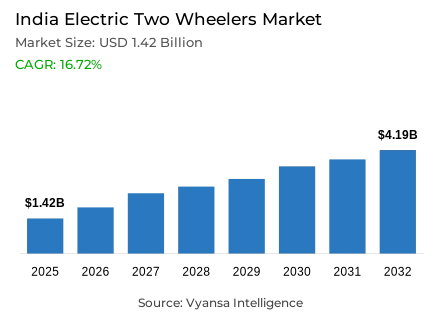
- Electric two wheelers market size in India was valued at USD 1.42 billion in 2025 and is estimated at USD 1.88 billion in 2026.
- The market size is expected to grow to USD 4.19 billion by 2032.
- Market to register a CAGR of around 16.72% during 2026-32.
- Type Shares
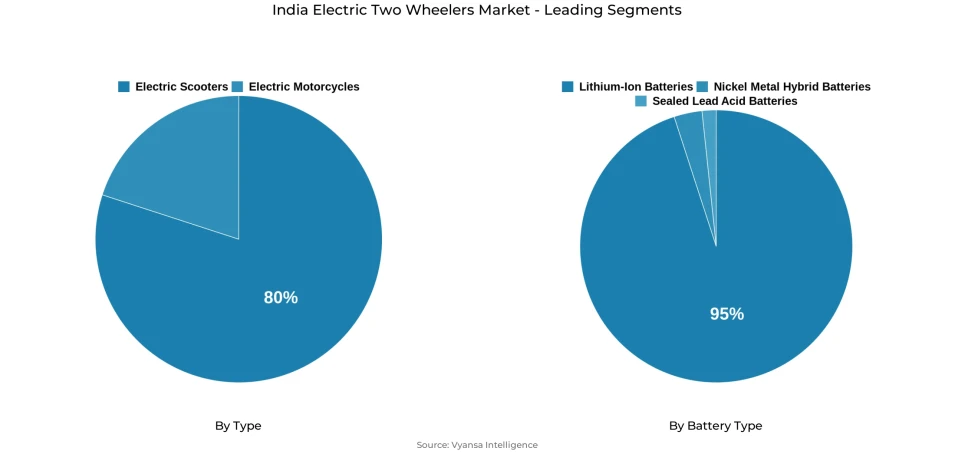
- Electric scooters grabbed market share of 80%.
- Competition
- More than 10 companies are actively engaged in producing electric two wheelers in India.
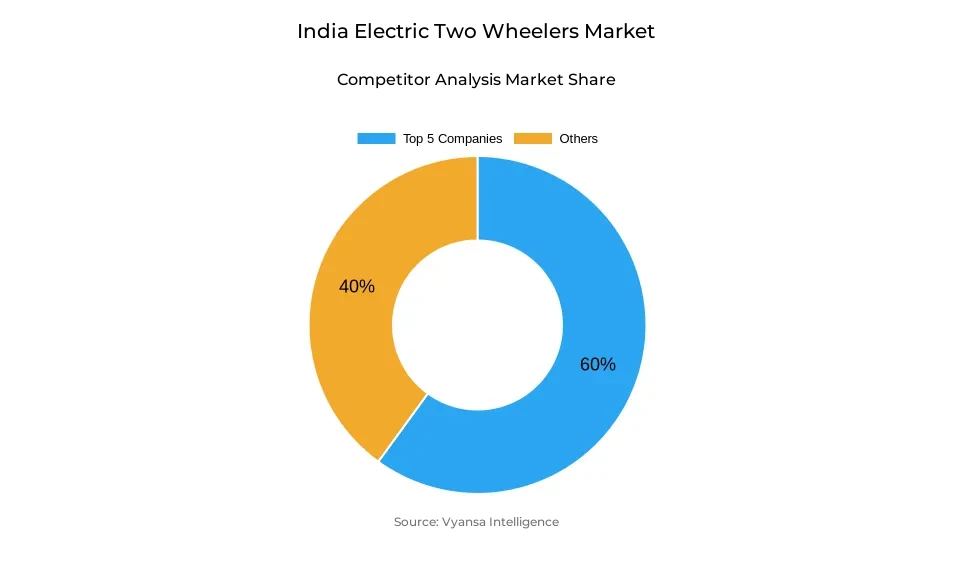
- Top 5 companies acquired around 60% of the market share.
- Greaves Electric Mobility Private Limited (Ampere), Okinawa Autotech International Private Limited, Simple Energy Private Limited, Ola Electric Mobility Limited, TVS Motor Company Limited etc., are few of the top companies.
- Battery Type
- Lithium-ion batteries grabbed 95% of the market.
India Electric Two Wheelers Market Outlook
The india electric two wheelers market size was valued at USD 1.42 billion in 2025 and is projected to grow from USD 1.88 billion in 2026 to USD 4.19 billion by 2032, exhibiting a CAGR of 16.72% during the forecast period. The market is expanding as electric scooters and electric motorcycles become practical alternatives for daily mobility, urban commuting, college travel, household movement, and last-mile delivery.
electric two wheelers in India are gaining relevance where riders need low running cost, simpler maintenance, and lower fuel dependence compared with petrol two wheelers. Demand is shaped by affordability, charging convenience, battery safety, financing access, after-sales support, and model availability across urban and semi-urban locations.
The India e-2W market includes electric scooters, electric motorcycles, battery-powered two wheelers, connected electric scooters, removable-battery models, fixed-battery vehicles, hub drive motor platforms, mid drive motor models, and fleet-oriented commuter electric two wheelers. Product adoption depends on lithium-ion batteries, battery management systems, electric drivetrain reliability, and service network depth.
The electric scooter market in India is moving from early adoption toward wider commuter and fleet usage. Growth remains tied to PM E-DRIVE scheme support, EV incentives, charging infrastructure, battery swapping, local service reach, affordable electric scooters, and manufacturers’ ability to combine pricing, warranty, dealer confidence, and convenient charging access for India’s mass two-wheeler users.
India Electric Two Wheelers Market Growth Driver
Purchase Incentives Strengthen Mass Adoption
The india electric two wheelers market is primarily driven by policy-backed demand support as adoption moves from early urban buyers toward wider commuter and fleet users. The Ministry of Heavy Industries reported that 11,49,334 electric two-wheelers were sold in FY2024-25, up 21% from 9,48,561 units in FY2023-24. It also stated that PM E-DRIVE has an outlay of Rs.10,900 crore for two years up to 31 March 2026, giving the industry a defined incentive framework after EMPS 2024 was subsumed into PM E-DRIVE.
electric two wheelers in India benefit from upfront purchase assistance and technology-linked eligibility. PM E-DRIVE allocates Rs.1,772 crore for 24.79 lakh e-2Ws, while a separate PIB note states that only e-2Ws equipped with advanced batteries are eligible for incentives and that both commercially registered and privately owned e-2Ws can benefit. This creates a clear demand chain: EV incentives reduce upfront cost, advanced-battery eligibility improves product discipline, and wider eligibility supports personal commuting, gig delivery riders, and last-mile delivery usage.
India Electric Two Wheelers Market Challenge
Charging Coverage Gaps Continue to Affect Confidence
The India e-2W market continues to face adoption pressure from charging infrastructure gaps because buyers evaluate both vehicle price and daily charging practicality. The Ministry of Heavy Industries reported 29,151 EV charging stations installed across India during the last five years, including 8,805 fast chargers and 20,346 slow chargers. Distribution remains uneven, with Karnataka at 6,096 chargers, Maharashtra at 4,166, Uttar Pradesh at 2,316, Delhi at 1,957, Tamil Nadu at 1,780, Rajasthan at 1,515, and Kerala at 1,389.
The electric scooter market in India is affected most where riders lack home parking, workplace chargers, or reliable public access. Delivery riders, tenants, apartment residents, and semi-urban buyers face higher range anxiety when charger density, uptime, parking access, and local service support remain inconsistent. Home charging helps private users, but high-utilization riders need faster turnaround. Charging confidence therefore remains central to converting buyer interest into sustained electric two wheeler usage.
Unlock Market Intelligence
Explore the market potential with our data-driven report
India Electric Two Wheelers Market Trend
Interoperable Charging and Battery Swapping Gain Momentum
The india electric two wheelers market is witnessing a shift toward connected, interoperable, and swapping-enabled charging systems that reduce downtime and improve practical vehicle use. The Ministry of Power issued the “Guidelines for Installation and Operation of Electric Vehicle Charging Infrastructure 2024” on 17 September 2024, outlining standards and protocols to create a connected and interoperable EV charging network, including battery swapping and charging stations.
electric two wheelers in India benefit from this trend because the category depends on short charging cycles, compact battery packs, predictable range, and low operating downtime. Battery swapping can support delivery fleets and high-use riders where waiting for a full charge reduces earning time. Product design is also moving toward removable batteries, battery management systems, fast-charging batteries, connected diagnostics, thermal safety, warranty traceability, and app-linked charging information, making the charging ecosystem a core part of electric mobility policy and product value.
India Electric Two Wheelers Market Opportunity
Semi-Urban and Last-Mile Users Create Scalable Demand
The India e-2W market has a strong opportunity in semi-urban mobility and last-mile usage, where electric scooters can solve daily short-distance movement with lower operating cost and easier maneuverability. The Ministry of Heavy Industries stated that, as of 8 February 2025, total EV registrations on the e-Vahan portal stood at 56.75 lakh against 3,897.71 lakh total registered vehicles. The same release notes that PM E-DRIVE supports targeted subsidies and demand incentives for e-2Ws and e-3Ws on a pan-India basis, including rural and semi-urban areas.
The electric motorcycle market in India and the scooter category both benefit where buyers need reliable daily mobility for commuting, local deliveries, office access, small retail operations, tuition travel, and household trips. Electric scooters remain especially well positioned due to automatic riding, compact parking, storage space, and charging flexibility. Manufacturers that combine affordable electric scooters, financing, exchange programs, battery warranty, dealer support, and neighborhood-level servicing can extend adoption beyond metro-focused early demand.
Unlock Market Intelligence
Explore the market potential with our data-driven report
India Electric Two Wheelers Market Segmentation Analysis
By Type
- Electric Motorcycles
- Electric Scooters
The segment with the highest share under the Type category in the india electric two wheelers market is Electric Scooters, holding around 80% of the market. Electric scooters lead because their form factor matches India’s everyday mobility needs through step-through access, automatic riding, compact parking, under-seat storage, short-distance usability, and suitability for household as well as delivery use.
electric two wheelers in India are also supported by the broader scooter-led mobility base. SIAM reported that two-wheeler sales reached 19.6 million units in FY2024-25, growing 9.1% over FY2023-24, while the share of EVs in overall two-wheelers crossed 6% in 2024-25. SIAM also noted that two-wheeler growth was led by the scooter segment due to improved rural and semi-urban connectivity and newer models with enhanced features. Electric motorcycles remain relevant for longer-distance and performance-oriented riders, but scooters lead due to daily practicality and lower usage friction.
By Battery Type
- Nickel Metal Hybrid Batteries
- Sealed Lead Acid Batteries
- Lithium-Ion Batteries
The segment with the highest share under the Battery Type category in the India e-2W market is Lithium-Ion Batteries, holding around 95% of the market. Lithium-ion batteries lead because they offer stronger energy density, lower weight, better packaging flexibility, faster charging compatibility, and better integration with battery management systems than older battery chemistries.
electric two wheelers in India depend heavily on battery reliability because riders expect usable range, manageable charging time, thermal safety, warranty coverage, and consistent performance across traffic and temperature conditions. Policy design reinforces this direction. PM E-DRIVE makes only e-2Ws equipped with advanced batteries eligible for incentives, while the PLI Advanced Chemistry Cell scheme supports domestic cell production for EV batteries. Lead-acid batteries remain less suitable for mainstream incentive-linked vehicles due to weight, lifecycle, charging, and performance limitations.
List of Companies Covered in India Electric Two Wheelers Market
The companies listed below are highly influential in the India electric two wheelers market, with a significant market share and a strong impact on industry developments.
- Greaves Electric Mobility Private Limited (Ampere)
- Okinawa Autotech International Private Limited
- Simple Energy Private Limited
- Ola Electric Mobility Limited
- TVS Motor Company Limited
- Bajaj Auto Limited
- Ather Energy Limited
- Hero MotoCorp Limited (VIDA)
- Ultraviolette Automotive Private Limited
- RattanIndia Enterprises Limited (Revolt Motors)
Market News & Updates
- Bajaj Auto Limited, 2026:
Bajaj Auto upgraded its Chetak electric scooter portfolio in April 2026 with the new C Series structure. The update added Google Maps on the C 35 01, higher top speeds across models, ride modes, hill hold assist, shorter charging time for C 30 01, and OTA updates for C 35 variants. The upgrade strengthens Chetak’s connected electric scooter offering in India.
- TVS Motor Company Limited, 2026:
TVS Motor launched the new TVS iQube 3.1 kWh electric scooter in February 2026. The model adds dual-tone colour options, large 14-inch wheels, under-seat storage, regenerative braking, battery management features, SmartXonnect connectivity, and a 3-year or 50,000 km standard warranty. The launch expands TVS iQube’s urban electric scooter range in India.
Frequently Asked Questions
Related Report
- Market Segmentation
- Research Scope
- Research Methodology
- Definitions and Assumptions
- Executive Summary
- India Electric Two Wheelers Market Policies, Regulations, and Standards
- India Electric Two Wheelers Production (Thousand Units) Trend 2022-2032
- India Electric Two Wheelers Production (Thousand Units) Trend By Type
- Electric Motorcycles
- Electric Scooters
- Company Wise Production Plants and Statistics
- Installed Production Capacity
- Actual Production
- Planned Production Target
- India Electric Two Wheelers Production (Thousand Units) Trend By Type
- India Electric Two Wheelers Pricing Analysis 2022-2032
- India Electric Two Wheelers Pricing Trend (USD/Thousand Units) 2022-2032
- India Electric Two Wheelers Pricing Trend (USD/Thousand Units) By Regions 2022-2032
- North
- East
- West
- South
- India Electric Two Wheelers Pricing Trend (USD/Thousand Units) By Type 2022-2032
- Electric Motorcycles
- Electric Scooters
- India Electric Two Wheelers Market Dynamics
- Growth Factors
- Challenges
- Trends
- Opportunities
- India Electric Two Wheelers Market Statistics, 2022-2032F
- Market Size & Growth Outlook
- By Revenues in USD Million
- By Units Sold (Thousand Units)
- Market Segmentation & Growth Outlook
- By Type
- Electric Motorcycles- Market Insights and Forecast 2022-2032, USD Million
- Electric Scooters- Market Insights and Forecast 2022-2032, USD Million
- By Battery Type
- Nickel Metal Hybrid Batteries- Market Insights and Forecast 2022-2032, USD Million
- Sealed Lead Acid Batteries- Market Insights and Forecast 2022-2032, USD Million
- Lithium-Ion Batteries- Market Insights and Forecast 2022-2032, USD Million
- By Drive Type
- Hub Drive Motor- Market Insights and Forecast 2022-2032, USD Million
- Mid Drive Motor- Market Insights and Forecast 2022-2032, USD Million
- By Voltage
- <48V- Market Insights and Forecast 2022-2032, USD Million
- 48-60V- Market Insights and Forecast 2022-2032, USD Million
- 61-72V- Market Insights and Forecast 2022-2032, USD Million
- 73-96V- Market Insights and Forecast 2022-2032, USD Million
- 96V- Market Insights and Forecast 2022-2032, USD Million
- By Peak Power
- <3 kW- Market Insights and Forecast 2022-2032, USD Million
- 3-6 kW- Market Insights and Forecast 2022-2032, USD Million
- 7-10 kW- Market Insights and Forecast 2022-2032, USD Million
- 10 kW- Market Insights and Forecast 2022-2032, USD Million
- By Battery Technology
- Removable- Market Insights and Forecast 2022-2032, USD Million
- Non-Removable- Market Insights and Forecast 2022-2032, USD Million
- By Motor Placement
- Hub Type- Market Insights and Forecast 2022-2032, USD Million
- Chassis Mounted- Market Insights and Forecast 2022-2032, USD Million
- By Region
- North- Market Insights and Forecast 2022-2032, USD Million
- East- Market Insights and Forecast 2022-2032, USD Million
- West- Market Insights and Forecast 2022-2032, USD Million
- South- Market Insights and Forecast 2022-2032, USD Million
- By Competitors
- Competition Characteristics
- Market Share & Analysis
- By Type
- Market Size & Growth Outlook
- India Electric Motorcycles Market Statistics, 2022-2032
- Market Size & Growth Outlook
- By Revenues in USD Million
- By Units Sold (Thousand Units)
- Market Segmentation & Growth Outlook
- By Battery Type- Market Insights and Forecast 2022-2032, USD Million
- By Drive Type- Market Insights and Forecast 2022-2032, USD Million
- By Voltage- Market Insights and Forecast 2022-2032, USD Million
- By Peak Power- Market Insights and Forecast 2022-2032, USD Million
- By Battery Technology- Market Insights and Forecast 2022-2032, USD Million
- By Motor Placement- Market Insights and Forecast 2022-2032, USD Million
- By Region- Market Insights and Forecast 2022-2032, USD Million
- Market Size & Growth Outlook
- India Electric Scooters Market Statistics, 2022-2032
- Market Size & Growth Outlook
- By Revenues in USD Million
- By Units Sold (Thousand Units)
- Market Segmentation & Growth Outlook
- By Battery Type- Market Insights and Forecast 2022-2032, USD Million
- By Drive Type- Market Insights and Forecast 2022-2032, USD Million
- By Voltage- Market Insights and Forecast 2022-2032, USD Million
- By Peak Power- Market Insights and Forecast 2022-2032, USD Million
- By Battery Technology- Market Insights and Forecast 2022-2032, USD Million
- By Motor Placement- Market Insights and Forecast 2022-2032, USD Million
- By Region- Market Insights and Forecast 2022-2032, USD Million
- Market Size & Growth Outlook
- Competitive Outlook
- Company Profiles
- Ola Electric Mobility Limited
- Business Description
- Product Portfolio
- Collaborations & Alliances
- Recent Developments
- Financial Details
- Others
- TVS Motor Company Limited
- Business Description
- Product Portfolio
- Collaborations & Alliances
- Recent Developments
- Financial Details
- Others
- Bajaj Auto Limited
- Business Description
- Product Portfolio
- Collaborations & Alliances
- Recent Developments
- Financial Details
- Others
- Ather Energy Limited
- Business Description
- Product Portfolio
- Collaborations & Alliances
- Recent Developments
- Financial Details
- Others
- Hero MotoCorp Limited (VIDA)
- Business Description
- Product Portfolio
- Collaborations & Alliances
- Recent Developments
- Financial Details
- Others
- Greaves Electric Mobility Private Limited (Ampere)
- Business Description
- Product Portfolio
- Collaborations & Alliances
- Recent Developments
- Financial Details
- Others
- Okinawa Autotech International Private Limited
- Business Description
- Product Portfolio
- Collaborations & Alliances
- Recent Developments
- Financial Details
- Others
- Simple Energy Private Limited
- Business Description
- Product Portfolio
- Collaborations & Alliances
- Recent Developments
- Financial Details
- Others
- Ultraviolette Automotive Private Limited
- Business Description
- Product Portfolio
- Collaborations & Alliances
- Recent Developments
- Financial Details
- Others
- RattanIndia Enterprises Limited (Revolt Motors)
- Business Description
- Product Portfolio
- Collaborations & Alliances
- Recent Developments
- Financial Details
- Others
- Ola Electric Mobility Limited
- Company Profiles
- Disclaimer
| Segment | Sub-Segment |
|---|---|
| By Type |
|
| By Battery Type |
|
| By Drive Type |
|
| By Voltage |
|
| By Peak Power |
|
| By Battery Technology |
|
| By Motor Placement |
|
| By Region |
|
Research Methodology
This study followed a structured approach comprising four key phases to assess the size and scope of the electro-oxidation market. The process began with thorough secondary research to collect data on the target market, related markets, and broader industry context. These findings, along with preliminary assumptions and estimates, were then validated through extensive primary research involving industry experts from across the value chain. To calculate the overall market size, both top-down and bottom-up methodologies were employed. Finally, market segmentation and data triangulation techniques were applied to refine and validate segment-level estimations.
Secondary Research
The secondary research phase involved gathering data from a wide range of credible and published sources. This step helped in identifying industry trends, defining market segmentation, and understanding the market landscape and value chain.
Sources consulted during this phase included:
- Company annual reports, investor presentations, and press releases
- Industry white papers and certified publications
- Trade directories and market-recognized databases
- Articles from authoritative authors and reputable journals
- Gold and silver standard websites
Secondary research was critical in mapping out the industry's value chain and monetary flow, identifying key market segments, understanding regional variations, and tracking significant industry developments.
Other key sources:
- Financial disclosures
- Industry associations and trade bodies
- News outlets and business magazines
- Academic journals and research studies
- Paid industry databases
Primary Research
To validate secondary data and gain deeper market insights, primary research was conducted with key stakeholders across both the supply and demand sides of the market.
On the demand side, participants included decision-makers and influencers from end-user industries—such as CIOs, CTOs, and CSOs—who provided first-hand perspectives on market needs, product usage, and future expectations.
On the supply side, interviews were conducted with manufacturers, industry associations, and institutional participants to gather insights into current offerings, product pipelines, and market challenges.
Primary interviews provided critical inputs such as:
- Market size and revenue data
- Product and service breakdowns
- Market forecasts
- Regional and application-specific trends
Stakeholders consulted included:
- Leading OEM and solution providers
- Channel and distribution partners
- End users across various applications
- Independent consultants and industry specialists
Market Size Estimation and Data Triangulation
- Identifying Key Market Participants (Secondary Research)
- Goal: To identify the major players or companies in the target market. This typically involves using publicly available data sources such as industry reports, market research publications, and financial statements of companies.
- Tools: Reports from firms like Gartner, Forrester, Euromonitor, Statista, IBISWorld, and others. Public financial statements, news articles, and press releases from top market players.
- Extracting Earnings of Key Market Participants
- Goal: To estimate the earnings generated from the product or service being analyzed. This step helps in understanding the revenue potential of each market player in a specific geography.
- Methods: Earnings data can be gathered from:
- Publicly available financial reports (for listed companies).
- Interviews and primary data sources from professionals, such as Directors, VPs, SVPs, etc. This is especially useful for understanding more nuanced, internal data that isn't publicly disclosed.
- Annual reports and investor presentations of key players.
- Data Collation and Development of a Relevant Data Model
- Goal: To collate inputs from both primary and secondary sources into a structured, data-driven model for market estimation. This model will incorporate key market KPIs and any independent variables relevant to the market.
- Key KPIs: These could include:
- Market size, growth rate, and demand drivers.
- Industry-specific metrics like market share, average revenue per customer (ARPC), or average deal size.
- External variables, such as economic growth rates, inflation rates, or commodity prices, that could affect the market.
- Data Modeling: Based on this data, the market forecasts are developed for the next 5 years. A combination of trend analysis, scenario modeling, and statistical regression might be used to generate projections.
- Scenario Analysis
- Goal: To test different assumptions and validate how sensitive the market is to changes in key variables (e.g., market demand, regulatory changes, technological disruptions).
- Types of Scenarios:
- Base Case: Based on current assumptions and historical data.
- Best-Case Scenario: Assuming favorable market conditions, regulatory environments, and technological advancements.
- Worst-Case Scenario: Accounting for adverse factors, such as economic downturns, stricter regulations, or unexpected disruptions.












