India Edible Oil Market Report: Trends, Growth and Forecast (2026-2032)
By Type (Olive Oil, Corn Oil, Palm Oil, Rapeseed Oil, Soy Oil, Sunflower Oil, Other Edible Oils), By Processing Level (Refined Oil, Unrefined Oil), By Product Formulation (Single-Oil Products, Blended Oils), By Packaging Type (Pouches, Bottles, Cans, Jars, Bulk Containers, Other), By Pack Size (Up to 1 Litre, 1–5 Litres, 5–10 Litres, Above 10 Litres), By End User (Household Consumers, Food Processing Companies, Hotels, Restaurants, and Cafés, Institutional Catering, Others), By Sales Channel (Retail Offline (Supermarkets and Hypermarkets, Convenience and Local Grocery Stores, Specialty Stores, Direct Sales, Others), Retail Online (E-Commerce Platforms, Online Grocery and Quick-Commerce Platforms, Company-Owned Websites, Others)), By Region (North, East, West, South) ... Read more
|
Major Players
|
India Edible Oil Market Overview
The India edible oil market encompasses oilseed procurement, crushing, extraction, refining, blending, fortification, packaging, distribution, and consumption across household, foodservice, institutional, and industrial applications. The edible oil industry in India is projected to grow at a CAGR of 4.04%, driven by rising consumption, formalization, and processing, which strengthen demand across India's diverse regional markets.
Key highlights of the India Edible Oil Market:
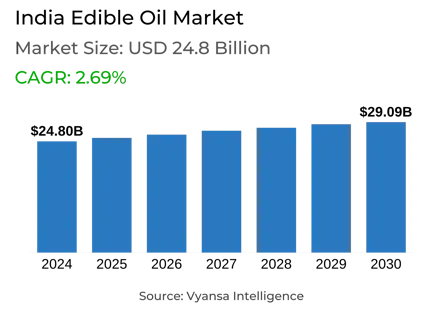
- The market was valued at USD 21.06 billion in 2025 and USD 23.66 billion in 2026, with revenue projected to reach USD 30 billion by 2032.
- The market is forecast to grow at a CAGR of approximately 4.04% during 2026-2032.
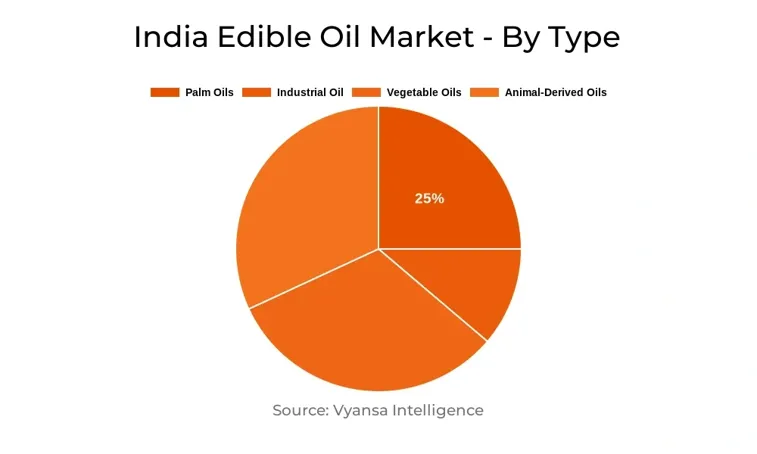
- Palm oil leads the type segment with 27% share in 2026.
- However, sunflower oil is projected to record the fastest Type-segment CAGR of approximately 5.19% during 2026-2032.
- Household consumers lead the End User segment with a modelled 58% share in 2026.
- Meanwhile, food-processing companies are projected to record the fastest end-user CAGR of approximately 5.21% during 2026-2032.
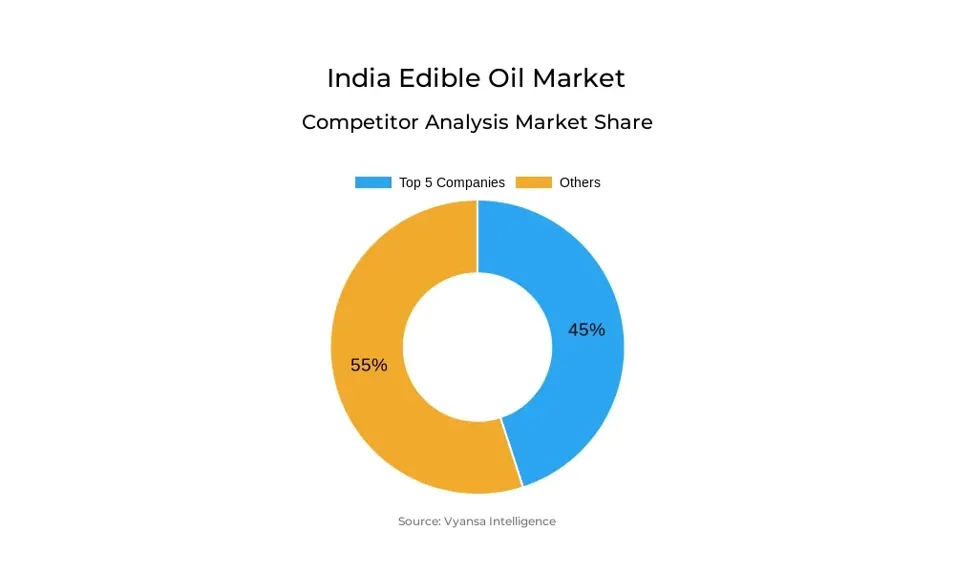
- The five leading companies account for an estimated 30% of market revenue, indicating a fragmented competitive structure.
Edible oils remain an essential component of India’s food consumption ecosystem, with widespread applications in household cooking, frying, tempering, sautéing, baking, snack manufacturing, confectionery, sauces, and ready-to-eat and ready-to-cook foods. As per the latest available consumption findings, annual per capita edible oil consumption in rural India increased from 5.76 kilograms in 2005 to 10.58 kilograms in 2023, while consumption in urban areas rose from 7.92 kilograms to 11.78 kilograms during the same period. The sustained increase across rural and urban households indicates a broad and recurring demand base supported by population growth, changing food habits, and the increasing consumption of prepared and processed foods.
Growth in household expenditure is further increasing consumers’ capacity to spend on food products and expanding demand across retail and foodservice channels. According to the latest Household Consumption Expenditure Survey released by the Ministry of Statistics and Programme Implementation, average monthly per capita consumption expenditure increased to approximately USD 49.66 in rural India and USD 84.29 in urban India during 2023–24, compared with USD 45.46 and USD 77.82, respectively, during 2022–23. Beverages, refreshments, and processed foods accounted for the largest share of household food expenditure in both rural and urban areas. The increasing consumption of packaged snacks, bakery products, convenience foods, and prepared meals is supporting edible oil demand beyond direct household cooking by expanding requirements among restaurants, bakeries, snack manufacturers, cloud kitchens, and packaged food producers.
Through 2032, the India edible oil market is estimated to be influenced by the interaction between rising consumption, domestic production expansion, processing investments, and continued import requirements. However, continued dependence on imported palm, soybean, and sunflower oils will keep the market sensitive to international commodity prices, currency movements, freight costs, import-duty revisions, and geopolitical supply disruptions. Consequently, companies with efficient sourcing strategies, diversified oil portfolios, domestic refining capabilities, extensive distribution networks, and the ability to maintain affordable retail prices are expected to remain competitively positioned during the forecast period.
Government Regulations Shaping the India Edible Oil Market
Government regulations are strengthening food safety, product transparency, nutritional quality, and supply-chain monitoring across the India edible oil market. The Food Safety and Standards Authority of India (FSSAI) regulates edible oils under the Food Safety and Standards framework, prescribing product-specific quality parameters for oils such as mustard, groundnut, soybean, sunflower, and other edible vegetable oils. The Food Safety and Standards (Labelling and Display) Regulations require packaged edible oils to disclose essential product information and restrict the use of exaggerated claims such as “Super-Refined” and “Extra-Refined,” supporting transparent product positioning and informed purchasing decisions.
Regulatory measures also support product differentiation through voluntary fortification. Edible oils marketed as fortified must comply with prescribed vitamin A and vitamin D levels and display the notified “+F” logo, creating opportunities for manufacturers to expand nutrition-focused product portfolios.
Supply-chain oversight has further increased following the amended Vegetable Oil Products, Production and Availability (Regulation) Order, 2025. Registered manufacturers, processors, importers, and other regulated entities are required to submit monthly data covering production, inventories, imports, dispatches, sales, and consumption. This framework improves market transparency and enables data-driven policy intervention; however, it also increases reporting, traceability, quality-control, and administrative requirements for industry participants. Consequently, regulatory compliance is encouraging investment in standardized processing, testing, packaging, digital reporting systems, and organized edible oil distribution.
India Edible Oil Market Drivers
Expansion of Packaged and Branded Edible Oil Consumption
The expansion of organized retail and demand for standardized food products is increasing the relevance of packaged and branded edible oils in India. Unlike loose oils, sealed products provide identifiable information regarding the oil type, net quantity, nutritional composition, batch number, manufacturing and expiry dates, and producer details. These disclosures improve product comparability and traceability while enabling manufacturers to serve different household requirements through pouches, bottles, jars, and bulk packs. Wider availability across neighbourhood stores, supermarkets, e-commerce platforms, quick-commerce services, and rural retail networks is further extending the reach of branded edible oils beyond major urban markets.
Quality-related concerns are also increasing the importance of verifiable sourcing and standardized processing. According to the latest available nationwide assessment published by the Food Safety and Standards Authority of India (FSSAI), 4,461 edible oil samples were tested under the Pan-India Edible Oil Survey 2020. Approximately 69% complied with all assessed parameters, while 31% failed one or more safety, quality, or labelling requirements. Quality-related non-compliance was identified in 24.21% of samples, misbranding in 12.82%, and safety-related non-compliance in 2.42%. These findings highlight continuing gaps in oil quality, composition, and product representation rather than directly measuring consumer preference for packaged products.
However, they strengthen the value proposition of branded oils that offer identifiable manufacturers, standardized specifications, regulatory labelling, and greater supply-chain accountability. Consequently, demand is expanding across refined, blended, fortified, mustard, sunflower, rice bran, and cold-pressed oils, enabling manufacturers to capture value through differentiated product portfolios and significantly accelerating the edible oil market growth in India.
India Edible Oil Market Restraints
Import Dependence and International Cost Exposure
India’s high dependence on imported edible oils remains a major challenge affecting domestic supply stability, pricing, and industry profitability. Despite being one of the world’s largest oilseed producers, domestic edible oil production is insufficient to meet the country’s growing consumption requirements. According to the latest available findings by Press Information Bureau, India produced approximately 12.18 million tonnes of edible oils during 2023–24, meeting only around 44% of domestic demand. Consequently, imports fulfil more than half of the country’s edible oil requirements, increasing market exposure to international commodity prices, currency fluctuations, freight costs, geopolitical disruptions, and production conditions in major exporting countries.
The concentration of imports across palm, soybean, and sunflower oils further increases supply-chain vulnerability. Changes in export policies or production levels in Indonesia and Malaysia can influence palm oil availability and prices, while soybean oil supplies remain linked to crop conditions and export dynamics in major South American producing countries. Similarly, geopolitical disruptions affecting the Black Sea region can influence sunflower oil trade flows. These external factors may increase procurement costs for Indian refiners and manufacturers, resulting in frequent changes in wholesale and retail prices, thereby negatively impacting India edible oil market growth outlook.
India Edible Oil Market Recent Trends
Growing Demand for Health-Positioned and Application-Specific Oils
Changing consumer preferences regarding nutritional positioning, processing methods, flavour profiles, and suitability for specific cooking applications are expanding demand beyond conventional refined edible oils in India. Mustard, rice bran, sunflower, fortified, blended, and cold-pressed oils are gaining greater market visibility as consumers increasingly evaluate products based on oil source, extraction method, ingredient composition, and intended use. This shift is encouraging manufacturers to develop differentiated products that complement high-volume refined oils while supporting premium market growth.
For instance, in June 2025, Marico entered the cold-pressed edible oil segment with the launch of Saffola Cold Pressed Oils. The portfolio includes single-seed mustard and groundnut oils and dual-seed variants combining sesame with sunflower oil and groundnut with rice bran oil. Produced using low-temperature extraction, the range was introduced nationwide through e-commerce and quick-commerce platforms. Marico subsequently reported a positive consumer response across these digital channels during the quarter ended September 2025, indicating growing interest in specialized edible oil products.
Manufacturers are also aligning product portfolios with regional tastes and cooking requirements. Mustard oil serves traditional flavour-intensive applications, while sunflower and rice bran oils support broader everyday use. Consequently, differentiated oils are creating value-growth opportunities through premium pricing, although sustained adoption will depend on affordable pack sizes, wider distribution, regulatory compliance, and credible nutritional claims.
Automated Refining and Precision Fortification
The increasing adoption of automated refining and precision fortification systems is supporting the growth of the India edible oil market by improving processing efficiency, product consistency, and manufacturing scalability. Automated neutralisation, bleaching, deodorisation, filtration, temperature control, filling, and weight-inspection systems enable manufacturers to increase production while maintaining consistent quality and packaging accuracy. Reduced manual intervention also limits processing losses, contamination risks, operational variability, and production downtime, helping companies control costs and supply standardized edible oils across retail, foodservice, and institutional channels.
Recent capacity investments indicate the industry’s movement toward larger and technologically advanced processing facilities. In July 2025, Gemini Edibles & Fats India commissioned a greenfield edible oil refinery in Telangana with an investment of approximately USD 45 million and a processing capacity of 700 tonnes per day. The expansion strengthens large-scale refining capacity and supports the increasing supply of packaged edible oils. Such investments also create opportunities to integrate automated process controls, quality-monitoring systems, and efficient filling and packaging lines.
Precision fortification further supports market growth by enabling accurate vitamin A and D dosing, controlled mixing, and consistent nutrient distribution. Integrated laboratory testing and digital batch records improve regulatory compliance, product traceability, and recall readiness. Consequently, modern refining technologies are supporting higher production volumes, standardized quality, product diversification, and wider market availability.
India Edible Oil Market Future Opportunities
Domestic Oilseed Value Chains and Rural Distribution Expansion
The development of integrated domestic oilseed value chains presents a significant growth opportunity for edible oil processors and packaged oil manufacturers in India. Stronger farmer linkages, access to high-yielding seeds, agronomic support, organized procurement, collection centers, storage facilities, crushing units, refineries, and regional packaging operations can improve the availability and traceability of locally sourced raw materials. These investments can strengthen supply across mustard, soybean, groundnut, sunflower, sesame, rice bran, cottonseed, and oil palm value chains.
Greater domestic integration can shorten procurement routes, improve refinery capacity utilization, reduce logistics costs, and limit exposure to foreign-exchange fluctuations and international supply disruptions. Establishing processing and packaging facilities closer to major oilseed-producing regions can also improve operational efficiency and support the distribution of affordable edible oils across rural and underserved markets.
Government initiatives are creating a supportive framework for this expansion. The National Mission on Edible Oils–Oilseeds aims to increase primary oilseed production from 39 million tonnes in 2022–23 to 69.7 million tonnes by 2030–31. Together with the National Mission on Edible Oils–Oil Palm, the initiative targets domestic edible oil production of approximately 25.45 million tonnes, equivalent to around 72% of the projected national requirement. Achieving these targets will create opportunities across seed development, farm services, procurement, storage, processing, packaging, and rural distribution while strengthening the growth of India edible oil industry.
Unlock Market Intelligence
Explore the market potential with our data-driven report
India Edible Oil Market Segmentation Analysis
By Type
- Palm Oil
- Soybean Oil
- Sunflower Oil
- Rapeseed/Canola Oil
- Corn Oil
- Olive Oil
- Others
Palm Oil Leads, While Sunflower Oil Records the Fastest Growth
Palm oil is estimated to lead the India edible oil market with a share of approximately 27% in 2026. Its dominant position is supported by competitive pricing, high-temperature frying stability, broad availability, and extensive use across households, foodservice outlets, bakeries, snack manufacturers, and packaged food companies. Established port infrastructure, large-scale refining capacity, bulk procurement networks, and extensive wholesale and retail distribution further support consumption across price-sensitive and high-volume applications.
To sustain growing demand while reducing dependence on imported palm oil, the government is expanding domestic cultivation and processing under the National Mission on Edible Oils–Oil Palm (NMEO–OP). In March 2024, India inaugurated the first oil-palm processing mill established under the mission in Arunachal Pradesh. The initiative targets domestic crude palm oil production of approximately 1.12 million tonnes by 2025–26 and identifies around 0.84 million hectares of oil-palm cultivation potential across Northeast India. Implementation continued in March 2026 with the launch of the Mega Oil Palm Plantation Drive in Nagaland, covering suitable areas across eight districts. Farmer support, planting materials, processing infrastructure, and market linkages with edible oil companies are expected to strengthen domestic supply and support palm oil availability over the forecast period.
Meanwhile, sunflower oil is projected to record the fastest growth within the Type segment, expanding at a CAGR of approximately 5.19% during 2026–2032. Its neutral flavor, household familiarity, suitability for multiple cooking applications, and availability in refined and fortified formats are supporting adoption. Expanding distribution through supermarkets, neighborhood stores, online grocery platforms, and quick-commerce channels, along with flexible pouch and bottle sizes, is improving accessibility across urban and emerging regional markets.
By End User
- Household Consumers
- Food-Processing Companies
- Foodservice and HoReCa
- Institutional Catering
- Others
Household Consumers Lead, While Food-Processing Companies Expand Faster
Household consumers are estimated to dominate the India edible oil market with a significant share of approximately 58% in 2026. Their leading position is supported by the essential use of cooking oils in frying, tempering, sautéing, baking, and preparing regional foods. Daily consumption, population growth, diverse culinary practices, and availability across multiple oil types, brands, pack sizes, and price points create recurring demand through neighborhood stores, supermarkets, online grocery platforms, and quick-commerce channels throughout urban, semi-urban, and rural markets nationwide.
Food-processing companies are projected to register the fastest growth within the end-user segment, expanding at a CAGR of approximately 5.21% during 2026–2032. Rising production of packaged snacks, bakery products, confectionery, sauces, ready meals, and frozen foods is increasing bulk oil procurement. Industrial buyers require consistent specifications, frying stability, flavor control, traceability, technical support, and uninterrupted deliveries. Expanding processing capacity and direct supply contracts are therefore expected to strengthen recurring demand for refined oils, customized blends, and application-specific fats nationwide.
Unlock Market Intelligence
Explore the market potential with our data-driven report
India Edible Oil Market Competitive Landscape
The India edible oil market is fragmented, with the five leading companies accounting for an estimated 30% of revenue. Large integrated manufacturers compete through oilseed procurement, port access, crushing and refining capacity, national brands, institutional contracts, and extensive retail distribution. Regional processors compete through locally preferred oils, flexible pricing, smaller pack sizes, retailer relationships, and lower regional logistics costs. Digital channels are also increasing product visibility, price transparency, and competition across specialised and premium categories.
Key Companies in the India Edible Oil Market
- AWL Agri Business Limited
- Patanjali Foods Limited
- Emami Agrotech Limited
- Cargill India Private Limited
- Gokul Agro Resources Limited
- Gemini Edibles & Fats India Limited
- Bunge India Private Limited
- Kaleesuwari Refinery Private Limited
- B.L. Agro Industries Limited
- M K Agrotech Private Limited
Company Profiles
AWL Agri Business Limited
AWL Agri Business participates across oilseed procurement, crushing, refining, packaging, consumer brands, and institutional supply. Its edible oil portfolio includes soybean, mustard, sunflower, rice bran, cottonseed, groundnut, blended, and palm-based products. The company competes through integrated processing infrastructure, the Fortune brand, general-trade distribution, modern retail, institutional channels, e-commerce, and quick commerce. Its scale provides procurement and distribution advantages, although profitability remains exposed to imported raw-material prices and domestic price competition.
Patanjali Foods Limited
Patanjali Foods is an integrated food and edible oil manufacturer with operations spanning oilseed processing, refining, packaging, branded consumer products, and oil palm cultivation. Its portfolio includes soybean, sunflower, mustard, palm, and blended edible oils sold across household and institutional channels. The company's upstream oil palm activities support greater domestic raw-material participation, while its manufacturing and distribution network enables national market access across mass-market and differentiated product categories.
Emami Agrotech Limited
Emami Agrotech operates across edible oils, specialty fats, foods, and related processing activities. Its consumer portfolio includes soybean, sunflower, mustard, rice bran, palmolein, and blended products under brands including Healthy & Tasty and Himani Best Choice. The company serves household, foodservice, and institutional demand through multiple plants and regional distribution networks. Competition is based on portfolio breadth, manufacturing scale, regional market access, pack availability, and participation in both consumer and business procurement channels.
Cargill India Private Limited
Cargill India processes and supplies indigenous and imported vegetable oils across household, foodservice, bakery, and industrial applications. Its portfolio includes products marketed through NatureFresh, Gemini, Sweekar, Leonardo, Rath, and other brands. The company combines refining, sourcing, product formulation, technical support, branded retail distribution, and business-to-business supply. Its participation across consumer oils, vanaspati, bakery fats, and application-specific products provides exposure to both household replenishment and recurring industrial procurement.
Gokul Agro Resources Limited
Gokul Agro Resources is an edible oil processor serving domestic branded, institutional, bulk, and export markets. Its portfolio includes soybean, mustard, sunflower, cottonseed, groundnut, rice bran, palmolein, and vanaspati products. The company's port-oriented processing presence supports imported raw-material handling and large-volume refining, while its distribution activities extend across several Indian states. Its competitive position is influenced by procurement efficiency, product breadth, refinery utilisation, regional distribution, and exposure to commodity-price movements.
Recent Developments in the India Edible Oil Industry
- April 2026: AWL Agri Business expanded its differentiated edible oil portfolio through Fortune Premio olive oil and cold-pressed mustard oil. Initial availability through e-commerce and quick-commerce platforms in Delhi, Hyderabad, Mumbai, and Bengaluru demonstrates how manufacturers are using digital channels to test premium products, reach targeted urban households, and broaden portfolios beyond conventional refined oils.
- March 2025: Cargill presented Gemini Plus Trans Fat-Free Vanaspati and other food solutions at AAHAR 2025. The vanaspati product, introduced in Kerala for HoReCa applications, supports preparation requirements across biryani, sweets, parottas, bakery products, and other commercial foods. The development reflects continued investment in application-specific fats designed around foodservice performance, regulatory requirements, and institutional procurement needs.
Frequently Asked Questions
Related Report
- Market Segmentation
- Research Scope
- Research Methodology
- Definitions and Assumptions
- Executive Summary
- India Edible Oil Market Policies, Regulations, and Standards
- India Edible Oil Market Dynamics
- Growth Factors
- Challenges
- Trends
- Opportunities
- India Edible Oil Market Statistics, 2022-2032
- Market Size & Growth Outlook
- By Revenues in USD Million
- By Quantity Sold in Million Litres
- Market Segmentation & Growth Outlook
- By Type
- Olive Oil- Market Insights and Forecast 2022-2032, USD Million
- Corn Oil- Market Insights and Forecast 2022-2032, USD Million
- Palm Oil- Market Insights and Forecast 2022-2032, USD Million
- Rapeseed Oil- Market Insights and Forecast 2022-2032, USD Million
- Soy Oil- Market Insights and Forecast 2022-2032, USD Million
- Sunflower Oil- Market Insights and Forecast 2022-2032, USD Million
- Other Edible Oils- Market Insights and Forecast 2022-2032, USD Million
- By Processing Level
- Refined Oil- Market Insights and Forecast 2022-2032, USD Million
- Unrefined Oil- Market Insights and Forecast 2022-2032, USD Million
- By Product Formulation
- Single-Oil Products- Market Insights and Forecast 2022-2032, USD Million
- Blended Oils- Market Insights and Forecast 2022-2032, USD Million
- By Packaging Type
- Pouches- Market Insights and Forecast 2022-2032, USD Million
- Bottles- Market Insights and Forecast 2022-2032, USD Million
- Cans- Market Insights and Forecast 2022-2032, USD Million
- Jars- Market Insights and Forecast 2022-2032, USD Million
- Bulk Containers- Market Insights and Forecast 2022-2032, USD Million
- Other- Market Insights and Forecast 2022-2032, USD Million
- By Pack Size
- Up to 1 Litre- Market Insights and Forecast 2022-2032, USD Million
- 1–5 Litres- Market Insights and Forecast 2022-2032, USD Million
- 5–10 Litres- Market Insights and Forecast 2022-2032, USD Million
- Above 10 Litres- Market Insights and Forecast 2022-2032, USD Million
- By End User
- Household Consumers- Market Insights and Forecast 2022-2032, USD Million
- Food Processing Companies- Market Insights and Forecast 2022-2032, USD Million
- Hotels, Restaurants, and Cafés- Market Insights and Forecast 2022-2032, USD Million
- Institutional Catering- Market Insights and Forecast 2022-2032, USD Million
- Others- Market Insights and Forecast 2022-2032, USD Million
- By Sales Channel
- Retail Offline- Market Insights and Forecast 2022-2032, USD Million
- Supermarkets and Hypermarkets- Market Insights and Forecast 2022-2032, USD Million
- Convenience and Local Grocery Stores- Market Insights and Forecast 2022-2032, USD Million
- Specialty Stores- Market Insights and Forecast 2022-2032, USD Million
- Direct Sales- Market Insights and Forecast 2022-2032, USD Million
- Others- Market Insights and Forecast 2022-2032, USD Million
- Retail Online- Market Insights and Forecast 2022-2032, USD Million
- E-Commerce Platforms- Market Insights and Forecast 2022-2032, USD Million
- Online Grocery and Quick-Commerce Platforms- Market Insights and Forecast 2022-2032, USD Million
- Company-Owned Websites- Market Insights and Forecast 2022-2032, USD Million
- Others- Market Insights and Forecast 2022-2032, USD Million
- Retail Offline- Market Insights and Forecast 2022-2032, USD Million
- By Region
- North- Market Insights and Forecast 2022-2032, USD Million
- East- Market Insights and Forecast 2022-2032, USD Million
- West- Market Insights and Forecast 2022-2032, USD Million
- South- Market Insights and Forecast 2022-2032, USD Million
- By Competitors
- Competition Characteristics
- Market Share & Analysis
- By Type
- Market Size & Growth Outlook
- India Olive Oil Edible Oil Market Statistics, 2022-2032
- Market Size & Growth Outlook
- By Revenues in USD Million
- By Quantity Sold in Million Litres
- Market Segmentation & Growth Outlook
- By Processing Level- Market Insights and Forecast 2022-2032, USD Million
- By Product Formulation- Market Insights and Forecast 2022-2032, USD Million
- By Primary Extraction Technology- Market Insights and Forecast 2022-2032, USD Million
- By Packaging Type- Market Insights and Forecast 2022-2032, USD Million
- By Pack Size- Market Insights and Forecast 2022-2032, USD Million
- By End User- Market Insights and Forecast 2022-2032, USD Million
- By Sales Channel- Market Insights and Forecast 2022-2032, USD Million
- By Region- Market Insights and Forecast 2022-2032, USD Million
- Market Size & Growth Outlook
- India Corn Oil Edible Oil Market Statistics, 2022-2032
- Market Size & Growth Outlook
- By Revenues in USD Million
- By Quantity Sold in Million Litres
- Market Segmentation & Growth Outlook
- By Processing Level- Market Insights and Forecast 2022-2032, USD Million
- By Product Formulation- Market Insights and Forecast 2022-2032, USD Million
- By Primary Extraction Technology- Market Insights and Forecast 2022-2032, USD Million
- By Packaging Type- Market Insights and Forecast 2022-2032, USD Million
- By Pack Size- Market Insights and Forecast 2022-2032, USD Million
- By End User- Market Insights and Forecast 2022-2032, USD Million
- By Sales Channel- Market Insights and Forecast 2022-2032, USD Million
- By Region- Market Insights and Forecast 2022-2032, USD Million
- Market Size & Growth Outlook
- India Palm Oil Edible Oil Market Statistics, 2022-2032
- Market Size & Growth Outlook
- By Revenues in USD Million
- By Quantity Sold in Million Litres
- Market Segmentation & Growth Outlook
- By Processing Level- Market Insights and Forecast 2022-2032, USD Million
- By Product Formulation- Market Insights and Forecast 2022-2032, USD Million
- By Primary Extraction Technology- Market Insights and Forecast 2022-2032, USD Million
- By Packaging Type- Market Insights and Forecast 2022-2032, USD Million
- By Pack Size- Market Insights and Forecast 2022-2032, USD Million
- By End User- Market Insights and Forecast 2022-2032, USD Million
- By Sales Channel- Market Insights and Forecast 2022-2032, USD Million
- By Region- Market Insights and Forecast 2022-2032, USD Million
- Market Size & Growth Outlook
- India Rapeseed Oil Edible Oil Market Statistics, 2022-2032
- Market Size & Growth Outlook
- By Revenues in USD Million
- By Quantity Sold in Million Litres
- Market Segmentation & Growth Outlook
- By Processing Level- Market Insights and Forecast 2022-2032, USD Million
- By Product Formulation- Market Insights and Forecast 2022-2032, USD Million
- By Primary Extraction Technology- Market Insights and Forecast 2022-2032, USD Million
- By Packaging Type- Market Insights and Forecast 2022-2032, USD Million
- By Pack Size- Market Insights and Forecast 2022-2032, USD Million
- By End User- Market Insights and Forecast 2022-2032, USD Million
- By Sales Channel- Market Insights and Forecast 2022-2032, USD Million
- By Region- Market Insights and Forecast 2022-2032, USD Million
- Market Size & Growth Outlook
- India Soy Oil Edible Oil Market Statistics, 2022-2032
- Market Size & Growth Outlook
- By Revenues in USD Million
- By Quantity Sold in Million Litres
- Market Segmentation & Growth Outlook
- By Processing Level- Market Insights and Forecast 2022-2032, USD Million
- By Product Formulation- Market Insights and Forecast 2022-2032, USD Million
- By Primary Extraction Technology- Market Insights and Forecast 2022-2032, USD Million
- By Packaging Type- Market Insights and Forecast 2022-2032, USD Million
- By Pack Size- Market Insights and Forecast 2022-2032, USD Million
- By End User- Market Insights and Forecast 2022-2032, USD Million
- By Sales Channel- Market Insights and Forecast 2022-2032, USD Million
- By Region- Market Insights and Forecast 2022-2032, USD Million
- Market Size & Growth Outlook
- India Sunflower Oil Edible Oil Market Statistics, 2022-2032
- Market Size & Growth Outlook
- By Revenues in USD Million
- By Quantity Sold in Million Litres
- Market Segmentation & Growth Outlook
- By Processing Level- Market Insights and Forecast 2022-2032, USD Million
- By Product Formulation- Market Insights and Forecast 2022-2032, USD Million
- By Primary Extraction Technology- Market Insights and Forecast 2022-2032, USD Million
- By Packaging Type- Market Insights and Forecast 2022-2032, USD Million
- By Pack Size- Market Insights and Forecast 2022-2032, USD Million
- By End User- Market Insights and Forecast 2022-2032, USD Million
- By Sales Channel- Market Insights and Forecast 2022-2032, USD Million
- By Region- Market Insights and Forecast 2022-2032, USD Million
- Market Size & Growth Outlook
- Competitive Outlook
- Company Profiles
- Other Edible Oils
- Business Description
- Product Portfolio
- Collaborations & Alliances
- Recent Developments
- Financial Details
- Others
- AWL Agri Business Limited
- Business Description
- Product Portfolio
- Collaborations & Alliances
- Recent Developments
- Financial Details
- Others
- Patanjali Foods Limited
- Business Description
- Product Portfolio
- Collaborations & Alliances
- Recent Developments
- Financial Details
- Others
- Emami Agrotech Limited
- Business Description
- Product Portfolio
- Collaborations & Alliances
- Recent Developments
- Financial Details
- Others
- Cargill India Private Limited
- Business Description
- Product Portfolio
- Collaborations & Alliances
- Recent Developments
- Financial Details
- Others
- Gokul Agro Resources Limited
- Business Description
- Product Portfolio
- Collaborations & Alliances
- Recent Developments
- Financial Details
- Others
- Gemini Edibles & Fats India Limited
- Business Description
- Product Portfolio
- Collaborations & Alliances
- Recent Developments
- Financial Details
- Others
- Bunge India Private Limited
- Business Description
- Product Portfolio
- Collaborations & Alliances
- Recent Developments
- Financial Details
- Others
- Kaleesuwari Refinery Private Limited
- Business Description
- Product Portfolio
- Collaborations & Alliances
- Recent Developments
- Financial Details
- Others
- B.L. Agro Industries Limited
- Business Description
- Product Portfolio
- Collaborations & Alliances
- Recent Developments
- Financial Details
- Others
- Other Edible Oils
- Company Profiles
- Disclaimer
| Segment | Sub-Segment |
|---|---|
| By Type |
|
| By Processing Level |
|
| By Product Formulation |
|
| By Packaging Type |
|
| By Pack Size |
|
| By End User |
|
| By Sales Channel |
|
| By Region |
|
Research Methodology
This study followed a structured approach comprising four key phases to assess the size and scope of the electro-oxidation market. The process began with thorough secondary research to collect data on the target market, related markets, and broader industry context. These findings, along with preliminary assumptions and estimates, were then validated through extensive primary research involving industry experts from across the value chain. To calculate the overall market size, both top-down and bottom-up methodologies were employed. Finally, market segmentation and data triangulation techniques were applied to refine and validate segment-level estimations.
Secondary Research
The secondary research phase involved gathering data from a wide range of credible and published sources. This step helped in identifying industry trends, defining market segmentation, and understanding the market landscape and value chain.
Sources consulted during this phase included:
- Company annual reports, investor presentations, and press releases
- Industry white papers and certified publications
- Trade directories and market-recognized databases
- Articles from authoritative authors and reputable journals
- Gold and silver standard websites
Secondary research was critical in mapping out the industry's value chain and monetary flow, identifying key market segments, understanding regional variations, and tracking significant industry developments.
Other key sources:
- Financial disclosures
- Industry associations and trade bodies
- News outlets and business magazines
- Academic journals and research studies
- Paid industry databases
Primary Research
To validate secondary data and gain deeper market insights, primary research was conducted with key stakeholders across both the supply and demand sides of the market.
On the demand side, participants included decision-makers and influencers from end-user industries—such as CIOs, CTOs, and CSOs—who provided first-hand perspectives on market needs, product usage, and future expectations.
On the supply side, interviews were conducted with manufacturers, industry associations, and institutional participants to gather insights into current offerings, product pipelines, and market challenges.
Primary interviews provided critical inputs such as:
- Market size and revenue data
- Product and service breakdowns
- Market forecasts
- Regional and application-specific trends
Stakeholders consulted included:
- Leading OEM and solution providers
- Channel and distribution partners
- End users across various applications
- Independent consultants and industry specialists
Market Size Estimation and Data Triangulation
- Identifying Key Market Participants (Secondary Research)
- Goal: To identify the major players or companies in the target market. This typically involves using publicly available data sources such as industry reports, market research publications, and financial statements of companies.
- Tools: Reports from firms like Gartner, Forrester, Euromonitor, Statista, IBISWorld, and others. Public financial statements, news articles, and press releases from top market players.
- Extracting Earnings of Key Market Participants
- Goal: To estimate the earnings generated from the product or service being analyzed. This step helps in understanding the revenue potential of each market player in a specific geography.
- Methods: Earnings data can be gathered from:
- Publicly available financial reports (for listed companies).
- Interviews and primary data sources from professionals, such as Directors, VPs, SVPs, etc. This is especially useful for understanding more nuanced, internal data that isn't publicly disclosed.
- Annual reports and investor presentations of key players.
- Data Collation and Development of a Relevant Data Model
- Goal: To collate inputs from both primary and secondary sources into a structured, data-driven model for market estimation. This model will incorporate key market KPIs and any independent variables relevant to the market.
- Key KPIs: These could include:
- Market size, growth rate, and demand drivers.
- Industry-specific metrics like market share, average revenue per customer (ARPC), or average deal size.
- External variables, such as economic growth rates, inflation rates, or commodity prices, that could affect the market.
- Data Modeling: Based on this data, the market forecasts are developed for the next 5 years. A combination of trend analysis, scenario modeling, and statistical regression might be used to generate projections.
- Scenario Analysis
- Goal: To test different assumptions and validate how sensitive the market is to changes in key variables (e.g., market demand, regulatory changes, technological disruptions).
- Types of Scenarios:
- Base Case: Based on current assumptions and historical data.
- Best-Case Scenario: Assuming favorable market conditions, regulatory environments, and technological advancements.
- Worst-Case Scenario: Accounting for adverse factors, such as economic downturns, stricter regulations, or unexpected disruptions.












