India Domestic Helper Market Report: Trends, Growth and Forecast (2026-2032)
By Service Type (Housekeeping & Cleaning, Child Care (Nanny/Babisitting), Elderly Care, Cooking & Meal Preparation, Laundry & Ironing, Live-in Household Assistance (Multi-service), Others (Pet Care, Gardening, Household Errands)), By Employment Type (Live-in Domestic Helpers, Live-out Domestic Helpers), By Hiring Model (Direct Hiring, Agency-Based Hiring, Online Platform/App-Based Hiring), By End User (Residential Households, Corporate Housing & Expat Accommodation, Hospitality & Vacation Homes, Others), By Service Duration (Full-Time, Part-Time, Temporary/On-Demand), By Region (North, East, West, South) ... Read more
|
Major Players
|
India Domestic Helper Market Statistics and Insights, 2026
- Market Size Statistics
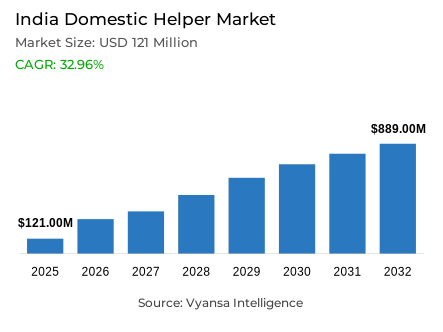
- Domestic helper market size in India was valued at USD 121 million in 2025 and is estimated at USD 174 million in 2026.
- The market size is expected to grow to USD 889 million by 2032.
- Market to register a CAGR of around 32.96% during 2026-32.
- Service Type Shares
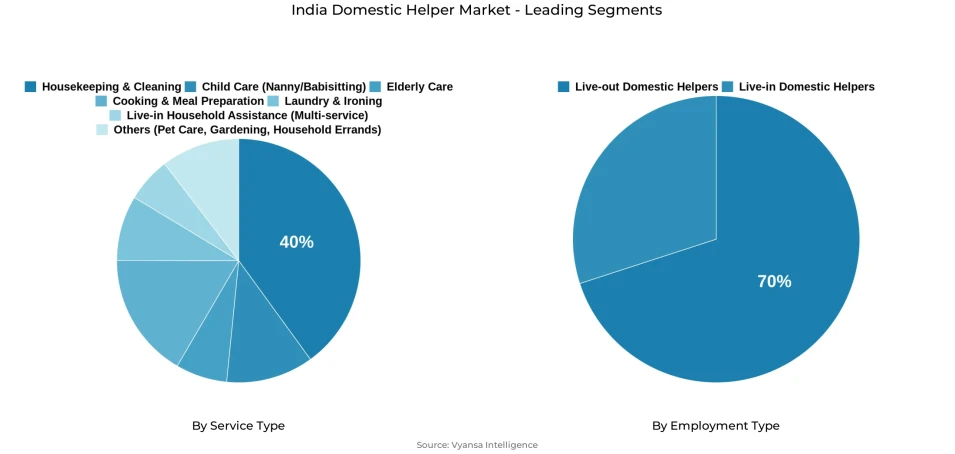
- Housekeeping & cleaning grabbed market share of 40%.
- Competition
- More than 10 companies are actively engaged in producing domestic helper in India.
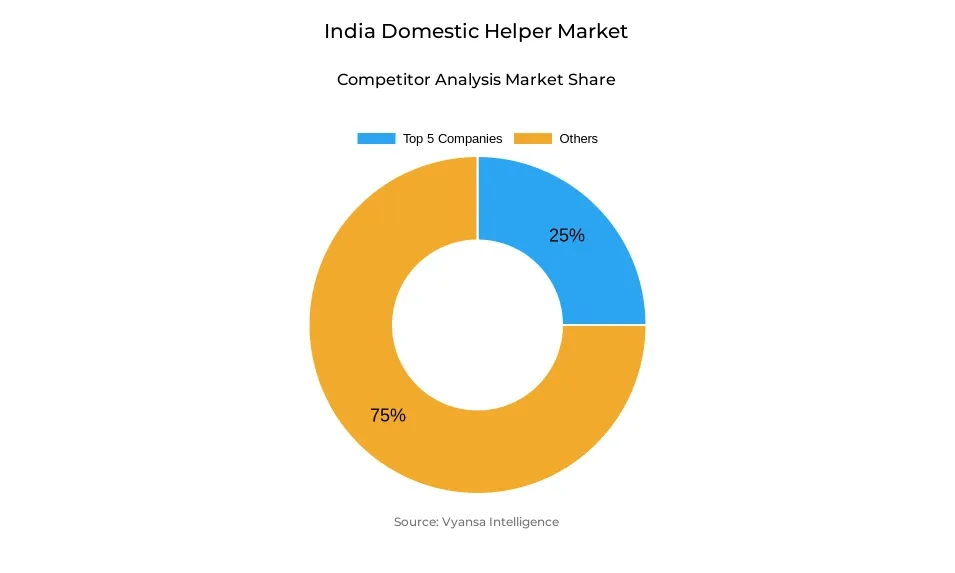
- Top 5 companies acquired around 25% of the market share in 2026.
- Helper4U Services LLP (Helper4U.in), JobNukkad Services Pvt Ltd (JobNukkad), Maidwale Consultancy India Private Limited (Maidwale), Maestroedge Solutions Private Limited (Snabbit), Swachh Saathi Private Limited (Pronto) etc., are few of the top companies.
- Employment Type
- Live-out domestic helpers grabbed 95% of the market.
India Domestic Helper Market Outlook
India domestic helper market is expanding rapidly as urban households outsource cleaning, mopping, dishwashing, cooking assistance, laundry and ironing, childcare support, elderly assistance, and short-duration household errands. The market size was valued at USD 121 million in 2025 and is projected to grow from USD 174 million in 2026 to USD 889 million by 2032, registering a CAGR of 32.96% during the forecast period. The sharp growth reflects rising demand for house help services in india, where time scarcity, apartment living, working professionals, dual-income families, verified house help, and repeat household routines are reshaping paid home support.
Housekeeping & Cleaning holds the leading 40% share because cleaning is the most frequent and basic household need. india’s 2024 Time Use Survey shows that 54.1% of people aged 6 years and above participate in unpaid domestic services for household members, while female participation is 81.5% and male participation is 27.1%. This proves the scale of daily household work. When families outsource sweeping, mopping, dishwashing, bathroom cleaning, dusting, and kitchen support, maid services become the largest paid category because the need is repeatable, visible, and required across income groups.
Live-out domestic helpers hold 95% share under employment type because urban households increasingly prefer flexible, task-based, hourly, or daily-visit support instead of full-time resident workers. This model fits nuclear families, apartment societies, working couples, and platform-led bookings, where helpers move across multiple homes and earn from several service slots. Urban Company’s Insta Help allows users to book domestic workers within 15 minutes, while Pronto offers laundry, kitchen prep, and home cleaning with workers available within 15 minutes. These models directly support live-out domestic helpers through location, task, time-window, and availability-based deployment.
The 2026 to 2032 outlook remains strong because the indian domestic help market is moving from informal referrals toward organized, verified, and app-enabled service access. The Ministry of Labour reported over 30.94 crore unorganized workers, including domestic workers, registered on e-Shram as of 16 July 2025, while e-Shram’s One-Stop-Solution integrates 14 welfare schemes. This matters because formal identity, worker registration, and digital access can improve trust, supply visibility, and welfare linkage. As platforms, maid agencies, and direct hiring models mature, domestic worker services in india can scale across cleaning, meal preparation, childcare, elderly care, and live-out assistance.
India Domestic Helper Market Growth Driver
Urban Time Scarcity Strengthens Paid Household Support
Rising employment participation and household time pressure are the primary demand drivers. PLFS 2023-24 shows india’s female Worker Population Ratio for persons aged 15 and above increased from 22.0% in 2017-18 to 40.3% in 2023-24, while the overall WPR reached 58.2%. This matters because more working adults reduce the time available for daily cleaning, cooking support, laundry, childcare, and elderly assistance. Demand for house help services in india rises when families convert unpaid household work into paid support to maintain home routines while managing jobs, commuting, education, and caregiving responsibilities.
The pressure is visible in time-use data. india’s 2024 Time Use Survey shows women who participate in unpaid domestic services spend 289 minutes per day, compared with 88 minutes for men. This gap highlights why paid help becomes valuable in households where women enter paid work or need relief from routine chores. Daily cleaning, dishwashing, mopping, laundry, cooking assistance, and child supervision are not occasional needs; they repeat every day. As urban households try to reduce unpaid workload, demand shifts toward scheduled domestic helpers, part-time maids, and app-based domestic help in large residential clusters.
India Domestic Helper Market Challenge
Informality and Worker Protection Remain Core Barriers
The main challenge is informality because domestic work takes place inside private homes and is often arranged through referrals, informal payments, unregistered placement agencies, or direct verbal agreements. The Ministry of Labour states that e-Shram is a national database for unorganized workers, including domestic workers, and had over 30.94 crore unorganized workers registered by 16 July 2025. This scale shows the large informal labor base, but registration alone does not guarantee standard wages, verified employers, predictable hours, grievance redressal, weekly rest, safety assurance, or portable benefits for every domestic helper.
Worker protection adds operating complexity for platforms and agencies. The Ministry of Labour notes that labour codes provide for decent working conditions, wages, occupational safety, grievance redressal, and social security benefits for all categories of workers including domestic workers, while states and union territories have been advised to regulate private placement agencies. This means organized providers must solve trust on both sides households need verified house help and background-checked maids, while workers need safe workplaces, fair pay, complaint channels, and welfare access. Without stronger compliance, the market can face reputational, regulatory, and worker-supply constraints.
Unlock Market Intelligence
Explore the market potential with our data-driven report
India Domestic Helper Market Trend
Instant Booking Platforms Reshape Household Services
The key trend is the shift toward online maid booking, instant live-out support, and app-based domestic help. Reuters reported that Urban Company launched Insta Help, allowing users to book domestic workers within 15 minutes, and that the company serves more than 7 million annual customers. This directly changes the domestic helper model from long-term informal hiring toward rapid, verified, task-based bookings. The product design fits urban households facing maid absenteeism, sudden cleaning needs, guest preparation, kitchen support, or daily time pressure, while also helping platforms match workers by location, availability, service type, and time window.
Competition confirms that the trend is wider than one company. Reuters reported in May 2026 that Pronto raised USD 20 million in Series B funding, doubling its valuation to USD 200 million, after previously raising USD 25 million in March at a USD 100 million valuation. Pronto provides laundry, kitchen prep, and home cleaning from ₹125, with workers available within 15 minutes, while daily bookings rose from 3,000 in December to more than 26,000. These figures show that on-demand maids are becoming a funded service model, not only an experimental add-on.
India Domestic Helper Market Opportunity
Organized Live-Out Services Create Scalable Opportunity
The strongest opportunity lies in organized live-out domestic help for urban households. Reuters reported that india’s app-driven instant home services include housecleaning, laundry, kitchen prep, and quick access to trained workers, with demand linked to 53 million households and a cleaning services opportunity estimated at USD 9 billion. This matters because organized providers can standardize onboarding, police verification, background checks, training, time-slot pricing, customer support, safety protocols, and repeat subscriptions. Live-out helpers can serve several homes per day, improving utilization while giving households flexible access without accommodation, food, or full-time employment obligations.
Formalization can strengthen this opportunity. The Ministry of Labour reported that e-Shram’s One-Stop-Solution enables unorganized workers, including domestic workers, to access social security schemes through a single portal, with 14 schemes integrated or mapped. This digital welfare layer can help platforms and domestic help agencies build trust with workers by linking identity, benefits, and grievance awareness. For customers, organized live-out services improve reliability through verified profiles, ratings, replacement support, and service tracking. For workers, the opportunity improves if platforms combine flexible earnings with welfare access, training, safety checks, and transparent payouts.
Unlock Market Intelligence
Explore the market potential with our data-driven report
India Domestic Helper Market Segmentation Analysis
By Service Type
- Housekeeping & Cleaning
- Child Care (Nanny/Babisitting)
- Elderly Care
- Cooking & Meal Preparation
- Laundry & Ironing
- Live-in Household Assistance (Multi-service)
- Others (Pet Care, Gardening, Household Errands)
The segment with the highest share under Service Type is Housekeeping & Cleaning, holding 40% of the market. This leadership is supported by the daily nature of cleaning work. india’s 2024 Time Use Survey shows that 54.1% of people aged 6 years and above participate in unpaid domestic services for household members, and participants spend 238 minutes per day on this activity. Cleaning, mopping, dusting, dishwashing, bathroom cleaning, kitchen upkeep, laundry and ironing sit inside this time burden, making them the most repeatable services that households are willing to outsource.
Housekeeping leads over childcare, elderly care, cooking services, and laundry services because it is required across almost every home, irrespective of household structure. Women’s 81.5% participation in unpaid domestic services and 289 minutes per day spent by female participants show how concentrated household work remains inside homes. When working women, elderly households, bachelors, shared apartments, and nuclear families buy domestic help, cleaning usually comes first because it is visible, physically demanding, hygiene-linked, and time-sensitive. Platform models also validate this, as Pronto offers home cleaning, laundry, and kitchen prep within 15 minutes.
By Employment Type
- Live-in Domestic Helpers
- Live-out Domestic Helpers
The segment with the highest share under Employment Type is Live-out domestic helpers, holding 95% of the market. This dominance reflects india’s urban household structure, where many families need daily or part-time support but do not want full-time resident workers. Live-out helpers are commercially flexible because they can visit for sweeping, mopping, dishwashing, cooking prep, laundry, childcare support, or elderly assistance during fixed time slots. The model suits apartments, gated communities, working couples, and platforms that schedule workers by locality, task, distance, availability, and customer rating across multiple homes daily.
Direct platform evidence supports live-out leadership. Urban Company’s Insta Help allows booking domestic workers within 15 minutes, while Pronto offers workers within 15 minutes for services starting at ₹125. Reuters also reported that Pronto’s daily bookings rose from 3,000 in December to more than 26,000 by May 2026, showing demand for short-duration, mobile, task-based household support. This proves that domestic helper demand is shifting toward time-slot services instead of permanent residence. Live-out models help workers diversify income across households, while customers avoid accommodation, meals, long commitments, and full-time supervision obligations.
List of Companies Covered in India Domestic Helper Market
The companies listed below are highly influential in the India domestic helper market, with a significant market share and a strong impact on industry developments.
- Helper4U Services LLP (Helper4U.in)
- JobNukkad Services Pvt Ltd (JobNukkad)
- Maidwale Consultancy India Private Limited (Maidwale)
- Maestroedge Solutions Private Limited (Snabbit)
- Swachh Saathi Private Limited (Pronto)
- Urban Company Limited (Insta Help)
- Nano Job Consultants Private Limited (BookMyBai)
- BROOMEES INDIA PRIVATE LIMITED (Broomees)
- Logibyte Technologies (Maidvy)
Market News & Updates
- Maestroedge Solutions Private Limited, 2026:
Snabbit listed its on-demand house-help service across Indian cities including Delhi, Noida, Ghaziabad, Gurugram, and Navi Mumbai. The service provides trained, background-verified female house-help experts for sweeping, mopping, dusting, dishwashing, laundry folding, kitchen cleaning, and bathroom cleaning. The update supports app-based short-duration domestic help bookings in urban India.
- Swachh Saathi Private Limited, 2026:
Pronto’s official platform listed house-help services across 11 Indian cities. The platform offers 20 services, including hourly bookings, bathroom cleaning, laundry, utensils, kitchen prep, sweeping, mopping, ironing, window cleaning, and plant care. The update strengthens Pronto’s quick-service domestic help model with instant, scheduled, and recurring booking options.
Frequently Asked Questions
Related Report
- Market Segmentation
- Research Scope
- Research Methodology
- Definitions and Assumptions
- Executive Summary
- India Domestic Helper Market Policies, Regulations, and Standards
- India Domestic Helper Market Dynamics
- Growth Factors
- Challenges
- Trends
- Opportunities
- India Domestic Helper Market Statistics, 2022-2032F
- Market Size & Growth Outlook
- By Revenues in USD Million
- Market Segmentation & Growth Outlook
- By Service Type
- Housekeeping & Cleaning- Market Insights and Forecast 2022-2032, USD Million
- Child Care (Nanny/Babisitting)- Market Insights and Forecast 2022-2032, USD Million
- Elderly Care- Market Insights and Forecast 2022-2032, USD Million
- Cooking & Meal Preparation- Market Insights and Forecast 2022-2032, USD Million
- Laundry & Ironing- Market Insights and Forecast 2022-2032, USD Million
- Live-in Household Assistance (Multi-service)- Market Insights and Forecast 2022-2032, USD Million
- Others (Pet Care, Gardening, Household Errands)- Market Insights and Forecast 2022-2032, USD Million
- By Employment Type
- Live-in Domestic Helpers- Market Insights and Forecast 2022-2032, USD Million
- Live-out Domestic Helpers- Market Insights and Forecast 2022-2032, USD Million
- By Hiring Model
- Direct Hiring- Market Insights and Forecast 2022-2032, USD Million
- Agency-Based Hiring- Market Insights and Forecast 2022-2032, USD Million
- Online Platform/App-Based Hiring- Market Insights and Forecast 2022-2032, USD Million
- By End User
- Residential Households- Market Insights and Forecast 2022-2032, USD Million
- Corporate Housing & Expat Accommodation- Market Insights and Forecast 2022-2032, USD Million
- Hospitality & Vacation Homes- Market Insights and Forecast 2022-2032, USD Million
- Others- Market Insights and Forecast 2022-2032, USD Million
- By Service Duration
- Full-Time- Market Insights and Forecast 2022-2032, USD Million
- Part-Time- Market Insights and Forecast 2022-2032, USD Million
- Temporary/On-Demand- Market Insights and Forecast 2022-2032, USD Million
- By Region
- North- Market Insights and Forecast 2022-2032, USD Million
- East- Market Insights and Forecast 2022-2032, USD Million
- West- Market Insights and Forecast 2022-2032, USD Million
- South- Market Insights and Forecast 2022-2032, USD Million
- By Competitors
- Competition Characteristics
- Market Share & Analysis
- By Service Type
- Market Size & Growth Outlook
- India Housekeeping & Cleaning Market Statistics, 2022-2032
- Market Size & Growth Outlook
- By Revenues in USD Million
- Market Segmentation & Growth Outlook
- By Employment Type- Market Insights and Forecast 2022-2032, USD Million
- By Hiring Model- Market Insights and Forecast 2022-2032, USD Million
- By End User- Market Insights and Forecast 2022-2032, USD Million
- By Service Duration- Market Insights and Forecast 2022-2032, USD Million
- By Region- Market Insights and Forecast 2022-2032, USD Million
- Market Size & Growth Outlook
- India Child Care (Nanny/Babisitting) Market Statistics, 2022-2032
- Market Size & Growth Outlook
- By Revenues in USD Million
- Market Segmentation & Growth Outlook
- By Employment Type- Market Insights and Forecast 2022-2032, USD Million
- By Hiring Model- Market Insights and Forecast 2022-2032, USD Million
- By End User- Market Insights and Forecast 2022-2032, USD Million
- By Service Duration- Market Insights and Forecast 2022-2032, USD Million
- By Region- Market Insights and Forecast 2022-2032, USD Million
- Market Size & Growth Outlook
- India Elderly Care Market Statistics, 2022-2032
- Market Size & Growth Outlook
- By Revenues in USD Million
- Market Segmentation & Growth Outlook
- By Employment Type- Market Insights and Forecast 2022-2032, USD Million
- By Hiring Model- Market Insights and Forecast 2022-2032, USD Million
- By End User- Market Insights and Forecast 2022-2032, USD Million
- By Service Duration- Market Insights and Forecast 2022-2032, USD Million
- By Region- Market Insights and Forecast 2022-2032, USD Million
- Market Size & Growth Outlook
- India Cooking & Meal Preparation Market Statistics, 2022-2032
- Market Size & Growth Outlook
- By Revenues in USD Million
- Market Segmentation & Growth Outlook
- By Employment Type- Market Insights and Forecast 2022-2032, USD Million
- By Hiring Model- Market Insights and Forecast 2022-2032, USD Million
- By End User- Market Insights and Forecast 2022-2032, USD Million
- By Service Duration- Market Insights and Forecast 2022-2032, USD Million
- By Region- Market Insights and Forecast 2022-2032, USD Million
- Market Size & Growth Outlook
- India Laundry & Ironing Market Statistics, 2022-2032
- Market Size & Growth Outlook
- By Revenues in USD Million
- Market Segmentation & Growth Outlook
- By Employment Type- Market Insights and Forecast 2022-2032, USD Million
- By Hiring Model- Market Insights and Forecast 2022-2032, USD Million
- By End User- Market Insights and Forecast 2022-2032, USD Million
- By Service Duration- Market Insights and Forecast 2022-2032, USD Million
- By Region- Market Insights and Forecast 2022-2032, USD Million
- Market Size & Growth Outlook
- India Live-in Household Assistance (Multi-service) Market Statistics, 2022-2032
- Market Size & Growth Outlook
- By Revenues in USD Million
- Market Segmentation & Growth Outlook
- By Employment Type- Market Insights and Forecast 2022-2032, USD Million
- By Hiring Model- Market Insights and Forecast 2022-2032, USD Million
- By End User- Market Insights and Forecast 2022-2032, USD Million
- By Service Duration- Market Insights and Forecast 2022-2032, USD Million
- By Region- Market Insights and Forecast 2022-2032, USD Million
- Market Size & Growth Outlook
- India Others (Pet Care, Gardening, Household Errands) Market Statistics, 2022-2032
- Market Size & Growth Outlook
- By Revenues in USD Million
- Market Segmentation & Growth Outlook
- By Employment Type- Market Insights and Forecast 2022-2032, USD Million
- By Hiring Model- Market Insights and Forecast 2022-2032, USD Million
- By End User- Market Insights and Forecast 2022-2032, USD Million
- By Service Duration- Market Insights and Forecast 2022-2032, USD Million
- By Region- Market Insights and Forecast 2022-2032, USD Million
- Market Size & Growth Outlook
- Competitive Outlook
- Company Profiles
- Maestroedge Solutions Private Limited (Snabbit)
- Business Description
- Product Portfolio
- Collaborations & Alliances
- Recent Developments
- Financial Details
- Others
- Swachh Saathi Private Limited (Pronto)
- Business Description
- Product Portfolio
- Collaborations & Alliances
- Recent Developments
- Financial Details
- Others
- Urban Company Limited (Insta Help)
- Business Description
- Product Portfolio
- Collaborations & Alliances
- Recent Developments
- Financial Details
- Others
- Nano Job Consultants Private Limited (BookMyBai)
- Business Description
- Product Portfolio
- Collaborations & Alliances
- Recent Developments
- Financial Details
- Others
- BROOMEES INDIA PRIVATE LIMITED (Broomees)
- Business Description
- Product Portfolio
- Collaborations & Alliances
- Recent Developments
- Financial Details
- Others
- Helper4U Services LLP (Helper4U.in)
- Business Description
- Product Portfolio
- Collaborations & Alliances
- Recent Developments
- Financial Details
- Others
- JobNukkad Services Pvt Ltd (JobNukkad)
- Business Description
- Product Portfolio
- Collaborations & Alliances
- Recent Developments
- Financial Details
- Others
- Maidwale Consultancy India Private Limited (Maidwale)
- Business Description
- Product Portfolio
- Collaborations & Alliances
- Recent Developments
- Financial Details
- Others
- Logibite Technologies (Maidvy)
- Business Description
- Product Portfolio
- Collaborations & Alliances
- Recent Developments
- Financial Details
- Others
- Maestroedge Solutions Private Limited (Snabbit)
- Company Profiles
- Disclaimer
| Segment | Sub-Segment |
|---|---|
| By Service Type |
|
| By Employment Type |
|
| By Hiring Model |
|
| By End User |
|
| By Service Duration |
|
| By Region |
|
Research Methodology
This study followed a structured approach comprising four key phases to assess the size and scope of the electro-oxidation market. The process began with thorough secondary research to collect data on the target market, related markets, and broader industry context. These findings, along with preliminary assumptions and estimates, were then validated through extensive primary research involving industry experts from across the value chain. To calculate the overall market size, both top-down and bottom-up methodologies were employed. Finally, market segmentation and data triangulation techniques were applied to refine and validate segment-level estimations.
Secondary Research
The secondary research phase involved gathering data from a wide range of credible and published sources. This step helped in identifying industry trends, defining market segmentation, and understanding the market landscape and value chain.
Sources consulted during this phase included:
- Company annual reports, investor presentations, and press releases
- Industry white papers and certified publications
- Trade directories and market-recognized databases
- Articles from authoritative authors and reputable journals
- Gold and silver standard websites
Secondary research was critical in mapping out the industry's value chain and monetary flow, identifying key market segments, understanding regional variations, and tracking significant industry developments.
Other key sources:
- Financial disclosures
- Industry associations and trade bodies
- News outlets and business magazines
- Academic journals and research studies
- Paid industry databases
Primary Research
To validate secondary data and gain deeper market insights, primary research was conducted with key stakeholders across both the supply and demand sides of the market.
On the demand side, participants included decision-makers and influencers from end-user industries—such as CIOs, CTOs, and CSOs—who provided first-hand perspectives on market needs, product usage, and future expectations.
On the supply side, interviews were conducted with manufacturers, industry associations, and institutional participants to gather insights into current offerings, product pipelines, and market challenges.
Primary interviews provided critical inputs such as:
- Market size and revenue data
- Product and service breakdowns
- Market forecasts
- Regional and application-specific trends
Stakeholders consulted included:
- Leading OEM and solution providers
- Channel and distribution partners
- End users across various applications
- Independent consultants and industry specialists
Market Size Estimation and Data Triangulation
- Identifying Key Market Participants (Secondary Research)
- Goal: To identify the major players or companies in the target market. This typically involves using publicly available data sources such as industry reports, market research publications, and financial statements of companies.
- Tools: Reports from firms like Gartner, Forrester, Euromonitor, Statista, IBISWorld, and others. Public financial statements, news articles, and press releases from top market players.
- Extracting Earnings of Key Market Participants
- Goal: To estimate the earnings generated from the product or service being analyzed. This step helps in understanding the revenue potential of each market player in a specific geography.
- Methods: Earnings data can be gathered from:
- Publicly available financial reports (for listed companies).
- Interviews and primary data sources from professionals, such as Directors, VPs, SVPs, etc. This is especially useful for understanding more nuanced, internal data that isn't publicly disclosed.
- Annual reports and investor presentations of key players.
- Data Collation and Development of a Relevant Data Model
- Goal: To collate inputs from both primary and secondary sources into a structured, data-driven model for market estimation. This model will incorporate key market KPIs and any independent variables relevant to the market.
- Key KPIs: These could include:
- Market size, growth rate, and demand drivers.
- Industry-specific metrics like market share, average revenue per customer (ARPC), or average deal size.
- External variables, such as economic growth rates, inflation rates, or commodity prices, that could affect the market.
- Data Modeling: Based on this data, the market forecasts are developed for the next 5 years. A combination of trend analysis, scenario modeling, and statistical regression might be used to generate projections.
- Scenario Analysis
- Goal: To test different assumptions and validate how sensitive the market is to changes in key variables (e.g., market demand, regulatory changes, technological disruptions).
- Types of Scenarios:
- Base Case: Based on current assumptions and historical data.
- Best-Case Scenario: Assuming favorable market conditions, regulatory environments, and technological advancements.
- Worst-Case Scenario: Accounting for adverse factors, such as economic downturns, stricter regulations, or unexpected disruptions.












