India Analgesics Market Report: Trends, Growth and Forecast (2026-2032)
By Product (Systemic Analgesics (Adult Analgesics, Paediatric Analgesics, Combined Systemic Analgesics), Topical Analgesics/Anaesthetic), By Drug Type (Opioid Analgesics (Strong Opioids, Weak Opioids), Non-opioid Analgesics (Acetaminophen, Aspirin, Combination Products, Diclofenac, Dipyrone, Ibuprofen, Ketoprofen, Naproxen, OTC Triptans), Compound/Combination Analgesics (Opioid + Non-Opioid Combinations, Multi-Ingredient Non-Opioid Combinations)), By Route of Administration (Oral, Parenteral/Injectable, Topical/External, Transdermal, Rectal/Other), By Pain Type (Acute Pain, Chronic Pain, Breakthrough Pain), By Application (Surgical & Post-operative Pain, Musculoskeletal Pain, Neuropathic Pain, Cancer Pain, Migraine/Headache, Dental Pain, Others), By Sales Channel (Retail Offline (Offline Pharmacies, Hospital Pharmacies, Retail Online), Online Pharmacies), By Prescription Type (Prescription, OTC), By Formulation (Tablets, Capsules, Liquids, Injectables, Gels/Creams, Patches), By End User (Hospitals, Clinics/ASCs, Homecare), By By Region (North, East, West, South) ... Read more
|
Major Players
|
India Analgesics Market Statistics and Insights, 2026
- Market Size Statistics
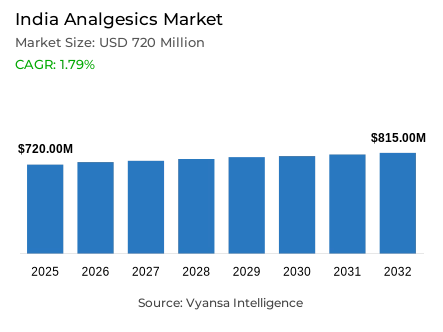
- Analgesics market size in India was valued at USD 720 million in 2025 and is estimated at USD 747 million in 2026.
- The market size is expected to grow to USD 815 million by 2032.
- Market to register a CAGR of around 1.79% during 2026-32.
- Product Shares
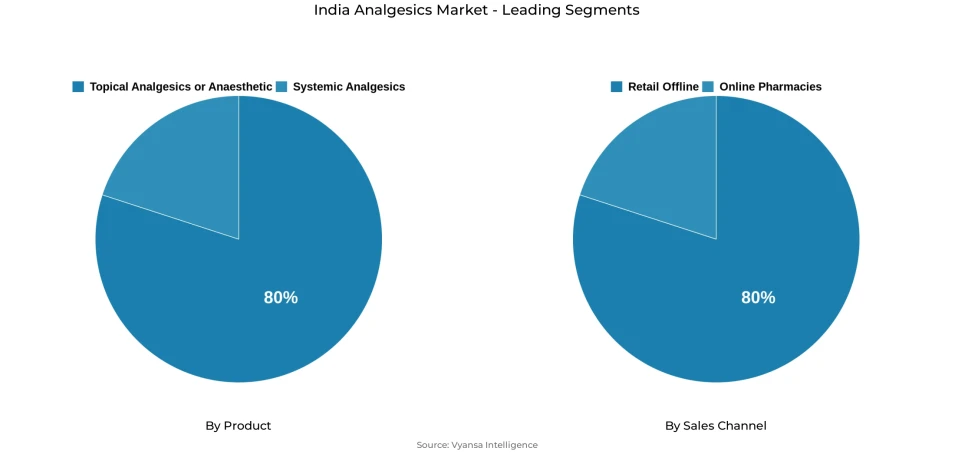
- Topical analgesics/anaesthetic grabbed market share of 80%.
- Competition
- More than 10 companies are actively engaged in producing analgesics in India.
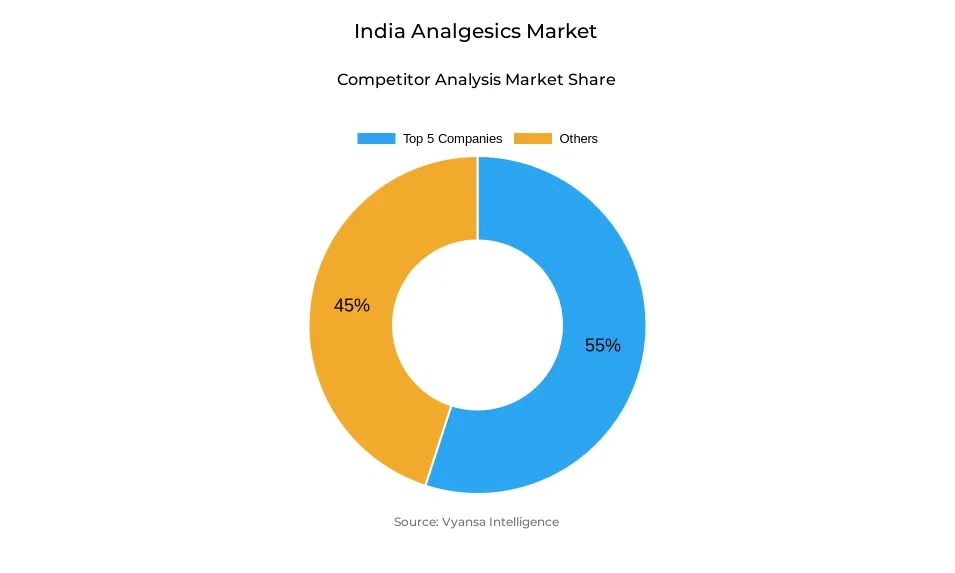
- Top 5 companies acquired around 55% of the market share.
- Piramal Enterprises Ltd, Alkem Laboratories Ltd, IPCA Laboratories Ltd, Emami Ltd, GSK Consumer Healthcare etc., are few of the top companies.
- Sales Channel
- Retail offline grabbed 80% of the market.
India Analgesics Market Outlook
The India analgesics market size was valued at USD 720 million in 2025 and is projected to grow from USD 747 million in 2026 to USD 815 million by 2032, exhibiting a CAGR of around 1.79% during the forecast period. Growth is being supported by long working hours, rising screen time, and less active routines, which are keeping neck, back, joint, and muscle pain common. This is increasing the need for quick and practical pain relief products that fit busy daily schedules.
Demand is also supported by a large active population and changing daily lifestyles. Ministry of Statistics and Programme Implementation (MoSPI) reports that the worker population ratio for people aged 15 years and above reached 53.2% in November 2025, while WHO’s India Physical Activity Factsheet says 49.4% of adults aged 18+ are physically inactive. These conditions keep everyday pain management important, and analgesics continue to see steady demand from consumers who want fast relief and easy use.
Within the category, topical analgesics/anaesthetic held the highest share at around 80%. This strong position is linked to the rising use of gels, sprays, roll ons, patches, and cryotherapy based products that are easier to carry, simple to apply, and better suited for work, travel, and physical activity. In analgesics, this shift towards convenience led formats is becoming more visible, especially among urban consumers and people with active lifestyles.
Price sensitivity remains an important challenge, as many buyers compare brands carefully and prefer products that balance relief, convenience, and affordable cost. At the same time, convenient availability is creating room for further expansion, with analgesics reaching consumers through local grocers, department stores, e-commerce platforms, and quick commerce services. Fast delivery and easier access are supporting stronger purchase behaviour, while the leading sales channel continues to hold a dominant position through the forecast period.
India Analgesics Market Growth Driver
Daily Discomfort Keeps Pain Relief Relevant
Long working hours, rising screen time, and less active routines are keeping neck, back, joint, and muscle pain common in India. This is supporting demand for analgesics that offer quick and practical relief, especially topical gels, sprays, and oral pain relievers that fit busy daily schedules. Fast relief and easy use remain important because many consumers want solutions that help them stay productive through routine pain and strain.
Official data supports this need. MoSPI reports the worker population ratio for people aged 15 years and above reaches 53.2% in November 2025, showing a large active working population. WHO’s India Physical Activity Factsheet also says 49.4% of adults aged 18+ are physically inactive. Together, these conditions keep everyday pain management important and support steady analgesics demand.
India Analgesics Market Challenge
Affordability Pressure Keeps Buying Decisions Cautious
Price sensitivity remains a key challenge in India because consumers often compare brands carefully before buying everyday healthcare products. In analgesics, this limits the pace at which premium or specialist products can expand, especially when many buyers still prefer formats that balance relief, convenience, and affordable upfront cost. This keeps strong pressure on manufacturers to justify higher pricing with clear performance or format benefits.
Official indicators reflect this cautious environment. MoSPI reports headline CPI inflation at 3.16% in April 2025, while health inflation stands higher at 4.25% in the same month. The Health Ministry also states that out of pocket expenditure still accounts for 39.4% of total health expenditure in India. This keeps consumers value conscious and makes price led competition stronger in analgesics.
Unlock Market Intelligence
Explore the market potential with our data-driven report
India Analgesics Market Trend
New Formats Are Changing Usage Patterns
Within India, topical pain relievers are no longer limited to the traditional balm/spray element. The market is shifting more toward roll on, patch, and cryotherapy based products. These formats are becoming increasingly desirable due to their portability, relative ease of application, and appropriateness for those who require fast, effective pain relief while at work, on the road, or partaking in physical activity. Convenience led innovation is becoming an obvious trend amongst analgesics (pain relievers) especially among the urban and active consumer segments.
The sports ecosystem also contributes to this trend. According to Press Information Bureau (PIB), there have been 50,000 athletes competing in Khelo India since its inception across the 17 editions held thus far and more than 1,041 Khelo India Centres developed throughout India due to this scheme all of which culminate in a larger and more visible sports culture that fuels the need for effective pain relief formats for muscle strain, recovery, and minor injuries suffered through activity.
India Analgesics Market Opportunity
Wider Access Opens More Room for Growth
Convenient availability creates a strong opportunity for analgesics in India. The category benefits from a wide retail base and is becoming easier to reach through e-commerce and quick commerce platforms that offer fast delivery. This matters in pain relief because buyers often look for immediate access rather than delayed purchase, especially for muscle pain, joint discomfort, and on the go needs. Wider reach can therefore support stronger category penetration across urban consumers.
Digital access is supporting this opportunity. Telecom Regulatory Authority of India (TRAI) reports that India had 1,200.80 million telephone subscribers at the end of March 2025, with overall teledensity at 85.04%. A telecom base of this size improves digital ordering access and supports faster last mile purchase journeys, which helps analgesics gain from online and hyperlocal delivery models alongside traditional retail channels.
Unlock Market Intelligence
Explore the market potential with our data-driven report
India Analgesics Market Segmentation Analysis
By Product
- Systemic Analgesics
- Adult Analgesics
- Paediatric Analgesics
- Combined Systemic Analgesics
- Topical Analgesics/Anaesthetic
The segment with the highest share under the product category is topical analgesics/anaesthetic, holding around 80% of the India analgesics market. This leadership position has been formed by the increasing amount of consumers looking for effective and rapid solutions to their muscle strain, joint pain, back pain, and associated discomfort due to poor posture. Because of the increasing amount of people working longer hours, spending at least 8 hours per day working at a desk, and maintaining an active lifestyle, topical analgesics will continue to be the primary choice of consumers looking for a fast and convenient pain relief solution.
Additionally, the increase in popularity of new formats of topical analgesics such as roll on, patch, cryotherapy spray, gel and spray makes topical analgesics easy to apply, portable, and able to meet the demands of today’s active urban lifestyles. Furthermore, growing consumer activity in the areas of fitness, sports, and wellness will further increase the demand for topical analgesics, as consumers seek practical solutions to incorporate into their daily lives.
By Sales Channel
- Retail Offline
- Offline Pharmacies
- Hospital Pharmacies
- Retail Online
- Online Pharmacies
The segment with the highest share under the sales channel category is retail offline with 80% market share and continues to dominate the India Analgesics Market. Their ability to be accessed easily and quickly without competitive advantages has helped maintain the position, as buyers have increased interest in purchasing pain relieving products quickly or conveniently.
In addition, the presence of a variety of retail outlets (e.g. small independent grocery store owners, large department stores) is providing consumers with more robust options for obtaining analgesics and, therefore, supporting growth. Complementary to this trend is the fact that fast delivery/availability of products and methods of accessing them are improving convenience for consumers and supporting increased sales. It is anticipated that the broad sales channel presence will continue to be a significant factor impacting category growth from 2026-2032.
List of Companies Covered in India Analgesics Market
The companies listed below are highly influential in the India analgesics market, with a significant market share and a strong impact on industry developments.
- Piramal Enterprises Ltd
- Alkem Laboratories Ltd
- IPCA Laboratories Ltd
- Emami Ltd
- GSK Consumer Healthcare
- Reckitt Benckiser (India) Ltd
- Ranbaxy Laboratories Ltd
- Amrutanjan Health Care Ltd
- Themis Pharmaceuticals Ltd
- Indoco Remedies Ltd
Competitive Landscape
In 2025, the analgesics market in India was led by Emami Ltd, which maintained a strong position driven by its well-established topical analgesics portfolio aligned with rising demand for fast-acting and convenient pain relief solutions, while GSK Consumer Healthcare followed as the second leading player, competing through a broad range of trusted products, with both companies benefiting from growth driven by lifestyle-related pain, increasing adoption of innovative formats such as sprays and patches, and expanding distribution through e-commerce and quick commerce channels.
Frequently Asked Questions
Related Report
- Market Segmentation
- Research Scope
- Research Methodology
- Definitions and Assumptions
- Executive Summary
- India Analgesics Market Policies, Regulations, and Standards
- India Analgesics Market Dynamics
- Growth Factors
- Challenges
- Trends
- Opportunities
- India Analgesics Market Statistics, 2022-2032F
- Market Size & Growth Outlook
- By Revenues in USD Million
- Market Segmentation & Growth Outlook
- By Product
- Systemic Analgesics- Market Insights and Forecast 2022-2032, USD Million
- Adult Analgesics- Market Insights and Forecast 2022-2032, USD Million
- Paediatric Analgesics- Market Insights and Forecast 2022-2032, USD Million
- Combined Systemic Analgesics- Market Insights and Forecast 2022-2032, USD Million
- Topical Analgesics/Anaesthetic- Market Insights and Forecast 2022-2032, USD Million
- Systemic Analgesics- Market Insights and Forecast 2022-2032, USD Million
- By Drug Type
- Opioid Analgesics- Market Insights and Forecast 2022-2032, USD Million
- Strong Opioids- Market Insights and Forecast 2022-2032, USD Million
- Weak Opioids- Market Insights and Forecast 2022-2032, USD Million
- Non-opioid Analgesics- Market Insights and Forecast 2022-2032, USD Million
- Acetaminophen- Market Insights and Forecast 2022-2032, USD Million
- Aspirin- Market Insights and Forecast 2022-2032, USD Million
- Combination Products- Market Insights and Forecast 2022-2032, USD Million
- Diclofenac- Market Insights and Forecast 2022-2032, USD Million
- Dipyrone- Market Insights and Forecast 2022-2032, USD Million
- Ibuprofen- Market Insights and Forecast 2022-2032, USD Million
- Ketoprofen- Market Insights and Forecast 2022-2032, USD Million
- Naproxen- Market Insights and Forecast 2022-2032, USD Million
- OTC Triptans- Market Insights and Forecast 2022-2032, USD Million
- Compound/Combination Analgesics- Market Insights and Forecast 2022-2032, USD Million
- Opioid + Non-Opioid Combinations- Market Insights and Forecast 2022-2032, USD Million
- Multi-Ingredient Non-Opioid Combinations- Market Insights and Forecast 2022-2032, USD Million
- Opioid Analgesics- Market Insights and Forecast 2022-2032, USD Million
- By Route of Administration
- Oral- Market Insights and Forecast 2022-2032, USD Million
- Parenteral/Injectable- Market Insights and Forecast 2022-2032, USD Million
- Topical/External- Market Insights and Forecast 2022-2032, USD Million
- Transdermal- Market Insights and Forecast 2022-2032, USD Million
- Rectal/Other- Market Insights and Forecast 2022-2032, USD Million
- By Pain Type
- Acute Pain- Market Insights and Forecast 2022-2032, USD Million
- Chronic Pain- Market Insights and Forecast 2022-2032, USD Million
- Breakthrough Pain- Market Insights and Forecast 2022-2032, USD Million
- By Application
- Surgical & Post-operative Pain- Market Insights and Forecast 2022-2032, USD Million
- Musculoskeletal Pain- Market Insights and Forecast 2022-2032, USD Million
- Neuropathic Pain- Market Insights and Forecast 2022-2032, USD Million
- Cancer Pain- Market Insights and Forecast 2022-2032, USD Million
- Migraine/Headache- Market Insights and Forecast 2022-2032, USD Million
- Dental Pain- Market Insights and Forecast 2022-2032, USD Million
- Others- Market Insights and Forecast 2022-2032, USD Million
- By Sales Channel
- Retail Offline- Market Insights and Forecast 2022-2032, USD Million
- Offline Pharmacies- Market Insights and Forecast 2022-2032, USD Million
- Hospital Pharmacies- Market Insights and Forecast 2022-2032, USD Million
- Retail Online- Market Insights and Forecast 2022-2032, USD Million
- Online Pharmacies- Market Insights and Forecast 2022-2032, USD Million
- Retail Offline- Market Insights and Forecast 2022-2032, USD Million
- By Prescription Type
- Prescription- Market Insights and Forecast 2022-2032, USD Million
- OTC- Market Insights and Forecast 2022-2032, USD Million
- By Formulation
- Tablets- Market Insights and Forecast 2022-2032, USD Million
- Capsules- Market Insights and Forecast 2022-2032, USD Million
- Liquids- Market Insights and Forecast 2022-2032, USD Million
- Injectables- Market Insights and Forecast 2022-2032, USD Million
- Gels/Creams- Market Insights and Forecast 2022-2032, USD Million
- Patches- Market Insights and Forecast 2022-2032, USD Million
- By End User
- Hospitals- Market Insights and Forecast 2022-2032, USD Million
- Clinics/ASCs- Market Insights and Forecast 2022-2032, USD Million
- Homecare- Market Insights and Forecast 2022-2032, USD Million
- By Region
- North
- East
- West
- South
- By Competitors
- Competition Characteristics
- Market Share & Analysis
- By Product
- Market Size & Growth Outlook
- India Systemic Analgesics Market Statistics, 2022-2032
- Market Size & Growth Outlook
- By Revenues in USD Million
- Market Segmentation & Growth Outlook
- By Drug Type- Market Insights and Forecast 2022-2032, USD Million
- By Route of Administration- Market Insights and Forecast 2022-2032, USD Million
- By Pain Type- Market Insights and Forecast 2022-2032, USD Million
- By Application- Market Insights and Forecast 2022-2032, USD Million
- By Sales Channel- Market Insights and Forecast 2022-2032, USD Million
- By Prescription Type- Market Insights and Forecast 2022-2032, USD Million
- By Formulation- Market Insights and Forecast 2022-2032, USD Million
- By End User- Market Insights and Forecast 2022-2032, USD Million
- By Region- Market Insights and Forecast 2022-2032, USD Million
- Market Size & Growth Outlook
- India Topical Analgesics/Anaesthetic Market Statistics, 2022-2032
- Market Size & Growth Outlook
- By Revenues in USD Million
- Market Segmentation & Growth Outlook
- By Drug Type- Market Insights and Forecast 2022-2032, USD Million
- By Route of Administration- Market Insights and Forecast 2022-2032, USD Million
- By Pain Type- Market Insights and Forecast 2022-2032, USD Million
- By Application- Market Insights and Forecast 2022-2032, USD Million
- By Sales Channel- Market Insights and Forecast 2022-2032, USD Million
- By Prescription Type- Market Insights and Forecast 2022-2032, USD Million
- By Formulation- Market Insights and Forecast 2022-2032, USD Million
- By End User- Market Insights and Forecast 2022-2032, USD Million
- By Region- Market Insights and Forecast 2022-2032, USD Million
- Market Size & Growth Outlook
- Competitive Outlook
- Company Profiles
- Emami Ltd
- Business Description
- Product Portfolio
- Collaborations & Alliances
- Recent Developments
- Financial Details
- Others
- GSK Consumer Healthcare
- Business Description
- Product Portfolio
- Collaborations & Alliances
- Recent Developments
- Financial Details
- Others
- Reckitt Benckiser (India) Ltd
- Business Description
- Product Portfolio
- Collaborations & Alliances
- Recent Developments
- Financial Details
- Others
- Ranbaxy Laboratories Ltd
- Business Description
- Product Portfolio
- Collaborations & Alliances
- Recent Developments
- Financial Details
- Others
- Amrutanjan Health Care Ltd
- Business Description
- Product Portfolio
- Collaborations & Alliances
- Recent Developments
- Financial Details
- Others
- Piramal Enterprises Ltd
- Business Description
- Product Portfolio
- Collaborations & Alliances
- Recent Developments
- Financial Details
- Others
- Alkem Laboratories Ltd
- Business Description
- Product Portfolio
- Collaborations & Alliances
- Recent Developments
- Financial Details
- Others
- IPCA Laboratories Ltd
- Business Description
- Product Portfolio
- Collaborations & Alliances
- Recent Developments
- Financial Details
- Others
- Themis Pharmaceuticals Ltd
- Business Description
- Product Portfolio
- Collaborations & Alliances
- Recent Developments
- Financial Details
- Others
- Indoco Remedies Ltd
- Business Description
- Product Portfolio
- Collaborations & Alliances
- Recent Developments
- Financial Details
- Others
- Emami Ltd
- Company Profiles
- Disclaimer
| Segment | Sub-Segment |
|---|---|
| By Product |
|
| By Drug Type |
|
| By Route of Administration |
|
| By Pain Type |
|
| By Application |
|
| By Sales Channel |
|
| By Prescription Type |
|
| By Formulation |
|
| By End User |
|
| By Region |
|
Research Methodology
This study followed a structured approach comprising four key phases to assess the size and scope of the electro-oxidation market. The process began with thorough secondary research to collect data on the target market, related markets, and broader industry context. These findings, along with preliminary assumptions and estimates, were then validated through extensive primary research involving industry experts from across the value chain. To calculate the overall market size, both top-down and bottom-up methodologies were employed. Finally, market segmentation and data triangulation techniques were applied to refine and validate segment-level estimations.
Secondary Research
The secondary research phase involved gathering data from a wide range of credible and published sources. This step helped in identifying industry trends, defining market segmentation, and understanding the market landscape and value chain.
Sources consulted during this phase included:
- Company annual reports, investor presentations, and press releases
- Industry white papers and certified publications
- Trade directories and market-recognized databases
- Articles from authoritative authors and reputable journals
- Gold and silver standard websites
Secondary research was critical in mapping out the industry's value chain and monetary flow, identifying key market segments, understanding regional variations, and tracking significant industry developments.
Other key sources:
- Financial disclosures
- Industry associations and trade bodies
- News outlets and business magazines
- Academic journals and research studies
- Paid industry databases
Primary Research
To validate secondary data and gain deeper market insights, primary research was conducted with key stakeholders across both the supply and demand sides of the market.
On the demand side, participants included decision-makers and influencers from end-user industries—such as CIOs, CTOs, and CSOs—who provided first-hand perspectives on market needs, product usage, and future expectations.
On the supply side, interviews were conducted with manufacturers, industry associations, and institutional participants to gather insights into current offerings, product pipelines, and market challenges.
Primary interviews provided critical inputs such as:
- Market size and revenue data
- Product and service breakdowns
- Market forecasts
- Regional and application-specific trends
Stakeholders consulted included:
- Leading OEM and solution providers
- Channel and distribution partners
- End users across various applications
- Independent consultants and industry specialists
Market Size Estimation and Data Triangulation
- Identifying Key Market Participants (Secondary Research)
- Goal: To identify the major players or companies in the target market. This typically involves using publicly available data sources such as industry reports, market research publications, and financial statements of companies.
- Tools: Reports from firms like Gartner, Forrester, Euromonitor, Statista, IBISWorld, and others. Public financial statements, news articles, and press releases from top market players.
- Extracting Earnings of Key Market Participants
- Goal: To estimate the earnings generated from the product or service being analyzed. This step helps in understanding the revenue potential of each market player in a specific geography.
- Methods: Earnings data can be gathered from:
- Publicly available financial reports (for listed companies).
- Interviews and primary data sources from professionals, such as Directors, VPs, SVPs, etc. This is especially useful for understanding more nuanced, internal data that isn't publicly disclosed.
- Annual reports and investor presentations of key players.
- Data Collation and Development of a Relevant Data Model
- Goal: To collate inputs from both primary and secondary sources into a structured, data-driven model for market estimation. This model will incorporate key market KPIs and any independent variables relevant to the market.
- Key KPIs: These could include:
- Market size, growth rate, and demand drivers.
- Industry-specific metrics like market share, average revenue per customer (ARPC), or average deal size.
- External variables, such as economic growth rates, inflation rates, or commodity prices, that could affect the market.
- Data Modeling: Based on this data, the market forecasts are developed for the next 5 years. A combination of trend analysis, scenario modeling, and statistical regression might be used to generate projections.
- Scenario Analysis
- Goal: To test different assumptions and validate how sensitive the market is to changes in key variables (e.g., market demand, regulatory changes, technological disruptions).
- Types of Scenarios:
- Base Case: Based on current assumptions and historical data.
- Best-Case Scenario: Assuming favorable market conditions, regulatory environments, and technological advancements.
- Worst-Case Scenario: Accounting for adverse factors, such as economic downturns, stricter regulations, or unexpected disruptions.












