Global Human Capital Management Software Market Report: Trends, Growth and Forecast (2026-2032)
By Solution (Payroll Management, Talent Management, Workforce Management, Others), By Enterprise Size (Small Business, Mid-sized Business, Large Business), By Deployment Mode (Cloud, On-Premise), By End User (Banking & Financial Services, Retail & E-Commerce, Government & Public Sector, Professional Services, Healthcare Sector, Others), By Region (North America, South America, Europe, Middle East and Africa, Asia Pacific) ... Read more
|
Major Players
|
Global Human Capital Management Software Market Statistics and Insights, 2026
- Market Size Statistics
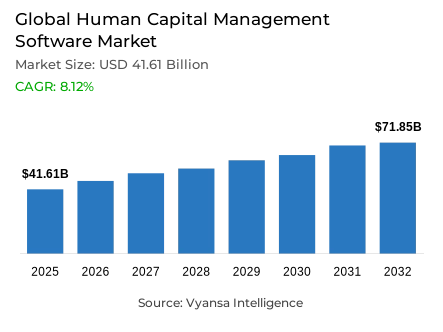
- Human Capital Management Software market size was valued at USD 41.61 billion in 2025 and is estimated at USD 44.34 billion in 2026.
- The market size is expected to grow to USD 71.85 billion by 2032.
- Market to register a CAGR of around 8.12% during 2026-32.
- End User Shares
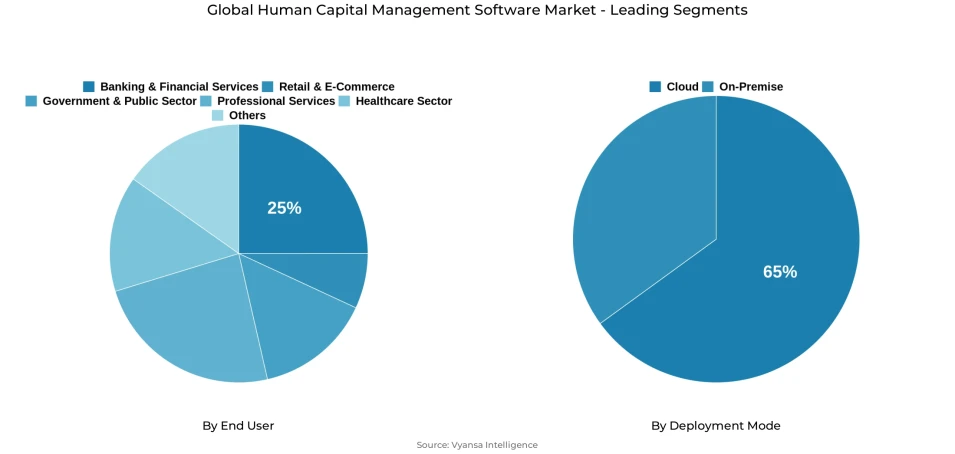
- Banking & financial services grabbed market share of 25%.
- Competition
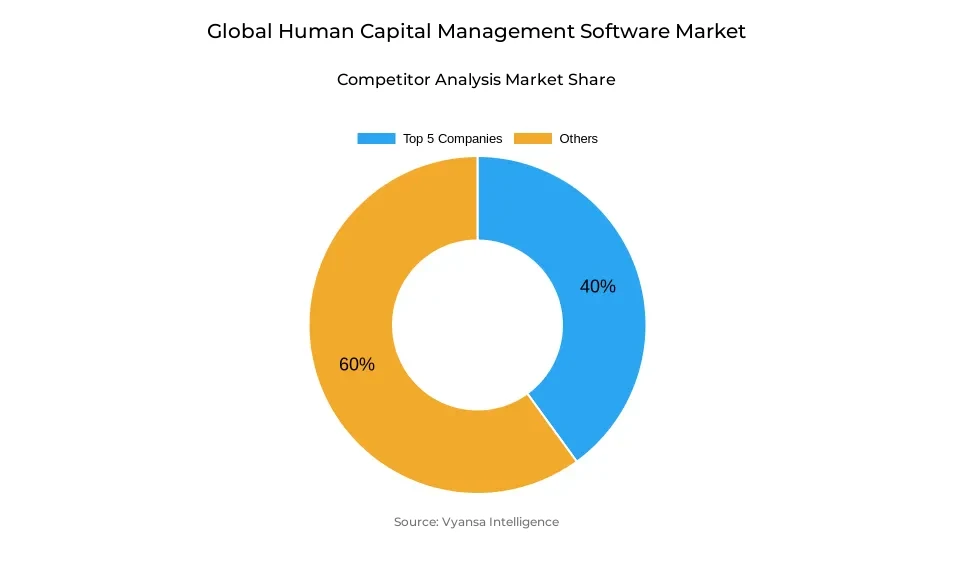
- Global human capital management software market is currently being catered to by more than 25 companies.
- Top 5 companies acquired around 40% of the market share.
- The Sage Group plc, Cegid SAS, Infor, Oracle Corporation, SAP SE etc., are few of the top companies.
- Deployment Mode
- Cloud grabbed 65% of the market.
- Region
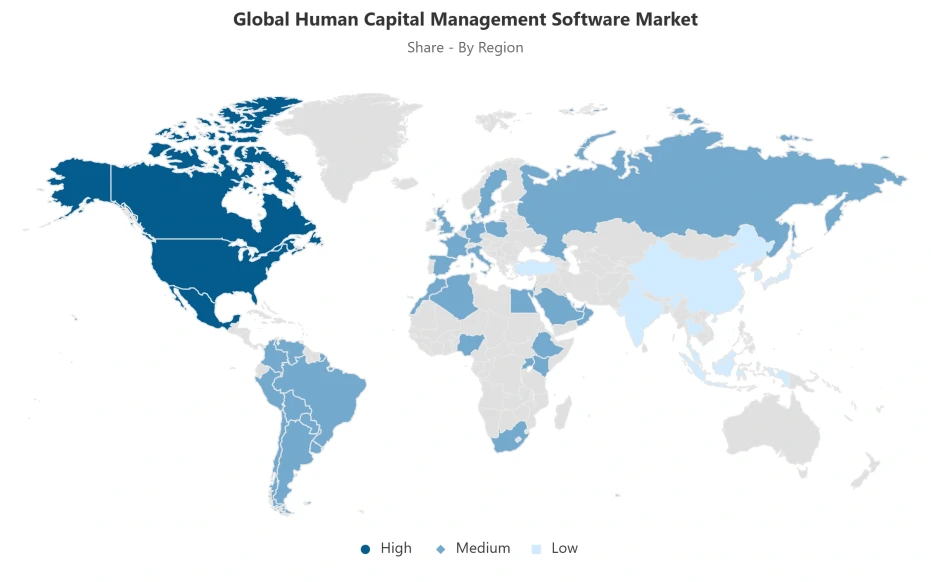
- North America leads with a 40% share of the global market.
Global Human Capital Management Software Market Outlook
Global human capital management (HCM) software market is positioned as a core enterprise software category, covering payroll management, talent management, workforce management, employee lifecycle management, HR analytics, and compliance-led workforce administration. The market is valued at USD 41.61 billion in 2025 and USD 44.34 billion in 2026, with a projected rise to USD 71.85 billion by 2032 at 8.12% CAGR during 2026-2032. The global human capital management (HCM) software industry supports banking, retail, government, professional services, and healthcare organizations.
Cloud migration, AI-enabled HR workflows, and integrated payroll compliance are strengthening demand as enterprises replace fragmented HRMS, HRIS, payroll, and workforce scheduling tools with unified platforms. SAP reports that SuccessFactors supports core HR and payroll, talent management, HR analytics, workforce planning, and employee experience management across more than 10,000 customers in over 200 countries and territories. This installed base reinforces how global human capital management (HCM) software market is moving toward global, multi-country platform standardization.
Procurement impact is expanding beyond HR departments as finance, operations, compliance, and IT teams use shared employee data to improve workforce cost visibility, payroll accuracy, and decision governance. Oracle states that Fusion Cloud HCM connects every HR process and every person across an enterprise through a single experience, single data model, and AI-embedded infrastructure. This architecture strengthens the global human capital management (HCM) software industry by linking employee records, workflow automation, talent decisions, and payroll governance.
Agentic AI, sovereign data controls, and faster cloud deployment models are shaping the 2026 trajectory as suppliers compete on automation depth, compliance confidence, and enterprise integration. ADP identifies agentic AI, stronger governance, and closer HR-IT collaboration as defining HR technology priorities for 2026. These shifts position global human capital management (HCM) software market for higher adoption among organizations modernizing payroll, skills intelligence, employee experience, and predictive workforce analytics securely.
Global Human Capital Management Software Market Growth Driver
Compliance-Driven Cloud HR Modernization
Payroll complexity, cross-border workforce administration, and demand for real-time employee data are accelerating platform replacement across large enterprises and regulated industries. Buyers are moving away from standalone payroll, performance, recruitment, and time-management applications toward integrated HCM suites that centralize records, automate validations, and improve audit readiness. This demand directly supports global human capital management (HCM) software market adoption as enterprises prioritize accurate workforce data, controlled workflows, and scalable service delivery across multi-location operating models and regulated workforce environments during audits and transitions.
ADP reported in 2025 that new AI features monitor local, national, and emerging workplace requirements and provide practitioner-verifiable compliance recommendations. That capability strengthens the global human capital management (HCM) software industry by converting compliance monitoring from a manual administrative function into an embedded software workflow, improving demand for payroll management software, HR compliance software, automated HR processes, and workforce analytics in high-volume employment environments at scale across geographies.
Global Human Capital Management Software Market Challenge
Fragmented Data and Regulatory Exposure
Fragmented employee data, inconsistent payroll inputs, and AI governance exposure are constraining deployment speed for organizations with legacy HR systems. As enterprises add AI-assisted recruiting, employee self-service, sentiment analytics, and workforce planning tools, weak data lineage can raise privacy, bias, access-control, and compliance risks. This barrier affects global human capital management (HCM) software market procurement because buyers must evaluate data architecture, integration quality, security controls, and auditability before expanding platform scope across sensitive workforce functions and jurisdictional reporting requirements.
The European Commission states that the EU AI Act, Regulation (EU) 2024/1689, sets risk-based rules for AI developers and deployers and supports trustworthy AI implementation. This regulatory environment increases compliance workload for the global human capital management (HCM) software industry, especially where AI supports candidate evaluation, performance monitoring, skills inference, or automated workforce recommendations, making governance features and human oversight central to vendor selection and implementation planning during enterprise rollout cycles.
Unlock Market Intelligence
Explore the market potential with our data-driven report
Global Human Capital Management Software Market Trend
AI-Led Workforce Intelligence Gains Momentum
AI agents, skills intelligence, and predictive workforce analytics are shifting HCM platforms from recordkeeping systems into decision-support infrastructure. Enterprises increasingly expect platforms to recommend career paths, automate onboarding, validate payroll workflows, surface compliance alerts, and forecast labor requirements. This trend strengthens global human capital management (HCM) software market differentiation because vendors now compete on embedded intelligence, data interoperability, workflow autonomy, and the ability to convert employee information into actionable workforce planning across complex enterprise structures while preserving governance and transparency.
Oracle announced in February 2025 that role-based AI agents embedded in Oracle Fusion Cloud HCM automate end-to-end workflows across onboarding, contracts, performance reviews, career support, and administrative HR tasks. This development advances the global human capital management (HCM) software industry by pushing AI-powered HCM platforms toward measurable productivity improvement, employee experience optimization, and deeper automation across talent management software and workforce management software across hybrid workforces and global teams securely.
Global Human Capital Management Software Market Opportunity
Mid-Market Cloud Conversion Opens Growth Headroom
Small and mid-sized enterprises are becoming a stronger adoption pool as cloud HCM software reduces implementation burden and expands access to payroll, recruiting, onboarding, performance, and benefits tools. These buyers need configurable platforms that improve compliance visibility without requiring large internal HR technology teams. This opportunity expands global human capital management (HCM) software market demand by widening procurement beyond global enterprises into scalable, subscription-based HCM solutions for growing companies and distributed workforces without lengthy infrastructure programs.
ADP's 2026 HR trends research states that small businesses face rising costs, complex compliance, and growing pressure to attract and retain talent, making strategic HR decisions more critical. That operating pressure supports the global human capital management (HCM) software industry by increasing demand for SME HCM software, employee self-service portals, payroll compliance automation, and HR digital transformation tools that simplify administration while preserving workforce control and management visibility across payroll and talent workflows quickly.
Global Human Capital Management Software Market Regional Analysis
By Region
- North America
- South America
- Europe
- Middle East and Africa
- Asia Pacific
North America holds 40% share because the region combines large enterprise software budgets, mature cloud adoption, high payroll complexity, strong HR compliance requirements, and dense headquarters presence of major HCM vendors. The regional ecosystem supports global human capital management (HCM) software market expansion through advanced SaaS procurement, early AI experimentation, and strong demand from financial services, healthcare, retail, professional services, and public-sector organizations with complex workforce administration needs and rapid vendor ecosystem development.
ADP states that more than 1,100,000 clients use its payroll services and that it provides payroll, global HCM, and outsourcing services in more than 140 countries. This operational footprint supports North America’s leadership by anchoring global payroll software expertise, enterprise HR software adoption, and compliance-driven workforce administration across a supplier base that includes Workday, Oracle, UKG, Dayforce, Paychex, and Paycom for complex domestic and cross-border employers across mature enterprise accounts at scale in practice.
Unlock Market Intelligence
Explore the market potential with our data-driven report
Global Human Capital Management Software Market Segmentation Analysis
By End User
- Banking & Financial Services
- Retail & E-Commerce
- Government & Public Sector
- Professional Services
- Healthcare Sector
- Others
Banking & Financial Services holds 25% share under end user segmentation because financial institutions require controlled payroll operations, role-based access, audit-ready employee data, workforce scheduling, and compliance-aligned talent governance. The segment’s demand profile supports global human capital management (HCM) software market growth because banks, credit unions, and insurers manage distributed workforces, regulated roles, sensitive employee records, and high service-continuity requirements across branch, contact-center, risk, and digital banking operations with limited tolerance for payroll disruption where process errors can create reputational exposure.
UKG states that its HCM software helps banks, credit unions, and insurance providers streamline payroll, simplify compliance, manage complex scheduling, and support workforce engagement in a secure, scalable platform. This sector-specific platform positioning reinforces demand for human capital management software across BFSI by linking workforce management software, payroll management software, and employee engagement software to operational resilience, audit confidence, and regulatory readiness across regulated operating units and audit teams.
By Deployment Mode
- Cloud
- On-Premise
Cloud holds 65% share under deployment mode because enterprises prioritize rapid configuration, continuous upgrades, multi-country access, mobile HR self-service, and lower infrastructure dependency. Cloud architecture allows HR teams to scale payroll, talent acquisition, performance management, and workforce analytics without maintaining separate on-premise systems. This dominance strengthens global human capital management (HCM) software market adoption as buyers align HCM transformation with SaaS procurement, data integration, and AI-enabled workflow modernization across enterprise operations with limited disruption to existing operating models.
Workday reported in February 2026 that it has more than 11,500 customers, including over 7,000 core Workday Financial Management and Workday HCM customers, and delivered 1.7 billion AI actions across its platform in fiscal 2026. This operational scale strengthens the global human capital management (HCM) software industry by validating enterprise preference for cloud-based HCM software, unified employee data platforms, and AI-powered HR workflows across upgrades and enterprise AI use cases.
Market Players in Global Human Capital Management Software Market
These market players maintain a significant presence in the Global human capital management software market and contribute to its ongoing evolution.
- The Sage Group plc
- Cegid SAS
- Infor
- Oracle Corporation
- SAP SE
- Workday Inc.
- UKG Inc.
- TALENTIA SOFTWARE GROUP (Talentia Software)
- Verge Inc. (WebHR)
- Automatic Data Processing Inc.
- PeopleFluent Limited
- Bamboo HR LLC
- Dayforce Inc.
- Paychex Inc.
- Paycom Software Inc.
Market News & Updates
- UKG Inc., 2026:
UKG showcased its AI-led Workforce Operating Platform in March 2026, positioning it as a governed, agentic system that unifies HR, payroll, and workforce management. The platform is designed to deliver real-time intelligence to leaders and managers handling workforce decisions. The update strengthens UKG’s HCM positioning around AI-enabled workforce orchestration, payroll visibility, and operational decision support.
- Dayforce Inc., 2025:
Dayforce announced Dayforce AI Workspace in October 2025 as a secure digital workspace where people and AI work together to turn workforce strategy into action. The company also expanded AI agents across HR, payroll, and business operations through its AI-powered people platform. The update expands Dayforce’s HCM automation depth across workforce planning, employee workflows, and AI-assisted HR operations.
Frequently Asked Questions
Related Report
- Market Segmentation
- Research Scope
- Research Methodology
- Definitions and Assumptions
- Executive Summary
- Global Human Capital Management (HCM) Software Market Policies, Regulations, and Standards
- Global Human Capital Management (HCM) Software Market Dynamics
- Growth Factors
- Challenges
- Trends
- Opportunities
- Global Human Capital Management (HCM) Software Market Statistics, 2022-2032F
- Market Size & Growth Outlook
- By Revenues in USD Million
- Market Segmentation & Growth Outlook
- By Solution
- Payroll Management- Market Insights and Forecast 2022-2032, USD Million
- Talent Management- Market Insights and Forecast 2022-2032, USD Million
- Workforce Management- Market Insights and Forecast 2022-2032, USD Million
- Others- Market Insights and Forecast 2022-2032, USD Million
- By Enterprise Size
- Small Business- Market Insights and Forecast 2022-2032, USD Million
- Mid-sized Business- Market Insights and Forecast 2022-2032, USD Million
- Large Business- Market Insights and Forecast 2022-2032, USD Million
- By Deployment Mode
- Cloud- Market Insights and Forecast 2022-2032, USD Million
- On-Premise- Market Insights and Forecast 2022-2032, USD Million
- By End User
- Banking & Financial Services- Market Insights and Forecast 2022-2032, USD Million
- Retail & E-Commerce- Market Insights and Forecast 2022-2032, USD Million
- Government & Public Sector- Market Insights and Forecast 2022-2032, USD Million
- Professional Services- Market Insights and Forecast 2022-2032, USD Million
- Healthcare Sector- Market Insights and Forecast 2022-2032, USD Million
- Others- Market Insights and Forecast 2022-2032, USD Million
- By Region
- North America
- South America
- Europe
- Middle East and Africa
- Asia Pacific
- By Competitors
- Competition Characteristics
- Market Share & Analysis
- By Solution
- Market Size & Growth Outlook
- North America Human Capital Management (HCM) Software Market Statistics, 2022-2032F
- Market Size & Growth Outlook
- By Revenues in USD Million
- Market Segmentation & Growth Outlook
- By Solution- Market Insights and Forecast 2022-2032, USD Million
- By Enterprise Size- Market Insights and Forecast 2022-2032, USD Million
- By Deployment Mode- Market Insights and Forecast 2022-2032, USD Million
- By End User- Market Insights and Forecast 2022-2032, USD Million
- By Country
- The US
- Canada
- Mexico
- Rest of North America
- The US Human Capital Management (HCM) Software Market Statistics, 2022-2032F
- Market Size & Growth Outlook
- By Revenues in USD Million
- Market Segmentation & Growth Outlook
- By Solution- Market Insights and Forecast 2022-2032, USD Million
- By Enterprise Size- Market Insights and Forecast 2022-2032, USD Million
- By Deployment Mode- Market Insights and Forecast 2022-2032, USD Million
- By End User- Market Insights and Forecast 2022-2032, USD Million
- Market Size & Growth Outlook
- Canada Human Capital Management (HCM) Software Market Statistics, 2022-2032F
- Market Size & Growth Outlook
- By Revenues in USD Million
- Market Segmentation & Growth Outlook
- By Solution- Market Insights and Forecast 2022-2032, USD Million
- By Enterprise Size- Market Insights and Forecast 2022-2032, USD Million
- By Deployment Mode- Market Insights and Forecast 2022-2032, USD Million
- By End User- Market Insights and Forecast 2022-2032, USD Million
- Market Size & Growth Outlook
- Mexico Human Capital Management (HCM) Software Market Statistics, 2022-2032F
- Market Size & Growth Outlook
- By Revenues in USD Million
- Market Segmentation & Growth Outlook
- By Solution- Market Insights and Forecast 2022-2032, USD Million
- By Enterprise Size- Market Insights and Forecast 2022-2032, USD Million
- By Deployment Mode- Market Insights and Forecast 2022-2032, USD Million
- By End User- Market Insights and Forecast 2022-2032, USD Million
- Market Size & Growth Outlook
- Market Size & Growth Outlook
- South America Human Capital Management (HCM) Software Market Statistics, 2022-2032F
- Market Size & Growth Outlook
- By Revenues in USD Million
- Market Segmentation & Growth Outlook
- By Solution- Market Insights and Forecast 2022-2032, USD Million
- By Enterprise Size- Market Insights and Forecast 2022-2032, USD Million
- By Deployment Mode- Market Insights and Forecast 2022-2032, USD Million
- By End User- Market Insights and Forecast 2022-2032, USD Million
- By Country
- Brazil
- Argentina
- Rest of South America
- Brazil Human Capital Management (HCM) Software Market Statistics, 2022-2032F
- Market Size & Growth Outlook
- By Revenues in USD Million
- Market Segmentation & Growth Outlook
- By Solution- Market Insights and Forecast 2022-2032, USD Million
- By Enterprise Size- Market Insights and Forecast 2022-2032, USD Million
- By Deployment Mode- Market Insights and Forecast 2022-2032, USD Million
- By End User- Market Insights and Forecast 2022-2032, USD Million
- Market Size & Growth Outlook
- Argentina Human Capital Management (HCM) Software Market Statistics, 2022-2032F
- Market Size & Growth Outlook
- By Revenues in USD Million
- Market Segmentation & Growth Outlook
- By Solution- Market Insights and Forecast 2022-2032, USD Million
- By Enterprise Size- Market Insights and Forecast 2022-2032, USD Million
- By Deployment Mode- Market Insights and Forecast 2022-2032, USD Million
- By End User- Market Insights and Forecast 2022-2032, USD Million
- Market Size & Growth Outlook
- Market Size & Growth Outlook
- Europe Human Capital Management (HCM) Software Market Statistics, 2022-2032F
- Market Size & Growth Outlook
- By Revenues in USD Million
- Market Segmentation & Growth Outlook
- By Solution- Market Insights and Forecast 2022-2032, USD Million
- By Enterprise Size- Market Insights and Forecast 2022-2032, USD Million
- By Deployment Mode- Market Insights and Forecast 2022-2032, USD Million
- By End User- Market Insights and Forecast 2022-2032, USD Million
- By Country
- Germany
- The UK
- France
- Italy
- Spain
- Rest of Europe
- Germany Human Capital Management (HCM) Software Market Statistics, 2022-2032F
- Market Size & Growth Outlook
- By Revenues in USD Million
- Market Segmentation & Growth Outlook
- By Solution- Market Insights and Forecast 2022-2032, USD Million
- By Enterprise Size- Market Insights and Forecast 2022-2032, USD Million
- By Deployment Mode- Market Insights and Forecast 2022-2032, USD Million
- By End User- Market Insights and Forecast 2022-2032, USD Million
- Market Size & Growth Outlook
- The UK Human Capital Management (HCM) Software Market Statistics, 2022-2032F
- Market Size & Growth Outlook
- By Revenues in USD Million
- Market Segmentation & Growth Outlook
- By Solution- Market Insights and Forecast 2022-2032, USD Million
- By Enterprise Size- Market Insights and Forecast 2022-2032, USD Million
- By Deployment Mode- Market Insights and Forecast 2022-2032, USD Million
- By End User- Market Insights and Forecast 2022-2032, USD Million
- Market Size & Growth Outlook
- France Human Capital Management (HCM) Software Market Statistics, 2022-2032F
- Market Size & Growth Outlook
- By Revenues in USD Million
- Market Segmentation & Growth Outlook
- By Solution- Market Insights and Forecast 2022-2032, USD Million
- By Enterprise Size- Market Insights and Forecast 2022-2032, USD Million
- By Deployment Mode- Market Insights and Forecast 2022-2032, USD Million
- By End User- Market Insights and Forecast 2022-2032, USD Million
- Market Size & Growth Outlook
- Italy Human Capital Management (HCM) Software Market Statistics, 2022-2032F
- Market Size & Growth Outlook
- By Revenues in USD Million
- Market Segmentation & Growth Outlook
- By Solution- Market Insights and Forecast 2022-2032, USD Million
- By Enterprise Size- Market Insights and Forecast 2022-2032, USD Million
- By Deployment Mode- Market Insights and Forecast 2022-2032, USD Million
- By End User- Market Insights and Forecast 2022-2032, USD Million
- Market Size & Growth Outlook
- Spain Human Capital Management (HCM) Software Market Statistics, 2022-2032F
- Market Size & Growth Outlook
- By Revenues in USD Million
- Market Segmentation & Growth Outlook
- By Solution- Market Insights and Forecast 2022-2032, USD Million
- By Enterprise Size- Market Insights and Forecast 2022-2032, USD Million
- By Deployment Mode- Market Insights and Forecast 2022-2032, USD Million
- By End User- Market Insights and Forecast 2022-2032, USD Million
- Market Size & Growth Outlook
- Market Size & Growth Outlook
- Middle East and Africa Human Capital Management (HCM) Software Market Statistics, 2022-2032F
- Market Size & Growth Outlook
- By Revenues in USD Million
- Market Segmentation & Growth Outlook
- By Solution- Market Insights and Forecast 2022-2032, USD Million
- By Enterprise Size- Market Insights and Forecast 2022-2032, USD Million
- By Deployment Mode- Market Insights and Forecast 2022-2032, USD Million
- By End User- Market Insights and Forecast 2022-2032, USD Million
- By Country
- Saudi Arabia
- The UAE
- South Africa
- Rest of Middle East and Africa
- Saudi Arabia Human Capital Management (HCM) Software Market Statistics, 2022-2032F
- Market Size & Growth Outlook
- By Revenues in USD Million
- Market Segmentation & Growth Outlook
- By Solution- Market Insights and Forecast 2022-2032, USD Million
- By Enterprise Size- Market Insights and Forecast 2022-2032, USD Million
- By Deployment Mode- Market Insights and Forecast 2022-2032, USD Million
- By End User- Market Insights and Forecast 2022-2032, USD Million
- Market Size & Growth Outlook
- The UAE Human Capital Management (HCM) Software Market Statistics, 2022-2032F
- Market Size & Growth Outlook
- By Revenues in USD Million
- Market Segmentation & Growth Outlook
- By Solution- Market Insights and Forecast 2022-2032, USD Million
- By Enterprise Size- Market Insights and Forecast 2022-2032, USD Million
- By Deployment Mode- Market Insights and Forecast 2022-2032, USD Million
- By End User- Market Insights and Forecast 2022-2032, USD Million
- Market Size & Growth Outlook
- South Africa Human Capital Management (HCM) Software Market Statistics, 2022-2032F
- Market Size & Growth Outlook
- By Revenues in USD Million
- Market Segmentation & Growth Outlook
- By Solution- Market Insights and Forecast 2022-2032, USD Million
- By Enterprise Size- Market Insights and Forecast 2022-2032, USD Million
- By Deployment Mode- Market Insights and Forecast 2022-2032, USD Million
- By End User- Market Insights and Forecast 2022-2032, USD Million
- Market Size & Growth Outlook
- Market Size & Growth Outlook
- Asia Pacific Human Capital Management (HCM) Software Market Statistics, 2022-2032F
- Market Size & Growth Outlook
- By Revenues in USD Million
- Market Segmentation & Growth Outlook
- By Solution- Market Insights and Forecast 2022-2032, USD Million
- By Enterprise Size- Market Insights and Forecast 2022-2032, USD Million
- By Deployment Mode- Market Insights and Forecast 2022-2032, USD Million
- By End User- Market Insights and Forecast 2022-2032, USD Million
- By Country
- China
- Japan
- India
- South Korea
- Australia and New Zealand
- Rest of Asia Pacific
- China Human Capital Management (HCM) Software Market Statistics, 2022-2032F
- Market Size & Growth Outlook
- By Revenues in USD Million
- Market Segmentation & Growth Outlook
- By Solution- Market Insights and Forecast 2022-2032, USD Million
- By Enterprise Size- Market Insights and Forecast 2022-2032, USD Million
- By Deployment Mode- Market Insights and Forecast 2022-2032, USD Million
- By End User- Market Insights and Forecast 2022-2032, USD Million
- Market Size & Growth Outlook
- Japan Human Capital Management (HCM) Software Market Statistics, 2022-2032F
- Market Size & Growth Outlook
- By Revenues in USD Million
- Market Segmentation & Growth Outlook
- By Solution- Market Insights and Forecast 2022-2032, USD Million
- By Enterprise Size- Market Insights and Forecast 2022-2032, USD Million
- By Deployment Mode- Market Insights and Forecast 2022-2032, USD Million
- By End User- Market Insights and Forecast 2022-2032, USD Million
- Market Size & Growth Outlook
- India Human Capital Management (HCM) Software Market Statistics, 2022-2032F
- Market Size & Growth Outlook
- By Revenues in USD Million
- Market Segmentation & Growth Outlook
- By Solution- Market Insights and Forecast 2022-2032, USD Million
- By Enterprise Size- Market Insights and Forecast 2022-2032, USD Million
- By Deployment Mode- Market Insights and Forecast 2022-2032, USD Million
- By End User- Market Insights and Forecast 2022-2032, USD Million
- Market Size & Growth Outlook
- South Korea Human Capital Management (HCM) Software Market Statistics, 2022-2032F
- Market Size & Growth Outlook
- By Revenues in USD Million
- Market Segmentation & Growth Outlook
- By Solution- Market Insights and Forecast 2022-2032, USD Million
- By Enterprise Size- Market Insights and Forecast 2022-2032, USD Million
- By Deployment Mode- Market Insights and Forecast 2022-2032, USD Million
- By End User- Market Insights and Forecast 2022-2032, USD Million
- Market Size & Growth Outlook
- Australia and New Zealand Human Capital Management (HCM) Software Market Statistics, 2022-2032F
- Market Size & Growth Outlook
- By Revenues in USD Million
- Market Segmentation & Growth Outlook
- By Solution- Market Insights and Forecast 2022-2032, USD Million
- By Enterprise Size- Market Insights and Forecast 2022-2032, USD Million
- By Deployment Mode- Market Insights and Forecast 2022-2032, USD Million
- By End User- Market Insights and Forecast 2022-2032, USD Million
- Market Size & Growth Outlook
- Market Size & Growth Outlook
- Competitive Outlook
- Company Profiles
- Oracle Corporation
- Business Description
- Service Portfolio
- Collaborations & Alliances
- Recent Developments
- Financial Details
- Others
- SAP SE
- Business Description
- Service Portfolio
- Collaborations & Alliances
- Recent Developments
- Financial Details
- Others
- Workday Inc.
- Business Description
- Service Portfolio
- Collaborations & Alliances
- Recent Developments
- Financial Details
- Others
- UKG Inc.
- Business Description
- Service Portfolio
- Collaborations & Alliances
- Recent Developments
- Financial Details
- Others
- TALENTIA SOFTWARE GROUP (Talentia Software)
- Business Description
- Service Portfolio
- Collaborations & Alliances
- Recent Developments
- Financial Details
- Others
- The Sage Group plc
- Business Description
- Service Portfolio
- Collaborations & Alliances
- Recent Developments
- Financial Details
- Others
- Cegid SAS
- Business Description
- Service Portfolio
- Collaborations & Alliances
- Recent Developments
- Financial Details
- Others
- Infor
- Business Description
- Service Portfolio
- Collaborations & Alliances
- Recent Developments
- Financial Details
- Others
- Verge Inc. (WebHR)
- Business Description
- Service Portfolio
- Collaborations & Alliances
- Recent Developments
- Financial Details
- Others
- Automatic Data Processing Inc.
- Business Description
- Service Portfolio
- Collaborations & Alliances
- Recent Developments
- Financial Details
- Others
- PeopleFluent Limited
- Business Description
- Service Portfolio
- Collaborations & Alliances
- Recent Developments
- Financial Details
- Others
- Bamboo HR LLC
- Business Description
- Service Portfolio
- Collaborations & Alliances
- Recent Developments
- Financial Details
- Others
- Dayforce Inc.
- Business Description
- Service Portfolio
- Collaborations & Alliances
- Recent Developments
- Financial Details
- Others
- Paychex Inc.
- Business Description
- Service Portfolio
- Collaborations & Alliances
- Recent Developments
- Financial Details
- Others
- Paycom Software Inc.
- Business Description
- Service Portfolio
- Collaborations & Alliances
- Recent Developments
- Financial Details
- Others
- Oracle Corporation
- Company Profiles
- Disclaimer
| Segment | Sub-Segment |
|---|---|
| By Solution |
|
| By Enterprise Size |
|
| By Deployment Mode |
|
| By End User |
|
| By Region |
|
Research Methodology
This study followed a structured approach comprising four key phases to assess the size and scope of the electro-oxidation market. The process began with thorough secondary research to collect data on the target market, related markets, and broader industry context. These findings, along with preliminary assumptions and estimates, were then validated through extensive primary research involving industry experts from across the value chain. To calculate the overall market size, both top-down and bottom-up methodologies were employed. Finally, market segmentation and data triangulation techniques were applied to refine and validate segment-level estimations.
Secondary Research
The secondary research phase involved gathering data from a wide range of credible and published sources. This step helped in identifying industry trends, defining market segmentation, and understanding the market landscape and value chain.
Sources consulted during this phase included:
- Company annual reports, investor presentations, and press releases
- Industry white papers and certified publications
- Trade directories and market-recognized databases
- Articles from authoritative authors and reputable journals
- Gold and silver standard websites
Secondary research was critical in mapping out the industry's value chain and monetary flow, identifying key market segments, understanding regional variations, and tracking significant industry developments.
Other key sources:
- Financial disclosures
- Industry associations and trade bodies
- News outlets and business magazines
- Academic journals and research studies
- Paid industry databases
Primary Research
To validate secondary data and gain deeper market insights, primary research was conducted with key stakeholders across both the supply and demand sides of the market.
On the demand side, participants included decision-makers and influencers from end-user industries—such as CIOs, CTOs, and CSOs—who provided first-hand perspectives on market needs, product usage, and future expectations.
On the supply side, interviews were conducted with manufacturers, industry associations, and institutional participants to gather insights into current offerings, product pipelines, and market challenges.
Primary interviews provided critical inputs such as:
- Market size and revenue data
- Product and service breakdowns
- Market forecasts
- Regional and application-specific trends
Stakeholders consulted included:
- Leading OEM and solution providers
- Channel and distribution partners
- End users across various applications
- Independent consultants and industry specialists
Market Size Estimation and Data Triangulation
- Identifying Key Market Participants (Secondary Research)
- Goal: To identify the major players or companies in the target market. This typically involves using publicly available data sources such as industry reports, market research publications, and financial statements of companies.
- Tools: Reports from firms like Gartner, Forrester, Euromonitor, Statista, IBISWorld, and others. Public financial statements, news articles, and press releases from top market players.
- Extracting Earnings of Key Market Participants
- Goal: To estimate the earnings generated from the product or service being analyzed. This step helps in understanding the revenue potential of each market player in a specific geography.
- Methods: Earnings data can be gathered from:
- Publicly available financial reports (for listed companies).
- Interviews and primary data sources from professionals, such as Directors, VPs, SVPs, etc. This is especially useful for understanding more nuanced, internal data that isn't publicly disclosed.
- Annual reports and investor presentations of key players.
- Data Collation and Development of a Relevant Data Model
- Goal: To collate inputs from both primary and secondary sources into a structured, data-driven model for market estimation. This model will incorporate key market KPIs and any independent variables relevant to the market.
- Key KPIs: These could include:
- Market size, growth rate, and demand drivers.
- Industry-specific metrics like market share, average revenue per customer (ARPC), or average deal size.
- External variables, such as economic growth rates, inflation rates, or commodity prices, that could affect the market.
- Data Modeling: Based on this data, the market forecasts are developed for the next 5 years. A combination of trend analysis, scenario modeling, and statistical regression might be used to generate projections.
- Scenario Analysis
- Goal: To test different assumptions and validate how sensitive the market is to changes in key variables (e.g., market demand, regulatory changes, technological disruptions).
- Types of Scenarios:
- Base Case: Based on current assumptions and historical data.
- Best-Case Scenario: Assuming favorable market conditions, regulatory environments, and technological advancements.
- Worst-Case Scenario: Accounting for adverse factors, such as economic downturns, stricter regulations, or unexpected disruptions.












