Germany Dog Food Market Report: Trends, Growth and Forecast (2026-2032)
By Product (Wet Dog Food, Dry Dog Food, Treats and Mixers), By Nature (Organic, Monoprotein, Conventional), By Ingredient (Animal Derivatives, Plant Derivatives), By Pet Type (Kitten/Pup, Adult, Senior), By Pricing (Economy, Mid-Priced, Premium), By Packaging (Pouches, Bags, Folding Cartons, Tubs & Cups, Can, Bottles & Jars), By Sales Channel (Retail Channels, Non-Retail Channels) ... Read more

|
Major Players
|
Germany Dog Food Market Statistics and Insights, 2026
- Market Size Statistics
- Dog Food in Germany is estimated at $ 2.81 Billion.
- The market size is expected to grow to $ 3.23 Billion by 2032.
- Market to register a CAGR of around 2.01% during 2026-32.
- Product Shares
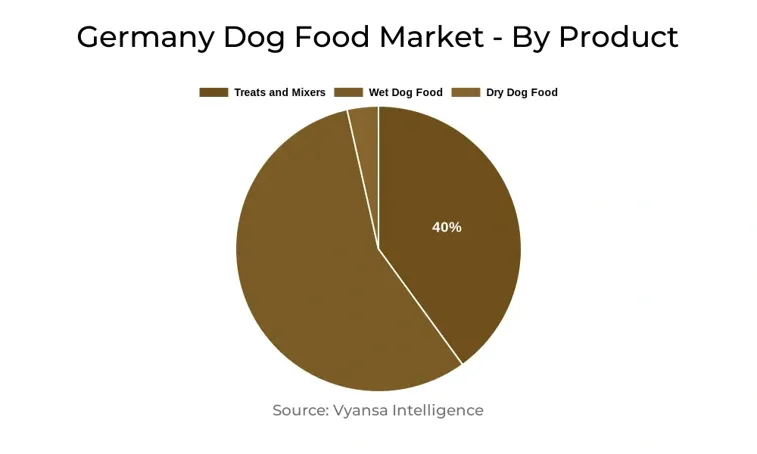
- Dog Treats and Mixers grabbed market share of 40%.
- Dog Treats and Mixers to witness a volume CAGR of around 2.95%.
- Competition
- More than 20 companies are actively engaged in producing Dog Food in Germany.
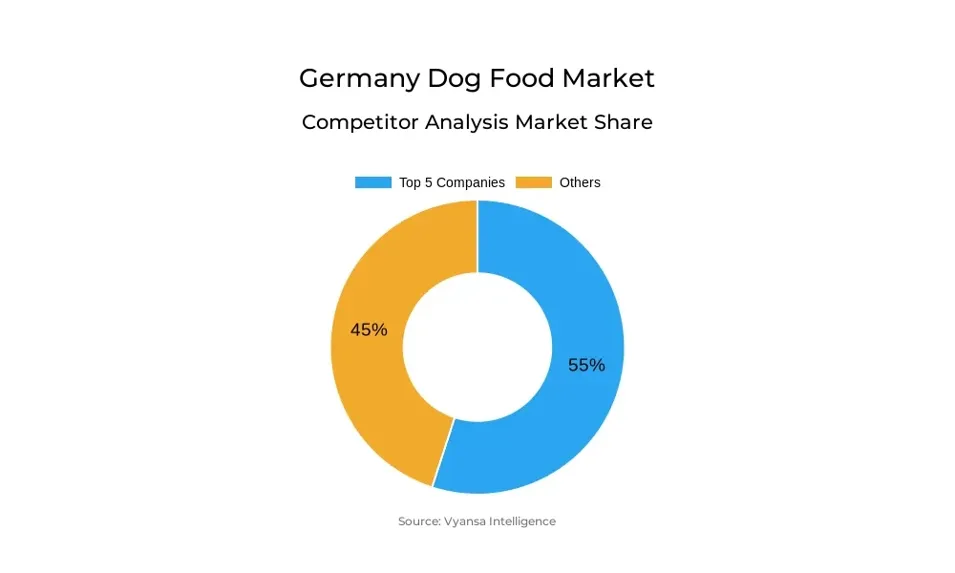
- Top 5 companies acquired 55% of the market share.
- Aldi Einkauf GmbH & Co oHG, Vet-Concept GmbH & Co KG, Animonda Petcare GmbH, Masterfoods GmbH, Fressnapf Holding SE etc., are few of the top companies.
- Sales Channel
- Retail Channels grabbed 95% of the market.
Germany Dog Food Market Outlook
The Germany dog food market is anticipated to keep developing up to 2025–2030 with increased demand for premium, health-oriented products. As owners treat their pets more like family, they are transferring the same health criteria to their pet's diet. This is creating solid growth in premium segments, particularly products that provide specific health benefits, fresh and organic components, or therapeutic assistance. Functional nutrition with added ingredients like omega-3s and probiotics is on the rise, endorsed by veterinarians who establish trust.
Meanwhile, competition is being increasingly segmented. As price-conscious consumers opt for cheap private label offerings, other consumers are opting for premium, natural, and vet-approved dog food. Smaller brands with emphasis on ethical sourcing and health claims are making waves but maintain relatively small shares in the market. The rise of e-commerce is supporting these trends by offering easier access to specialised products and subscription-based services, especially among younger, urban pet owners seeking personalised nutrition.
As the dog population of Germany stabilises, volume growth will give way to value growth. An aging pet population and smaller breeds will propel demand for functional, portion-controlled, and age-formulated nutrition. Demographic changes within households—increased number of single-person households and apartment dwellings—will continue to influence product formats and feeding behavior, with mixers and treats continuing as most dynamic performers.
In the future, innovation will focus on health, customization, and sustainability. Consumers will demand science-based nutrition, transparent sourcing, and sustainable packaging. Brands that share these principles and spend money in product development will best be placed to prosper in this mature yet developing marketplace.
Germany Dog Food Market Challenge
With Germany's dog population stabilizing after several years of consistent expansion, the dog food market is confronted with slower volume growth by 2030. Fewer new dog owners are entering the market, so it becomes more challenging to bank on rising pet numbers. With the aging of the dog population, there is increasing demand for specialist products that cater to health ailments such as joint care, digestive health, and weight management. This change forces brands to be more concerned with premium products than they are with selling volume.
In parallel, changing lifestyles are transforming the pet ownership profile. Increased small household numbers, aging pet owners, and urban living have resulted in growth in smaller breeds and aged rescue dogs. These shifts influence feeding habits, propelling demand for convenient-to-serve, portion-controlled, and functional canine food. Brands need to keep pace with appropriate product formats like smaller packs, calming treats, or dietary supplements to match changing expectations.
Germany Dog Food Market Trend
Innovation fueled by the pet humanisation trend. Dog owners in Germany increasingly seek products that mirror their own lifestyle attitudes. Health-oriented alternatives, ethical manufacturing, and sustainability are now taking priority in purchase choices. Hence, there is growing demand for vegan or vegetarian recipes, formulations linked to particular breeds, and individualised meals through subscription.
Sustainability is also a major trend. Green packaging is not a choice anymore, as consumers increasingly prefer brands committed to recyclability and transparent sourcing. Businesses that are betting on scientifically backed plant-based nutrition, with open labelling and sustainable packaging, will be more likely to win the long-term trust of consumers. The trend is heading toward a world where health, ethics, and the environment drive innovation across all aspects of the dog food business.
Unlock Market Intelligence
Explore the market potential with our data-driven report
| Report Coverage | Details |
|---|---|
| Market Forecast | 2026-32 |
| USD Value 2025 | $ 2.81 Billion |
| USD Value 2032 | $ 3.23 Billion |
| CAGR 2026-2032 | 2.01% |
| Largest Category | Dog Treats and Mixers segment leads with 40% market share |
| Top Challenges | Ageing Dogs and Shifting Lifestyles Hindering Market Growth |
| Top Trends | Health and Sustainability Continue to Shape Consumer Choices |
| Key Players | Aldi Einkauf GmbH & Co oHG, Vet-Concept GmbH & Co KG, Animonda Petcare GmbH, Masterfoods GmbH, Fressnapf Holding SE, Nestlé Purina PetCare Deutschland GmbH, Vitakraft Pet Care GmbH & Co KG, Rewe Zentral AG, Edeka Zentrale AG & Co KG, Bewital Petfood GmbH & Co KG and Others. |
Unlock Market Intelligence
Explore the market potential with our data-driven report
Germany Dog Food Market Segmentation Analysis
By Sales Channel
- Retail Channels
- Non-Retail Channels
The largest market share under the sales channel is the segment of retail, comprising grocery retailers, pet stores, superstores, and discounters. These traditional channels remain significant because of their ubiquity and increasing variety of products available. Pet stores and veterinary clinics are also supporting their role by providing personalized consultations, particularly for dogs with particular dietary requirements. Discounters and supermarkets at the value end are also developing their low-cost private label ranges, enticing budget-conscious buyers with enhanced quality.
Meanwhile, digital and omnichannel retailing is transforming how pet owners purchase pet food. Online retail is likely to experience the most dynamic development in 2025 through convenience, subscription deliveries, and availability of a vast range of specialised products. This channel is particularly attractive to younger, urban pet owners looking for personalised services and curated nutrition plans. As a result, the market is polarising between premium and budget segments, while mid-tier options are seeing reduced interest.
Top Companies in Germany Dog Food Market
The top companies operating in the market include Aldi Einkauf GmbH & Co oHG, Vet-Concept GmbH & Co KG, Animonda Petcare GmbH, Masterfoods GmbH, Fressnapf Holding SE, Nestlé Purina PetCare Deutschland GmbH, Vitakraft Pet Care GmbH & Co KG, Rewe Zentral AG, Edeka Zentrale AG & Co KG, Bewital Petfood GmbH & Co KG, etc., are the top players operating in the Germany Dog Food Market.
Frequently Asked Questions
Related Report
1. Market Segmentation
1.1. Research Scope
1.2. Research Methodology
1.3. Definitions and Assumptions
2. Executive Summary
3. Germany Dog Food Market Policies, Regulations, and Standards
4. Germany Dog Food Market Dynamics
4.1. Growth Factors
4.2. Challenges
4.3. Trends
4.4. Opportunities
5. Germany Dog Food Market Statistics, 2022-2032F
5.1. Market Size & Growth Outlook
5.1.1.By Revenues in US$ Million
5.1.2.By Quantity Sold in Kilo Tons
5.2. Market Segmentation & Growth Outlook
5.2.1.By Product
5.2.1.1. Wet Dog Food- Market Insights and Forecast 2022-2032, USD Million
5.2.1.2. Dry Dog Food- Market Insights and Forecast 2022-2032, USD Million
5.2.1.3. Treats and Mixers- Market Insights and Forecast 2022-2032, USD Million
5.2.2.By Nature
5.2.2.1. Organic- Market Insights and Forecast 2022-2032, USD Million
5.2.2.2. Monoprotein- Market Insights and Forecast 2022-2032, USD Million
5.2.2.3. Conventional- Market Insights and Forecast 2022-2032, USD Million
5.2.3.By Ingredient
5.2.3.1. Animal Derivatives- Market Insights and Forecast 2022-2032, USD Million
5.2.3.2. Plant Derivatives- Market Insights and Forecast 2022-2032, USD Million
5.2.4.By Pet Type
5.2.4.1. Kitten/Pup- Market Insights and Forecast 2022-2032, USD Million
5.2.4.2. Adult- Market Insights and Forecast 2022-2032, USD Million
5.2.4.3. Senior- Market Insights and Forecast 2022-2032, USD Million
5.2.5.By Pricing
5.2.5.1. Economy- Market Insights and Forecast 2022-2032, USD Million
5.2.5.2. Mid-Priced- Market Insights and Forecast 2022-2032, USD Million
5.2.5.3. Premium- Market Insights and Forecast 2022-2032, USD Million
5.2.6.By Packaging
5.2.6.1. Pouches- Market Insights and Forecast 2022-2032, USD Million
5.2.6.2. Bags- Market Insights and Forecast 2022-2032, USD Million
5.2.6.3. Folding Cartons- Market Insights and Forecast 2022-2032, USD Million
5.2.6.4. Tubs & Cups- Market Insights and Forecast 2022-2032, USD Million
5.2.6.5. Can- Market Insights and Forecast 2022-2032, USD Million
5.2.6.6. Bottles & Jars- Market Insights and Forecast 2022-2032, USD Million
5.2.7.By Sales Channel
5.2.7.1. Retail Channels- Market Insights and Forecast 2022-2032, USD Million
5.2.7.1.1. Retail Offline- Market Insights and Forecast 2022-2032, USD Million
5.2.7.1.2. Retail Online- Market Insights and Forecast 2022-2032, USD Million
5.2.7.2. Non-Retail Channels- Market Insights and Forecast 2022-2032, USD Million
5.2.7.2.1. Veterinary Clinics- Market Insights and Forecast 2022-2032, USD Million
5.2.8.By Competitors
5.2.8.1. Competition Characteristics
5.2.8.2. Market Share & Analysis
6. Germany Wet Dog Food Market Statistics, 2022-2032F
6.1. Market Size & Growth Outlook
6.1.1.By Revenues in US$ Million
6.1.2.By Quantity Sold in Kilo Tons
6.2. Market Segmentation & Growth Outlook
6.2.1.By Nature- Market Insights and Forecast 2022-2032, USD Million
6.2.2.By Ingredient- Market Insights and Forecast 2022-2032, USD Million
6.2.3.By Pet Type- Market Insights and Forecast 2022-2032, USD Million
6.2.4.By Pricing- Market Insights and Forecast 2022-2032, USD Million
6.2.5.By Packaging- Market Insights and Forecast 2022-2032, USD Million
6.2.6.By Sales Channel- Market Insights and Forecast 2022-2032, USD Million
7. Germany Dry Dog Food Market Statistics, 2022-2032F
7.1. Market Size & Growth Outlook
7.1.1.By Revenues in US$ Million
7.1.2.By Quantity Sold in Kilo Tons
7.2. Market Segmentation & Growth Outlook
7.2.1.By Nature- Market Insights and Forecast 2022-2032, USD Million
7.2.2.By Ingredient- Market Insights and Forecast 2022-2032, USD Million
7.2.3.By Pet Type- Market Insights and Forecast 2022-2032, USD Million
7.2.4.By Pricing- Market Insights and Forecast 2022-2032, USD Million
7.2.5.By Packaging- Market Insights and Forecast 2022-2032, USD Million
7.2.6.By Sales Channel- Market Insights and Forecast 2022-2032, USD Million
8. Germany Treats and Mixers Dog Food Market Statistics, 2022-2032F
8.1. Market Size & Growth Outlook
8.1.1.By Revenues in US$ Million
8.1.2.By Quantity Sold in Kilo Tons
8.2. Market Segmentation & Growth Outlook
8.2.1.By Nature- Market Insights and Forecast 2022-2032, USD Million
8.2.2.By Ingredient- Market Insights and Forecast 2022-2032, USD Million
8.2.3.By Pet Type- Market Insights and Forecast 2022-2032, USD Million
8.2.4.By Pricing- Market Insights and Forecast 2022-2032, USD Million
8.2.5.By Packaging- Market Insights and Forecast 2022-2032, USD Million
8.2.6.By Sales Channel- Market Insights and Forecast 2022-2032, USD Million
9. Competitive Outlook
9.1. Company Profiles
9.1.1.Masterfoods GmbH
9.1.1.1. Business Description
9.1.1.2. Product Portfolio
9.1.1.3. Collaborations & Alliances
9.1.1.4. Recent Developments
9.1.1.5. Financial Details
9.1.1.6. Others
9.1.2.Fressnapf Holding SE
9.1.2.1. Business Description
9.1.2.2. Product Portfolio
9.1.2.3. Collaborations & Alliances
9.1.2.4. Recent Developments
9.1.2.5. Financial Details
9.1.2.6. Others
9.1.3.Nestlé Purina PetCare Deutschland GmbH
9.1.3.1. Business Description
9.1.3.2. Product Portfolio
9.1.3.3. Collaborations & Alliances
9.1.3.4. Recent Developments
9.1.3.5. Financial Details
9.1.3.6. Others
9.1.4.Vitakraft Pet Care GmbH & Co KG
9.1.4.1. Business Description
9.1.4.2. Product Portfolio
9.1.4.3. Collaborations & Alliances
9.1.4.4. Recent Developments
9.1.4.5. Financial Details
9.1.4.6. Others
9.1.5.Rewe Zentral AG
9.1.5.1. Business Description
9.1.5.2. Product Portfolio
9.1.5.3. Collaborations & Alliances
9.1.5.4. Recent Developments
9.1.5.5. Financial Details
9.1.5.6. Others
9.1.6.Aldi Einkauf GmbH & Co oHG
9.1.6.1. Business Description
9.1.6.2. Product Portfolio
9.1.6.3. Collaborations & Alliances
9.1.6.4. Recent Developments
9.1.6.5. Financial Details
9.1.6.6. Others
9.1.7.Vet-Concept GmbH & Co KG
9.1.7.1. Business Description
9.1.7.2. Product Portfolio
9.1.7.3. Collaborations & Alliances
9.1.7.4. Recent Developments
9.1.7.5. Financial Details
9.1.7.6. Others
9.1.8.Animonda Petcare GmbH
9.1.8.1. Business Description
9.1.8.2. Product Portfolio
9.1.8.3. Collaborations & Alliances
9.1.8.4. Recent Developments
9.1.8.5. Financial Details
9.1.8.6. Others
9.1.9.Edeka Zentrale AG & Co KG
9.1.9.1. Business Description
9.1.9.2. Product Portfolio
9.1.9.3. Collaborations & Alliances
9.1.9.4. Recent Developments
9.1.9.5. Financial Details
9.1.9.6. Others
9.1.10. Bewital Petfood GmbH & Co KG
9.1.10.1. Business Description
9.1.10.2. Product Portfolio
9.1.10.3. Collaborations & Alliances
9.1.10.4. Recent Developments
9.1.10.5. Financial Details
9.1.10.6. Others
10. Disclaimer
| Segment | Sub-Segment |
|---|---|
| By Product |
|
| By Nature |
|
| By Ingredient |
|
| By Pet Type |
|
| By Pricing |
|
| By Packaging |
|
| By Sales Channel |
|
Research Methodology
This study followed a structured approach comprising four key phases to assess the size and scope of the electro-oxidation market. The process began with thorough secondary research to collect data on the target market, related markets, and broader industry context. These findings, along with preliminary assumptions and estimates, were then validated through extensive primary research involving industry experts from across the value chain. To calculate the overall market size, both top-down and bottom-up methodologies were employed. Finally, market segmentation and data triangulation techniques were applied to refine and validate segment-level estimations.
Secondary Research
The secondary research phase involved gathering data from a wide range of credible and published sources. This step helped in identifying industry trends, defining market segmentation, and understanding the market landscape and value chain.
Sources consulted during this phase included:
- Company annual reports, investor presentations, and press releases
- Industry white papers and certified publications
- Trade directories and market-recognized databases
- Articles from authoritative authors and reputable journals
- Gold and silver standard websites
Secondary research was critical in mapping out the industry's value chain and monetary flow, identifying key market segments, understanding regional variations, and tracking significant industry developments.
Other key sources:
- Financial disclosures
- Industry associations and trade bodies
- News outlets and business magazines
- Academic journals and research studies
- Paid industry databases
Primary Research
To validate secondary data and gain deeper market insights, primary research was conducted with key stakeholders across both the supply and demand sides of the market.
On the demand side, participants included decision-makers and influencers from end-user industries—such as CIOs, CTOs, and CSOs—who provided first-hand perspectives on market needs, product usage, and future expectations.
On the supply side, interviews were conducted with manufacturers, industry associations, and institutional participants to gather insights into current offerings, product pipelines, and market challenges.
Primary interviews provided critical inputs such as:
- Market size and revenue data
- Product and service breakdowns
- Market forecasts
- Regional and application-specific trends
Stakeholders consulted included:
- Leading OEM and solution providers
- Channel and distribution partners
- End users across various applications
- Independent consultants and industry specialists
Market Size Estimation and Data Triangulation
- Identifying Key Market Participants (Secondary Research)
- Goal: To identify the major players or companies in the target market. This typically involves using publicly available data sources such as industry reports, market research publications, and financial statements of companies.
- Tools: Reports from firms like Gartner, Forrester, Euromonitor, Statista, IBISWorld, and others. Public financial statements, news articles, and press releases from top market players.
- Extracting Earnings of Key Market Participants
- Goal: To estimate the earnings generated from the product or service being analyzed. This step helps in understanding the revenue potential of each market player in a specific geography.
- Methods: Earnings data can be gathered from:
- Publicly available financial reports (for listed companies).
- Interviews and primary data sources from professionals, such as Directors, VPs, SVPs, etc. This is especially useful for understanding more nuanced, internal data that isn't publicly disclosed.
- Annual reports and investor presentations of key players.
- Data Collation and Development of a Relevant Data Model
- Goal: To collate inputs from both primary and secondary sources into a structured, data-driven model for market estimation. This model will incorporate key market KPIs and any independent variables relevant to the market.
- Key KPIs: These could include:
- Market size, growth rate, and demand drivers.
- Industry-specific metrics like market share, average revenue per customer (ARPC), or average deal size.
- External variables, such as economic growth rates, inflation rates, or commodity prices, that could affect the market.
- Data Modeling: Based on this data, the market forecasts are developed for the next 5 years. A combination of trend analysis, scenario modeling, and statistical regression might be used to generate projections.
- Scenario Analysis
- Goal: To test different assumptions and validate how sensitive the market is to changes in key variables (e.g., market demand, regulatory changes, technological disruptions).
- Types of Scenarios:
- Base Case: Based on current assumptions and historical data.
- Best-Case Scenario: Assuming favorable market conditions, regulatory environments, and technological advancements.
- Worst-Case Scenario: Accounting for adverse factors, such as economic downturns, stricter regulations, or unexpected disruptions.












