GCC Proptech Market Report: Trends, Growth and Forecast (2027-2033)
By Property Type (Residential, Commercial, Industrial & Logistics, Hospitality), By Solution (Software, Services), By Deployment (Cloud, On-Premise), By End User (Property Owners & Developers, Real Estate Agents & Brokerages, Facility & Property Managers, Property Investors & REITs), By Technology (IoT & Smart Sensor Networks, AI & Big Data Analytics, AR, VR & Digital Twins, Blockchain & Distributed Ledger Technology), By Country (Saudi Arabia, United Arab Emirates, Qatar, Kuwait, Oman, Bahrain) ... Read more
|
Major Players
|
GCC Proptech Market Overview
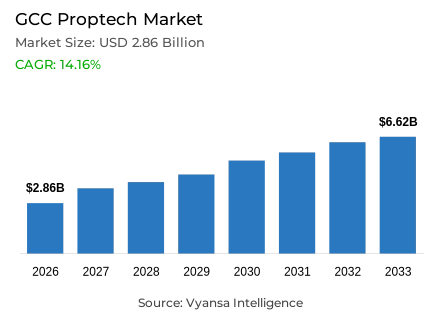
Proptech in the Gulf Cooperation Council region comprises digital platforms and software that support property discovery, listing verification, transaction registration, mortgage origination, and portfolio management across residential and commercial real estate. Property owners, real estate agents and brokerages, development companies, and institutional portfolio managers rely on these platforms to search, finance, register, and manage property. The GCC Proptech market is forecast to grow at a CAGR of 14.16% between 2027 and 2033.
Key Highlights of the GCC Proptech Market
- The GCC proptech market was valued at USD 2.86 billion in 2026, is estimated at USD 2.99 billion in 2027, and is forecast to reach USD 6.62 billion by 2033.
- The market is forecast to expand at a compound annual growth rate of 14.16% between 2027 and 2033 across the GCC.
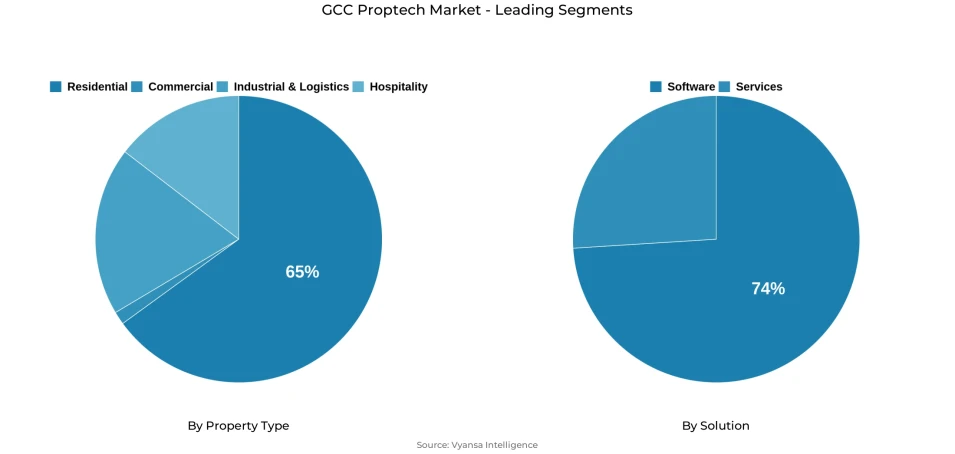
- By property type, residential led the market with a 65% share in 2026.
- Industrial & logistics is the fastest-growing property type, expanding at a CAGR of 17.55% between 2027 and 2033.
- By solution, software led the market with a 74% share in 2026.
- Services is the fastest-growing solution segment, expanding at a CAGR of 15.45% between 2027 and 2033.
- By country, Saudi Arabia led the market with a 36% share in 2026.
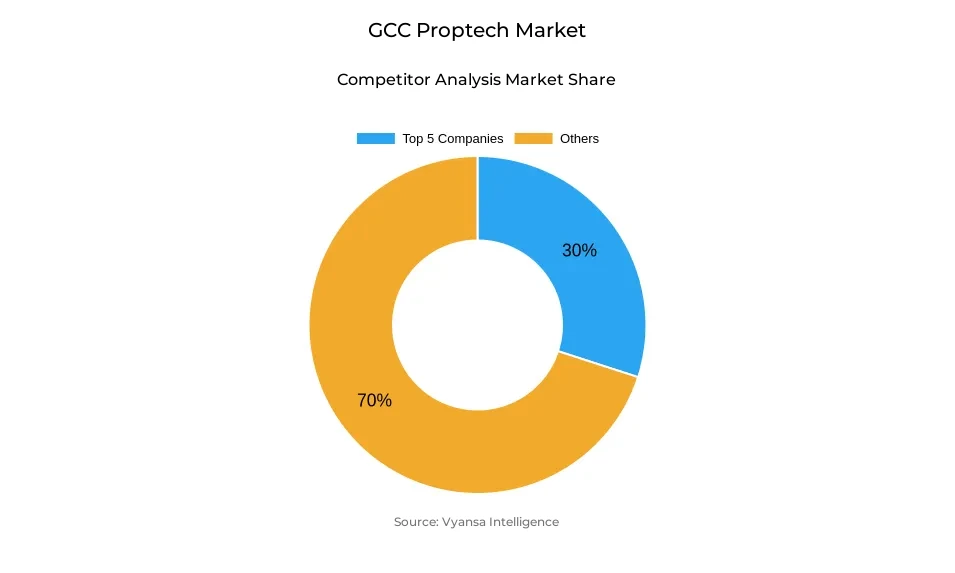
- The market is fragmented, with the top five companies holding a combined 30% share of industry revenue in 2026.
Property market activity across the GCC is creating a substantial foundation for the expansion of digital real estate services. Dubai recorded 3.11 million real estate procedures in 2025, covering sales, leases, and related services, representing a 7% increase from 2024. In Saudi Arabia, more than 96,000 brokerage contracts were recorded during Q1 2025, indicating continued transaction activity across the region’s two major real estate markets. The scale and digitization of these activities are expanding opportunities for proptech platforms across property discovery, brokerage, documentation, transaction processing, and post-sale services. Dubai’s digital sale service, for instance, enables eligible customers to complete property sale and registration procedures electronically, demonstrating the shift toward end-to-end digital transactions.
However, the near-term growth environment has become more uneven as affordability pressures, geopolitical uncertainty, and softer transaction activity affect property markets across the GCC. Saudi Arabia’s residential transaction volume declined 12% year-on-year in Q2 2026, while transaction value fell 24.6%, with Knight Frank attributing the weakness to affordability constraints and regional uncertainty. Dubai recorded 34,850 residential transactions during the same quarter, representing a 31% year-on-year decline. These declines occurred before the renewed security incidents reported in September 2026 and therefore should not be directly attributed to those events. Nevertheless, heightened regional uncertainty can influence the timing of property purchases, development decisions, and technology investments.
The impact is likely to vary across proptech applications. Lower transaction volumes can constrain near-term demand for property listing, brokerage, mortgage, valuation, and digital closing platforms, whereas property-management technologies may remain comparatively resilient because maintenance, tenant engagement, and building operations continue after occupancy. Over the forecast period, the continued development of digital property processes, expanding building stock, and government-led digitalization initiatives should support structural proptech demand across the GCC. However, the pace of market expansion is likely to remain closely linked to country-level transaction activity, construction and development pipelines, affordability conditions, and regional stability, with a recovery in property transactions potentially creating additional demand for transaction-oriented proptech solutions.
GCC Proptech Market Government Compliance
Government-led property systems are increasingly shaping how proptech platforms participate in real estate transactions across the GCC. In Saudi Arabia, the new Law of Real Estate Ownership by Non-Saudis entered into force on 22 January 2026, with applications processed through the official Saudi Properties digital portal. The platform supports automated eligibility verification and electronic completion of ownership procedures, while integrating with the Real Estate Registration System. This makes digital government connectivity an increasingly important component of transaction-oriented proptech services.
Dubai is also expanding the regulated digital infrastructure surrounding property tokenization. In February 2026, the Dubai Land Department launched Phase II of its Real Estate Tokenisation Project, with secondary-market resale of tokenized property interests beginning on 20 February 2026. The initiative remains within a controlled pilot framework designed to assess market efficiency, operational readiness, governance, investor protection, and transaction integrity.
These developments raise the regulatory and technical requirements for transaction-focused proptech providers. Platforms operating across property ownership, brokerage, financing, tokenization, and digital closing increasingly need to accommodate identity verification, ownership validation, regulatory compliance, government-system connectivity, and secure transaction records. As GCC governments continue digitizing property registries and transaction processes, the ability to integrate with official infrastructure is likely to become an increasingly important consideration for proptech companies seeking to scale across individual country markets.
GCC Proptech Market Driver
Rising Property Transactions and Investor Activity Are Expanding Digital Real Estate Usage
The GCC's expanding real estate transaction base is increasing the number of property journeys that can move through digital platforms. Every new purchase, lease, mortgage or investment creates opportunities for online discovery, valuation, documentation, financing and transaction management. Proptech growth therefore depends not only on technology adoption but also on the increasing volume and diversity of property activity taking place across the region.
Dubai demonstrates the scale of this mechanism. Real estate transactions reached approximately USD 68.6 billion during the first quarter of 2026, increasing 31% year over year, while foreign investment rose to around USD 40 billion. More than 48,000 investors participated during the quarter, including a large number of new entrants, strengthening demand for digital platforms able to serve buyers remotely and provide transparent property information.
Saudi Arabia provides another large transaction base. Official real estate indicators show tens of thousands of quarterly property sales and substantial transaction value, while government systems increasingly make this data available digitally. As transaction volumes and investor participation expand, Proptech platforms gain more opportunities to monetize search, brokerage, financing, analytics and transaction services rather than depending on advertising alone.
GCC Proptech Market Challenge
Regulatory Fragmentation Across GCC Countries Raises Expansion Costs
The GCC operates as an integrated economic region but not as a single real estate regulatory market. Saudi Arabia, the UAE, Qatar, Kuwait, Oman and Bahrain maintain separate property registries, licensing systems, identity infrastructure and transaction procedures. A platform integrated successfully in one country therefore cannot simply reproduce the same regulatory and technical setup across the rest of the region.
For a proptech provider expanding from the UAE into Saudi Arabia, Qatar, Oman, Kuwait, or Bahrain, each additional market can require separate licensing assessments, government-system integrations, data-handling procedures, and local operating arrangements. This creates duplicated technology and compliance costs and can extend deployment timelines, particularly for smaller providers with limited implementation resources.
Large regional platforms can spread these integration costs across broader user and transaction bases, while smaller Proptech companies may need local partners or narrower country strategies. Regulatory fragmentation therefore slows cross-border scaling even when consumer demand exists across several GCC countries.
GCC Proptech Market Trends
AI-Based Valuation and Property Intelligence Are Becoming Core Platform Features
Proptech technology in the GCC is shifting from basic property search toward AI-supported valuation, recommendation and decision-making. Large platforms increasingly use transaction data and machine learning to estimate property values, improve search results, and help users compare investment opportunities without relying entirely on manual broker assessment.
Property Finder introduced an AI-supported Home Valuation feature that provides current property estimates together with a six-month value forecast. The system combines proprietary property data and market information to provide buyers and owners with forward-looking price guidance rather than only historical transaction information.
Dubizzle Group is following a similar direction through TruEstimate, which provides data-backed sales and rental valuations using verified property and transaction information. The company has also embedded AI across search, moderation, and marketplace operations. As these features become more common, competitive differentiation should increasingly depend on the depth and quality of proprietary property data rather than the number of listings alone.
Unlock Market Intelligence
Explore the market potential with our data-driven report
GCC Proptech Market Segmentation Analysis
By Property Type:
- Residential
- Commercial
- Industrial & Logistics
- Hospitality
Residential Property Anchors 65% of GCC Proptech Revenue
Residential accounts for 65% of GCC proptech market demand in 2026 because property search, rental registration, mortgage origination, brokerage, and property management are most widely digitized around housing. Residential users also interact with technology across several stages of the property journey, creating more frequent digital touchpoints than many commercial or institutional transactions.
The scale of digital rental activity reinforces this leadership. Dubai registered approximately 1.38 million tenancy contracts during 2025, with both contract volume and value increasing from the previous year. Saudi Arabia also maintains large digitally registered rental and ownership ecosystems, supporting continued residential platform usage across the region's two largest proptech markets.
Industrial & Logistics is the fastest-growing property type at a 17.55% CAGR during 2027 to 2033. Growth comes from increasing use of facility management, asset-monitoring and portfolio software across logistics parks and industrial properties, where technology adoption is starting from a smaller base than the mature residential search and rental market.
By Solution:
- Software
- Services
Software Leads with 74% in 2026 While Services Expand Faster
Software accounts for 74% of the GCC proptech industry in 2026 because most core real estate technology functions are delivered directly through digital platforms. Property marketplaces, brokerage systems, property-management software, valuation tools, transaction platforms and portfolio analytics all depend primarily on software, giving the segment the largest share of technology spending across residential and commercial real estate.
Services are the fastest-growing Solution segment at a 15.45% CAGR during 2027 to 2033. Growth is being supported by increasing integration requirements as developers, brokerages and property managers connect multiple platforms with government registration systems, payment infrastructure and internal operating systems. Unlike standardized software products, these deployments frequently require implementation, customization, data migration and ongoing technical support, allowing services to grow faster from a smaller existing base.
Unlock Market Intelligence
Explore the market potential with our data-driven report
GCC Proptech Market Regional Analysis
Saudi Arabia accounts for 36% of GCC proptech market revenue in 2026, giving it the largest country share in the region. Its position is supported by the combination of a large residential property market, government-led digital registration infrastructure and a growing number of real estate activities that now operate through centralized digital systems.
The country's real estate infrastructure is also becoming increasingly data driven. REGA's official real estate indicators platform provides digital access to sales, rental and listing information derived from government property systems, while Ejar and Saudi Properties connect rental and ownership workflows with centralized digital verification.
Saudi Arabia's January 2026 opening of eligible property ownership to non-Saudi buyers further widens the digital user base because applications are completed through an official online ownership portal linked with real estate registration. The combination of transaction scale, residential demand and government-integrated infrastructure should keep Saudi Arabia ahead of other GCC markets through the forecast period.
GCC Proptech Market Competitive Landscape
The GCC proptech market is fragmented, with the five leading companies holding a combined 30% share in 2026. The major companies in the market are Propertyfinder FZ-LLC, Dubizzle Group Holdings Limited, Huspy Mortgage Broker FZE, MRI Software LLC and Stake Properties Limited. These five companies represent the principal participants profiled across property discovery, mortgage technology, institutional property software and fractional real estate investment.
Key Companies in the GCC Proptech Market
- Propertyfinder FZ-LLC
- Dubizzle Group Holdings Limited
- Huspy Mortgage Broker - FZE
- MRI Software LLC
- Stake Properties Limited
- Smart Crowd Limited
- PRYPCO Real Estate LLC
- Aqar App Company
- Wasalt Real Estate Services Company
- Munjz LLC
- Property Monitor
- Proptech Systems Ltd (PropSpace)
Company Profiling
The following profiles cover the five leading companies shaping platform development, distribution and competitive positioning in the GCC proptech industry.
Propertyfinder FZ-LLC: Property Finder operates a multi-market property discovery platform across the GCC and wider Middle East, serving buyers, tenants and real estate agencies. Its platform is increasingly moving beyond listings into property intelligence. In late 2025, the company introduced an AI-supported Home Valuation feature providing current estimates and six-month property value forecasts, strengthening its position in data-led property decision support.
Dubizzle Group Holdings Limited: Dubizzle Group operates Bayut and dubizzle across several regional property markets and is expanding beyond conventional listings into valuation, verification and transaction-related services. In June 2026, Bayut became the first UAE-based real estate platform available as an app on ChatGPT, allowing users to conduct conversational property searches. Dubizzle also expanded its AI-based TruEstimate valuation technology during 2026.
Huspy Mortgage Broker FZE: Huspy combines property technology with digital mortgage origination and financing support. The company works with more than 20 banks in the UAE and had supported more than 12,000 homeowners by May 2026. During 2026, Huspy expanded developer partnerships, including an agreement with Dubai Holding Real Estate to provide mortgage and handover financing directly within the property ownership journey.
MRI Software LLC: MRI supplies facilities, property and portfolio-management software to institutional real estate operators rather than focusing on consumer search. In June 2026, Khadamat selected MRI's cloud facilities-management platform to standardize operations across 15 client portfolios in the UAE. The rollout supports more than 500 site-based users and demonstrates MRI's exposure to recurring operational Proptech demand.
Stake Properties Limited: Stake operates a digital fractional real estate investment platform serving investors across the region. In April 2026, Stake partnered with ACE & Company to develop secondary-transfer capabilities for fractional property holdings in the UAE. The initiative is designed to improve liquidity and transparency for fractional real estate investors, extending the platform beyond initial property investment into secondary-market functionality.
Recent Developments in the GCC Proptech Market
- August 2026: Qatar's Cabinet approved a draft legal framework for real estate tokenization and trading of property-linked digital interests. The proposal connects tokenized ownership directly with the country's real estate registration system and represents another GCC market moving toward regulated digital property investment.
- May 2026: Oman introduced a new real estate registry law aimed at modernizing property documentation and accelerating digital real estate registration. The reform supports further development of electronic property services through the country's Amlak platform.
- April 2026: Bayut reported that its Claim Transactions system had surpassed 55,000 verified property deals with more than USD 33 billion in associated transaction value. The feature embeds verified deal history into agent profiles and strengthens the shift toward data-backed trust and transparency within digital property platforms.
Frequently Asked Questions
Related Report
- Market Segmentation
- Research Scope
- Research Methodology
- Definitions and Assumptions
- Executive Summary
- GCC Proptech Market Policies, Regulations, and Standards
- GCC Proptech Market Dynamics
- Growth Factors
- Challenges
- Trends
- Opportunities
- GCC Proptech Market Statistics, 2023-2033F
- Market Size & Growth Outlook
- By Revenues in USD Million
- Market Segmentation & Growth Outlook
- By Property Type
- Residential- Market Insights and Forecast 2023-2033, USD Million
- Commercial- Market Insights and Forecast 2023-2033, USD Million
- Industrial & Logistics- Market Insights and Forecast 2023-2033, USD Million
- Hospitality- Market Insights and Forecast 2023-2033, USD Million
- By Solution
- Software- Market Insights and Forecast 2023-2033, USD Million
- Services- Market Insights and Forecast 2023-2033, USD Million
- By Deployment
- Cloud- Market Insights and Forecast 2023-2033, USD Million
- On-Premise- Market Insights and Forecast 2023-2033, USD Million
- By End User
- Property Owners & Developers- Market Insights and Forecast 2023-2033, USD Million
- Real Estate Agents & Brokerages- Market Insights and Forecast 2023-2033, USD Million
- Facility & Property Managers- Market Insights and Forecast 2023-2033, USD Million
- Property Investors & REITs- Market Insights and Forecast 2023-2033, USD Million
- By Technology
- IoT & Smart Sensor Networks- Market Insights and Forecast 2023-2033, USD Million
- AI & Big Data Analytics- Market Insights and Forecast 2023-2033, USD Million
- AR, VR & Digital Twins- Market Insights and Forecast 2023-2033, USD Million
- Blockchain & Distributed Ledger Technology- Market Insights and Forecast 2023-2033, USD Million
- By Country
- Saudi Arabia
- United Arab Emirates
- Qatar
- Kuwait
- Oman
- Bahrain
- By Competitors
- Competition Characteristics
- Market Share & Analysis
- By Property Type
- Market Size & Growth Outlook
- Saudi Arabia Proptech Market Statistics, 2023-2033F
- Market Size & Growth Outlook
- By Revenues in USD Million
- Market Segmentation & Growth Outlook
- By Property Type- Market Insights and Forecast 2023-2033, USD Million
- By Solution- Market Insights and Forecast 2023-2033, USD Million
- By Deployment- Market Insights and Forecast 2023-2033, USD Million
- By End User- Market Insights and Forecast 2023-2033, USD Million
- By Technology- Market Insights and Forecast 2023-2033, USD Million
- Market Size & Growth Outlook
- United Arab Emirates Proptech Market Statistics, 2023-2033F
- Market Size & Growth Outlook
- By Revenues in USD Million
- Market Segmentation & Growth Outlook
- By Property Type- Market Insights and Forecast 2023-2033, USD Million
- By Solution- Market Insights and Forecast 2023-2033, USD Million
- By Deployment- Market Insights and Forecast 2023-2033, USD Million
- By End User- Market Insights and Forecast 2023-2033, USD Million
- By Technology- Market Insights and Forecast 2023-2033, USD Million
- Market Size & Growth Outlook
- Qatar Proptech Market Statistics, 2023-2033F
- Market Size & Growth Outlook
- By Revenues in USD Million
- Market Segmentation & Growth Outlook
- By Property Type- Market Insights and Forecast 2023-2033, USD Million
- By Solution- Market Insights and Forecast 2023-2033, USD Million
- By Deployment- Market Insights and Forecast 2023-2033, USD Million
- By End User- Market Insights and Forecast 2023-2033, USD Million
- By Technology- Market Insights and Forecast 2023-2033, USD Million
- Market Size & Growth Outlook
- Kuwait Proptech Market Statistics, 2023-2033F
- Market Size & Growth Outlook
- By Revenues in USD Million
- Market Segmentation & Growth Outlook
- By Property Type- Market Insights and Forecast 2023-2033, USD Million
- By Solution- Market Insights and Forecast 2023-2033, USD Million
- By Deployment- Market Insights and Forecast 2023-2033, USD Million
- By End User- Market Insights and Forecast 2023-2033, USD Million
- By Technology- Market Insights and Forecast 2023-2033, USD Million
- Market Size & Growth Outlook
- Oman Proptech Market Statistics, 2023-2033F
- Market Size & Growth Outlook
- By Revenues in USD Million
- Market Segmentation & Growth Outlook
- By Property Type- Market Insights and Forecast 2023-2033, USD Million
- By Solution- Market Insights and Forecast 2023-2033, USD Million
- By Deployment- Market Insights and Forecast 2023-2033, USD Million
- By End User- Market Insights and Forecast 2023-2033, USD Million
- By Technology- Market Insights and Forecast 2023-2033, USD Million
- Market Size & Growth Outlook
- Competitive Outlook
- Company Profiles
- Propertyfinder FZ-LLC (Property Finder)
- Business Description
- Product Portfolio
- Collaborations & Alliances
- Recent Developments
- Financial Details
- Others
- Dubizzle Group Holdings Limited (including brands)
- Business Description
- Product Portfolio
- Collaborations & Alliances
- Recent Developments
- Financial Details
- Others
- Home Matters Real Estate Broker LLC (Huspy)
- Business Description
- Product Portfolio
- Collaborations & Alliances
- Recent Developments
- Financial Details
- Others
- MRI Software LLC
- Business Description
- Product Portfolio
- Collaborations & Alliances
- Recent Developments
- Financial Details
- Others
- Hessa Menfea Financial Technology Company (Stake)
- Business Description
- Product Portfolio
- Collaborations & Alliances
- Recent Developments
- Financial Details
- Others
- Smart Crowd Limited (SmartCrowd)
- Business Description
- Product Portfolio
- Collaborations & Alliances
- Recent Developments
- Financial Details
- Others
- PRYPCO Real Estate LLC
- Business Description
- Product Portfolio
- Collaborations & Alliances
- Recent Developments
- Financial Details
- Others
- Aqar App Company (Aqar)
- Business Description
- Product Portfolio
- Collaborations & Alliances
- Recent Developments
- Financial Details
- Others
- Wasalt Real Estate Services Company
- Business Description
- Product Portfolio
- Collaborations & Alliances
- Recent Developments
- Financial Details
- Others
- Munjz LLC (including brands)
- Business Description
- Product Portfolio
- Collaborations & Alliances
- Recent Developments
- Financial Details
- Others
- Dubizzle Group Holdings Limited (Property Monitor)
- Business Description
- Product Portfolio
- Collaborations & Alliances
- Recent Developments
- Financial Details
- Others
- PropTech Systems Ltd (PropSpace)
- Business Description
- Product Portfolio
- Collaborations & Alliances
- Recent Developments
- Financial Details
- Others
- Propertyfinder FZ-LLC (Property Finder)
- Company Profiles
- Disclaimer
| Segment | Sub-Segment |
|---|---|
| By Property Type |
|
| By Solution |
|
| By Deployment |
|
| By End User |
|
| By Technology |
|
| By Country |
|
Research Methodology
This study followed a structured approach comprising four key phases to assess the size and scope of the electro-oxidation market. The process began with thorough secondary research to collect data on the target market, related markets, and broader industry context. These findings, along with preliminary assumptions and estimates, were then validated through extensive primary research involving industry experts from across the value chain. To calculate the overall market size, both top-down and bottom-up methodologies were employed. Finally, market segmentation and data triangulation techniques were applied to refine and validate segment-level estimations.
Secondary Research
The secondary research phase involved gathering data from a wide range of credible and published sources. This step helped in identifying industry trends, defining market segmentation, and understanding the market landscape and value chain.
Sources consulted during this phase included:
- Company annual reports, investor presentations, and press releases
- Industry white papers and certified publications
- Trade directories and market-recognized databases
- Articles from authoritative authors and reputable journals
- Gold and silver standard websites
Secondary research was critical in mapping out the industry's value chain and monetary flow, identifying key market segments, understanding regional variations, and tracking significant industry developments.
Other key sources:
- Financial disclosures
- Industry associations and trade bodies
- News outlets and business magazines
- Academic journals and research studies
- Paid industry databases
Primary Research
To validate secondary data and gain deeper market insights, primary research was conducted with key stakeholders across both the supply and demand sides of the market.
On the demand side, participants included decision-makers and influencers from end-user industries—such as CIOs, CTOs, and CSOs—who provided first-hand perspectives on market needs, product usage, and future expectations.
On the supply side, interviews were conducted with manufacturers, industry associations, and institutional participants to gather insights into current offerings, product pipelines, and market challenges.
Primary interviews provided critical inputs such as:
- Market size and revenue data
- Product and service breakdowns
- Market forecasts
- Regional and application-specific trends
Stakeholders consulted included:
- Leading OEM and solution providers
- Channel and distribution partners
- End users across various applications
- Independent consultants and industry specialists
Market Size Estimation and Data Triangulation
- Identifying Key Market Participants (Secondary Research)
- Goal: To identify the major players or companies in the target market. This typically involves using publicly available data sources such as industry reports, market research publications, and financial statements of companies.
- Tools: Reports from firms like Gartner, Forrester, Euromonitor, Statista, IBISWorld, and others. Public financial statements, news articles, and press releases from top market players.
- Extracting Earnings of Key Market Participants
- Goal: To estimate the earnings generated from the product or service being analyzed. This step helps in understanding the revenue potential of each market player in a specific geography.
- Methods: Earnings data can be gathered from:
- Publicly available financial reports (for listed companies).
- Interviews and primary data sources from professionals, such as Directors, VPs, SVPs, etc. This is especially useful for understanding more nuanced, internal data that isn't publicly disclosed.
- Annual reports and investor presentations of key players.
- Data Collation and Development of a Relevant Data Model
- Goal: To collate inputs from both primary and secondary sources into a structured, data-driven model for market estimation. This model will incorporate key market KPIs and any independent variables relevant to the market.
- Key KPIs: These could include:
- Market size, growth rate, and demand drivers.
- Industry-specific metrics like market share, average revenue per customer (ARPC), or average deal size.
- External variables, such as economic growth rates, inflation rates, or commodity prices, that could affect the market.
- Data Modeling: Based on this data, the market forecasts are developed for the next 5 years. A combination of trend analysis, scenario modeling, and statistical regression might be used to generate projections.
- Scenario Analysis
- Goal: To test different assumptions and validate how sensitive the market is to changes in key variables (e.g., market demand, regulatory changes, technological disruptions).
- Types of Scenarios:
- Base Case: Based on current assumptions and historical data.
- Best-Case Scenario: Assuming favorable market conditions, regulatory environments, and technological advancements.
- Worst-Case Scenario: Accounting for adverse factors, such as economic downturns, stricter regulations, or unexpected disruptions.












