Europe Robotaxi Market Report: Trends, Growth and Forecast (2026-2032)
By Level of Autonomy (Level 4, Level 5), By Vehicle Type (Cars, Shuttles/Vans, Purpose-Built Pods, Others), By Propulsion Type (Electric Vehicles (BEV), Hybrid Electric Vehicles (HEV), Fuel Cell Vehicles (FCV)), By Application (Passenger Transportation, Goods Transportation, Others), By Service Type (Ride-Hailing (On-Demand), Station-Based Shuttles, Goods Delivery, Others), By Component Type (LiDAR, Radar (mmWave), Camera, Ultrasonic Sensors, Sensor Fusion Systems, Others), By Country (Germany, The UK, France, Spain, Italy, Benelux, Nordic, Rest of Europe) ... Read more
|
Major Players
|
Europe Robotaxi Market Statistics and Insights, 2026
- Market Size Statistics
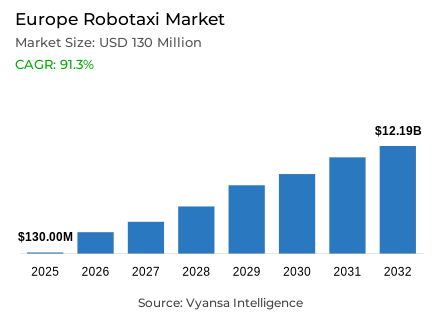
- Robotaxi market size in Europe was valued at USD 130 million in 2025 and is estimated at USD 140 million in 2026.
- The market size is expected to grow to USD 12.19 billion by 2032.
- Market to register a CAGR of around 91.3% during 2026-32.
- Application Shares
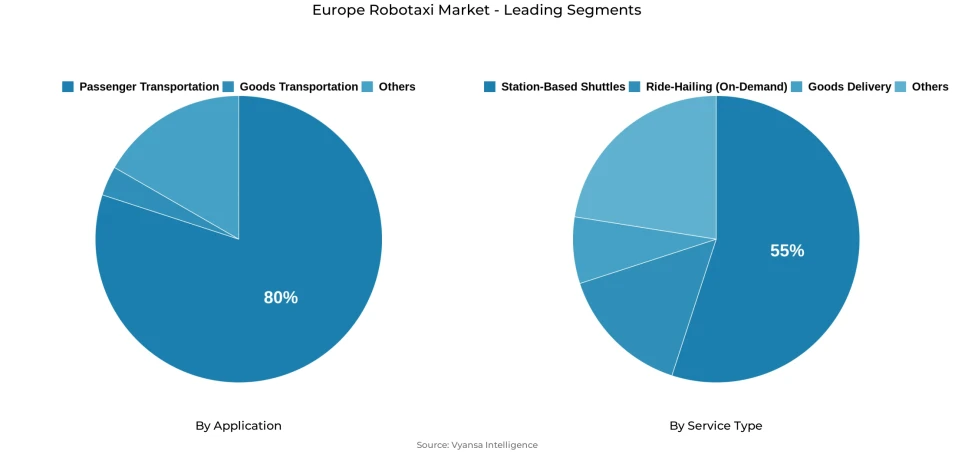
- Passenger transportation grabbed market share of 80%.
- Competition
- Robotaxi in Europe is currently being catered to by more than 10 companies.
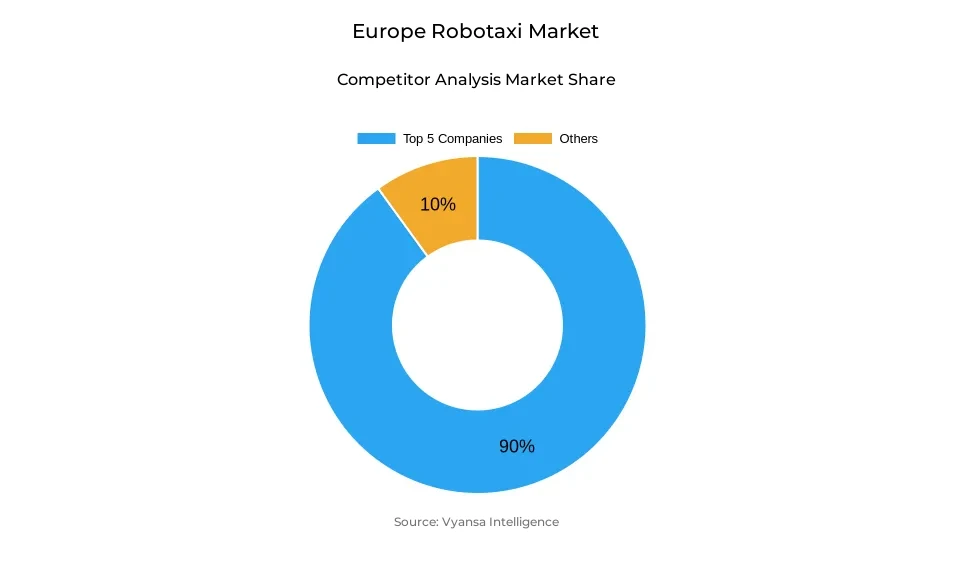
- Top 5 companies acquired around 90% of the market share in 2026.
- Holo A/S, Transdev Group, Renault SAS, Guangzhou WeRide Technologies Co. Ltd., MOIA GmbH etc., are few of the top companies.
- Service Type
- Station-Based Shuttles grabbed 55% of the market.
- Country
- Germany leads with a 25% share of the Europe market.
Europe Robotaxi Market Outlook
Valued at USD 130 million in 2025, the Europe Robotaxi Market reaches USD 140 million in 2026 and is projected to attain USD 12.19 billion by 2032, expanding at a CAGR of 91.3% during 2026-2032. The commercial scope covers autonomous passenger vehicles, dispatch platforms, remote support systems, sensor systems, fleet operations, and mobility services serving urban travelers, transit authorities, airports, business districts, and municipalities seeking safer, scalable, demand-responsive transport capacity across fragmented European mobility networks.
Policy coordination, automated-driving approvals, digital mapping, connected infrastructure, and battery-electric fleet readiness are moving the Europe Robotaxi Industry from isolated trials toward commercial pre-deployment. European institutions are strengthening interoperable testing and technology development, while international regulators are advancing technical frameworks for unsupervised automated driving. These measures improve procurement visibility for operators, reduce duplication in safety validation, and support autonomous fleet orchestration across cities with road rules, data requirements, and public-transport operating models at commercial scale.
Rapid growth in the robotaxi market in Europe reshapes automotive and mobility value chains because vehicle manufacturing, lidar, radar, cameras, simulation, cybersecurity, charging, maintenance, and platform integration must be coordinated as one operating system. Higher deployment volumes can improve vehicle utilization, lower per-ride operating costs, and create recurring demand for software updates and depot services. Suppliers able to integrate hardware, AI-powered autonomous driving, and fleet management gain stronger positioning in municipal and platform procurement cycles.
Commercial launches, ride-hailing partnerships, purpose-built vehicles, and public-transit integration define the 2026 trajectory. Investment priorities are shifting from prototype performance toward operational design domains, remote assistance, depot automation, charging availability, and passenger-service reliability. Competitive advantage increasingly depends on securing city access, regulatory approval, fleet partners, and app distribution simultaneously. Suppliers offering turnkey autonomous mobility solutions can capture demand faster as European operators seek scalable deployment models rather than standalone vehicles or isolated autonomous-driving software components.
Europe Robotaxi Market Growth Driver
Cross-Border Coordination Accelerates Operational Scale
Urban transport capacity constraints, driver availability pressures, and demand for first-mile last-mile connectivity are accelerating procurement of automated passenger services. The Europe Robotaxi Market benefits when municipalities can combine autonomous ride-hailing with rail, airport, and bus networks through app-based robotaxi booking and demand-responsive routing. Shared technical rules also reduce deployment friction, allowing operators to reuse validated vehicles, mapping workflows, and safety cases across neighboring markets while improving fleet utilization and service coverage without equivalent staffing.
According to the European Commission, 17 Member States signed a June 2026 declaration supporting large-scale cross-border autonomous vehicle testbeds and continuous operations. This initiative strengthens the Europe Robotaxi Industry by improving regulatory learning, interoperability, and infrastructure coordination across jurisdictions. Larger shared test environments can shorten validation cycles, expand operational design domain evidence, and give vehicle manufacturers, platform operators, and public authorities clearer pathways for scaling commercial services beyond individual pilot cities with lower duplicated expenditure.
Europe Robotaxi Market Challenge
Fragmented Approvals Slow Commercial Expansion
Fragmented approval pathways, differing liability rules, and uneven city access requirements constrain service expansion despite improving vehicle capability. The robotaxi market in Europe must navigate national road laws, municipal operating permissions, insurance arrangements, data protection obligations, and separate safety demonstrations. These layers raise compliance costs and extend deployment timelines, particularly for operators seeking multi-country fleets. Small pilot zones also limit utilization, making vehicle depreciation, supervision, maintenance, and mapping costs difficult to spread across ride volumes.
UK government guidance published in March 2026 states that the remaining Automated Vehicles Act provisions are due to enter force in late 2027, while an interim automated passenger services pilot scheme advances separately. This timing illustrates the Europe Robotaxi Industry’s commercialization gap: operators can test geofenced robotaxi services before complete national frameworks mature, but long-term fleet commitments remain exposed to evolving authorization, safety, reporting, and permit conditions that complicate pricing and expansion decisions across Europe.
Unlock Market Intelligence
Explore the market potential with our data-driven report
Europe Robotaxi Market Trend
Platform Partnerships Convert Pilots into Launches
Ride-hailing platforms are shifting autonomous mobility from technology demonstrations toward customer-facing launch models. The Europe Robotaxi Market increasingly combines specialized vehicle developers, autonomous-driving software suppliers, local fleet operators, and established mobility applications. This partnership structure reduces the need for one company to own every capability and accelerates access to users, payments, dispatch, customer support, and fleet operations. It also strengthens driverless ride-hailing economics by matching vehicles with existing demand rather than building standalone booking networks.
Uber announced in March 2026 that Verne and Pony.ai plan to launch Europe’s first commercial robotaxi service in Zagreb through the Uber app. This development strengthens the Europe Robotaxi Industry by validating a platform-led route to market that combines purpose-built vehicles, autonomous technology, local operations, and established digital demand. Successful execution can encourage comparable partnerships in other cities, increase competitive pressure on incumbent pilots, and accelerate commercial robotaxi deployment Europe-wide through scalable autonomous mobility partnerships.
Europe Robotaxi Market Opportunity
Controlled Mobility Corridors Unlock Scalable Demand
Large metropolitan areas with late-night transport gaps, airport transfer demand, and underserved suburban corridors create scalable entry points for autonomous mobility providers. The robotaxi market in Europe can expand through tightly geofenced services that connect rail stations, airports, hospitals, campuses, and business districts before broader citywide operation. These controlled use cases improve route predictability, charging planning, and service reliability, while giving municipalities measurable evidence on safety, accessibility, congestion effects, and robotaxi public transport integration outcomes.
Waymo stated in April 2026 that it had begun autonomous driving in London with trained specialists behind the wheel as the next step toward fully autonomous ride-hailing. This progression expands opportunity for the Europe Robotaxi Industry by demonstrating how global operators can localize mapping, road behavior, safety validation, and public engagement before launch. London’s scale can attract depot, charging, maintenance, insurance, and teleoperation investment, creating supplier openings around automated passenger services and connected city transport.
Europe Robotaxi Market Country Analysis
By Country
- Germany
- The UK
- France
- Spain
- Italy
- Benelux
- Nordic
- Rest of Europe
Germany holds 25% share by country, supported by automotive engineering capacity, autonomous-driving development, public-transport digitization, and established vehicle approval institutions. The Europe Robotaxi Market gains from Germany’s ability to connect OEM manufacturing, software integration, sensor validation, and mobility operations within one industrial ecosystem. Germany also offers large metropolitan test environments and municipal transport partners, enabling the Europe Robotaxi Market to progress from vehicle trials toward structured ride-pooling and shuttle procurement with locally available technical support.
Volkswagen Group stated in June 2025 that MOIA introduced the series-production ID. Buzz AD and an end-to-end package covering vehicles, software, fleet management, booking, and operator services. This German platform strengthens local competitive positioning by offering cities and mobility providers a commercially structured deployment pathway. Integrated production and service capabilities improve procurement accountability, reduce integration risk, and position Germany to scale autonomous ride-pooling, shared autonomous mobility, and smart urban mobility applications from demonstrations toward commercialization.
Unlock Market Intelligence
Explore the market potential with our data-driven report
Europe Robotaxi Market Segmentation Analysis
By Application
- Passenger Transportation
- Goods Transportation
- Others
Passenger transportation holds 80% share under application because early commercial programs prioritize urban mobility, transit feeders, airport transfers, and shared shuttle operations. The Europe Robotaxi Market concentrates demand where repeat passenger flows justify mapping, charging, dispatch, and remote-support investment. Automated passenger transportation also aligns with municipal accessibility and service-continuity objectives, allowing operators to target routes affected by driver shortages or limited schedules while consistently collecting operational evidence within clearly defined service areas and passenger-support protocols.
Data from WeRide shows that its Level 4 Robobus began fully driverless commercial passenger operations between Valence TGV station and the Rovaltain business park in March 2025. This deployment supports the Europe Robotaxi Industry by proving that autonomous passenger services can link rail infrastructure with employment destinations under commercial conditions. Such routes strengthen demand for station-based dispatch, remote vehicle supervision, passenger information systems, and reliable fleet scheduling while lowering dependence on conventional fixed-frequency feeder services.
By Service Type
- Ride-Hailing (On-Demand)
- Station-Based Shuttles
- Goods Delivery
- Others
Station-based shuttles hold 55% share under service type because fixed origins, destinations, and operating zones simplify validation and improve asset scheduling. The robotaxi market in Europe favors these services during early commercialization because airports, rail stations, campuses, and business districts provide concentrated demand and predictable routes. Station-based robotaxi services also support controlled boarding, charging, cleaning, and passenger assistance, reducing operational variability while enabling authorities to assess safety performance before approving wider on-demand coverage at scale.
Karsan reported that two Autonomous e-ATAK buses entered passenger service between Meijersplein metro station and Rotterdam The Hague Airport in August 2025. The deployment advances the Europe Robotaxi Industry by demonstrating a repeatable station-to-airport operating model using battery-electric, Level 4 vehicles. It strengthens procurement confidence for transport authorities seeking low-emission feeder capacity and creates demand for lidar-radar-camera fusion, route mapping, fleet energy management, and maintenance processes designed around scheduled autonomous shuttle operations across European networks.
Various Market Players in Europe Robotaxi Market
The companies mentioned below are highly active in the Europe robotaxi market, occupying a considerable portion of the market and shaping industry progress.
- Holo A/S
- Transdev Group
- Renault SAS
- Guangzhou WeRide Technologies Co. Ltd.
- MOIA GmbH
- EasyMile SAS
- Karsan Otomotiv Sanayii ve Ticaret A.Ş.
- ADASTEC Corp.
- Mobileye Vision Technologies Ltd.
- beti
- HOLON GmbH
- Wayve Technologies Ltd.
Market News & Updates
- Guangzhou WeRide Technologies Co. Ltd., 2026:
WeRide and Renault returned the autonomous Robobus service to Roland-Garros in Paris for a third year. Operated by beti, the vehicle runs along a 2.8-kilometre route connecting three stops and includes daytime and late-evening operations. The deployment supports real-world autonomous passenger transport in a dense European environment and provides additional operating experience across extended service hours.
- MOIA GmbH, 2025:
MOIA placed the first Level 4 ID. Buzz AD vehicles on public roads in northwest Berlin under the NoWeL4 autonomous shuttle project. The vehicles combine MOIA’s software and operating services with Volkswagen’s autonomous vehicle platform. The deployment creates a pathway for passenger testing across an approximately 15-square-kilometre area with around 80 planned stops.
Frequently Asked Questions
Related Report
- Market Segmentation
- Research Scope
- Research Methodology
- Definitions and Assumptions
- Executive Summary
- Europe Robotaxi Market Policies, Regulations, and Standards
- Europe Robotaxi Market Dynamics
- Growth Factors
- Challenges
- Trends
- Opportunities
- Europe Robotaxi Market Statistics, 2022-2032F
- Market Size & Growth Outlook
- By Revenues in USD Million
- Market Segmentation & Growth Outlook
- By Level of Autonomy
- Level 4- Market Insights and Forecast 2022-2032, USD Million
- Level 5- Market Insights and Forecast 2022-2032, USD Million
- By Vehicle Type
- Cars- Market Insights and Forecast 2022-2032, USD Million
- Shuttles/Vans- Market Insights and Forecast 2022-2032, USD Million
- Purpose-Built Pods- Market Insights and Forecast 2022-2032, USD Million
- Others- Market Insights and Forecast 2022-2032, USD Million
- By Propulsion Type
- Electric Vehicles (BEV)- Market Insights and Forecast 2022-2032, USD Million
- Hybrid Electric Vehicles (HEV)- Market Insights and Forecast 2022-2032, USD Million
- Fuel Cell Vehicles (FCV)- Market Insights and Forecast 2022-2032, USD Million
- By Application
- Passenger Transportation- Market Insights and Forecast 2022-2032, USD Million
- Goods Transportation- Market Insights and Forecast 2022-2032, USD Million
- Others- Market Insights and Forecast 2022-2032, USD Million
- By Service Type
- Ride-Hailing (On-Demand)- Market Insights and Forecast 2022-2032, USD Million
- Station-Based Shuttles- Market Insights and Forecast 2022-2032, USD Million
- Goods Delivery- Market Insights and Forecast 2022-2032, USD Million
- Others- Market Insights and Forecast 2022-2032, USD Million
- By Component Type
- LiDAR- Market Insights and Forecast 2022-2032, USD Million
- Radar (mmWave)- Market Insights and Forecast 2022-2032, USD Million
- Camera- Market Insights and Forecast 2022-2032, USD Million
- Ultrasonic Sensors- Market Insights and Forecast 2022-2032, USD Million
- Sensor Fusion Systems- Market Insights and Forecast 2022-2032, USD Million
- Others- Market Insights and Forecast 2022-2032, USD Million
- By Country
- Germany
- The UK
- France
- Spain
- Italy
- Benelux
- Nordic
- Rest of Europe
- By Competitors
- Competition Characteristics
- Market Share & Analysis
- By Level of Autonomy
- Market Size & Growth Outlook
- Germany Robotaxi Market Statistics, 2022-2032F
- Market Size & Growth Outlook
- By Revenues in USD Million
- Market Segmentation & Growth Outlook
- By Level of Autonomy- Market Insights and Forecast 2022-2032, USD Million
- By Vehicle Type- Market Insights and Forecast 2022-2032, USD Million
- By Propulsion Type- Market Insights and Forecast 2022-2032, USD Million
- By Application- Market Insights and Forecast 2022-2032, USD Million
- By Service Type- Market Insights and Forecast 2022-2032, USD Million
- By Component Type- Market Insights and Forecast 2022-2032, USD Million
- Market Size & Growth Outlook
- The UK Robotaxi Market Statistics, 2022-2032F
- Market Size & Growth Outlook
- By Revenues in USD Million
- Market Segmentation & Growth Outlook
- By Level of Autonomy- Market Insights and Forecast 2022-2032, USD Million
- By Vehicle Type- Market Insights and Forecast 2022-2032, USD Million
- By Propulsion Type- Market Insights and Forecast 2022-2032, USD Million
- By Application- Market Insights and Forecast 2022-2032, USD Million
- By Service Type- Market Insights and Forecast 2022-2032, USD Million
- By Component Type- Market Insights and Forecast 2022-2032, USD Million
- Market Size & Growth Outlook
- France Robotaxi Market Statistics, 2022-2032F
- Market Size & Growth Outlook
- By Revenues in USD Million
- Market Segmentation & Growth Outlook
- By Level of Autonomy- Market Insights and Forecast 2022-2032, USD Million
- By Vehicle Type- Market Insights and Forecast 2022-2032, USD Million
- By Propulsion Type- Market Insights and Forecast 2022-2032, USD Million
- By Application- Market Insights and Forecast 2022-2032, USD Million
- By Service Type- Market Insights and Forecast 2022-2032, USD Million
- By Component Type- Market Insights and Forecast 2022-2032, USD Million
- Market Size & Growth Outlook
- Spain Robotaxi Market Statistics, 2022-2032F
- Market Size & Growth Outlook
- By Revenues in USD Million
- Market Segmentation & Growth Outlook
- By Level of Autonomy- Market Insights and Forecast 2022-2032, USD Million
- By Vehicle Type- Market Insights and Forecast 2022-2032, USD Million
- By Propulsion Type- Market Insights and Forecast 2022-2032, USD Million
- By Application- Market Insights and Forecast 2022-2032, USD Million
- By Service Type- Market Insights and Forecast 2022-2032, USD Million
- By Component Type- Market Insights and Forecast 2022-2032, USD Million
- Market Size & Growth Outlook
- Italy Robotaxi Market Statistics, 2022-2032F
- Market Size & Growth Outlook
- By Revenues in USD Million
- Market Segmentation & Growth Outlook
- By Level of Autonomy- Market Insights and Forecast 2022-2032, USD Million
- By Vehicle Type- Market Insights and Forecast 2022-2032, USD Million
- By Propulsion Type- Market Insights and Forecast 2022-2032, USD Million
- By Application- Market Insights and Forecast 2022-2032, USD Million
- By Service Type- Market Insights and Forecast 2022-2032, USD Million
- By Component Type- Market Insights and Forecast 2022-2032, USD Million
- Market Size & Growth Outlook
- Benelux Robotaxi Market Statistics, 2022-2032F
- Market Size & Growth Outlook
- By Revenues in USD Million
- Market Segmentation & Growth Outlook
- By Level of Autonomy- Market Insights and Forecast 2022-2032, USD Million
- By Vehicle Type- Market Insights and Forecast 2022-2032, USD Million
- By Propulsion Type- Market Insights and Forecast 2022-2032, USD Million
- By Application- Market Insights and Forecast 2022-2032, USD Million
- By Service Type- Market Insights and Forecast 2022-2032, USD Million
- By Component Type- Market Insights and Forecast 2022-2032, USD Million
- Market Size & Growth Outlook
- Nordic Robotaxi Market Statistics, 2022-2032F
- Market Size & Growth Outlook
- By Revenues in USD Million
- Market Segmentation & Growth Outlook
- By Level of Autonomy- Market Insights and Forecast 2022-2032, USD Million
- By Vehicle Type- Market Insights and Forecast 2022-2032, USD Million
- By Propulsion Type- Market Insights and Forecast 2022-2032, USD Million
- By Application- Market Insights and Forecast 2022-2032, USD Million
- By Service Type- Market Insights and Forecast 2022-2032, USD Million
- By Component Type- Market Insights and Forecast 2022-2032, USD Million
- Market Size & Growth Outlook
- Competitive Outlook
- Company Profiles
- Guangzhou WeRide Technologies Co. Ltd.
- Business Description
- Product Portfolio
- Collaborations & Alliances
- Recent Developments
- Financial Details
- Others
- MOIA GmbH
- Business Description
- Product Portfolio
- Collaborations & Alliances
- Recent Developments
- Financial Details
- Others
- EasyMile SAS
- Business Description
- Product Portfolio
- Collaborations & Alliances
- Recent Developments
- Financial Details
- Others
- Karsan Otomotiv Sanayii ve Ticaret A.Ş.
- Business Description
- Product Portfolio
- Collaborations & Alliances
- Recent Developments
- Financial Details
- Others
- ADASTEC Corp.
- Business Description
- Product Portfolio
- Collaborations & Alliances
- Recent Developments
- Financial Details
- Others
- Holo A/S
- Business Description
- Product Portfolio
- Collaborations & Alliances
- Recent Developments
- Financial Details
- Others
- Transdev Group
- Business Description
- Product Portfolio
- Collaborations & Alliances
- Recent Developments
- Financial Details
- Others
- Renault SAS
- Business Description
- Product Portfolio
- Collaborations & Alliances
- Recent Developments
- Financial Details
- Others
- Mobileye Vision Technologies Ltd.
- Business Description
- Product Portfolio
- Collaborations & Alliances
- Recent Developments
- Financial Details
- Others
- beti
- Business Description
- Product Portfolio
- Collaborations & Alliances
- Recent Developments
- Financial Details
- Others
- HOLON GmbH
- Business Description
- Product Portfolio
- Collaborations & Alliances
- Recent Developments
- Financial Details
- Others
- Wayve Technologies Ltd.
- Business Description
- Product Portfolio
- Collaborations & Alliances
- Recent Developments
- Financial Details
- Others
- Guangzhou WeRide Technologies Co. Ltd.
- Company Profiles
- Disclaimer
| Segment | Sub-Segment |
|---|---|
| By Level of Autonomy |
|
| By Vehicle Type |
|
| By Propulsion Type |
|
| By Application |
|
| By Service Type |
|
| By Component Type |
|
| By Country |
|
Research Methodology
This study followed a structured approach comprising four key phases to assess the size and scope of the electro-oxidation market. The process began with thorough secondary research to collect data on the target market, related markets, and broader industry context. These findings, along with preliminary assumptions and estimates, were then validated through extensive primary research involving industry experts from across the value chain. To calculate the overall market size, both top-down and bottom-up methodologies were employed. Finally, market segmentation and data triangulation techniques were applied to refine and validate segment-level estimations.
Secondary Research
The secondary research phase involved gathering data from a wide range of credible and published sources. This step helped in identifying industry trends, defining market segmentation, and understanding the market landscape and value chain.
Sources consulted during this phase included:
- Company annual reports, investor presentations, and press releases
- Industry white papers and certified publications
- Trade directories and market-recognized databases
- Articles from authoritative authors and reputable journals
- Gold and silver standard websites
Secondary research was critical in mapping out the industry's value chain and monetary flow, identifying key market segments, understanding regional variations, and tracking significant industry developments.
Other key sources:
- Financial disclosures
- Industry associations and trade bodies
- News outlets and business magazines
- Academic journals and research studies
- Paid industry databases
Primary Research
To validate secondary data and gain deeper market insights, primary research was conducted with key stakeholders across both the supply and demand sides of the market.
On the demand side, participants included decision-makers and influencers from end-user industries—such as CIOs, CTOs, and CSOs—who provided first-hand perspectives on market needs, product usage, and future expectations.
On the supply side, interviews were conducted with manufacturers, industry associations, and institutional participants to gather insights into current offerings, product pipelines, and market challenges.
Primary interviews provided critical inputs such as:
- Market size and revenue data
- Product and service breakdowns
- Market forecasts
- Regional and application-specific trends
Stakeholders consulted included:
- Leading OEM and solution providers
- Channel and distribution partners
- End users across various applications
- Independent consultants and industry specialists
Market Size Estimation and Data Triangulation
- Identifying Key Market Participants (Secondary Research)
- Goal: To identify the major players or companies in the target market. This typically involves using publicly available data sources such as industry reports, market research publications, and financial statements of companies.
- Tools: Reports from firms like Gartner, Forrester, Euromonitor, Statista, IBISWorld, and others. Public financial statements, news articles, and press releases from top market players.
- Extracting Earnings of Key Market Participants
- Goal: To estimate the earnings generated from the product or service being analyzed. This step helps in understanding the revenue potential of each market player in a specific geography.
- Methods: Earnings data can be gathered from:
- Publicly available financial reports (for listed companies).
- Interviews and primary data sources from professionals, such as Directors, VPs, SVPs, etc. This is especially useful for understanding more nuanced, internal data that isn't publicly disclosed.
- Annual reports and investor presentations of key players.
- Data Collation and Development of a Relevant Data Model
- Goal: To collate inputs from both primary and secondary sources into a structured, data-driven model for market estimation. This model will incorporate key market KPIs and any independent variables relevant to the market.
- Key KPIs: These could include:
- Market size, growth rate, and demand drivers.
- Industry-specific metrics like market share, average revenue per customer (ARPC), or average deal size.
- External variables, such as economic growth rates, inflation rates, or commodity prices, that could affect the market.
- Data Modeling: Based on this data, the market forecasts are developed for the next 5 years. A combination of trend analysis, scenario modeling, and statistical regression might be used to generate projections.
- Scenario Analysis
- Goal: To test different assumptions and validate how sensitive the market is to changes in key variables (e.g., market demand, regulatory changes, technological disruptions).
- Types of Scenarios:
- Base Case: Based on current assumptions and historical data.
- Best-Case Scenario: Assuming favorable market conditions, regulatory environments, and technological advancements.
- Worst-Case Scenario: Accounting for adverse factors, such as economic downturns, stricter regulations, or unexpected disruptions.












