Europe Iris Recognition Market Report: Trends, Growth and Forecast (2026-2032)
By Component (Hardware, Software), By Product Type (Iris Scanners, Access Control & Time Attendance Terminals, Border Control Kiosks/eGates, Smartphones, Embedded/OEM Iris Modules, Others), By Application (Identity Management & Access Control, Border Control & Immigration, Time Monitoring, E-Payment, Others), By End Use (Government, Military & Defense, BFSI, Healthcare, Consumer Electronics, Travel & Immigration, Automotive, Others), By Country (Germany, The UK, France, Spain, Italy, Benelux, Nordic, Rest of Europe) ... Read more
|
Major Players
|
Europe Iris Recognition Market Statistics and Insights, 2026
- Market Size Statistics
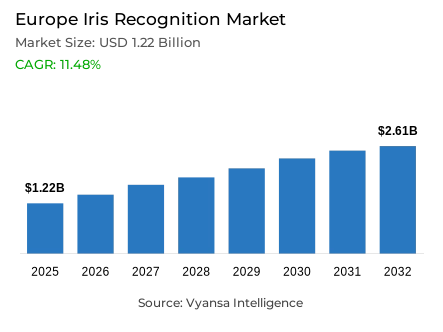
- Iris recognition market size in Europe was valued at USD 1.22 billion in 2025 and is estimated at USD 1.34 billion in 2026.
- The market size is expected to grow to USD 2.61 billion by 2032.
- Market to register a CAGR of around 11.48% during 2026-32.
- Application Shares
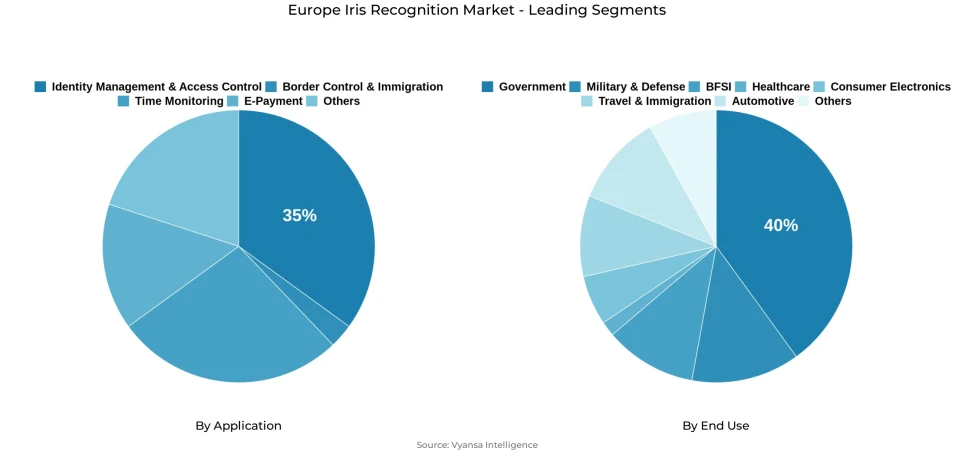
- Identity management & access control grabbed market share of 35%.
- Competition
- Iris recognition in Europe is currently being catered to by more than 10 companies.
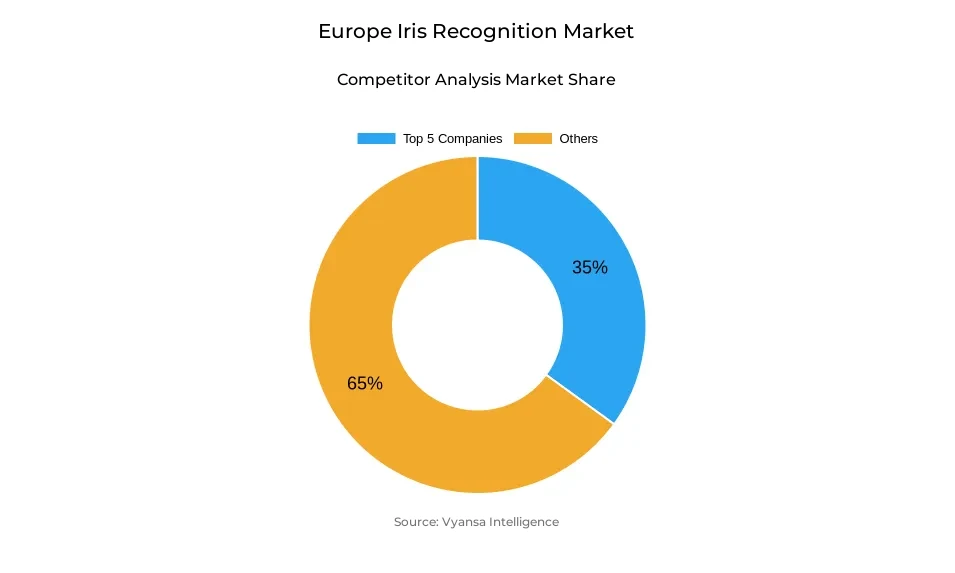
- Top 5 companies acquired around 35% of the market share in 2026.
- Veridos GmbH, DERMALOG Identification Systems GmbH, Innovatrics s.r.o., IDEMIA France SAS (IDEMIA Public Security), Thales S.A. etc., are few of the top companies.
- End Use
- Government grabbed 40% of the market.
- Country
- Germany leads with a 15% share of the Europe market.
Europe Iris Recognition Market Outlook
High-assurance identity verification is moving from isolated security projects into border, public-sector, enterprise, healthcare, and financial workflows. The Europe iris recognition market covers iris scanners, software, embedded modules, biometric access terminals, border eGates, and identity management platforms used for contactless authentication and biometric identification. Valued at USD 1.22 billion in 2025, USD 1.34 billion in 2026, and projected at USD 2.16 billion by 2032, the Europe iris recognition industry is expanding at a CAGR of 11.48% during 2026-2032.
Digital identity modernization, airport automation, and passwordless access control are increasing demand for faster identity assurance in controlled environments. The European Digital Identity Framework requires Member States to provide EU Digital Identity Wallets to citizens by the end of 2026, strengthening policy support for trusted authentication infrastructure. This direction supports iris recognition market in Europe where secure identity verification, biometric access control, and encrypted biometric templates are becoming procurement priorities.
Economic value is concentrated in systems that reduce identity fraud exposure, improve facility access discipline, and support compliance-led procurement. Iris scanners and iris recognition software can help regulated users strengthen enrollment quality, automate repeat verification, and reduce dependence on cards, passwords, or PIN credentials. Demand is therefore linked to operational efficiency, security assurance, privacy-by-design architecture, and supplier ability to integrate biometric middleware with existing identity platforms.
Supplier positioning in 2026 is shifting toward multimodal biometrics, liveness detection, contactless iris scanning, and privacy-preserving biometric design. Buyers are evaluating vendors around interoperability, template security, deployment flexibility, and documented compliance workflows rather than device availability alone. The Europe iris recognition market trajectory favors companies that can combine hardware, matching algorithms, access terminals, and integration services across government, travel, BFSI, healthcare, and critical infrastructure users. Adoption momentum is strongest where procurement teams require high accuracy, low-friction enrollment, and integration with digital identity programs across regulated settings.
Europe Iris Recognition Market Growth Driver
Identity Pressure is Lifting Biometric Demand
Rising passenger throughput at airports and border facilities is converting biometric verification from a security enhancement into an operational capacity tool. The Europe iris recognition market benefits as authorities and operators look for contactless identity authentication that supports faster processing without weakening assurance. Iris scan authentication, biometric access control, and multimodal biometrics help high-traffic locations maintain secure movement where manual inspection, passwords, cards, and PIN-based credentials create delays or identity-risk exposure.
Figures published by ACI EUROPE show that passenger traffic across the European airport network increased by 4.4% in 2025, adding 100 million passengers and reaching 2.6 billion travellers. That scale strengthens demand for iris scanner Europe deployments, airport iris scan systems, and automated identity verification. It also supports the Europe iris recognition industry because border agencies, airport operators, and enterprise facilities need technologies that can improve throughput, limit contact-based friction, and sustain secure identity management under peak operating pressure.
Europe Iris Recognition Market Challenge
Compliance Scrutiny is Raising Deployment Friction
Biometric privacy exposure is slowing procurement cycles because iris templates are immutable identifiers and fall under strict data-protection scrutiny. The Europe iris recognition market faces higher due-diligence requirements around consent, lawful basis, template storage, encryption, deletion, and vendor accountability. This raises deployment cost for GDPR-compliant iris recognition solutions and makes biometric data governance a critical purchasing criterion for public authorities, airports, enterprises, and banking biometric authentication buyers.
Recent enforcement material from the European Data Protection Board reported that Worldcoin Foundation was ordered to erase iris codes and SMPC shares connected with Worldcoin Europe GmbH after GDPR infringement findings covering July 2023 to May 2024. The case strengthens compliance caution across the Europe iris recognition industry because buyers must verify biometric template protection, privacy-preserving iris recognition, and lifecycle controls before scaling deployments. Vendors without auditable data security, biometric consent management, and lawful processing workflows face narrower access to regulated European demand.
Unlock Market Intelligence
Explore the market potential with our data-driven report
Europe Iris Recognition Market Trend
Multimodal Identity Stacks are Reshaping Deployment Models
Multimodal identity stacks are replacing single-modality procurement as buyers prioritize resilience against spoofing, environmental variability, and failure in high-security checkpoints. The Europe iris recognition market is gaining from AI-based iris recognition, liveness detection, anti-spoofing iris recognition, and biometric matching engines that can integrate iris, face, and fingerprint workflows. This shift improves vendor differentiation as buyers select systems around accuracy, interoperability, and secure identity management outcomes.
DERMALOG reported in September 2025 that its iris recognition technology achieved 99.99% accuracy in detecting advanced contact lens fraud at LivDet-Iris 2025 and secured first place in every test category. That performance signal supports the Europe iris recognition industry by strengthening confidence in presentation-attack detection for access terminals, border control kiosks, and government identity verification. Suppliers with proven anti-spoofing capability are better positioned for regulated procurement where false acceptance, biometric spoofing risk, and auditability shape purchasing decisions across European security programs and critical infrastructure estates.
Europe Iris Recognition Market Opportunity
Secure Digital Identity Programs Open New Addressable Demand
Border automation and secure facility access create underpenetrated demand for suppliers that can combine iris recognition software, encrypted biometric templates, and identity verification platforms. The Europe iris recognition market offers expansion room for vendors serving airports, embassies, defence sites, data centers, and critical infrastructure security Europe buyers. Procurement teams are prioritizing modular biometric middleware that can connect to legacy access systems while preserving audit trails and consent records.
Thales stated in August 2025 that France needed to retrofit biometric capabilities into new and legacy airport terminals while maintaining ISO-standard passenger flow rates for EES compliance. This widens supplier opportunity beyond hardware because eGates, kiosks, enrollment devices, and matching software require integration, maintenance, and compliance services. It supports the Europe iris recognition industry by improving market access for companies able to offer GDPR-compliant biometric authentication platforms, near-infrared iris imaging, and multimodal biometric systems aligned with border modernization programs and security procurement.
Europe Iris Recognition Market Country Analysis
By Country
- Germany
- The UK
- France
- Spain
- Italy
- Benelux
- Nordic
- Rest of Europe
Germany holds 15% share because biometric security demand is supported by border infrastructure, public-sector identity systems, enterprise access control, and a domestic supplier base with strong technical specialization. The Europe iris recognition market benefits from Germany’s concentration of biometric technology providers, compliance-led procurement culture, and high-security facility requirements. German buyers also emphasize testing, auditability, and attack resistance, which favors suppliers with proven iris matching technology and liveness detection.
Data from Germany’s BSI 2025 draft Technical Guideline TR-03166 states that biometric performance and attack resistance are both critical for the security of a biometric system and must be evaluated properly. That standard-setting environment supports Germany’s leadership and strengthens the Europe iris recognition industry by encouraging robust certification readiness, procurement transparency, and higher confidence in biometric access control across government, border, financial, healthcare, and critical infrastructure environments, especially where false acceptance risk affects operational continuity and procurement assurance requirements.
Unlock Market Intelligence
Explore the market potential with our data-driven report
Europe Iris Recognition Market Segmentation Analysis
By Application
- Identity Management & Access Control
- Border Control & Immigration
- Time Monitoring
- E-Payment
- Others
Identity Management & Access Control holds 35% share because controlled identity assurance remains the broadest procurement use case across enterprise facilities, airports, public buildings, healthcare sites, and secure campuses. The Europe iris recognition market benefits from this segment’s fit with passwordless authentication, one-to-one iris verification, and high-assurance identity verification. Buyers prioritize contactless identity authentication where access cards can be shared, passwords can be compromised, and facial systems may face lighting or masking limitations.
Schiphol states that its Privium service enables non-Schengen passengers to use iris scan-based fast border passage and pass passport control in ten seconds. That operational use case supports iris biometric authentication Europe demand by showing how iris scanning can improve throughput in a controlled access workflow. It strengthens adoption logic for biometric access terminals, secure facility entry systems, and identity verification platforms that combine speed, assurance, user enrollment reliability, audit-ready access control, and governance across regulated sites.
By End Use
- Government
- Military & Defense
- BFSI
- Healthcare
- Consumer Electronics
- Travel & Immigration
- Automotive
- Others
Government holds 40% share because public identity, border security, immigration control, and secure citizen service delivery require high-assurance biometric verification at scale. The Europe iris recognition market is structurally aligned with government procurement because iris systems support deduplication, identity proofing, and access control in environments where credential misuse can create national security, compliance, and service-delivery exposure. Public agencies also influence vendor standards through long-term tenders and system integration requirements.
The European Commission reported that the Entry/Exit System became fully operational across all Schengen countries on 10 April 2026 and registers facial images, fingerprints, travel document data, and entry or exit records. Although EES does not currently record iris data, it expands biometric border management and strengthens demand adjacencies for the Europe iris recognition industry. Government buyers can use similar compliance, enrollment, and matching infrastructure when evaluating future iris identification systems Europe deployments within European public security procurement cycles and compliance.
Various Market Players in Europe Iris Recognition Market
The companies mentioned below are highly active in the Europe iris recognition market, occupying a considerable portion of the market and shaping industry progress.
- Veridos GmbH
- DERMALOG Identification Systems GmbH
- Innovatrics s.r.o.
- IDEMIA France SAS (IDEMIA Public Security)
- Thales S.A.
- NEC Europe Ltd (NEC)
- Iris ID Systems Inc.
- IrisGuard UK Ltd
- UAB Neurotechnology
- IriTech Inc.
- Princeton Identity Inc.
- Aratek Biometrics Co. Ltd. (Aratek)
Market News & Updates
- UAB Neurotechnology, 2025:
Neurotechnology released MegaMatcher ABIS 2025.1 with a newly designed iris recognition algorithm for more reliable biometric identification. The update also added wider multi-biometric improvements across face, palmprint, fingerprint, and contactless capture functions. The release supports European identity, border, civil registry, and law-enforcement systems that need scalable iris matching within multimodal ABIS platforms.
- IrisGuard UK Ltd, 2025:
IrisGuard launched EyeKnow, an interactive iris-intelligence resource built from the company’s iris recognition knowledge base and deployment experience. The tool helps users understand iris recognition, deployment models, and application benefits across payments, identity verification, border control, and social protection services. The launch adds a digital support layer for buyers evaluating iris-based authentication solutions.
Frequently Asked Questions
Related Report
- Market Segmentation
- Research Scope
- Research Methodology
- Definitions and Assumptions
- Executive Summary
- Europe Iris Recognition Market Policies, Regulations, and Standards
- Europe Iris Recognition Market Dynamics
- Growth Factors
- Challenges
- Trends
- Opportunities
- Europe Iris Recognition Market Statistics, 2022-2032F
- Market Size & Growth Outlook
- By Revenues in USD Million
- Market Segmentation & Growth Outlook
- By Component
- Hardware- Market Insights and Forecast 2022-2032, USD Million
- Software- Market Insights and Forecast 2022-2032, USD Million
- By Product Type
- Iris Scanners- Market Insights and Forecast 2022-2032, USD Million
- Access Control & Time Attendance Terminals- Market Insights and Forecast 2022-2032, USD Million
- Border Control Kiosks/eGates- Market Insights and Forecast 2022-2032, USD Million
- Smartphones- Market Insights and Forecast 2022-2032, USD Million
- Embedded/OEM Iris Modules- Market Insights and Forecast 2022-2032, USD Million
- Others- Market Insights and Forecast 2022-2032, USD Million
- By Application
- Identity Management & Access Control- Market Insights and Forecast 2022-2032, USD Million
- Border Control & Immigration- Market Insights and Forecast 2022-2032, USD Million
- Time Monitoring- Market Insights and Forecast 2022-2032, USD Million
- E-Payment- Market Insights and Forecast 2022-2032, USD Million
- Others- Market Insights and Forecast 2022-2032, USD Million
- By End Use
- Government- Market Insights and Forecast 2022-2032, USD Million
- Military & Defense- Market Insights and Forecast 2022-2032, USD Million
- BFSI- Market Insights and Forecast 2022-2032, USD Million
- Healthcare- Market Insights and Forecast 2022-2032, USD Million
- Consumer Electronics- Market Insights and Forecast 2022-2032, USD Million
- Travel & Immigration- Market Insights and Forecast 2022-2032, USD Million
- Automotive- Market Insights and Forecast 2022-2032, USD Million
- Others- Market Insights and Forecast 2022-2032, USD Million
- By Country
- Germany
- The UK
- France
- Spain
- Italy
- Benelux
- Nordic
- Rest of Europe
- By Competitors
- Competition Characteristics
- Market Share & Analysis
- By Component
- Market Size & Growth Outlook
- Germany Iris Recognition Market Statistics, 2022-2032F
- Market Size & Growth Outlook
- By Revenues in USD Million
- Market Segmentation & Growth Outlook
- By Component- Market Insights and Forecast 2022-2032, USD Million
- By Product Type- Market Insights and Forecast 2022-2032, USD Million
- By Application- Market Insights and Forecast 2022-2032, USD Million
- By End Use- Market Insights and Forecast 2022-2032, USD Million
- Market Size & Growth Outlook
- The UK Iris Recognition Market Statistics, 2022-2032F
- Market Size & Growth Outlook
- By Revenues in USD Million
- Market Segmentation & Growth Outlook
- By Component- Market Insights and Forecast 2022-2032, USD Million
- By Product Type- Market Insights and Forecast 2022-2032, USD Million
- By Application- Market Insights and Forecast 2022-2032, USD Million
- By End Use- Market Insights and Forecast 2022-2032, USD Million
- Market Size & Growth Outlook
- France Iris Recognition Market Statistics, 2022-2032F
- Market Size & Growth Outlook
- By Revenues in USD Million
- Market Segmentation & Growth Outlook
- By Component- Market Insights and Forecast 2022-2032, USD Million
- By Product Type- Market Insights and Forecast 2022-2032, USD Million
- By Application- Market Insights and Forecast 2022-2032, USD Million
- By End Use- Market Insights and Forecast 2022-2032, USD Million
- Market Size & Growth Outlook
- Spain Iris Recognition Market Statistics, 2022-2032F
- Market Size & Growth Outlook
- By Revenues in USD Million
- Market Segmentation & Growth Outlook
- By Component- Market Insights and Forecast 2022-2032, USD Million
- By Product Type- Market Insights and Forecast 2022-2032, USD Million
- By Application- Market Insights and Forecast 2022-2032, USD Million
- By End Use- Market Insights and Forecast 2022-2032, USD Million
- Market Size & Growth Outlook
- Italy Iris Recognition Market Statistics, 2022-2032F
- Market Size & Growth Outlook
- By Revenues in USD Million
- Market Segmentation & Growth Outlook
- By Component- Market Insights and Forecast 2022-2032, USD Million
- By Product Type- Market Insights and Forecast 2022-2032, USD Million
- By Application- Market Insights and Forecast 2022-2032, USD Million
- By End Use- Market Insights and Forecast 2022-2032, USD Million
- Market Size & Growth Outlook
- Benelux Iris Recognition Market Statistics, 2022-2032F
- Market Size & Growth Outlook
- By Revenues in USD Million
- Market Segmentation & Growth Outlook
- By Component- Market Insights and Forecast 2022-2032, USD Million
- By Product Type- Market Insights and Forecast 2022-2032, USD Million
- By Application- Market Insights and Forecast 2022-2032, USD Million
- By End Use- Market Insights and Forecast 2022-2032, USD Million
- Market Size & Growth Outlook
- Nordic Iris Recognition Market Statistics, 2022-2032F
- Market Size & Growth Outlook
- By Revenues in USD Million
- Market Segmentation & Growth Outlook
- By Component- Market Insights and Forecast 2022-2032, USD Million
- By Product Type- Market Insights and Forecast 2022-2032, USD Million
- By Application- Market Insights and Forecast 2022-2032, USD Million
- By End Use- Market Insights and Forecast 2022-2032, USD Million
- Market Size & Growth Outlook
- Competitive Outlook
- Company Profiles
- IDEMIA France SAS (IDEMIA Public Security)
- Business Description
- Product Portfolio
- Collaborations & Alliances
- Recent Developments
- Financial Details
- Others
- Thales S.A.
- Business Description
- Product Portfolio
- Collaborations & Alliances
- Recent Developments
- Financial Details
- Others
- NEC Europe Ltd (NEC)
- Business Description
- Product Portfolio
- Collaborations & Alliances
- Recent Developments
- Financial Details
- Others
- Iris ID Systems Inc.
- Business Description
- Product Portfolio
- Collaborations & Alliances
- Recent Developments
- Financial Details
- Others
- IrisGuard UK Ltd
- Business Description
- Product Portfolio
- Collaborations & Alliances
- Recent Developments
- Financial Details
- Others
- Veridos GmbH
- Business Description
- Product Portfolio
- Collaborations & Alliances
- Recent Developments
- Financial Details
- Others
- DERMALOG Identification Systems GmbH
- Business Description
- Product Portfolio
- Collaborations & Alliances
- Recent Developments
- Financial Details
- Others
- Innovatrics s.r.o.
- Business Description
- Product Portfolio
- Collaborations & Alliances
- Recent Developments
- Financial Details
- Others
- UAB Neurotechnology
- Business Description
- Product Portfolio
- Collaborations & Alliances
- Recent Developments
- Financial Details
- Others
- IriTech Inc.
- Business Description
- Product Portfolio
- Collaborations & Alliances
- Recent Developments
- Financial Details
- Others
- Princeton Identity Inc.
- Business Description
- Product Portfolio
- Collaborations & Alliances
- Recent Developments
- Financial Details
- Others
- Aratek Biometrics Co. Ltd. (Aratek)
- Business Description
- Product Portfolio
- Collaborations & Alliances
- Recent Developments
- Financial Details
- Others
- IDEMIA France SAS (IDEMIA Public Security)
- Company Profiles
- Disclaimer
| Segment | Sub-Segment |
|---|---|
| By Component |
|
| By Product Type |
|
| By Application |
|
| By End Use |
|
| By Country |
|
Research Methodology
This study followed a structured approach comprising four key phases to assess the size and scope of the electro-oxidation market. The process began with thorough secondary research to collect data on the target market, related markets, and broader industry context. These findings, along with preliminary assumptions and estimates, were then validated through extensive primary research involving industry experts from across the value chain. To calculate the overall market size, both top-down and bottom-up methodologies were employed. Finally, market segmentation and data triangulation techniques were applied to refine and validate segment-level estimations.
Secondary Research
The secondary research phase involved gathering data from a wide range of credible and published sources. This step helped in identifying industry trends, defining market segmentation, and understanding the market landscape and value chain.
Sources consulted during this phase included:
- Company annual reports, investor presentations, and press releases
- Industry white papers and certified publications
- Trade directories and market-recognized databases
- Articles from authoritative authors and reputable journals
- Gold and silver standard websites
Secondary research was critical in mapping out the industry's value chain and monetary flow, identifying key market segments, understanding regional variations, and tracking significant industry developments.
Other key sources:
- Financial disclosures
- Industry associations and trade bodies
- News outlets and business magazines
- Academic journals and research studies
- Paid industry databases
Primary Research
To validate secondary data and gain deeper market insights, primary research was conducted with key stakeholders across both the supply and demand sides of the market.
On the demand side, participants included decision-makers and influencers from end-user industries—such as CIOs, CTOs, and CSOs—who provided first-hand perspectives on market needs, product usage, and future expectations.
On the supply side, interviews were conducted with manufacturers, industry associations, and institutional participants to gather insights into current offerings, product pipelines, and market challenges.
Primary interviews provided critical inputs such as:
- Market size and revenue data
- Product and service breakdowns
- Market forecasts
- Regional and application-specific trends
Stakeholders consulted included:
- Leading OEM and solution providers
- Channel and distribution partners
- End users across various applications
- Independent consultants and industry specialists
Market Size Estimation and Data Triangulation
- Identifying Key Market Participants (Secondary Research)
- Goal: To identify the major players or companies in the target market. This typically involves using publicly available data sources such as industry reports, market research publications, and financial statements of companies.
- Tools: Reports from firms like Gartner, Forrester, Euromonitor, Statista, IBISWorld, and others. Public financial statements, news articles, and press releases from top market players.
- Extracting Earnings of Key Market Participants
- Goal: To estimate the earnings generated from the product or service being analyzed. This step helps in understanding the revenue potential of each market player in a specific geography.
- Methods: Earnings data can be gathered from:
- Publicly available financial reports (for listed companies).
- Interviews and primary data sources from professionals, such as Directors, VPs, SVPs, etc. This is especially useful for understanding more nuanced, internal data that isn't publicly disclosed.
- Annual reports and investor presentations of key players.
- Data Collation and Development of a Relevant Data Model
- Goal: To collate inputs from both primary and secondary sources into a structured, data-driven model for market estimation. This model will incorporate key market KPIs and any independent variables relevant to the market.
- Key KPIs: These could include:
- Market size, growth rate, and demand drivers.
- Industry-specific metrics like market share, average revenue per customer (ARPC), or average deal size.
- External variables, such as economic growth rates, inflation rates, or commodity prices, that could affect the market.
- Data Modeling: Based on this data, the market forecasts are developed for the next 5 years. A combination of trend analysis, scenario modeling, and statistical regression might be used to generate projections.
- Scenario Analysis
- Goal: To test different assumptions and validate how sensitive the market is to changes in key variables (e.g., market demand, regulatory changes, technological disruptions).
- Types of Scenarios:
- Base Case: Based on current assumptions and historical data.
- Best-Case Scenario: Assuming favorable market conditions, regulatory environments, and technological advancements.
- Worst-Case Scenario: Accounting for adverse factors, such as economic downturns, stricter regulations, or unexpected disruptions.












