Dominican Republic Sports Nutrition Market Report: Trends, Growth and Forecast (2026-2032)
Product Type (Sports Protein Products (Protein/Energy Bars, Sports Protein Powder, Sports Protein RTD), Sports Non-Protein Products), Sales Channel (Retail Offline, Retail Online), Ingredients (Vitamins and Minerals, Proteins and Amino Acids, Carbohydrates, Probiotics, Botanicals/Herbals, Others), Functionality (Energy, Muscle growth, Hydration, Weight Management, Others), End User (Bodybuilders, Athletes, Lifestyle Users) ... Read more
|
Major Players
|
Dominican Republic Sports Nutrition Market Statistics and Insights, 2026
- Market Size Statistics
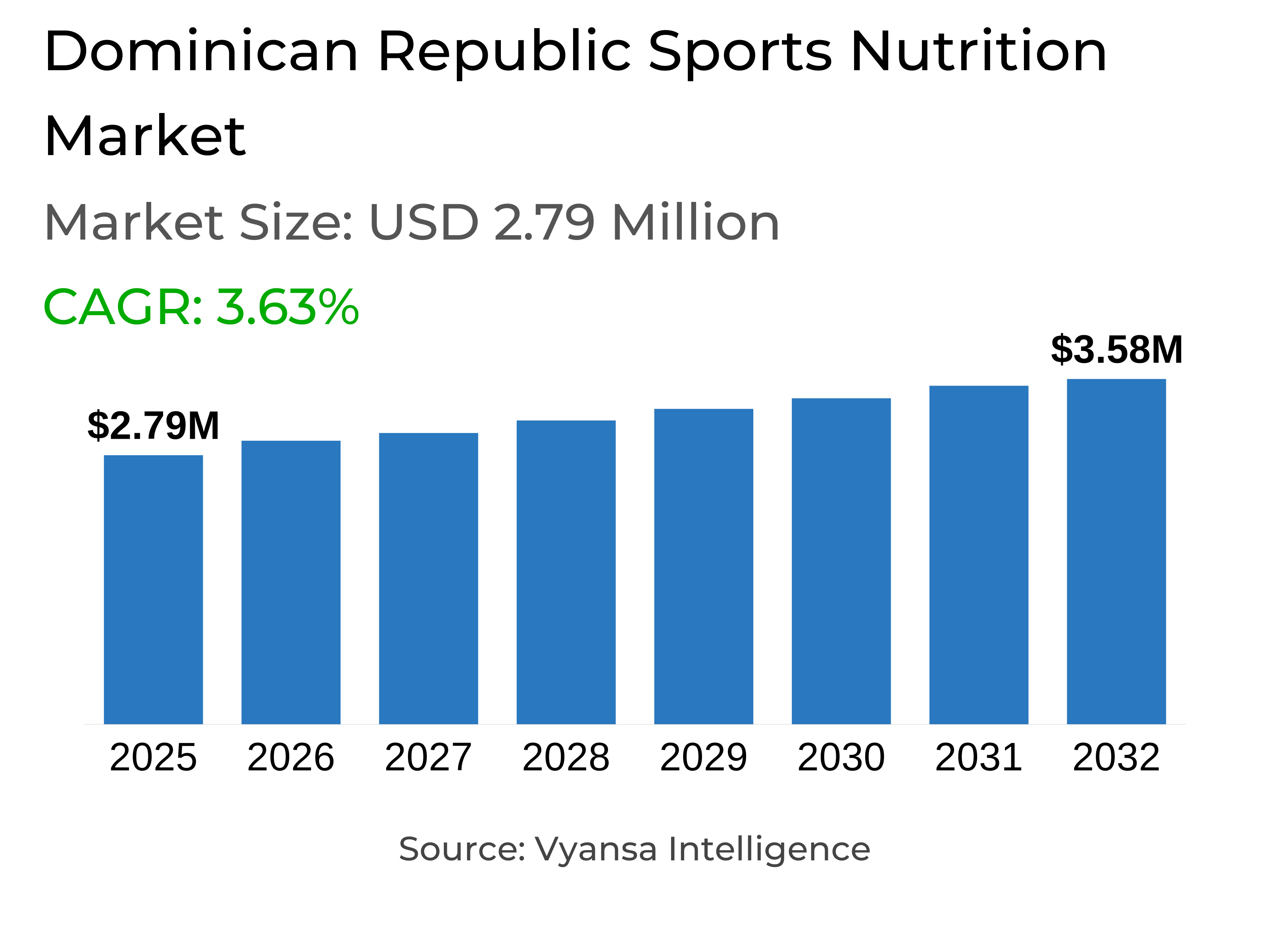
- Sports nutrition in dominican republic is estimated at USD 2.79 million.
- The market size is expected to grow to USD 3.58 million by 2032.
- Market to register a cagr of around 3.63% during 2026-32.
- Product Type Shares
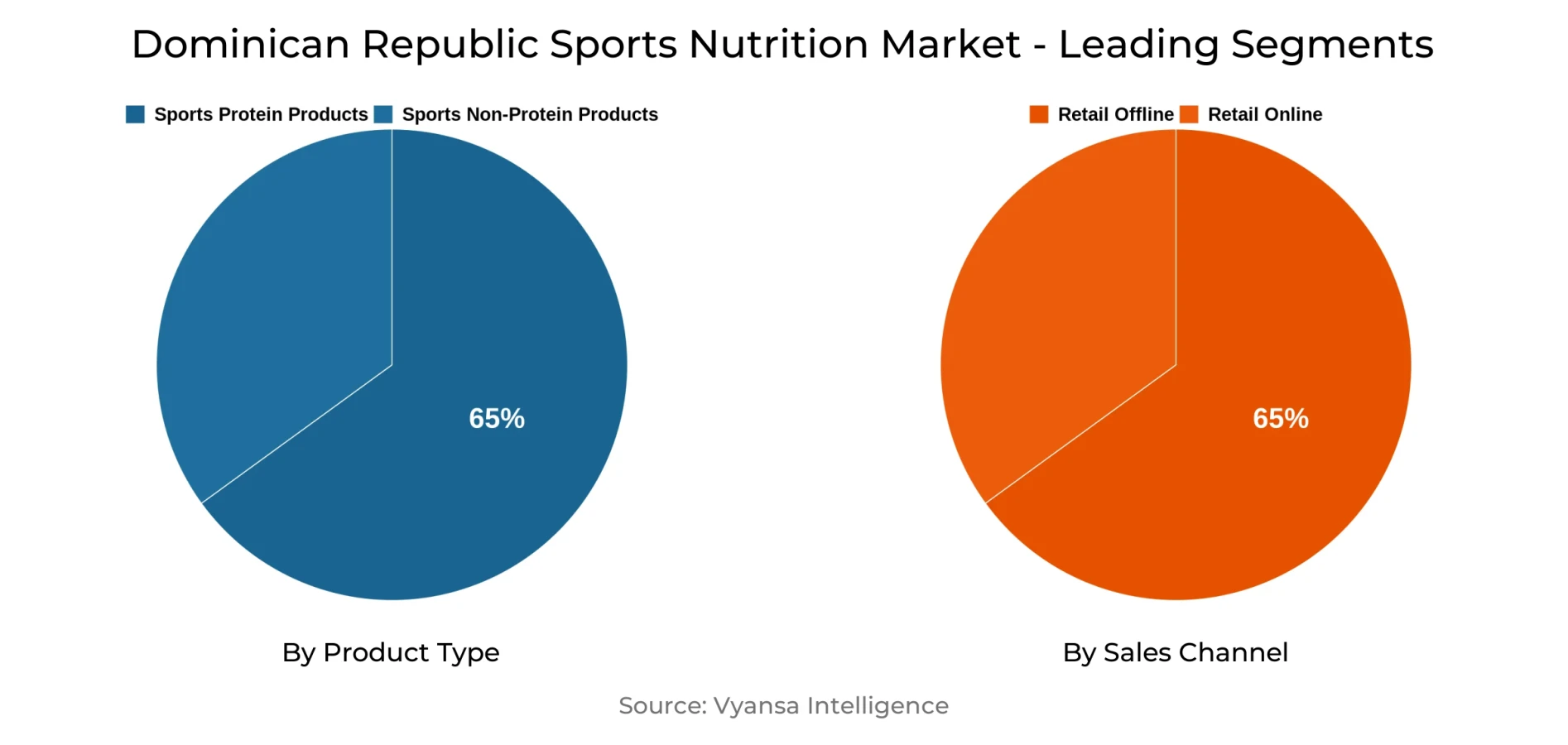
- Sports protein products grabbed market share of 65%.
- Competition
- More than 5 companies are actively engaged in producing sports nutrition in dominican republic.
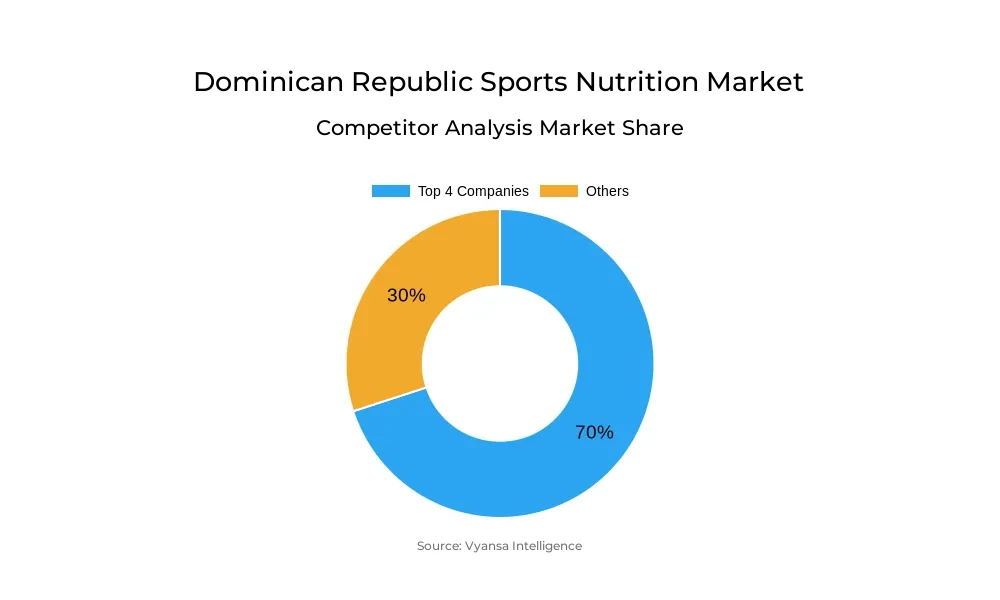
- Top 4 companies acquired around 70% of the market share.
- Herbalife Dominicana SA, Amway Dominican Republic LLC, Almacenes Gurabo CxA, Omnilife Dominicana etc., are few of the top companies.
- Sales Channel
- Retail offline grabbed 65% of the market.
Dominican Republic Sports Nutrition Market Outlook
The sports nutrition market in the Dominican Republic is anticipated to grow steadily from around $2.79 million in 2025 to around $3.58 million by 2032, at a CAGR of around 3.63% from 2026-32. Growth is fostered by increasing numbers of end users adopting active lifestyles and making investments in fitness and rising awareness of muscle recovery, performance improvement, and general wellbeing. As increasing numbers of individuals embrace regular physical activity, demand for sports nutrition products should grow across various age and activity segments.
Sports protein products continue to dominate the market, with a share of around 65% of total sales. These products, including protein powders, bars, and ready to drink options, remain highly preferred by end users for muscle development and recovery. Innovation like dissolvable protein pods, gluten free RTDs, and pre workout formats is making it easier to consume protein, facilitating steady growth in this segment.
Retail offline is still the primary sales channel, representing around 65% of the market. Supermarkets, hypermarkets, pharmacies, and gyms offer solid access points, convenience, and product assortment, which attract a large number of end users. Retail online is growing fast, with convenience and personalized experiences, especially for younger, digitally educated end users, although it is still a smaller portion of the market.
The market is also likely to benefit from diversification and innovation in product format and offerings. New products like pre workout gummies and energy boosting beverages that combine nutrition, convenience, and performance support are likely to attract more health conscious end users. With further increases both in protein and non-protein products, and a balance of retail offline and online channels, the market is positioned for steady expansion during the forecast period.
Dominican Republic Sports Nutrition Market Growth Driver
Growing Fitness Awareness Boosts Demand
More end users are adopting active lifestyles and showing interest in wellbeing and fitness. Sports nutrition, previously targeted on professional athletes, now reaches a more diverse base of end users for a variety of purposes, including recovery after injury or maintaining a balanced routine. This growing base supports consistent growth in adoption of protein products and help in extending the market reach across different age groups.
The country's growing focus on sports further contributes to this momentum. Physical activity is officially recognized as a fundamental right, generating investment in public sports spaces and fitness infrastructure. The growth of gyms, sports facilities, and recreational complexes, both public and private, has increased accessibility to fitness. With growing participation in exercise and training, the consumption of sports nutrition products continues to grow among end users who want to improve their performance and recovery.
Dominican Republic Sports Nutrition Market Challenge
Rising Enriched Foods Limit Product Growth
Enriched foods with added protein are increasingly becoming popular in the market. Everyday products like milk, cereals, and snacks are now enriched with additional protein to appeal the end users who are concerned about their health. This enables them to obtain their protein through a normal diet rather than relying on sports nutrition products. The increasing popularity of such products is altering the way end users incorporate protein in their daily diets.
Additionally, the growing range of food products with added protein is creating pressure on sports nutrition sales. These options are often cheaper and easier to find, making them a preferred choice for many end users. As more end users switch to these convenient products, the demand for specialized sports nutrition items faces slower growth.
Unlock Market Intelligence
Explore the market potential with our data-driven report
Dominican Republic Sports Nutrition Market Trend
Shift Toward Plant Based and Clean Label Products
End users are now showing interested in natural plant based sports nutrition products. Plant protein is gaining popularity as it is perceived as healthier and easier to digest. Companies are marketing products consisting of plant protein and highlight that they are lactose free. This change indicates growing awareness regarding wellness and the use of products that are compatible with cleaner lifestyles.
Meanwhile, this change is associated with a wider change in the food and beverage industry, with end users looking for simple ingredient lists and avoiding artificial additives. Due to this, companies are reformulating products with more natural and easy to understand ingredients. Consequently, plant based and clean label sports nutrition products are gaining interest and are attracting more health conscious end users.
Dominican Republic Sports Nutrition Market Opportunity
Innovation and Variety in Products
The industry will grow by expanding and diversifying the range of product offerings and formats. Products that are positioned to assist in muscle building, improve physical performance, and offer other functional benefits will attract a bigger base of end users. Drinks and supplements with the balance of energy, nutrition, and convenience will become more widely accepted, which will drive innovation in solutions that meet the varying needs of fitness enthusiasts and health conscious end users. This growth will allow brands to differentiate their portfolios and cater to specific performance and wellness goals.
Besides, innovative and creative formats, products such as pre workout gummies and dissolvable protein pods, are likely to attract end users who look for convenience, ease of preparation, and easy consumption. Focusing on creating such user friendly, accessible products will allow firms to connect with wider populations and engage more with health conscious end users. Ongoing diversification and innovation in the range are likely to drive overall market expansion and strengthen adoption across different segments.
Unlock Market Intelligence
Explore the market potential with our data-driven report
Dominican Republic Sports Nutrition Market Segmentation Analysis
By Product Type
- Sports Protein Products
- Sports Non-Protein Products
Sports protein products lead the market, accounting for around 65% of total sales. These products are highly preferred by end users for muscle development, recovery, and developing strength. The segment icludes protein powders, bars, and ready to drink (RTD) options. Recent developments are making it moeew convenient to consume protein, including dissolvable protein pods, gluten free RTDs, and pre workout. These products make it easier for end users to consume protein regularly and facilitate performance goals, leading to long term growth in this segment.
Sports non-protein products also remain on a steady growth path, with emphasis on energy and endurance support. Energy RTDs, pre workout gummies, and hydration supplements are all part of this segment, enabling end users to enhance performance during exercise. While smaller in size compared to sports protein products, these products are these products cater to end users seeking quick energy or convenience. In total, innovation and new formats should continue to drive both segments on a growth path.
By Sales Channel
- Retail Offline
- Retail Online
Retail offline holds around 65% of the market and is leading channel for sports nutrition products. Supermarkets and hypermarkets lead this category because of their extensive reach, product variety, and established access points. End users prefer these stores since they can touch and feel products, enjoy promotions, and easily buy a variety of sports nutrition products such as supplements, protein powders, and beverages. Pharmacies, health food stores, gyms, and fitness centers also lend a helping hand by providing personalized advice, product sampling, and bundled deals, further strenthening retail offline position .
Moreover, retail online accounts for rest of the market share and is emerging as a fast growing channel. Retail online channels provide convenience, extended product range, and personalized shopping experiences, which particularly resonate with younger, tech-savvy end users Even with this expansion, retail offline maintains the upper hand because of its reachability and presence in the physical world.
Top Companies in Dominican Republic Sports Nutrition Market
The top companies operating in the market include Herbalife Dominicana SA, Amway Dominican Republic LLC, Almacenes Gurabo CxA, Omnilife Dominicana, etc., are the top players operating in the dominican republic sports nutrition market.
Frequently Asked Questions
Related Report
1. Market Segmentation
1.1. Research Scope
1.2. Research Methodology
1.3. Definitions and Assumptions
2. Executive Summary
3. Dominican Republic Sports Nutrition Market Policies, Regulations, and Standards
4. Dominican Republic Sports Nutrition Market Dynamics
4.1. Growth Factors
4.2. Challenges
4.3. Trends
4.4. Opportunities
5. Dominican Republic Sports Nutrition Market Statistics, 2022-2032F
5.1. Market Size & Growth Outlook
5.1.1.By Revenues in US$ Million
5.2. Market Segmentation & Growth Outlook
5.2.1.By Product Type
5.2.1.1. Sports Protein Products- Market Insights and Forecast 2022-2032, USD Million
5.2.1.1.1. Protein/Energy Bars- Market Insights and Forecast 2022-2032, USD Million
5.2.1.1.2. Sports Protein Powder- Market Insights and Forecast 2022-2032, USD Million
5.2.1.1.3. Sports Protein RTD- Market Insights and Forecast 2022-2032, USD Million
5.2.1.2. Sports Non-Protein Products- Market Insights and Forecast 2022-2032, USD Million
5.2.2.By Sales Channel
5.2.2.1. Retail Offline- Market Insights and Forecast 2022-2032, USD Million
5.2.2.2. Retail Online- Market Insights and Forecast 2022-2032, USD Million
5.2.3.By Ingredients
5.2.3.1. Vitamins and Minerals- Market Insights and Forecast 2022-2032, USD Million
5.2.3.2. Proteins and Amino Acids- Market Insights and Forecast 2022-2032, USD Million
5.2.3.3. Carbohydrates- Market Insights and Forecast 2022-2032, USD Million
5.2.3.4. Probiotics- Market Insights and Forecast 2022-2032, USD Million
5.2.3.5. Botanicals/Herbals- Market Insights and Forecast 2022-2032, USD Million
5.2.3.6. Others- Market Insights and Forecast 2022-2032, USD Million
5.2.4.By Functionality
5.2.4.1. Energy- Market Insights and Forecast 2022-2032, USD Million
5.2.4.2. Muscle growth- Market Insights and Forecast 2022-2032, USD Million
5.2.4.3. Hydration- Market Insights and Forecast 2022-2032, USD Million
5.2.4.4. Weight Management- Market Insights and Forecast 2022-2032, USD Million
5.2.4.5. Others- Market Insights and Forecast 2022-2032, USD Million
5.2.5.By End User
5.2.5.1. Bodybuilders- Market Insights and Forecast 2022-2032, USD Million
5.2.5.2. Athletes- Market Insights and Forecast 2022-2032, USD Million
5.2.5.3. Lifestyle Users- Market Insights and Forecast 2022-2032, USD Million
5.2.6.By Competitors
5.2.6.1. Competition Characteristics
5.2.6.2. Market Share & Analysis
6. Dominican Republic Protein Products Sports Nutrition Market Statistics, 2022-2032F
6.1. Market Size & Growth Outlook
6.1.1.By Revenues in US$ Million
6.2. Market Segmentation & Growth Outlook
6.2.1.By Sales Channel- Market Insights and Forecast 2022-2032, USD Million
6.2.2.By Ingredients- Market Insights and Forecast 2022-2032, USD Million
6.2.3.By Functionality- Market Insights and Forecast 2022-2032, USD Million
6.2.4.By End User- Market Insights and Forecast 2022-2032, USD Million
7. Dominican Republic Non-Protein Products Sports Nutrition Market Statistics, 2022-2032F
7.1. Market Size & Growth Outlook
7.1.1.By Revenues in US$ Million
7.2. Market Segmentation & Growth Outlook
7.2.1.By Sales Channel- Market Insights and Forecast 2022-2032, USD Million
7.2.2.By Ingredients- Market Insights and Forecast 2022-2032, USD Million
7.2.3.By Functionality- Market Insights and Forecast 2022-2032, USD Million
7.2.4.By End User- Market Insights and Forecast 2022-2032, USD Million
8. Competitive Outlook
8.1. Company Profiles
8.1.1.Almacenes Gurabo CxA
8.1.1.1. Business Description
8.1.1.2. Product Portfolio
8.1.1.3. Collaborations & Alliances
8.1.1.4. Recent Developments
8.1.1.5. Financial Details
8.1.1.6. Others
8.1.2.Omnilife Dominicana
8.1.2.1. Business Description
8.1.2.2. Product Portfolio
8.1.2.3. Collaborations & Alliances
8.1.2.4. Recent Developments
8.1.2.5. Financial Details
8.1.2.6. Others
8.1.3.Herbalife Dominicana SA
8.1.3.1. Business Description
8.1.3.2. Product Portfolio
8.1.3.3. Collaborations & Alliances
8.1.3.4. Recent Developments
8.1.3.5. Financial Details
8.1.3.6. Others
8.1.4.Amway Dominican Republic LLC
8.1.4.1. Business Description
8.1.4.2. Product Portfolio
8.1.4.3. Collaborations & Alliances
8.1.4.4. Recent Developments
8.1.4.5. Financial Details
8.1.4.6. Others
8.1.5.Company 5
8.1.5.1. Business Description
8.1.5.2. Product Portfolio
8.1.5.3. Collaborations & Alliances
8.1.5.4. Recent Developments
8.1.5.5. Financial Details
8.1.5.6. Others
8.1.6.Company 6
8.1.6.1. Business Description
8.1.6.2. Product Portfolio
8.1.6.3. Collaborations & Alliances
8.1.6.4. Recent Developments
8.1.6.5. Financial Details
8.1.6.6. Others
8.1.7.Company 7
8.1.7.1. Business Description
8.1.7.2. Product Portfolio
8.1.7.3. Collaborations & Alliances
8.1.7.4. Recent Developments
8.1.7.5. Financial Details
8.1.7.6. Others
8.1.8.Company 8
8.1.8.1. Business Description
8.1.8.2. Product Portfolio
8.1.8.3. Collaborations & Alliances
8.1.8.4. Recent Developments
8.1.8.5. Financial Details
8.1.8.6. Others
8.1.9.Company 9
8.1.9.1. Business Description
8.1.9.2. Product Portfolio
8.1.9.3. Collaborations & Alliances
8.1.9.4. Recent Developments
8.1.9.5. Financial Details
8.1.9.6. Others
8.1.10. Company 10
8.1.10.1. Business Description
8.1.10.2. Product Portfolio
8.1.10.3. Collaborations & Alliances
8.1.10.4. Recent Developments
8.1.10.5. Financial Details
8.1.10.6. Others
9. Disclaimer
| Segment | Sub-Segment |
|---|---|
| By Product Type |
|
| By Sales Channel |
|
| By Ingredients |
|
| By Functionality |
|
| By End User |
|
Research Methodology
This study followed a structured approach comprising four key phases to assess the size and scope of the electro-oxidation market. The process began with thorough secondary research to collect data on the target market, related markets, and broader industry context. These findings, along with preliminary assumptions and estimates, were then validated through extensive primary research involving industry experts from across the value chain. To calculate the overall market size, both top-down and bottom-up methodologies were employed. Finally, market segmentation and data triangulation techniques were applied to refine and validate segment-level estimations.
Secondary Research
The secondary research phase involved gathering data from a wide range of credible and published sources. This step helped in identifying industry trends, defining market segmentation, and understanding the market landscape and value chain.
Sources consulted during this phase included:
- Company annual reports, investor presentations, and press releases
- Industry white papers and certified publications
- Trade directories and market-recognized databases
- Articles from authoritative authors and reputable journals
- Gold and silver standard websites
Secondary research was critical in mapping out the industry's value chain and monetary flow, identifying key market segments, understanding regional variations, and tracking significant industry developments.
Other key sources:
- Financial disclosures
- Industry associations and trade bodies
- News outlets and business magazines
- Academic journals and research studies
- Paid industry databases
Primary Research
To validate secondary data and gain deeper market insights, primary research was conducted with key stakeholders across both the supply and demand sides of the market.
On the demand side, participants included decision-makers and influencers from end-user industries—such as CIOs, CTOs, and CSOs—who provided first-hand perspectives on market needs, product usage, and future expectations.
On the supply side, interviews were conducted with manufacturers, industry associations, and institutional participants to gather insights into current offerings, product pipelines, and market challenges.
Primary interviews provided critical inputs such as:
- Market size and revenue data
- Product and service breakdowns
- Market forecasts
- Regional and application-specific trends
Stakeholders consulted included:
- Leading OEM and solution providers
- Channel and distribution partners
- End users across various applications
- Independent consultants and industry specialists
Market Size Estimation and Data Triangulation
- Identifying Key Market Participants (Secondary Research)
- Goal: To identify the major players or companies in the target market. This typically involves using publicly available data sources such as industry reports, market research publications, and financial statements of companies.
- Tools: Reports from firms like Gartner, Forrester, Euromonitor, Statista, IBISWorld, and others. Public financial statements, news articles, and press releases from top market players.
- Extracting Earnings of Key Market Participants
- Goal: To estimate the earnings generated from the product or service being analyzed. This step helps in understanding the revenue potential of each market player in a specific geography.
- Methods: Earnings data can be gathered from:
- Publicly available financial reports (for listed companies).
- Interviews and primary data sources from professionals, such as Directors, VPs, SVPs, etc. This is especially useful for understanding more nuanced, internal data that isn't publicly disclosed.
- Annual reports and investor presentations of key players.
- Data Collation and Development of a Relevant Data Model
- Goal: To collate inputs from both primary and secondary sources into a structured, data-driven model for market estimation. This model will incorporate key market KPIs and any independent variables relevant to the market.
- Key KPIs: These could include:
- Market size, growth rate, and demand drivers.
- Industry-specific metrics like market share, average revenue per customer (ARPC), or average deal size.
- External variables, such as economic growth rates, inflation rates, or commodity prices, that could affect the market.
- Data Modeling: Based on this data, the market forecasts are developed for the next 5 years. A combination of trend analysis, scenario modeling, and statistical regression might be used to generate projections.
- Scenario Analysis
- Goal: To test different assumptions and validate how sensitive the market is to changes in key variables (e.g., market demand, regulatory changes, technological disruptions).
- Types of Scenarios:
- Base Case: Based on current assumptions and historical data.
- Best-Case Scenario: Assuming favorable market conditions, regulatory environments, and technological advancements.
- Worst-Case Scenario: Accounting for adverse factors, such as economic downturns, stricter regulations, or unexpected disruptions.












