China Iris Recognition Market Report: Trends, Growth and Forecast (2026-2032)
By Component (Hardware, Software), By Product Type (Iris Scanners, Access Control & Time Attendance Terminals, Border Control Kiosks/eGates, Smartphones, Embedded/OEM Iris Modules, Others), By Application (Identity Management & Access Control, Border Control & Immigration, Time Monitoring, E-Payment, Others), By End Use (Government, Military & Defense, BFSI, Healthcare, Consumer Electronics, Travel & Immigration, Automotive, Others), By Region (North, East, Southwest, Northwest, North East, South) ... Read more

|
Major Players
|
China Iris Recognition Market Statistics and Insights, 2026
- Market Size Statistics
- Iris recognition market size in China was valued at USD 298 million in 2025 and is estimated at USD 322 million in 2026.
- The market size is expected to grow to USD 528 million by 2032.
- Market to register a CAGR of around 8.51% during 2026-32.
- Application Shares
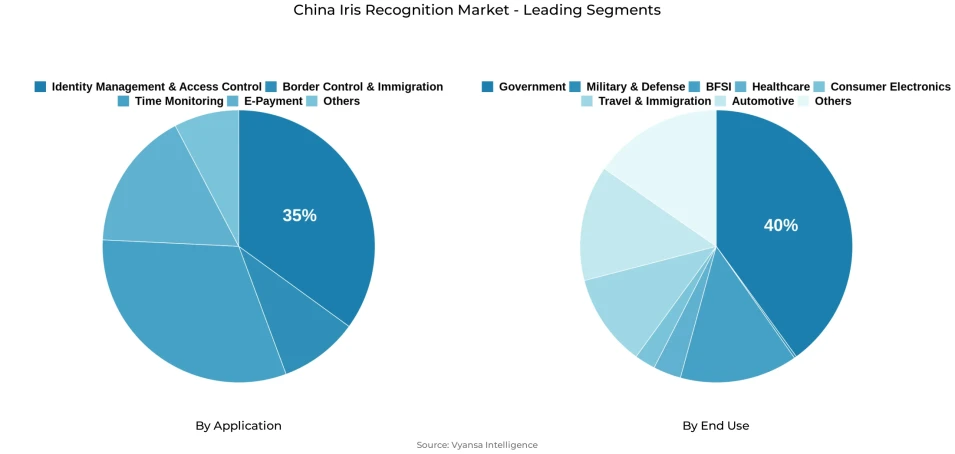
- Identity management & access control grabbed market share of 35%.
- Competition
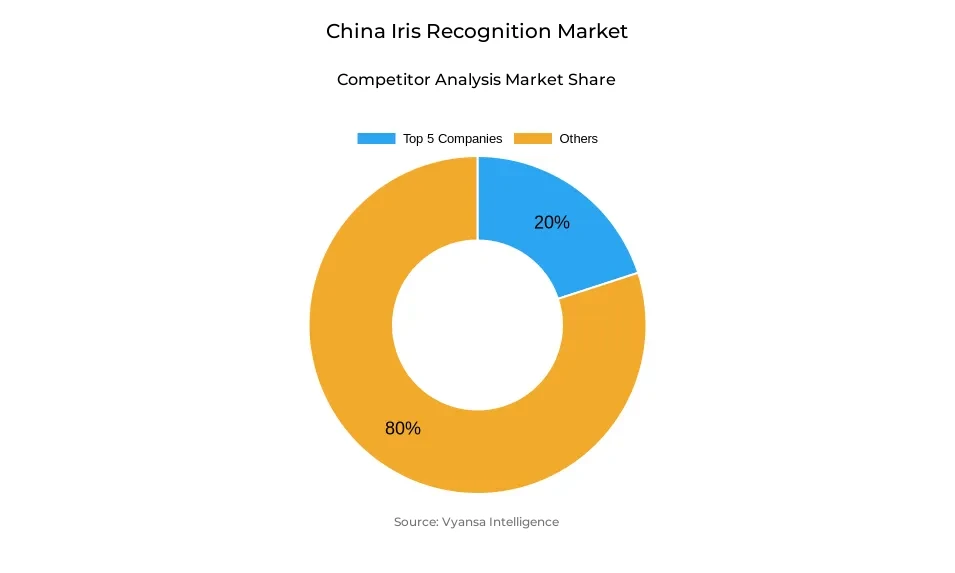
- Iris recognition in China is currently being catered to by more than 10 companies.
- Top 5 companies acquired around 20% of the market share in 2026.
- Wuhan Homsh Technology Co. Ltd., Hangzhou Hikvision Digital Technology Co. Ltd., Beijing Zhongke Linghong Technology Co. Ltd., Beijing Zhongke Hongba Technology Co. Ltd., Beijing Wanlihong Technology Co. Ltd. etc., are few of the top companies.
- End Use
- Government grabbed 40% of the market.
China Iris Recognition Market Outlook
The China iris recognition market covers hardware devices, software algorithms, embedded modules, scanners, access terminals, and authentication platforms used to verify identity through iris-pattern matching. Demand is concentrated across government security, access control, immigration, defense, BFSI, healthcare, and selected consumer electronics use cases. Valued at USD 298 million in 2025, USD 322 million in 2026, and USD 528 million by 2032, it is projected to expand at 8.51% CAGR during 2026-32.
Operational demand is reinforced by China’s digital identity, smart-city, and high-security access agenda. The 2025 National Online Identity Authentication Public Service rules formalize online identity verification through state-backed wanghao and wangzheng credentials, strengthening the institutional role of trusted authentication. That policy direction expands the addressable base for multimodal biometric authentication China deployments where iris scan authentication can complement face, fingerprint, and document checks across controlled environments, including public services and enterprise networks.
The China iris recognition market contributes to procurement efficiency by replacing manual credential checks with automated, high-assurance identity verification technology. For operators, biometric access control reduces card-sharing risk, improves auditability, and supports secure authentication technology in sensitive locations. For suppliers, demand is tied to algorithm accuracy, near-infrared iris scanner performance, liveness detection, device reliability, and compliance-ready biometric database management, making product differentiation increasingly technical rather than purely price-led and suited to long-cycle public procurement programs.
Adoption momentum in the China iris recognition market is moving toward contactless biometric recognition, AI-powered iris recognition, and multimodal biometric authentication. Supplier positioning in 2026 depends on embedded iris sensors, biometric identity platform integration, enterprise access-control terminals, and secure facility entry use cases. Regulatory scrutiny around biometric data protection also shifts purchasing priorities toward privacy-compliant biometrics China solutions with local storage, encryption, audit trails, consent management, and alternatives to single-mode biometric verification for scalable, audit-ready deployment at scale domestically.
China Iris Recognition Market Growth Driver
High-Assurance Identity Demand Strengthens Uptake
High-security identity assurance is expanding demand where cards, passwords, and facial-only verification are considered insufficient for controlled premises. The China iris recognition market benefits because iris patterns remain stable, difficult to duplicate, and suitable for contactless authentication in facilities that require stronger audit trails. Within the China iris recognition industry, suppliers gain traction when terminals combine iris capture, access control, attendance, and platform integration instead of selling standalone scanners.
Data from the Cyberspace Administration of China shows that the National Online Identity Authentication Public Service Management Measures took effect on July 15, 2025, supporting trusted digital identity and real-name verification through public infrastructure. That framework strengthens procurement visibility for identity management systems, encouraging buyers to evaluate iris biometric identification as part of broader secure authentication technology stacks for public services, banking, campuses, and regulated enterprise access and higher security assurance programs across controlled public infrastructure and enterprise facilities nationwide deployments.
China Iris Recognition Market Challenge
Compliance Complexity Raises Deployment Barriers
Biometric privacy obligations are increasing integration cost, especially for deployments involving centralized templates, remote verification, and large user databases. The China iris recognition market faces slower private-sector rollout when buyers must redesign consent flows, retention rules, storage architecture, and fallback authentication. In the China iris recognition industry, compliance readiness now influences vendor selection as much as matching speed, false rejection performance, and hardware reliability.
The Cyberspace Administration of China and Ministry of Public Security stated that facial-recognition systems reaching 100,000 stored face records must complete filing with provincial or higher cyberspace authorities within 30 working days. Although iris templates are technically different, the rule signals stricter biometric governance, raising documentation, audit, encryption, and local-storage expectations for any high-volume identity verification technology deployment. This pressure also increases procurement preference for privacy-compliant biometrics China solutions, secure audit logs, and controlled biometric template lifecycle management during large-scale public and enterprise deployments nationwide.
Unlock Market Intelligence
Explore the market potential with our data-driven report
China Iris Recognition Market Trend
Multimodal Authentication Moves Into Security Workflows
Multimodal authentication is becoming the preferred technical pathway as buyers seek stronger assurance without creating friction at gates, terminals, and restricted zones. The China iris recognition market is shifting from single iris scanners toward iris and face recognition fusion, edge-based biometric authentication, liveness detection, and biometric SDK integration. In the China iris recognition industry, this trend favors vendors that can package algorithms, terminals, and platform software together.
Eyecool’s official product page describes its ECX333 as a multimodal face and iris access-control terminal that integrates identity authentication, access control, and temperature measurement through face and iris biometric identification. This supports adoption of AI biometric recognition where enterprises need faster enrollment, real-time iris matching, and device-level integration rather than isolated capture hardware. It also strengthens supplier positioning in biometric access control China tenders, smart building access control, and secure facility entry projects with integrated device management and lifecycle-ready software maintenance support models.
China Iris Recognition Market Opportunity
Public Infrastructure and Embedded Modules Open New Demand
Border-control modernization and high-throughput public infrastructure create an underpenetrated opportunity for iris-enabled multimodal terminals. The China iris recognition market can capture incremental demand when scanners and embedded/OEM iris modules support eGates, immigration counters, smart campuses, and critical infrastructure. In the China iris recognition industry, modular designs improve localization potential because suppliers can integrate near-infrared iris cameras into existing access-control and identity platforms.
The National Immigration Administration announced in November 2025 that smart customs clearance would be promoted at 12 ports, including Shanghai Hongqiao Airport and Xiamen Gaoqi Airport, using face and fingerprint verification for eligible travelers. That expansion does not mandate iris use, but it normalizes biometric passenger processing and opens procurement space for multimodal upgrades where iris authentication improves assurance. For instance, suppliers can position iris-enabled access terminals for border-adjacent government facilities, secure data centers, and airports requiring higher identity confidence across scalable, compliance-ready procurement cycles in China.
Unlock Market Intelligence
Explore the market potential with our data-driven report
China Iris Recognition Market Segmentation Analysis
By Application
- Identity Management & Access Control
- Border Control & Immigration
- Time Monitoring
- E-Payment
- Others
Identity management and access control hold 40% share because secure facility entry, staff authentication, campus access, and high-security enterprise gates generate repeatable procurement demand. The China iris recognition market benefits from this application because iris verification reduces credential sharing and strengthens audit trails in controlled buildings. In the China iris recognition industry, access-control terminals offer clearer monetization than standalone scanners because hardware, software, enrollment, and maintenance can be bundled.
Hikvision’s access-control product pages position iris-recognition terminals for higher-level access security and time attendance, showing how established security vendors commercialize iris within door-entry workflows. This supports procurement for biometric access control, employee attendance authentication, and secure facility entry, while encouraging suppliers to improve terminal speed, user enrollment, device integration, and lifecycle serviceability. It also supports pricing power for vendors that combine iris recognition software, access control terminals, and biometric enrollment devices into unified deployments across public and enterprise security portfolios nationwide.
By End Use
- Government
- Military & Defense
- BFSI
- Healthcare
- Consumer Electronics
- Travel & Immigration
- Automotive
- Others
Government holds 40% share because public security, digital identity, immigration, justice, and secure administrative facilities represent the highest-compliance buyers for iris-based identity verification. The China iris recognition market is shaped by these procurement cycles because public agencies require accuracy, auditability, template protection, and interoperability with identity systems. In the China iris recognition industry, government demand also supports domestic suppliers with algorithm ownership, localized deployment capacity, and long-term service capability.
Xinhua reported in May 2025 that the National Online Identity Authentication Public Service platform had gone online, allowing users to apply for and use wanghao and wangzheng credentials through an app while reducing collection and retention of personal identity information. This reinforces public-sector demand for compliant biometric security systems, government ID authentication, and identity platforms that can operate under stricter data-protection rules. It also favors vendors offering secure authentication technology with controllable deployment, encryption, and audit-ready platform governance across public agencies.
List of Companies Covered in China Iris Recognition Market
The companies listed below are highly influential in the China iris recognition market, with a significant market share and a strong impact on industry developments.
- Wuhan Homsh Technology Co. Ltd.
- Hangzhou Hikvision Digital Technology Co. Ltd.
- Beijing Zhongke Linghong Technology Co. Ltd.
- Beijing Zhongke Hongba Technology Co. Ltd.
- Beijing Wanlihong Technology Co. Ltd.
- Beijing Eyecool Technology Co. Ltd.
- Shanghai Irisian Optoelectronics Technology Co. Ltd.
- Shanghai Pixsur Smart Technology Co. Ltd.
- ZKTeco Co. Ltd.
- Tianjin Zhongke Hongxing Technology Co. Ltd.
Competitive Landscape
Competition in the China Iris Recognition Market is led by domestic biometric specialists with strong iris algorithm, scanner, module, and access-control capabilities. Beijing Zhongke Hongba Technology Co., Ltd., Beijing Wanlihong Technology Co., Ltd., and Beijing Eyecool Technology Co., Ltd. hold leading positions through dedicated iris-recognition portfolios and public-sector deployment relevance. Shanghai Irisian Optoelectronics Technology Co., Ltd., Shanghai Pixsur Smart Technology Co., Ltd., Wuhan Homsh Technology Co., Ltd., and Beijing Zhongke Linghong Technology Co., Ltd. strengthen the specialist supplier base through multimodal terminals, embedded/OEM iris modules, and platform integration. Hikvision and ZKTeco add competitive pressure through broader access-control channels. Differentiation is increasingly shaped by algorithm accuracy, near-infrared capture quality, liveness detection, compliance readiness, and scalable government and enterprise deployment support.
Frequently Asked Questions
Related Report
- Market Segmentation
- Research Scope
- Research Methodology
- Definitions and Assumptions
- Executive Summary
- China Iris Recognition Market Policies, Regulations, and Standards
- China Iris Recognition Market Dynamics
- Growth Factors
- Challenges
- Trends
- Opportunities
- China Iris Recognition Market Statistics, 2022-2032F
- Market Size & Growth Outlook
- By Revenues in USD Million
- Market Segmentation & Growth Outlook
- By Component
- Hardware- Market Insights and Forecast 2022-2032, USD Million
- Software- Market Insights and Forecast 2022-2032, USD Million
- By Product Type
- Iris Scanners- Market Insights and Forecast 2022-2032, USD Million
- Access Control & Time Attendance Terminals- Market Insights and Forecast 2022-2032, USD Million
- Border Control Kiosks/eGates- Market Insights and Forecast 2022-2032, USD Million
- Smartphones- Market Insights and Forecast 2022-2032, USD Million
- Embedded/OEM Iris Modules- Market Insights and Forecast 2022-2032, USD Million
- Others- Market Insights and Forecast 2022-2032, USD Million
- By Application
- Identity Management & Access Control- Market Insights and Forecast 2022-2032, USD Million
- Border Control & Immigration- Market Insights and Forecast 2022-2032, USD Million
- Time Monitoring- Market Insights and Forecast 2022-2032, USD Million
- E-Payment- Market Insights and Forecast 2022-2032, USD Million
- Others- Market Insights and Forecast 2022-2032, USD Million
- By End Use
- Government- Market Insights and Forecast 2022-2032, USD Million
- Military & Defense- Market Insights and Forecast 2022-2032, USD Million
- BFSI- Market Insights and Forecast 2022-2032, USD Million
- Healthcare- Market Insights and Forecast 2022-2032, USD Million
- Consumer Electronics- Market Insights and Forecast 2022-2032, USD Million
- Travel & Immigration- Market Insights and Forecast 2022-2032, USD Million
- Automotive- Market Insights and Forecast 2022-2032, USD Million
- Others- Market Insights and Forecast 2022-2032, USD Million
- By Region
- North- Market Insights and Forecast 2022-2032, USD Million
- East- Market Insights and Forecast 2022-2032, USD Million
- Southwest- Market Insights and Forecast 2022-2032, USD Million
- Northwest- Market Insights and Forecast 2022-2032, USD Million
- North East- Market Insights and Forecast 2022-2032, USD Million
- South- Market Insights and Forecast 2022-2032, USD Million
- By Competitors
- Competition Characteristics
- Market Share & Analysis
- By Component
- Market Size & Growth Outlook
- China Identity Management & Access Control Market Statistics, 2022-2032
- Market Size & Growth Outlook
- By Revenues in USD Million
- Market Segmentation & Growth Outlook
- By Product Type- Market Insights and Forecast 2022-2032, USD Million
- By Application- Market Insights and Forecast 2022-2032, USD Million
- By End Use- Market Insights and Forecast 2022-2032, USD Million
- By Region- Market Insights and Forecast 2022-2032, USD Million
- Market Size & Growth Outlook
- China Border Control & Immigration Market Statistics, 2022-2032
- Market Size & Growth Outlook
- By Revenues in USD Million
- Market Segmentation & Growth Outlook
- By Product Type- Market Insights and Forecast 2022-2032, USD Million
- By Application- Market Insights and Forecast 2022-2032, USD Million
- By End Use- Market Insights and Forecast 2022-2032, USD Million
- By Region- Market Insights and Forecast 2022-2032, USD Million
- Market Size & Growth Outlook
- China Time Monitoring Market Statistics, 2022-2032
- Market Size & Growth Outlook
- By Revenues in USD Million
- Market Segmentation & Growth Outlook
- By Product Type- Market Insights and Forecast 2022-2032, USD Million
- By Application- Market Insights and Forecast 2022-2032, USD Million
- By End Use- Market Insights and Forecast 2022-2032, USD Million
- By Region- Market Insights and Forecast 2022-2032, USD Million
- Market Size & Growth Outlook
- China E-Payment Market Statistics, 2022-2032
- Market Size & Growth Outlook
- By Revenues in USD Million
- Market Segmentation & Growth Outlook
- By Product Type- Market Insights and Forecast 2022-2032, USD Million
- By Application- Market Insights and Forecast 2022-2032, USD Million
- By End Use- Market Insights and Forecast 2022-2032, USD Million
- By Region- Market Insights and Forecast 2022-2032, USD Million
- Market Size & Growth Outlook
- Competitive Outlook
- Company Profiles
- Beijing Zhongke Hongba Technology Co. Ltd.
- Business Description
- Product Portfolio
- Collaborations & Alliances
- Recent Developments
- Financial Details
- Others
- Beijing Wanlihong Technology Co. Ltd.
- Business Description
- Product Portfolio
- Collaborations & Alliances
- Recent Developments
- Financial Details
- Others
- Beijing Eyecool Technology Co. Ltd.
- Business Description
- Product Portfolio
- Collaborations & Alliances
- Recent Developments
- Financial Details
- Others
- Shanghai Irisian Optoelectronics Technology Co. Ltd.
- Business Description
- Product Portfolio
- Collaborations & Alliances
- Recent Developments
- Financial Details
- Others
- Shanghai Pixsur Smart Technology Co. Ltd.
- Business Description
- Product Portfolio
- Collaborations & Alliances
- Recent Developments
- Financial Details
- Others
- Wuhan Homsh Technology Co. Ltd.
- Business Description
- Product Portfolio
- Collaborations & Alliances
- Recent Developments
- Financial Details
- Others
- Hangzhou Hikvision Digital Technology Co. Ltd.
- Business Description
- Product Portfolio
- Collaborations & Alliances
- Recent Developments
- Financial Details
- Others
- Beijing Zhongke Linghong Technology Co. Ltd.
- Business Description
- Product Portfolio
- Collaborations & Alliances
- Recent Developments
- Financial Details
- Others
- ZKTeco Co. Ltd.
- Business Description
- Product Portfolio
- Collaborations & Alliances
- Recent Developments
- Financial Details
- Others
- Tianjin Zhongke Hongxing Technology Co. Ltd.
- Business Description
- Product Portfolio
- Collaborations & Alliances
- Recent Developments
- Financial Details
- Others
- Beijing Zhongke Hongba Technology Co. Ltd.
- Company Profiles
- Disclaimer
| Segment | Sub-Segment |
|---|---|
| By Component |
|
| By Product Type |
|
| By Application |
|
| By End Use |
|
| By Region |
|
Research Methodology
This study followed a structured approach comprising four key phases to assess the size and scope of the electro-oxidation market. The process began with thorough secondary research to collect data on the target market, related markets, and broader industry context. These findings, along with preliminary assumptions and estimates, were then validated through extensive primary research involving industry experts from across the value chain. To calculate the overall market size, both top-down and bottom-up methodologies were employed. Finally, market segmentation and data triangulation techniques were applied to refine and validate segment-level estimations.
Secondary Research
The secondary research phase involved gathering data from a wide range of credible and published sources. This step helped in identifying industry trends, defining market segmentation, and understanding the market landscape and value chain.
Sources consulted during this phase included:
- Company annual reports, investor presentations, and press releases
- Industry white papers and certified publications
- Trade directories and market-recognized databases
- Articles from authoritative authors and reputable journals
- Gold and silver standard websites
Secondary research was critical in mapping out the industry's value chain and monetary flow, identifying key market segments, understanding regional variations, and tracking significant industry developments.
Other key sources:
- Financial disclosures
- Industry associations and trade bodies
- News outlets and business magazines
- Academic journals and research studies
- Paid industry databases
Primary Research
To validate secondary data and gain deeper market insights, primary research was conducted with key stakeholders across both the supply and demand sides of the market.
On the demand side, participants included decision-makers and influencers from end-user industries—such as CIOs, CTOs, and CSOs—who provided first-hand perspectives on market needs, product usage, and future expectations.
On the supply side, interviews were conducted with manufacturers, industry associations, and institutional participants to gather insights into current offerings, product pipelines, and market challenges.
Primary interviews provided critical inputs such as:
- Market size and revenue data
- Product and service breakdowns
- Market forecasts
- Regional and application-specific trends
Stakeholders consulted included:
- Leading OEM and solution providers
- Channel and distribution partners
- End users across various applications
- Independent consultants and industry specialists
Market Size Estimation and Data Triangulation
- Identifying Key Market Participants (Secondary Research)
- Goal: To identify the major players or companies in the target market. This typically involves using publicly available data sources such as industry reports, market research publications, and financial statements of companies.
- Tools: Reports from firms like Gartner, Forrester, Euromonitor, Statista, IBISWorld, and others. Public financial statements, news articles, and press releases from top market players.
- Extracting Earnings of Key Market Participants
- Goal: To estimate the earnings generated from the product or service being analyzed. This step helps in understanding the revenue potential of each market player in a specific geography.
- Methods: Earnings data can be gathered from:
- Publicly available financial reports (for listed companies).
- Interviews and primary data sources from professionals, such as Directors, VPs, SVPs, etc. This is especially useful for understanding more nuanced, internal data that isn't publicly disclosed.
- Annual reports and investor presentations of key players.
- Data Collation and Development of a Relevant Data Model
- Goal: To collate inputs from both primary and secondary sources into a structured, data-driven model for market estimation. This model will incorporate key market KPIs and any independent variables relevant to the market.
- Key KPIs: These could include:
- Market size, growth rate, and demand drivers.
- Industry-specific metrics like market share, average revenue per customer (ARPC), or average deal size.
- External variables, such as economic growth rates, inflation rates, or commodity prices, that could affect the market.
- Data Modeling: Based on this data, the market forecasts are developed for the next 5 years. A combination of trend analysis, scenario modeling, and statistical regression might be used to generate projections.
- Scenario Analysis
- Goal: To test different assumptions and validate how sensitive the market is to changes in key variables (e.g., market demand, regulatory changes, technological disruptions).
- Types of Scenarios:
- Base Case: Based on current assumptions and historical data.
- Best-Case Scenario: Assuming favorable market conditions, regulatory environments, and technological advancements.
- Worst-Case Scenario: Accounting for adverse factors, such as economic downturns, stricter regulations, or unexpected disruptions.












