China Agricultural Machinery Market Report: Trends, Growth and Forecast (2026-2032)
By Type (Tractors (Horsepower (Less than 40 HP, 40 HP–99 HP, Greater than 100 HP), Tractor Type (Compact Utility Tractors, Utility Tractors, Row-Crop Tractors)), Plowing and Cultivating Machinery (Plows, Harrows, Cultivators and Tillers, Others), Planting Machinery (Seed Drills, Planters, Spreaders, Others), Harvesting Machinery (Combine Harvesters-Threshers, Forage Harvesters, Others), Haying and Forage Machinery (Mower-conditioners, Balers, Others), Irrigation Machinery (Sprinkler Irrigation, Drip Irrigation, Others), Others), By Application (Land Development & Seed Bed Preparation, Sowing & Planting, Weed Cultivation, Plant Protection, Harvesting & Threshing, Post-harvest & Agro Processing), By Automation (Automatic, Semi-automatic, Manual), By Region (North, East, Southwest, Northwest, North East, South) ... Read more
|
Major Players
|
China Agricultural Machinery Market Statistics and Insights, 2026
- Market Size Statistics
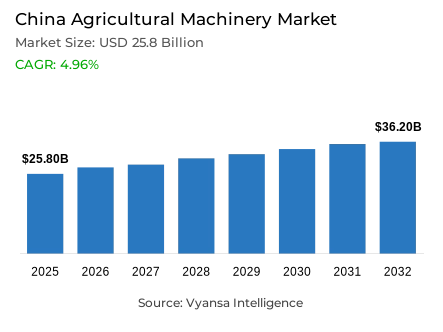
- Agricultural machinery market size in China was valued at USD 25.8 billion in 2025 and is estimated at USD 27.5 billion in 2026.
- The market size is expected to grow to USD 36.2 billion by 2032.
- Market to register a CAGR of around 4.96% during 2026-32.
- Type Shares
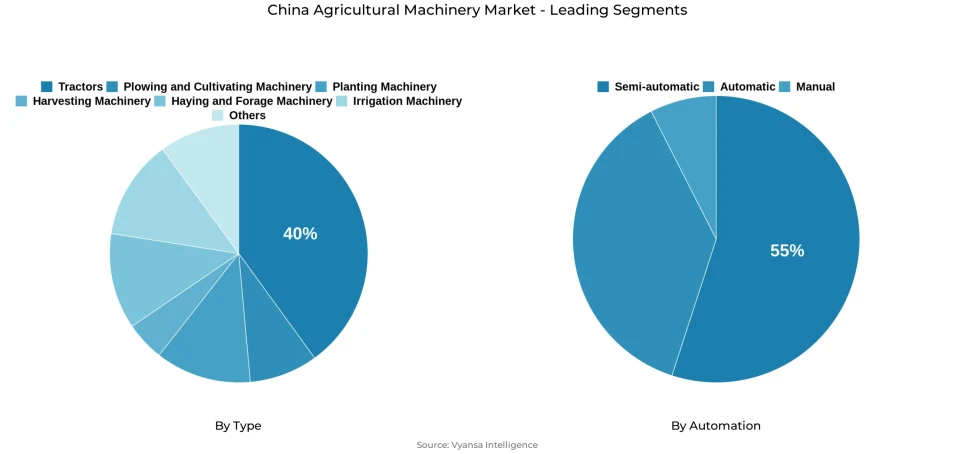
- Tractors grabbed market share of 40%.
- Competition
- More than 10 companies are actively engaged in producing agricultural machinery in China.
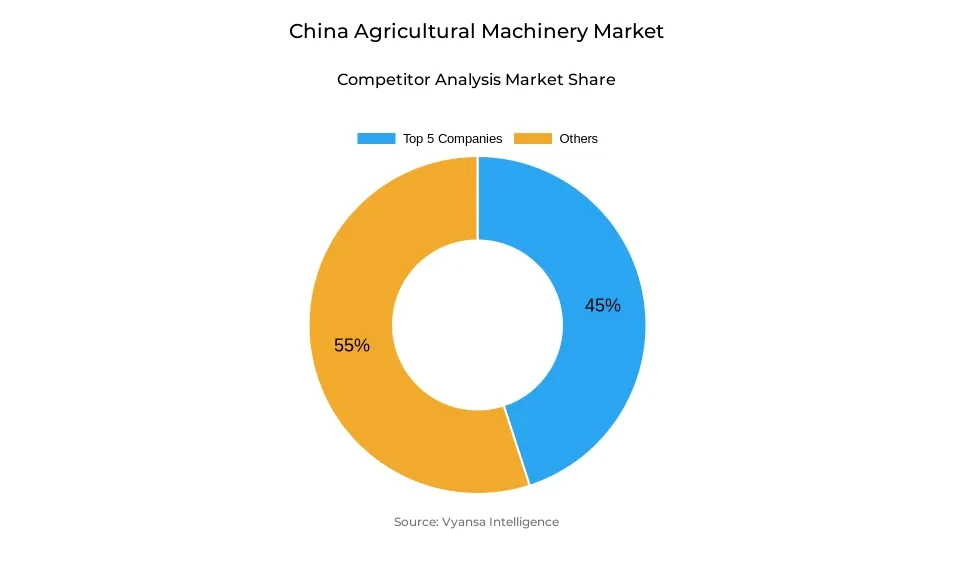
- Top 5 companies acquired around 45% of the market share.
- Dongfeng Agricultural Machinery Group Co. Ltd., Weichai Lovol Intelligent Agricultural Technology, Kubota Agricultural Machinery (Suzhou) Co. Ltd., YTO Group Corporation, Lovol Heavy Industry Co. Ltd. etc., are few of the top companies.
- Automation
- Semi-automatic grabbed 55% of the market.
China Agricultural Machinery Market Outlook
The China Agricultural Machinery Market was valued at USD 25.8 billion in 2025 and is projected to advance from USD 27.5 billion in 2026 to USD 36.2 billion by 2032, registering a CAGR of approximately 4.96% during the forecast period. China's structural position as the world's most populous nation and one of its largest grain-producing economies creates a demand environment for agricultural machinery that is simultaneously driven by food security imperatives, large-scale cultivation requirements, and continuous policy-backed modernization of farming infrastructure across major agricultural provinces. The scale and diversity of China's farming systems, spanning commercial grain operations in the northeast to fragmented smallholder cultivation across the south and central regions, sustain broad and layered demand for mechanized equipment across the forecast period.
Tractors command approximately 40% share within the equipment category, reflecting their multi-functional role across plowing, planting, harvesting support, and transportation activities that make them the most operationally versatile and commercially indispensable machinery class within the China Agricultural Machinery Market. Based on data from the Ministry of Agriculture and Rural Affairs, government policies actively promote advanced farming equipment adoption to improve field efficiency and reduce labor dependency, reinforcing tractor demand as the foundational layer of China's national mechanization programme across both commercial and smallholder farming systems.
Semi-automatic machinery holds approximately 55% share within the automation segment, a dominance sustained by its capacity to deliver an operationally productive balance between affordability and mechanized efficiency across China's fragmented farm structures, where full automation deployment remains economically inaccessible for a significant proportion of active agricultural holdings. As per data published by the National Bureau of Statistics of China, grain production across the country reached over 700 million tonnes in recent years, reinforcing the scale of cultivation activity that semi-automatic systems are increasingly relied upon to support.
Government-led agricultural modernization continues to shape the long-term trajectory of equipment demand across China's farming regions. According to statistics released by the Food and Agriculture Organization, China's sustained investment in farm mechanization and smart agriculture technologies is progressively elevating mechanization rates across provinces where manual farming previously dominated, broadening the geographic and operational demand base of the China Agricultural Machinery Market through 2032.
China Agricultural Machinery Market Growth Driver
Food Security Focus and Farm Mechanization Policy Support
Rising food security emphasis and government mechanization support establish sustained demand for farm equipment throughout China. Statistics from National Bureau of Statistics confirm country's grain output reached approximately 706.5 million tonnes in 2024 establishing massive production base requiring continuous mechanization. This agricultural importance directly translates into heightened relevance for mechanized solutions. Growing food security imperatives ensure persistent equipment demand supporting improved farming outcomes throughout extended forecast period.
Rural mechanization advancement and government policy support strengthen commercial foundation for agricultural machinery deployment. Published evidence from Ministry of Agriculture and Rural Affairs indicates comprehensive mechanization rate advanced to 76.7% with government continuing support for modern farming and rural mechanization. This policy momentum creates opportunity for equipment suppliers developing solutions supporting large-scale cultivation. Food security focus ensures sustained machinery demand supporting enhanced regional agricultural production and efficiency.
China Agricultural Machinery Market Challenge
High Equipment Costs and Fragmented Agricultural Landholdings
China agricultural machinery sector faces substantial challenge from high purchasing and maintenance costs restricting small farmer adoption. Official records from Organisation for Economic Co-operation and Development (OECD) indicate average farm size in China remains less than one hectare with Reuters reporting farms average approximately 0.65 hectares compared with 187 hectares in U.S. and 60 hectares in Germany. This scale disparity creates operational barriers limiting equipment acquisition for smallholder operations. Service providers must develop affordable solutions addressing capital constraints for smaller farming systems.
Farm fragmentation and machinery utilization inefficiency intensity adoption barriers for agricultural equipment. Evidence from Frontiers reveals average cultivated land area of China's rural households below 7.5 mu distributed across approximately 5.5 separate plots, reducing machinery efficiency and increasing operational costs. This fragmentation combined with limited servicing infrastructure in remote provinces creates difficult operating environment affecting equipment viability. Manufacturers must develop solutions supporting feasible deployment across fragmented landholding systems.
Unlock Market Intelligence
Explore the market potential with our data-driven report
China Agricultural Machinery Market Trend
Smart Farming and Precision Agriculture Technology Integration
China agricultural machinery sector demonstrates pronounced shift toward smart farming and precision agriculture technologies enabling productivity optimization. Market data from FAO indicates digital agriculture technologies expanding globally to improve productivity while OECD-FAO Agricultural Outlook notes China accounts for approximately 24% global grain production with less than 9% arable land, establishing efficiency imperative. This technology momentum directly supports expansion for autonomous machinery and AI-supported systems. Published evidence from Civil Aviation Administration reveals country operated more than 251,000 agricultural drones in 2024 demonstrating rapid adoption.
Fuel-efficient equipment and technology-integrated machinery adoption strengthen sector-wide adoption of advanced farming solutions. Published data establishes manufacturers increasingly focusing on technology-integrated equipment suitable for large-scale grain cultivation with rising use of automation and precision farming technologies supporting modernization. This innovation focus supports expansion for GPS-enabled tractors and smart irrigation across China. Service providers developing technology-enabled solutions position themselves advantageously capturing growth opportunities throughout regional agricultural sector.
China Agricultural Machinery Market Opportunity
Large-Scale Grain Farming and Advanced Harvesting System Expansion
Strong opportunities emerge in large-scale grain farming supporting advanced harvesting system deployment. Official records from National Bureau of Statistics reveal nation's total grain production climbed to record-breaking 714.88 million tonnes establishing substantial equipment demand for combine harvesters, seeders, balers, and irrigation machinery. This production scale creates commercial opportunity for equipment suppliers developing specialized solutions supporting large-scale operations. Grain production expansion directly enables accelerated machinery adoption across major agricultural regions.
Government modernization initiatives and commercial farming expansion strengthen commercial foundation for agricultural machinery deployment. Evidence indicates Ministry of Agriculture and Rural Affairs continues supporting agricultural mechanization with mechanized farming expanding across grain-producing provinces to improve productivity. This policy momentum combined with rising commercial farming activities creates sustained opportunity for advanced machinery providers. Growing agricultural modernization initiatives ensure sustained equipment demand throughout extended forecast period.
Unlock Market Intelligence
Explore the market potential with our data-driven report
China Agricultural Machinery Market Segmentation Analysis
By Type
- Tractors
- Horsepower
- Less than 40 HP
- 40 HP–99 HP
- Greater than 100 HP
- Tractor Type
- Compact Utility Tractors
- Utility Tractors
- Row-Crop Tractors
- Horsepower
- Plowing and Cultivating Machinery
- Plows
- Harrows
- Cultivators and Tillers
- Others
- Planting Machinery
- Seed Drills
- Planters
- Spreaders
- Others
- Harvesting Machinery
- Combine Harvesters-Threshers
- Forage Harvesters
- Others
- Haying and Forage Machinery
- Mower-conditioners
- Balers
- Others
- Irrigation Machinery
- Sprinkler Irrigation
- Drip Irrigation
- Others
- Others
Tractors commands market leadership at 40% share within China agricultural machinery sector, establishing dominant equipment positioning through broad applicability supporting plowing, tilling, planting, and hauling across grain, wheat, corn, rice, and vegetable operations. This segment maintains leading position due to tractor suitability for multiple farming applications improving labor productivity and operational efficiency, generating sustained demand for versatile solutions. Tractor delivery accessible positioning supporting routine farming applications while enabling productivity enhancement, establishing broad appeal across smallholder and commercial farming operations.
This sector leadership position reflects farming community's continued selection of tractors supporting essential work throughout agricultural lifecycles. Tractors remain important because farm mechanization levels continue increasing across major agricultural provinces while supporting large-scale cultivation performance. The 40% share indicates this segment continues shaping equipment demand, manufacturer innovation focus, and operational structure throughout China agricultural sector. Manufacturers maintaining tractor leadership develop competitive advantages enabling broader market penetration and sustained revenue growth supporting diverse farming applications.
By Automation
- Automatic
- Semi-automatic
- Manual
The segment has the highest share around Semi-automatic under the Automation segment, accounting for nearly 55% market share in the China Agricultural Machinery Market. Semi-automatic agricultural machinery witnesses strong demand due to its balance between operational efficiency, affordability, and ease of use across small and medium-sized farms. Farmers widely prefer semi-automatic tractors, harvesters, seeders, and spraying equipment because these machines reduce manual labor while remaining more cost-effective than fully automated systems.
China continues to strengthen agricultural mechanization and smart farming development to improve food production efficiency. According to China’s Ministry of Agriculture and Rural Affairs (MARA), the country continues expanding mechanized farming practices across grain production regions to improve operational productivity and reduce labor dependency. Semi-automatic machinery remains highly suitable for diverse farming conditions and fragmented agricultural land areas across China. These advantages continue supporting strong adoption of semi-automatic agricultural equipment across commercial and regional farming activities.
List of Companies Covered in China Agricultural Machinery Market
The companies listed below are highly influential in the China agricultural machinery market, with a significant market share and a strong impact on industry developments.
- Dongfeng Agricultural Machinery Group Co. Ltd.
- Weichai Lovol Intelligent Agricultural Technology
- Kubota Agricultural Machinery (Suzhou) Co. Ltd.
- YTO Group Corporation
- Lovol Heavy Industry Co. Ltd.
- Zoomlion Heavy Industry Science & Technology Co. Ltd.
- Jiangsu World Agriculture Machinery Co. Ltd.
- Changfa Agricultural Equipment Co. Ltd.
- Yanmar Agricultural Equipment (China) Co. Ltd.
- Deere & Company China
Market News & Updates
- Weichai Lovol Intelligent Agricultural Technology, 2025:
Weichai Lovol Intelligent Agricultural Technology commissioned its intelligent tractor manufacturing base in Weifang, Shandong in May 2025. The facility is designed for annual production capacity of 100,000 high-horsepower intelligent tractors and integrates 5G-enabled industrial internet systems, automated machining, and digital manufacturing technologies. The site also supports production of CVT and power-shift tractors aimed at China’s growing demand for high-end smart agricultural machinery.
- LOVOL, 2025:
LOVOL introduced its integrated smart farming solutions and launched the E1000 all-electric tractor at AGRITECHNICA 2025. The electric tractor features a fully electric drivetrain with lithium iron phosphate battery technology and supports precision farming applications. Alongside the launch, the company showcased intelligent planting, harvesting, and autonomous agricultural equipment technologies targeting modernization of large-scale farming operations.
Frequently Asked Questions
Related Report
- Market Segmentation
- Research Scope
- Research Methodology
- Definitions and Assumptions
- Executive Summary
- China Agricultural Machinery Market Policies, Regulations, and Standards
- China Agricultural Machinery Production (Thousand Unit) Trend 2022-2032
- China Agricultural Machinery Production (Thousand Unit) Trend By Type
- Tractors
- Plowing and Cultivating Machinery
- Planting Machinery
- Harvesting Machinery
- Haying and Forage Machinery
- Irrigation Machinery
- Company Wise Production Plants and Statistics
- Installed Production Capacity
- Actual Production
- Planned Production Target
- China Agricultural Machinery Production (Thousand Unit) Trend By Type
- China Agricultural Machinery Market Dynamics
- Growth Factors
- Challenges
- Trends
- Opportunities
- China Agricultural Machinery Market Statistics, 2022-2032F
- Market Size & Growth Outlook
- By Revenues in USD Million
- Market Segmentation & Growth Outlook
- By Type
- Tractors- Market Insights and Forecast 2022-2032, USD Million
- Horsepower- Market Insights and Forecast 2022-2032, USD Million
- Less than 40 HP- Market Insights and Forecast 2022-2032, USD Million
- 40 HP–99 HP- Market Insights and Forecast 2022-2032, USD Million
- Greater than 100 HP- Market Insights and Forecast 2022-2032, USD Million
- Tractor Type- Market Insights and Forecast 2022-2032, USD Million
- Compact Utility Tractors- Market Insights and Forecast 2022-2032, USD Million
- Utility Tractors- Market Insights and Forecast 2022-2032, USD Million
- Row-Crop Tractors- Market Insights and Forecast 2022-2032, USD Million
- Horsepower- Market Insights and Forecast 2022-2032, USD Million
- Plowing and Cultivating Machinery- Market Insights and Forecast 2022-2032, USD Million
- Plows- Market Insights and Forecast 2022-2032, USD Million
- Harrows- Market Insights and Forecast 2022-2032, USD Million
- Cultivators and Tillers- Market Insights and Forecast 2022-2032, USD Million
- Others- Market Insights and Forecast 2022-2032, USD Million
- Planting Machinery- Market Insights and Forecast 2022-2032, USD Million
- Seed Drills- Market Insights and Forecast 2022-2032, USD Million
- Planters- Market Insights and Forecast 2022-2032, USD Million
- Spreaders- Market Insights and Forecast 2022-2032, USD Million
- Others- Market Insights and Forecast 2022-2032, USD Million
- Harvesting Machinery- Market Insights and Forecast 2022-2032, USD Million
- Combine Harvesters-Threshers- Market Insights and Forecast 2022-2032, USD Million
- Forage Harvesters- Market Insights and Forecast 2022-2032, USD Million
- Others- Market Insights and Forecast 2022-2032, USD Million
- Haying and Forage Machinery- Market Insights and Forecast 2022-2032, USD Million
- Mower-conditioners- Market Insights and Forecast 2022-2032, USD Million
- Balers- Market Insights and Forecast 2022-2032, USD Million
- Others- Market Insights and Forecast 2022-2032, USD Million
- Irrigation Machinery- Market Insights and Forecast 2022-2032, USD Million
- Sprinkler Irrigation- Market Insights and Forecast 2022-2032, USD Million
- Drip Irrigation- Market Insights and Forecast 2022-2032, USD Million
- Others- Market Insights and Forecast 2022-2032, USD Million
- Others- Market Insights and Forecast 2022-2032, USD Million
- Tractors- Market Insights and Forecast 2022-2032, USD Million
- By Application
- Land Development & Seed Bed Preparation- Market Insights and Forecast 2022-2032, USD Million
- Sowing & Planting- Market Insights and Forecast 2022-2032, USD Million
- Weed Cultivation- Market Insights and Forecast 2022-2032, USD Million
- Plant Protection- Market Insights and Forecast 2022-2032, USD Million
- Harvesting & Threshing- Market Insights and Forecast 2022-2032, USD Million
- Post-harvest & Agro Processing- Market Insights and Forecast 2022-2032, USD Million
- By Automation
- Automatic- Market Insights and Forecast 2022-2032, USD Million
- Semi-automatic- Market Insights and Forecast 2022-2032, USD Million
- Manual- Market Insights and Forecast 2022-2032, USD Million
- By Region
- North- Market Insights and Forecast 2022-2032, USD Million
- East- Market Insights and Forecast 2022-2032, USD Million
- Southwest- Market Insights and Forecast 2022-2032, USD Million
- Northwest- Market Insights and Forecast 2022-2032, USD Million
- North East- Market Insights and Forecast 2022-2032, USD Million
- South- Market Insights and Forecast 2022-2032, USD Million
- By Competitors
- Competition Characteristics
- Market Share & Analysis
- By Type
- Market Size & Growth Outlook
- China Tractors Market Statistics, 2022-2032
- Market Size & Growth Outlook
- By Revenues in USD Million
- Market Segmentation & Growth Outlook
- By Application- Market Insights and Forecast 2022-2032, USD Million
- By Automation- Market Insights and Forecast 2022-2032, USD Million
- By Region- Market Insights and Forecast 2022-2032, USD Million
- Market Size & Growth Outlook
- China Plowing and Cultivating Machinery Market Statistics, 2022-2032
- Market Size & Growth Outlook
- By Revenues in USD Million
- Market Segmentation & Growth Outlook
- By Application- Market Insights and Forecast 2022-2032, USD Million
- By Automation- Market Insights and Forecast 2022-2032, USD Million
- By Region- Market Insights and Forecast 2022-2032, USD Million
- Market Size & Growth Outlook
- China Planting Machinery Market Statistics, 2022-2032
- Market Size & Growth Outlook
- By Revenues in USD Million
- Market Segmentation & Growth Outlook
- By Application- Market Insights and Forecast 2022-2032, USD Million
- By Automation- Market Insights and Forecast 2022-2032, USD Million
- By Region- Market Insights and Forecast 2022-2032, USD Million
- Market Size & Growth Outlook
- China Harvesting Machinery Market Statistics, 2022-2032
- Market Size & Growth Outlook
- By Revenues in USD Million
- Market Segmentation & Growth Outlook
- By Application- Market Insights and Forecast 2022-2032, USD Million
- By Automation- Market Insights and Forecast 2022-2032, USD Million
- By Region- Market Insights and Forecast 2022-2032, USD Million
- Market Size & Growth Outlook
- China Haying and Forage Machinery Market Statistics, 2022-2032
- Market Size & Growth Outlook
- By Revenues in USD Million
- Market Segmentation & Growth Outlook
- By Application- Market Insights and Forecast 2022-2032, USD Million
- By Automation- Market Insights and Forecast 2022-2032, USD Million
- By Region- Market Insights and Forecast 2022-2032, USD Million
- Market Size & Growth Outlook
- China Irrigation Machinery Market Statistics, 2022-2032
- Market Size & Growth Outlook
- By Revenues in USD Million
- Market Segmentation & Growth Outlook
- By Application- Market Insights and Forecast 2022-2032, USD Million
- By Automation- Market Insights and Forecast 2022-2032, USD Million
- By Region- Market Insights and Forecast 2022-2032, USD Million
- Market Size & Growth Outlook
- Competitive Outlook
- Company Profiles
- YTO Group Corporation
- Business Description
- Product Portfolio
- Collaborations & Alliances
- Recent Developments
- Financial Details
- Others
- Lovol Heavy Industry Co. Ltd.
- Business Description
- Product Portfolio
- Collaborations & Alliances
- Recent Developments
- Financial Details
- Others
- Zoomlion Heavy Industry Science & Technology Co. Ltd.
- Business Description
- Product Portfolio
- Collaborations & Alliances
- Recent Developments
- Financial Details
- Others
- Jiangsu World Agriculture Machinery Co. Ltd.
- Business Description
- Product Portfolio
- Collaborations & Alliances
- Recent Developments
- Financial Details
- Others
- Changfa Agricultural Equipment Co. Ltd.
- Business Description
- Product Portfolio
- Collaborations & Alliances
- Recent Developments
- Financial Details
- Others
- Dongfeng Agricultural Machinery Group Co. Ltd.
- Business Description
- Product Portfolio
- Collaborations & Alliances
- Recent Developments
- Financial Details
- Others
- Weichai Lovol Intelligent Agricultural Technology
- Business Description
- Product Portfolio
- Collaborations & Alliances
- Recent Developments
- Financial Details
- Others
- Kubota Agricultural Machinery (Suzhou) Co. Ltd.
- Business Description
- Product Portfolio
- Collaborations & Alliances
- Recent Developments
- Financial Details
- Others
- Yanmar Agricultural Equipment (China) Co. Ltd.
- Business Description
- Product Portfolio
- Collaborations & Alliances
- Recent Developments
- Financial Details
- Others
- Deere & Company China
- Business Description
- Product Portfolio
- Collaborations & Alliances
- Recent Developments
- Financial Details
- Others
- YTO Group Corporation
- Company Profiles
- Disclaimer
| Segment | Sub-Segment |
|---|---|
| By Type |
|
| By Application |
|
| By Automation |
|
| By Region |
|
Research Methodology
This study followed a structured approach comprising four key phases to assess the size and scope of the electro-oxidation market. The process began with thorough secondary research to collect data on the target market, related markets, and broader industry context. These findings, along with preliminary assumptions and estimates, were then validated through extensive primary research involving industry experts from across the value chain. To calculate the overall market size, both top-down and bottom-up methodologies were employed. Finally, market segmentation and data triangulation techniques were applied to refine and validate segment-level estimations.
Secondary Research
The secondary research phase involved gathering data from a wide range of credible and published sources. This step helped in identifying industry trends, defining market segmentation, and understanding the market landscape and value chain.
Sources consulted during this phase included:
- Company annual reports, investor presentations, and press releases
- Industry white papers and certified publications
- Trade directories and market-recognized databases
- Articles from authoritative authors and reputable journals
- Gold and silver standard websites
Secondary research was critical in mapping out the industry's value chain and monetary flow, identifying key market segments, understanding regional variations, and tracking significant industry developments.
Other key sources:
- Financial disclosures
- Industry associations and trade bodies
- News outlets and business magazines
- Academic journals and research studies
- Paid industry databases
Primary Research
To validate secondary data and gain deeper market insights, primary research was conducted with key stakeholders across both the supply and demand sides of the market.
On the demand side, participants included decision-makers and influencers from end-user industries—such as CIOs, CTOs, and CSOs—who provided first-hand perspectives on market needs, product usage, and future expectations.
On the supply side, interviews were conducted with manufacturers, industry associations, and institutional participants to gather insights into current offerings, product pipelines, and market challenges.
Primary interviews provided critical inputs such as:
- Market size and revenue data
- Product and service breakdowns
- Market forecasts
- Regional and application-specific trends
Stakeholders consulted included:
- Leading OEM and solution providers
- Channel and distribution partners
- End users across various applications
- Independent consultants and industry specialists
Market Size Estimation and Data Triangulation
- Identifying Key Market Participants (Secondary Research)
- Goal: To identify the major players or companies in the target market. This typically involves using publicly available data sources such as industry reports, market research publications, and financial statements of companies.
- Tools: Reports from firms like Gartner, Forrester, Euromonitor, Statista, IBISWorld, and others. Public financial statements, news articles, and press releases from top market players.
- Extracting Earnings of Key Market Participants
- Goal: To estimate the earnings generated from the product or service being analyzed. This step helps in understanding the revenue potential of each market player in a specific geography.
- Methods: Earnings data can be gathered from:
- Publicly available financial reports (for listed companies).
- Interviews and primary data sources from professionals, such as Directors, VPs, SVPs, etc. This is especially useful for understanding more nuanced, internal data that isn't publicly disclosed.
- Annual reports and investor presentations of key players.
- Data Collation and Development of a Relevant Data Model
- Goal: To collate inputs from both primary and secondary sources into a structured, data-driven model for market estimation. This model will incorporate key market KPIs and any independent variables relevant to the market.
- Key KPIs: These could include:
- Market size, growth rate, and demand drivers.
- Industry-specific metrics like market share, average revenue per customer (ARPC), or average deal size.
- External variables, such as economic growth rates, inflation rates, or commodity prices, that could affect the market.
- Data Modeling: Based on this data, the market forecasts are developed for the next 5 years. A combination of trend analysis, scenario modeling, and statistical regression might be used to generate projections.
- Scenario Analysis
- Goal: To test different assumptions and validate how sensitive the market is to changes in key variables (e.g., market demand, regulatory changes, technological disruptions).
- Types of Scenarios:
- Base Case: Based on current assumptions and historical data.
- Best-Case Scenario: Assuming favorable market conditions, regulatory environments, and technological advancements.
- Worst-Case Scenario: Accounting for adverse factors, such as economic downturns, stricter regulations, or unexpected disruptions.












