Brazil Pet Products Market Report: Trends, Growth and Forecast (2025-2030)
By Product (Cat Litter, Pet Healthcare (Flea/Tick Treatments, Pet Dietary Supplements, Worming Treatments, Others), Other Pet Products (Beauty Products, Accessories, Others)), By Sales Channel (Retail Offline, Retail E-Commerce, Veterinary Clinics) ... Read more
|
Major Players
|
Brazil Pet Products Market Statistics and Insights, 2025
- Market Size Statistics
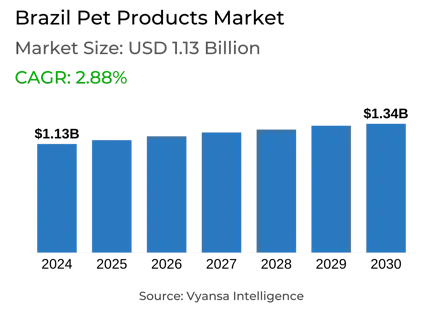
- Pet Products in Brazil is estimated at $ 1.13 Billion.
- The market size is expected to grow to $ 1.34 Billion by 2030.
- Market to register a CAGR of around 2.88% during 2025-30.
- Product Shares
- Other Pet Products grabbed market share of 40%.
- Competition
- More than 10 companies are actively engaged in producing Pet Products in Brazil.
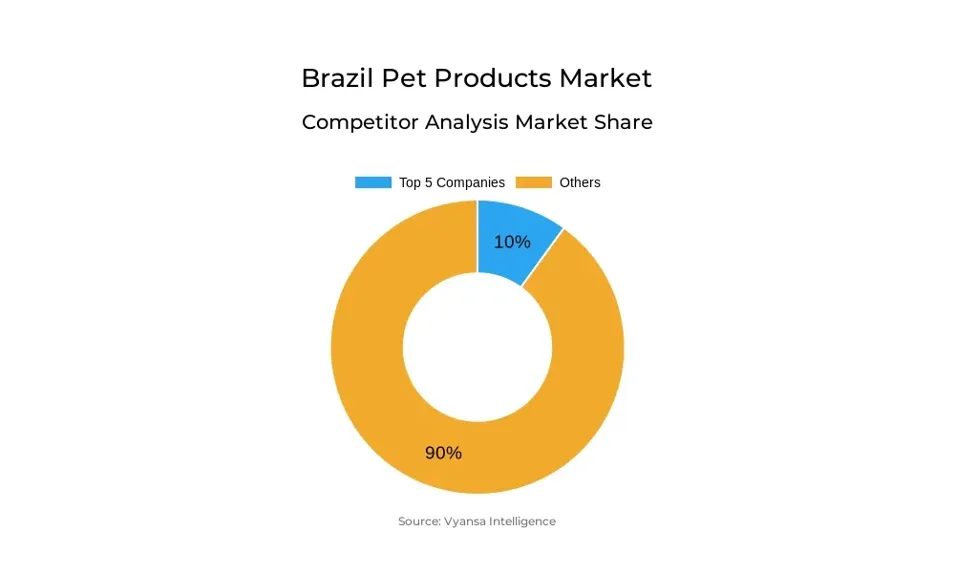
- Top 5 companies acquired 10% of the market share.
- Merial Saúde Animal Ltda, Laboratórios Pfizer Ltda, Schering-Plough Farmacêutica SA, Merial Saúde Animal Ltda, Bayer Brazil SA etc., are few of the top companies.
- Sales Channel
- Retail Offline grabbed 52% of the market.
Brazil Pet Products Market Outlook
Brazil pet products market will continue to expand between 2025 and 2030, albeit at a reduced and conservative rate as a result of continued economic uncertainty. Basic health-related products such as anti-parasitics will continue to be a core component of family expenditures because they are perceived as essentials with strong brand recognition. The larger players will maintain their dominance of this category with little scope for significant change or innovation.
At the same time, the "other pet products" category – comprised of beds, toys, hygienic items, and accessories – will be the most vibrant sector. End-users are more and more searching for lifestyle-driven, functional, and fashionable products that mirror how much they love and care about their pets. Even during economically constrained times, pet owners continue to shell out for their animals' comfort and well-being, especially when the products bring value and beauty.
E-commerce will be the growth driver, particularly for small and niche brands. As online consumer shopping habits become more entrenched, consumers increasingly are going to online sites for convenience, diversity, and direct access to new and specialist products. This is good news for smaller firms that can start up rapidly and adapt to evolving tastes, without depending on big retail intermediaries.
The increasing humanisation of pets, particularly smaller animals such as rodents and fish, is influencing the way individuals style pet areas in their homes. Social media trends are motivating pet owners to customise and furnish these spaces with comfort and aesthetics in consideration. This trend will drive demand for decorative and high-end accessories, opening up new room for innovation and brand narratives.
Brazil Pet Products Market Trend
The pet humanisation trend is deepening in Brazil, particularly for small animals such as rodents, birds, and fish. Instead of just cages and tanks, pet owners are going beyond to provide personalised and enriching living spaces within homes. This ranges from padded flooring, natural materials, and miniature furniture to seasonal decorations and interactive toys that enhance pet welfare. Social media sites such as Instagram and TikTok are helping to make these "pet rooms" popular, as users post pictures of their arrangements and regimens to the tune of cat and dog setups.
This increased emotional attachment is reshaping the way individuals shop for pet accessories. Shoppers are no longer looking for products that are merely functional but want things that are both functional and stylish, with a personality attached. As this trend catches on, it is compelling brands to provide decorative, expressive, and lifestyle-oriented solutions that indicate an increasing bond between pets and owners.
Brazil Pet Products Market Opportunity
Hygiene innovation and sustainability are anticipated to drive robust growth opportunities throughout Brazil pet product market. Although basic healthcare products like anti-parasitic medicines are going to be a steadfast pillar, faster development is anticipated in categories that reflect the contemporary consumer issues of convenience and the environment.
One such example is the increased demand for drain-connected dog toilets, pioneered by local brand Weasy. The systems minimize waste generated by disposable pads while providing better hygiene and cleanliness for pet owners. With urban living becoming increasingly prominent, demand for such practical and eco-friendly solutions is poised to grow, leading brands to innovate
Unlock Market Intelligence
Explore the market potential with our data-driven report
| Report Coverage | Details |
|---|---|
| Market Forecast | 2025-30 |
| USD Value 2024 | $ 1.13 Billion |
| USD Value 2030 | $ 1.34 Billion |
| CAGR 2025-2030 | 2.88% |
| Largest Category | Other Pet Products segment leads with 40% market share |
| Top Trends | Rising Influence of Pet Humanisation on Small Pet Care |
| Top Opportunities | Emerging Demand for Eco-Friendly and Functional Innovations |
| Key Players | Merial Saúde Animal Ltda, Laboratórios Pfizer Ltda, Schering-Plough Farmacêutica SA, Merial Saúde Animal Ltda, Bayer Brazil SA, Total Quimica Ltda, Pet Society Ltda, Guararapes Confecções SA, Oil-Dri Corp of America, Clorox Co and Others. |
Unlock Market Intelligence
Explore the market potential with our data-driven report
Brazil Pet Products Market Segmentation Analysis
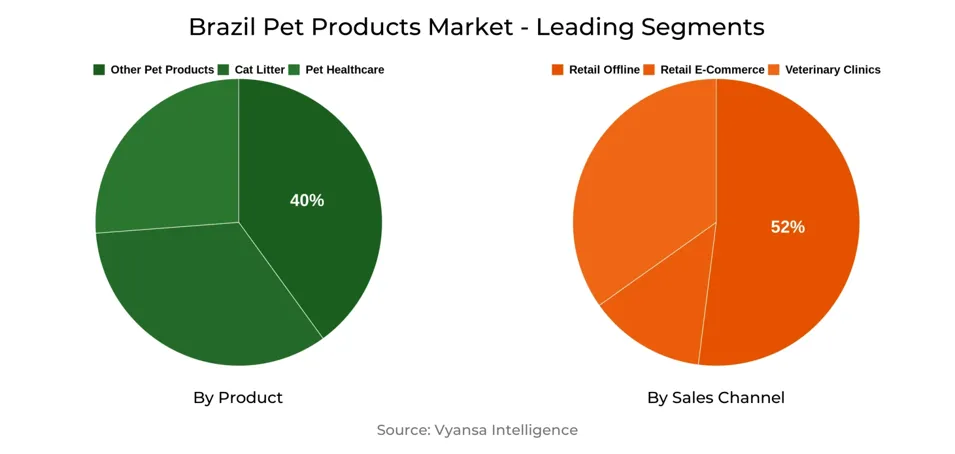
The most prominent segment within the sales channel is retail offline, which is primarily dominated by pet superstores and independent pet stores. They are favorites because they provide a holistic and hands-on shopping experience with the ability for pet owners to see, touch, and test products before purchasing. Major chains such as Petz and Cobasiv have broadened their services to add grooming, vaccination, and play areas, which generate weekend traffic and impulse buys of accessories, toys, and grooming aids. Their brick-and-mortar presence facilitates community building, brand loyalty, and repeat business.
E-commerce, on the other hand, is the most rapidly expanding channel, becoming increasingly popular for convenience and ease. Retailers such as Petz provide in-store pick-up and same-day delivery discounts, while sites like Pet Love have expanded proven subscription models. Smaller cities also see specialist online platforms expand, with social media and targeted advertising support. The future is in merging excellent in-store experiences with digital convenience.
Top Companies in Brazil Pet Products Market
The top companies operating in the market include Merial Saúde Animal Ltda, Laboratórios Pfizer Ltda, Schering-Plough Farmacêutica SA, Merial Saúde Animal Ltda, Bayer Brazil SA, Total Quimica Ltda, Pet Society Ltda, Guararapes Confecções SA, Oil-Dri Corp of America, Clorox Co, etc., are the top players operating in the Brazil Pet Products Market.
Frequently Asked Questions
Related Report
1. Market Segmentation
1.1. Research Scope
1.2. Research Methodology
1.3. Definitions and Assumptions
2. Executive Summary
3. Brazil Pet Products Market Policies, Regulations, and Standards
4. Brazil Pet Products Market Dynamics
4.1. Growth Factors
4.2. Challenges
4.3. Trends
4.4. Opportunities
5. Brazil Pet Products Market Statistics, 2020-2030F
5.1. Market Size & Growth Outlook
5.1.1.By Revenues in US$ Million
5.2. Market Segmentation & Growth Outlook
5.2.1.By Product
5.2.1.1. Cat Litter- Market Insights and Forecast 2020-2030, USD Million
5.2.1.2. Pet Healthcare- Market Insights and Forecast 2020-2030, USD Million
5.2.1.2.1. Flea/Tick Treatments- Market Insights and Forecast 2020-2030, USD Million
5.2.1.2.2. Pet Dietary Supplements- Market Insights and Forecast 2020-2030, USD Million
5.2.1.2.3. Worming Treatments- Market Insights and Forecast 2020-2030, USD Million
5.2.1.2.4. Others- Market Insights and Forecast 2020-2030, USD Million
5.2.1.3. Other Pet Products- Market Insights and Forecast 2020-2030, USD Million
5.2.1.3.1. Beauty Products- Market Insights and Forecast 2020-2030, USD Million
5.2.1.3.2. Accessories- Market Insights and Forecast 2020-2030, USD Million
5.2.1.3.3. Others- Market Insights and Forecast 2020-2030, USD Million
5.2.2.By Sales Channel
5.2.2.1. Retail Offline- Market Insights and Forecast 2020-2030, USD Million
5.2.2.2. Retail E-Commerce- Market Insights and Forecast 2020-2030, USD Million
5.2.2.3. Veterinary Clinics- Market Insights and Forecast 2020-2030, USD Million
5.2.3.By Competitors
5.2.3.1. Competition Characteristics
5.2.3.2. Market Share & Analysis
6. Brazil Cat Litter Products Market Statistics, 2020-2030F
6.1. Market Size & Growth Outlook
6.1.1.By Revenues in US$ Million
6.2. Market Segmentation & Growth Outlook
6.2.1.By Sales Channel- Market Insights and Forecast 2020-2030, USD Million
7. Brazil Pet Healthcare Market Statistics, 2020-2030F
7.1. Market Size & Growth Outlook
7.1.1.By Revenues in US$ Million
7.2. Market Segmentation & Growth Outlook
7.2.1.By Product- Market Insights and Forecast 2020-2030, USD Million
7.2.2.By Sales Channel- Market Insights and Forecast 2020-2030, USD Million
8. Brazil Other Pet Products Market Statistics, 2020-2030F
8.1. Market Size & Growth Outlook
8.1.1.By Revenues in US$ Million
8.2. Market Segmentation & Growth Outlook
8.2.1.By Product- Market Insights and Forecast 2020-2030, USD Million
8.2.2.By Sales Channel- Market Insights and Forecast 2020-2030, USD Million
9. Competitive Outlook
9.1. Company Profiles
9.1.1.Merial Saúde Animal Ltda
9.1.1.1. Business Description
9.1.1.2. Product Portfolio
9.1.1.3. Collaborations & Alliances
9.1.1.4. Recent Developments
9.1.1.5. Financial Details
9.1.1.6. Others
9.1.2.Bayer Brazil SA
9.1.2.1. Business Description
9.1.2.2. Product Portfolio
9.1.2.3. Collaborations & Alliances
9.1.2.4. Recent Developments
9.1.2.5. Financial Details
9.1.2.6. Others
9.1.3.Total Quimica Ltda
9.1.3.1. Business Description
9.1.3.2. Product Portfolio
9.1.3.3. Collaborations & Alliances
9.1.3.4. Recent Developments
9.1.3.5. Financial Details
9.1.3.6. Others
9.1.4.Pet Society Ltda
9.1.4.1. Business Description
9.1.4.2. Product Portfolio
9.1.4.3. Collaborations & Alliances
9.1.4.4. Recent Developments
9.1.4.5. Financial Details
9.1.4.6. Others
9.1.5.Guararapes Confecções SA
9.1.5.1. Business Description
9.1.5.2. Product Portfolio
9.1.5.3. Collaborations & Alliances
9.1.5.4. Recent Developments
9.1.5.5. Financial Details
9.1.5.6. Others
9.1.6.Laboratórios Pfizer Ltda
9.1.6.1. Business Description
9.1.6.2. Product Portfolio
9.1.6.3. Collaborations & Alliances
9.1.6.4. Recent Developments
9.1.6.5. Financial Details
9.1.6.6. Others
9.1.7.Schering-Plough Farmacêutica SA
9.1.7.1. Business Description
9.1.7.2. Product Portfolio
9.1.7.3. Collaborations & Alliances
9.1.7.4. Recent Developments
9.1.7.5. Financial Details
9.1.7.6. Others
9.1.8.Oil-Dri Corp of America
9.1.8.1. Business Description
9.1.8.2. Product Portfolio
9.1.8.3. Collaborations & Alliances
9.1.8.4. Recent Developments
9.1.8.5. Financial Details
9.1.8.6. Others
9.1.9.Clorox Co
9.1.9.1. Business Description
9.1.9.2. Product Portfolio
9.1.9.3. Collaborations & Alliances
9.1.9.4. Recent Developments
9.1.9.5. Financial Details
9.1.9.6. Others
9.1.10. Church & Dwight Co Inc
9.1.10.1. Business Description
9.1.10.2. Product Portfolio
9.1.10.3. Collaborations & Alliances
9.1.10.4. Recent Developments
9.1.10.5. Financial Details
9.1.10.6. Others
10. Disclaimer
| Segment | Sub-Segment |
|---|---|
| By Product |
|
| By Sales Channel |
|
Research Methodology
This study followed a structured approach comprising four key phases to assess the size and scope of the electro-oxidation market. The process began with thorough secondary research to collect data on the target market, related markets, and broader industry context. These findings, along with preliminary assumptions and estimates, were then validated through extensive primary research involving industry experts from across the value chain. To calculate the overall market size, both top-down and bottom-up methodologies were employed. Finally, market segmentation and data triangulation techniques were applied to refine and validate segment-level estimations.
Secondary Research
The secondary research phase involved gathering data from a wide range of credible and published sources. This step helped in identifying industry trends, defining market segmentation, and understanding the market landscape and value chain.
Sources consulted during this phase included:
- Company annual reports, investor presentations, and press releases
- Industry white papers and certified publications
- Trade directories and market-recognized databases
- Articles from authoritative authors and reputable journals
- Gold and silver standard websites
Secondary research was critical in mapping out the industry's value chain and monetary flow, identifying key market segments, understanding regional variations, and tracking significant industry developments.
Other key sources:
- Financial disclosures
- Industry associations and trade bodies
- News outlets and business magazines
- Academic journals and research studies
- Paid industry databases
Primary Research
To validate secondary data and gain deeper market insights, primary research was conducted with key stakeholders across both the supply and demand sides of the market.
On the demand side, participants included decision-makers and influencers from end-user industries—such as CIOs, CTOs, and CSOs—who provided first-hand perspectives on market needs, product usage, and future expectations.
On the supply side, interviews were conducted with manufacturers, industry associations, and institutional participants to gather insights into current offerings, product pipelines, and market challenges.
Primary interviews provided critical inputs such as:
- Market size and revenue data
- Product and service breakdowns
- Market forecasts
- Regional and application-specific trends
Stakeholders consulted included:
- Leading OEM and solution providers
- Channel and distribution partners
- End users across various applications
- Independent consultants and industry specialists
Market Size Estimation and Data Triangulation
- Identifying Key Market Participants (Secondary Research)
- Goal: To identify the major players or companies in the target market. This typically involves using publicly available data sources such as industry reports, market research publications, and financial statements of companies.
- Tools: Reports from firms like Gartner, Forrester, Euromonitor, Statista, IBISWorld, and others. Public financial statements, news articles, and press releases from top market players.
- Extracting Earnings of Key Market Participants
- Goal: To estimate the earnings generated from the product or service being analyzed. This step helps in understanding the revenue potential of each market player in a specific geography.
- Methods: Earnings data can be gathered from:
- Publicly available financial reports (for listed companies).
- Interviews and primary data sources from professionals, such as Directors, VPs, SVPs, etc. This is especially useful for understanding more nuanced, internal data that isn't publicly disclosed.
- Annual reports and investor presentations of key players.
- Data Collation and Development of a Relevant Data Model
- Goal: To collate inputs from both primary and secondary sources into a structured, data-driven model for market estimation. This model will incorporate key market KPIs and any independent variables relevant to the market.
- Key KPIs: These could include:
- Market size, growth rate, and demand drivers.
- Industry-specific metrics like market share, average revenue per customer (ARPC), or average deal size.
- External variables, such as economic growth rates, inflation rates, or commodity prices, that could affect the market.
- Data Modeling: Based on this data, the market forecasts are developed for the next 5 years. A combination of trend analysis, scenario modeling, and statistical regression might be used to generate projections.
- Scenario Analysis
- Goal: To test different assumptions and validate how sensitive the market is to changes in key variables (e.g., market demand, regulatory changes, technological disruptions).
- Types of Scenarios:
- Base Case: Based on current assumptions and historical data.
- Best-Case Scenario: Assuming favorable market conditions, regulatory environments, and technological advancements.
- Worst-Case Scenario: Accounting for adverse factors, such as economic downturns, stricter regulations, or unexpected disruptions.












