Brazil Pet Care Market Report: Trends, Growth and Forecast (2025-2030)
By Product (Pet Food (Dry Food, Wet Food, Treats & Mixers), Pet Products (Cat Litter, Pet Healthcare (Veterinary Diets, Probiotics and Supplements, Tele-health Services)), Services (Veterinary Clinics, Pet Insurance, Boarding, Day-Care, and Training), Grooming and Hygiene (Shampoos and Conditioners, Brushes and Combs, Clippers and Scissors)), By Pet Type (Dog, Cat, Others), By Sales Channel (Retail Offline, Retail E-Commerce, Veterinary Clinics) ... Read more
|
Major Players
|
Brazil Pet Care Market Statistics and Insights, 2025
- Market Size Statistics
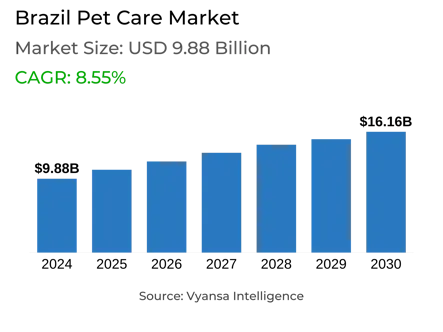
- Pet Care in Brazil is estimated at $ 9.88 Billion.
- The market size is expected to grow to $ 16.16 Billion by 2030.
- Market to register a CAGR of around 8.55% during 2025-30.
- Product Shares
- Pet Food grabbed market share of 85%.
- Pet Food to witness a volume CAGR of around 4.82%.
- Competition
- More than 15 companies are actively engaged in producing Pet Care in Brazil.
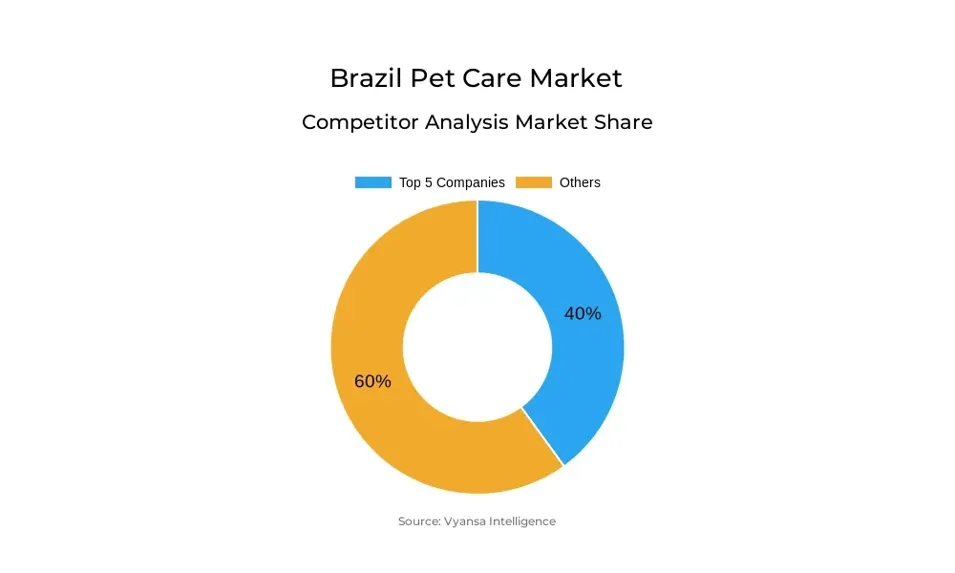
- Top 5 companies acquired 40% of the market share.
- BRF SA, Total Alimentos SA, Royal Canin do Brasil Indústria e Comércio Ltda, Grandfood Industria e Comercio Ltda, Mars Brasil Alimentos Ltda etc., are few of the top companies.
- Sales Channel
- Retail Offline grabbed 80% of the market.
Brazil Pet Care Market Outlook
The pet care market in Brazil is anticipated to grow steadily between the period 2025-2030 on the back of shifting demographics, changing consumer habits, and ongoing product development. Urbanization, compact living, and declining fertility rates are prompting individuals to opt for small dog breeds and, more so now, cats. This transition is expected to drive sales in the cat food category, especially premium wet food and mixers to meet hydration and health requirements, whereas dog food will continue to grow in mid-priced dry food and treats.
Pet humanisation will continue to be a key driver, but now it is going beyond premiumising to focus on overall wellbeing and lifestyle fit. Goods that blend nutrition, indulgence, and functional health benefits – like supplements, high-moisture treats, and environmentally friendly accessories – will be highly sought after. Value-for-money will also continue to matter, particularly during inflation, leading to brands providing affordable yet high-quality alternatives. Local firms are likely to make even greater inroads by being able to react quickly to consumer demands and leveraging sustainability in their plans.
More will be done online, with e-commerce assuming a growing role, providing convenience, customisation, and subscription models that build customer loyalty. Large pack sizes, previously hard to buy in-store, are becoming popular online due to doorstep delivery and competitive prices. Digital platforms are also extending their services to enable the consumer to buy, book the groom, or schedule veterinary visits under one roof.
In rural and semi-urban regions, farm supply stores are evolving with hybrid digital models, reaching out and sustaining confidence. Small online players and specialty boutiques will also grow, going after specialist niches with differentiated offerings. Generally, the market will be defined by a combination of affordability, innovation, and sustainability, with digital channels serving as a pillar of future growth.
Brazil Pet Care Market Trend
The pet humanisation trend is shifting, progressing beyond high-end food and accessories to encompass pets' emotional and physical health in general. Pet owners increasingly look for products that replicate humans' experiences, including decadent treats, functional supplements, and interactive feeding systems. Health and wellness drive purchase decisions, with increasing interest in solutions that promote joint health, digestion, immunity, and general vitality.
Artisanal and smaller companies are driving this trend with inventive products. Petvi launches multivitamin treats, omega-3 supplements, and protein bars for energetic dogs, targeting specific health requirements. Likewise, Biobone launches onto the market with environmentally friendly, edible chew toys made of natural fibres, uniting health, safety, and sustainability in one. This is part of a wider trend toward conscious and purpose-led pet care shopping.
Brazil Pet Care Market Opportunity
Smaller producers in the years to come will be introducing natural treats infused with functional ingredients like omega-3, collagen, and probiotics. These treats will find favour among pet owners who value both nutrition and health benefits for their pets, whose overall well-being will improve as a result.
Eco-friendly alternatives, such as biodegradable chew toys like those produced by Biobone, will get more significant market pull as sustainability goes from being a niche desire to becoming an expected standard. Consumers will increasingly seek more than the bare essentials of pet food or accessories, opting for products that reinforce the pet-owner connection, promote pet wellness, and connect with their individual values regarding environmental stewardship.
Unlock Market Intelligence
Explore the market potential with our data-driven report
| Report Coverage | Details |
|---|---|
| Market Forecast | 2025-30 |
| USD Value 2024 | $ 9.88 Billion |
| USD Value 2030 | $ 16.16 Billion |
| CAGR 2025-2030 | 8.55% |
| Largest Category | Pet Food segment leads with 85% market share |
| Top Trends | Rising Traction Towards Pet Humanisation |
| Top Opportunities | Rising Demand for Functional and Sustainable Pet Products |
| Key Players | BRF SA, Total Alimentos SA, Royal Canin do Brasil Indústria e Comércio Ltda, Grandfood Industria e Comercio Ltda, Mars Brasil Alimentos Ltda, Adimax Industria e Comercio Ltda, Nestlé Brasil Ltda, Manfrim Industrial e Comercial Ltda, Indústria e Comércio de Alimentos Desidratados Alcon Ltda, Colgate-Palmolive Indústria e Comércio Ltda and Others. |
Unlock Market Intelligence
Explore the market potential with our data-driven report
Brazil Pet Care Market Segmentation Analysis
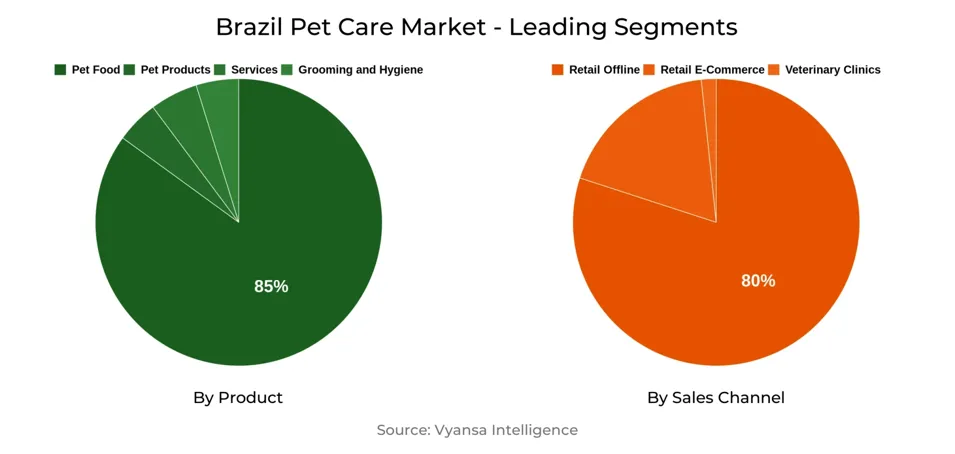
The most popular market segment under the sales channel is retail offline, dominated by superstores and pet shops in Brazil in 2025. These stores continue to hold sway through an engaging shopping experience and deep product assortment. Several have transformed into multifunctional establishments with grooming salons, routine veterinary services, and play areas for dogs. This strategy makes everyday purchases into fun trips, making customers more emotionally connected and loyal through convenience and interaction.
Retail e-commerce is the most rapidly growing channel, with its value share continuously rising as increasingly more consumers switch to digital buying. Growth, fueled by the COVID-19 pandemic, has been underpinned by aggressive pricing, flexible delivery, and subscription models. One of the prime drivers is the ease of purchasing 10–20 kilogram packages of dog food online instead of the inconvenience of hauling heavy items from traditional stores.
Top Companies in Brazil Pet Care Market
The top companies operating in the market include BRF SA, Total Alimentos SA, Royal Canin do Brasil Indústria e Comércio Ltda, Grandfood Industria e Comercio Ltda, Mars Brasil Alimentos Ltda, Adimax Industria e Comercio Ltda, Nestlé Brasil Ltda, Manfrim Industrial e Comercial Ltda, Indústria e Comércio de Alimentos Desidratados Alcon Ltda, Colgate-Palmolive Indústria e Comércio Ltda, etc., are the top players operating in the Brazil Pet Care Market.
Frequently Asked Questions
Related Report
1. Market Segmentation
1.1. Research Scope
1.2. Research Methodology
1.3. Definitions and Assumptions
2. Executive Summary
3. Brazil Pet Care Market Policies, Regulations, and Standards
4. Brazil Pet Care Market Dynamics
4.1. Growth Factors
4.2. Challenges
4.3. Trends
4.4. Opportunities
5. Brazil Pet Care Market Statistics, 2020-2030F
5.1. Market Size & Growth Outlook
5.1.1.By Revenues in US$ Million
5.2. Market Segmentation & Growth Outlook
5.2.1.By Product
5.2.1.1. Pet Food- Market Insights and Forecast 2020-2030, USD Million
5.2.1.1.1. Dry Food- Market Insights and Forecast 2020-2030, USD Million
5.2.1.1.2. Wet Food- Market Insights and Forecast 2020-2030, USD Million
5.2.1.1.3. Treats & Mixers- Market Insights and Forecast 2020-2030, USD Million
5.2.1.2. Pet Products- Market Insights and Forecast 2020-2030, USD Million
5.2.1.2.1. Cat Litter- Market Insights and Forecast 2020-2030, USD Million
5.2.1.2.2. Pet Healthcare- Market Insights and Forecast 2020-2030, USD Million
5.2.1.2.2.1. Veterinary Diets- Market Insights and Forecast 2020-2030, USD Million
5.2.1.2.2.2. Probiotics and Supplements- Market Insights and Forecast 2020-2030, USD Million
5.2.1.2.2.3. Tele-health Services- Market Insights and Forecast 2020-2030, USD Million
5.2.1.3. Services- Market Insights and Forecast 2020-2030, USD Million
5.2.1.3.1. Veterinary Clinics- Market Insights and Forecast 2020-2030, USD Million
5.2.1.3.2. Pet Insurance- Market Insights and Forecast 2020-2030, USD Million
5.2.1.3.3. Boarding, Day-Care, and Training- Market Insights and Forecast 2020-2030, USD Million
5.2.1.4. Grooming and Hygiene- Market Insights and Forecast 2020-2030, USD Million
5.2.1.4.1. Shampoos and Conditioners- Market Insights and Forecast 2020-2030, USD Million
5.2.1.4.2. Brushes and Combs- Market Insights and Forecast 2020-2030, USD Million
5.2.1.4.3. Clippers and Scissors- Market Insights and Forecast 2020-2030, USD Million
5.2.2.By Pet Type
5.2.2.1. Dog- Market Insights and Forecast 2020-2030, USD Million
5.2.2.2. Cat- Market Insights and Forecast 2020-2030, USD Million
5.2.2.3. Others- Market Insights and Forecast 2020-2030, USD Million
5.2.3.By Sales Channel
5.2.3.1. Retail Offline- Market Insights and Forecast 2020-2030, USD Million
5.2.3.2. Retail E-Commerce- Market Insights and Forecast 2020-2030, USD Million
5.2.3.3. Veterinary Clinics- Market Insights and Forecast 2020-2030, USD Million
5.2.4.By Competitors
5.2.4.1. Competition Characteristics
5.2.4.2. Market Share & Analysis
6. Brazil Pet Food Market Statistics, 2020-2030F
6.1. Market Size & Growth Outlook
6.1.1.By Revenues in US$ Million
6.1.2.By Quantity Sold in Kilo Tons
6.2. Market Segmentation & Growth Outlook
6.2.1.By Product- Market Insights and Forecast 2020-2030, USD Million
6.2.2.By Pet Type- Market Insights and Forecast 2020-2030, USD Million
6.2.3.By Sales Channel- Market Insights and Forecast 2020-2030, USD Million
7. Brazil Pet Product Market Statistics, 2020-2030F
7.1. Market Size & Growth Outlook
7.1.1.By Revenues in US$ Million
7.2. Market Segmentation & Growth Outlook
7.2.1.By Product- Market Insights and Forecast 2020-2030, USD Million
7.2.2.By Pet Type- Market Insights and Forecast 2020-2030, USD Million
7.2.3.By Sales Channel- Market Insights and Forecast 2020-2030, USD Million
8. Brazil Pet Care Service Market Statistics, 2020-2030F
8.1. Market Size & Growth Outlook
8.1.1.By Revenues in US$ Million
8.2. Market Segmentation & Growth Outlook
8.2.1.By Services- Market Insights and Forecast 2020-2030, USD Million
8.2.2.By Pet Type- Market Insights and Forecast 2020-2030, USD Million
8.2.3.By Sales Channel- Market Insights and Forecast 2020-2030, USD Million
9. Brazil Grooming and Hygiene Pet Care Market Statistics, 2020-2030F
9.1. Market Size & Growth Outlook
9.1.1.By Revenues in US$ Million
9.2. Market Segmentation & Growth Outlook
9.2.1.By Product- Market Insights and Forecast 2020-2030, USD Million
9.2.2.By Pet Type- Market Insights and Forecast 2020-2030, USD Million
9.2.3.By Sales Channel- Market Insights and Forecast 2020-2030, USD Million
10. Competitive Outlook
10.1. Company Profiles
10.1.1. Grandfood Industria e Comercio Ltda
10.1.1.1. Business Description
10.1.1.2. Product Portfolio
10.1.1.3. Collaborations & Alliances
10.1.1.4. Recent Developments
10.1.1.5. Financial Details
10.1.1.6. Others
10.1.2. Mars Brasil Alimentos Ltda
10.1.2.1. Business Description
10.1.2.2. Product Portfolio
10.1.2.3. Collaborations & Alliances
10.1.2.4. Recent Developments
10.1.2.5. Financial Details
10.1.2.6. Others
10.1.3. Adimax Industria e Comercio Ltda
10.1.3.1. Business Description
10.1.3.2. Product Portfolio
10.1.3.3. Collaborations & Alliances
10.1.3.4. Recent Developments
10.1.3.5. Financial Details
10.1.3.6. Others
10.1.4. Nestlé Brasil Ltda
10.1.4.1. Business Description
10.1.4.2. Product Portfolio
10.1.4.3. Collaborations & Alliances
10.1.4.4. Recent Developments
10.1.4.5. Financial Details
10.1.4.6. Others
10.1.5. Manfrim Industrial e Comercial Ltda
10.1.5.1. Business Description
10.1.5.2. Product Portfolio
10.1.5.3. Collaborations & Alliances
10.1.5.4. Recent Developments
10.1.5.5. Financial Details
10.1.5.6. Others
10.1.6. BRF SA
10.1.6.1. Business Description
10.1.6.2. Product Portfolio
10.1.6.3. Collaborations & Alliances
10.1.6.4. Recent Developments
10.1.6.5. Financial Details
10.1.6.6. Others
10.1.7. Total Alimentos SA
10.1.7.1. Business Description
10.1.7.2. Product Portfolio
10.1.7.3. Collaborations & Alliances
10.1.7.4. Recent Developments
10.1.7.5. Financial Details
10.1.7.6. Others
10.1.8. Royal Canin do Brasil Indústria e Comércio Ltda
10.1.8.1. Business Description
10.1.8.2. Product Portfolio
10.1.8.3. Collaborations & Alliances
10.1.8.4. Recent Developments
10.1.8.5. Financial Details
10.1.8.6. Others
10.1.9. Indústria e Comércio de Alimentos Desidratados Alcon Ltda
10.1.9.1. Business Description
10.1.9.2. Product Portfolio
10.1.9.3. Collaborations & Alliances
10.1.9.4. Recent Developments
10.1.9.5. Financial Details
10.1.9.6. Others
10.1.10. Colgate-Palmolive Indústria e Comércio Ltda
10.1.10.1.Business Description
10.1.10.2.Product Portfolio
10.1.10.3.Collaborations & Alliances
10.1.10.4.Recent Developments
10.1.10.5.Financial Details
10.1.10.6.Others
11. Disclaimer
| Segment | Sub-Segment |
|---|---|
| By Product |
|
| By Pet Type |
|
| By Sales Channel |
|
Research Methodology
This study followed a structured approach comprising four key phases to assess the size and scope of the electro-oxidation market. The process began with thorough secondary research to collect data on the target market, related markets, and broader industry context. These findings, along with preliminary assumptions and estimates, were then validated through extensive primary research involving industry experts from across the value chain. To calculate the overall market size, both top-down and bottom-up methodologies were employed. Finally, market segmentation and data triangulation techniques were applied to refine and validate segment-level estimations.
Secondary Research
The secondary research phase involved gathering data from a wide range of credible and published sources. This step helped in identifying industry trends, defining market segmentation, and understanding the market landscape and value chain.
Sources consulted during this phase included:
- Company annual reports, investor presentations, and press releases
- Industry white papers and certified publications
- Trade directories and market-recognized databases
- Articles from authoritative authors and reputable journals
- Gold and silver standard websites
Secondary research was critical in mapping out the industry's value chain and monetary flow, identifying key market segments, understanding regional variations, and tracking significant industry developments.
Other key sources:
- Financial disclosures
- Industry associations and trade bodies
- News outlets and business magazines
- Academic journals and research studies
- Paid industry databases
Primary Research
To validate secondary data and gain deeper market insights, primary research was conducted with key stakeholders across both the supply and demand sides of the market.
On the demand side, participants included decision-makers and influencers from end-user industries—such as CIOs, CTOs, and CSOs—who provided first-hand perspectives on market needs, product usage, and future expectations.
On the supply side, interviews were conducted with manufacturers, industry associations, and institutional participants to gather insights into current offerings, product pipelines, and market challenges.
Primary interviews provided critical inputs such as:
- Market size and revenue data
- Product and service breakdowns
- Market forecasts
- Regional and application-specific trends
Stakeholders consulted included:
- Leading OEM and solution providers
- Channel and distribution partners
- End users across various applications
- Independent consultants and industry specialists
Market Size Estimation and Data Triangulation
- Identifying Key Market Participants (Secondary Research)
- Goal: To identify the major players or companies in the target market. This typically involves using publicly available data sources such as industry reports, market research publications, and financial statements of companies.
- Tools: Reports from firms like Gartner, Forrester, Euromonitor, Statista, IBISWorld, and others. Public financial statements, news articles, and press releases from top market players.
- Extracting Earnings of Key Market Participants
- Goal: To estimate the earnings generated from the product or service being analyzed. This step helps in understanding the revenue potential of each market player in a specific geography.
- Methods: Earnings data can be gathered from:
- Publicly available financial reports (for listed companies).
- Interviews and primary data sources from professionals, such as Directors, VPs, SVPs, etc. This is especially useful for understanding more nuanced, internal data that isn't publicly disclosed.
- Annual reports and investor presentations of key players.
- Data Collation and Development of a Relevant Data Model
- Goal: To collate inputs from both primary and secondary sources into a structured, data-driven model for market estimation. This model will incorporate key market KPIs and any independent variables relevant to the market.
- Key KPIs: These could include:
- Market size, growth rate, and demand drivers.
- Industry-specific metrics like market share, average revenue per customer (ARPC), or average deal size.
- External variables, such as economic growth rates, inflation rates, or commodity prices, that could affect the market.
- Data Modeling: Based on this data, the market forecasts are developed for the next 5 years. A combination of trend analysis, scenario modeling, and statistical regression might be used to generate projections.
- Scenario Analysis
- Goal: To test different assumptions and validate how sensitive the market is to changes in key variables (e.g., market demand, regulatory changes, technological disruptions).
- Types of Scenarios:
- Base Case: Based on current assumptions and historical data.
- Best-Case Scenario: Assuming favorable market conditions, regulatory environments, and technological advancements.
- Worst-Case Scenario: Accounting for adverse factors, such as economic downturns, stricter regulations, or unexpected disruptions.












