Global Automotive Coolant Aftermarket Market Report: Trends, Growth and Forecast (2026-2032)
By Product Type (Concentrated Coolant, Ready-to-Use Coolant, Coolant Additives, Coolant Flush & Cleaners, Others), By Coolant Technology (Inorganic Acid Technology Coolant, Organic Acid Technology Coolant, Hybrid Organic Acid Technology Coolant, Phosphate-Based Coolant, Silicate-Free Coolant, Others), By Vehicle Type (Passenger Cars, Light Commercial Vehicles, Heavy Commercial Vehicles, Two-Wheelers, Others), By Sales Channel (Service Centers & Workshops, Auto Parts Retailers, Distributors & Dealers, Online Retail, Others), By Region (North America, South America, Europe, Middle East & Africa, Asia Pacific) ... Read more
|
Major Players
|
Global Automotive Coolant Aftermarket Market Statistics and Insights, 2026
- Market Size Statistics
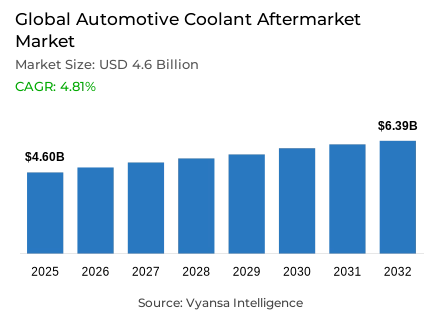
- Automotive Coolant Aftermarket market size was valued at USD 4.6 billion in 2025 and is estimated at USD 4.82 billion in 2026.
- The market size is expected to grow to USD 6.39 billion by 2032.
- Market to register a CAGR of around 4.81% during 2026-32.
- Product Type Shares
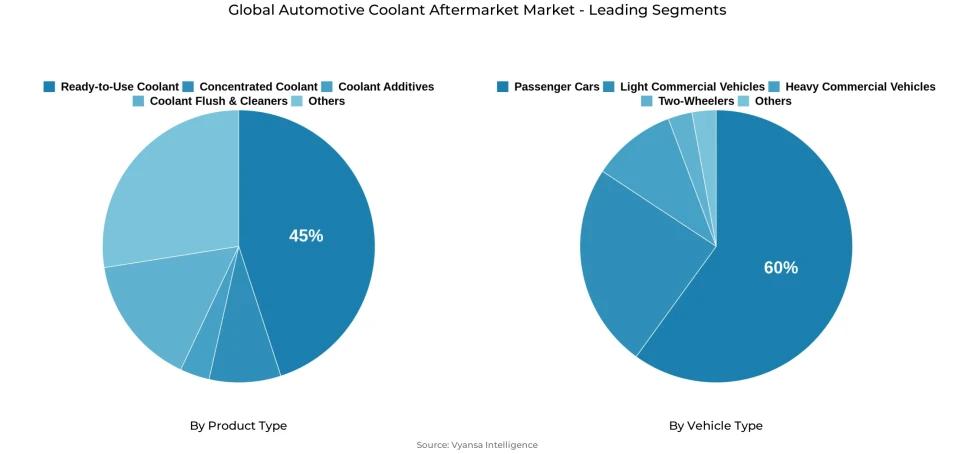
- Ready-to-use coolant grabbed market share of 45%.
- Competition
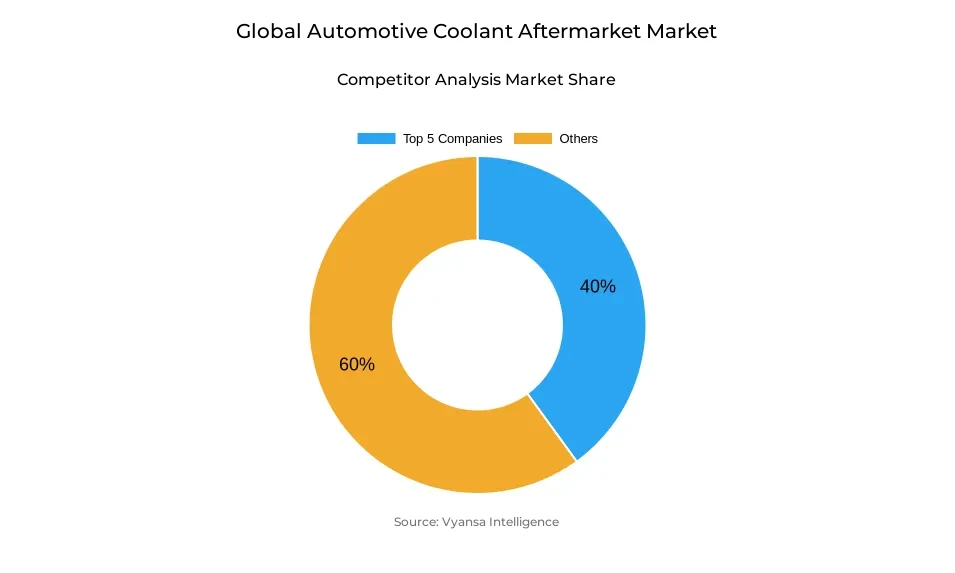
- More than 30 companies are actively engaged in producing automotive coolant aftermarket.
- Top 5 companies acquired around 40% of the market share.
- Chevron Corporation, TotalEnergies SE, FUCHS SE, Valvoline Global Operations, Prestone Products Corporation etc., are few of the top companies.
- Vehicle Type
- Passenger cars grabbed 60% of the market.
- Region
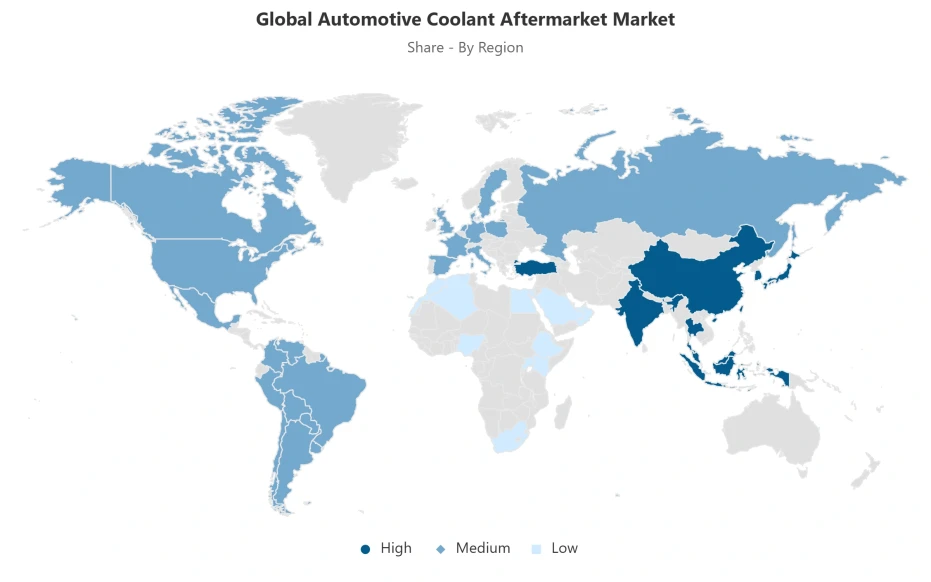
- Asia Pacific leads with a 45% share of the global market.
Global Automotive Coolant Aftermarket Market Outlook
The Global Automotive Coolant Aftermarket is expanding as vehicles require recurring engine coolant, antifreeze coolant, and radiator coolant service to maintain engine temperature control, overheating prevention, corrosion protection, freeze protection, and heat transfer efficiency. The market size was valued at USD 4.6 billion in 2025 and is projected to grow from USD 4.82 billion in 2026 to USD 6.39 billion by 2032, at a CAGR of 4.81% during the forecast period.
The automotive coolant aftermarket includes ready-to-use coolant, concentrate coolant, long-life coolant, organic acid technology coolant, hybrid organic acid technology coolant, and EV-compatible thermal fluids. These products support coolant replacement, coolant flushing, coolant top-up, radiator servicing, leak repair, cooling system repair, and aftermarket coolant service across workshops, dealerships, retailers, distributors, fuel stations, and online channels.
Ready-to-Use Coolant holds around 45% share under Product Type, supported by controlled dilution, convenience, and lower risk of incorrect water mixing. Passenger Cars hold around 60% share under Vehicle Type because they represent the widest installed base and generate regular replacement demand through routine service cycles.
Asia Pacific leads with around 45% share globally. Growth remains tied to aging vehicle fleet, vehicle parc expansion, preventive maintenance, high-mileage vehicles, workshop servicing, hot-climate operation, and rising EV battery coolant requirements across electric vehicles and hybrid vehicles.
Global Automotive Coolant Aftermarket Market Growth Driver
Aging Vehicle Fleet Strengthens Coolant Replacement
Aging vehicle fleet is the strongest demand force in the automotive coolant aftermarket, as older vehicles require more frequent inspection of coolant concentration, radiators, water pumps, thermostats, coolant hoses, heater cores, and coolant reservoirs. ACEA reports that EU cars averaged 12.7 years in 2024, while light commercial vehicles averaged 12.9 years, trucks 14 years, and buses 12.2 years. This vehicle age profile increases coolant replacement and cooling system maintenance because heat cycling, contamination, and inhibitor depletion raise overheating prevention and corrosion protection needs across service networks.
Preventive maintenance gives this driver a clear service pathway. Engine coolant protects heat transfer efficiency, freeze protection, and component life, while degraded antifreeze coolant can increase radiator damage, water-pump wear, hose failure, poor cabin heating, and engine stress. Ready-to-use coolant and long-life coolant gain relevance as workshops need faster service, lower mixing errors, and consistent coolant top-up. Demand remains strongest across passenger cars, light commercial vehicles, and high-mileage vehicles where workshop servicing reduces repair risk and supports recurring replacement. This keeps the engine coolant replacement market tied to maintenance intervals and vehicle age.
Global Automotive Coolant Aftermarket Market Challenge
Compatibility and Waste Handling Restrict Service Consistency
Coolant compatibility remains the main challenge because vehicle platforms use different metals, seals, inhibitor technologies, radiator materials, service histories, climates, and OEM specifications. Incorrect coolant mixing can weaken corrosion protection, create deposits, reduce heat transfer efficiency, and increase cooling system repair risk. Counterfeit coolants and low consumer awareness add further pressure in price-sensitive aftermarket channels, where buyers may select antifreeze coolant by color or price rather than technical compatibility, service interval, or manufacturer guidance.
Waste handling also complicates aftermarket coolant service. The U.S. EPA explains that used antifreeze can become hazardous after picking up metals, and non-closed-loop used antifreeze may require storage and disposal under hazardous-waste provisions. This increases compliance work for independent garages, distributors, and workshops. The restraint does not reduce the need for coolant replacement, but it makes service quality, technician knowledge, recycling access, and product guidance more important. Organized service networks and branded suppliers benefit when they provide clear compatibility tools and responsible disposal support for workshop servicing. It also limits informal handling across workshops.
Unlock Market Intelligence
Explore the market potential with our data-driven report
Global Automotive Coolant Aftermarket Market Trend
Vehicle-Specific Formulations Reshape Product Positioning
Vehicle-specific coolant positioning is reshaping the vehicle coolant aftermarket as service providers move away from generic antifreeze products. Workshops increasingly need extended-life coolant, organic acid technology coolant, hybrid organic acid technology coolant, and OEM-approved coolant aligned with engine materials, inhibitor chemistry, service intervals, coolant color, climate, and vehicle platform. BASF’s GLYSANTIN portfolio highlights OEM approvals and recommendations, showing that supplier credibility now depends on compatibility assurance rather than broad freeze and boilover claims alone.
Ready-to-use coolant benefits from this trend because it offers fixed concentration and controlled water quality, reducing dilution errors for retail buyers and smaller garages. Concentrates remain useful for professional workshops that control mixing and inventory. However, the trend favors clearer labels, wider compatibility guides, and SKU specialization. As cooling systems become more vehicle-specific, suppliers need formulation accuracy, technician education, and service-channel support to maintain corrosion protection, overheating prevention, and heat transfer efficiency across aging vehicles, hybrids, and newer electric vehicle platforms during routine service cycles. This strengthens demand for application-specific antifreeze coolant. clearly.
Global Automotive Coolant Aftermarket Market Opportunity
EV Battery Coolant Opens Premium Demand
EV battery coolant creates the strongest opportunity as electric vehicles and hybrid vehicles expand the role of thermal fluids beyond engine temperature control. IEA reports that electric car sales exceeded 17 million globally in 2024, accounting for more than 20% of new car sales worldwide. This builds a future aftermarket base for low-conductivity coolant, battery thermal fluids, inverter cooling fluids, motor cooling fluids, and cabin thermal systems as vehicles move beyond warranty periods and enter independent service networks.
The opportunity is premium because EV thermal management is more sensitive than conventional radiator coolant top-up. Battery fluids must support heat transfer, electrical safety, material compatibility, range stability, charging performance, and long service life. Castrol and Shell position EV thermal fluids for batteries, motors, inverters, and fast chargers, indicating supplier movement toward specialized coolant chemistry. Workshops will need training for leak repair, radiator servicing, coolant replacement, and hybrid vehicle coolant selection. Demand strengthens where suppliers combine OEM-aligned formulations, service guidance, and product differentiation for electric vehicle thermal systems. This turns EV cooling into a higher-specification aftermarket coolant service category as parc ages.
Global Automotive Coolant Aftermarket Market Regional Analysis
By Region
- North America
- South America
- Europe
- Middle East & Africa
- Asia Pacific
Asia Pacific leads with around 45% share of the Global Automotive Coolant Aftermarket, driven by vehicle parc expansion, hot-climate operation, dense workshop networks, and strong replacement demand. OICA reports 2025 passenger car sales of 30,103,140 units in China, 4,489,717 units in India, and 3,836,380 units in Japan. This large vehicle base creates recurring coolant replacement, radiator servicing, coolant flushing, and cooling system repair through retail and workshop channels across major national markets.
Regional leadership is scale-led and service-led. China supports demand through the largest vehicle base and a fast-growing EV parc, while India adds rising passenger vehicle ownership and independent garage expansion. Japan and Southeast Asia strengthen organized maintenance behavior, parts distribution, and supplier localization. Hot weather, urban congestion, long vehicle retention, and price-sensitive maintenance increase demand for engine coolant, antifreeze coolant, ready-to-use coolant, and aftermarket coolant service. EV growth also raises future use of EV battery coolant and low-conductivity coolant across regional service systems and workshops.
Unlock Market Intelligence
Explore the market potential with our data-driven report
Global Automotive Coolant Aftermarket Market Segmentation Analysis
By Product Type
- Concentrated Coolant
- Ready-to-Use Coolant
- Coolant Additives
- Coolant Flush & Cleaners
- Others
The leading Product Type segment is Ready-to-Use Coolant, holding around 45% of the Global Automotive Coolant Aftermarket. This segment leads because it provides convenience, controlled dilution, consistent water quality, and lower risk of user error. Vehicle owners, service stations, small garages, and quick-lube channels prefer ready-to-use coolant where fast coolant top-up, coolant flushing, and routine maintenance require simple handling and predictable concentration during workshop and retail service.
Concentrate coolant remains relevant for professional workshops, large garages, and fleet maintenance teams because it reduces storage volume and allows controlled dilution across climates. However, it depends on correct water quality and mixing discipline. Ready-to-use formats stay ahead because they simplify aftermarket coolant service and reduce incorrect mixing risk. Long-life coolant, engine coolant, antifreeze coolant, and radiator coolant variants add value when they offer OEM-approved compatibility, overheating prevention, corrosion protection, and longer service intervals. The emerging sub-category is EV-compatible ready-to-use thermal fluid, where convenience must align with battery safety, low conductivity, and repeat workshop use.
By Vehicle Type
- Passenger Cars
- Light Commercial Vehicles
- Heavy Commercial Vehicles
- Two-Wheelers
- Others
The leading Vehicle Type segment is Passenger Cars, holding around 60% of the automotive coolant aftermarket. Passenger cars lead because they represent the widest installed base and require periodic coolant replacement, coolant flushing, inspection, and top-up during routine service cycles. Hatchbacks, sedans, SUVs, compact cars, electric vehicles, and hybrid vehicles all create recurring replacement demand through cooling system maintenance and component wear across organized garages and retail channels.
Commercial vehicles use higher coolant volumes per unit, but passenger cars dominate through scale, retail access, and frequent workshop servicing. High-mileage cars need closer attention to radiators, coolant reservoirs, water pumps, thermostats, coolant hoses, radiator caps, and heater cores. The emerging shift is electric and hybrid passenger cars, where coolant demand moves from engine coolant toward EV battery coolant and low-conductivity thermal fluids. This expands formulation requirements while keeping passenger cars the main volume base for aftermarket coolant service, replacement demand, preventive maintenance, supplier inventory planning, and SKU availability.
Market Players in Global Automotive Coolant Aftermarket Market
These market players maintain a significant presence in the Global automotive coolant aftermarket market and contribute to its ongoing evolution.
- Chevron Corporation
- TotalEnergies SE
- FUCHS SE
- Valvoline Global Operations
- Prestone Products Corporation
- Castrol Limited
- Shell plc
- Exxon Mobil Corporation
- Old World Industries, LLC
- BASF SE
- Motul S.A.
- Petronas Lubricants International
- Gulf Oil International
- Repsol S.A.
- Recochem Inc.
Market News & Updates
- Prestone Products Corporation, 2025:
Prestone EV presented new technology launches at The Battery Show North America 2025 in Detroit. The update highlighted Prestone EV thermal management fluids for electric and hybrid vehicles, including EVantage fluids designed for battery performance and corrosion protection. The launch supports coolant and thermal fluid development for electrified vehicle aftermarket needs.
- Shell plc, 2025:
Shell announced EV-Plus Thermal Fluid development in September 2025 for safer fast-charging thermal management. The fluid is designed for immersion cooling and supports reductions in charging time while maintaining cell integrity and lifetime. The update expands Shell’s EV thermal fluid work linked to electric vehicle cooling applications.
Frequently Asked Questions
Related Report
- Market Segmentation
- Research Scope
- Research Methodology
- Definitions and Assumptions
- Executive Summary
- Global Automotive Coolant Aftermarket Market Policies, Regulations, and Standards
- Global Automotive Coolant Aftermarket Production (Million Litres) Trend 2022-2032
- Global Automotive Coolant Aftermarket Production (Million Litres) Trend By Product Type
- Concentrated Coolant
- Ready-to-Use Coolant
- Coolant Additives
- Coolant Flush & Cleaners
- Company Wise Production Plants and Statistics
- Installed Production Capacity
- Actual Production
- Planned Production Target
- Global Automotive Coolant Aftermarket Production (Million Litres) Trend By Product Type
- Global Automotive Coolant Aftermarket Pricing Analysis 2022-2032
- Global Automotive Coolant Aftermarket Pricing Trend (USD/Million Litres) 2022-2032
- Global Automotive Coolant Aftermarket Pricing Trend (USD/Million Litres) By Regions 2022-2032
- North America
- South America
- Europe
- Middle East & Africa
- Asia Pacific
- Global Automotive Coolant Aftermarket Pricing Trend (USD/Million Litres) By Product Type 2022-2032
- Concentrated Coolant
- Ready-to-Use Coolant
- Coolant Additives
- Coolant Flush & Cleaners
- Global Automotive Coolant Aftermarket Market Dynamics
- Growth Factors
- Challenges
- Trends
- Opportunities
- Global Automotive Coolant Aftermarket Market Statistics, 2022-2032F
- Market Size & Growth Outlook
- By Revenues in USD Million
- By Quantity Sold in Million Litres
- Market Segmentation & Growth Outlook
- By Product Type
- Concentrated Coolant- Market Insights and Forecast 2022-2032, USD Million
- Ready-to-Use Coolant- Market Insights and Forecast 2022-2032, USD Million
- Coolant Additives- Market Insights and Forecast 2022-2032, USD Million
- Coolant Flush & Cleaners- Market Insights and Forecast 2022-2032, USD Million
- Others- Market Insights and Forecast 2022-2032, USD Million
- By Coolant Technology
- Inorganic Acid Technology Coolant- Market Insights and Forecast 2022-2032, USD Million
- Organic Acid Technology Coolant- Market Insights and Forecast 2022-2032, USD Million
- Hybrid Organic Acid Technology Coolant- Market Insights and Forecast 2022-2032, USD Million
- Phosphate-Based Coolant- Market Insights and Forecast 2022-2032, USD Million
- Silicate-Free Coolant- Market Insights and Forecast 2022-2032, USD Million
- Others- Market Insights and Forecast 2022-2032, USD Million
- By Vehicle Type
- Passenger Cars- Market Insights and Forecast 2022-2032, USD Million
- Light Commercial Vehicles- Market Insights and Forecast 2022-2032, USD Million
- Heavy Commercial Vehicles- Market Insights and Forecast 2022-2032, USD Million
- Two-Wheelers- Market Insights and Forecast 2022-2032, USD Million
- Others- Market Insights and Forecast 2022-2032, USD Million
- By Sales Channel
- Service Centers & Workshops- Market Insights and Forecast 2022-2032, USD Million
- Auto Parts Retailers- Market Insights and Forecast 2022-2032, USD Million
- Distributors & Dealers- Market Insights and Forecast 2022-2032, USD Million
- Online Retail- Market Insights and Forecast 2022-2032, USD Million
- Others- Market Insights and Forecast 2022-2032, USD Million
- By Region
- North America
- South America
- Europe
- Middle East & Africa
- Asia Pacific
- By Competitors
- Competition Characteristics
- Market Share & Analysis
- By Product Type
- Market Size & Growth Outlook
- North America Automotive Coolant Aftermarket Market Statistics, 2022-2032F
- Market Size & Growth Outlook
- By Revenues in USD Million
- By Quantity Sold in Million Litres
- Market Segmentation & Growth Outlook
- By Product Type- Market Insights and Forecast 2022-2032, USD Million
- By Coolant Technology- Market Insights and Forecast 2022-2032, USD Million
- By Vehicle Type- Market Insights and Forecast 2022-2032, USD Million
- By Sales Channel- Market Insights and Forecast 2022-2032, USD Million
- By Country
- US
- Canada
- Mexico
- Rest of North America
- US Automotive Coolant Aftermarket Market Statistics, 2022-2032F
- Market Size & Growth Outlook
- By Revenues in USD Million
- By Quantity Sold in Million Litres
- Market Segmentation & Growth Outlook
- By Product Type- Market Insights and Forecast 2022-2032, USD Million
- By Coolant Technology- Market Insights and Forecast 2022-2032, USD Million
- By Vehicle Type- Market Insights and Forecast 2022-2032, USD Million
- By Sales Channel- Market Insights and Forecast 2022-2032, USD Million
- Market Size & Growth Outlook
- Canada Automotive Coolant Aftermarket Market Statistics, 2022-2032F
- Market Size & Growth Outlook
- By Revenues in USD Million
- By Quantity Sold in Million Litres
- Market Segmentation & Growth Outlook
- By Product Type- Market Insights and Forecast 2022-2032, USD Million
- By Coolant Technology- Market Insights and Forecast 2022-2032, USD Million
- By Vehicle Type- Market Insights and Forecast 2022-2032, USD Million
- By Sales Channel- Market Insights and Forecast 2022-2032, USD Million
- Market Size & Growth Outlook
- Mexico Automotive Coolant Aftermarket Market Statistics, 2022-2032F
- Market Size & Growth Outlook
- By Revenues in USD Million
- By Quantity Sold in Million Litres
- Market Segmentation & Growth Outlook
- By Product Type- Market Insights and Forecast 2022-2032, USD Million
- By Coolant Technology- Market Insights and Forecast 2022-2032, USD Million
- By Vehicle Type- Market Insights and Forecast 2022-2032, USD Million
- By Sales Channel- Market Insights and Forecast 2022-2032, USD Million
- Market Size & Growth Outlook
- Market Size & Growth Outlook
- South America Automotive Coolant Aftermarket Market Statistics, 2022-2032F
- Market Size & Growth Outlook
- By Revenues in USD Million
- By Quantity Sold in Million Litres
- Market Segmentation & Growth Outlook
- By Product Type- Market Insights and Forecast 2022-2032, USD Million
- By Coolant Technology- Market Insights and Forecast 2022-2032, USD Million
- By Vehicle Type- Market Insights and Forecast 2022-2032, USD Million
- By Sales Channel- Market Insights and Forecast 2022-2032, USD Million
- By Country
- Brazil
- Argentina
- Rest of South America
- Brazil Automotive Coolant Aftermarket Market Statistics, 2022-2032F
- Market Size & Growth Outlook
- By Revenues in USD Million
- By Quantity Sold in Million Litres
- Market Segmentation & Growth Outlook
- By Product Type- Market Insights and Forecast 2022-2032, USD Million
- By Coolant Technology- Market Insights and Forecast 2022-2032, USD Million
- By Vehicle Type- Market Insights and Forecast 2022-2032, USD Million
- By Sales Channel- Market Insights and Forecast 2022-2032, USD Million
- Market Size & Growth Outlook
- Argentina Automotive Coolant Aftermarket Market Statistics, 2022-2032F
- Market Size & Growth Outlook
- By Revenues in USD Million
- By Quantity Sold in Million Litres
- Market Segmentation & Growth Outlook
- By Product Type- Market Insights and Forecast 2022-2032, USD Million
- By Coolant Technology- Market Insights and Forecast 2022-2032, USD Million
- By Vehicle Type- Market Insights and Forecast 2022-2032, USD Million
- By Sales Channel- Market Insights and Forecast 2022-2032, USD Million
- Market Size & Growth Outlook
- Market Size & Growth Outlook
- Europe Automotive Coolant Aftermarket Market Statistics, 2022-2032F
- Market Size & Growth Outlook
- By Revenues in USD Million
- By Quantity Sold in Million Litres
- Market Segmentation & Growth Outlook
- By Product Type- Market Insights and Forecast 2022-2032, USD Million
- By Coolant Technology- Market Insights and Forecast 2022-2032, USD Million
- By Vehicle Type- Market Insights and Forecast 2022-2032, USD Million
- By Sales Channel- Market Insights and Forecast 2022-2032, USD Million
- By Country
- Germany
- UK
- France
- Spain
- Italy
- Poland
- Rest of Europe
- Germany Automotive Coolant Aftermarket Market Statistics, 2022-2032F
- Market Size & Growth Outlook
- By Revenues in USD Million
- By Quantity Sold in Million Litres
- Market Segmentation & Growth Outlook
- By Product Type- Market Insights and Forecast 2022-2032, USD Million
- By Coolant Technology- Market Insights and Forecast 2022-2032, USD Million
- By Vehicle Type- Market Insights and Forecast 2022-2032, USD Million
- By Sales Channel- Market Insights and Forecast 2022-2032, USD Million
- Market Size & Growth Outlook
- UK Automotive Coolant Aftermarket Market Statistics, 2022-2032F
- Market Size & Growth Outlook
- By Revenues in USD Million
- By Quantity Sold in Million Litres
- Market Segmentation & Growth Outlook
- By Product Type- Market Insights and Forecast 2022-2032, USD Million
- By Coolant Technology- Market Insights and Forecast 2022-2032, USD Million
- By Vehicle Type- Market Insights and Forecast 2022-2032, USD Million
- By Sales Channel- Market Insights and Forecast 2022-2032, USD Million
- Market Size & Growth Outlook
- France Automotive Coolant Aftermarket Market Statistics, 2022-2032F
- Market Size & Growth Outlook
- By Revenues in USD Million
- By Quantity Sold in Million Litres
- Market Segmentation & Growth Outlook
- By Product Type- Market Insights and Forecast 2022-2032, USD Million
- By Coolant Technology- Market Insights and Forecast 2022-2032, USD Million
- By Vehicle Type- Market Insights and Forecast 2022-2032, USD Million
- By Sales Channel- Market Insights and Forecast 2022-2032, USD Million
- Market Size & Growth Outlook
- Spain Automotive Coolant Aftermarket Market Statistics, 2022-2032F
- Market Size & Growth Outlook
- By Revenues in USD Million
- By Quantity Sold in Million Litres
- Market Segmentation & Growth Outlook
- By Product Type- Market Insights and Forecast 2022-2032, USD Million
- By Coolant Technology- Market Insights and Forecast 2022-2032, USD Million
- By Vehicle Type- Market Insights and Forecast 2022-2032, USD Million
- By Sales Channel- Market Insights and Forecast 2022-2032, USD Million
- Market Size & Growth Outlook
- Italy Automotive Coolant Aftermarket Market Statistics, 2022-2032F
- Market Size & Growth Outlook
- By Revenues in USD Million
- By Quantity Sold in Million Litres
- Market Segmentation & Growth Outlook
- By Product Type- Market Insights and Forecast 2022-2032, USD Million
- By Coolant Technology- Market Insights and Forecast 2022-2032, USD Million
- By Vehicle Type- Market Insights and Forecast 2022-2032, USD Million
- By Sales Channel- Market Insights and Forecast 2022-2032, USD Million
- Market Size & Growth Outlook
- Poland Automotive Coolant Aftermarket Market Statistics, 2022-2032F
- Market Size & Growth Outlook
- By Revenues in USD Million
- By Quantity Sold in Million Litres
- Market Segmentation & Growth Outlook
- By Product Type- Market Insights and Forecast 2022-2032, USD Million
- By Coolant Technology- Market Insights and Forecast 2022-2032, USD Million
- By Vehicle Type- Market Insights and Forecast 2022-2032, USD Million
- By Sales Channel- Market Insights and Forecast 2022-2032, USD Million
- Market Size & Growth Outlook
- Market Size & Growth Outlook
- Middle East & Africa Automotive Coolant Aftermarket Market Statistics, 2022-2032F
- Market Size & Growth Outlook
- By Revenues in USD Million
- By Quantity Sold in Million Litres
- Market Segmentation & Growth Outlook
- By Product Type- Market Insights and Forecast 2022-2032, USD Million
- By Coolant Technology- Market Insights and Forecast 2022-2032, USD Million
- By Vehicle Type- Market Insights and Forecast 2022-2032, USD Million
- By Sales Channel- Market Insights and Forecast 2022-2032, USD Million
- By Country
- Saudi Arabia
- UAE
- Egypt
- Nigeria
- South Africa
- Rest of Middle East & Africa
- Saudi Arabia Automotive Coolant Aftermarket Market Statistics, 2022-2032F
- Market Size & Growth Outlook
- By Revenues in USD Million
- By Quantity Sold in Million Litres
- Market Segmentation & Growth Outlook
- By Product Type- Market Insights and Forecast 2022-2032, USD Million
- By Coolant Technology- Market Insights and Forecast 2022-2032, USD Million
- By Vehicle Type- Market Insights and Forecast 2022-2032, USD Million
- By Sales Channel- Market Insights and Forecast 2022-2032, USD Million
- Market Size & Growth Outlook
- UAE Automotive Coolant Aftermarket Market Statistics, 2022-2032F
- Market Size & Growth Outlook
- By Revenues in USD Million
- By Quantity Sold in Million Litres
- Market Segmentation & Growth Outlook
- By Product Type- Market Insights and Forecast 2022-2032, USD Million
- By Coolant Technology- Market Insights and Forecast 2022-2032, USD Million
- By Vehicle Type- Market Insights and Forecast 2022-2032, USD Million
- By Sales Channel- Market Insights and Forecast 2022-2032, USD Million
- Market Size & Growth Outlook
- Egypt Automotive Coolant Aftermarket Market Statistics, 2022-2032F
- Market Size & Growth Outlook
- By Revenues in USD Million
- By Quantity Sold in Million Litres
- Market Segmentation & Growth Outlook
- By Product Type- Market Insights and Forecast 2022-2032, USD Million
- By Coolant Technology- Market Insights and Forecast 2022-2032, USD Million
- By Vehicle Type- Market Insights and Forecast 2022-2032, USD Million
- By Sales Channel- Market Insights and Forecast 2022-2032, USD Million
- Market Size & Growth Outlook
- Nigeria Automotive Coolant Aftermarket Market Statistics, 2022-2032F
- Market Size & Growth Outlook
- By Revenues in USD Million
- By Quantity Sold in Million Litres
- Market Segmentation & Growth Outlook
- By Product Type- Market Insights and Forecast 2022-2032, USD Million
- By Coolant Technology- Market Insights and Forecast 2022-2032, USD Million
- By Vehicle Type- Market Insights and Forecast 2022-2032, USD Million
- By Sales Channel- Market Insights and Forecast 2022-2032, USD Million
- Market Size & Growth Outlook
- South Africa Automotive Coolant Aftermarket Market Statistics, 2022-2032F
- Market Size & Growth Outlook
- By Revenues in USD Million
- By Quantity Sold in Million Litres
- Market Segmentation & Growth Outlook
- By Product Type- Market Insights and Forecast 2022-2032, USD Million
- By Coolant Technology- Market Insights and Forecast 2022-2032, USD Million
- By Vehicle Type- Market Insights and Forecast 2022-2032, USD Million
- By Sales Channel- Market Insights and Forecast 2022-2032, USD Million
- Market Size & Growth Outlook
- Market Size & Growth Outlook
- Asia Pacific Automotive Coolant Aftermarket Market Statistics, 2022-2032F
- Market Size & Growth Outlook
- By Revenues in USD Million
- By Quantity Sold in Million Litres
- Market Segmentation & Growth Outlook
- By Product Type- Market Insights and Forecast 2022-2032, USD Million
- By Coolant Technology- Market Insights and Forecast 2022-2032, USD Million
- By Vehicle Type- Market Insights and Forecast 2022-2032, USD Million
- By Sales Channel- Market Insights and Forecast 2022-2032, USD Million
- By Country
- China
- India
- Japan
- South Korea
- Australia
- Indonesia
- Rest of Asia Pacific
- China Automotive Coolant Aftermarket Market Statistics, 2022-2032F
- Market Size & Growth Outlook
- By Revenues in USD Million
- By Quantity Sold in Million Litres
- Market Segmentation & Growth Outlook
- By Product Type- Market Insights and Forecast 2022-2032, USD Million
- By Coolant Technology- Market Insights and Forecast 2022-2032, USD Million
- By Vehicle Type- Market Insights and Forecast 2022-2032, USD Million
- By Sales Channel- Market Insights and Forecast 2022-2032, USD Million
- Market Size & Growth Outlook
- India Automotive Coolant Aftermarket Market Statistics, 2022-2032F
- Market Size & Growth Outlook
- By Revenues in USD Million
- By Quantity Sold in Million Litres
- Market Segmentation & Growth Outlook
- By Product Type- Market Insights and Forecast 2022-2032, USD Million
- By Coolant Technology- Market Insights and Forecast 2022-2032, USD Million
- By Vehicle Type- Market Insights and Forecast 2022-2032, USD Million
- By Sales Channel- Market Insights and Forecast 2022-2032, USD Million
- Market Size & Growth Outlook
- Japan Automotive Coolant Aftermarket Market Statistics, 2022-2032F
- Market Size & Growth Outlook
- By Revenues in USD Million
- By Quantity Sold in Million Litres
- Market Segmentation & Growth Outlook
- By Product Type- Market Insights and Forecast 2022-2032, USD Million
- By Coolant Technology- Market Insights and Forecast 2022-2032, USD Million
- By Vehicle Type- Market Insights and Forecast 2022-2032, USD Million
- By Sales Channel- Market Insights and Forecast 2022-2032, USD Million
- Market Size & Growth Outlook
- South Korea Automotive Coolant Aftermarket Market Statistics, 2022-2032F
- Market Size & Growth Outlook
- By Revenues in USD Million
- By Quantity Sold in Million Litres
- Market Segmentation & Growth Outlook
- By Product Type- Market Insights and Forecast 2022-2032, USD Million
- By Coolant Technology- Market Insights and Forecast 2022-2032, USD Million
- By Vehicle Type- Market Insights and Forecast 2022-2032, USD Million
- By Sales Channel- Market Insights and Forecast 2022-2032, USD Million
- Market Size & Growth Outlook
- Australia Automotive Coolant Aftermarket Market Statistics, 2022-2032F
- Market Size & Growth Outlook
- By Revenues in USD Million
- By Quantity Sold in Million Litres
- Market Segmentation & Growth Outlook
- By Product Type- Market Insights and Forecast 2022-2032, USD Million
- By Coolant Technology- Market Insights and Forecast 2022-2032, USD Million
- By Vehicle Type- Market Insights and Forecast 2022-2032, USD Million
- By Sales Channel- Market Insights and Forecast 2022-2032, USD Million
- Market Size & Growth Outlook
- Indonesia Automotive Coolant Aftermarket Market Statistics, 2022-2032F
- Market Size & Growth Outlook
- By Revenues in USD Million
- By Quantity Sold in Million Litres
- Market Segmentation & Growth Outlook
- By Product Type- Market Insights and Forecast 2022-2032, USD Million
- By Coolant Technology- Market Insights and Forecast 2022-2032, USD Million
- By Vehicle Type- Market Insights and Forecast 2022-2032, USD Million
- By Sales Channel- Market Insights and Forecast 2022-2032, USD Million
- Market Size & Growth Outlook
- Market Size & Growth Outlook
- Competitive Outlook
- Company Profiles
- Valvoline Global Operations
- Business Description
- Product Portfolio
- Collaborations & Alliances
- Recent Developments
- Financial Details
- Others
- Prestone Products Corporation
- Business Description
- Product Portfolio
- Collaborations & Alliances
- Recent Developments
- Financial Details
- Others
- Castrol Limited
- Business Description
- Product Portfolio
- Collaborations & Alliances
- Recent Developments
- Financial Details
- Others
- Shell plc
- Business Description
- Product Portfolio
- Collaborations & Alliances
- Recent Developments
- Financial Details
- Others
- Exxon Mobil Corporation
- Business Description
- Product Portfolio
- Collaborations & Alliances
- Recent Developments
- Financial Details
- Others
- Chevron Corporation
- Business Description
- Product Portfolio
- Collaborations & Alliances
- Recent Developments
- Financial Details
- Others
- TotalEnergies SE
- Business Description
- Product Portfolio
- Collaborations & Alliances
- Recent Developments
- Financial Details
- Others
- FUCHS SE
- Business Description
- Product Portfolio
- Collaborations & Alliances
- Recent Developments
- Financial Details
- Others
- Old World Industries, LLC
- Business Description
- Product Portfolio
- Collaborations & Alliances
- Recent Developments
- Financial Details
- Others
- BASF SE
- Business Description
- Product Portfolio
- Collaborations & Alliances
- Recent Developments
- Financial Details
- Others
- Motul S.A.
- Business Description
- Product Portfolio
- Collaborations & Alliances
- Recent Developments
- Financial Details
- Others
- Petronas Lubricants International
- Business Description
- Product Portfolio
- Collaborations & Alliances
- Recent Developments
- Financial Details
- Others
- Gulf Oil International
- Business Description
- Product Portfolio
- Collaborations & Alliances
- Recent Developments
- Financial Details
- Others
- Repsol S.A.
- Business Description
- Product Portfolio
- Collaborations & Alliances
- Recent Developments
- Financial Details
- Others
- Recochem Inc.
- Business Description
- Product Portfolio
- Collaborations & Alliances
- Recent Developments
- Financial Details
- Others
- Valvoline Global Operations
- Company Profiles
- Disclaimer
| Segment | Sub-Segment |
|---|---|
| By Product Type |
|
| By Coolant Technology |
|
| By Vehicle Type |
|
| By Sales Channel |
|
| By Region |
|
Research Methodology
This study followed a structured approach comprising four key phases to assess the size and scope of the electro-oxidation market. The process began with thorough secondary research to collect data on the target market, related markets, and broader industry context. These findings, along with preliminary assumptions and estimates, were then validated through extensive primary research involving industry experts from across the value chain. To calculate the overall market size, both top-down and bottom-up methodologies were employed. Finally, market segmentation and data triangulation techniques were applied to refine and validate segment-level estimations.
Secondary Research
The secondary research phase involved gathering data from a wide range of credible and published sources. This step helped in identifying industry trends, defining market segmentation, and understanding the market landscape and value chain.
Sources consulted during this phase included:
- Company annual reports, investor presentations, and press releases
- Industry white papers and certified publications
- Trade directories and market-recognized databases
- Articles from authoritative authors and reputable journals
- Gold and silver standard websites
Secondary research was critical in mapping out the industry's value chain and monetary flow, identifying key market segments, understanding regional variations, and tracking significant industry developments.
Other key sources:
- Financial disclosures
- Industry associations and trade bodies
- News outlets and business magazines
- Academic journals and research studies
- Paid industry databases
Primary Research
To validate secondary data and gain deeper market insights, primary research was conducted with key stakeholders across both the supply and demand sides of the market.
On the demand side, participants included decision-makers and influencers from end-user industries—such as CIOs, CTOs, and CSOs—who provided first-hand perspectives on market needs, product usage, and future expectations.
On the supply side, interviews were conducted with manufacturers, industry associations, and institutional participants to gather insights into current offerings, product pipelines, and market challenges.
Primary interviews provided critical inputs such as:
- Market size and revenue data
- Product and service breakdowns
- Market forecasts
- Regional and application-specific trends
Stakeholders consulted included:
- Leading OEM and solution providers
- Channel and distribution partners
- End users across various applications
- Independent consultants and industry specialists
Market Size Estimation and Data Triangulation
- Identifying Key Market Participants (Secondary Research)
- Goal: To identify the major players or companies in the target market. This typically involves using publicly available data sources such as industry reports, market research publications, and financial statements of companies.
- Tools: Reports from firms like Gartner, Forrester, Euromonitor, Statista, IBISWorld, and others. Public financial statements, news articles, and press releases from top market players.
- Extracting Earnings of Key Market Participants
- Goal: To estimate the earnings generated from the product or service being analyzed. This step helps in understanding the revenue potential of each market player in a specific geography.
- Methods: Earnings data can be gathered from:
- Publicly available financial reports (for listed companies).
- Interviews and primary data sources from professionals, such as Directors, VPs, SVPs, etc. This is especially useful for understanding more nuanced, internal data that isn't publicly disclosed.
- Annual reports and investor presentations of key players.
- Data Collation and Development of a Relevant Data Model
- Goal: To collate inputs from both primary and secondary sources into a structured, data-driven model for market estimation. This model will incorporate key market KPIs and any independent variables relevant to the market.
- Key KPIs: These could include:
- Market size, growth rate, and demand drivers.
- Industry-specific metrics like market share, average revenue per customer (ARPC), or average deal size.
- External variables, such as economic growth rates, inflation rates, or commodity prices, that could affect the market.
- Data Modeling: Based on this data, the market forecasts are developed for the next 5 years. A combination of trend analysis, scenario modeling, and statistical regression might be used to generate projections.
- Scenario Analysis
- Goal: To test different assumptions and validate how sensitive the market is to changes in key variables (e.g., market demand, regulatory changes, technological disruptions).
- Types of Scenarios:
- Base Case: Based on current assumptions and historical data.
- Best-Case Scenario: Assuming favorable market conditions, regulatory environments, and technological advancements.
- Worst-Case Scenario: Accounting for adverse factors, such as economic downturns, stricter regulations, or unexpected disruptions.












