Asia Pacific In-Cabin Monitoring Systems Market Report: Trends, Growth and Forecast (2026-2032)
By System Type (Driver Monitoring Systems, Occupant Monitoring Systems, Integrated Driver and Occupant Monitoring Systems, Others), By Component (Cameras and Imaging Modules, Radar Sensors, Infrared and Time-of-Flight Sensing Modules, Processing ECUs and AI Compute Units, Software and AI Algorithms, Others), By Sensing Technology (Camera-Based Monitoring, Radar-Based Monitoring, Time-of-Flight and 3D Depth Sensing, Biometric and Vital-Sign Sensing, Multi-Sensor Fusion Monitoring, Others), By Application (Driver Drowsiness and Fatigue Detection, Driver Distraction and Attention Monitoring, Occupant Presence and Classification, Seatbelt Usage and Posture Monitoring, Child Presence Detection, Vital Signs Monitoring, Biometric Identification and Cabin Personalization, Others), By Vehicle Type (Passenger Cars, Light Commercial Vehicles, Heavy Commercial Vehicles, Buses and Coaches, Others), By Installation Channel (OEM-Installed Systems, Aftermarket and Fleet Retrofit Systems), By Country (China, Japan, South Korea, India, Thailand, Indonesia, Rest of Asia Pacific) ... Read more
|
Major Players
|
Asia Pacific In-Cabin Monitoring Systems Market Statistics and Insights, 2026
- Market Size Statistics
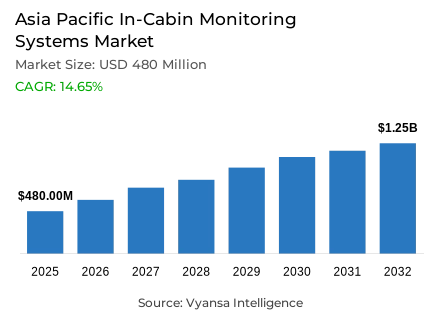
- In-cabin monitoring systems market size in Asia Pacific was valued at USD 480 million in 2025 and is estimated at USD 670 million in 2026.
- The market size is expected to grow to USD 1.25 billion by 2032.
- Market to register a CAGR of around 14.65% during 2026-32.
- Component Shares
- Cameras and imaging modules grabbed market share of 40%.
- Competition
- In-cabin monitoring systems in Asia Pacific is currently being catered to by more than 10 companies.
- Top 5 companies acquired around 30% of the market share.
- Panasonic Automotive Systems Co. Ltd., FORVIA SE, Aptiv PLC, DENSO Corporation, Hyundai Mobis Co. Ltd. etc., are few of the top companies.
- Application
- Driver Drowsiness and Fatigue Detection grabbed 30% of the market.
- Country
- China leads with a 40% share of the Asia Pacific market.
Asia Pacific In-Cabin Monitoring Systems Market Outlook
Vehicle interiors are shifting from passive space to safety domain as OEMs integrate driver monitoring, occupant monitoring, cabin sensing, smart cockpit systems, and ADAS integration. The Asia Pacific in-cabin monitoring systems market covers cameras, radar sensors, AI algorithms, ECUs, and software used by vehicles and fleets. The Asia Pacific in-cabin monitoring systems industry is valued at USD 480 Million in 2025, increasing to USD 670 Million in 2026, and is projected to reach USD 1.25 Billion by 2032, expanding at a CAGR of 14.65% during 2026-2032.
Safety-rating pressure, electrification, and software-defined vehicle programs are tightening the link between cabin intelligence and vehicle approval strategy. Euro NCAP’s 2026 Safe Driving protocols include Occupant Monitoring and Driver Engagement, signalling stronger assessment focus on driver engagement, child presence detection, and occupant status functions. This supports Asia Pacific in-cabin monitoring systems market adoption as APAC OEMs build export-ready architectures and local suppliers align cameras, near-infrared sensing, and embedded AI compute with global test expectations.
Industrial impact is concentrated around higher electronics content per vehicle, wider Tier 1 collaboration, and stronger demand for camera-based monitoring, automotive AI vision, and vehicle interior sensing platforms. The Asia Pacific in-cabin monitoring systems industry improves compliance readiness by linking driver attention, seatbelt status, occupant classification, and restraint logic to real-time cabin data. This shifts procurement from discrete safety components toward integrated perception stacks, strengthening supplier positioning across intelligent cockpit, ADAS, and connected vehicle safety programs.
Camera, software, and radar suppliers are entering 2026 with stronger order pipelines as OEMs prioritize scalable safety features over optional comfort packages. China’s vehicle production reached 34.531 million units in 2025, while NEV production and sales exceeded 16 million units, according to CAAM data reported by Gasgoo. That production base positions the Asia Pacific in-cabin monitoring systems market for faster localization, deeper electronics sourcing, and broader deployment across EVs, premium models, and commercial fleets.

Asia Pacific In-Cabin Monitoring Systems Market Growth Driver
Safety-Rating Compliance Accelerates Cabin Intelligence Demand
Safety-rating compliance is becoming a direct procurement catalyst as OEMs specify driver engagement, drowsiness detection, distraction detection, and occupant monitoring earlier in vehicle programs. The Asia Pacific in-cabin monitoring systems market benefits because cameras, AI software, and embedded processors move from premium-option content into homologation-aligned safety packages. This raises component attach rates and strengthens supplier leverage across passenger vehicles, connected vehicle platforms, and export programs serving markets with stricter rating visibility and testing discipline requirements.
Euro NCAP reported that from 2026 its assessments are structured around four safety stages, including Safe Driving, and that minimum thresholds influence overall star ratings. This framework strengthens Asia Pacific in-cabin monitoring systems industry demand by pushing APAC OEMs to validate driver attention monitoring, ADAS cabin monitoring, and safety-alert logic before model launch, improving procurement visibility for camera-module, software, and ECU suppliers across multiple vehicle platforms and model-year programs and regional technology localization programs initiatives.
Asia Pacific In-Cabin Monitoring Systems Market Challenge
Software Validation and Data Governance Pressure Supplier Scale-Up
Software validation and data-governance pressure limit faster deployment as camera feeds, biometric signals, driver behavior analytics, and OTA-updated safety logic must operate reliably across lighting, posture, age, and privacy conditions. The Asia Pacific in-cabin monitoring systems market faces longer design cycles because OEMs need accurate algorithms, cybersecurity controls, calibration procedures, and regional data-handling compliance before scaling AI-based cabin sensing from flagship programs to mass-volume vehicle platforms. This slows sourcing decisions and raises per-vehicle engineering overhead.
China’s industry ministry published draft rules in 2024 to strengthen oversight of recalls and over-the-air software upgrades for intelligent connected vehicles, with incident-reporting requirements for vehicles using combined driver-assistance systems, Reuters reported. That scrutiny raises compliance workload for Asia Pacific in-cabin monitoring systems industry participants, affecting software update governance, supplier documentation, validation budgets, and market participation for smaller developers lacking OEM-grade quality systems, particularly where integrated cockpit platforms rely on continuous feature refinement and releases.
Unlock Market Intelligence
Explore the market potential with our data-driven report
Asia Pacific In-Cabin Monitoring Systems Market Trend
Multi-Modal Cabin Sensing Moves Toward Integrated Safety Control
Multi-modal cabin sensing is moving beyond single-driver alerts toward integrated monitoring of every seating position, enabling safety, personalization, and restraint-control logic from the same sensing stack. The Asia Pacific in-cabin monitoring systems market is shifting toward combined DMS and OMS architectures because OEMs want fewer fragmented modules, better software reuse, and more consistent alerts across drowsiness detection, child presence detection, seatbelt monitoring, and passenger safety monitoring functions across shared electronic platforms and trim levels steadily.
Hyundai Mobis stated in January 2025 that its In-Cabin Monitoring System uses cameras and software logic to detect passenger posture, actions, and bio-signals across front and rear seats, covering more than 10 safety scenarios. This product direction strengthens Asia Pacific in-cabin monitoring systems industry adoption by linking AI-based cabin sensing with commercial fleet use, smart cockpit systems, next-generation automotive safety systems, higher software-defined vehicle content, and broader OEM order conversion across regional vehicle platforms consistently.
Asia Pacific In-Cabin Monitoring Systems Market Opportunity
Localized OEM Programs Open New Software-Supplier Access
Software-led supplier access is widening as Japanese and Korean OEMs add interior sensing to upcoming model programs, creating room for AI specialists that can integrate with established Tier 1 hardware. The Asia Pacific in-cabin monitoring systems market offers underpenetrated demand for scalable algorithms, validation datasets, driver attention monitoring, occupant classification, and cockpit personalization software that can be localized without redesigning camera and ECU hardware across export-oriented regional vehicle architectures and trim strategies and sourcing plans.
Smart Eye announced in April 2025 that its DMS software would be integrated into two upcoming models from a leading Japanese OEM, while a separate April 2025 release reported Interior Sensing AI for three new models from a Korean manufacturer. These wins improve demand capture for software suppliers by proving that APAC model pipelines can absorb combined DMS and CMS functionality across multiple platforms, supporting licensing, integration services, and long-cycle OEM relationships over successive launches.
Asia Pacific In-Cabin Monitoring Systems Market Country Analysis
By Country
- China
- Japan
- South Korea
- India
- Thailand
- Indonesia
- Rest of Asia Pacific
China’s scale, EV penetration, smart cockpit localization, and dense supplier ecosystem make it the dominant country with 40% share. The Asia Pacific in-cabin monitoring systems market is anchored by China because high vehicle output gives OEMs room to standardize cameras, AI processors, and passenger safety monitoring across multiple trims, while local electronics suppliers can support faster cost-down cycles and shorter validation feedback loops for domestic and export model programs, especially NEV platforms and fleets regionally.
CAAM data reported by Gasgoo shows that China’s full-year vehicle shipments topped 7 million units in 2025, including 2.615 million NEVs, highlighting a large export base tied to rising electronics content. This export exposure strengthens Asia Pacific in-cabin monitoring systems industry demand by pushing Chinese OEMs to align driver monitoring, child presence detection, and occupant classification with overseas safety expectations and supplier localization strategies across connected vehicle safety architectures and export homologation requirements globally.
Unlock Market Intelligence
Explore the market potential with our data-driven report
Asia Pacific In-Cabin Monitoring Systems Market Segmentation Analysis
By Component
- Cameras and Imaging Modules
- Radar Sensors
- Infrared and Time-of-Flight Sensing Modules
- Processing ECUs and AI Compute Units
- Software and AI Algorithms
- Others
Cameras and Imaging Modules hold 40% share because optical sensing remains the most deployment-ready layer for eye tracking, facial analysis, head-pose detection, driver distraction detection, and cabin-state interpretation. The Asia Pacific in-cabin monitoring systems market relies on camera modules as the primary capture point for near-infrared driver monitoring, smart cabin safety systems, and software-defined perception, giving this component category stronger bill-of-material visibility than newer radar or depth-sensing modules in regional programs and trim strategies overall.
DENSO states that its Driver Status Monitor uses a camera to capture the driver’s face, applies visual analysis to detect carelessness, distraction, and drowsiness, and uses near-infrared lighting plus image recognition for darker conditions. This supports Asia Pacific in-cabin monitoring systems industry supply planning by confirming that camera optics, CMOS image sensors, illumination control, and AI algorithms remain central to OEM-grade monitoring architectures across passenger cars, commercial vehicles, and fleet retrofit channels at scale regionally.

By Application
- Driver Drowsiness and Fatigue Detection
- Driver Distraction and Attention Monitoring
- Occupant Presence and Classification
- Seatbelt Usage and Posture Monitoring
- Child Presence Detection
- Vital Signs Monitoring
- Biometric Identification and Cabin Personalization
- Others
Driver Drowsiness and Fatigue Detection holds 30% share because fatigue-alert use cases sit closest to regulatory intent, safety-rating visibility, and fleet-risk reduction. The Asia Pacific in-cabin monitoring systems market places this application ahead of broader personalization features because driver state monitoring has clearer procurement justification, measurable alert logic, and direct linkage with ADAS handover, lane-keeping support, and automated-driving readiness in passenger and commercial vehicle programs across regional OEM platforms and export certification plans in 2026.
Smart Eye states that its driver monitoring software has been installed in more than 4,000,000 cars and uses in-car cameras, computer vision, and artificial intelligence to understand driver state and behavior. This operating evidence reinforces drowsiness detection demand by showing that AI-based driver attention monitoring can move from development validation into scaled OEM deployment, supporting supplier investment in facial, eye, and head-movement analytics for high-volume safety packages and fleet applications over time regionally.
Various Market Players in Asia Pacific In-Cabin Monitoring Systems Market
The companies mentioned below are highly active in the Asia Pacific in-cabin monitoring systems market, occupying a considerable portion of the market and shaping industry progress.
- Panasonic Automotive Systems Co. Ltd.
- FORVIA SE
- Aptiv PLC
- DENSO Corporation
- Hyundai Mobis Co. Ltd.
- Valeo SE
- Robert Bosch GmbH
- Continental AG
- Desay SV
- Smart Eye Aktiebolag (publ)
- Minieye Technology Co. Ltd.
- Sony Semiconductor Solutions Corporation
Market News & Updates
- FORVIA SE, 2025:
FORVIA presented AirVision at Auto Shanghai 2025 in China as part of its smart-cabin technology portfolio. The solution uses a Driver Monitoring System camera to detect driver gaze and enable gaze-and-select interaction with a 3D virtual image display. The update adds an in-cabin monitoring interface layer that supports lower-distraction cockpit interaction for APAC OEM programs.
- Robert Bosch GmbH, 2025:
Bosch received its first customer order in China for a high-performance vehicle computer used to create an AI cockpit. Production was scheduled to start in 2025, with the system supporting natural driver-vehicle interaction and Bosch’s software-defined mobility portfolio for Chinese automakers. The update adds localized cockpit compute capability for APAC smart-cabin and ADAS integration programs.
Frequently Asked Questions
Related Report
- Market Segmentation
- Research Scope
- Research Methodology
- Definitions and Assumptions
- Executive Summary
- Asia Pacific Automotive In-Cabin Monitoring Systems Market Policies, Regulations, and Standards
- Asia Pacific Automotive In-Cabin Monitoring Systems Market Dynamics
- Growth Factors
- Challenges
- Trends
- Opportunities
- Asia Pacific Automotive In-Cabin Monitoring Systems Market Statistics, 2022-2032F
- Market Size & Growth Outlook
- By Revenues in USD Million
- Market Segmentation & Growth Outlook
- By System Type
- Driver Monitoring Systems- Market Insights and Forecast 2022-2032, USD Million
- Occupant Monitoring Systems- Market Insights and Forecast 2022-2032, USD Million
- Integrated Driver and Occupant Monitoring Systems- Market Insights and Forecast 2022-2032, USD Million
- Others- Market Insights and Forecast 2022-2032, USD Million
- By Component
- Cameras and Imaging Modules- Market Insights and Forecast 2022-2032, USD Million
- Radar Sensors- Market Insights and Forecast 2022-2032, USD Million
- Infrared and Time-of-Flight Sensing Modules- Market Insights and Forecast 2022-2032, USD Million
- Processing ECUs and AI Compute Units- Market Insights and Forecast 2022-2032, USD Million
- Software and AI Algorithms- Market Insights and Forecast 2022-2032, USD Million
- Others- Market Insights and Forecast 2022-2032, USD Million
- By Sensing Technology
- Camera-Based Monitoring- Market Insights and Forecast 2022-2032, USD Million
- Radar-Based Monitoring- Market Insights and Forecast 2022-2032, USD Million
- Time-of-Flight and 3D Depth Sensing- Market Insights and Forecast 2022-2032, USD Million
- Biometric and Vital-Sign Sensing- Market Insights and Forecast 2022-2032, USD Million
- Multi-Sensor Fusion Monitoring- Market Insights and Forecast 2022-2032, USD Million
- Others- Market Insights and Forecast 2022-2032, USD Million
- By Application
- Driver Drowsiness and Fatigue Detection- Market Insights and Forecast 2022-2032, USD Million
- Driver Distraction and Attention Monitoring- Market Insights and Forecast 2022-2032, USD Million
- Occupant Presence and Classification- Market Insights and Forecast 2022-2032, USD Million
- Seatbelt Usage and Posture Monitoring- Market Insights and Forecast 2022-2032, USD Million
- Child Presence Detection- Market Insights and Forecast 2022-2032, USD Million
- Vital Signs Monitoring- Market Insights and Forecast 2022-2032, USD Million
- Biometric Identification and Cabin Personalization- Market Insights and Forecast 2022-2032, USD Million
- Others- Market Insights and Forecast 2022-2032, USD Million
- By Vehicle Type
- Passenger Cars- Market Insights and Forecast 2022-2032, USD Million
- Light Commercial Vehicles- Market Insights and Forecast 2022-2032, USD Million
- Heavy Commercial Vehicles- Market Insights and Forecast 2022-2032, USD Million
- Buses and Coaches- Market Insights and Forecast 2022-2032, USD Million
- Others- Market Insights and Forecast 2022-2032, USD Million
- By Installation Channel
- OEM-Installed Systems- Market Insights and Forecast 2022-2032, USD Million
- Aftermarket and Fleet Retrofit Systems- Market Insights and Forecast 2022-2032, USD Million
- By Country
- China
- Japan
- South Korea
- India
- Thailand
- Indonesia
- Rest of Asia Pacific
- By Competitors
- Competition Characteristics
- Market Share & Analysis
- By System Type
- Market Size & Growth Outlook
- China In-Cabin Monitoring Systems Market Statistics, 2022-2032F
- Market Size & Growth Outlook
- By Revenues in USD Million
- Market Segmentation & Growth Outlook
- By System Type- Market Insights and Forecast 2022-2032, USD Million
- By Component- Market Insights and Forecast 2022-2032, USD Million
- By Sensing Technology- Market Insights and Forecast 2022-2032, USD Million
- By Application- Market Insights and Forecast 2022-2032, USD Million
- By Vehicle Type- Market Insights and Forecast 2022-2032, USD Million
- By Installation Channel- Market Insights and Forecast 2022-2032, USD Million
- Market Size & Growth Outlook
- Japan In-Cabin Monitoring Systems Market Statistics, 2022-2032F
- Market Size & Growth Outlook
- By Revenues in USD Million
- Market Segmentation & Growth Outlook
- By System Type- Market Insights and Forecast 2022-2032, USD Million
- By Component- Market Insights and Forecast 2022-2032, USD Million
- By Sensing Technology- Market Insights and Forecast 2022-2032, USD Million
- By Application- Market Insights and Forecast 2022-2032, USD Million
- By Vehicle Type- Market Insights and Forecast 2022-2032, USD Million
- By Installation Channel- Market Insights and Forecast 2022-2032, USD Million
- Market Size & Growth Outlook
- South Korea In-Cabin Monitoring Systems Market Statistics, 2022-2032F
- Market Size & Growth Outlook
- By Revenues in USD Million
- Market Segmentation & Growth Outlook
- By System Type- Market Insights and Forecast 2022-2032, USD Million
- By Component- Market Insights and Forecast 2022-2032, USD Million
- By Sensing Technology- Market Insights and Forecast 2022-2032, USD Million
- By Application- Market Insights and Forecast 2022-2032, USD Million
- By Vehicle Type- Market Insights and Forecast 2022-2032, USD Million
- By Installation Channel- Market Insights and Forecast 2022-2032, USD Million
- Market Size & Growth Outlook
- India In-Cabin Monitoring Systems Market Statistics, 2022-2032F
- Market Size & Growth Outlook
- By Revenues in USD Million
- Market Segmentation & Growth Outlook
- By System Type- Market Insights and Forecast 2022-2032, USD Million
- By Component- Market Insights and Forecast 2022-2032, USD Million
- By Sensing Technology- Market Insights and Forecast 2022-2032, USD Million
- By Application- Market Insights and Forecast 2022-2032, USD Million
- By Vehicle Type- Market Insights and Forecast 2022-2032, USD Million
- By Installation Channel- Market Insights and Forecast 2022-2032, USD Million
- Market Size & Growth Outlook
- Thailand In-Cabin Monitoring Systems Market Statistics, 2022-2032F
- Market Size & Growth Outlook
- By Revenues in USD Million
- Market Segmentation & Growth Outlook
- By System Type- Market Insights and Forecast 2022-2032, USD Million
- By Component- Market Insights and Forecast 2022-2032, USD Million
- By Sensing Technology- Market Insights and Forecast 2022-2032, USD Million
- By Application- Market Insights and Forecast 2022-2032, USD Million
- By Vehicle Type- Market Insights and Forecast 2022-2032, USD Million
- By Installation Channel- Market Insights and Forecast 2022-2032, USD Million
- Market Size & Growth Outlook
- Indonesia In-Cabin Monitoring Systems Market Statistics, 2022-2032F
- Market Size & Growth Outlook
- By Revenues in USD Million
- Market Segmentation & Growth Outlook
- By System Type- Market Insights and Forecast 2022-2032, USD Million
- By Component- Market Insights and Forecast 2022-2032, USD Million
- By Sensing Technology- Market Insights and Forecast 2022-2032, USD Million
- By Application- Market Insights and Forecast 2022-2032, USD Million
- By Vehicle Type- Market Insights and Forecast 2022-2032, USD Million
- By Installation Channel- Market Insights and Forecast 2022-2032, USD Million
- Market Size & Growth Outlook
- Competitive Outlook
- Company Profiles
- DENSO Corporation
- Business Description
- Service Portfolio
- Collaborations & Alliances
- Recent Developments
- Financial Details
- Others
- Hyundai Mobis Co. Ltd.
- Business Description
- Service Portfolio
- Collaborations & Alliances
- Recent Developments
- Financial Details
- Others
- Valeo SE
- Business Description
- Service Portfolio
- Collaborations & Alliances
- Recent Developments
- Financial Details
- Others
- Robert Bosch GmbH
- Business Description
- Service Portfolio
- Collaborations & Alliances
- Recent Developments
- Financial Details
- Others
- Continental AG
- Business Description
- Service Portfolio
- Collaborations & Alliances
- Recent Developments
- Financial Details
- Others
- Panasonic Automotive Systems Co. Ltd.
- Business Description
- Service Portfolio
- Collaborations & Alliances
- Recent Developments
- Financial Details
- Others
- FORVIA SE
- Business Description
- Service Portfolio
- Collaborations & Alliances
- Recent Developments
- Financial Details
- Others
- Aptiv PLC
- Business Description
- Service Portfolio
- Collaborations & Alliances
- Recent Developments
- Financial Details
- Others
- Desay SV
- Business Description
- Service Portfolio
- Collaborations & Alliances
- Recent Developments
- Financial Details
- Others
- Smart Eye Aktiebolag (publ)
- Business Description
- Service Portfolio
- Collaborations & Alliances
- Recent Developments
- Financial Details
- Others
- Minieye Technology Co. Ltd.
- Business Description
- Service Portfolio
- Collaborations & Alliances
- Recent Developments
- Financial Details
- Others
- Sony Semiconductor Solutions Corporation
- Business Description
- Service Portfolio
- Collaborations & Alliances
- Recent Developments
- Financial Details
- Others
- DENSO Corporation
- Company Profiles
- Disclaimer
| Segment | Sub-Segment |
|---|---|
| By System Type |
|
| By Component |
|
| By Sensing Technology |
|
| By Application |
|
| By Vehicle Type |
|
| By Installation Channel |
|
| By Country |
|
Research Methodology
This study followed a structured approach comprising four key phases to assess the size and scope of the electro-oxidation market. The process began with thorough secondary research to collect data on the target market, related markets, and broader industry context. These findings, along with preliminary assumptions and estimates, were then validated through extensive primary research involving industry experts from across the value chain. To calculate the overall market size, both top-down and bottom-up methodologies were employed. Finally, market segmentation and data triangulation techniques were applied to refine and validate segment-level estimations.
Secondary Research
The secondary research phase involved gathering data from a wide range of credible and published sources. This step helped in identifying industry trends, defining market segmentation, and understanding the market landscape and value chain.
Sources consulted during this phase included:
- Company annual reports, investor presentations, and press releases
- Industry white papers and certified publications
- Trade directories and market-recognized databases
- Articles from authoritative authors and reputable journals
- Gold and silver standard websites
Secondary research was critical in mapping out the industry's value chain and monetary flow, identifying key market segments, understanding regional variations, and tracking significant industry developments.
Other key sources:
- Financial disclosures
- Industry associations and trade bodies
- News outlets and business magazines
- Academic journals and research studies
- Paid industry databases
Primary Research
To validate secondary data and gain deeper market insights, primary research was conducted with key stakeholders across both the supply and demand sides of the market.
On the demand side, participants included decision-makers and influencers from end-user industries—such as CIOs, CTOs, and CSOs—who provided first-hand perspectives on market needs, product usage, and future expectations.
On the supply side, interviews were conducted with manufacturers, industry associations, and institutional participants to gather insights into current offerings, product pipelines, and market challenges.
Primary interviews provided critical inputs such as:
- Market size and revenue data
- Product and service breakdowns
- Market forecasts
- Regional and application-specific trends
Stakeholders consulted included:
- Leading OEM and solution providers
- Channel and distribution partners
- End users across various applications
- Independent consultants and industry specialists
Market Size Estimation and Data Triangulation
- Identifying Key Market Participants (Secondary Research)
- Goal: To identify the major players or companies in the target market. This typically involves using publicly available data sources such as industry reports, market research publications, and financial statements of companies.
- Tools: Reports from firms like Gartner, Forrester, Euromonitor, Statista, IBISWorld, and others. Public financial statements, news articles, and press releases from top market players.
- Extracting Earnings of Key Market Participants
- Goal: To estimate the earnings generated from the product or service being analyzed. This step helps in understanding the revenue potential of each market player in a specific geography.
- Methods: Earnings data can be gathered from:
- Publicly available financial reports (for listed companies).
- Interviews and primary data sources from professionals, such as Directors, VPs, SVPs, etc. This is especially useful for understanding more nuanced, internal data that isn't publicly disclosed.
- Annual reports and investor presentations of key players.
- Data Collation and Development of a Relevant Data Model
- Goal: To collate inputs from both primary and secondary sources into a structured, data-driven model for market estimation. This model will incorporate key market KPIs and any independent variables relevant to the market.
- Key KPIs: These could include:
- Market size, growth rate, and demand drivers.
- Industry-specific metrics like market share, average revenue per customer (ARPC), or average deal size.
- External variables, such as economic growth rates, inflation rates, or commodity prices, that could affect the market.
- Data Modeling: Based on this data, the market forecasts are developed for the next 5 years. A combination of trend analysis, scenario modeling, and statistical regression might be used to generate projections.
- Scenario Analysis
- Goal: To test different assumptions and validate how sensitive the market is to changes in key variables (e.g., market demand, regulatory changes, technological disruptions).
- Types of Scenarios:
- Base Case: Based on current assumptions and historical data.
- Best-Case Scenario: Assuming favorable market conditions, regulatory environments, and technological advancements.
- Worst-Case Scenario: Accounting for adverse factors, such as economic downturns, stricter regulations, or unexpected disruptions.












