Asia Pacific Healthy Biscuits Market Report: Trends, Growth and Forecast (2026-2032)
By Product Type (Digestive & High-Fibre Biscuits, Reduced-Fat & Low-Calorie Biscuits, Gluten-Free Biscuits, Protein-Enriched Biscuits, Others), By Ingredient (Wheat-Based, Oat-Based, Multigrain-Based, Millet-Based, Nut & Seed-Based, Fruit-Based, Others), By Consumers (Children, Teenagers, Adults, Seniors), By Dietary Preference (Vegan, Gluten-Free, Keto-Friendly, Low-Carb, High-Protein, Sugar-Free/Diabetic-Friendly, Others), By Sales Channel (Retail Offline (Supermarkets & Hypermarkets, Convenience Stores, Traditional Grocery & Independent Retailers, Specialty Food & Health Stores), Retail Online (E-commerce Marketplaces, Online Grocery & Quick-Commerce Platforms, Brand-Owned Direct-to-Consumer Websites)), By Packaging Format (Flexible Packs & Pouches, Cartons & Boxes, Tins & Canisters, Others), By Nature (Conventional, Certified Organic), By Country (China, India, Japan, South Korea, Australia, Singapore, Rest of Asia Pacific) ... Read more
|
Major Players
|
Asia-Pacific Healthy Biscuits Market Size, Share & Forecast (2026-2032)
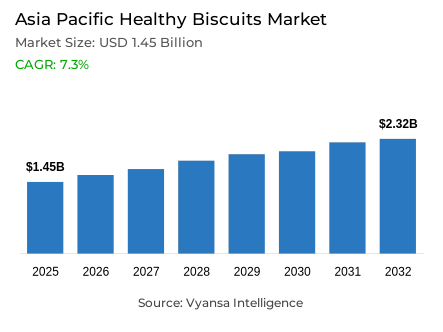
The Asia-Pacific healthy biscuits market covers packaged biscuits positioned around fibre, reduced fat or calories, gluten avoidance, protein enrichment, and other nutrition-led attributes. These products serve routine snacking, breakfast accompaniment, school or workplace consumption, and portion-controlled eating. The Asia-Pacific healthy biscuits industry is forecast to expand at a CAGR of 7.3% during 2026-2032 as consumers seek convenient formats aligned with healthier diets, while manufacturers broaden whole-grain formulations, improve nutrient claims, and increase access through modern retail and digital commerce.
Key Highlights of the Asia-Pacific Healthy Biscuits Market:
- The Asia-Pacific Healthy Biscuits Market reached USD 1.52 billion in 2026 and is projected to attain USD 2.32 billion by 2032.
- The market is expected to expand at a CAGR of 7.30% during 2026–2032.
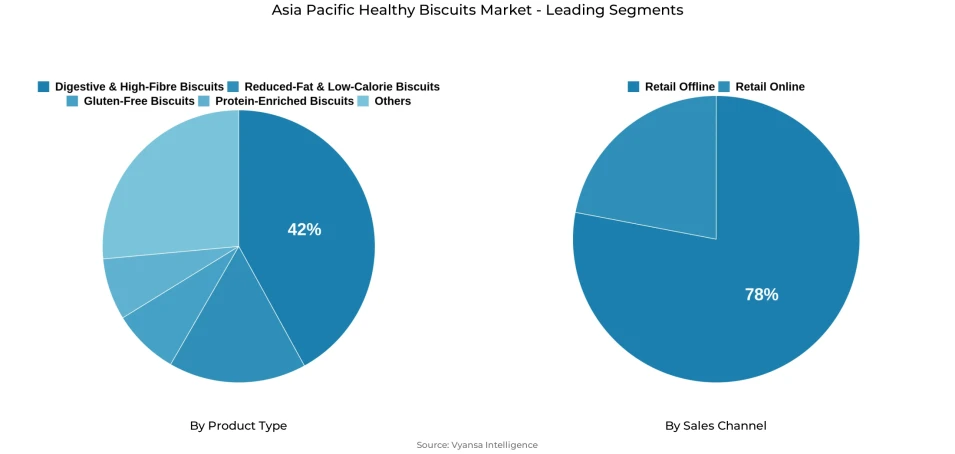
- Digestive & High-Fibre Biscuits dominated the market with a 42% share in 2026.
- Protein-Enriched Biscuits are projected to be the fastest-growing product type, at a 14.89% CAGR during 2026–2032.
- Retail Offline led distribution with a 78% market share in 2026.
- Retail Online is anticipated to witness the fastest growth, registering a 14.51% CAGR during 2026–2032.
- China accounted for the largest regional share, holding 45% of the market in 2026.
- India is projected to be the fastest-growing country, expanding at a 12.66% CAGR during 2026–2032.
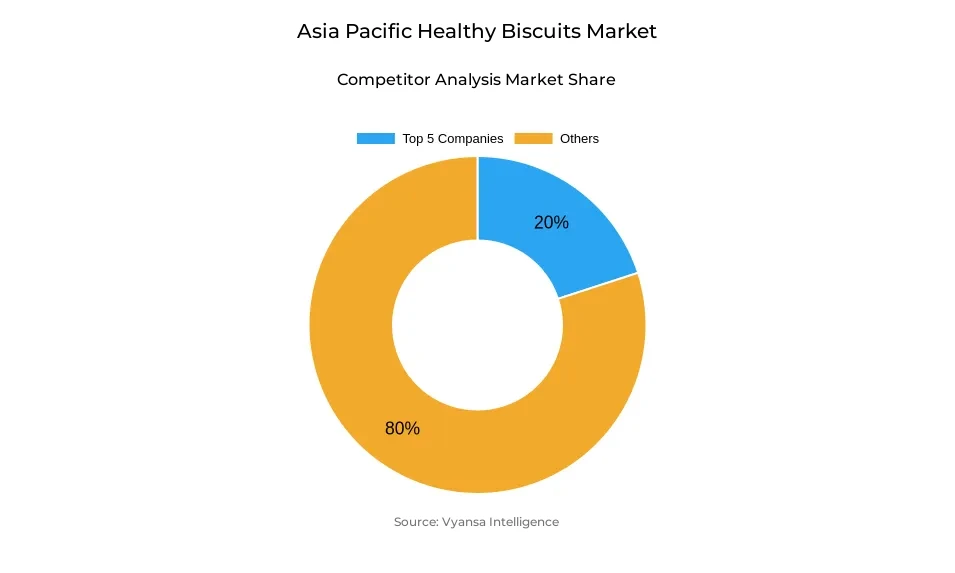
- The top five companies held 20% of the market, indicating a highly fragmented competitive landscape.
The Asia-Pacific Healthy Biscuits Market is witnessing steady expansion, supported by evolving consumer lifestyles, increasing health awareness, and rising demand for convenient yet nutritious snack options. Rapid urbanization is reshaping food consumption patterns across the region, encouraging greater reliance on packaged and ready-to-eat products. According to the United Nations, Asia's urban population reached approximately 2.42 billion in 2025, while the FAO notes that urbanization continues to increase household consumption of processed and convenience foods. This transition is accelerating demand for healthy biscuits formulated with whole grains, dietary fiber, reduced sugar, protein, and other functional ingredients.
At the same time, manufacturers are strengthening supply capabilities through continuous investments in production modernization and advanced food-processing technologies. Automated baking systems, intelligent manufacturing solutions, high-speed packaging equipment, and digital quality management platforms are improving production efficiency, product consistency, and operational scalability. According to UNIDO and the FAO, modernization of agri-food processing infrastructure is enhancing manufacturing capabilities, expanding production capacity, and enabling faster commercialization of innovative healthy biscuit products across the region.
Looking ahead, the Asia-Pacific healthy biscuits market is expected to maintain robust growth throughout the forecast period, driven by continuous innovation in clean-label formulations, sugar-reduction technologies, plant-based ingredients, functional nutrition, and sustainable packaging solutions. Increasing investments in research and development, advanced manufacturing capabilities, and product innovation will continue to improve nutritional value while maintaining taste, quality, and affordability. These developments are expected to strengthen market competitiveness and create long-term growth opportunities for both regional and international healthy biscuit manufacturers.
Government Regulations Shaping the Asia-Pacific Healthy Biscuits Market
China: Blue Hat Health Food Registration System (SAMR)
China's Blue Hat Health Food Registration System, administered by the State Administration for Market Regulation (SAMR), requires food products carrying approved health function claims to obtain official registration or filing before such claims can appear on product packaging. The regulation ensures that health claims are supported by scientific evidence and comply with the approved catalogue of permitted functional claims. This framework encourages manufacturers to strengthen product validation and regulatory compliance while promoting innovation in scientifically substantiated functional healthy biscuits across the Asia-Pacific healthy biscuits market.
India: Food Safety and Standards (Labelling and Display) Regulations
The Food Safety and Standards Authority of India (FSSAI) amended the Food Safety and Standards (Labelling and Display) Regulations to require packaged foods to prominently display Total Sugar, Total Salt, and Saturated Fat on product labels. The regulation improves nutrition transparency and supports informed product comparison across packaged foods. It is encouraging manufacturers to reformulate biscuit products with improved nutritional profiles while strengthening clean-label and reduced-sugar product development. Ongoing discussions on front-of-pack nutrition labeling are also expected to further support healthier product innovation across the Asia-Pacific Healthy Biscuits Market.
Asia-Pacific Healthy Biscuits Market Drivers
Health-Focused Snacking Habits Strengthen Healthy Biscuits Demand
The growing prevalence of diabetes, obesity, and other lifestyle-related health conditions is accelerating demand across the Asia-Pacific healthy biscuits market. Increasing emphasis on balanced nutrition has encouraged manufacturers to expand portfolios featuring whole grains, dietary fiber, reduced sugar, and functional ingredients that support healthier everyday snacking. According to the International Diabetes Federation (IDF) Diabetes Atlas 2025, the Western Pacific Region has 215 million adults living with diabetes, while South-East Asia accounts for 107 million adults, highlighting a substantial population requiring improved dietary alternatives. This evolving health landscape continues to reshape product development across the biscuit industry.
Healthy biscuits are well positioned to address this transition because they combine nutritional value with convenience across breakfast, workplace, school, and on-the-go consumption occasions. Rising awareness of preventive nutrition, together with increasing childhood overweight prevalence, is reinforcing demand for fiber-rich and reduced-sugar formulations throughout the region. Continuous investment in clean-label ingredients, functional nutrition, and product reformulation is expected to strengthen commercial opportunities, supporting sustained expansion of the Asia-Pacific healthy biscuits market during the forecast period.
Asia-Pacific Healthy Biscuits Market Restraints
Cost Premium of Healthy Ingredients Restrains Wider Market Penetration
The higher production cost associated with functional ingredients remains a key challenge for the Asia-Pacific healthy biscuits market. Whole grains, plant proteins, dietary fibers, resistant starches, and natural sweeteners generally carry higher procurement costs than conventional refined ingredients, increasing manufacturing expenses across healthy biscuit portfolios. This pricing gap creates commercial pressure in several Asia-Pacific economies where value-oriented packaged food purchases remain dominant, limiting the ability of manufacturers to expand premium healthy biscuit offerings across broader retail channels while maintaining competitive pricing.
The challenge is further intensified by fluctuations in global agricultural commodity prices and supply chain costs. According to the FAO Food Price Index, the global food price index averaged 130.7 points in April 2026, while the Cereal Price Index increased to 114.3 points in May 2026, reflecting continued volatility in wheat and grain markets. Rising raw material, transportation, and energy costs continue to influence production economics, requiring manufacturers to balance product affordability with ongoing investments in innovation, quality enhancement, and nutritional reformulation across the Asia-Pacific healthy biscuits market.
Asia-Pacific Healthy Biscuits Market Recent Trends
Shift Toward Claim-Specific Healthy Biscuits
The Asia-Pacific healthy biscuits market is shifting toward claim-specific product positioning as purchasing decisions increasingly assess packaged foods through clearly stated nutritional benefits rather than broad “healthy” messaging. Claims such as “No Maida,” “Millet-Based,” “High Fibre,” “Low Sugar,” and “Plant-Based” are becoming important shelf differentiators. In India, millet-based and no-maida products are gaining stronger visibility, while low-sugar and high-fibre biscuits are expanding in China and Japan. Australia and New Zealand are also seeing rising interest in gluten-free and plant-based varieties. Reflecting this trend, Britannia Industries Limited launched NutriChoice 100% Millets Apple Cinnamon cookies in December 2025, featuring millet flours and claims including no maida, no added sugar, and no palm oil.
This movement is reinforced by growing attention to transparent nutrition information across packaged foods. The World Health Organization identifies front-of-pack nutrition labelling as a tool that can help consumers understand nutritional value and encourage manufacturers to improve product formulations. In India, FSSAI requires pre-packaged foods to display nutritional information and ingredient details, while increasing scrutiny of health-related claims. As labelling becomes more standardized, manufacturers are using focused claims such as wholegrain, high protein, no added sugar, and millet-based to differentiate products effectively and support long-term innovation across the regional market.
Asia-Pacific Healthy Biscuits Market Future Opportunities
Life Stage- and Condition-Specific Healthy Biscuits Create Long-Term Growth Opportunities
The Asia-Pacific healthy biscuits industry presents opportunities through products tailored to life stages and nutritional requirements. Manufacturers are increasingly developing formulations for diabetic-friendly diets, healthy ageing, children’s nutrition, sports nutrition, and weight management, moving beyond broad “healthy” positioning. Such targeted portfolios help companies address defined dietary needs while creating premium categories with stronger differentiation. This approach supports diversification across ageing economies such as Japan, South Korea, and China, alongside younger urbanizing markets including India, Indonesia, Vietnam, and the Philippines. Reflecting this opportunity, ITC Limited launched Sunfeast Farmlite Sugar Free Cookies in April 2026 in Choco Nut and Hazelnut & Oats variants. The cookies are positioned as a source of protein with no trans fats, while the Hazelnut & Oats variant is also lactose-free.
The long-term opportunity is reinforced by demographic and healthcare trends. According to the International Diabetes Federation’s Diabetes Atlas 2025, the Western Pacific Region could have 254 million adults living with diabetes by 2050, while India’s diabetic population could reach 156.7 million. Simultaneously, population ageing and participation in active lifestyles are strengthening demand for low-glycaemic, protein-rich, fibre-enriched, and functional biscuits. These shifts are expected to encourage innovation and create premium growth avenues across the Asia-Pacific healthy biscuits market.
Unlock Market Intelligence
Explore the market potential with our data-driven report
Asia-Pacific Healthy Biscuits Market Segmentation Analysis
By Product Type
- Digestive & High-Fibre Biscuits
- Reduced-Fat & Low-Calorie Biscuits
- Gluten-Free Biscuits
- Protein-Enriched Biscuits
Digestive & High-Fibre Biscuits Held a 42% Market Share; Protein-Enriched Biscuits to Grow at 14.89%
Digestive & high-fibre biscuits led with 42% of 2026 revenue because they combine familiar taste, established consumer understanding, broad price coverage, and extensive availability. Wheat, bran, oats, millet, and seed formulations allow manufacturers to communicate fibre benefits without moving far from conventional biscuit textures or tea-time usage. Within the Asia-Pacific healthy biscuits market, this segment benefits from mass retail distribution, frequent household replenishment, accessible pack sizes, and lower formulation complexity than specialized gluten-free or protein-heavy alternatives across the markets.
Protein-enriched biscuits are forecast to record a 14.89% CAGR during 2026-2032, making them the fastest-growing product type. Expansion is supported by active-lifestyle consumption, workplace snacking, breakfast substitution, and interest in convenient protein beyond powders and bars. Compared with digestive products, protein biscuits address a smaller current base but provide stronger premiumization potential. Manufacturers can accelerate adoption through improved texture, balanced flavor, plant-dairy protein blends, clear serving-level claims, and distribution through gyms, pharmacies, supermarkets, and online retail platforms regionally at scale.
By Sales Channel
- Retail Offline
- Supermarkets & Hypermarkets
- Convenience Stores
- Traditional Grocery & Independent Retailers
- Specialty Food & Health Stores
- Retail Online
- E-commerce Marketplaces
- Online Grocery & Quick-Commerce Platforms
- Brand-Owned Direct-to-Consumer Websites
Retail Offline Held a 78% Market Share; Retail Online to Grow at 14.51% CAGR
Retail Offline accounted for 78% of 2026 revenue because biscuits remain high-frequency, low-ticket products purchased through supermarkets, convenience stores, traditional groceries, independent retailers, and specialty outlets. Physical channels provide immediate availability, visible pack-price comparison, impulse placement, and access for consumers who do not routinely buy food online. Established distributor relationships and broad store coverage also support regular replenishment across metropolitan, secondary-city, and rural locations, despite substantial differences among national retail structures and household purchasing patterns across the region's diverse economies.
Retail Online is projected to expand at a 14.51% CAGR during 2026-2032, supported by wider smartphone commerce, online grocery adoption, quick-commerce delivery, marketplace assortment, and brand-owned websites. Digital channels improve access to gluten-free, protein-enriched, premium, and imported products that may receive limited shelf space offline. Compared with store-based retail, online platforms enable targeted discovery, subscription purchasing, detailed nutrition comparison, and rapid product testing, allowing smaller brands to reach consumers efficiently before developing extensive distributor and physical-retail networks across multiple countries.
Unlock Market Intelligence
Explore the market potential with our data-driven report
Asia-Pacific Healthy Biscuits Market Regional Analysis
China is projected to account for approximately 45% of the Asia-Pacific healthy biscuits market during 2026–2032, driven by its large-scale food manufacturing base, extensive retail infrastructure, and strong consumer demand for healthier packaged snacks. Rising health awareness, expanding availability of high-fiber, low-sugar, and functional biscuit varieties, and continuous product innovation are supporting market growth across urban and emerging cities. Furthermore, increasing penetration of modern retail formats, rapid e-commerce expansion, and favorable demand for nutritious convenience foods are expected to strengthen China’s leadership position in the regional healthy biscuits market throughout the forecast period.
India is forecast to register a 12.66% CAGR during 2026–2032, making it the fastest-growing country in the Asia-Pacific healthy biscuits market. Growth is driven by a large biscuit-consuming population, expanding general-trade and modern retail networks, rapid quick-commerce adoption, and rising demand for healthier biscuits containing fiber, millets, protein, and reduced-sugar ingredients. Reflecting this shift, Britannia launched 100% Millets Apple Cinnamon Cookies in December 2025, while ITC continues expanding its Farm lite high-fiber and digestive portfolio. Compared with China's mature market, India's affordable packs, localized grains, wider distribution, premium product innovation, and increasing health awareness will sustain robust market expansion.
Asia-Pacific Healthy Biscuits Market Competitive Landscape
The Asia-Pacific healthy biscuits industry is fragmented, with the top five companies collectively accounting for 20% of value in 2026. Competition is shaped by product breadth, nutritional credibility, taste, pricing, pack architecture, manufacturing efficiency, retail visibility, and e-commerce access. Large FMCG groups benefit from distribution scale and brand recognition, while specialist biscuit producers compete through sugar-free, gluten-free, whole-grain, millet, fiber, and protein formulations.
Key Companies in the Asia-Pacific Healthy Biscuits Market
- Danone
- Want Want China Holdings Limited
- Jiashili Food Group Co. Ltd.
- Ezaki Glico Co. Ltd.
- Morinaga & Co. Ltd.
- Meiji Holdings Co. Ltd.
- Britannia Industries Limited
- ITC Limited
- UNIBIC Foods India Pvt. Ltd.
- Lotus Bakeries / pladis Global
- Gullón
Recent Developments in the Asia-Pacific Healthy Biscuits Industry
- In April 2026, ITC introduced Sunfeast Farmlite Sugar Free Cookies, including Choco Nut and Hazelnut Oats variants. The launch expands the company’s better-for-you biscuit portfolio with sugar-free positioning and supports wider choice for consumers seeking familiar cookie formats with differentiated nutrition claims.
- In December 2025, Britannia Industries Limited launched NutriChoice 100% Millets Apple Cinnamon cookies made with jowar, foxtail millet, and ragi flour. The product carries no-added-sugar, no-maida, and no-palm-oil positioning and entered modern trade and leading quick-commerce platforms across key Indian metros.
Frequently Asked Questions
Related Report
- Market Segmentation
- Research Scope
- Research Methodology
- Definitions and Assumptions
- Executive Summary
- Asia-Pacific Healthy Biscuits Market Policies, Regulations, and Standards
- Asia-Pacific Healthy Biscuits Production Trend 2022-2032
- Asia-Pacific Healthy Biscuits Production Trend By Product Type
- Digestive & High-Fibre Biscuits
- Reduced-Fat & Low-Calorie Biscuits
- Gluten-Free Biscuits
- Protein-Enriched Biscuits
- Others
- Company Wise Production Plants and Statistics
- Installed Production Capacity
- Actual Production
- Planned Production Target
- Asia-Pacific Healthy Biscuits Production Trend By Product Type
- Asia-Pacific Healthy Biscuits Pricing Analysis 2022-2032
- Asia-Pacific Healthy Biscuits Pricing Trend (USD) 2022-2032
- Asia-Pacific Healthy Biscuits Pricing Trend (USD) By Country 2022-2032
- China
- India
- Japan
- South Korea
- Australia
- Singapore
- Rest of Asia Pacific
- Asia-Pacific Healthy Biscuits Pricing Trend (USD) By Product Type 2022-2032
- Digestive & High-Fibre Biscuits
- Reduced-Fat & Low-Calorie Biscuits
- Gluten-Free Biscuits
- Protein-Enriched Biscuits
- Others
- Asia-Pacific Healthy Biscuits Market Dynamics
- Growth Factors
- Challenges
- Trends
- Opportunities
- Asia-Pacific Healthy Biscuits Market Statistics, 2022-2032F
- Market Size & Growth Outlook
- By Revenues in USD Million
- Market Segmentation & Growth Outlook
- By Product Type
- Digestive & High-Fibre Biscuits- Market Insights and Forecast 2022-2032, USD Million
- Reduced-Fat & Low-Calorie Biscuits- Market Insights and Forecast 2022-2032, USD Million
- Gluten-Free Biscuits- Market Insights and Forecast 2022-2032, USD Million
- Protein-Enriched Biscuits- Market Insights and Forecast 2022-2032, USD Million
- Others- Market Insights and Forecast 2022-2032, USD Million
- By Ingredient
- Wheat-Based- Market Insights and Forecast 2022-2032, USD Million
- Oat-Based- Market Insights and Forecast 2022-2032, USD Million
- Multigrain-Based- Market Insights and Forecast 2022-2032, USD Million
- Millet-Based- Market Insights and Forecast 2022-2032, USD Million
- Nut & Seed-Based- Market Insights and Forecast 2022-2032, USD Million
- Fruit-Based- Market Insights and Forecast 2022-2032, USD Million
- Others- Market Insights and Forecast 2022-2032, USD Million
- By Consumers
- Children- Market Insights and Forecast 2022-2032, USD Million
- Teenagers- Market Insights and Forecast 2022-2032, USD Million
- Adults- Market Insights and Forecast 2022-2032, USD Million
- Seniors- Market Insights and Forecast 2022-2032, USD Million
- By Dietary Preference
- Vegan- Market Insights and Forecast 2022-2032, USD Million
- Gluten-Free- Market Insights and Forecast 2022-2032, USD Million
- Keto-Friendly- Market Insights and Forecast 2022-2032, USD Million
- Low-Carb- Market Insights and Forecast 2022-2032, USD Million
- High-Protein- Market Insights and Forecast 2022-2032, USD Million
- Sugar-Free/Diabetic-Friendly- Market Insights and Forecast 2022-2032, USD Million
- Others- Market Insights and Forecast 2022-2032, USD Million
- By Sales Channel
- Retail Offline- Market Insights and Forecast 2022-2032, USD Million
- Supermarkets & Hypermarkets- Market Insights and Forecast 2022-2032, USD Million
- Convenience Stores- Market Insights and Forecast 2022-2032, USD Million
- Traditional Grocery & Independent Retailers- Market Insights and Forecast 2022-2032, USD Million
- Specialty Food & Health Stores- Market Insights and Forecast 2022-2032, USD Million
- Retail Online- Market Insights and Forecast 2022-2032, USD Million
- E-commerce Marketplaces- Market Insights and Forecast 2022-2032, USD Million
- Online Grocery & Quick-Commerce Platforms- Market Insights and Forecast 2022-2032, USD Million
- Brand-Owned Direct-to-Consumer Websites- Market Insights and Forecast 2022-2032, USD Million
- Retail Offline- Market Insights and Forecast 2022-2032, USD Million
- By Packaging Format
- Flexible Packs & Pouches- Market Insights and Forecast 2022-2032, USD Million
- Cartons & Boxes- Market Insights and Forecast 2022-2032, USD Million
- Tins & Canisters- Market Insights and Forecast 2022-2032, USD Million
- Others- Market Insights and Forecast 2022-2032, USD Million
- By Nature
- Conventional- Market Insights and Forecast 2022-2032, USD Million
- Certified Organic- Market Insights and Forecast 2022-2032, USD Million
- By Country
- China
- India
- Japan
- South Korea
- Australia
- Singapore
- Rest of Asia Pacific
- By Competitors
- Competition Characteristics
- Market Share & Analysis
- By Product Type
- Market Size & Growth Outlook
- China Healthy Biscuits Market Statistics, 2022-2032F
- Market Size & Growth Outlook
- By Revenues in USD Million
- Market Segmentation & Growth Outlook
- By Product Type- Market Insights and Forecast 2022-2032, USD Million
- By Ingredient- Market Insights and Forecast 2022-2032, USD Million
- By Consumers- Market Insights and Forecast 2022-2032, USD Million
- By Dietary Preference- Market Insights and Forecast 2022-2032, USD Million
- By Sales Channel- Market Insights and Forecast 2022-2032, USD Million
- By Packaging Format- Market Insights and Forecast 2022-2032, USD Million
- By Nature- Market Insights and Forecast 2022-2032, USD Million
- Market Size & Growth Outlook
- India Healthy Biscuits Market Statistics, 2022-2032F
- Market Size & Growth Outlook
- By Revenues in USD Million
- Market Segmentation & Growth Outlook
- By Product Type- Market Insights and Forecast 2022-2032, USD Million
- By Ingredient- Market Insights and Forecast 2022-2032, USD Million
- By Consumers- Market Insights and Forecast 2022-2032, USD Million
- By Dietary Preference- Market Insights and Forecast 2022-2032, USD Million
- By Sales Channel- Market Insights and Forecast 2022-2032, USD Million
- By Packaging Format- Market Insights and Forecast 2022-2032, USD Million
- By Nature- Market Insights and Forecast 2022-2032, USD Million
- Market Size & Growth Outlook
- Japan Healthy Biscuits Market Statistics, 2022-2032F
- Market Size & Growth Outlook
- By Revenues in USD Million
- Market Segmentation & Growth Outlook
- By Product Type- Market Insights and Forecast 2022-2032, USD Million
- By Ingredient- Market Insights and Forecast 2022-2032, USD Million
- By Consumers- Market Insights and Forecast 2022-2032, USD Million
- By Dietary Preference- Market Insights and Forecast 2022-2032, USD Million
- By Sales Channel- Market Insights and Forecast 2022-2032, USD Million
- By Packaging Format- Market Insights and Forecast 2022-2032, USD Million
- By Nature- Market Insights and Forecast 2022-2032, USD Million
- Market Size & Growth Outlook
- South Korea Healthy Biscuits Market Statistics, 2022-2032F
- Market Size & Growth Outlook
- By Revenues in USD Million
- Market Segmentation & Growth Outlook
- By Product Type- Market Insights and Forecast 2022-2032, USD Million
- By Ingredient- Market Insights and Forecast 2022-2032, USD Million
- By Consumers- Market Insights and Forecast 2022-2032, USD Million
- By Dietary Preference- Market Insights and Forecast 2022-2032, USD Million
- By Sales Channel- Market Insights and Forecast 2022-2032, USD Million
- By Packaging Format- Market Insights and Forecast 2022-2032, USD Million
- By Nature- Market Insights and Forecast 2022-2032, USD Million
- Market Size & Growth Outlook
- Australia Healthy Biscuits Market Statistics, 2022-2032F
- Market Size & Growth Outlook
- By Revenues in USD Million
- Market Segmentation & Growth Outlook
- By Product Type- Market Insights and Forecast 2022-2032, USD Million
- By Ingredient- Market Insights and Forecast 2022-2032, USD Million
- By Consumers- Market Insights and Forecast 2022-2032, USD Million
- By Dietary Preference- Market Insights and Forecast 2022-2032, USD Million
- By Sales Channel- Market Insights and Forecast 2022-2032, USD Million
- By Packaging Format- Market Insights and Forecast 2022-2032, USD Million
- By Nature- Market Insights and Forecast 2022-2032, USD Million
- Market Size & Growth Outlook
- Singapore Healthy Biscuits Market Statistics, 2022-2032F
- Market Size & Growth Outlook
- By Revenues in USD Million
- Market Segmentation & Growth Outlook
- By Product Type- Market Insights and Forecast 2022-2032, USD Million
- By Ingredient- Market Insights and Forecast 2022-2032, USD Million
- By Consumers- Market Insights and Forecast 2022-2032, USD Million
- By Dietary Preference- Market Insights and Forecast 2022-2032, USD Million
- By Sales Channel- Market Insights and Forecast 2022-2032, USD Million
- By Packaging Format- Market Insights and Forecast 2022-2032, USD Million
- By Nature- Market Insights and Forecast 2022-2032, USD Million
- Market Size & Growth Outlook
- Competitive Outlook
- Company Profiles
- Danone
- Business Description
- Product Portfolio
- Collaborations & Alliances
- Recent Developments
- Financial Details
- Others
- Want Want China Holdings Limited
- Business Description
- Product Portfolio
- Collaborations & Alliances
- Recent Developments
- Financial Details
- Others
- Jiashili Food Group Co.Ltd.
- Business Description
- Product Portfolio
- Collaborations & Alliances
- Recent Developments
- Financial Details
- Others
- Ezaki Glico Co.Ltd.
- Business Description
- Product Portfolio
- Collaborations & Alliances
- Recent Developments
- Financial Details
- Others
- Morinaga & Co.Ltd.
- Business Description
- Product Portfolio
- Collaborations & Alliances
- Recent Developments
- Financial Details
- Others
- Meiji Holdings Co.Ltd.
- Business Description
- Product Portfolio
- Collaborations & Alliances
- Recent Developments
- Financial Details
- Others
- Britannia Industries Limited
- Business Description
- Product Portfolio
- Collaborations & Alliances
- Recent Developments
- Financial Details
- Others
- ITC Limited
- Business Description
- Product Portfolio
- Collaborations & Alliances
- Recent Developments
- Financial Details
- Others
- UNIBIC Foods India Pvt. Ltd.
- Business Description
- Product Portfolio
- Collaborations & Alliances
- Recent Developments
- Financial Details
- Others
- Lotus Bakeries/pladis Global
- Business Description
- Product Portfolio
- Collaborations & Alliances
- Recent Developments
- Financial Details
- Others
- Gullón
- Business Description
- Product Portfolio
- Collaborations & Alliances
- Recent Developments
- Financial Details
- Others
- Danone
- Company Profiles
- Disclaimer
| Segment | Sub-Segment |
|---|---|
| By Product Type |
|
| By Ingredient |
|
| By Consumers |
|
| By Dietary Preference |
|
| By Sales Channel |
|
| By Packaging Format |
|
| By Nature |
|
| By Country |
|
Research Methodology
This study followed a structured approach comprising four key phases to assess the size and scope of the electro-oxidation market. The process began with thorough secondary research to collect data on the target market, related markets, and broader industry context. These findings, along with preliminary assumptions and estimates, were then validated through extensive primary research involving industry experts from across the value chain. To calculate the overall market size, both top-down and bottom-up methodologies were employed. Finally, market segmentation and data triangulation techniques were applied to refine and validate segment-level estimations.
Secondary Research
The secondary research phase involved gathering data from a wide range of credible and published sources. This step helped in identifying industry trends, defining market segmentation, and understanding the market landscape and value chain.
Sources consulted during this phase included:
- Company annual reports, investor presentations, and press releases
- Industry white papers and certified publications
- Trade directories and market-recognized databases
- Articles from authoritative authors and reputable journals
- Gold and silver standard websites
Secondary research was critical in mapping out the industry's value chain and monetary flow, identifying key market segments, understanding regional variations, and tracking significant industry developments.
Other key sources:
- Financial disclosures
- Industry associations and trade bodies
- News outlets and business magazines
- Academic journals and research studies
- Paid industry databases
Primary Research
To validate secondary data and gain deeper market insights, primary research was conducted with key stakeholders across both the supply and demand sides of the market.
On the demand side, participants included decision-makers and influencers from end-user industries—such as CIOs, CTOs, and CSOs—who provided first-hand perspectives on market needs, product usage, and future expectations.
On the supply side, interviews were conducted with manufacturers, industry associations, and institutional participants to gather insights into current offerings, product pipelines, and market challenges.
Primary interviews provided critical inputs such as:
- Market size and revenue data
- Product and service breakdowns
- Market forecasts
- Regional and application-specific trends
Stakeholders consulted included:
- Leading OEM and solution providers
- Channel and distribution partners
- End users across various applications
- Independent consultants and industry specialists
Market Size Estimation and Data Triangulation
- Identifying Key Market Participants (Secondary Research)
- Goal: To identify the major players or companies in the target market. This typically involves using publicly available data sources such as industry reports, market research publications, and financial statements of companies.
- Tools: Reports from firms like Gartner, Forrester, Euromonitor, Statista, IBISWorld, and others. Public financial statements, news articles, and press releases from top market players.
- Extracting Earnings of Key Market Participants
- Goal: To estimate the earnings generated from the product or service being analyzed. This step helps in understanding the revenue potential of each market player in a specific geography.
- Methods: Earnings data can be gathered from:
- Publicly available financial reports (for listed companies).
- Interviews and primary data sources from professionals, such as Directors, VPs, SVPs, etc. This is especially useful for understanding more nuanced, internal data that isn't publicly disclosed.
- Annual reports and investor presentations of key players.
- Data Collation and Development of a Relevant Data Model
- Goal: To collate inputs from both primary and secondary sources into a structured, data-driven model for market estimation. This model will incorporate key market KPIs and any independent variables relevant to the market.
- Key KPIs: These could include:
- Market size, growth rate, and demand drivers.
- Industry-specific metrics like market share, average revenue per customer (ARPC), or average deal size.
- External variables, such as economic growth rates, inflation rates, or commodity prices, that could affect the market.
- Data Modeling: Based on this data, the market forecasts are developed for the next 5 years. A combination of trend analysis, scenario modeling, and statistical regression might be used to generate projections.
- Scenario Analysis
- Goal: To test different assumptions and validate how sensitive the market is to changes in key variables (e.g., market demand, regulatory changes, technological disruptions).
- Types of Scenarios:
- Base Case: Based on current assumptions and historical data.
- Best-Case Scenario: Assuming favorable market conditions, regulatory environments, and technological advancements.
- Worst-Case Scenario: Accounting for adverse factors, such as economic downturns, stricter regulations, or unexpected disruptions.












