Argentina Skin Care Market Report: Trends, Growth and Forecast (2025-2030)
By Product (Body Care, Facial Care, Hand Care, Skin Care Sets/Kits), By Category (Premium, Mass), By Gender (Men, Women, Unisex), By End User (Adults, Teenagers, Children), By Packaging (Tubes, Bottles, Jars, Others), By Sales Channel (Online, Offline) ... Read more

|
Major Players
|
Argentina Skin Care Market Statistics, 2025
- Market Size Statistics
- Skin Care in Argentina is estimated at $ 700 Million.
- The market size is expected to grow to $ 935 Million by 2030.
- Market to register a CAGR of around 4.94% during 2025-30.
- Product Shares
- Facial Care grabbed market share of 65%.
- Competition
- More than 20 companies are actively engaged in producing Skin Care in Argentina.
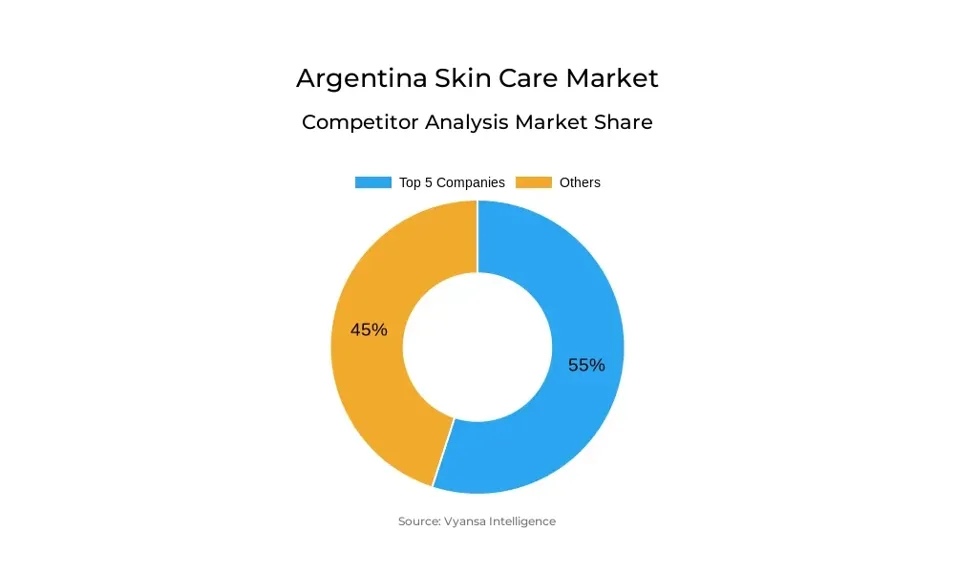
- Top 5 companies acquired 55% of the market share.
- Laboratorios Andrómaco SA, Naturel SA, GlaxoSmithKline Argentina SA, Natura Argentina SA, L'Oréal Argentina SA etc., are few of the top companies.
- Sales Channel
- Retail Offline grabbed 85% of the market.
Argentina Skin Care Market Outlook
From 2025 onwards, the skin care market in Argentina will bounce back from the precipitous drop witnessed in 2024, when retail volume sales declined against severe economic hardships. With improving economic conditions, increasing employment and purchasing power are anticipated to drive the market towards positive growth. While inflationary pressures fueled current value sales in 2024, volume recovery will be one of the trends driving the market during the forecast period, particularly fueled by demand for low-cost products.
More affordable brands like Villeneuve and Adermicina will likely continue their pace, appealing to low- and middle-income consumers who continue to be frugal with spending. Meanwhile, hand care is expected to be the most vibrant category, since consumers will switch back to specialist products after having used body care substitutes earlier in light of budget considerations. Growing availability of new affordable items and private labels, such as Pigmento's Mine Beauty, will continue to fuel category expansion.
End of import restrictions is likely to bring new brands into the Argentine skin care industry, particularly dermocosmetics and then mass products. A few luxury international brands already came in towards the end of 2024, and product lines led by influencers are also growing. This trend is probably going to increase competition and add variety for consumers.
Digital platforms will be essential for growth. Online shopping, driven by promotions and effective social media campaigning, will keep growing. Channels like Instagram and TikTok are imperative for brand marketing, particularly among young consumers. Market leaders will continue to invest in online presence and influencer collaborations to cement their places in this changing scenario.
Argentina Skin Care Market Growth Driver
The Argentina skin care market will bounce back from the steep falls during 2024 with the help of enhanced purchasing power and robust employment rates. This economic boost is expected to revitalize consumer expenditure, particularly in the vital categories of skin care.
Even with the upbeat projection, cheaper products are anticipated to drive growth. Private labels and cheaper alternatives like Adermicina and Villeneuve are on the rise. Adermicina, which was introduced in 2021 by Laboratorio Elea Phoenix, is further solidifying its presence. Furthermore, the private label market increased with the addition of new players like Mine Beauty, launched in December of 2024 by Pigmento, to further support the presence of inexpensive alternatives.
Argentina Skin Care Market Trend
Social media is emerging as a pillar in the development of the skin care market, with companies such as L'Oréal Argentina and Beiersdorf (Argentina) investing heavily into the digital space. Influencers are also taking the lead in reaching young consumers and influencing their buying patterns. In Argentina, some influencers have even started their own skin care brands. For example, Luli Fernández, a model turned influencer, launched her brand Classy in mid-2023, mirroring the increasing popularity of influencer-based brands.
Meanwhile, e-commerce will gain even more traction during the projection period. Digital shopping occasions like Black Friday and Cyber Monday remain a major driver of sales increase. The ease of online buying coupled with compelling offers is poised to accentuate the trend, making digital channels a prominent distribution channel for skin care items in the future.
Unlock Market Intelligence
Explore the market potential with our data-driven report
Argentina Skin Care Market Opportunity
With the rollback of import restrictions, Argentina's skin care market will witness a significant number of new brand introductions during 2025–30. The country's economic rebound and enhanced import procedures are redefining competition, opening up space for others to join. In the later half of 2024, some of the premium dermocosmetic brands, including South Korean Skin 1004, have made an entry into the country in limited volumes, pointing towards increasing opportunities for premium products.
The trend is set to spill over into dermocosmetics, prompting the advent of mass-market skin care products too. Additionally, numerous local influencers are venturing into launching their own skin care products, fueled by cheap production costs overseas and increased access to foreign imports. All these transformations are set to enhance market dynamism and product variety in the next few years.
| Report Coverage | Details |
|---|---|
| Market Forecast | 2025-30 |
| USD Value 2024 | $ 700 Million |
| USD Value 2030 | $ 935 Million |
| CAGR 2025-2030 | 4.94% |
| Largest Category | Facial Care segment leads with 65% market share |
| Top Drivers | Rising Popularity of Affordable Brands to Support Market Recovery |
| Top Trends | Rising Influence of Social Media and E-Commerce Driving Market Growth |
| Top Opportunities | Easing Imports to Encourage New Entrants and Brand Expansion |
| Key Players | Laboratorios Andrómaco SA, Naturel SA, GlaxoSmithKline Argentina SA, Natura Argentina SA, L'Oréal Argentina SA, Beiersdorf (Argentina) SA, Cosméticos Avon SACI, Genomma Laboratories Argentina SA, Laboratorios Bagó SA, Unilever de Argentina SA and Others. |
Unlock Market Intelligence
Explore the market potential with our data-driven report
Argentina Skin Care Market Segmentation Analysis

The highest market share under the sales channel is Retail Offline in the Argentina Skin Care Market for 2025–30. Direct selling retains its leadership in single retail value share despite experiencing a number of setbacks since the 2020–2021 peak in popularity, caused by the COVID-19 pandemic. Its position has been weakened by increased competition from beauty experts and pharmacies, company closures, and operating downsizing, like the factory shutdown by Cosméticos Avon at the end of 2024.
Conversely, the fastest-growing retail value sales channel is e-commerce. It is buoyed by high discounts, particularly for products nearing expiry, and robust promotion efforts on Instagram and TikTok. L'Oréal, for example, increased its visibility with influencer-hosted online events. Hypermarkets and supermarkets, previously confined to standard mass brands, meanwhile have added more products as a response to increasing demand, led in particular by middle-to-low-income consumers.
Top Companies in Argentina Skin Care Market
The top companies operating in the market include Laboratorios Andrómaco SA, Naturel SA, GlaxoSmithKline Argentina SA, Natura Argentina SA, L'Oréal Argentina SA, Beiersdorf (Argentina) SA, Cosméticos Avon SACI, Genomma Laboratories Argentina SA, Laboratorios Bagó SA, Unilever de Argentina SA, etc., are the top players operating in the Argentina Skin Care Market.
Frequently Asked Questions
Related Report
1. Market Segmentation
1.1. Research Scope
1.2. Research Methodology
1.3. Definitions and Assumptions
2. Executive Summary
3. Argentina Skin Care Market Policies, Regulations, and Standards
4. Argentina Skin Care Market Dynamics
4.1. Growth Factors
4.2. Challenges
4.3. Trends
4.4. Opportunities
5. Argentina Skin Care Market Statistics, 2020-2030F
5.1. Market Size & Growth Outlook
5.1.1.By Revenues in US$ Million
5.2. Market Segmentation & Growth Outlook
5.2.1.By Product
5.2.1.1. Body Care- Market Insights and Forecast 2020-2030, USD Million
5.2.1.1.1. Firming Body Care- Market Insights and Forecast 2020-2030, USD Million
5.2.1.1.2. General Purpose Body Care- Market Insights and Forecast 2020-2030, USD Million
5.2.1.2. Facial Care- Market Insights and Forecast 2020-2030, USD Million
5.2.1.2.1. Acne Treatments- Market Insights and Forecast 2020-2030, USD Million
5.2.1.2.2. Face Masks- Market Insights and Forecast 2020-2030, USD Million
5.2.1.2.3. Facial Cleansers- Market Insights and Forecast 2020-2030, USD Million
5.2.1.2.3.1. Liquid- Market Insights and Forecast 2020-2030, USD Million
5.2.1.2.3.2. Cream- Market Insights and Forecast 2020-2030, USD Million
5.2.1.2.3.3. Gel- Market Insights and Forecast 2020-2030, USD Million
5.2.1.2.3.4. Bar Cleansers- Market Insights and Forecast 2020-2030, USD Million
5.2.1.2.3.5. Facial Cleansing Wipes- Market Insights and Forecast 2020-2030, USD Million
5.2.1.2.4. Moisturisers and Treatments- Market Insights and Forecast 2020-2030, USD Million
5.2.1.2.4.1. Basic Moisturisers- Market Insights and Forecast 2020-2030, USD Million
5.2.1.2.4.2. Anti-Agers- Market Insights and Forecast 2020-2030, USD Million
5.2.1.2.5. Lip Care- Market Insights and Forecast 2020-2030, USD Million
5.2.1.2.6. Toners- Market Insights and Forecast 2020-2030, USD Million
5.2.1.3. Hand Care- Market Insights and Forecast 2020-2030, USD Million
5.2.1.4. Skin Care Sets/Kits- Market Insights and Forecast 2020-2030, USD Million
5.2.2.By Category
5.2.2.1. Premium- Market Insights and Forecast 2020-2030, USD Million
5.2.2.2. Mass- Market Insights and Forecast 2020-2030, USD Million
5.2.3.By Gender
5.2.3.1. Men- Market Insights and Forecast 2020-2030, USD Million
5.2.3.2. Women- Market Insights and Forecast 2020-2030, USD Million
5.2.3.3. Unisex- Market Insights and Forecast 2020-2030, USD Million
5.2.4.By End User
5.2.4.1. Adults- Market Insights and Forecast 2020-2030, USD Million
5.2.4.2. Teenagers- Market Insights and Forecast 2020-2030, USD Million
5.2.4.3. Children- Market Insights and Forecast 2020-2030, USD Million
5.2.5.By Packaging
5.2.5.1. Tubes- Market Insights and Forecast 2020-2030, USD Million
5.2.5.2. Bottles- Market Insights and Forecast 2020-2030, USD Million
5.2.5.3. Jars- Market Insights and Forecast 2020-2030, USD Million
5.2.5.4. Others- Market Insights and Forecast 2020-2030, USD Million
5.2.6.By Sales Channel
5.2.6.1. Online- Market Insights and Forecast 2020-2030, USD Million
5.2.6.2. Offline- Market Insights and Forecast 2020-2030, USD Million
5.2.7.By Competitors
5.2.7.1. Competition Characteristics
5.2.7.2. Market Share & Analysis
6. Argentina Body Care Market Statistics, 2020-2030F
6.1. Market Size & Growth Outlook
6.1.1.By Revenues in US$ Million
6.2. Market Segmentation & Growth Outlook
6.2.1.By Product- Market Insights and Forecast 2020-2030, USD Million
6.2.2.By Category- Market Insights and Forecast 2020-2030, USD Million
6.2.3.By Gender- Market Insights and Forecast 2020-2030, USD Million
6.2.4.By End User- Market Insights and Forecast 2020-2030, USD Million
6.2.5.By Packaging- Market Insights and Forecast 2020-2030, USD Million
6.2.6.By Sales Channel- Market Insights and Forecast 2020-2030, USD Million
7. Argentina Facial Care Market Statistics, 2020-2030F
7.1. Market Size & Growth Outlook
7.1.1.By Revenues in US$ Million
7.2. Market Segmentation & Growth Outlook
7.2.1.By Product- Market Insights and Forecast 2020-2030, USD Million
7.2.2.By Category- Market Insights and Forecast 2020-2030, USD Million
7.2.3.By Gender- Market Insights and Forecast 2020-2030, USD Million
7.2.4.By End User- Market Insights and Forecast 2020-2030, USD Million
7.2.5.By Packaging- Market Insights and Forecast 2020-2030, USD Million
7.2.6.By Sales Channel- Market Insights and Forecast 2020-2030, USD Million
8. Argentina Hand Care Market Statistics, 2020-2030F
8.1. Market Size & Growth Outlook
8.1.1.By Revenues in US$ Million
8.2. Market Segmentation & Growth Outlook
8.2.1.By Category- Market Insights and Forecast 2020-2030, USD Million
8.2.2.By Gender- Market Insights and Forecast 2020-2030, USD Million
8.2.3.By End User- Market Insights and Forecast 2020-2030, USD Million
8.2.4.By Packaging- Market Insights and Forecast 2020-2030, USD Million
8.2.5.By Sales Channel- Market Insights and Forecast 2020-2030, USD Million
9. Argentina Skin Care Sets/Kits Market Statistics, 2020-2030F
9.1. Market Size & Growth Outlook
9.1.1.By Revenues in US$ Million
9.2. Market Segmentation & Growth Outlook
9.2.1.By Category- Market Insights and Forecast 2020-2030, USD Million
9.2.2.By Gender- Market Insights and Forecast 2020-2030, USD Million
9.2.3.By End User- Market Insights and Forecast 2020-2030, USD Million
9.2.4.By Packaging- Market Insights and Forecast 2020-2030, USD Million
9.2.5.By Sales Channel- Market Insights and Forecast 2020-2030, USD Million
10. Competitive Outlook
10.1. Company Profiles
10.1.1. Natura Argentina SA
10.1.1.1. Business Description
10.1.1.2. Product Portfolio
10.1.1.3. Collaborations & Alliances
10.1.1.4. Recent Developments
10.1.1.5. Financial Details
10.1.1.6. Others
10.1.2. L'Oréal Argentina SA
10.1.2.1. Business Description
10.1.2.2. Product Portfolio
10.1.2.3. Collaborations & Alliances
10.1.2.4. Recent Developments
10.1.2.5. Financial Details
10.1.2.6. Others
10.1.3. Beiersdorf (Argentina) SA
10.1.3.1. Business Description
10.1.3.2. Product Portfolio
10.1.3.3. Collaborations & Alliances
10.1.3.4. Recent Developments
10.1.3.5. Financial Details
10.1.3.6. Others
10.1.4. Cosméticos Avon SACI
10.1.4.1. Business Description
10.1.4.2. Product Portfolio
10.1.4.3. Collaborations & Alliances
10.1.4.4. Recent Developments
10.1.4.5. Financial Details
10.1.4.6. Others
10.1.5. Genomma Laboratories Argentina SA
10.1.5.1. Business Description
10.1.5.2. Product Portfolio
10.1.5.3. Collaborations & Alliances
10.1.5.4. Recent Developments
10.1.5.5. Financial Details
10.1.5.6. Others
10.1.6. Laboratorios Andrómaco SA
10.1.6.1. Business Description
10.1.6.2. Product Portfolio
10.1.6.3. Collaborations & Alliances
10.1.6.4. Recent Developments
10.1.6.5. Financial Details
10.1.6.6. Others
10.1.7. Naturel SA
10.1.7.1. Business Description
10.1.7.2. Product Portfolio
10.1.7.3. Collaborations & Alliances
10.1.7.4. Recent Developments
10.1.7.5. Financial Details
10.1.7.6. Others
10.1.8. GlaxoSmithKline Argentina SA
10.1.8.1. Business Description
10.1.8.2. Product Portfolio
10.1.8.3. Collaborations & Alliances
10.1.8.4. Recent Developments
10.1.8.5. Financial Details
10.1.8.6. Others
10.1.9. Laboratorios Bagó SA
10.1.9.1. Business Description
10.1.9.2. Product Portfolio
10.1.9.3. Collaborations & Alliances
10.1.9.4. Recent Developments
10.1.9.5. Financial Details
10.1.9.6. Others
10.1.10. Unilever de Argentina SA
10.1.10.1.Business Description
10.1.10.2.Product Portfolio
10.1.10.3.Collaborations & Alliances
10.1.10.4.Recent Developments
10.1.10.5.Financial Details
10.1.10.6.Others
11. Disclaimer
| Segment | Sub-Segment |
|---|---|
| By Product |
|
| By Category |
|
| By Gender |
|
| By End User |
|
| By Packaging |
|
| By Sales Channel |
|
Research Methodology
This study followed a structured approach comprising four key phases to assess the size and scope of the electro-oxidation market. The process began with thorough secondary research to collect data on the target market, related markets, and broader industry context. These findings, along with preliminary assumptions and estimates, were then validated through extensive primary research involving industry experts from across the value chain. To calculate the overall market size, both top-down and bottom-up methodologies were employed. Finally, market segmentation and data triangulation techniques were applied to refine and validate segment-level estimations.
Secondary Research
The secondary research phase involved gathering data from a wide range of credible and published sources. This step helped in identifying industry trends, defining market segmentation, and understanding the market landscape and value chain.
Sources consulted during this phase included:
- Company annual reports, investor presentations, and press releases
- Industry white papers and certified publications
- Trade directories and market-recognized databases
- Articles from authoritative authors and reputable journals
- Gold and silver standard websites
Secondary research was critical in mapping out the industry's value chain and monetary flow, identifying key market segments, understanding regional variations, and tracking significant industry developments.
Other key sources:
- Financial disclosures
- Industry associations and trade bodies
- News outlets and business magazines
- Academic journals and research studies
- Paid industry databases
Primary Research
To validate secondary data and gain deeper market insights, primary research was conducted with key stakeholders across both the supply and demand sides of the market.
On the demand side, participants included decision-makers and influencers from end-user industries—such as CIOs, CTOs, and CSOs—who provided first-hand perspectives on market needs, product usage, and future expectations.
On the supply side, interviews were conducted with manufacturers, industry associations, and institutional participants to gather insights into current offerings, product pipelines, and market challenges.
Primary interviews provided critical inputs such as:
- Market size and revenue data
- Product and service breakdowns
- Market forecasts
- Regional and application-specific trends
Stakeholders consulted included:
- Leading OEM and solution providers
- Channel and distribution partners
- End users across various applications
- Independent consultants and industry specialists
Market Size Estimation and Data Triangulation
- Identifying Key Market Participants (Secondary Research)
- Goal: To identify the major players or companies in the target market. This typically involves using publicly available data sources such as industry reports, market research publications, and financial statements of companies.
- Tools: Reports from firms like Gartner, Forrester, Euromonitor, Statista, IBISWorld, and others. Public financial statements, news articles, and press releases from top market players.
- Extracting Earnings of Key Market Participants
- Goal: To estimate the earnings generated from the product or service being analyzed. This step helps in understanding the revenue potential of each market player in a specific geography.
- Methods: Earnings data can be gathered from:
- Publicly available financial reports (for listed companies).
- Interviews and primary data sources from professionals, such as Directors, VPs, SVPs, etc. This is especially useful for understanding more nuanced, internal data that isn't publicly disclosed.
- Annual reports and investor presentations of key players.
- Data Collation and Development of a Relevant Data Model
- Goal: To collate inputs from both primary and secondary sources into a structured, data-driven model for market estimation. This model will incorporate key market KPIs and any independent variables relevant to the market.
- Key KPIs: These could include:
- Market size, growth rate, and demand drivers.
- Industry-specific metrics like market share, average revenue per customer (ARPC), or average deal size.
- External variables, such as economic growth rates, inflation rates, or commodity prices, that could affect the market.
- Data Modeling: Based on this data, the market forecasts are developed for the next 5 years. A combination of trend analysis, scenario modeling, and statistical regression might be used to generate projections.
- Scenario Analysis
- Goal: To test different assumptions and validate how sensitive the market is to changes in key variables (e.g., market demand, regulatory changes, technological disruptions).
- Types of Scenarios:
- Base Case: Based on current assumptions and historical data.
- Best-Case Scenario: Assuming favorable market conditions, regulatory environments, and technological advancements.
- Worst-Case Scenario: Accounting for adverse factors, such as economic downturns, stricter regulations, or unexpected disruptions.












