Global AI Governance Market Report: Trends, Growth and Forecast (2026-2032)
By Component (Platform/Solution, Services (Professional Services, Managed Services)), By Governance Function (AI Inventory Management, Model Risk Management, Policy & Workflow Management, Bias & Fairness Monitoring, Performance Monitoring, Audit Evidence Management, Regulatory Compliance Management, GenAI Guardrails), By AI System Type (Machine Learning Models, Generative AI Models, Large Language Models, AI Agents, Computer Vision Systems, Third-Party AI Tools), By Deployment Mode (Cloud-Based, On-Premises, Hybrid), By Organization Size (Large Enterprises, Small & Medium Enterprises), By End User (BFSI, Healthcare, Government & Public Sector, IT & Telecom, Retail & E-Commerce, Manufacturing, Legal & Compliance, Others), By Region (North America, South America, Europe, Middle East & Africa, Asia Pacific) ... Read more
|
Major Players
|
Global AI Governance Market Statistics and Insights, 2026
- Market Size Statistics
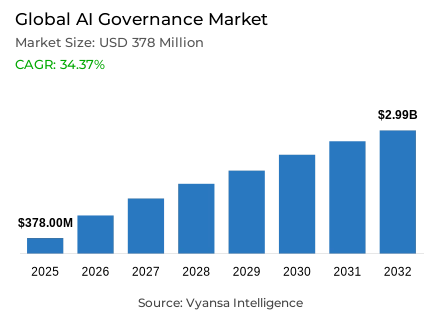
- Ai governance market size in Global was valued at USD 378 million in 2025 and is estimated at USD 449 million in 2026.
- The market size is expected to grow to USD 2.99 billion by 2032.
- Market to register a CAGR of around 34.37% during 2026-32.
- Governance Function Shares
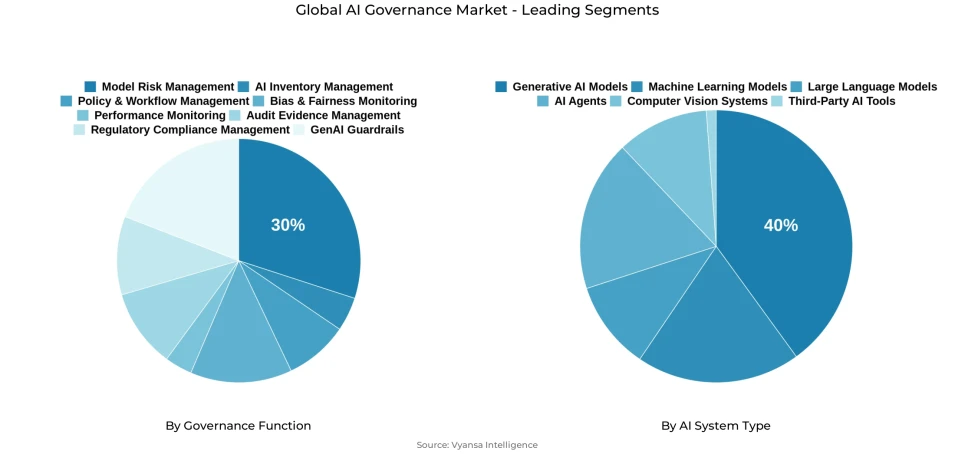
- Model risk management grabbed market share of 30%.
- Competition
- More than 30 companies are actively engaged in producing ai governance.
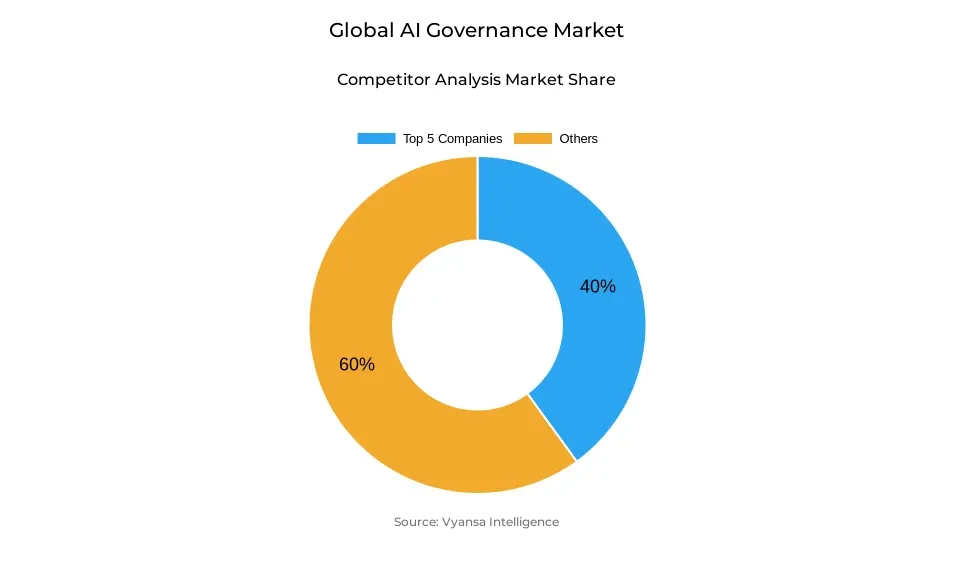
- Top 5 companies acquired around 40% of the market share.
- OneTrust, Collibra, DataRobot, IBM, Microsoft etc., are few of the top companies.
- AI System Type
- Generative ai models grabbed 40% of the market.
- Region
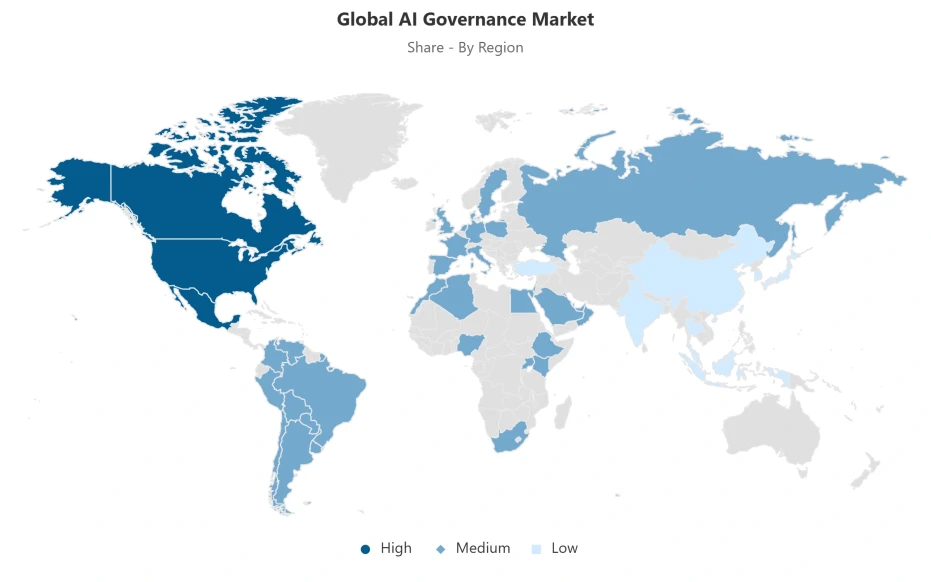
- North America leads with a 45% share of the global market.
Global AI Governance Market Outlook
Controlled AI deployment needs are reshaping the Global AI governance market, which was valued at USD 378 million in 2025 and is projected to grow from USD 449 million in 2026 to USD 2.99 billion by 2032, at a CAGR of 34.37%. Demand is shaped by enterprises moving from experimental AI use toward governed operating models covering model inventories, risk classification, audit trails, policy enforcement, bias monitoring, explainability, data privacy, cybersecurity, and regulatory reporting across predictive AI, generative AI, AI copilots, and automated decision systems.
Model Risk Management leads the Governance Function category with 30% share, reflecting the need to identify, validate, monitor, and document AI model risks. AI risk management tools support model registries, ownership mapping, approval workflows, risk scoring, bias testing, drift monitoring, and audit-ready evidence. Therefore, this segment remains closely linked with controlled AI deployment in BFSI, healthcare, insurance, public sector, telecom, retail, and enterprise software workflows.
Generative AI Models hold 40% share under AI System Type, showing that GenAI governance is becoming central to enterprise AI control. Large language models, foundation models, copilots, AI agents, code assistants, synthetic content systems, and multimodal tools require prompt monitoring, hallucination checks, content safety filters, sensitive-data controls, red-teaming records, output traceability, and human-review workflows. Hence, governance demand is shifting from static model documentation toward continuous AI behavior oversight.
North America leads with 45% share, supported by AI investment, cloud infrastructure, regulated enterprise adoption, and responsible AI frameworks. Stanford HAI’s 2025 AI Index reports that legislative mentions of AI rose by 21.3% across 75 countries since 2023, while U.S. federal agencies introduced 59 AI-related regulations in 2024. The outlook for the AI governance market remains tied to regulatory mapping, model accountability, GenAI controls, audit evidence, and responsible deployment across high-risk enterprise AI systems.
Global AI Governance Market Growth Driver
Regulatory Pressure Turns Governance Into Enterprise Infrastructure
Rising regulatory pressure remains the strongest driver for the Global AI governance market, as organizations deploy AI faster than internal control systems can manage. Enterprises use AI for credit scoring, fraud detection, insurance underwriting, customer service, software coding, clinical documentation, legal review, HR screening, logistics planning, and enterprise search. Each use case creates risk around model accuracy, bias, explainability, privacy, cybersecurity, intellectual property, and human oversight. Therefore, AI governance platforms are becoming necessary for inventories, ownership mapping, risk classification, approvals, and audit evidence.
Stanford HAI’s 2025 AI Index shows that legislative mentions of AI increased by 21.3% across 75 countries since 2023, while U.S. federal agencies introduced 59 AI-related regulations in 2024. This supports demand for AI compliance software that maps AI systems against policies, controls, and reporting needs. Model inventory tools identify where AI is used, policy engines enforce approval workflows, bias dashboards track fairness, and explainability tools support decision review. Hence, governance becomes an operating layer for regulated AI use rather than a document-based compliance task.
Global AI Governance Market Challenge
Fragmented Rules and Complex Risks Slow Deployment
The main challenge in the Global AI governance market is implementing governance across different jurisdictions, industries, model types, and risk levels. AI governance requires coordination between legal, compliance, data science, cybersecurity, privacy, procurement, IT, risk, product, and business teams. However, many organizations still lack mature AI operating models that define ownership, approval responsibility, data-use limits, output monitoring, incident response, and evidence storage. This slows deployment where AI systems move into regulated or customer-facing workflows.
Regulatory fragmentation adds further complexity. The EU AI Act, Regulation 2024/1689, entered into force on 1 August 2024 and establishes a risk-based framework for AI systems. This increases demand for EU AI Act compliance software, yet it also raises implementation difficulty as enterprises classify unacceptable-risk, high-risk, transparency-related, and general-purpose AI obligations. NIST’s 2024 Generative AI Profile also identifies risks linked with synthetic content, information integrity, privacy, cybersecurity, and misuse. Therefore, AI model governance depends on regulatory mapping, technical integration, prompt logs, red-team evidence, output traceability, and workflow controls across existing AI pipelines.
Unlock Market Intelligence
Explore the market potential with our data-driven report
Global AI Governance Market Trend
GenAI and Agentic Systems Redefine Governance Workflows
The strongest trend in the Global AI governance market is the shift from traditional model governance toward LLM governance and agentic AI control. Earlier governance systems focused on machine learning models used for scoring, forecasting, fraud detection, recommendations, and classification. However, enterprise risk is now expanding toward large language models, foundation models, copilots, multimodal systems, synthetic content tools, and autonomous AI agents. These systems create text, code, summaries, images, recommendations, and workflow actions, making governance more continuous and runtime-focused.
Stanford HAI’s 2025 AI Index reports that private investment in generative AI reached USD 33.9 billion in 2024, up 18.7% from 2023. This supports rapid use of GenAI across enterprise search, software development, marketing content, customer support, legal research, HR support, and knowledge management. Therefore, governance tools increasingly require prompt monitoring, hallucination detection, sensitive-data filtering, toxicity screening, copyright-risk review, model cards, training-data summaries, content provenance, tool-use logs, and escalation workflows. The trend keeps responsible AI governance tied to live monitoring, access control, and policy enforcement across AI-assisted work.
Global AI Governance Market Opportunity
Governance Gaps Create Platform-Led Demand
Governance gaps create the strongest opportunity in the Global AI governance market, as many organizations already use AI tools, copilots, predictive models, document assistants, chatbots, and automated decision systems without a centralized AI inventory or risk framework. This creates demand for platforms that organize fragmented AI activity into structured controls. Model registries, risk scoring engines, validation workflows, audit logs, compliance mapping, and monitoring dashboards help enterprises manage AI systems through a consistent governance environment.
NIST’s AI Risk Management Framework gives organizations a structured approach to mapping, measuring, managing, and governing AI risks. Hence, demand is moving toward enterprise AI governance systems that align AI use with recognized risk-management practices. Generative AI adds further need for prompt monitoring, LLM evaluation, hallucination scoring, content safety checks, data leakage prevention, red-teaming records, and approved-response workflows. The opportunity remains tied to operational maturity, not promotional adoption, as enterprises require governance systems that work before launch, during usage, and after incidents.
Global AI Governance Market Regional Analysis
By Region
- North America
- South America
- Europe
- Middle East & Africa
- Asia Pacific
North America leads the Global AI governance market with 45% share, supported by large AI software vendors, cloud infrastructure, regulated enterprise demand, institutional AI investment, and early responsible AI adoption. The region has a deep buyer base across BFSI, healthcare, insurance, government, retail, telecom, and technology sectors. Therefore, AI governance market demand is closely linked with compliance reporting, model documentation, bias monitoring, policy automation, cybersecurity controls, and GenAI oversight across enterprise AI deployments.
The region’s leadership is reinforced by policy and standards activity. Stanford HAI’s 2025 AI Index reports that U.S. federal agencies introduced 59 AI-related regulations in 2024, more than double the prior year. This regulatory momentum supports demand for AI audit readiness, model inventories, AI risk management systems, compliance workflows, and responsible AI controls. However, North America’s lead also depends on practical implementation, as enterprises need governance systems that connect with cloud platforms, MLOps tools, data catalogs, privacy systems, identity controls, cybersecurity workflows, and audit functions across production AI environments.
Unlock Market Intelligence
Explore the market potential with our data-driven report
Global AI Governance Market Segmentation Analysis
By Governance Function
- AI Inventory Management
- Model Risk Management
- Policy & Workflow Management
- Bias & Fairness Monitoring
- Performance Monitoring
- Audit Evidence Management
- Regulatory Compliance Management
- GenAI Guardrails
The segment with the highest share under Governance Function is Model Risk Management, holding 30% of the Global AI governance market. This position reflects the need to identify, assess, validate, monitor, and document risks across predictive models, generative AI systems, fraud models, credit models, pricing engines, recommendation systems, and AI copilots. AI model inventory tools remain central because enterprises need to know which AI systems exist, who owns them, what data they use, and how they affect business decisions.
Model risk management remains important as AI systems can drift, produce biased outputs, expose sensitive data, or lose accuracy after deployment. These tools support ownership assignment, risk classification, testing evidence, performance monitoring, and audit readiness. Therefore, AI risk controls are becoming foundational across BFSI, healthcare, insurance, government, telecom, and critical infrastructure use cases. The segment remains tied to accountable AI lifecycle management, where documentation, validation, monitoring, and incident review reduce unmanaged model exposure across enterprise decision workflows.
By AI System Type
- Machine Learning Models
- Generative AI Models
- Large Language Models
- AI Agents
- Computer Vision Systems
- Third-Party AI Tools
The segment with the highest share under AI System Type is Generative AI Models, holding 40% of the Global AI governance market. This leadership reflects the rapid use of large language models, AI agents, copilots, chatbots, code assistants, image generators, synthetic content tools, and enterprise knowledge assistants. Generative AI risk management is more complex than traditional model oversight because outputs change by prompt, user role, context, retrieval source, and connected workflow.
Generative AI systems require controls for hallucinations, toxic output, sensitive-data exposure, copyright risk, prompt misuse, drift, and unauthorized actions. Therefore, foundation model governance depends on prompt logs, output evaluation, access control, content provenance, red-team records, and human-review workflows. These requirements keep GenAI governance linked with production-scale use, especially where AI systems summarize documents, generate code, answer customer queries, support clinical notes, or interact with enterprise applications. The segment’s leadership reflects the shift from model documentation toward active behavior monitoring across AI-enabled workflows.
Market Players in Global AI Governance Market
These market players maintain a significant presence in the Global ai governance market and contribute to its ongoing evolution.
- OneTrust
- Collibra
- DataRobot
- IBM
- Microsoft
- Credo AI
- Holistic AI
- ModelOp
- Arthur AI
- ServiceNow
- Google Cloud
- Amazon Web Services
- SAS
- Monitaur
- Fiddler AI
Market News & Updates
- ServiceNow, 2026:
ServiceNow expanded AI Control Tower in May 2026 to discover, observe, govern, secure, and measure AI deployed across enterprise systems. The enhancements cover AI agents, models, identities, compliance workflows, runtime performance, and AI value measurement. The update strengthens ServiceNow’s governance layer for enterprise AI and agent oversight.
- Credo AI, 2026:
Credo AI announced general availability of Govern AI Assistant, GAIA, in May 2026. GAIA runs inside the Credo AI platform and uses risk and control libraries to support governance recommendations. The release adds an AI governance agent for assessment, review, documentation, and oversight workflows.
Frequently Asked Questions
Related Report
- Market Segmentation
- Research Scope
- Research Methodology
- Definitions and Assumptions
- Executive Summary
- Global AI governance Market Policies, Regulations, and Standards
- Global AI governance Market Dynamics
- Growth Factors
- Challenges
- Trends
- Opportunities
- Global AI governance Market Statistics, 2022-2032F
- Market Size & Growth Outlook
- By Revenues in USD Million
- Market Segmentation & Growth Outlook
- By Component
- Platform/Solution- Market Insights and Forecast 2022-2032, USD Million
- Services- Market Insights and Forecast 2022-2032, USD Million
- Professional Services- Market Insights and Forecast 2022-2032, USD Million
- Managed Services- Market Insights and Forecast 2022-2032, USD Million
- By Governance Function
- AI Inventory Management- Market Insights and Forecast 2022-2032, USD Million
- Model Risk Management- Market Insights and Forecast 2022-2032, USD Million
- Policy & Workflow Management- Market Insights and Forecast 2022-2032, USD Million
- Bias & Fairness Monitoring- Market Insights and Forecast 2022-2032, USD Million
- Performance Monitoring- Market Insights and Forecast 2022-2032, USD Million
- Audit Evidence Management- Market Insights and Forecast 2022-2032, USD Million
- Regulatory Compliance Management- Market Insights and Forecast 2022-2032, USD Million
- GenAI Guardrails- Market Insights and Forecast 2022-2032, USD Million
- By AI System Type
- Machine Learning Models- Market Insights and Forecast 2022-2032, USD Million
- Generative AI Models- Market Insights and Forecast 2022-2032, USD Million
- Large Language Models- Market Insights and Forecast 2022-2032, USD Million
- AI Agents- Market Insights and Forecast 2022-2032, USD Million
- Computer Vision Systems- Market Insights and Forecast 2022-2032, USD Million
- Third-Party AI Tools- Market Insights and Forecast 2022-2032, USD Million
- By Deployment Mode
- Cloud-Based- Market Insights and Forecast 2022-2032, USD Million
- On-Premises- Market Insights and Forecast 2022-2032, USD Million
- Hybrid- Market Insights and Forecast 2022-2032, USD Million
- By Organization Size
- Large Enterprises- Market Insights and Forecast 2022-2032, USD Million
- Small & Medium Enterprises- Market Insights and Forecast 2022-2032, USD Million
- By End User
- BFSI- Market Insights and Forecast 2022-2032, USD Million
- Healthcare- Market Insights and Forecast 2022-2032, USD Million
- Government & Public Sector- Market Insights and Forecast 2022-2032, USD Million
- IT & Telecom- Market Insights and Forecast 2022-2032, USD Million
- Retail & E-Commerce- Market Insights and Forecast 2022-2032, USD Million
- Manufacturing- Market Insights and Forecast 2022-2032, USD Million
- Legal & Compliance- Market Insights and Forecast 2022-2032, USD Million
- Others- Market Insights and Forecast 2022-2032, USD Million
- By Region
- North America
- South America
- Europe
- Middle East & Africa
- Asia Pacific
- By Competitors
- Competition Characteristics
- Market Share & Analysis
- By Component
- Market Size & Growth Outlook
- North America AI governance Market Statistics, 2022-2032F
- Market Size & Growth Outlook
- By Revenues in USD Million
- Market Segmentation & Growth Outlook
- By Component- Market Insights and Forecast 2022-2032, USD Million
- By Governance Function- Market Insights and Forecast 2022-2032, USD Million
- By AI System Type- Market Insights and Forecast 2022-2032, USD Million
- By Deployment Mode- Market Insights and Forecast 2022-2032, USD Million
- By Organization Size- Market Insights and Forecast 2022-2032, USD Million
- By End User- Market Insights and Forecast 2022-2032, USD Million
- By Country
- The US
- Canada
- Mexico
- Rest of North America
- The US AI governance Market Statistics, 2022-2032F
- Market Size & Growth Outlook
- By Revenues in USD Million
- Market Segmentation & Growth Outlook
- By Component- Market Insights and Forecast 2022-2032, USD Million
- By Governance Function- Market Insights and Forecast 2022-2032, USD Million
- By AI System Type- Market Insights and Forecast 2022-2032, USD Million
- By Deployment Mode- Market Insights and Forecast 2022-2032, USD Million
- By Organization Size- Market Insights and Forecast 2022-2032, USD Million
- By End User- Market Insights and Forecast 2022-2032, USD Million
- Market Size & Growth Outlook
- Canada AI governance Market Statistics, 2022-2032F
- Market Size & Growth Outlook
- By Revenues in USD Million
- Market Segmentation & Growth Outlook
- By Component- Market Insights and Forecast 2022-2032, USD Million
- By Governance Function- Market Insights and Forecast 2022-2032, USD Million
- By AI System Type- Market Insights and Forecast 2022-2032, USD Million
- By Deployment Mode- Market Insights and Forecast 2022-2032, USD Million
- By Organization Size- Market Insights and Forecast 2022-2032, USD Million
- By End User- Market Insights and Forecast 2022-2032, USD Million
- Market Size & Growth Outlook
- Mexico AI governance Market Statistics, 2022-2032F
- Market Size & Growth Outlook
- By Revenues in USD Million
- Market Segmentation & Growth Outlook
- By Component- Market Insights and Forecast 2022-2032, USD Million
- By Governance Function- Market Insights and Forecast 2022-2032, USD Million
- By AI System Type- Market Insights and Forecast 2022-2032, USD Million
- By Deployment Mode- Market Insights and Forecast 2022-2032, USD Million
- By Organization Size- Market Insights and Forecast 2022-2032, USD Million
- By End User- Market Insights and Forecast 2022-2032, USD Million
- Market Size & Growth Outlook
- Market Size & Growth Outlook
- South America AI governance Market Statistics, 2022-2032F
- Market Size & Growth Outlook
- By Revenues in USD Million
- Market Segmentation & Growth Outlook
- By Component- Market Insights and Forecast 2022-2032, USD Million
- By Governance Function- Market Insights and Forecast 2022-2032, USD Million
- By AI System Type- Market Insights and Forecast 2022-2032, USD Million
- By Deployment Mode- Market Insights and Forecast 2022-2032, USD Million
- By Organization Size- Market Insights and Forecast 2022-2032, USD Million
- By End User- Market Insights and Forecast 2022-2032, USD Million
- By Country
- Brazil
- Argentina
- Rest of South America
- Brazil AI governance Market Statistics, 2022-2032F
- Market Size & Growth Outlook
- By Revenues in USD Million
- Market Segmentation & Growth Outlook
- By Component- Market Insights and Forecast 2022-2032, USD Million
- By Governance Function- Market Insights and Forecast 2022-2032, USD Million
- By AI System Type- Market Insights and Forecast 2022-2032, USD Million
- By Deployment Mode- Market Insights and Forecast 2022-2032, USD Million
- By Organization Size- Market Insights and Forecast 2022-2032, USD Million
- By End User- Market Insights and Forecast 2022-2032, USD Million
- Market Size & Growth Outlook
- Argentina AI governance Market Statistics, 2022-2032F
- Market Size & Growth Outlook
- By Revenues in USD Million
- Market Segmentation & Growth Outlook
- By Component- Market Insights and Forecast 2022-2032, USD Million
- By Governance Function- Market Insights and Forecast 2022-2032, USD Million
- By AI System Type- Market Insights and Forecast 2022-2032, USD Million
- By Deployment Mode- Market Insights and Forecast 2022-2032, USD Million
- By Organization Size- Market Insights and Forecast 2022-2032, USD Million
- By End User- Market Insights and Forecast 2022-2032, USD Million
- Market Size & Growth Outlook
- Market Size & Growth Outlook
- Europe AI governance Market Statistics, 2022-2032F
- Market Size & Growth Outlook
- By Revenues in USD Million
- Market Segmentation & Growth Outlook
- By Component- Market Insights and Forecast 2022-2032, USD Million
- By Governance Function- Market Insights and Forecast 2022-2032, USD Million
- By AI System Type- Market Insights and Forecast 2022-2032, USD Million
- By Deployment Mode- Market Insights and Forecast 2022-2032, USD Million
- By Organization Size- Market Insights and Forecast 2022-2032, USD Million
- By End User- Market Insights and Forecast 2022-2032, USD Million
- By Country
- Germany
- The UK
- France
- Italy
- Spain
- Rest of Europe
- Germany AI governance Market Statistics, 2022-2032F
- Market Size & Growth Outlook
- By Revenues in USD Million
- Market Segmentation & Growth Outlook
- By Component- Market Insights and Forecast 2022-2032, USD Million
- By Governance Function- Market Insights and Forecast 2022-2032, USD Million
- By AI System Type- Market Insights and Forecast 2022-2032, USD Million
- By Deployment Mode- Market Insights and Forecast 2022-2032, USD Million
- By Organization Size- Market Insights and Forecast 2022-2032, USD Million
- By End User- Market Insights and Forecast 2022-2032, USD Million
- Market Size & Growth Outlook
- The UK AI governance Market Statistics, 2022-2032F
- Market Size & Growth Outlook
- By Revenues in USD Million
- Market Segmentation & Growth Outlook
- By Component- Market Insights and Forecast 2022-2032, USD Million
- By Governance Function- Market Insights and Forecast 2022-2032, USD Million
- By AI System Type- Market Insights and Forecast 2022-2032, USD Million
- By Deployment Mode- Market Insights and Forecast 2022-2032, USD Million
- By Organization Size- Market Insights and Forecast 2022-2032, USD Million
- By End User- Market Insights and Forecast 2022-2032, USD Million
- Market Size & Growth Outlook
- France AI governance Market Statistics, 2022-2032F
- Market Size & Growth Outlook
- By Revenues in USD Million
- Market Segmentation & Growth Outlook
- By Component- Market Insights and Forecast 2022-2032, USD Million
- By Governance Function- Market Insights and Forecast 2022-2032, USD Million
- By AI System Type- Market Insights and Forecast 2022-2032, USD Million
- By Deployment Mode- Market Insights and Forecast 2022-2032, USD Million
- By Organization Size- Market Insights and Forecast 2022-2032, USD Million
- By End User- Market Insights and Forecast 2022-2032, USD Million
- Market Size & Growth Outlook
- Italy AI governance Market Statistics, 2022-2032F
- Market Size & Growth Outlook
- By Revenues in USD Million
- Market Segmentation & Growth Outlook
- By Component- Market Insights and Forecast 2022-2032, USD Million
- By Governance Function- Market Insights and Forecast 2022-2032, USD Million
- By AI System Type- Market Insights and Forecast 2022-2032, USD Million
- By Deployment Mode- Market Insights and Forecast 2022-2032, USD Million
- By Organization Size- Market Insights and Forecast 2022-2032, USD Million
- By End User- Market Insights and Forecast 2022-2032, USD Million
- Market Size & Growth Outlook
- Spain AI governance Market Statistics, 2022-2032F
- Market Size & Growth Outlook
- By Revenues in USD Million
- Market Segmentation & Growth Outlook
- By Component- Market Insights and Forecast 2022-2032, USD Million
- By Governance Function- Market Insights and Forecast 2022-2032, USD Million
- By AI System Type- Market Insights and Forecast 2022-2032, USD Million
- By Deployment Mode- Market Insights and Forecast 2022-2032, USD Million
- By Organization Size- Market Insights and Forecast 2022-2032, USD Million
- By End User- Market Insights and Forecast 2022-2032, USD Million
- Market Size & Growth Outlook
- Market Size & Growth Outlook
- Middle East & Africa AI governance Market Statistics, 2022-2032F
- Market Size & Growth Outlook
- By Revenues in USD Million
- Market Segmentation & Growth Outlook
- By Component- Market Insights and Forecast 2022-2032, USD Million
- By Governance Function- Market Insights and Forecast 2022-2032, USD Million
- By AI System Type- Market Insights and Forecast 2022-2032, USD Million
- By Deployment Mode- Market Insights and Forecast 2022-2032, USD Million
- By Organization Size- Market Insights and Forecast 2022-2032, USD Million
- By End User- Market Insights and Forecast 2022-2032, USD Million
- By Country
- The UAE
- Saudi Arabia
- South Africa
- Egypt
- Rest of Middle East and Africa
- The UAE AI governance Market Statistics, 2022-2032F
- Market Size & Growth Outlook
- By Revenues in USD Million
- Market Segmentation & Growth Outlook
- By Component- Market Insights and Forecast 2022-2032, USD Million
- By Governance Function- Market Insights and Forecast 2022-2032, USD Million
- By AI System Type- Market Insights and Forecast 2022-2032, USD Million
- By Deployment Mode- Market Insights and Forecast 2022-2032, USD Million
- By Organization Size- Market Insights and Forecast 2022-2032, USD Million
- By End User- Market Insights and Forecast 2022-2032, USD Million
- Market Size & Growth Outlook
- Saudi Arabia AI governance Market Statistics, 2022-2032F
- Market Size & Growth Outlook
- By Revenues in USD Million
- Market Segmentation & Growth Outlook
- By Component- Market Insights and Forecast 2022-2032, USD Million
- By Governance Function- Market Insights and Forecast 2022-2032, USD Million
- By AI System Type- Market Insights and Forecast 2022-2032, USD Million
- By Deployment Mode- Market Insights and Forecast 2022-2032, USD Million
- By Organization Size- Market Insights and Forecast 2022-2032, USD Million
- By End User- Market Insights and Forecast 2022-2032, USD Million
- Market Size & Growth Outlook
- South Africa AI governance Market Statistics, 2022-2032F
- Market Size & Growth Outlook
- By Revenues in USD Million
- Market Segmentation & Growth Outlook
- By Component- Market Insights and Forecast 2022-2032, USD Million
- By Governance Function- Market Insights and Forecast 2022-2032, USD Million
- By AI System Type- Market Insights and Forecast 2022-2032, USD Million
- By Deployment Mode- Market Insights and Forecast 2022-2032, USD Million
- By Organization Size- Market Insights and Forecast 2022-2032, USD Million
- By End User- Market Insights and Forecast 2022-2032, USD Million
- Market Size & Growth Outlook
- Egypt AI governance Market Statistics, 2022-2032F
- Market Size & Growth Outlook
- By Revenues in USD Million
- Market Segmentation & Growth Outlook
- By Component- Market Insights and Forecast 2022-2032, USD Million
- By Governance Function- Market Insights and Forecast 2022-2032, USD Million
- By AI System Type- Market Insights and Forecast 2022-2032, USD Million
- By Deployment Mode- Market Insights and Forecast 2022-2032, USD Million
- By Organization Size- Market Insights and Forecast 2022-2032, USD Million
- By End User- Market Insights and Forecast 2022-2032, USD Million
- Market Size & Growth Outlook
- Market Size & Growth Outlook
- Asia Pacific AI governance Market Statistics, 2022-2032F
- Market Size & Growth Outlook
- By Revenues in USD Million
- Market Segmentation & Growth Outlook
- By Component- Market Insights and Forecast 2022-2032, USD Million
- By Governance Function- Market Insights and Forecast 2022-2032, USD Million
- By AI System Type- Market Insights and Forecast 2022-2032, USD Million
- By Deployment Mode- Market Insights and Forecast 2022-2032, USD Million
- By Organization Size- Market Insights and Forecast 2022-2032, USD Million
- By End User- Market Insights and Forecast 2022-2032, USD Million
- By Country
- China
- India
- Japan
- South Korea
- Australia
- Indonesia
- Rest of Asia Pacific
- China AI governance Market Statistics, 2022-2032F
- Market Size & Growth Outlook
- By Revenues in USD Million
- Market Segmentation & Growth Outlook
- By Component- Market Insights and Forecast 2022-2032, USD Million
- By Governance Function- Market Insights and Forecast 2022-2032, USD Million
- By AI System Type- Market Insights and Forecast 2022-2032, USD Million
- By Deployment Mode- Market Insights and Forecast 2022-2032, USD Million
- By Organization Size- Market Insights and Forecast 2022-2032, USD Million
- By End User- Market Insights and Forecast 2022-2032, USD Million
- Market Size & Growth Outlook
- India AI governance Market Statistics, 2022-2032F
- Market Size & Growth Outlook
- By Revenues in USD Million
- Market Segmentation & Growth Outlook
- By Component- Market Insights and Forecast 2022-2032, USD Million
- By Governance Function- Market Insights and Forecast 2022-2032, USD Million
- By AI System Type- Market Insights and Forecast 2022-2032, USD Million
- By Deployment Mode- Market Insights and Forecast 2022-2032, USD Million
- By Organization Size- Market Insights and Forecast 2022-2032, USD Million
- By End User- Market Insights and Forecast 2022-2032, USD Million
- Market Size & Growth Outlook
- Japan AI governance Market Statistics, 2022-2032F
- Market Size & Growth Outlook
- By Revenues in USD Million
- Market Segmentation & Growth Outlook
- By Component- Market Insights and Forecast 2022-2032, USD Million
- By Governance Function- Market Insights and Forecast 2022-2032, USD Million
- By AI System Type- Market Insights and Forecast 2022-2032, USD Million
- By Deployment Mode- Market Insights and Forecast 2022-2032, USD Million
- By Organization Size- Market Insights and Forecast 2022-2032, USD Million
- By End User- Market Insights and Forecast 2022-2032, USD Million
- Market Size & Growth Outlook
- South Korea AI governance Market Statistics, 2022-2032F
- Market Size & Growth Outlook
- By Revenues in USD Million
- Market Segmentation & Growth Outlook
- By Component- Market Insights and Forecast 2022-2032, USD Million
- By Governance Function- Market Insights and Forecast 2022-2032, USD Million
- By AI System Type- Market Insights and Forecast 2022-2032, USD Million
- By Deployment Mode- Market Insights and Forecast 2022-2032, USD Million
- By Organization Size- Market Insights and Forecast 2022-2032, USD Million
- By End User- Market Insights and Forecast 2022-2032, USD Million
- Market Size & Growth Outlook
- Australia AI governance Market Statistics, 2022-2032F
- Market Size & Growth Outlook
- By Revenues in USD Million
- Market Segmentation & Growth Outlook
- By Component- Market Insights and Forecast 2022-2032, USD Million
- By Governance Function- Market Insights and Forecast 2022-2032, USD Million
- By AI System Type- Market Insights and Forecast 2022-2032, USD Million
- By Deployment Mode- Market Insights and Forecast 2022-2032, USD Million
- By Organization Size- Market Insights and Forecast 2022-2032, USD Million
- By End User- Market Insights and Forecast 2022-2032, USD Million
- Market Size & Growth Outlook
- Indonesia AI governance Market Statistics, 2022-2032F
- Market Size & Growth Outlook
- By Revenues in USD Million
- Market Segmentation & Growth Outlook
- By Component- Market Insights and Forecast 2022-2032, USD Million
- By Governance Function- Market Insights and Forecast 2022-2032, USD Million
- By AI System Type- Market Insights and Forecast 2022-2032, USD Million
- By Deployment Mode- Market Insights and Forecast 2022-2032, USD Million
- By Organization Size- Market Insights and Forecast 2022-2032, USD Million
- By End User- Market Insights and Forecast 2022-2032, USD Million
- Market Size & Growth Outlook
- Market Size & Growth Outlook
- Competitive Outlook
- Company Profiles
- IBM
- Business Description
- Product Portfolio
- Collaborations & Alliances
- Recent Developments
- Financial Details
- Others
- Microsoft
- Business Description
- Product Portfolio
- Collaborations & Alliances
- Recent Developments
- Financial Details
- Others
- Credo AI
- Business Description
- Product Portfolio
- Collaborations & Alliances
- Recent Developments
- Financial Details
- Others
- Holistic AI
- Business Description
- Product Portfolio
- Collaborations & Alliances
- Recent Developments
- Financial Details
- Others
- ModelOp
- Business Description
- Product Portfolio
- Collaborations & Alliances
- Recent Developments
- Financial Details
- Others
- OneTrust
- Business Description
- Product Portfolio
- Collaborations & Alliances
- Recent Developments
- Financial Details
- Others
- Collibra
- Business Description
- Product Portfolio
- Collaborations & Alliances
- Recent Developments
- Financial Details
- Others
- DataRobot
- Business Description
- Product Portfolio
- Collaborations & Alliances
- Recent Developments
- Financial Details
- Others
- Arthur AI
- Business Description
- Product Portfolio
- Collaborations & Alliances
- Recent Developments
- Financial Details
- Others
- ServiceNow
- Business Description
- Product Portfolio
- Collaborations & Alliances
- Recent Developments
- Financial Details
- Others
- Google Cloud
- Business Description
- Product Portfolio
- Collaborations & Alliances
- Recent Developments
- Financial Details
- Others
- Amazon Web Services
- Business Description
- Product Portfolio
- Collaborations & Alliances
- Recent Developments
- Financial Details
- Others
- SAS
- Business Description
- Product Portfolio
- Collaborations & Alliances
- Recent Developments
- Financial Details
- Others
- Monitaur
- Business Description
- Product Portfolio
- Collaborations & Alliances
- Recent Developments
- Financial Details
- Others
- Fiddler AI
- Business Description
- Product Portfolio
- Collaborations & Alliances
- Recent Developments
- Financial Details
- Others
- IBM
- Company Profiles
- Disclaimer
| Segment | Sub-Segment |
|---|---|
| By Component |
|
| By Governance Function |
|
| By AI System Type |
|
| By Deployment Mode |
|
| By Organization Size |
|
| By End User |
|
| By Region |
|
Research Methodology
This study followed a structured approach comprising four key phases to assess the size and scope of the electro-oxidation market. The process began with thorough secondary research to collect data on the target market, related markets, and broader industry context. These findings, along with preliminary assumptions and estimates, were then validated through extensive primary research involving industry experts from across the value chain. To calculate the overall market size, both top-down and bottom-up methodologies were employed. Finally, market segmentation and data triangulation techniques were applied to refine and validate segment-level estimations.
Secondary Research
The secondary research phase involved gathering data from a wide range of credible and published sources. This step helped in identifying industry trends, defining market segmentation, and understanding the market landscape and value chain.
Sources consulted during this phase included:
- Company annual reports, investor presentations, and press releases
- Industry white papers and certified publications
- Trade directories and market-recognized databases
- Articles from authoritative authors and reputable journals
- Gold and silver standard websites
Secondary research was critical in mapping out the industry's value chain and monetary flow, identifying key market segments, understanding regional variations, and tracking significant industry developments.
Other key sources:
- Financial disclosures
- Industry associations and trade bodies
- News outlets and business magazines
- Academic journals and research studies
- Paid industry databases
Primary Research
To validate secondary data and gain deeper market insights, primary research was conducted with key stakeholders across both the supply and demand sides of the market.
On the demand side, participants included decision-makers and influencers from end-user industries—such as CIOs, CTOs, and CSOs—who provided first-hand perspectives on market needs, product usage, and future expectations.
On the supply side, interviews were conducted with manufacturers, industry associations, and institutional participants to gather insights into current offerings, product pipelines, and market challenges.
Primary interviews provided critical inputs such as:
- Market size and revenue data
- Product and service breakdowns
- Market forecasts
- Regional and application-specific trends
Stakeholders consulted included:
- Leading OEM and solution providers
- Channel and distribution partners
- End users across various applications
- Independent consultants and industry specialists
Market Size Estimation and Data Triangulation
- Identifying Key Market Participants (Secondary Research)
- Goal: To identify the major players or companies in the target market. This typically involves using publicly available data sources such as industry reports, market research publications, and financial statements of companies.
- Tools: Reports from firms like Gartner, Forrester, Euromonitor, Statista, IBISWorld, and others. Public financial statements, news articles, and press releases from top market players.
- Extracting Earnings of Key Market Participants
- Goal: To estimate the earnings generated from the product or service being analyzed. This step helps in understanding the revenue potential of each market player in a specific geography.
- Methods: Earnings data can be gathered from:
- Publicly available financial reports (for listed companies).
- Interviews and primary data sources from professionals, such as Directors, VPs, SVPs, etc. This is especially useful for understanding more nuanced, internal data that isn't publicly disclosed.
- Annual reports and investor presentations of key players.
- Data Collation and Development of a Relevant Data Model
- Goal: To collate inputs from both primary and secondary sources into a structured, data-driven model for market estimation. This model will incorporate key market KPIs and any independent variables relevant to the market.
- Key KPIs: These could include:
- Market size, growth rate, and demand drivers.
- Industry-specific metrics like market share, average revenue per customer (ARPC), or average deal size.
- External variables, such as economic growth rates, inflation rates, or commodity prices, that could affect the market.
- Data Modeling: Based on this data, the market forecasts are developed for the next 5 years. A combination of trend analysis, scenario modeling, and statistical regression might be used to generate projections.
- Scenario Analysis
- Goal: To test different assumptions and validate how sensitive the market is to changes in key variables (e.g., market demand, regulatory changes, technological disruptions).
- Types of Scenarios:
- Base Case: Based on current assumptions and historical data.
- Best-Case Scenario: Assuming favorable market conditions, regulatory environments, and technological advancements.
- Worst-Case Scenario: Accounting for adverse factors, such as economic downturns, stricter regulations, or unexpected disruptions.












