Vietnam Childrenswear Market Report: Trends, Growth and Forecast (2026-2032)
Product Type (Apparel (Baby and Toddler Wear, Boys Apparel, Girls Apparel), Footwear (Boys Footwear, Girls Footwear), Accessories (Boys Accessories, Girls Accessories), Others), Age Group (Infant/Toddler (Below 2 years), Kids/Children (2 - 14 years)), Price Category (Mass, Premium), Sales Channel (Retail Offline, Retail Online) ... Read more

|
Major Players
|
Vietnam Childrenswear Market Statistics and Insights, 2026
- Market Size Statistics
- Childrenswear in Vietnam is estimated at USD 420 million in 2025.
- The market size is expected to grow to USD 470 million by 2032.
- Market to register a cagr of around 1.62% during 2026-32.
- Product Type Shares
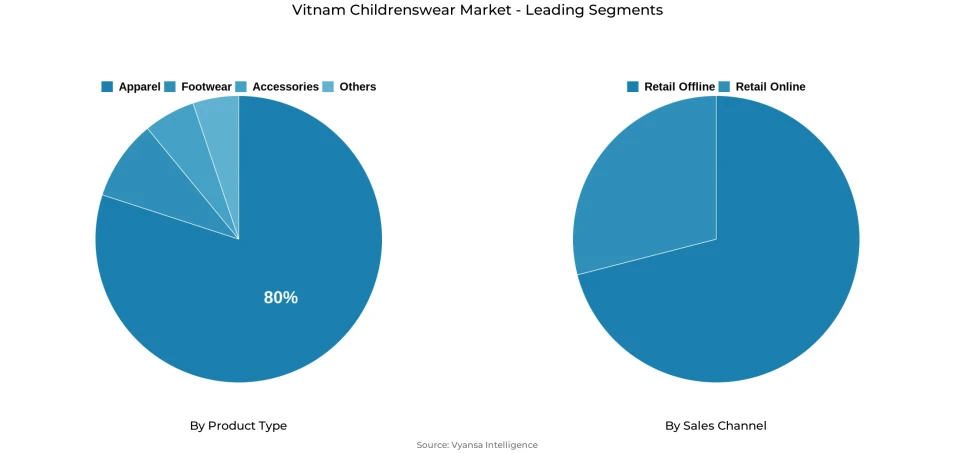
- Apparel grabbed market share of 80%.
- Competition
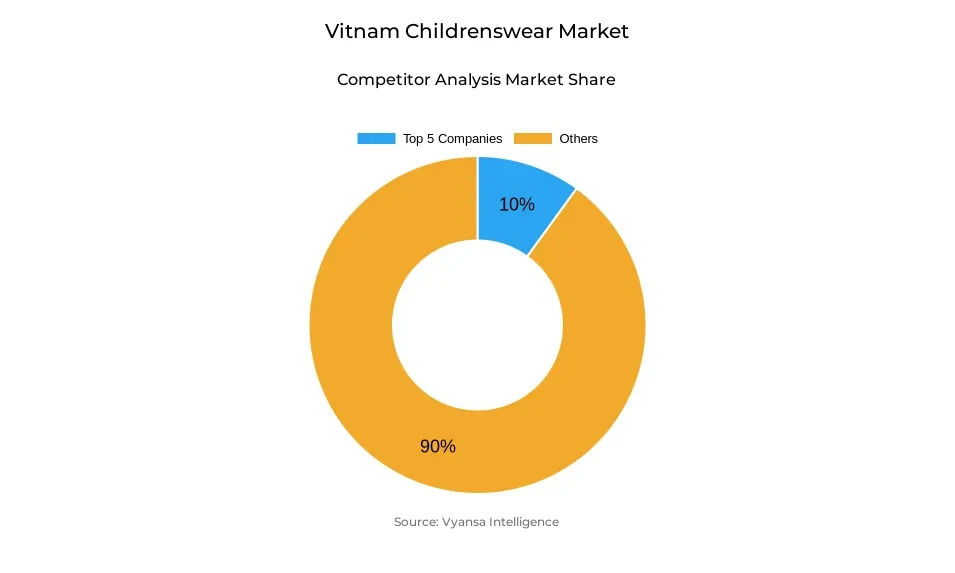
- More than 5 companies are actively engaged in producing childrenswear in Vietnam.
- Top 5 companies acquired around 10% of the market share.
- H&M Hennes & Mauritz Vietnam Co Ltd; Inditex, Industria de Diseño Textil SA; Au Chau Fashion & Cosmetic Co Ltd (ACFC); Uniqlo Vietnam Co Ltd; Li Ning Co Ltd etc., are few of the top companies.
- Sales Channel
- Retail offline continues to dominate the market.
Vietnam Childrenswear Market Outlook
The Vietnam childrenswear market is likely to see a steady growth from USD 420 million in 2025 to nearly USD 470 million by 2032, at a CAGR of around 1.62% during 2026–2032. The market will see healthy growth because improved economic performance and increased disposable income are prompting parents to spend more on quality apparel for children. Growing awareness of children's fashion trends through platforms like Facebook and TikTok has increased demand, and parents have started focusing on both comfort and style. The apparel segment, holding about 80% of the total market, will keep dominating because the category continues to see frequent replacements in wardrobes and increased interest in trendy, climate-appropriate designs.
However, the gradual decline in Vietnam's fertility rate and population growth may restrain the overall market growth. According to the Ministry of Health, the population growth rate of the country will decrease from 0.93% in 2024 to 0.73% by 2029, shrinking the number of potential end-users. Still, an increase in parents' willingness to buy clothes for going outdoors and traveling, along with enhancing GDP growth, estimated in the range of 6–6.5% in the mid-term, will continue to keep sales on course.
Local brands like Canifa, Yody, and YF are predicted to reinforce their market position by offering affordable, locally relevant designs to appeal to price-sensitive households. These brands are using e-commerce and social media channels to expand their reach, while international players such as H&M, Gap, and Uniqlo remain focused on the urban markets of Hanoi and Ho Chi Minh City.
Sustainability will also be one of the main factors shaping the future of Vietnam's childrenswear sector. The growing move toward organic, eco-friendly, and recycled materials-in line with Vietnam's COP26 commitments-will appeal to health-conscious and environmentally aware parents. Meanwhile, retail offline channels will continue their dominance, supported by the prevalence of physical stores that enable parents to check product quality directly, while online sales continue to rise through live-streaming and discount promotions.
Vietnam Childrenswear Market Growth Driver
Economic Stability and Rising Parental Spending
The improving economic environment in Vietnam continues to play an essential role in determining demand for childrenswear. According to estimates by the World Bank, the country's GDP is expected to grow 6.0% in 2025 and 6.5% in 2026, supported by robust domestic consumption and rising household incomes. This economic stability gives more opportunities for spending on quality apparel, with an increased preference for fashionable and occasion-specific clothing. Higher disposable income coupled with evolving lifestyle aspirations is considered to create greater appeal for premium childrenswear.
Furthermore, increasing urbanization in Vietnam is giving a boost to exposure to modern fashion, thereby influencing buying behavior. According to a report, urban residents accounted for 38.7% of the total population in 2024, according to the General Statistics Office of Vietnam (GSO). Major cities such as Hanoi and Ho Chi Minh City are at the forefront in fashion adoption. Influenced by digital media and global trends, urban parents increasingly shape the direction of the childrenswear market, resulting in consistent growth across the country.
Vietnam Childrenswear Market Challenge
Declining Birth Rates Restrain Long-Term Market Growth
While the economy is promising, a decrease in the birth rate could cut long-term demand for the childrenswear market. According to the UNFPA, in 2024, the country recorded a fertility rate of 2.02 births per woman. The Department of Population under the Ministry of Health projects that the country will see population growth slow down from 0.93% in 2024 to 0.73% in 2029. These changes in demography are driven by the increasing cost of living, changes in lifestyles, and delayed family formation.
Smaller family trends reflect wider social changes, such as increased female participation in the workforce and high urban housing costs. These factors are contributing to a gradual contraction in the number of children-the key end-user group for childrenswear. While the market continues to benefit from regular replacement cycles for clothing, a smaller youth population could dampen future sales volumes, forcing manufacturers to concentrate on higher-value or niche segments of apparel in order to maintain profitability.
Unlock Market Intelligence
Explore the market potential with our data-driven report
Vietnam Childrenswear Market Trend
Growing Preference for Local Brands That Provide Affordability and Cultural Appeal
The childrenswear market in Vietnam is increasingly gravitating toward local brands that achieve a balance between affordability, comfort, and cultural resonance. A crop of domestic labels are catering to the local tastes with designs inspired by the region and fabrics suited to Vietnam's tropical climate: Canifa, Yody, and YF among them. According to GSO, this rise in household spending on clothes was 4.2% in 2024, indicating growth in value-based spending. This growth shows the tendencies toward homegrown brands that offer quality and accessibility at reasonable prices.
Besides that, inflationary pressures have further solidified this cost-conscious buying behavior of middle-income families. The World Bank projected an inflation rate of 3.5% for Vietnam in 2024, leading most households to return to domestically produced garments rather than imported ones. Local brands have capitalized on this transition by substantially leveraging various social media platforms like Facebook and TikTok for greater involvement and visibility. All these changes indicate the maturation of the local fashion market, wherein domestic players gradually compete with international brands in both quality and end users perception
Vietnam Childrenswear Market Opportunity
Sustainability and Eco-Friendly Materials Create New Growth Pathways
The future of childrenswear in Vietnam is all about sustainability and eco-friendly materials. Several apparel producers in the country have begun to embrace greener manufacturing practices following Vietnam's pledge at the COP26 Climate Summit to reach net-zero emissions by 2050. Local brands like Canifa and Rabity are launching products made from organic cotton, bamboo fibre, and recycled materials that offer comfort and durability for active kids while appealing to ecologically aware parents.
The increasing trend of sustainable consumption is further facilitated by rising public awareness. The VEA reported a 12% increase in the green consumption awareness index in 2024, while UNDP data indicates that 64% of Vietnamese end userss are willing to pay more for sustainable products. This growth offers significant opportunity for brands prioritizing ethical sourcing and environmentally responsible production. As awareness grows among young parents, sustainability is poised to be a key differentiator driving future demand for childrenswear.
Unlock Market Intelligence
Explore the market potential with our data-driven report
Vietnam Childrenswear Market Segmentation Analysis
By Product Type
- Apparel
- Footwear
- Accessories
- Others
The segment with highest market share under by Product Type is Apparel, capturing almost 75% of the Turkey childrenswear market. This is highly explained by the frequent replacement cycle that characterizes apparel, as children outgrow their clothes very fast. With economic uncertainty, expenditure on children's clothes remains one of the last things parents cut, which therefore means apparel remains resilient compared to menswear or womenswear segments. Growing traction for affordable and mainstream brands also helps boost the segment, as families operate on tight budgets.
Moreover, fashion trends among teens drive up the need for new styles and designs, encouraging parents to make more frequent purchases. Social media's growing influence and the introduction of teen-focused collections by leading brands like LC Waikiki, Defacto, and H&M will also be important in shaping preferences. This ensures that apparel remains the largest and most essential category in the childrenswear market.
By Sales Channel
- Retail Offline
- Retail Online
The segment with highest market share under sales channel is retail offline, captured about 85% share of the Turkey childrenswear market. Turkish parents still prefer going to stores and checking the quality, size, and fabric of the clothes before buying for their children. Offline retail is dominated, with domestic chains such as LC Waikiki and Defacto maintaining strong brand trust and competitive pricing options across most parts of the country.
With Retail e-commerce and social media-driven sales recently developing very fast, it cannot replace the assurance and convenience that parents seek in offline stores for these essential purchases. Discount campaigns, multibuy offers, and seasonal promotions also entice price-sensitive shoppers. Thus, retail offline remains the leading channel for childrenswear sales, holding its ground even as online platforms take gradual strides in the market.
List of Companies Covered in Vietnam Childrenswear Market
The companies listed below are highly influential in the Vietnam childrenswear market, with a significant market share and a strong impact on industry developments.
- H&M Hennes & Mauritz Vietnam Co Ltd
- Inditex, Industria de Diseño Textil SA
- Au Chau Fashion & Cosmetic Co Ltd (ACFC)
- Uniqlo Vietnam Co Ltd
- Li Ning Co Ltd
- Roadget Business Pte Ltd
- Hoang Duong Trading & Service Co Ltd
Frequently Asked Questions
Related Report
1. Market Segmentation
1.1. Research Scope
1.2. Research Methodology
1.3. Definitions and Assumptions
2. Executive Summary
3. Vietnam Childrenswear Market Policies, Regulations, and Standards
4. Vietnam Childrenswear Market Dynamics
4.1. Growth Factors
4.2. Challenges
4.3. Trends
4.4. Opportunities
5. Vietnam Childrenswear Market Statistics, 2022-2032F
5.1. Market Size & Growth Outlook
5.1.1.By Revenues in USD Million
5.2. Market Segmentation & Growth Outlook
5.2.1.By Product Type
5.2.1.1. Apparel- Market Insights and Forecast 2022-2032, USD Million
5.2.1.1.1. Baby and Toddler Wear- Market Insights and Forecast 2022-2032, USD Million
5.2.1.1.2. Boys Apparel- Market Insights and Forecast 2022-2032, USD Million
5.2.1.1.3. Girls Apparel- Market Insights and Forecast 2022-2032, USD Million
5.2.1.2. Footwear- Market Insights and Forecast 2022-2032, USD Million
5.2.1.2.1. Boys Footwear- Market Insights and Forecast 2022-2032, USD Million
5.2.1.2.2. Girls Footwear- Market Insights and Forecast 2022-2032, USD Million
5.2.1.3. Accessories- Market Insights and Forecast 2022-2032, USD Million
5.2.1.3.1. Boys Accessories- Market Insights and Forecast 2022-2032, USD Million
5.2.1.3.2. Girls Accessories- Market Insights and Forecast 2022-2032, USD Million
5.2.1.4. Others- Market Insights and Forecast 2022-2032, USD Million
5.2.2.By Age Group
5.2.2.1. Infant/Toddler (Below 2 years)- Market Insights and Forecast 2022-2032, USD Million
5.2.2.2. Kids/Children (2 - 14 years)- Market Insights and Forecast 2022-2032, USD Million
5.2.3.By Price Category
5.2.3.1. Mass- Market Insights and Forecast 2022-2032, USD Million
5.2.3.2. Premium- Market Insights and Forecast 2022-2032, USD Million
5.2.4.By Sales Channel
5.2.4.1. Retail Offline- Market Insights and Forecast 2022-2032, USD Million
5.2.4.2. Retail Online- Market Insights and Forecast 2022-2032, USD Million
5.2.5.By Competitors
5.2.5.1. Competition Characteristics
5.2.5.2. Market Share & Analysis
6. Vietnam Apparel Childrenswear Market Statistics, 2022-2032
6.1. Market Size & Growth Outlook
6.1.1.By Revenues in USD Million
6.2. Market Segmentation & Growth Outlook
6.2.1.By Age Group- Market Insights and Forecast 2022-2032, USD Million
6.2.2.By Price Category- Market Insights and Forecast 2022-2032, USD Million
6.2.3.By Sales Channel- Market Insights and Forecast 2022-2032, USD Million
7. Vietnam Footwear Childrenswear Market Statistics, 2022-2032
7.1. Market Size & Growth Outlook
7.1.1.By Revenues in USD Million
7.2. Market Segmentation & Growth Outlook
7.2.1.By Age Group- Market Insights and Forecast 2022-2032, USD Million
7.2.2.By Price Category- Market Insights and Forecast 2022-2032, USD Million
7.2.3.By Sales Channel- Market Insights and Forecast 2022-2032, USD Million
8. Vietnam Accessories Childrenswear Market Statistics, 2022-2032
8.1. Market Size & Growth Outlook
8.1.1.By Revenues in USD Million
8.2. Market Segmentation & Growth Outlook
8.2.1.By Age Group- Market Insights and Forecast 2022-2032, USD Million
8.2.2.By Price Category- Market Insights and Forecast 2022-2032, USD Million
8.2.3.By Sales Channel- Market Insights and Forecast 2022-2032, USD Million
9. Competitive Outlook
9.1. Company Profiles
9.1.1.Uniqlo Vietnam Co Ltd
9.1.1.1. Business Description
9.1.1.2. Product Portfolio
9.1.1.3. Collaborations & Alliances
9.1.1.4. Recent Developments
9.1.1.5. Financial Details
9.1.1.6. Others
9.1.2.Li Ning Co Ltd
9.1.2.1. Business Description
9.1.2.2. Product Portfolio
9.1.2.3. Collaborations & Alliances
9.1.2.4. Recent Developments
9.1.2.5. Financial Details
9.1.2.6. Others
9.1.3.Roadget Business Pte Ltd
9.1.3.1. Business Description
9.1.3.2. Product Portfolio
9.1.3.3. Collaborations & Alliances
9.1.3.4. Recent Developments
9.1.3.5. Financial Details
9.1.3.6. Others
9.1.4.Hoang Duong Trading & Service Co Ltd
9.1.4.1. Business Description
9.1.4.2. Product Portfolio
9.1.4.3. Collaborations & Alliances
9.1.4.4. Recent Developments
9.1.4.5. Financial Details
9.1.4.6. Others
9.1.5.Au Chau Fashion & Cosmetic Co Ltd (ACFC)
9.1.5.1. Business Description
9.1.5.2. Product Portfolio
9.1.5.3. Collaborations & Alliances
9.1.5.4. Recent Developments
9.1.5.5. Financial Details
9.1.5.6. Others
9.1.6.H&M Hennes & Mauritz Vietnam Co Ltd
9.1.6.1. Business Description
9.1.6.2. Product Portfolio
9.1.6.3. Collaborations & Alliances
9.1.6.4. Recent Developments
9.1.6.5. Financial Details
9.1.6.6. Others
9.1.7.Inditex, Industria de Diseño Textil SA
9.1.7.1. Business Description
9.1.7.2. Product Portfolio
9.1.7.3. Collaborations & Alliances
9.1.7.4. Recent Developments
9.1.7.5. Financial Details
9.1.7.6. Others
9.1.8.Nanjing Lingtian Information Technology Co Ltd
9.1.8.1. Business Description
9.1.8.2. Product Portfolio
9.1.8.3. Collaborations & Alliances
9.1.8.4. Recent Developments
9.1.8.5. Financial Details
9.1.8.6. Others
9.1.9.Others
9.1.9.1. Business Description
9.1.9.2. Product Portfolio
9.1.9.3. Collaborations & Alliances
9.1.9.4. Recent Developments
9.1.9.5. Financial Details
9.1.9.6. Others
10. Disclaimer
| Segment | Sub-Segment |
|---|---|
| By Product Type |
|
| By Age Group |
|
| By Price Category |
|
| By Sales Channel |
|
Research Methodology
This study followed a structured approach comprising four key phases to assess the size and scope of the electro-oxidation market. The process began with thorough secondary research to collect data on the target market, related markets, and broader industry context. These findings, along with preliminary assumptions and estimates, were then validated through extensive primary research involving industry experts from across the value chain. To calculate the overall market size, both top-down and bottom-up methodologies were employed. Finally, market segmentation and data triangulation techniques were applied to refine and validate segment-level estimations.
Secondary Research
The secondary research phase involved gathering data from a wide range of credible and published sources. This step helped in identifying industry trends, defining market segmentation, and understanding the market landscape and value chain.
Sources consulted during this phase included:
- Company annual reports, investor presentations, and press releases
- Industry white papers and certified publications
- Trade directories and market-recognized databases
- Articles from authoritative authors and reputable journals
- Gold and silver standard websites
Secondary research was critical in mapping out the industry's value chain and monetary flow, identifying key market segments, understanding regional variations, and tracking significant industry developments.
Other key sources:
- Financial disclosures
- Industry associations and trade bodies
- News outlets and business magazines
- Academic journals and research studies
- Paid industry databases
Primary Research
To validate secondary data and gain deeper market insights, primary research was conducted with key stakeholders across both the supply and demand sides of the market.
On the demand side, participants included decision-makers and influencers from end-user industries—such as CIOs, CTOs, and CSOs—who provided first-hand perspectives on market needs, product usage, and future expectations.
On the supply side, interviews were conducted with manufacturers, industry associations, and institutional participants to gather insights into current offerings, product pipelines, and market challenges.
Primary interviews provided critical inputs such as:
- Market size and revenue data
- Product and service breakdowns
- Market forecasts
- Regional and application-specific trends
Stakeholders consulted included:
- Leading OEM and solution providers
- Channel and distribution partners
- End users across various applications
- Independent consultants and industry specialists
Market Size Estimation and Data Triangulation
- Identifying Key Market Participants (Secondary Research)
- Goal: To identify the major players or companies in the target market. This typically involves using publicly available data sources such as industry reports, market research publications, and financial statements of companies.
- Tools: Reports from firms like Gartner, Forrester, Euromonitor, Statista, IBISWorld, and others. Public financial statements, news articles, and press releases from top market players.
- Extracting Earnings of Key Market Participants
- Goal: To estimate the earnings generated from the product or service being analyzed. This step helps in understanding the revenue potential of each market player in a specific geography.
- Methods: Earnings data can be gathered from:
- Publicly available financial reports (for listed companies).
- Interviews and primary data sources from professionals, such as Directors, VPs, SVPs, etc. This is especially useful for understanding more nuanced, internal data that isn't publicly disclosed.
- Annual reports and investor presentations of key players.
- Data Collation and Development of a Relevant Data Model
- Goal: To collate inputs from both primary and secondary sources into a structured, data-driven model for market estimation. This model will incorporate key market KPIs and any independent variables relevant to the market.
- Key KPIs: These could include:
- Market size, growth rate, and demand drivers.
- Industry-specific metrics like market share, average revenue per customer (ARPC), or average deal size.
- External variables, such as economic growth rates, inflation rates, or commodity prices, that could affect the market.
- Data Modeling: Based on this data, the market forecasts are developed for the next 5 years. A combination of trend analysis, scenario modeling, and statistical regression might be used to generate projections.
- Scenario Analysis
- Goal: To test different assumptions and validate how sensitive the market is to changes in key variables (e.g., market demand, regulatory changes, technological disruptions).
- Types of Scenarios:
- Base Case: Based on current assumptions and historical data.
- Best-Case Scenario: Assuming favorable market conditions, regulatory environments, and technological advancements.
- Worst-Case Scenario: Accounting for adverse factors, such as economic downturns, stricter regulations, or unexpected disruptions.












