Vietnam Bottled Water Market Report: Trends, Growth and Forecast (2026-2032)
By Type of Water (Carbonated Bottled Water, Flavoured Bottled Water, Functional Bottled Water, Still Bottled Water), By Sub Types (Purified (Desalinated, Atmospheric Generated, Others), Mineral, Other (Spring, Alkaline, Other)), By Packaging Material (Flexible Packaging (Aluminium, Pouches), Glass, Rigid Plastic (PET Bottles, Thin Wall Plastic Containers, Others)), By Price Category (Budget, Economy, Premium), By Pack Size (100 ml, 125 ml, 200 ml, 250 ml, 330 ml, 370 ml, 450 ml, 500 ml, 591 ml, 750 ml, 1,000 ml, 1,500 ml, 4,000 ml, 5,000 ml, Others), By Sales Channel (On Trade (Restaurants, Hotels, Cafes, Others), Off Trade (Grocery Retailers (Convenience Retail, Supermarkets, Hypermarkets, Small Local Grocer), Non-Grocery Retailers (General Merchandise Stores), Vending, E-commerce)) ... Read more
|
Major Players
|
Vietnam Bottled Water Market Statistics and Insights, 2026
- Market Size Statistics
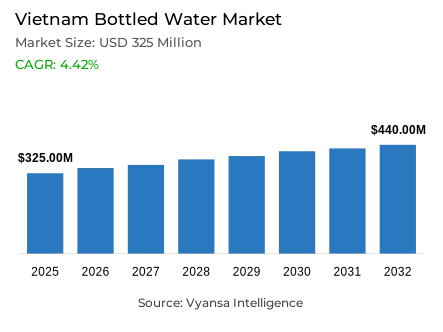
- Bottled water market size in Vietnam was estimated at USD 325 million in 2025.
- The market size is expected to grow to USD 440 million by 2032.
- Market to register a CAGR of around 4.42% during 2026-32.
- Type of Water Shares
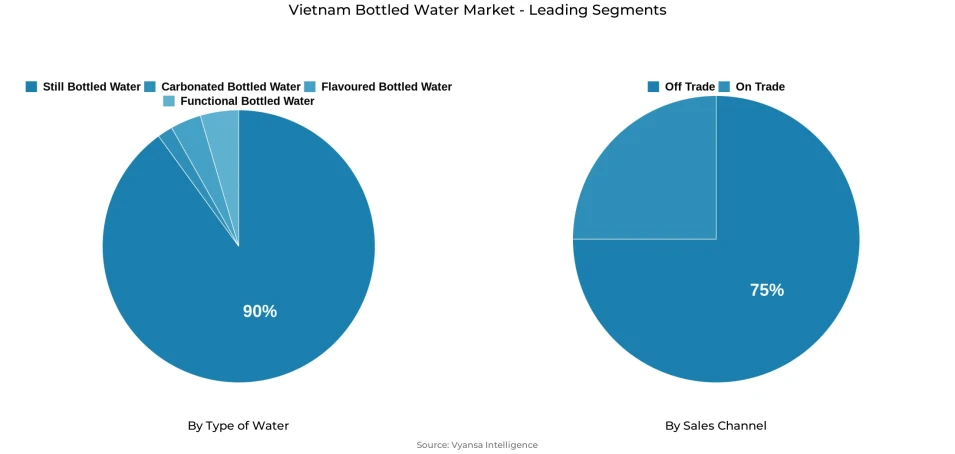
- Still bottled water grabbed market share of 90%.
- Competition
- More than 10 companies are actively engaged in producing bottled water in Vietnam.
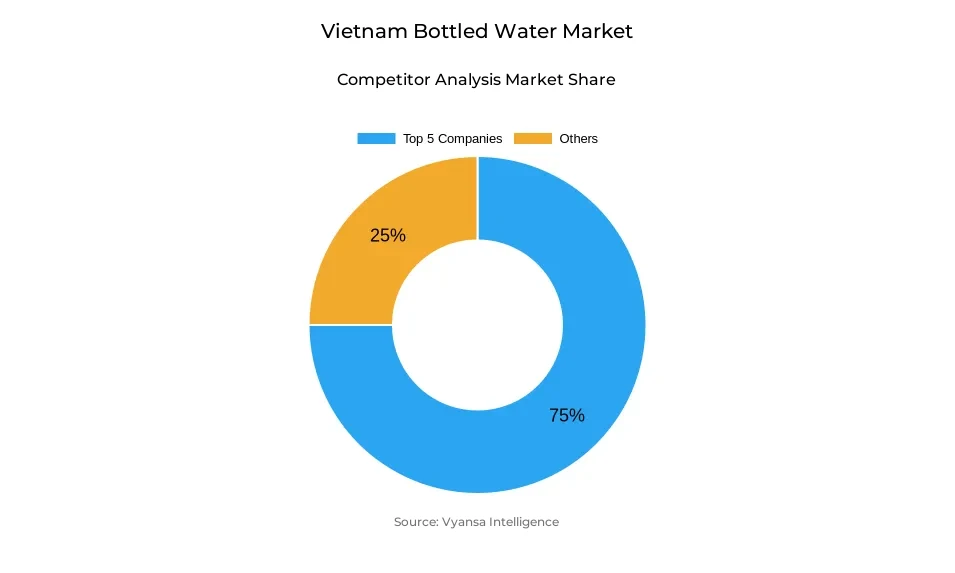
- Top 5 companies acquired around 75% of the market share.
- Quang Ngai Sugar JSC, Hoang Minh Water JSC, Vital JSC, Suntory PepsiCo Vietnam Beverage Co Ltd, La Vie JV Co etc., are few of the top companies.
- Sales Channel
- Off trade grabbed 75% of the market.
Vietnam Bottled Water Market Outlook
The market value was projected at USD 325 million in 2025 and USD 440 million in 2032, which is a CAGR of about 4.42% between 2026 and 2032. In 2026, international tourism is one of the key drivers of demand. The future of the Vietnamese bottled-water market in 2026-2032 can be described as stable, supported by structural demand factors and recent regulatory changes. According to the statistics of the Vietnam National Authority of Tourism (2025), in the first seven months of 2025, the country received 12.23 million foreigners, which is 22.5% more than in the last year. It is expected that the momentum of travel in 2026 will continue to increase visitor mobility, which will increase the consumption of packaged water in hotels, restaurants, and entertainment facilities.
However, the environmental pressure is a structural issue. The World Bank estimates that the overall amount of plastic waste shipped out of Vietnam stood at approximately 3.9 million tonnes a year, and packaging was a substantial contributor to the production. The regulatory pressure will rise in the single-use plastics market from 2026; essentially, the cost of compliance will increase for beverage manufacturers, and the industry will experience the build-out of recycling plants and production of more eco-friendly products.
One of the trends that will be dominant in the market in 2026 is the high rate of growth of digital retail. Based on the report by the Ministry of Industry and Trade of Vietnam, e-commerce in the market grew at a rate of 25% annually in 2024. This simply means the market will embrace online spending. In turn, it would be very easy to purchase in bulk items like packaged drinking water.
There are many opportunities that lie within public health policies. The Ministry of Finance (2025) has made many proposals to implement excise tax on sugar-sweetened beverages, similar to the WHO recommendations to reduce the consumption of sugar. As the spotlight is focused more on regulating in 2026, consumption of zero-sugar drinks is becoming more prominent among end users. Still, bottled water maintains a large market share of 90% in terms of types, while off-trade holds 75% in terms of distribution.
Vietnam Bottled Water Market Growth DriverRising International Tourism Fuels Out-of-Home Consumption
Vietnam records strong growth in international arrivals, directly supporting packaged drinking water demand in food service locations. According to the Vietnam National Authority of Tourism (2025), the country welcomes 12.23 million international visitors in the first seven months of 2025, marking a 22.5% increase year-on-year. This steady inflow of tourists increases consumption in hotels, restaurants, cafes, and entertainment venues where packaged water is preferred for safety and convenience.
The mobility and consumption associated with tourism act as the basis that sustains the frequent consumption of bottled water, notably in urban and coastal tourist centers. Furthermore, government statistics indicate that it is one of the economic pillars, as are the drinking habits adopted outside of the home. Tourism is a reliable source of support that sustains category growth as the number of tourists rises and infrastructure improves.
Vietnam Bottled Water Market ChallengePlastic Waste Management Pressures Create Operational Constraints
Vietnam is facing a growing environmental pressure that is linked to plastic waste management. According to the World Bank , the country produces approximately 3.9 million tonnes of plastic waste every year, and packaging is a significant part of it. Increased regulatory attention and consumer awareness about single-use plastics are widening the compliance requirements of beverage producers.
Stricter sustainability regulations and increased environmental awareness require producers to invest in recycling facilities, environmentally friendly materials, and reverse logistics. These changes raise the cost of operation and complexity of supply-chain. With the government stepping up plastic-cutting efforts, the packaging sustainability is a structural issue among Vietnamese bottled-water manufacturers.
Unlock Market Intelligence
Explore the market potential with our data-driven report
Vietnam Bottled Water Market TrendDigital Commerce Expands Access to Essential Goods
The fast pace of digital adoption in Vietnam is transforming the retail distribution trends. According to the Ministry of Industry and Trade of Vietnam, the e-commerce industry in the country grew by 25% annually in 2024, as end users increasingly depend on online shopping platforms. This trend makes it easy to make regular purchases of bulk necessities, such as packaged drinking water.
Customers are more and more inclined towards home delivery with the help of online payments and mobile shopping. The government data proves the increased internet penetration and the use of digital payments by urban households, which reinforces the impact of e-commerce platforms on daily buying choices. This change in structure to digital retail is still influencing the accessibility and purchasing behaviour of packaged water.
Vietnam Bottled Water Market OpportunitySugar Tax Policy Encourages Healthier Beverage Choices
Vietnam is strengthening public-health interventions to restrict sugar intake. In 2025, the Ministry of Finance affirmed that the government is progressing plans to introduce an excise tax on sugar-sweetened drinks, in a bid to reduce the increasing rate of non-communicable diseases. The World Health Organization suggests that sugar-sweetened drinks should be taxed across the globe to decrease the high consumption of sugar and enhance the population-health outcomes.
With the increasing regulatory focus on sugary beverages, end users are increasingly turning to healthier hydration sources. The favourable conditions of packaged water consumption are created by policy-based behavioural changes towards low or zero-sugar drinks. In turn, the government-supported health programs are a structural opportunity that supports the long-term applicability of the category.
Unlock Market Intelligence
Explore the market potential with our data-driven report
Vietnam Bottled Water Market Segmentation Analysis
By Type of Water
- Carbonated Bottled Water
- Flavoured Bottled Water
- Functional Bottled Water
- Still Bottled Water
The largest share segment remains still bottled water under the water type category with a 90% market share. Still water is still very popular due to its low cost, availability, and its compatibility with the everyday hydration requirements. Its wide coverage in both urban and rural areas strengthens its dominance in the product landscape. .
The simplicity and naturalness of hydration continues to drive the continued demand of still formats in retail stores and food-service restaurants. The segment enjoys a high level of accessibility and congruence with health-conscious consumption trends.
By Sales Channel
- On Trade
- Off Trade
The sales channel with the largest share is off-trade, which captured approximately 75% of the bottled water market in Vietnam. Among off-trade, small local convenience stores are the main distribution channels for off-trade due to their widespread reach in both urban and rural areas. Their strategic locations, easy accessibility, and strong connections with the community make them the point of first purchase for bottled water. However, modern convenience store chains like 7-Eleven are rapidly expanding, especially in urban areas, further boosting off-trade sales with improved brand awareness and organized retailing.
On the other hand, retail e-commerce is the fastest-growing new sales channel, which is capturing off-trade market share as more consumers begin to purchase bulky bottled water packs online. Online shopping platforms such as Shopee.vn, fueled by promotions, live streaming, and deep discounts, are driving the digital revolution. Home delivery convenience and competitive pricing are propelling this paradigm shift in the bottled water retail market in Vietnam for 2026-32.
List of Companies Covered in Vietnam Bottled Water Market
The companies listed below are highly influential in the Vietnam bottled water market, with a significant market share and a strong impact on industry developments.
- Quang Ngai Sugar JSC
- Hoang Minh Water JSC
- Vital JSC
- Suntory PepsiCo Vietnam Beverage Co Ltd
- La Vie JV Co
- Coca-Cola Beverages Vietnam Co Ltd
- Saigon Pure Water Co Ltd
- Masan Group Corp
- PetroVietnam Oil Thai Binh JSC
- International Food Industry JSC
Competitive Landscape
In 2025, Suntory PepsiCo Vietnam Beverage Co Ltd maintained its leadership in Vietnam’s highly consolidated bottled water market through its flagship brand, Aquafina. Strong investments in production facilities across key cities supported an extensive and efficient distribution network, while sustained marketing efforts reinforced brand visibility. Aquafina strengthened its premium and sustainable positioning by sponsoring Aquafina Vietnam International Fashion Week (SS 2025), aligning the brand with fashion, innovation, and environmental consciousness. Meanwhile, La Vie JV Co and Coca-Cola Beverages Vietnam continued to compete actively through community-focused initiatives and strong promotional strategies. In off-trade volume growth, Hoang Minh Water JSC stood out as the most dynamic player, driven by its i-on Life brand. Emphasising health benefits and active consumer engagement, including social initiatives such as the “Love Mid-Autumn” programme, the company enhanced brand loyalty and reinforced its socially responsible image.
Frequently Asked Questions
Related Report
- Market Segmentation
- Research Scope
- Research Methodology
- Definitions and Assumptions
- Executive Summary
- Vietnam Bottled Water Market Policies, Regulations, and Standards
- Vietnam Bottled Water Market Dynamics
- Growth Factors
- Challenges
- Trends
- Opportunities
- Vietnam Bottled Water Market Statistics, 2022-2032F
- Market Size & Growth Outlook
- By Revenues in USD Million
- By Volume (Million Litres)
- Market Segmentation & Growth Outlook
- By Type of Water
- Carbonated Bottled Water- Market Insights and Forecast 2022-2032, USD Million
- Flavoured Bottled Water- Market Insights and Forecast 2022-2032, USD Million
- Functional Bottled Water- Market Insights and Forecast 2022-2032, USD Million
- Still Bottled Water- Market Insights and Forecast 2022-2032, USD Million
- By Sub Types
- Purified- Market Insights and Forecast 2022-2032, USD Million
- Desalinated- Market Insights and Forecast 2022-2032, USD Million
- Atmospheric Generated- Market Insights and Forecast 2022-2032, USD Million
- Others- Market Insights and Forecast 2022-2032, USD Million
- Mineral- Market Insights and Forecast 2022-2032, USD Million
- Other (Spring, Alkaline, Other) - Market Insights and Forecast 2022-2032, USD Million
- Purified- Market Insights and Forecast 2022-2032, USD Million
- By Packaging Material
- Flexible Packaging- Market Insights and Forecast 2022-2032, USD Million
- Aluminium- Market Insights and Forecast 2022-2032, USD Million
- Pouches- Market Insights and Forecast 2022-2032, USD Million
- Glass- Market Insights and Forecast 2022-2032, USD Million
- Rigid Plastic- Market Insights and Forecast 2022-2032, USD Million
- PET Bottles- Market Insights and Forecast 2022-2032, USD Million
- Thin Wall Plastic Containers- Market Insights and Forecast 2022-2032, USD Million
- Others- Market Insights and Forecast 2022-2032, USD Million
- Flexible Packaging- Market Insights and Forecast 2022-2032, USD Million
- By Price Category
- Budget- Market Insights and Forecast 2022-2032, USD Million
- Economy- Market Insights and Forecast 2022-2032, USD Million
- Premium- Market Insights and Forecast 2022-2032, USD Million
- By Pack Size
- 100 ml- Market Insights and Forecast 2022-2032, USD Million
- 125 ml- Market Insights and Forecast 2022-2032, USD Million
- 200 ml- Market Insights and Forecast 2022-2032, USD Million
- 250 ml- Market Insights and Forecast 2022-2032, USD Million
- 330 ml- Market Insights and Forecast 2022-2032, USD Million
- 370 ml- Market Insights and Forecast 2022-2032, USD Million
- 450 ml- Market Insights and Forecast 2022-2032, USD Million
- 500 ml- Market Insights and Forecast 2022-2032, USD Million
- 591 ml- Market Insights and Forecast 2022-2032, USD Million
- 750 ml- Market Insights and Forecast 2022-2032, USD Million
- 1,000 ml- Market Insights and Forecast 2022-2032, USD Million
- 1,500 ml- Market Insights and Forecast 2022-2032, USD Million
- 4,000 ml- Market Insights and Forecast 2022-2032, USD Million
- 5,000 ml- Market Insights and Forecast 2022-2032, USD Million
- Others- Market Insights and Forecast 2022-2032, USD Million
- By Sales Channel
- On Trade- Market Insights and Forecast 2022-2032, USD Million
- Restaurants- Market Insights and Forecast 2022-2032, USD Million
- Hotels- Market Insights and Forecast 2022-2032, USD Million
- Cafes- Market Insights and Forecast 2022-2032, USD Million
- Others- Market Insights and Forecast 2022-2032, USD Million
- Off Trade- Market Insights and Forecast 2022-2032, USD Million
- Grocery Retailers- Market Insights and Forecast 2022-2032, USD Million
- Convenience Retail- Market Insights and Forecast 2022-2032, USD Million
- Supermarkets- Market Insights and Forecast 2022-2032, USD Million
- Hypermarkets- Market Insights and Forecast 2022-2032, USD Million
- Small Local Grocer- Market Insights and Forecast 2022-2032, USD Million
- Non-Grocery Retailers- Market Insights and Forecast 2022-2032, USD Million
- General Merchandise Stores- Market Insights and Forecast 2022-2032, USD Million
- Vending- Market Insights and Forecast 2022-2032, USD Million
- E-commerce- Market Insights and Forecast 2022-2032, USD Million
- Grocery Retailers- Market Insights and Forecast 2022-2032, USD Million
- On Trade- Market Insights and Forecast 2022-2032, USD Million
- By Competitors
- Competition Characteristics
- Market Share & Analysis
- By Type of Water
- Market Size & Growth Outlook
- Vietnam Carbonated Bottled Water Market Statistics, 2022-2032
- Market Size & Growth Outlook
- By Revenues in USD Million
- By Volume (Million Litres)
- Market Segmentation & Growth Outlook
- By Sub Types- Market Insights and Forecast 2022-2032, USD Million
- By Packaging Material- Market Insights and Forecast 2022-2032, USD Million
- By Pack Size- Market Insights and Forecast 2022-2032, USD Million
- By Price Category- Market Insights and Forecast 2022-2032, USD Million
- By Sales Channel- Market Insights and Forecast 2022-2032, USD Million
- Market Size & Growth Outlook
- Vietnam Flavoured Bottled Water Market Statistics, 2022-2032
- Market Size & Growth Outlook
- By Revenues in USD Million
- By Volume (Million Litres)
- Market Segmentation & Growth Outlook
- By Sub Types- Market Insights and Forecast 2022-2032, USD Million
- By Packaging Material- Market Insights and Forecast 2022-2032, USD Million
- By Pack Size- Market Insights and Forecast 2022-2032, USD Million
- By Price Category- Market Insights and Forecast 2022-2032, USD Million
- By Sales Channel- Market Insights and Forecast 2022-2032, USD Million
- Market Size & Growth Outlook
- Vietnam Functional Bottled Water Market Statistics, 2022-2032
- Market Size & Growth Outlook
- By Revenues in USD Million
- By Volume (Million Litres)
- Market Segmentation & Growth Outlook
- By Sub Types- Market Insights and Forecast 2022-2032, USD Million
- By Packaging Material- Market Insights and Forecast 2022-2032, USD Million
- By Pack Size- Market Insights and Forecast 2022-2032, USD Million
- By Price Category- Market Insights and Forecast 2022-2032, USD Million
- By Sales Channel- Market Insights and Forecast 2022-2032, USD Million
- Market Size & Growth Outlook
- Vietnam Still Bottled Water Market Statistics, 2022-2032
- Market Size & Growth Outlook
- By Revenues in USD Million
- By Volume (Million Litres)
- Market Segmentation & Growth Outlook
- By Sub Types- Market Insights and Forecast 2022-2032, USD Million
- By Packaging Material- Market Insights and Forecast 2022-2032, USD Million
- By Pack Size- Market Insights and Forecast 2022-2032, USD Million
- By Price Category- Market Insights and Forecast 2022-2032, USD Million
- By Sales Channel- Market Insights and Forecast 2022-2032, USD Million
- Market Size & Growth Outlook
- Competitive Outlook
- Company Profiles
- Suntory PepsiCo Vietnam Beverage Co Ltd
- Business Description
- Product Portfolio
- Collaborations & Alliances
- Recent Developments
- Financial Details
- Others
- La Vie JV Co
- Business Description
- Product Portfolio
- Collaborations & Alliances
- Recent Developments
- Financial Details
- Others
- Coca-Cola Beverages Vietnam Co Ltd
- Business Description
- Product Portfolio
- Collaborations & Alliances
- Recent Developments
- Financial Details
- Others
- Saigon Pure Water Co Ltd
- Business Description
- Product Portfolio
- Collaborations & Alliances
- Recent Developments
- Financial Details
- Others
- Masan Group Corp
- Business Description
- Product Portfolio
- Collaborations & Alliances
- Recent Developments
- Financial Details
- Others
- Quang Ngai Sugar JSC
- Business Description
- Product Portfolio
- Collaborations & Alliances
- Recent Developments
- Financial Details
- Others
- Hoang Minh Water JSC
- Business Description
- Product Portfolio
- Collaborations & Alliances
- Recent Developments
- Financial Details
- Others
- Vital JSC
- Business Description
- Product Portfolio
- Collaborations & Alliances
- Recent Developments
- Financial Details
- Others
- PetroVietnam Oil Thai Binh JSC
- Business Description
- Product Portfolio
- Collaborations & Alliances
- Recent Developments
- Financial Details
- Others
- International Food Industry JSC
- Business Description
- Product Portfolio
- Collaborations & Alliances
- Recent Developments
- Financial Details
- Others
- Suntory PepsiCo Vietnam Beverage Co Ltd
- Company Profiles
- Disclaimer
| Segment | Sub-Segment |
|---|---|
| By Type of Water |
|
| By Sub Types |
|
| By Packaging Material |
|
| By Price Category |
|
| By Pack Size |
|
| By Sales Channel |
|
Research Methodology
This study followed a structured approach comprising four key phases to assess the size and scope of the electro-oxidation market. The process began with thorough secondary research to collect data on the target market, related markets, and broader industry context. These findings, along with preliminary assumptions and estimates, were then validated through extensive primary research involving industry experts from across the value chain. To calculate the overall market size, both top-down and bottom-up methodologies were employed. Finally, market segmentation and data triangulation techniques were applied to refine and validate segment-level estimations.
Secondary Research
The secondary research phase involved gathering data from a wide range of credible and published sources. This step helped in identifying industry trends, defining market segmentation, and understanding the market landscape and value chain.
Sources consulted during this phase included:
- Company annual reports, investor presentations, and press releases
- Industry white papers and certified publications
- Trade directories and market-recognized databases
- Articles from authoritative authors and reputable journals
- Gold and silver standard websites
Secondary research was critical in mapping out the industry's value chain and monetary flow, identifying key market segments, understanding regional variations, and tracking significant industry developments.
Other key sources:
- Financial disclosures
- Industry associations and trade bodies
- News outlets and business magazines
- Academic journals and research studies
- Paid industry databases
Primary Research
To validate secondary data and gain deeper market insights, primary research was conducted with key stakeholders across both the supply and demand sides of the market.
On the demand side, participants included decision-makers and influencers from end-user industries—such as CIOs, CTOs, and CSOs—who provided first-hand perspectives on market needs, product usage, and future expectations.
On the supply side, interviews were conducted with manufacturers, industry associations, and institutional participants to gather insights into current offerings, product pipelines, and market challenges.
Primary interviews provided critical inputs such as:
- Market size and revenue data
- Product and service breakdowns
- Market forecasts
- Regional and application-specific trends
Stakeholders consulted included:
- Leading OEM and solution providers
- Channel and distribution partners
- End users across various applications
- Independent consultants and industry specialists
Market Size Estimation and Data Triangulation
- Identifying Key Market Participants (Secondary Research)
- Goal: To identify the major players or companies in the target market. This typically involves using publicly available data sources such as industry reports, market research publications, and financial statements of companies.
- Tools: Reports from firms like Gartner, Forrester, Euromonitor, Statista, IBISWorld, and others. Public financial statements, news articles, and press releases from top market players.
- Extracting Earnings of Key Market Participants
- Goal: To estimate the earnings generated from the product or service being analyzed. This step helps in understanding the revenue potential of each market player in a specific geography.
- Methods: Earnings data can be gathered from:
- Publicly available financial reports (for listed companies).
- Interviews and primary data sources from professionals, such as Directors, VPs, SVPs, etc. This is especially useful for understanding more nuanced, internal data that isn't publicly disclosed.
- Annual reports and investor presentations of key players.
- Data Collation and Development of a Relevant Data Model
- Goal: To collate inputs from both primary and secondary sources into a structured, data-driven model for market estimation. This model will incorporate key market KPIs and any independent variables relevant to the market.
- Key KPIs: These could include:
- Market size, growth rate, and demand drivers.
- Industry-specific metrics like market share, average revenue per customer (ARPC), or average deal size.
- External variables, such as economic growth rates, inflation rates, or commodity prices, that could affect the market.
- Data Modeling: Based on this data, the market forecasts are developed for the next 5 years. A combination of trend analysis, scenario modeling, and statistical regression might be used to generate projections.
- Scenario Analysis
- Goal: To test different assumptions and validate how sensitive the market is to changes in key variables (e.g., market demand, regulatory changes, technological disruptions).
- Types of Scenarios:
- Base Case: Based on current assumptions and historical data.
- Best-Case Scenario: Assuming favorable market conditions, regulatory environments, and technological advancements.
- Worst-Case Scenario: Accounting for adverse factors, such as economic downturns, stricter regulations, or unexpected disruptions.












