US Green Hydrogen Testing Market Report: Trends, Growth and Forecast (2026-2032)
By Testing Type (Water Quality Testing, Hydrogen Purity Testing, Electrolyzer Performance Testing, Material Compatibility Testing, Infrastructure Integrity Testing, Leak Detection & Safety Testing, Storage & Pressure Testing, Carbon Intensity Testing, Certification & Compliance Testing, Fuel Cell & System Testing), By Process (Production, Storage, Transportation, Distribution, Refueling), By Technology (Gas Chromatography, Spectroscopy, Electrochemical Analysis, Non-Destructive Testing, Sensor-Based Monitoring), By End User (Hydrogen Producers, Energy & Utilities, Oil & Gas Companies, Chemical & Petrochemical Companies, Transportation & Mobility Operators, Industrial Manufacturers, Hydrogen Infrastructure Developers, Others), By Region (West, Midwest, South, North, Northeast) ... Read more
|
Major Players
|
US Green Hydrogen Testing Market Statistics and Insights, 2026
- Market Size Statistics
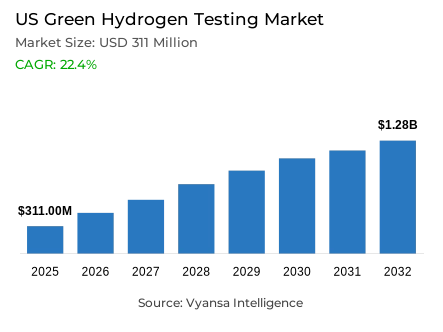
- Green hydrogen testing market size in US was valued at USD 311 million in 2025 and is estimated at USD 356 million in 2026.
- The market size is expected to grow to USD 1.28 billion by 2032.
- Market to register a CAGR of around 22.4% during 2026-32.
- Testing Type Shares
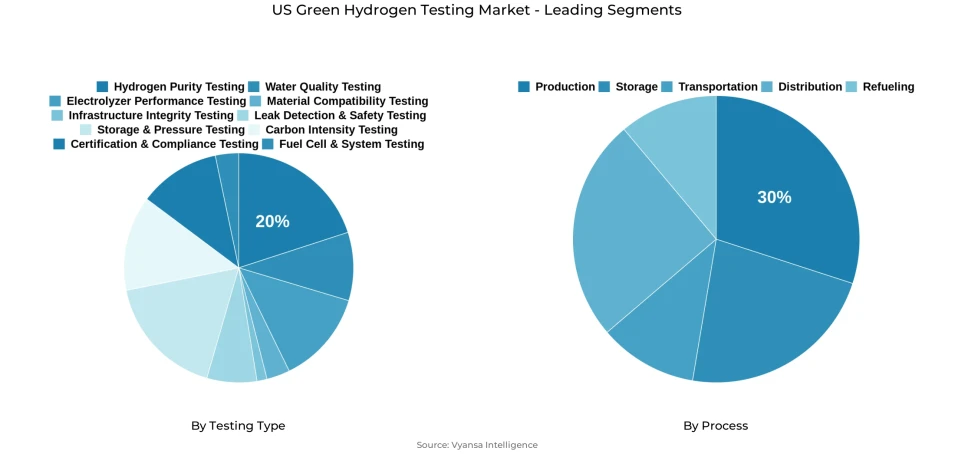
- Hydrogen purity testing grabbed market share of 20%.
- Competition
- More than 10 companies are actively engaged in producing green hydrogen testing in US.
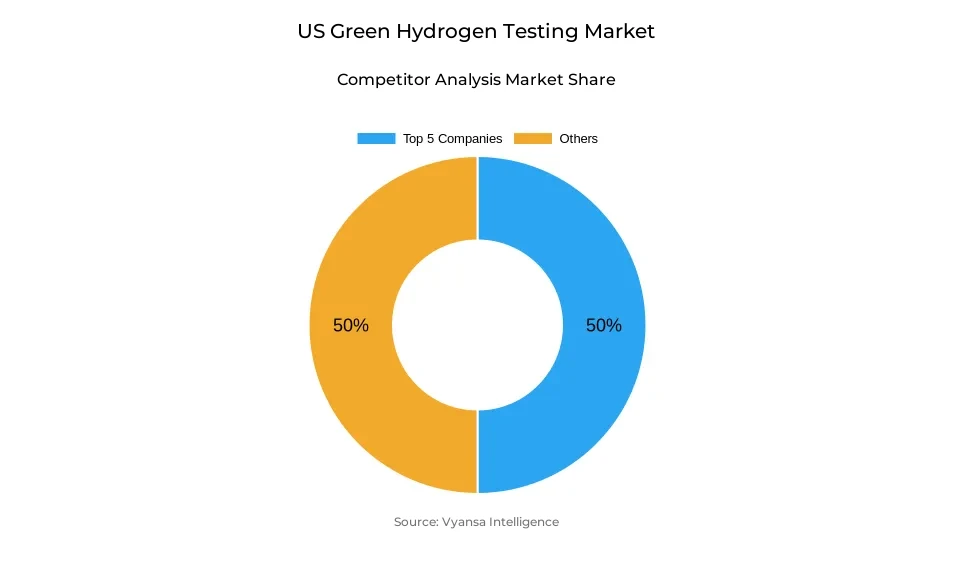
- Top 5 companies acquired around 50% of the market share in 2026.
- TÜV SÜD AG, DEKRA SE, Element Materials Technology Group Limited, SGS SA, Bureau Veritas SA etc., are few of the top companies.
- Process
- Production grabbed 30% of the market.
US Green Hydrogen Testing Market Outlook
The US Green Hydrogen Testing Market size was valued at USD 311 million in 2025 and is projected to grow from USD 356 million in 2026 to USD 1.28 billion by 2032, exhibiting a CAGR of 22.4% during the forecast period. The market is expanding as hydrogen projects move from development to commercialization across industrial, transportation, and energy sectors. Rising investments in hydrogen production facilities, storage systems, and transportation infrastructure are increasing the need for hydrogen quality testing, hydrogen certification services, and hydrogen safety testing throughout the value chain.
According to the U.S. Department of Energy (DOE), the United States selected seven Regional Clean Hydrogen Hubs with up to USD 7 billion in federal funding to support hydrogen production, processing, delivery, storage, and end-use deployment. As hydrogen infrastructure expands, the green hydrogen testing market is experiencing growing demand for hydrogen purity testing, hydrogen infrastructure testing, and hydrogen compliance testing activities required to validate operational performance and regulatory compliance.
The green hydrogen testing market is becoming increasingly important as developers seek reliable hydrogen quality assurance and renewable hydrogen validation across production and distribution networks. Hydrogen Purity Testing accounts for the largest share of the testing type segment at around 20%, while Production leads the process segment with approximately 30% share. These segments remain critical because hydrogen quality must be verified before it enters storage, transportation, or end-use applications.
Green hydrogen testing supports project commissioning, certification, operational reliability, and clean hydrogen verification. As hydrogen projects advance toward commercial operation, testing providers are becoming essential participants in ensuring product quality, safety standards, and compliance requirements across the expanding hydrogen economy.
US Green Hydrogen Testing Market Growth Driver
Federal Support Accelerates Project Deployment
Government-backed hydrogen initiatives continue to strengthen investment activity across the hydrogen value chain. According to the U.S. Department of Energy, the Hydrogen Shot initiative aims to reduce clean hydrogen costs to USD 1 per kilogram within one decade. This objective is encouraging investment in hydrogen production facilities, transportation networks, storage systems, and end-use applications that require extensive testing and validation.
As more projects progress from planning to deployment, the green hydrogen testing market benefits from rising demand for hydrogen quality testing, hydrogen compliance testing, and hydrogen safety validation services. Testing activities are becoming essential for verifying hydrogen purity, operational performance, and regulatory compliance before hydrogen enters commercial markets.
US Green Hydrogen Testing Market Challenge
Evolving Standards and Certification Requirements
The development of low-carbon hydrogen markets continues to create complexity for testing providers. According to the International Energy Agency (IEA), more than 90% of announced low-emissions hydrogen projects globally had not reached final investment decision status by 2025. This reflects ongoing uncertainty surrounding certification methodologies, carbon accounting frameworks, and market requirements.
For the green hydrogen testing market, evolving standards increase the need for adaptable hydrogen certification services, renewable hydrogen validation, and hydrogen compliance assessment capabilities. Laboratories and certification bodies must continuously update testing protocols to align with changing regulatory frameworks, creating operational and technical challenges across the industry.
Unlock Market Intelligence
Explore the market potential with our data-driven report
US Green Hydrogen Testing Market Trend
Growing Emphasis on Carbon Intensity Verification
Carbon accounting is becoming a central component of hydrogen project economics. The U.S. Treasury Department and Internal Revenue Service finalized guidance for the federal 45V Clean Hydrogen Production Tax Credit in 2025, linking incentives to lifecycle greenhouse gas emissions performance. This has increased industry focus on carbon intensity measurement and reporting.
As a result, the green hydrogen testing market is witnessing rising demand for carbon intensity testing, hydrogen emissions verification, and clean hydrogen certification services. Project developers increasingly require testing providers capable of validating production pathways, emissions performance, and sustainability metrics to support incentive eligibility and regulatory compliance.
US Green Hydrogen Testing Market Opportunity
Expansion of Hydrogen Hub Infrastructure
The build-out of regional hydrogen ecosystems presents a significant growth opportunity. According to the U.S. Department of Energy, the selected Regional Clean Hydrogen Hubs are expected to collectively produce approximately 3 million metric tons of clean hydrogen annually once fully developed. These projects span production, storage, transportation, and utilization infrastructure.
The expansion of hydrogen networks creates substantial opportunities for the green hydrogen testing market through increasing demand for hydrogen production testing, hydrogen storage testing, hydrogen transportation testing, and hydrogen infrastructure testing services. Testing requirements will continue to grow as hydrogen projects move through commissioning, certification, and operational phases.
Unlock Market Intelligence
Explore the market potential with our data-driven report
US Green Hydrogen Testing Market Segmentation Analysis
By Testing Type
- Water Quality Testing
- Hydrogen Purity Testing
- Electrolyzer Performance Testing
- Material Compatibility Testing
- Infrastructure Integrity Testing
- Leak Detection & Safety Testing
- Storage & Pressure Testing
- Carbon Intensity Testing
- Certification & Compliance Testing
- Fuel Cell & System Testing
The segment with the highest share around the testing type category is hydrogen purity testing, accounting for approximately 20% of the green hydrogen testing market. The segment leads because hydrogen quality directly affects fuel cell performance, industrial processing efficiency, storage integrity, and transportation reliability. Even minor impurities can impact downstream applications, making purity verification a critical requirement.
Within the green hydrogen testing market, hydrogen purity testing serves as a core quality assurance function supporting hydrogen certification, clean hydrogen verification, and regulatory compliance. As hydrogen trading and commercial utilization expand, demand for hydrogen quality testing and laboratory analysis continues to strengthen the segment's leadership position.
By Process
- Production
- Storage
- Transportation
- Distribution
- Refueling
The segment with the highest share around the process category is production, accounting for approximately 30% of the green hydrogen testing market. Production-stage testing remains essential because hydrogen quality, process efficiency, and compliance requirements must be validated before hydrogen enters storage, transportation, or end-use systems.
The green hydrogen testing market relies heavily on production-stage testing activities including hydrogen production testing, electrolyzer performance testing, and hydrogen performance testing. Since quality assurance begins at the point of generation, production continues to represent the largest concentration of testing activity across the hydrogen value chain.
List of Companies Covered in US Green Hydrogen Testing Market
The companies listed below are highly influential in the US green hydrogen testing market, with a significant market share and a strong impact on industry developments.
- TÜV SÜD AG
- DEKRA SE
- Element Materials Technology Group Limited
- SGS SA
- Bureau Veritas SA
- Intertek Group plc
- UL Solutions Inc.
- DNV AS
- Powertech Labs Inc.
- Applus+ Laboratories S.A.
Market News & Updates
- UL Solutions Inc., 2026:
UL Solutions launched new certification and testing services for hydrogen fueling station components in May 2026. The program covers hydrogen fueling station valves and dispenser hoses and evaluates products against ISO 19880 standards through third-party testing, technical documentation review, and conformity assessment. The launch strengthens hydrogen testing and certification capabilities supporting the expansion of hydrogen mobility infrastructure, fueling networks, and clean energy projects across the United States.
- DNV AS, 2026:
DNV published DNV-RP-F123 Hydrogen Pipeline Systems in March 2026, a recommended practice developed to support the safe design, operation, testing, and requalification of hydrogen pipeline infrastructure. The guidance addresses hydrogen-specific risks and integrity requirements for pipeline systems transporting hydrogen. The development supports the growing need for testing, verification, and certification services as hydrogen transportation infrastructure expands across the United States.
Frequently Asked Questions
Related Report
- Market Segmentation
- Research Scope
- Research Methodology
- Definitions and Assumptions
- Executive Summary
- The US Green Hydrogen Testing Market Policies, Regulations, and Standards
- The US Green Hydrogen Testing Production (USD) Trend 2022-2032
- The US Green Hydrogen Testing Production (USD) Trend By Testing Type
- Water Quality Testing
- Hydrogen Purity Testing
- Electrolyzer Performance Testing
- Material Compatibility Testing
- Infrastructure Integrity Testing
- Leak Detection & Safety Testing
- Storage & Pressure Testing
- Carbon Intensity Testing
- Certification & Compliance Testing
- Fuel Cell & System Testing
- Company Wise Production Plants and Statistics
- Installed Production Capacity
- Actual Production
- Planned Production Target
- The US Green Hydrogen Testing Production (USD) Trend By Testing Type
- The US Green Hydrogen Testing Pricing Analysis 2022-2032
- The US Green Hydrogen Testing Pricing Trend (USD) 2022-2032
- The US Green Hydrogen Testing Pricing Trend (USD) By Testing Type 2022-2032
- Water Quality Testing
- Hydrogen Purity Testing
- Electrolyzer Performance Testing
- Material Compatibility Testing
- Infrastructure Integrity Testing
- Leak Detection & Safety Testing
- Storage & Pressure Testing
- Carbon Intensity Testing
- Certification & Compliance Testing
- Fuel Cell & System Testing
- The US Green Hydrogen Testing Market Dynamics
- Growth Factors
- Challenges
- Trends
- Opportunities
- The US Green Hydrogen Testing Market Statistics, 2022-2032F
- Market Size & Growth Outlook
- By Revenues in USD Million
- Market Segmentation & Growth Outlook
- By Testing Type
- Water Quality Testing- Market Insights and Forecast 2022-2032, USD Million
- Hydrogen Purity Testing- Market Insights and Forecast 2022-2032, USD Million
- Electrolyzer Performance Testing- Market Insights and Forecast 2022-2032, USD Million
- Material Compatibility Testing- Market Insights and Forecast 2022-2032, USD Million
- Infrastructure Integrity Testing- Market Insights and Forecast 2022-2032, USD Million
- Leak Detection & Safety Testing- Market Insights and Forecast 2022-2032, USD Million
- Storage & Pressure Testing- Market Insights and Forecast 2022-2032, USD Million
- Carbon Intensity Testing- Market Insights and Forecast 2022-2032, USD Million
- Certification & Compliance Testing- Market Insights and Forecast 2022-2032, USD Million
- Fuel Cell & System Testing- Market Insights and Forecast 2022-2032, USD Million
- By Process
- Production- Market Insights and Forecast 2022-2032, USD Million
- Storage- Market Insights and Forecast 2022-2032, USD Million
- Transportation- Market Insights and Forecast 2022-2032, USD Million
- Distribution- Market Insights and Forecast 2022-2032, USD Million
- Refueling- Market Insights and Forecast 2022-2032, USD Million
- By Technology
- Gas Chromatography- Market Insights and Forecast 2022-2032, USD Million
- Spectroscopy- Market Insights and Forecast 2022-2032, USD Million
- Electrochemical Analysis- Market Insights and Forecast 2022-2032, USD Million
- Non-Destructive Testing- Market Insights and Forecast 2022-2032, USD Million
- Sensor-Based Monitoring- Market Insights and Forecast 2022-2032, USD Million
- By End User
- Hydrogen Producers- Market Insights and Forecast 2022-2032, USD Million
- Energy & Utilities- Market Insights and Forecast 2022-2032, USD Million
- Oil & Gas Companies- Market Insights and Forecast 2022-2032, USD Million
- Chemical & Petrochemical Companies- Market Insights and Forecast 2022-2032, USD Million
- Transportation & Mobility Operators- Market Insights and Forecast 2022-2032, USD Million
- Industrial Manufacturers- Market Insights and Forecast 2022-2032, USD Million
- Hydrogen Infrastructure Developers- Market Insights and Forecast 2022-2032, USD Million
- Others- Market Insights and Forecast 2022-2032, USD Million
- By Region
- West- Market Insights and Forecast 2022-2032, USD Million
- Midwest- Market Insights and Forecast 2022-2032, USD Million
- South- Market Insights and Forecast 2022-2032, USD Million
- North- Market Insights and Forecast 2022-2032, USD Million
- Northeast- Market Insights and Forecast 2022-2032, USD Million
- By Competitors
- Competition Characteristics
- Market Share & Analysis
- By Testing Type
- Market Size & Growth Outlook
- The US Water Quality Testing Market Statistics, 2022-2032
- Market Size & Growth Outlook
- By Revenues in USD Million
- Market Segmentation & Growth Outlook
- By Process- Market Insights and Forecast 2022-2032, USD Million
- By Technology- Market Insights and Forecast 2022-2032, USD Million
- By End User- Market Insights and Forecast 2022-2032, USD Million
- By Region- Market Insights and Forecast 2022-2032, USD Million
- Market Size & Growth Outlook
- The US Hydrogen Purity Testing Market Statistics, 2022-2032
- Market Size & Growth Outlook
- By Revenues in USD Million
- Market Segmentation & Growth Outlook
- By Process- Market Insights and Forecast 2022-2032, USD Million
- By Technology- Market Insights and Forecast 2022-2032, USD Million
- By End User- Market Insights and Forecast 2022-2032, USD Million
- By Region- Market Insights and Forecast 2022-2032, USD Million
- Market Size & Growth Outlook
- The US Electrolyzer Performance Testing Market Statistics, 2022-2032
- Market Size & Growth Outlook
- By Revenues in USD Million
- Market Segmentation & Growth Outlook
- By Process- Market Insights and Forecast 2022-2032, USD Million
- By Technology- Market Insights and Forecast 2022-2032, USD Million
- By End User- Market Insights and Forecast 2022-2032, USD Million
- By Region- Market Insights and Forecast 2022-2032, USD Million
- Market Size & Growth Outlook
- The US Material Compatibility Testing Market Statistics, 2022-2032
- Market Size & Growth Outlook
- By Revenues in USD Million
- Market Segmentation & Growth Outlook
- By Process- Market Insights and Forecast 2022-2032, USD Million
- By Technology- Market Insights and Forecast 2022-2032, USD Million
- By End User- Market Insights and Forecast 2022-2032, USD Million
- By Region- Market Insights and Forecast 2022-2032, USD Million
- Market Size & Growth Outlook
- The US Infrastructure Integrity Testing Market Statistics, 2022-2032
- Market Size & Growth Outlook
- By Revenues in USD Million
- Market Segmentation & Growth Outlook
- By Process- Market Insights and Forecast 2022-2032, USD Million
- By Technology- Market Insights and Forecast 2022-2032, USD Million
- By End User- Market Insights and Forecast 2022-2032, USD Million
- By Region- Market Insights and Forecast 2022-2032, USD Million
- Market Size & Growth Outlook
- The US Leak Detection & Safety Testing Market Statistics, 2022-2032
- Market Size & Growth Outlook
- By Revenues in USD Million
- Market Segmentation & Growth Outlook
- By Process- Market Insights and Forecast 2022-2032, USD Million
- By Technology- Market Insights and Forecast 2022-2032, USD Million
- By End User- Market Insights and Forecast 2022-2032, USD Million
- By Region- Market Insights and Forecast 2022-2032, USD Million
- Market Size & Growth Outlook
- The US Storage & Pressure Testing Market Statistics, 2022-2032
- Market Size & Growth Outlook
- By Revenues in USD Million
- Market Segmentation & Growth Outlook
- By Process- Market Insights and Forecast 2022-2032, USD Million
- By Technology- Market Insights and Forecast 2022-2032, USD Million
- By End User- Market Insights and Forecast 2022-2032, USD Million
- By Region- Market Insights and Forecast 2022-2032, USD Million
- Market Size & Growth Outlook
- The US Carbon Intensity Testing Market Statistics, 2022-2032
- Market Size & Growth Outlook
- By Revenues in USD Million
- Market Segmentation & Growth Outlook
- By Process- Market Insights and Forecast 2022-2032, USD Million
- By Technology- Market Insights and Forecast 2022-2032, USD Million
- By End User- Market Insights and Forecast 2022-2032, USD Million
- By Region- Market Insights and Forecast 2022-2032, USD Million
- Market Size & Growth Outlook
- The US Certification & Compliance Testing Market Statistics, 2022-2032
- Market Size & Growth Outlook
- By Revenues in USD Million
- Market Segmentation & Growth Outlook
- By Process- Market Insights and Forecast 2022-2032, USD Million
- By Technology- Market Insights and Forecast 2022-2032, USD Million
- By End User- Market Insights and Forecast 2022-2032, USD Million
- By Region- Market Insights and Forecast 2022-2032, USD Million
- Market Size & Growth Outlook
- The US Fuel Cell & System Testing Market Statistics, 2022-2032
- Market Size & Growth Outlook
- By Revenues in USD Million
- Market Segmentation & Growth Outlook
- By Process- Market Insights and Forecast 2022-2032, USD Million
- By Technology- Market Insights and Forecast 2022-2032, USD Million
- By End User- Market Insights and Forecast 2022-2032, USD Million
- By Region- Market Insights and Forecast 2022-2032, USD Million
- Market Size & Growth Outlook
- Competitive Outlook
- Company Profiles
- SGS SA
- Business Description
- Product Portfolio
- Collaborations & Alliances
- Recent Developments
- Financial Details
- Others
- Bureau Veritas SA
- Business Description
- Product Portfolio
- Collaborations & Alliances
- Recent Developments
- Financial Details
- Others
- Intertek Group plc
- Business Description
- Product Portfolio
- Collaborations & Alliances
- Recent Developments
- Financial Details
- Others
- UL Solutions Inc.
- Business Description
- Product Portfolio
- Collaborations & Alliances
- Recent Developments
- Financial Details
- Others
- DNV AS
- Business Description
- Product Portfolio
- Collaborations & Alliances
- Recent Developments
- Financial Details
- Others
- TÜV SÜD AG
- Business Description
- Product Portfolio
- Collaborations & Alliances
- Recent Developments
- Financial Details
- Others
- DEKRA SE
- Business Description
- Product Portfolio
- Collaborations & Alliances
- Recent Developments
- Financial Details
- Others
- Element Materials Technology Group Limited
- Business Description
- Product Portfolio
- Collaborations & Alliances
- Recent Developments
- Financial Details
- Others
- Powertech Labs Inc.
- Business Description
- Product Portfolio
- Collaborations & Alliances
- Recent Developments
- Financial Details
- Others
- Applus+ Laboratories S.A.
- Business Description
- Product Portfolio
- Collaborations & Alliances
- Recent Developments
- Financial Details
- Others
- SGS SA
- Company Profiles
- Disclaimer
| Segment | Sub-Segment |
|---|---|
| By Testing Type |
|
| By Process |
|
| By Technology |
|
| By End User |
|
| By Region |
|
Research Methodology
This study followed a structured approach comprising four key phases to assess the size and scope of the electro-oxidation market. The process began with thorough secondary research to collect data on the target market, related markets, and broader industry context. These findings, along with preliminary assumptions and estimates, were then validated through extensive primary research involving industry experts from across the value chain. To calculate the overall market size, both top-down and bottom-up methodologies were employed. Finally, market segmentation and data triangulation techniques were applied to refine and validate segment-level estimations.
Secondary Research
The secondary research phase involved gathering data from a wide range of credible and published sources. This step helped in identifying industry trends, defining market segmentation, and understanding the market landscape and value chain.
Sources consulted during this phase included:
- Company annual reports, investor presentations, and press releases
- Industry white papers and certified publications
- Trade directories and market-recognized databases
- Articles from authoritative authors and reputable journals
- Gold and silver standard websites
Secondary research was critical in mapping out the industry's value chain and monetary flow, identifying key market segments, understanding regional variations, and tracking significant industry developments.
Other key sources:
- Financial disclosures
- Industry associations and trade bodies
- News outlets and business magazines
- Academic journals and research studies
- Paid industry databases
Primary Research
To validate secondary data and gain deeper market insights, primary research was conducted with key stakeholders across both the supply and demand sides of the market.
On the demand side, participants included decision-makers and influencers from end-user industries—such as CIOs, CTOs, and CSOs—who provided first-hand perspectives on market needs, product usage, and future expectations.
On the supply side, interviews were conducted with manufacturers, industry associations, and institutional participants to gather insights into current offerings, product pipelines, and market challenges.
Primary interviews provided critical inputs such as:
- Market size and revenue data
- Product and service breakdowns
- Market forecasts
- Regional and application-specific trends
Stakeholders consulted included:
- Leading OEM and solution providers
- Channel and distribution partners
- End users across various applications
- Independent consultants and industry specialists
Market Size Estimation and Data Triangulation
- Identifying Key Market Participants (Secondary Research)
- Goal: To identify the major players or companies in the target market. This typically involves using publicly available data sources such as industry reports, market research publications, and financial statements of companies.
- Tools: Reports from firms like Gartner, Forrester, Euromonitor, Statista, IBISWorld, and others. Public financial statements, news articles, and press releases from top market players.
- Extracting Earnings of Key Market Participants
- Goal: To estimate the earnings generated from the product or service being analyzed. This step helps in understanding the revenue potential of each market player in a specific geography.
- Methods: Earnings data can be gathered from:
- Publicly available financial reports (for listed companies).
- Interviews and primary data sources from professionals, such as Directors, VPs, SVPs, etc. This is especially useful for understanding more nuanced, internal data that isn't publicly disclosed.
- Annual reports and investor presentations of key players.
- Data Collation and Development of a Relevant Data Model
- Goal: To collate inputs from both primary and secondary sources into a structured, data-driven model for market estimation. This model will incorporate key market KPIs and any independent variables relevant to the market.
- Key KPIs: These could include:
- Market size, growth rate, and demand drivers.
- Industry-specific metrics like market share, average revenue per customer (ARPC), or average deal size.
- External variables, such as economic growth rates, inflation rates, or commodity prices, that could affect the market.
- Data Modeling: Based on this data, the market forecasts are developed for the next 5 years. A combination of trend analysis, scenario modeling, and statistical regression might be used to generate projections.
- Scenario Analysis
- Goal: To test different assumptions and validate how sensitive the market is to changes in key variables (e.g., market demand, regulatory changes, technological disruptions).
- Types of Scenarios:
- Base Case: Based on current assumptions and historical data.
- Best-Case Scenario: Assuming favorable market conditions, regulatory environments, and technological advancements.
- Worst-Case Scenario: Accounting for adverse factors, such as economic downturns, stricter regulations, or unexpected disruptions.












