Global Ultra-High Temperature Ceramics Market Report: Trends, Growth and Forecast (2026-2032)
By Material Type (Zirconium Diboride, Hafnium Diboride, Hafnium Carbide, Tantalum Carbide, Tantalum Diboride, Zirconium Carbide, Titanium Diboride, UHTC Composites, Others), By Product Form (Powder, Coatings, Bulk Shapes, Tiles, Composite Parts, Others), By Application (Hypersonic Vehicle Leading Edges & Nose Tips, Re-Entry Heat Shields & Thermal Tiles, Rocket Nozzles & Throat Inserts, Scramjet Combustors & Engine Liners, Tactical Missile Nose Cones & Control Surfaces, Nuclear Reactor Components, Industrial Furnace Linings & Fixtures, Plasma Arc & High-Temperature Wear Components, Others), By Region (North America, South America, Europe, Middle East & Africa, Asia Pacific) ... Read more
|
Major Players
|
Global Ultra-High Temperature Ceramics Market Statistics and Insights, 2026
- Market Size Statistics
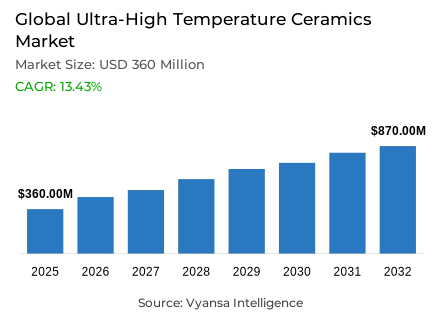
- Ultra-High Temperature Ceramics market size was valued at USD 360 million in 2025 and is estimated at USD 410 million in 2026.
- The market size is expected to grow to USD 870 million by 2032.
- Market to register a CAGR of around 13.43% during 2026-32.
- Material Type Shares
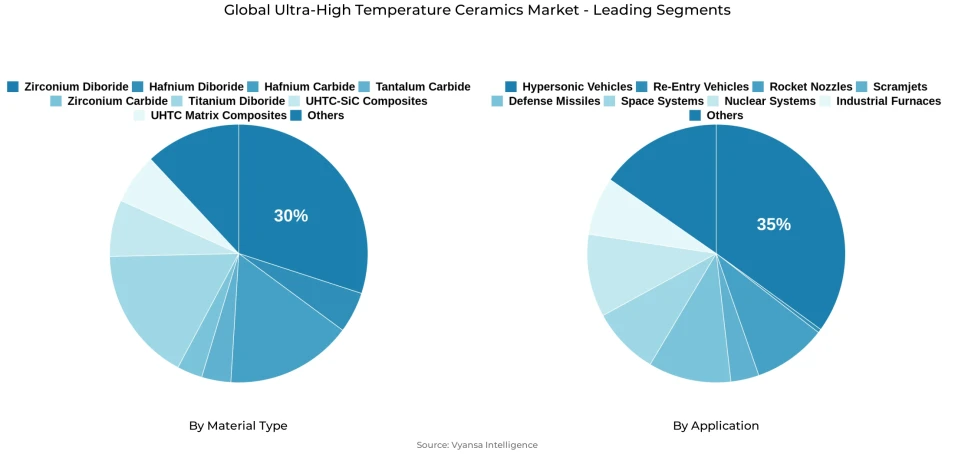
- Zirconium diboride grabbed market share of 30%.
- Competition
- More than 15 companies are actively engaged in producing ultra-high temperature ceramics.
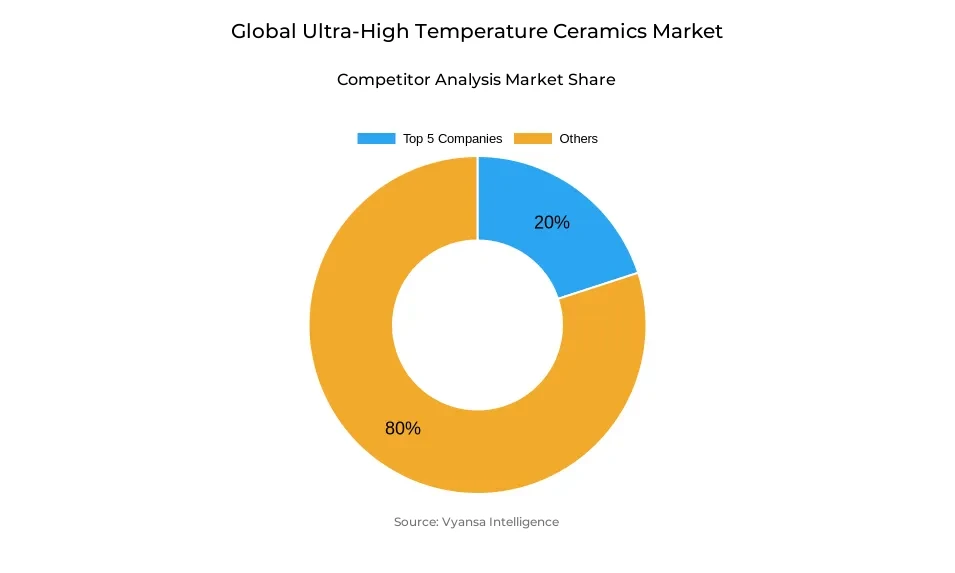
- Top 5 companies acquired around 20% of the market share.
- Elmet Technologies LLC (H.C. Starck Solutions), Momentive Technologies Inc., Höganäs AB, American Elements, Materion Corporation etc., are few of the top companies.
- Application
- Hypersonic vehicles grabbed 30% of the market.
- Region
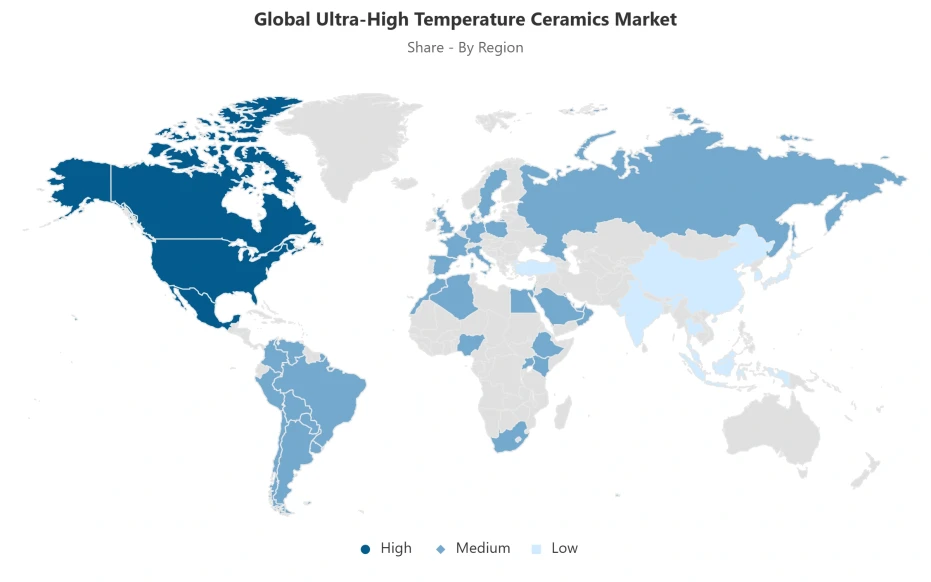
- North America leads with a 45% share of the global market.
Global Ultra-High Temperature Ceramics Market Outlook
The global ultra-high temperature ceramics (UHTCS) market is expanding as hypersonic, space, defense, and advanced propulsion programs require material systems that can retain strength, surface stability, and shape control under severe aerothermal exposure. The market size was valued at USD 360 million in 2025 and is projected to grow from USD 410 million in 2026 to USD 870 million by 2032, at a CAGR of 13.43% during the forecast period.
The ultra-high temperature ceramics market includes zirconium diboride, hafnium diboride, zirconium carbide, hafnium carbide, tantalum carbide, titanium diboride, and UHTC composites used in thermal protection systems, rocket nozzles, nose tips, propulsion components, and re-entry vehicle components.
Zirconium Diboride holds around 30% share under Material Type, based on the supplied market input. NASA technical evaluation supports its material relevance through ZrB2-SiC testing under oxidation, strength, fracture toughness, and high-velocity thermal shock conditions.
Hypersonic Vehicles hold around 35% share under Application, as high-speed flight systems require extreme temperature resistance, ablation resistance, thermal shock resistance, oxidation resistance, erosion resistance, and shape stability. North America leads with around 45% share, supported by NASA, DARPA, DoD, and AFRL-linked hypersonic material development.
Global Ultra-High Temperature Ceramics Market Growth Driver
Hypersonic Thermal Loads Intensify Material Need
Hypersonic material demand is driven by the operating environment of vehicles moving above Mach 5, where aerodynamic heating, oxidation exposure, shock-layer effects, and edge geometry retention create severe material requirements. NASA’s 2025 U.S. hypersonics update identifies “Reusable High-Temperature Material and Structural Technologies” as Research Task 4 under the Hypersonic Technology Project, covering airframe components, propulsion components, high-temperature seals, and ground-test techniques.
The product need is concentrated in nose tips, hypersonic leading edges, control surfaces, and propulsion-facing ceramics. These components must resist oxidation, ablation, and thermal shock while maintaining aerodynamic shape. NASA’s evaluation of ZrB2-SiC and reinforced zirconium diboride systems under strength, fracture toughness, oxidation, and high-velocity thermal shock exposure directly supports the use of ultra-high temperature ceramic materials in flight-relevant thermal protection systems.
Global Ultra-High Temperature Ceramics Market Challenge
Processing and Oxidation Barriers Slow Qualification
Processing remains a major qualification barrier because UHTCs are difficult to densify, machine, coat, and validate at component scale. NASA’s state-of-the-art assessment notes that bulk UHTCs are fabricated through hot pressing at 1,900 to 2,100°C and 60 to 100 MPa, while pure samples are extremely difficult to consolidate through conventional routes. This creates cost, repeatability, geometry, and scale-up constraints for advanced ceramic materials.
Oxidation control adds another limitation. NASA’s aeropropulsion evaluation states that poor oxidation resistance is the predominant factor limiting UHTC applicability in propulsion uses. Zirconium diboride, hafnium diboride, and carbide-based UHTCs may offer high-temperature capability, but flight hardware also requires additives, coatings, composite reinforcement, arc-jet testing, and thermal shock validation. Buyers therefore prioritize suppliers with repeatable densification, oxidation protection, machining precision, inspection capability, and flight-environment evidence.
Unlock Market Intelligence
Explore the market potential with our data-driven report
Global Ultra-High Temperature Ceramics Market Trend
Engineered Composite Architectures Advance Performance
Material development is moving from monolithic ceramics toward engineered UHTC composites that combine ceramic phases, reinforcement, coatings, and thermal-management design. DARPA’s MACH program targets material architectures for sharp, shape-stable, cooled leading edges for hypersonic vehicles, including scalable net-shape manufacturing, advanced thermal design, coatings, and future cooled leading-edge applications. This shifts the UHTCs market toward complete material-system durability.
The product direction favors zirconium diboride silicon carbide composites, hafnium diboride silicon carbide composites, carbide-boride systems, and coated ceramic matrix UHTC composites. These systems are designed to improve shape stability under heat flux, reduce surface recession, and improve repeatability during reusable exposure. AFRL’s Materials and Manufacturing Directorate also identifies high-performance ceramics through design, modeling, processing, and evaluation in extreme environments, reinforcing the defense-linked pathway for advanced ceramic manufacturing.
Global Ultra-High Temperature Ceramics Market Opportunity
Flight-Test Infrastructure Supports Component Validation
Flight-test and reusable high-speed vehicle programs move UHTC demand from laboratory samples toward flight-relevant hardware. NASA’s 2025 U.S. hypersonics update identifies the Multi-Service Advanced Capability Hypersonic Test Bed as a program supporting frequent and affordable hypersonic flight testing. This strengthens demand for coated panels, nose tips, hypersonic leading edges, propulsion-facing ceramics, and instrumentation-ready test articles that can generate validated thermal and structural data.
DoD budget continuity supports the same validation pathway. The FY2025 R-1 lists Joint Hypersonic Technology Development & Transition at USD 65.706 million for FY2024, USD 52.292 million for FY2025, and USD 51.941 million for FY2026. This funding line supports technology maturation rather than volume procurement, but it is relevant because UHTC qualification depends on repeated ground and flight testing before use in high-speed aerospace and defense systems.
Global Ultra-High Temperature Ceramics Market Regional Analysis
By Region
- North America
- South America
- Europe
- Middle East & Africa
- Asia Pacific
North America leads with around 45% share of the global ultra-high temperature ceramics (UHTCS)market, supported by NASA, DARPA, DoD, AFRL, national laboratories, aerospace primes, and hypersonic technology programs. NASA’s Hypersonic Technology Project focuses on reusable airbreathing hypersonic flight, while its 2025 update identifies high-temperature materials, material-environment interactions, ground and flight testing, and partnerships with industry, academia, and government agencies.
The region’s position is based on institutional depth and technical continuity. DARPA’s MACH program advances leading-edge material architectures, AFRL develops high-performance ceramics for extreme environments, and DoD’s Joint Hypersonic Technology Development & Transition line provides USD 65.706 million for FY2024, USD 52.292 million for FY2025, and USD 51.941 million for FY2026. This creates a connected pathway for UHTC materials, coatings, test articles, and aerospace and defense qualification.
Unlock Market Intelligence
Explore the market potential with our data-driven report
Global Ultra-High Temperature Ceramics Market Segmentation Analysis
By Material Type
- Zirconium Diboride
- Hafnium Diboride
- Hafnium Carbide
- Tantalum Carbide
- Tantalum Diboride
- Zirconium Carbide
- Titanium Diboride
- UHTC Composites
- Others
Zirconium Diboride holds the leading position under Material Type, accounting for around 30% of the market. Its leadership is supported by strong suitability for ultra-high-temperature structural environments where thermal stability, oxidation resistance, and mechanical strength are critical. A 2025 review highlights that ZrB₂-based ceramics are suitable for re-entry space vehicles, hypersonic vehicles, and propulsion systems due to their distinctive high-temperature performance characteristics.
The segment also benefits from its ability to serve as a base material for advanced composite development. The same review notes that monolithic ZrB₂ faces processing and oxidation limitations, but performance can be improved by adding carbides such as SiC and ZrC. This strengthens its relevance in demanding aerospace structures, where composite optimization is required for sharper geometries, higher heat exposure, stronger oxidation control, and improved durability under extreme operating conditions.
By Application
- Hypersonic Vehicle Leading Edges & Nose Tips
- Re-Entry Heat Shields & Thermal Tiles
- Rocket Nozzles & Throat Inserts
- Scramjet Combustors & Engine Liners
- Tactical Missile Nose Cones & Control Surfaces
- Nuclear Reactor Components
- Industrial Furnace Linings & Fixtures
- Plasma Arc & High-Temperature Wear Components
- Others
Hypersonic Vehicle Leading Edges and Nose Tips hold the leading position under Application, accounting for around 30% of the market. These components dominate demand because they experience direct aerodynamic heating, oxidation, ablation, and thermal shock during high-speed flight. NASA states that thermal protection systems are designed to protect spacecraft structures from extreme thermal environments during atmospheric entry, reinforcing the importance of advanced heat-resistant materials in such applications.
This application is further supported by UHTC composite research focused on high-temperature aerospace structures. A 2025 CEAS Space Journal article states that UHTC matrix composites are strong candidates for leading edges and inlet ramps in ramjets and scramjets, operating in oxidizing atmospheres at temperatures exceeding 1700°C. This directly supports their relevance in nose tips, sharp leading edges, inlet ramps, and propulsion-adjacent hot structures exposed to severe thermal and mechanical loads.
Market Players in Global Ultra-High Temperature Ceramics Market
These market players maintain a significant presence in the Global ultra-high temperature ceramics market and contribute to its ongoing evolution.
- Stanford Advanced Materials
- Edgetech Industries LLC
- ALB Materials Inc.
- American Elements
- Materion Corporation
- Goodfellow Cambridge Ltd.
- Treibacher Industrie AG
- Höganäs AB
- Micron Metals Inc.
- Precision Ceramics
- 3M Company
- Momentive Technologies Inc.
Market News & Updates
- Materion Corporation, 2026:
Materion lists aerospace materials for thermal protection applications, including borides, carbides, silicides, and nitrides. The portfolio includes hafnium carbide, hafnium boride, titanium boride, silicon carbide, zirconium boride, and related coating materials. The listing supports UHTC material supply for jet engine turbines, leading-edge surfaces, and aerospace thermal protection systems.
- American Elements, 2026:
American Elements lists zirconium diboride in multiple purity grades, including 99%, 99.5%, 99.9%, 99.95%, 99.99%, and 99.999% forms. The material is available in high-purity, submicron, and nanopowder formats and is linked to space, refractory ceramic, and ceramic applications. The listing supports commercial UHTC powder availability.
Frequently Asked Questions
Related Report
- Market Segmentation
- Research Scope
- Research Methodology
- Definitions and Assumptions
- Executive Summary
- Global Ultra-High Temperature Ceramics Market Policies, Regulations, and Standards
- Global Ultra-High Temperature Ceramics Market Dynamics
- Growth Factors
- Challenges
- Trends
- Opportunities
- Global Ultra-High Temperature Ceramics Market Statistics, 2022-2032F
- Market Size & Growth Outlook
- By Revenues in USD Million
- Market Segmentation & Growth Outlook
- By Material Type
- Zirconium Diboride- Market Insights and Forecast 2022-2032, USD Million
- Hafnium Diboride- Market Insights and Forecast 2022-2032, USD Million
- Hafnium Carbide- Market Insights and Forecast 2022-2032, USD Million
- Tantalum Carbide- Market Insights and Forecast 2022-2032, USD Million
- Tantalum Diboride- Market Insights and Forecast 2022-2032, USD Million
- Zirconium Carbide- Market Insights and Forecast 2022-2032, USD Million
- Titanium Diboride- Market Insights and Forecast 2022-2032, USD Million
- UHTC Composites- Market Insights and Forecast 2022-2032, USD Million
- Others- Market Insights and Forecast 2022-2032, USD Million
- By Product Form
- Powder- Market Insights and Forecast 2022-2032, USD Million
- Coatings- Market Insights and Forecast 2022-2032, USD Million
- Bulk Shapes- Market Insights and Forecast 2022-2032, USD Million
- Tiles- Market Insights and Forecast 2022-2032, USD Million
- Composite Parts- Market Insights and Forecast 2022-2032, USD Million
- Others- Market Insights and Forecast 2022-2032, USD Million
- By Application
- Hypersonic Vehicle Leading Edges & Nose Tips- Market Insights and Forecast 2022-2032, USD Million
- Re-Entry Heat Shields & Thermal Tiles- Market Insights and Forecast 2022-2032, USD Million
- Rocket Nozzles & Throat Inserts- Market Insights and Forecast 2022-2032, USD Million
- Scramjet Combustors & Engine Liners- Market Insights and Forecast 2022-2032, USD Million
- Tactical Missile Nose Cones & Control Surfaces- Market Insights and Forecast 2022-2032, USD Million
- Nuclear Reactor Components- Market Insights and Forecast 2022-2032, USD Million
- Industrial Furnace Linings & Fixtures- Market Insights and Forecast 2022-2032, USD Million
- Plasma Arc & High-Temperature Wear Components- Market Insights and Forecast 2022-2032, USD Million
- Others- Market Insights and Forecast 2022-2032, USD Million
- By Region
- North America
- South America
- Europe
- Middle East & Africa
- Asia Pacific
- By Competitors
- Competition Characteristics
- Market Share & Analysis
- By Material Type
- Market Size & Growth Outlook
- North America Ultra-High Temperature Ceramics Market Statistics, 2022-2032F
- Market Size & Growth Outlook
- By Revenues in USD Million
- Market Segmentation & Growth Outlook
- By Material Type- Market Insights and Forecast 2022-2032, USD Million
- By Product Form- Market Insights and Forecast 2022-2032, USD Million
- By Application- Market Insights and Forecast 2022-2032, USD Million
- By Country
- US
- Canada
- Mexico
- Rest of North America
- US Ultra-High Temperature Ceramics Market Statistics, 2022-2032F
- Market Size & Growth Outlook
- By Revenues in USD Million
- Market Segmentation & Growth Outlook
- By Material Type- Market Insights and Forecast 2022-2032, USD Million
- By Product Form- Market Insights and Forecast 2022-2032, USD Million
- By Application- Market Insights and Forecast 2022-2032, USD Million
- Market Size & Growth Outlook
- Canada Ultra-High Temperature Ceramics Market Statistics, 2022-2032F
- Market Size & Growth Outlook
- By Revenues in USD Million
- Market Segmentation & Growth Outlook
- By Material Type- Market Insights and Forecast 2022-2032, USD Million
- By Product Form- Market Insights and Forecast 2022-2032, USD Million
- By Application- Market Insights and Forecast 2022-2032, USD Million
- Market Size & Growth Outlook
- Mexico Ultra-High Temperature Ceramics Market Statistics, 2022-2032F
- Market Size & Growth Outlook
- By Revenues in USD Million
- Market Segmentation & Growth Outlook
- By Material Type- Market Insights and Forecast 2022-2032, USD Million
- By Product Form- Market Insights and Forecast 2022-2032, USD Million
- By Application- Market Insights and Forecast 2022-2032, USD Million
- Market Size & Growth Outlook
- Market Size & Growth Outlook
- South America Ultra-High Temperature Ceramics Market Statistics, 2022-2032F
- Market Size & Growth Outlook
- By Revenues in USD Million
- Market Segmentation & Growth Outlook
- By Material Type- Market Insights and Forecast 2022-2032, USD Million
- By Product Form- Market Insights and Forecast 2022-2032, USD Million
- By Application- Market Insights and Forecast 2022-2032, USD Million
- By Country
- Brazil
- Argentina
- Rest of South America
- Brazil Ultra-High Temperature Ceramics Market Statistics, 2022-2032F
- Market Size & Growth Outlook
- By Revenues in USD Million
- Market Segmentation & Growth Outlook
- By Material Type- Market Insights and Forecast 2022-2032, USD Million
- By Product Form- Market Insights and Forecast 2022-2032, USD Million
- By Application- Market Insights and Forecast 2022-2032, USD Million
- Market Size & Growth Outlook
- Argentina Ultra-High Temperature Ceramics Market Statistics, 2022-2032F
- Market Size & Growth Outlook
- By Revenues in USD Million
- Market Segmentation & Growth Outlook
- By Material Type- Market Insights and Forecast 2022-2032, USD Million
- By Product Form- Market Insights and Forecast 2022-2032, USD Million
- By Application- Market Insights and Forecast 2022-2032, USD Million
- Market Size & Growth Outlook
- Market Size & Growth Outlook
- Europe Ultra-High Temperature Ceramics Market Statistics, 2022-2032F
- Market Size & Growth Outlook
- By Revenues in USD Million
- Market Segmentation & Growth Outlook
- By Material Type- Market Insights and Forecast 2022-2032, USD Million
- By Product Form- Market Insights and Forecast 2022-2032, USD Million
- By Application- Market Insights and Forecast 2022-2032, USD Million
- By Country
- Germany
- UK
- France
- Spain
- Italy
- Poland
- Rest of Europe
- Germany Ultra-High Temperature Ceramics Market Statistics, 2022-2032F
- Market Size & Growth Outlook
- By Revenues in USD Million
- Market Segmentation & Growth Outlook
- By Material Type- Market Insights and Forecast 2022-2032, USD Million
- By Product Form- Market Insights and Forecast 2022-2032, USD Million
- By Application- Market Insights and Forecast 2022-2032, USD Million
- Market Size & Growth Outlook
- UK Ultra-High Temperature Ceramics Market Statistics, 2022-2032F
- Market Size & Growth Outlook
- By Revenues in USD Million
- Market Segmentation & Growth Outlook
- By Material Type- Market Insights and Forecast 2022-2032, USD Million
- By Product Form- Market Insights and Forecast 2022-2032, USD Million
- By Application- Market Insights and Forecast 2022-2032, USD Million
- Market Size & Growth Outlook
- France Ultra-High Temperature Ceramics Market Statistics, 2022-2032F
- Market Size & Growth Outlook
- By Revenues in USD Million
- Market Segmentation & Growth Outlook
- By Material Type- Market Insights and Forecast 2022-2032, USD Million
- By Product Form- Market Insights and Forecast 2022-2032, USD Million
- By Application- Market Insights and Forecast 2022-2032, USD Million
- Market Size & Growth Outlook
- Spain Ultra-High Temperature Ceramics Market Statistics, 2022-2032F
- Market Size & Growth Outlook
- By Revenues in USD Million
- Market Segmentation & Growth Outlook
- By Material Type- Market Insights and Forecast 2022-2032, USD Million
- By Product Form- Market Insights and Forecast 2022-2032, USD Million
- By Application- Market Insights and Forecast 2022-2032, USD Million
- Market Size & Growth Outlook
- Italy Ultra-High Temperature Ceramics Market Statistics, 2022-2032F
- Market Size & Growth Outlook
- By Revenues in USD Million
- Market Segmentation & Growth Outlook
- By Material Type- Market Insights and Forecast 2022-2032, USD Million
- By Product Form- Market Insights and Forecast 2022-2032, USD Million
- By Application- Market Insights and Forecast 2022-2032, USD Million
- Market Size & Growth Outlook
- Poland Ultra-High Temperature Ceramics Market Statistics, 2022-2032F
- Market Size & Growth Outlook
- By Revenues in USD Million
- Market Segmentation & Growth Outlook
- By Material Type- Market Insights and Forecast 2022-2032, USD Million
- By Product Form- Market Insights and Forecast 2022-2032, USD Million
- By Application- Market Insights and Forecast 2022-2032, USD Million
- Market Size & Growth Outlook
- Market Size & Growth Outlook
- Middle East & Africa Ultra-High Temperature Ceramics Market Statistics, 2022-2032F
- Market Size & Growth Outlook
- By Revenues in USD Million
- Market Segmentation & Growth Outlook
- By Material Type- Market Insights and Forecast 2022-2032, USD Million
- By Product Form- Market Insights and Forecast 2022-2032, USD Million
- By Application- Market Insights and Forecast 2022-2032, USD Million
- By Country
- Saudi Arabia
- UAE
- Egypt
- Nigeria
- South Africa
- Rest of Middle East & Africa
- Saudi Arabia Ultra-High Temperature Ceramics Market Statistics, 2022-2032F
- Market Size & Growth Outlook
- By Revenues in USD Million
- Market Segmentation & Growth Outlook
- By Material Type- Market Insights and Forecast 2022-2032, USD Million
- By Product Form- Market Insights and Forecast 2022-2032, USD Million
- By Application- Market Insights and Forecast 2022-2032, USD Million
- Market Size & Growth Outlook
- UAE Ultra-High Temperature Ceramics Market Statistics, 2022-2032F
- Market Size & Growth Outlook
- By Revenues in USD Million
- Market Segmentation & Growth Outlook
- By Material Type- Market Insights and Forecast 2022-2032, USD Million
- By Product Form- Market Insights and Forecast 2022-2032, USD Million
- By Application- Market Insights and Forecast 2022-2032, USD Million
- Market Size & Growth Outlook
- Egypt Ultra-High Temperature Ceramics Market Statistics, 2022-2032F
- Market Size & Growth Outlook
- By Revenues in USD Million
- Market Segmentation & Growth Outlook
- By Material Type- Market Insights and Forecast 2022-2032, USD Million
- By Product Form- Market Insights and Forecast 2022-2032, USD Million
- By Application- Market Insights and Forecast 2022-2032, USD Million
- Market Size & Growth Outlook
- Nigeria Ultra-High Temperature Ceramics Market Statistics, 2022-2032F
- Market Size & Growth Outlook
- By Revenues in USD Million
- Market Segmentation & Growth Outlook
- By Material Type- Market Insights and Forecast 2022-2032, USD Million
- By Product Form- Market Insights and Forecast 2022-2032, USD Million
- By Application- Market Insights and Forecast 2022-2032, USD Million
- Market Size & Growth Outlook
- South Africa Ultra-High Temperature Ceramics Market Statistics, 2022-2032F
- Market Size & Growth Outlook
- By Revenues in USD Million
- Market Segmentation & Growth Outlook
- By Material Type- Market Insights and Forecast 2022-2032, USD Million
- By Product Form- Market Insights and Forecast 2022-2032, USD Million
- By Application- Market Insights and Forecast 2022-2032, USD Million
- Market Size & Growth Outlook
- Market Size & Growth Outlook
- Asia Pacific Ultra-High Temperature Ceramics Market Statistics, 2022-2032F
- Market Size & Growth Outlook
- By Revenues in USD Million
- Market Segmentation & Growth Outlook
- By Material Type- Market Insights and Forecast 2022-2032, USD Million
- By Product Form- Market Insights and Forecast 2022-2032, USD Million
- By Application- Market Insights and Forecast 2022-2032, USD Million
- By Country
- China
- India
- Japan
- South Korea
- Australia
- Indonesia
- Rest of Asia Pacific
- China Ultra-High Temperature Ceramics Market Statistics, 2022-2032F
- Market Size & Growth Outlook
- By Revenues in USD Million
- Market Segmentation & Growth Outlook
- By Material Type- Market Insights and Forecast 2022-2032, USD Million
- By Product Form- Market Insights and Forecast 2022-2032, USD Million
- By Application- Market Insights and Forecast 2022-2032, USD Million
- Market Size & Growth Outlook
- India Ultra-High Temperature Ceramics Market Statistics, 2022-2032F
- Market Size & Growth Outlook
- By Revenues in USD Million
- Market Segmentation & Growth Outlook
- By Material Type- Market Insights and Forecast 2022-2032, USD Million
- By Product Form- Market Insights and Forecast 2022-2032, USD Million
- By Application- Market Insights and Forecast 2022-2032, USD Million
- Market Size & Growth Outlook
- Japan Ultra-High Temperature Ceramics Market Statistics, 2022-2032F
- Market Size & Growth Outlook
- By Revenues in USD Million
- Market Segmentation & Growth Outlook
- By Material Type- Market Insights and Forecast 2022-2032, USD Million
- By Product Form- Market Insights and Forecast 2022-2032, USD Million
- By Application- Market Insights and Forecast 2022-2032, USD Million
- Market Size & Growth Outlook
- South Korea Ultra-High Temperature Ceramics Market Statistics, 2022-2032F
- Market Size & Growth Outlook
- By Revenues in USD Million
- Market Segmentation & Growth Outlook
- By Material Type- Market Insights and Forecast 2022-2032, USD Million
- By Product Form- Market Insights and Forecast 2022-2032, USD Million
- By Application- Market Insights and Forecast 2022-2032, USD Million
- Market Size & Growth Outlook
- Australia Ultra-High Temperature Ceramics Market Statistics, 2022-2032F
- Market Size & Growth Outlook
- By Revenues in USD Million
- Market Segmentation & Growth Outlook
- By Material Type- Market Insights and Forecast 2022-2032, USD Million
- By Product Form- Market Insights and Forecast 2022-2032, USD Million
- By Application- Market Insights and Forecast 2022-2032, USD Million
- Market Size & Growth Outlook
- Indonesia Ultra-High Temperature Ceramics Market Statistics, 2022-2032F
- Market Size & Growth Outlook
- By Revenues in USD Million
- Market Segmentation & Growth Outlook
- By Material Type- Market Insights and Forecast 2022-2032, USD Million
- By Product Form- Market Insights and Forecast 2022-2032, USD Million
- By Application- Market Insights and Forecast 2022-2032, USD Million
- Market Size & Growth Outlook
- Market Size & Growth Outlook
- Competitive Outlook
- Company Profiles
- American Elements
- Business Description
- Product Portfolio
- Collaborations & Alliances
- Recent Developments
- Financial Details
- Others
- Materion Corporation
- Business Description
- Product Portfolio
- Collaborations & Alliances
- Recent Developments
- Financial Details
- Others
- Goodfellow Cambridge Ltd.
- Business Description
- Product Portfolio
- Collaborations & Alliances
- Recent Developments
- Financial Details
- Others
- Treibacher Industrie AG
- Business Description
- Product Portfolio
- Collaborations & Alliances
- Recent Developments
- Financial Details
- Others
- Höganäs AB
- Business Description
- Product Portfolio
- Collaborations & Alliances
- Recent Developments
- Financial Details
- Others
- Stanford Advanced Materials
- Business Description
- Product Portfolio
- Collaborations & Alliances
- Recent Developments
- Financial Details
- Others
- Edgetech Industries LLC
- Business Description
- Product Portfolio
- Collaborations & Alliances
- Recent Developments
- Financial Details
- Others
- ALB Materials Inc.
- Business Description
- Product Portfolio
- Collaborations & Alliances
- Recent Developments
- Financial Details
- Others
- Micron Metals Inc.
- Business Description
- Product Portfolio
- Collaborations & Alliances
- Recent Developments
- Financial Details
- Others
- Precision Ceramics
- Business Description
- Product Portfolio
- Collaborations & Alliances
- Recent Developments
- Financial Details
- Others
- 3M Company
- Business Description
- Product Portfolio
- Collaborations & Alliances
- Recent Developments
- Financial Details
- Others
- Momentive Technologies Inc.
- Business Description
- Product Portfolio
- Collaborations & Alliances
- Recent Developments
- Financial Details
- Others
- Company 13
- Business Description
- Product Portfolio
- Collaborations & Alliances
- Recent Developments
- Financial Details
- Others
- Company 14
- Business Description
- Product Portfolio
- Collaborations & Alliances
- Recent Developments
- Financial Details
- Others
- Company 15
- Business Description
- Product Portfolio
- Collaborations & Alliances
- Recent Developments
- Financial Details
- Others
- American Elements
- Company Profiles
- Disclaimer
| Segment | Sub-Segment |
|---|---|
| By Material Type |
|
| By Product Form |
|
| By Application |
|
| By Region |
|
Research Methodology
This study followed a structured approach comprising four key phases to assess the size and scope of the electro-oxidation market. The process began with thorough secondary research to collect data on the target market, related markets, and broader industry context. These findings, along with preliminary assumptions and estimates, were then validated through extensive primary research involving industry experts from across the value chain. To calculate the overall market size, both top-down and bottom-up methodologies were employed. Finally, market segmentation and data triangulation techniques were applied to refine and validate segment-level estimations.
Secondary Research
The secondary research phase involved gathering data from a wide range of credible and published sources. This step helped in identifying industry trends, defining market segmentation, and understanding the market landscape and value chain.
Sources consulted during this phase included:
- Company annual reports, investor presentations, and press releases
- Industry white papers and certified publications
- Trade directories and market-recognized databases
- Articles from authoritative authors and reputable journals
- Gold and silver standard websites
Secondary research was critical in mapping out the industry's value chain and monetary flow, identifying key market segments, understanding regional variations, and tracking significant industry developments.
Other key sources:
- Financial disclosures
- Industry associations and trade bodies
- News outlets and business magazines
- Academic journals and research studies
- Paid industry databases
Primary Research
To validate secondary data and gain deeper market insights, primary research was conducted with key stakeholders across both the supply and demand sides of the market.
On the demand side, participants included decision-makers and influencers from end-user industries—such as CIOs, CTOs, and CSOs—who provided first-hand perspectives on market needs, product usage, and future expectations.
On the supply side, interviews were conducted with manufacturers, industry associations, and institutional participants to gather insights into current offerings, product pipelines, and market challenges.
Primary interviews provided critical inputs such as:
- Market size and revenue data
- Product and service breakdowns
- Market forecasts
- Regional and application-specific trends
Stakeholders consulted included:
- Leading OEM and solution providers
- Channel and distribution partners
- End users across various applications
- Independent consultants and industry specialists
Market Size Estimation and Data Triangulation
- Identifying Key Market Participants (Secondary Research)
- Goal: To identify the major players or companies in the target market. This typically involves using publicly available data sources such as industry reports, market research publications, and financial statements of companies.
- Tools: Reports from firms like Gartner, Forrester, Euromonitor, Statista, IBISWorld, and others. Public financial statements, news articles, and press releases from top market players.
- Extracting Earnings of Key Market Participants
- Goal: To estimate the earnings generated from the product or service being analyzed. This step helps in understanding the revenue potential of each market player in a specific geography.
- Methods: Earnings data can be gathered from:
- Publicly available financial reports (for listed companies).
- Interviews and primary data sources from professionals, such as Directors, VPs, SVPs, etc. This is especially useful for understanding more nuanced, internal data that isn't publicly disclosed.
- Annual reports and investor presentations of key players.
- Data Collation and Development of a Relevant Data Model
- Goal: To collate inputs from both primary and secondary sources into a structured, data-driven model for market estimation. This model will incorporate key market KPIs and any independent variables relevant to the market.
- Key KPIs: These could include:
- Market size, growth rate, and demand drivers.
- Industry-specific metrics like market share, average revenue per customer (ARPC), or average deal size.
- External variables, such as economic growth rates, inflation rates, or commodity prices, that could affect the market.
- Data Modeling: Based on this data, the market forecasts are developed for the next 5 years. A combination of trend analysis, scenario modeling, and statistical regression might be used to generate projections.
- Scenario Analysis
- Goal: To test different assumptions and validate how sensitive the market is to changes in key variables (e.g., market demand, regulatory changes, technological disruptions).
- Types of Scenarios:
- Base Case: Based on current assumptions and historical data.
- Best-Case Scenario: Assuming favorable market conditions, regulatory environments, and technological advancements.
- Worst-Case Scenario: Accounting for adverse factors, such as economic downturns, stricter regulations, or unexpected disruptions.












