Turkey Bottled Water Market Report: Trends, Growth and Forecast (2026-2032)
By Type of Water (Carbonated Bottled Water, Flavoured Bottled Water, Functional Bottled Water, Still Bottled Water), By Sub Types (Purified (Desalinated, Atmospheric Generated, Others), Mineral, Other (Spring, Alkaline, Other)), By Packaging Material (Flexible Packaging (Aluminium, Pouches), Glass, Rigid Plastic (PET Bottles, Thin Wall Plastic Containers, Others)), By Price Category (Budget, Economy, Premium), By Pack Size (100 ml, 125 ml, 200 ml, 250 ml, 330 ml, 370 ml, 450 ml, 500 ml, 591 ml, 750 ml, 1,000 ml, 1,500 ml, 4,000 ml, 5,000 ml, Others), By Sales Channel (On Trade (Restaurants, Hotels, Cafes, Others), Off Trade (Grocery Retailers (Convenience Retail, Supermarkets, Hypermarkets, Small Local Grocer), Non-Grocery Retailers (General Merchandise Stores, Health and Beauty Specialists), Vending, E-commerce)) ... Read more
|
Major Players
|
Turkey Bottled Water Market Statistics and Insights, 2026
- Market Size Statistics
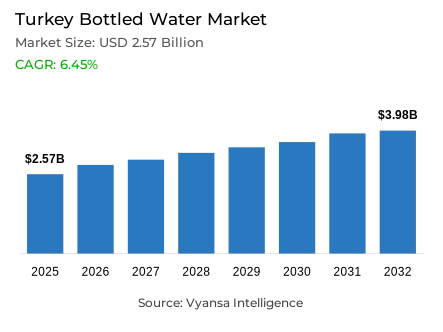
- Bottled water market size in Turkey was estimated at USD 2.57 billion in 2025.
- The market size is expected to grow to USD 3.98 billion by 2032.
- Market to register a CAGR of around 6.45% during 2026-32.
- Type of Water Shares
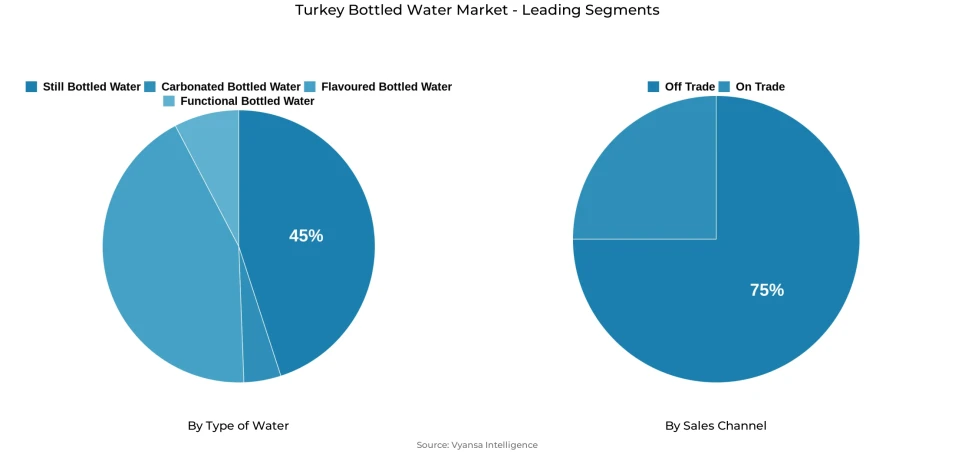
- Still bottled water grabbed market share of 45%.
- Competition
- More than 20 companies are actively engaged in producing bottled water in Turkey.
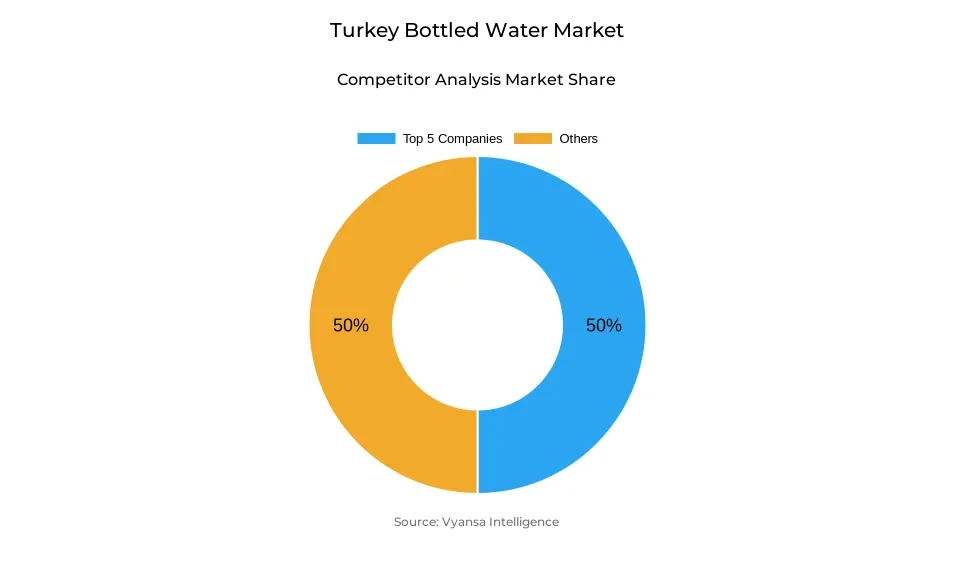
- Top 5 companies acquired around 50% of the market share.
- Kizilay Maden Sulari AS, Danone Tikvesli Gida ve Icecek San ve Tic AS, Cakirmelikoglu Madensuyu Isletmesi Sanayi Ticaret AS, Sirmagrup Icecek San ve Tic AS, Erbak-Uludag Mesrubatlari AS etc., are few of the top companies.
- Sales Channel
- Off trade grabbed 75% of the market.
Turkey Bottled Water Market Outlook
Turkey’s bottled water market outlook for 2026-2032 remains steady, supported by strong urban consumption patterns. The World Bank confirms that 78% of Turkey’s population lives in urban areas as of 2024, reinforcing structured retail access and routine packaged beverage purchases. With Turkey’s population reaching 85.7 million in 2024 as stated by TurkStat, demand remains supported by dense metropolitan consumption clusters. Bottled water in Turkey was estimated at USD 2.57 billion in 2025 and is estimated to reach USD 3.98 billion by 2032, registering a CAGR of around 6.45% during 2026-2032.
Structurally, the overall availability of safe drinking water will reduce the demand that is based on safety issues. The latest update of the WHO/UNICEF Joint Monitoring Programme states that 100% of the population in Turkey has access to at least basic drinking water services, and the World Bank states that the coverage of urban municipal water supply is over 99%. This vast infrastructure minimizes the use of bottled water due to safety concerns especially by the low-income families.
Consumer behavior is being transformed by digital retail e-commerce. According to Turkish Statistical Institute (TurkStat), in 2024, 51.7% of people aged 16-74 years old purchased online, and the internet penetration was 88.8%. This growth reinforces online grocery platforms, increasing visibility, subscriptions, and home delivery of bottled water brands.
Still bottled water has a market share of 45% in terms of market segments, which has been maintained by the habitual hydration habits and high volume household consumption. In terms of sales channels, the off-trade market is the most dominant with a share of 75%; this is supported by the supermarkets, hypermarkets, discount chains, and the growing digital grocery platforms across the urban regions of Turkey.
Turkey Bottled Water Market Growth DriverRising Health Awareness Drives Consumption Patterns
The growing health awareness in Turkey is a major demand force. The urban population of Turkey was estimated to be 78% of the total population in 2024, according to the World Bank , which strengthens the organized access to retail and consumption of packaged drinks. At the same time, the WHO Global Health Observatory highlights an increasing policy focus on the need to decrease sugar consumption and encourage healthier beverage options, thus affecting consumer behavior towards calorie-free hydration sources. This climate maintains a greater inclination towards bottled water as compared to sugary soft drinks.
The growing population of Turkey, which is documented at 85.7 million in 2024 according to Turkish Statistical Institute, also contributes to the steady demand of packaged water, especially in the urban areas where convenience buying is the leading factor. The increased focus on mineral content, natural sourcing, and clean-label beverages reinforce the position of bottled water as a daily essential that is consistent with wellness-oriented lifestyles.
Turkey Bottled Water Market ChallengeHigh Safe Tap Water Access Limits Incremental Demand
The availability of safe drinking water is a structural challenge. According to the WHO/UNICEF Joint Monitoring Programme , 100% of the population in Turkey has access to at least basic drinking-water services. Having a wide coverage of infrastructure, end users are now more dependent on better municipal water systems, thus reducing the reliance on packaged water due to safety reasons.
The coverage of municipal water supply in urban regions in Turkey is over 99% , as stated by World Bank, 2024, which strengthens the trust of households in treated tap water. With the increased availability of domestic water-purification systems, the dependence on bulk still-bottled water is moderated, limiting the growth of volume in larger pack sizes, especially within households with low incomes that focus on long-term affordability.
Unlock Market Intelligence
Explore the market potential with our data-driven report
Turkey Bottled Water Market TrendRapid Digital Retail Expansion Reshapes Purchasing Behavior
The growth of online trade is transforming the buying behaviour of beverages. Digital adoption is high, with 51.7% of people aged 16-74 years buying goods or services online in 2024 , backed by TurkStat. This helps in the increase of online grocery penetration, such as packaged beverages, as end users are becoming more concerned with convenience and home delivery.
In 2024, the internet penetration in Turkey was 88.8% according to Turkish Statistical Institute, which allows retailers investing in logistics and digital platforms to reach a wider audience. The growing digital retail platform allows bottled water brands to increase visibility, provide subscription-based buying, and increase last-mile delivery, thus changing the way end users obtain packaged hydration products in urban households.
Turkey Bottled Water Market OpportunityUrbanization and Climate Conditions Create Sustained Demand Base
Since the urban population of Turkey is more, it forms high-density consumption areas where convenience drinks have steady demand. City living, long commuting times, and systematic retail growth favor consistent packaged water buying habits.
Also, according to the Turkish State Meteorological Service , 2024 is one of the hottest years in Turkey, which supports increased per-capita fluid consumption. Extended summer temperatures in the central and southern parts of the country support the daily hydration requirements. Turkish Statistical Institute stated that these structural factors, when combined with a population of 85.7 million , offer a continuing opportunity to packaged water suppliers to consolidate distribution networks in high-density urban areas.
Unlock Market Intelligence
Explore the market potential with our data-driven report
Turkey Bottled Water Market Segmentation Analysis
By Type of Water
- Carbonated Bottled Water
- Flavoured Bottled Water
- Functional Bottled Water
- Still Bottled Water
The segment has the highest share around segment under the product type is still bottled water, accounting for 45% share. Still water maintains leadership due to its widespread daily consumption across households, workplaces, and foodservice channels. Its neutral taste profile and suitability for bulk packaging make it a staple hydration option across urban and semi-urban areas.
Carbonated and flavored variants continue to diversify consumer choice; however, still bottled water remains the core volume contributor due to its affordability, routine usage patterns, and alignment with everyday hydration habits. Its strong presence across retail formats further reinforces its dominant position within the product segmentation.
By Sales Channel
- On Trade
- Restaurants
- Hotels
- Cafes
- Others
- Off Trade
- Grocery Retailers
- Convenience Retail
- Supermarkets
- Hypermarkets
- Small Local Grocer
- Non-Grocery Retailers
- General Merchandise Stores
- Health and Beauty Specialists
- Vending
- E-commerce
- Grocery Retailers
The segment has the highest share around segment under the sales channel is off-Trade, accounting for 75% share. Off-trade dominates due to the strong presence of supermarkets, hypermarkets, and discount chains across Turkey’s urban centers. High household stocking behavior and multipack purchases reinforce this channel’s leadership.
Organized retail expansion and growing digital grocery adoption further strengthen off-trade distribution. End user increasingly purchase bottled water during routine grocery trips or via online retail platforms, making this channel structurally stronger compared to on-trade consumption patterns.
List of Companies Covered in Turkey Bottled Water Market
The companies listed below are highly influential in the Turkey bottled water market, with a significant market share and a strong impact on industry developments.
- Kizilay Maden Sulari AS
- Danone Tikvesli Gida ve Icecek San ve Tic AS
- Cakirmelikoglu Madensuyu Isletmesi Sanayi Ticaret AS
- Sirmagrup Icecek San ve Tic AS
- Erbak-Uludag Mesrubatlari AS
- Nestle Waters Gida ve Mesrubat San Tic AS
- Beypazari Karakoca Dogal Mineralli Su Isletmesi Ltd Sti
- Suayp Demirel Ith Ihr Taah ve Tic
- Coca-Cola Icecek AS
- Pinar Sut Mamulleri San ve Tic AS
Competitive Landscape
In 2025, Sırma Grup Icecek San ve Tic AS remained the leading company in Turkey’s bottled water market, supported by its diversified Sırma brand portfolio spanning carbonated, flavoured, functional, and still mineral water. Its strong distribution network and nationwide presence reinforced its leadership, although the company experienced a slight decline in share, partly due to boycotts affecting international brands. The market remained highly fragmented, with many small local players competing aggressively. Domestic producers and private label brands gained ground, benefiting from lower prices and the expanding reach of discount retailers such as BIM and A101, which strengthened private label visibility and sales.
Frequently Asked Questions
Related Report
- Market Segmentation
- Research Scope
- Research Methodology
- Definitions and Assumptions
- Executive Summary
- Turkey Bottled Water Market Policies, Regulations, and Standards
- Turkey Bottled Water Market Dynamics
- Growth Factors
- Challenges
- Trends
- Opportunities
- Turkey Bottled Water Market Statistics, 2022-2032F
- Market Size & Growth Outlook
- By Revenues in USD Million
- By Volume (Million Litres)
- Market Segmentation & Growth Outlook
- By Type of Water
- Carbonated Bottled Water- Market Insights and Forecast 2022-2032, USD Million
- Flavoured Bottled Water- Market Insights and Forecast 2022-2032, USD Million
- Functional Bottled Water- Market Insights and Forecast 2022-2032, USD Million
- Still Bottled Water- Market Insights and Forecast 2022-2032, USD Million
- By Sub Types
- Purified- Market Insights and Forecast 2022-2032, USD Million
- Desalinated- Market Insights and Forecast 2022-2032, USD Million
- Atmospheric Generated- Market Insights and Forecast 2022-2032, USD Million
- Others- Market Insights and Forecast 2022-2032, USD Million
- Mineral- Market Insights and Forecast 2022-2032, USD Million
- Other (Spring, Alkaline, Other) - Market Insights and Forecast 2022-2032, USD Million
- Purified- Market Insights and Forecast 2022-2032, USD Million
- By Packaging Material
- Flexible Packaging- Market Insights and Forecast 2022-2032, USD Million
- Aluminium- Market Insights and Forecast 2022-2032, USD Million
- Pouches- Market Insights and Forecast 2022-2032, USD Million
- Glass- Market Insights and Forecast 2022-2032, USD Million
- Rigid Plastic- Market Insights and Forecast 2022-2032, USD Million
- PET Bottles- Market Insights and Forecast 2022-2032, USD Million
- Thin Wall Plastic Containers- Market Insights and Forecast 2022-2032, USD Million
- Others- Market Insights and Forecast 2022-2032, USD Million
- Flexible Packaging- Market Insights and Forecast 2022-2032, USD Million
- By Price Category
- Budget- Market Insights and Forecast 2022-2032, USD Million
- Economy- Market Insights and Forecast 2022-2032, USD Million
- Premium- Market Insights and Forecast 2022-2032, USD Million
- By Pack Size
- 100 ml- Market Insights and Forecast 2022-2032, USD Million
- 125 ml- Market Insights and Forecast 2022-2032, USD Million
- 200 ml- Market Insights and Forecast 2022-2032, USD Million
- 250 ml- Market Insights and Forecast 2022-2032, USD Million
- 330 ml- Market Insights and Forecast 2022-2032, USD Million
- 370 ml- Market Insights and Forecast 2022-2032, USD Million
- 450 ml- Market Insights and Forecast 2022-2032, USD Million
- 500 ml- Market Insights and Forecast 2022-2032, USD Million
- 591 ml- Market Insights and Forecast 2022-2032, USD Million
- 750 ml- Market Insights and Forecast 2022-2032, USD Million
- 1,000 ml- Market Insights and Forecast 2022-2032, USD Million
- 1,500 ml- Market Insights and Forecast 2022-2032, USD Million
- 4,000 ml- Market Insights and Forecast 2022-2032, USD Million
- 5,000 ml- Market Insights and Forecast 2022-2032, USD Million
- Others- Market Insights and Forecast 2022-2032, USD Million
- By Sales Channel
- On Trade- Market Insights and Forecast 2022-2032, USD Million
- Restaurants- Market Insights and Forecast 2022-2032, USD Million
- Hotels- Market Insights and Forecast 2022-2032, USD Million
- Cafes- Market Insights and Forecast 2022-2032, USD Million
- Others- Market Insights and Forecast 2022-2032, USD Million
- Off Trade- Market Insights and Forecast 2022-2032, USD Million
- Grocery Retailers- Market Insights and Forecast 2022-2032, USD Million
- Convenience Retail- Market Insights and Forecast 2022-2032, USD Million
- Supermarkets- Market Insights and Forecast 2022-2032, USD Million
- Hypermarkets- Market Insights and Forecast 2022-2032, USD Million
- Small Local Grocer- Market Insights and Forecast 2022-2032, USD Million
- Non-Grocery Retailers- Market Insights and Forecast 2022-2032, USD Million
- General Merchandise Stores- Market Insights and Forecast 2022-2032, USD Million
- Health and Beauty Specialists- Market Insights and Forecast 2022-2032, USD Million
- Vending- Market Insights and Forecast 2022-2032, USD Million
- E-commerce- Market Insights and Forecast 2022-2032, USD Million
- Grocery Retailers- Market Insights and Forecast 2022-2032, USD Million
- On Trade- Market Insights and Forecast 2022-2032, USD Million
- By Competitors
- Competition Characteristics
- Market Share & Analysis
- By Type of Water
- Market Size & Growth Outlook
- Turkey Carbonated Bottled Water Market Statistics, 2022-2032
- Market Size & Growth Outlook
- By Revenues in USD Million
- By Volume (Million Litres)
- Market Segmentation & Growth Outlook
- By Sub Types- Market Insights and Forecast 2022-2032, USD Million
- By Packaging Material- Market Insights and Forecast 2022-2032, USD Million
- By Pack Size- Market Insights and Forecast 2022-2032, USD Million
- By Price Category- Market Insights and Forecast 2022-2032, USD Million
- By Sales Channel- Market Insights and Forecast 2022-2032, USD Million
- Market Size & Growth Outlook
- Turkey Flavoured Bottled Water Market Statistics, 2022-2032
- Market Size & Growth Outlook
- By Revenues in USD Million
- By Volume (Million Litres)
- Market Segmentation & Growth Outlook
- By Sub Types- Market Insights and Forecast 2022-2032, USD Million
- By Packaging Material- Market Insights and Forecast 2022-2032, USD Million
- By Pack Size- Market Insights and Forecast 2022-2032, USD Million
- By Price Category- Market Insights and Forecast 2022-2032, USD Million
- By Sales Channel- Market Insights and Forecast 2022-2032, USD Million
- Market Size & Growth Outlook
- Turkey Functional Bottled Water Market Statistics, 2022-2032
- Market Size & Growth Outlook
- By Revenues in USD Million
- By Volume (Million Litres)
- Market Segmentation & Growth Outlook
- By Sub Types- Market Insights and Forecast 2022-2032, USD Million
- By Packaging Material- Market Insights and Forecast 2022-2032, USD Million
- By Pack Size- Market Insights and Forecast 2022-2032, USD Million
- By Price Category- Market Insights and Forecast 2022-2032, USD Million
- By Sales Channel- Market Insights and Forecast 2022-2032, USD Million
- Market Size & Growth Outlook
- Turkey Still Bottled Water Market Statistics, 2022-2032
- Market Size & Growth Outlook
- By Revenues in USD Million
- By Volume (Million Litres)
- Market Segmentation & Growth Outlook
- By Sub Types- Market Insights and Forecast 2022-2032, USD Million
- By Packaging Material- Market Insights and Forecast 2022-2032, USD Million
- By Pack Size- Market Insights and Forecast 2022-2032, USD Million
- By Price Category- Market Insights and Forecast 2022-2032, USD Million
- By Sales Channel- Market Insights and Forecast 2022-2032, USD Million
- Market Size & Growth Outlook
- Competitive Outlook
- Company Profiles
- Sirmagrup Icecek San ve Tic AS
- Business Description
- Product Portfolio
- Collaborations & Alliances
- Recent Developments
- Financial Details
- Others
- Erbak-Uludag Mesrubatlari AS
- Business Description
- Product Portfolio
- Collaborations & Alliances
- Recent Developments
- Financial Details
- Others
- Nestle Waters Gida ve Mesrubat San Tic AS
- Business Description
- Product Portfolio
- Collaborations & Alliances
- Recent Developments
- Financial Details
- Others
- Beypazari Karakoca Dogal Mineralli Su Isletmesi Ltd Sti
- Business Description
- Product Portfolio
- Collaborations & Alliances
- Recent Developments
- Financial Details
- Others
- Suayp Demirel Ith Ihr Taah ve Tic
- Business Description
- Product Portfolio
- Collaborations & Alliances
- Recent Developments
- Financial Details
- Others
- Kizilay Maden Sulari AS
- Business Description
- Product Portfolio
- Collaborations & Alliances
- Recent Developments
- Financial Details
- Others
- Danone Tikvesli Gida ve Icecek San ve Tic AS
- Business Description
- Product Portfolio
- Collaborations & Alliances
- Recent Developments
- Financial Details
- Others
- Cakirmelikoglu Madensuyu Isletmesi Sanayi Ticaret AS
- Business Description
- Product Portfolio
- Collaborations & Alliances
- Recent Developments
- Financial Details
- Others
- Coca-Cola Icecek AS
- Business Description
- Product Portfolio
- Collaborations & Alliances
- Recent Developments
- Financial Details
- Others
- Pinar Süt Mamulleri San ve Tic AS
- Business Description
- Product Portfolio
- Collaborations & Alliances
- Recent Developments
- Financial Details
- Others
- Sirmagrup Icecek San ve Tic AS
- Company Profiles
- Disclaimer
| Segment | Sub-Segment |
|---|---|
| By Type of Water |
|
| By Sub Types |
|
| By Packaging Material |
|
| By Price Category |
|
| By Pack Size |
|
| By Sales Channel |
|
Research Methodology
This study followed a structured approach comprising four key phases to assess the size and scope of the electro-oxidation market. The process began with thorough secondary research to collect data on the target market, related markets, and broader industry context. These findings, along with preliminary assumptions and estimates, were then validated through extensive primary research involving industry experts from across the value chain. To calculate the overall market size, both top-down and bottom-up methodologies were employed. Finally, market segmentation and data triangulation techniques were applied to refine and validate segment-level estimations.
Secondary Research
The secondary research phase involved gathering data from a wide range of credible and published sources. This step helped in identifying industry trends, defining market segmentation, and understanding the market landscape and value chain.
Sources consulted during this phase included:
- Company annual reports, investor presentations, and press releases
- Industry white papers and certified publications
- Trade directories and market-recognized databases
- Articles from authoritative authors and reputable journals
- Gold and silver standard websites
Secondary research was critical in mapping out the industry's value chain and monetary flow, identifying key market segments, understanding regional variations, and tracking significant industry developments.
Other key sources:
- Financial disclosures
- Industry associations and trade bodies
- News outlets and business magazines
- Academic journals and research studies
- Paid industry databases
Primary Research
To validate secondary data and gain deeper market insights, primary research was conducted with key stakeholders across both the supply and demand sides of the market.
On the demand side, participants included decision-makers and influencers from end-user industries—such as CIOs, CTOs, and CSOs—who provided first-hand perspectives on market needs, product usage, and future expectations.
On the supply side, interviews were conducted with manufacturers, industry associations, and institutional participants to gather insights into current offerings, product pipelines, and market challenges.
Primary interviews provided critical inputs such as:
- Market size and revenue data
- Product and service breakdowns
- Market forecasts
- Regional and application-specific trends
Stakeholders consulted included:
- Leading OEM and solution providers
- Channel and distribution partners
- End users across various applications
- Independent consultants and industry specialists
Market Size Estimation and Data Triangulation
- Identifying Key Market Participants (Secondary Research)
- Goal: To identify the major players or companies in the target market. This typically involves using publicly available data sources such as industry reports, market research publications, and financial statements of companies.
- Tools: Reports from firms like Gartner, Forrester, Euromonitor, Statista, IBISWorld, and others. Public financial statements, news articles, and press releases from top market players.
- Extracting Earnings of Key Market Participants
- Goal: To estimate the earnings generated from the product or service being analyzed. This step helps in understanding the revenue potential of each market player in a specific geography.
- Methods: Earnings data can be gathered from:
- Publicly available financial reports (for listed companies).
- Interviews and primary data sources from professionals, such as Directors, VPs, SVPs, etc. This is especially useful for understanding more nuanced, internal data that isn't publicly disclosed.
- Annual reports and investor presentations of key players.
- Data Collation and Development of a Relevant Data Model
- Goal: To collate inputs from both primary and secondary sources into a structured, data-driven model for market estimation. This model will incorporate key market KPIs and any independent variables relevant to the market.
- Key KPIs: These could include:
- Market size, growth rate, and demand drivers.
- Industry-specific metrics like market share, average revenue per customer (ARPC), or average deal size.
- External variables, such as economic growth rates, inflation rates, or commodity prices, that could affect the market.
- Data Modeling: Based on this data, the market forecasts are developed for the next 5 years. A combination of trend analysis, scenario modeling, and statistical regression might be used to generate projections.
- Scenario Analysis
- Goal: To test different assumptions and validate how sensitive the market is to changes in key variables (e.g., market demand, regulatory changes, technological disruptions).
- Types of Scenarios:
- Base Case: Based on current assumptions and historical data.
- Best-Case Scenario: Assuming favorable market conditions, regulatory environments, and technological advancements.
- Worst-Case Scenario: Accounting for adverse factors, such as economic downturns, stricter regulations, or unexpected disruptions.












