Thailand Biofungicides Market Report: Trends, Growth and Forecast (2026-2032)
By Source (Microbial, Botanical), By Species (Bacillus, Trichoderma, Pseudomonas, Streptomyces, Saccharomyces, Aureobasidium, Coniothyrium, Others), By Form (Wettable Powder, Aqueous Solution, Granules, Powder, Liquid), By Mode of Application (Foliar Spray, Soil Treatment, Seed Treatment, Post-Harvest Treatment, Root Dipping, Drip Irrigation, Sprinkler Irrigation, Others), By Crop Type (Fruits and Vegetables, Cereals and Grains, Oilseeds and Pulses, Turf and Ornamentals, Plantation Crops, Nursery Crops, Others) ... Read more
|
Major Players
|
Thailand Biofungicides Market Statistics and Insights, 2026
- Market Size Statistics
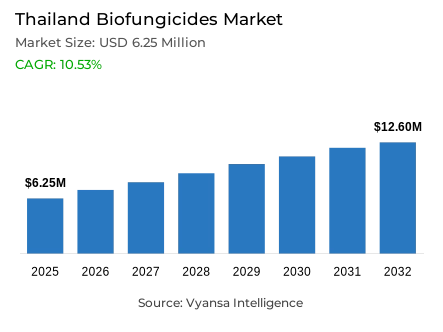
- Biofungicides market size in Thailand was valued at USD 6.25 million in 2025 and is estimated at USD 6.9 million in 2026.
- The market size is expected to grow to USD 12.6 million by 2032.
- Market to register a CAGR of around 10.53% during 2026-32.
- Source Shares
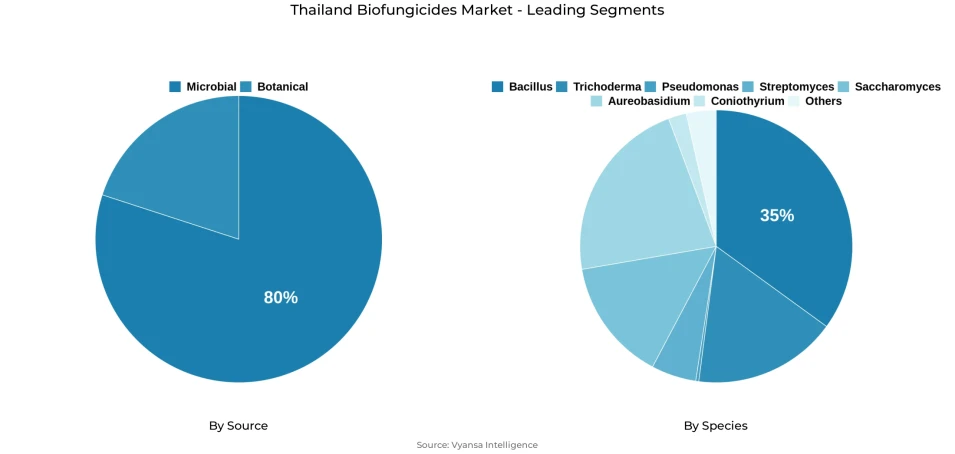
- Microbial grabbed market share of 80%.
- Competition
- More than 5 companies are actively engaged in producing biofungicides in Thailand.
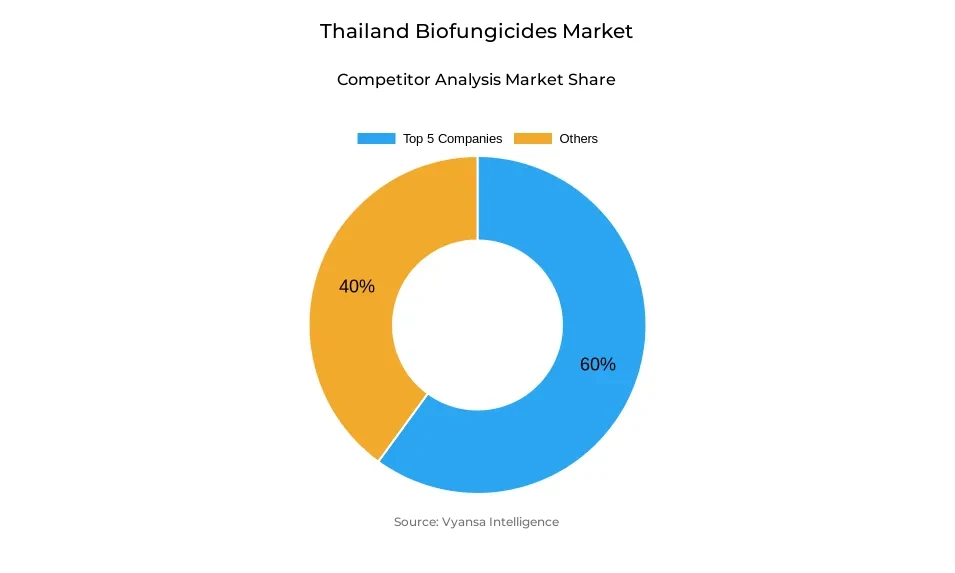
- Top 5 companies acquired around 60% of the market share.
- Walaibiocontrol Co. Ltd., Majorfar Corporation Co. Ltd., Appliedchem (Thailand) Co. Ltd., TAB Innovation Co. Ltd. etc., are few of the top companies.
- Species
- Bacillus grabbed 35% of the market.
Thailand Biofungicides Market Outlook
Thailand Biofungicides Market is valued at USD 6.25 Million in 2025 and USD 6.90 Million in 2026, and it is projected to reach USD 12.60 Million by 2032, growing at a CAGR of 10.53% from 2026 to 2032. The market covers microbial and biological fungicide products used to manage fungal and bacterial crop diseases across rice, fruits, vegetables, ornamentals, and high-value tropical crops. Its buyers include growers, crop advisors, input distributors, cooperatives, and farm-service operators seeking residue-conscious disease-control programs.
Biological disease-control demand is strengthening as Thai agriculture faces tighter residue expectations, export-quality requirements, and persistent pest-pressure risks. According to ScienceDirect, a 2024 study of 300 smallholder farmers producing rice, fruit, vegetables, and flowers found that 65% used biopesticides, although conventional pesticides remained the primary control method. This supports adoption through IPM-linked procurement, extension contact, and increased willingness to combine chemical and biological inputs when disease risk is recurring.
Thailand Biofungicides Industry creates operational value by reducing reliance on synthetic fungicide rotations, supporting residue-compliance strategies, and improving disease-management flexibility for growers supplying domestic and export channels. Microbial products also fit decentralized distribution because local advisory systems, DOA biological product lists, and farm-level demonstration programs can translate laboratory strains into field-ready inputs for disease suppression. This improves supplier credibility where growers need practical proof before shifting seasonal input budgets.
Thailand Biofungicides Market enters 2026 with a clearer route toward microbial formulation uptake, supported by official bioproduct dissemination, crop-protection research, and safer input policy direction. Supplier positioning will depend on stable spore viability, locally validated strains, farmer training, and registration readiness, while sector expansion will be shaped by the ability to convert biopesticide awareness into repeat seasonal purchases. Product differentiation is expected to center on disease specificity, compatibility with IPM schedules, and performance under humid tropical conditions across core commercial crops in 2026.
Thailand Biofungicides Market Growth Driver
Residue-Safe Crop Production is Pulling Biological Fungicides Into IPM Programs
Residue-management pressure across rice, fruit, vegetable, and flower production is increasing demand for biological disease-control tools that can sit alongside chemical fungicide rotations without intensifying residue risk. Thailand Biofungicides Market benefits from this shift because microbial formulations support preventive disease suppression, rotation planning, and IPM adoption among growers seeking safer crop-protection systems. Export-oriented growers also need tools that help maintain crop quality while reducing the probability of residue-related compliance friction.
ScienceDirect reported in 2024 that biopesticide use among sampled Thai smallholders was positively associated with education, farming experience, positive attitudes, IPM adoption, and contact with government extension agents. This strengthens Thailand Biofungicides Industry demand by linking product uptake with advisory access, field credibility, and institutional promotion rather than price-led substitution alone. The driver is therefore anchored in production discipline, not only sustainability messaging, because grower confidence rises when extension networks support correct application during procurement cycles and practical training sessions.
Thailand Biofungicides Market Challenge
Registration and Field-Performance Constraints Limit Faster Commercial Scaling
Registration complexity, field-performance variability, and storage sensitivity continue to slow supplier participation, especially for microbial products that need strain viability, quality control, and tropical-condition stability. Thailand Biofungicides Market therefore faces a commercialization bottleneck where farmer interest is present, but recurring procurement depends on consistent efficacy, correct application timing, and confidence in labeled disease-control outcomes. These constraints raise distributor risk because biological products require stronger technical selling than conventional fungicides.
The 2024 Heliyon review published on ScienceDirect notes that Thailand has a biopesticide registration system with fast-track features, yet it remains relatively costly considering the small market size. This constrains Thailand Biofungicides Industry participation by raising entry costs for specialized suppliers and limiting the breadth of registered biological fungicide options available to growers. The challenge directly affects market participation because smaller biological-input firms must justify dossier costs before scaling local portfolios across early-stage portfolio planning cycles and channel expansion decisions locally.
Unlock Market Intelligence
Explore the market potential with our data-driven report
Thailand Biofungicides Market Trend
Official Biocontrol Portfolios are Moving From Research Assets to Farm Inputs
Government-backed biological product portfolios are increasingly shaping technology transfer, creating a stronger bridge between plant-protection research and grower-ready microbial disease-control inputs. Thailand Biofungicides Market gains from this trend as DOA-backed strains and advisory materials improve recognition of Bacillus, Trichoderma, and other microbial agents used against crop diseases. This trend also strengthens trust because public-sector validation can reduce farmer hesitation around living-microbe products and field handling.
For instance, the Department of Agriculture lists biological products including Bacillus subtilis 20W33 for chili anthracnose, BS products for bacterial wilt, Bacillus subtilis 20W1 for leaf spot in brassica crops, and Trichoderma for banana disease control. This supports Thailand Biofungicides Industry commercialization by giving distributors and extension channels named biological technologies that can be positioned around crop-specific disease pressure. It also improves product education by linking organism, crop, and disease target for clearer procurement decisions during extension-led demonstration programs and seasonal disease-control planning across provinces.
Thailand Biofungicides Market Opportunity
High-Value Tropical Crops Create Underpenetrated Demand Pockets
Fruit, vegetable, and ornamental growers offer the strongest underpenetrated opportunity because disease losses, residue scrutiny, and export-quality requirements are concentrated in higher-value crop systems. Thailand Biofungicides Market can capture stronger margins in these crops where preventive programs, shelf-life protection, and biological rotation fit commercial growers’ risk-management priorities. Suppliers can improve demand capture by combining microbial products with field training, disease monitoring, and season-specific spray guidance for intensive production areas.
In June 2025, the Department of Agriculture’s regional office received 17,082 kilograms of bioproducts for outbreak suppression and farmer support, including 14,235 kilograms of Trichoderma and 2,847 kilograms of Bacillus subtilis BS-DOA24. This creates Thailand Biofungicides Industry opportunity by demonstrating public-sector distribution capacity and practical demand for localized biological input availability. The opportunity is especially meaningful for domestic suppliers that can maintain freshness, storage discipline, and rapid delivery during disease outbreaks within priority horticulture supply chains locally.
Unlock Market Intelligence
Explore the market potential with our data-driven report
Thailand Biofungicides Market Segmentation Analysis
By Source
- Microbial
- Botanical
Microbial products hold 80% share by source, supported by their fit with farm-level disease prevention, compatibility with IPM systems, and ability to target soil-borne and foliar pathogens through bacteria and fungi. Thailand Biofungicides Market is therefore structurally weighted toward microbial products because growers need biological options that can be applied across seed, soil, and foliar disease-management programs. Microbial dominance also reflects formulation versatility, with products used in preventive, curative-support, and rotation-based applications.
According to the U.S. Environmental Protection Agency, microbial pesticides use microorganisms such as bacteria, fungi, viruses, or protozoa as active ingredients, and each active ingredient is relatively specific to its target pest. This strengthens Thailand Biofungicides Industry supply planning because microbial specificity supports differentiated positioning by crop, pathogen, formulation, and application route. For suppliers, segment leadership requires strain selection, shelf-life control, and clear label guidance that farmers can apply reliably within commercial farm-service and dealer networks across provinces.
By Species
- Bacillus
- Trichoderma
- Pseudomonas
- Streptomyces
- Saccharomyces
- Aureobasidium
- Coniothyrium
- Others
Bacillus holds 35% share by species due to its commercial compatibility, spore-forming stability, and strong use case across bacterial and fungal disease-management programs. Thailand Biofungicides Market benefits from Bacillus-based products because they are easier to integrate into tropical distribution chains than many sensitive microbial cultures and can support foliar as well as soil-oriented applications. This species base also fits input dealers that need stockable biological products with practical handling requirements for distributors managing inventory across humid production provinces and seasonal demand peaks.
Frontiers in Agronomy reported in 2025 that Bacillus and Trichoderma are key biocontrol agents, with Bacillus using mechanisms including lipopeptide production, lytic enzymes, siderophores, and induced systemic resistance. This supports Thailand Biofungicides Industry innovation by strengthening the technical basis for Bacillus formulations targeting repeatable disease suppression under field conditions. Species-level leadership therefore depends on formulation stability, disease spectrum clarity, and evidence that supports farmer confidence across crop cycles.
List of Companies Covered in Thailand Biofungicides Market
The companies listed below are highly influential in the Thailand biofungicides market, with a significant market share and a strong impact on industry developments.
- Walaibiocontrol Co. Ltd.
- Majorfar Corporation Co. Ltd.
- Appliedchem (Thailand) Co. Ltd.
- TAB Innovation Co. Ltd.
- Sotus International Co. Ltd.
- Green Inno Thai Co. Ltd.
- CPI AgroTech Co. Ltd.
Market News & Updates
- TAB Innovation Co. Ltd., 2025:
TAB Innovation listed Tri-Tab in January 2025 as a Trichoderma asperellum NST-009 bioproduct in Thailand. The product page positions Tri-Tab for soil-borne plant disease control and notes registration with the Department of Agriculture and Organic Thailand certification. The update supports domestic Trichoderma availability for residue-conscious disease-control programs.
Frequently Asked Questions
Related Report
- Market Segmentation
- Research Scope
- Research Methodology
- Definitions and Assumptions
- Executive Summary
- Thailand Biofungicides Market Policies, Regulations, and Standards
- Thailand Biofungicides Market Dynamics
- Growth Factors
- Challenges
- Trends
- Opportunities
- Thailand Biofungicides Market Statistics, 2022-2032F
- Market Size & Growth Outlook
- By Revenues in USD Million
- By Volume in Metric Tonnes
- Market Segmentation & Growth Outlook
- By Source
- Microbial- Market Insights and Forecast 2022-2032, USD Million
- Botanical- Market Insights and Forecast 2022-2032, USD Million
- By Species
- Bacillus- Market Insights and Forecast 2022-2032, USD Million
- Trichoderma- Market Insights and Forecast 2022-2032, USD Million
- Pseudomonas- Market Insights and Forecast 2022-2032, USD Million
- Streptomyces- Market Insights and Forecast 2022-2032, USD Million
- Saccharomyces- Market Insights and Forecast 2022-2032, USD Million
- Aureobasidium- Market Insights and Forecast 2022-2032, USD Million
- Coniothyrium- Market Insights and Forecast 2022-2032, USD Million
- Others- Market Insights and Forecast 2022-2032, USD Million
- By Form
- Wettable Powder- Market Insights and Forecast 2022-2032, USD Million
- Aqueous Solution- Market Insights and Forecast 2022-2032, USD Million
- Granules- Market Insights and Forecast 2022-2032, USD Million
- Powder- Market Insights and Forecast 2022-2032, USD Million
- Liquid- Market Insights and Forecast 2022-2032, USD Million
- By Mode of Application
- Foliar Spray- Market Insights and Forecast 2022-2032, USD Million
- Soil Treatment- Market Insights and Forecast 2022-2032, USD Million
- Seed Treatment- Market Insights and Forecast 2022-2032, USD Million
- Post-Harvest Treatment- Market Insights and Forecast 2022-2032, USD Million
- Root Dipping- Market Insights and Forecast 2022-2032, USD Million
- Drip Irrigation- Market Insights and Forecast 2022-2032, USD Million
- Sprinkler Irrigation- Market Insights and Forecast 2022-2032, USD Million
- Others- Market Insights and Forecast 2022-2032, USD Million
- By Crop Type
- Fruits and Vegetables- Market Insights and Forecast 2022-2032, USD Million
- Cereals and Grains- Market Insights and Forecast 2022-2032, USD Million
- Oilseeds and Pulses- Market Insights and Forecast 2022-2032, USD Million
- Turf and Ornamentals- Market Insights and Forecast 2022-2032, USD Million
- Plantation Crops- Market Insights and Forecast 2022-2032, USD Million
- Nursery Crops- Market Insights and Forecast 2022-2032, USD Million
- Others- Market Insights and Forecast 2022-2032, USD Million
- By Competitors
- Competition Characteristics
- Market Share & Analysis
- By Source
- Market Size & Growth Outlook
- Thailand Microbial Market Statistics, 2022-2032
- Market Size & Growth Outlook
- By Revenues in USD Million
- By Volume in Metric Tonnes
- Market Segmentation & Growth Outlook
- By Species- Market Insights and Forecast 2022-2032, USD Million
- By Form- Market Insights and Forecast 2022-2032, USD Million
- By Mode of Application- Market Insights and Forecast 2022-2032, USD Million
- By Crop Type- Market Insights and Forecast 2022-2032, USD Million
- Market Size & Growth Outlook
- Thailand Botanical Market Statistics, 2022-2032
- Market Size & Growth Outlook
- By Revenues in USD Million
- By Volume in Metric Tonnes
- Market Segmentation & Growth Outlook
- By Species- Market Insights and Forecast 2022-2032, USD Million
- By Form- Market Insights and Forecast 2022-2032, USD Million
- By Mode of Application- Market Insights and Forecast 2022-2032, USD Million
- By Crop Type- Market Insights and Forecast 2022-2032, USD Million
- Market Size & Growth Outlook
- Competitive Outlook
- Company Profiles
- Appliedchem (Thailand) Co. Ltd.
- Business Description
- Product Portfolio
- Collaborations & Alliances
- Recent Developments
- Financial Details
- Others
- TAB Innovation Co. Ltd.
- Business Description
- Product Portfolio
- Collaborations & Alliances
- Recent Developments
- Financial Details
- Others
- Sotus International Co. Ltd.
- Business Description
- Product Portfolio
- Collaborations & Alliances
- Recent Developments
- Financial Details
- Others
- Green Inno Thai Co. Ltd.
- Business Description
- Product Portfolio
- Collaborations & Alliances
- Recent Developments
- Financial Details
- Others
- CPI AgroTech Co. Ltd.
- Business Description
- Product Portfolio
- Collaborations & Alliances
- Recent Developments
- Financial Details
- Others
- Walaibiocontrol Co. Ltd.
- Business Description
- Product Portfolio
- Collaborations & Alliances
- Recent Developments
- Financial Details
- Others
- Majorfar Corporation Co. Ltd.
- Business Description
- Product Portfolio
- Collaborations & Alliances
- Recent Developments
- Financial Details
- Others
- Appliedchem (Thailand) Co. Ltd.
- Company Profiles
- Disclaimer
| Segment | Sub-Segment |
|---|---|
| By Source |
|
| By Species |
|
| By Form |
|
| By Mode of Application |
|
| By Crop Type |
|
Research Methodology
This study followed a structured approach comprising four key phases to assess the size and scope of the electro-oxidation market. The process began with thorough secondary research to collect data on the target market, related markets, and broader industry context. These findings, along with preliminary assumptions and estimates, were then validated through extensive primary research involving industry experts from across the value chain. To calculate the overall market size, both top-down and bottom-up methodologies were employed. Finally, market segmentation and data triangulation techniques were applied to refine and validate segment-level estimations.
Secondary Research
The secondary research phase involved gathering data from a wide range of credible and published sources. This step helped in identifying industry trends, defining market segmentation, and understanding the market landscape and value chain.
Sources consulted during this phase included:
- Company annual reports, investor presentations, and press releases
- Industry white papers and certified publications
- Trade directories and market-recognized databases
- Articles from authoritative authors and reputable journals
- Gold and silver standard websites
Secondary research was critical in mapping out the industry's value chain and monetary flow, identifying key market segments, understanding regional variations, and tracking significant industry developments.
Other key sources:
- Financial disclosures
- Industry associations and trade bodies
- News outlets and business magazines
- Academic journals and research studies
- Paid industry databases
Primary Research
To validate secondary data and gain deeper market insights, primary research was conducted with key stakeholders across both the supply and demand sides of the market.
On the demand side, participants included decision-makers and influencers from end-user industries—such as CIOs, CTOs, and CSOs—who provided first-hand perspectives on market needs, product usage, and future expectations.
On the supply side, interviews were conducted with manufacturers, industry associations, and institutional participants to gather insights into current offerings, product pipelines, and market challenges.
Primary interviews provided critical inputs such as:
- Market size and revenue data
- Product and service breakdowns
- Market forecasts
- Regional and application-specific trends
Stakeholders consulted included:
- Leading OEM and solution providers
- Channel and distribution partners
- End users across various applications
- Independent consultants and industry specialists
Market Size Estimation and Data Triangulation
- Identifying Key Market Participants (Secondary Research)
- Goal: To identify the major players or companies in the target market. This typically involves using publicly available data sources such as industry reports, market research publications, and financial statements of companies.
- Tools: Reports from firms like Gartner, Forrester, Euromonitor, Statista, IBISWorld, and others. Public financial statements, news articles, and press releases from top market players.
- Extracting Earnings of Key Market Participants
- Goal: To estimate the earnings generated from the product or service being analyzed. This step helps in understanding the revenue potential of each market player in a specific geography.
- Methods: Earnings data can be gathered from:
- Publicly available financial reports (for listed companies).
- Interviews and primary data sources from professionals, such as Directors, VPs, SVPs, etc. This is especially useful for understanding more nuanced, internal data that isn't publicly disclosed.
- Annual reports and investor presentations of key players.
- Data Collation and Development of a Relevant Data Model
- Goal: To collate inputs from both primary and secondary sources into a structured, data-driven model for market estimation. This model will incorporate key market KPIs and any independent variables relevant to the market.
- Key KPIs: These could include:
- Market size, growth rate, and demand drivers.
- Industry-specific metrics like market share, average revenue per customer (ARPC), or average deal size.
- External variables, such as economic growth rates, inflation rates, or commodity prices, that could affect the market.
- Data Modeling: Based on this data, the market forecasts are developed for the next 5 years. A combination of trend analysis, scenario modeling, and statistical regression might be used to generate projections.
- Scenario Analysis
- Goal: To test different assumptions and validate how sensitive the market is to changes in key variables (e.g., market demand, regulatory changes, technological disruptions).
- Types of Scenarios:
- Base Case: Based on current assumptions and historical data.
- Best-Case Scenario: Assuming favorable market conditions, regulatory environments, and technological advancements.
- Worst-Case Scenario: Accounting for adverse factors, such as economic downturns, stricter regulations, or unexpected disruptions.












