China Biofungicides Market Report: Trends, Growth and Forecast (2026-2032)
By Source (Microbial, Botanical), By Species (Bacillus, Trichoderma, Pseudomonas, Streptomyces, Saccharomyces, Aureobasidium, Coniothyrium, Others), By Form (Wettable Powder, Aqueous Solution, Granules, Powder, Liquid), By Mode of Application (Foliar Spray, Soil Treatment, Seed Treatment, Post-Harvest Treatment, Root Dipping, Drip Irrigation, Sprinkler Irrigation, Others), By Crop Type (Fruits and Vegetables, Cereals and Grains, Oilseeds and Pulses, Turf and Ornamentals, Plantation Crops, Nursery Crops, Others), By Region (North, East, Southwest, Northwest, North East, South) ... Read more
|
Major Players
|
China Biofungicides Market Statistics and Insights, 2026
- Market Size Statistics
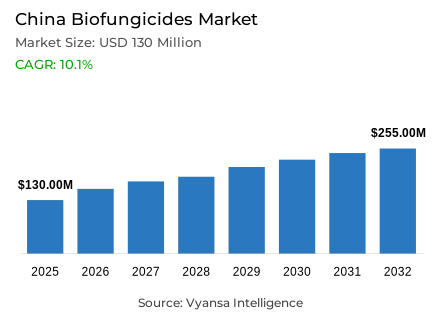
- Biofungicides market size in China was valued at USD 130 million in 2025 and is estimated at USD 140 million in 2026.
- The market size is expected to grow to USD 255 million by 2032.
- Market to register a CAGR of around 10.1% during 2026-32.
- Source Shares
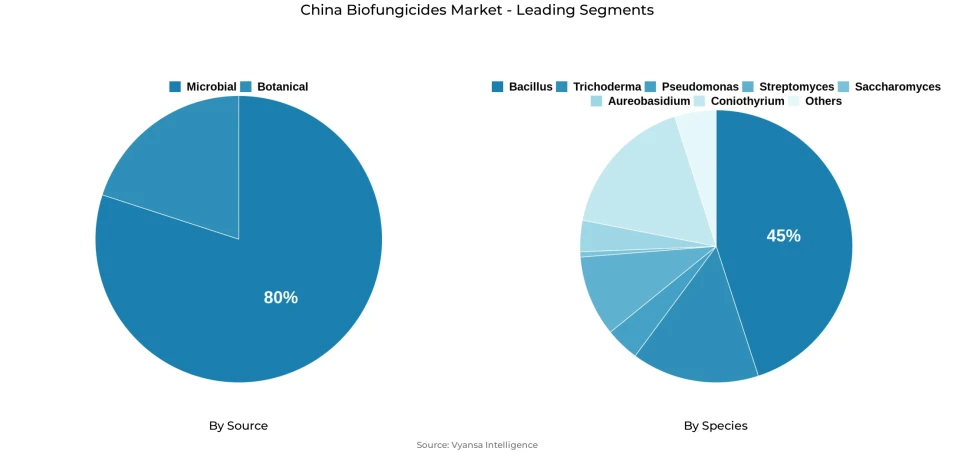
- Microbial grabbed market share of 80%.
- Competition
- More than 10 companies are actively engaged in producing biofungicides in China.
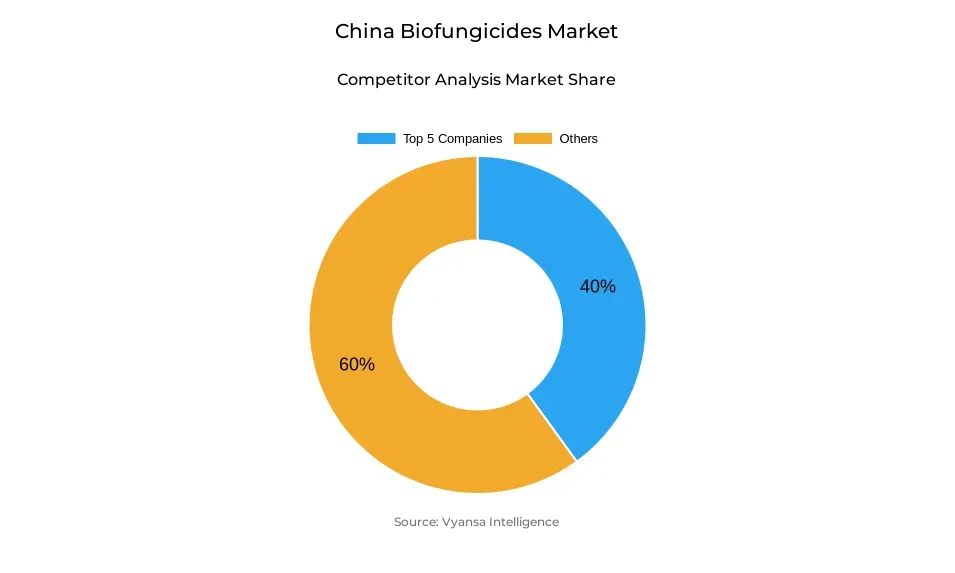
- Top 5 companies acquired around 40% of the market share.
- North China Pharmaceutical Group Aino Co. Ltd., Jilin Yanbian Chunlei Bio-pharmaceutical Co. Ltd., Liaoning Microke Biological Engineering Co. Ltd., Zhejiang Qianjiang Biochemical Co. Ltd., Wuhan Kernel Bio-tech Co. Ltd. etc., are few of the top companies.
- Species
- Bacillus grabbed 45% of the market.
China Biofungicides Market Outlook
China Biofungicides Market is valued at USD 130 Million in 2025 and USD 140 Million in 2026, and is projected to reach USD 255 Million by 2032, growing at a CAGR of 10.1% during 2026-2032. The market covers microbial, botanical, and biochemical disease-control inputs used across rice, wheat, corn, fruit, vegetable, tea, and greenhouse systems. China Biofungicides Industry supports lower-residue crop protection and integrated pest management across commercial farming networks and distributors.
Biofungicides Market in China demand is reinforced by crop security priorities, high-value horticulture, and policy-backed chemical pesticide reduction. The National Bureau of Statistics reported 714.88 million tons of grain output in 2025, while FAO estimated record cereal output and average 2026 winter wheat area. These conditions keep disease-control procurement active across staple and protected-crop systems where fungal pressure can disrupt yield stability, storage quality, and input planning during intensive planting and harvest cycles.
China Biofungicides Industry gains economic importance as growers, distributors, and formulation suppliers align disease control with residue compliance, organic certification, and traceable pesticide use. Regulatory scrutiny is increasing across registration, labelling, online sales, and post-certification oversight. This improves procurement discipline, favors registered microbial pesticides, and supports supplier differentiation through efficacy data, compliant labels, localized technical service, and stronger channel accountability across agricultural input distribution across provinces with increasingly formal pesticide retail and advisory networks.
Biofungicides Market in China enters 2026 with adoption momentum shaped by biotech-oriented agriculture, digital compliance systems, and sustainable crop protection priorities. The industry is positioned to benefit from higher demand for biological crop protection China solutions, especially where growers need seed treatment biofungicides China, foliar applications, soil-borne disease control biofungicides, and biofungicides for rice and vegetables in China. Product innovation and distributor training will remain central to supplier positioning throughout major crop seasons.
China Biofungicides Market Growth Driver
Residue Pressure Repositions Disease-Control Procurement
Residue management and green crop protection are shifting procurement toward biological disease-control inputs as farms balance yield protection with stricter compliance expectations. China Biofungicides Market benefits when growers seek low-toxicity fungicides that complement chemical programmes, reduce residue risk, and maintain crop quality across export-oriented fruit, vegetable, tea, and greenhouse supply chains. This demand force strengthens interest in microbial crop protection China and IPM-compatible fungicides among professional growers and service distributors through formal retail networks.
In 2024 that China reached 54.1% nationwide green pest-control coverage and that MARA prioritized biological pesticides as green pest-control measures. This strengthens China Biofungicides Industry demand by linking microbial pesticide procurement with policy-supported chemical pesticide reduction, broader field demonstration, and distributor-led adoption. The result is stronger institutional support for registered biological disease control products across commercial crop systems and advisory networks that influence grower purchasing decisions.
China Biofungicides Market Challenge
Registration Complexity Raises Commercialization Hurdles
Registration, efficacy validation, residue review, and label compliance create commercialization pressure for suppliers that lack strong dossier capacity or field-performance data. China Biofungicides Market faces slower product onboarding when microbial formulation stability, strain identity, toxicology, environmental behavior, and application instructions must be documented across different crop-disease combinations. Smaller manufacturers can face higher testing costs, longer review preparation, and weaker distributor confidence before launch, especially when disease claims require localized field validation.
China's 2025 MARA Order No. 3 revised pesticide registration, production licensing, business licensing, and registration-test management, with several provisions entering force on January 1, 2026. This raises compliance intensity for China Biofungicides Industry participants by increasing the need for qualified testing, documented active-ingredient specifications, verified labels, and platform-based regulatory records. Compliance delays can affect pricing, deployment timing, and participation among low-capacity suppliers lacking regulatory teams and testing partnerships and portfolio planning decisions.
Unlock Market Intelligence
Explore the market potential with our data-driven report
China Biofungicides Market Trend
Digital Traceability Tightens Product Accountability
Digital pesticide governance is reshaping how biological fungicides are registered, distributed, labelled, and monitored. China Biofungicides Market gains stronger quality discipline as QR-code labels, online sales filing, product information platforms, and transaction recordkeeping reduce informality and improve visibility across suppliers, distributors, and farm-level procurement channels. Traceability also improves post-market surveillance, complaint handling, and confidence in registered microbial pesticides across formal retail, e-commerce, and technical service channels during seasonal demand and procurement peaks.
MARA's 2025 amendments require pesticide management information-platform disclosure covering registration certificates, standards, maximum residue limits, inspection methods, and approved labels. The same order also requires online pesticide operators to complete filing before January 31, 2026. This strengthens China Biofungicides Industry transparency and rewards compliant manufacturers with better market access. Suppliers with accurate product data can support procurement screening and distributor qualification, while reducing space for informal products and unsupported disease-control claims.
China Biofungicides Market Opportunity
High-Value Crops Open Premium Bio-Based Demand
Fruit, vegetable, greenhouse, and organic production systems create underpenetrated demand for premium bio-based crop disease control where residue limits, repeated harvest cycles, and soil health priorities influence procurement. China Biofungicides Market can capture higher-value adoption through microbial spore formulation, suspension concentrate biofungicides, wettable powder biofungicides, and application support tailored to protected cultivation. These use cases support pricing resilience and stronger grower advisory requirements where crop value justifies preventive biological treatment programmes and residue-sensitive marketing plans.
ECNS reported in 2026 that China's 2025 vegetable output exceeded 800 million metric tons and fruit production surpassed 360 million metric tons. New organic certification rules effective January 1, 2026 also tightened traceability and post-certification supervision, expanding China Biofungicides Industry opportunities in compliant disease-management programmes. This creates space for biofungicide suppliers China to align labels, field support, and certification-oriented residue strategies for greenhouse, orchard, vegetable, and tea producers.
Unlock Market Intelligence
Explore the market potential with our data-driven report
China Biofungicides Market Segmentation Analysis
By Source
- Microbial
- Botanical
Microbial products lead source-level demand because they align with biological crop protection, residue-sensitive production, and integrated pest management systems. Microbial holds 80% share by source, reflecting stronger acceptance of beneficial microorganisms, microbial active ingredients, and registered microbial pesticides. China Biofungicides Market benefits from microbial inputs that can be applied through seed, soil, foliar, and greenhouse disease-control routes. Their compatibility with combined crop-protection programmes supports repeat procurement across farms seeking lower-residue disease suppression and flexible application scheduling.
OECD's 2025 consensus document on Beauveria bassiana strains supports dossier preparation and evaluation for microbial plant-protection products, covering taxonomy, metabolites, host range, non-target organisms, and human health. This strengthens China Biofungicides Industry supply planning by reinforcing science-based evaluation of microbial crop protection China products and scalable biocontrol agents. Clearer dossier logic can improve commercialization readiness for biological pesticide producers China entering registered microbial pesticide categories.
By Species
- Bacillus
- Trichoderma
- Pseudomonas
- Streptomyces
- Saccharomyces
- Aureobasidium
- Coniothyrium
- Others
Bacillus leads species-level positioning because spore-forming bacterial platforms provide formulation durability, broad disease-suppression utility, and compatibility with conventional crop-protection programmes. Bacillus holds 45% share by species, supported by procurement preference for shelf-stable biofungicide products, Bacillus biofungicides China, and bacterial biofungicides China used in soil, seed, and foliar programmes. China Biofungicides Market benefits from this technical fit across cereal, vegetable, and greenhouse applications where storage stability and handling simplicity are important.
The US EPA's 2026 biopesticide active-ingredient list includes multiple Bacillus entries, including Bacillus subtilis strain CH4000 and Bacillus paralicheniformis strain CH0273 first registered in 2024. This global regulatory activity reinforces Bacillus as a mature microbial platform and supports confidence in species-based formulation innovation. It also signals continuing acceptance of strain-specific review frameworks for microbial fungicide adoption in China crop protection and strain-specific product differentiation across regulated biological pesticide portfolios globally.
List of Companies Covered in China Biofungicides Market
The companies listed below are highly influential in the China biofungicides market, with a significant market share and a strong impact on industry developments.
- North China Pharmaceutical Group Aino Co. Ltd.
- Jilin Yanbian Chunlei Bio-pharmaceutical Co. Ltd.
- Liaoning Microke Biological Engineering Co. Ltd.
- Zhejiang Qianjiang Biochemical Co. Ltd.
- Wuhan Kernel Bio-tech Co. Ltd.
- Shaanxi Microbe Biotechnology Co. Ltd.
- Deqiang Biology Co. Ltd.
- Fujian Kaili Bio-Product Co. Ltd.
- Jiangxi Xinlong Biological Technology Co. Ltd.
- Hailir Pesticides and Chemicals Group Co. Ltd.
Market News & Updates
- Wuhan Kernel Bio-tech Co. Ltd., 2025:
Wuhan Kernel Bio-tech’s Hubei operation advanced its agricultural biological fermentation project. The project relies on Wuhan Kernel’s fermentation platform and field-application technology, with planned product lines covering biological fungicides, biological insecticides, and microbial agents. The update adds China-based fermentation capacity relevant to microbial crop disease-control inputs.
Frequently Asked Questions
Related Report
- Market Segmentation
- Research Scope
- Research Methodology
- Definitions and Assumptions
- Executive Summary
- China Biofungicides Market Policies, Regulations, and Standards
- China Biofungicides Market Dynamics
- Growth Factors
- Challenges
- Trends
- Opportunities
- China Biofungicides Market Statistics, 2022-2032F
- Market Size & Growth Outlook
- By Revenues in USD Million
- By Volume in Metric Tonnes
- Market Segmentation & Growth Outlook
- By Source
- Microbial- Market Insights and Forecast 2022-2032, USD Million
- Botanical- Market Insights and Forecast 2022-2032, USD Million
- By Species
- Bacillus- Market Insights and Forecast 2022-2032, USD Million
- Trichoderma- Market Insights and Forecast 2022-2032, USD Million
- Pseudomonas- Market Insights and Forecast 2022-2032, USD Million
- Streptomyces- Market Insights and Forecast 2022-2032, USD Million
- Saccharomyces- Market Insights and Forecast 2022-2032, USD Million
- Aureobasidium- Market Insights and Forecast 2022-2032, USD Million
- Coniothyrium- Market Insights and Forecast 2022-2032, USD Million
- Others- Market Insights and Forecast 2022-2032, USD Million
- By Form
- Wettable Powder- Market Insights and Forecast 2022-2032, USD Million
- Aqueous Solution- Market Insights and Forecast 2022-2032, USD Million
- Granules- Market Insights and Forecast 2022-2032, USD Million
- Powder- Market Insights and Forecast 2022-2032, USD Million
- Liquid- Market Insights and Forecast 2022-2032, USD Million
- By Mode of Application
- Foliar Spray- Market Insights and Forecast 2022-2032, USD Million
- Soil Treatment- Market Insights and Forecast 2022-2032, USD Million
- Seed Treatment- Market Insights and Forecast 2022-2032, USD Million
- Post-Harvest Treatment- Market Insights and Forecast 2022-2032, USD Million
- Root Dipping- Market Insights and Forecast 2022-2032, USD Million
- Drip Irrigation- Market Insights and Forecast 2022-2032, USD Million
- Sprinkler Irrigation- Market Insights and Forecast 2022-2032, USD Million
- Others- Market Insights and Forecast 2022-2032, USD Million
- By Crop Type
- Fruits and Vegetables- Market Insights and Forecast 2022-2032, USD Million
- Cereals and Grains- Market Insights and Forecast 2022-2032, USD Million
- Oilseeds and Pulses- Market Insights and Forecast 2022-2032, USD Million
- Turf and Ornamentals- Market Insights and Forecast 2022-2032, USD Million
- Plantation Crops- Market Insights and Forecast 2022-2032, USD Million
- Nursery Crops- Market Insights and Forecast 2022-2032, USD Million
- Others- Market Insights and Forecast 2022-2032, USD Million
- By Region
- North
- East
- Southwest
- Northwest
- North East
- South
- By Competitors
- Competition Characteristics
- Market Share & Analysis
- By Source
- Market Size & Growth Outlook
- China Microbial Market Statistics, 2022-2032
- Market Size & Growth Outlook
- By Revenues in USD Million
- By Volume in Metric Tonnes
- Market Segmentation & Growth Outlook
- By Species- Market Insights and Forecast 2022-2032, USD Million
- By Form- Market Insights and Forecast 2022-2032, USD Million
- By Mode of Application- Market Insights and Forecast 2022-2032, USD Million
- By Crop Type- Market Insights and Forecast 2022-2032, USD Million
- By Region- Market Insights and Forecast 2022-2032, USD Million
- Market Size & Growth Outlook
- China Botanical Market Statistics, 2022-2032
- Market Size & Growth Outlook
- By Revenues in USD Million
- By Volume in Metric Tonnes
- Market Segmentation & Growth Outlook
- By Species- Market Insights and Forecast 2022-2032, USD Million
- By Form- Market Insights and Forecast 2022-2032, USD Million
- By Mode of Application- Market Insights and Forecast 2022-2032, USD Million
- By Crop Type- Market Insights and Forecast 2022-2032, USD Million
- By Region- Market Insights and Forecast 2022-2032, USD Million
- Market Size & Growth Outlook
- Competitive Outlook
- Company Profiles
- Zhejiang Qianjiang Biochemical Co. Ltd.
- Business Description
- Product Portfolio
- Collaborations & Alliances
- Recent Developments
- Financial Details
- Others
- Wuhan Kernel Bio-tech Co. Ltd.
- Business Description
- Product Portfolio
- Collaborations & Alliances
- Recent Developments
- Financial Details
- Others
- Shaanxi Microbe Biotechnology Co. Ltd.
- Business Description
- Product Portfolio
- Collaborations & Alliances
- Recent Developments
- Financial Details
- Others
- Deqiang Biology Co. Ltd.
- Business Description
- Product Portfolio
- Collaborations & Alliances
- Recent Developments
- Financial Details
- Others
- Fujian Kaili Bio-Product Co. Ltd.
- Business Description
- Product Portfolio
- Collaborations & Alliances
- Recent Developments
- Financial Details
- Others
- North China Pharmaceutical Group Aino Co. Ltd.
- Business Description
- Product Portfolio
- Collaborations & Alliances
- Recent Developments
- Financial Details
- Others
- Jilin Yanbian Chunlei Bio-pharmaceutical Co. Ltd.
- Business Description
- Product Portfolio
- Collaborations & Alliances
- Recent Developments
- Financial Details
- Others
- Liaoning Microke Biological Engineering Co. Ltd.
- Business Description
- Product Portfolio
- Collaborations & Alliances
- Recent Developments
- Financial Details
- Others
- Jiangxi Xinlong Biological Technology Co. Ltd.
- Business Description
- Product Portfolio
- Collaborations & Alliances
- Recent Developments
- Financial Details
- Others
- Hailir Pesticides and Chemicals Group Co. Ltd.
- Business Description
- Product Portfolio
- Collaborations & Alliances
- Recent Developments
- Financial Details
- Others
- Zhejiang Qianjiang Biochemical Co. Ltd.
- Company Profiles
- Disclaimer
| Segment | Sub-Segment |
|---|---|
| By Source |
|
| By Species |
|
| By Form |
|
| By Mode of Application |
|
| By Crop Type |
|
| By Region |
|
Research Methodology
This study followed a structured approach comprising four key phases to assess the size and scope of the electro-oxidation market. The process began with thorough secondary research to collect data on the target market, related markets, and broader industry context. These findings, along with preliminary assumptions and estimates, were then validated through extensive primary research involving industry experts from across the value chain. To calculate the overall market size, both top-down and bottom-up methodologies were employed. Finally, market segmentation and data triangulation techniques were applied to refine and validate segment-level estimations.
Secondary Research
The secondary research phase involved gathering data from a wide range of credible and published sources. This step helped in identifying industry trends, defining market segmentation, and understanding the market landscape and value chain.
Sources consulted during this phase included:
- Company annual reports, investor presentations, and press releases
- Industry white papers and certified publications
- Trade directories and market-recognized databases
- Articles from authoritative authors and reputable journals
- Gold and silver standard websites
Secondary research was critical in mapping out the industry's value chain and monetary flow, identifying key market segments, understanding regional variations, and tracking significant industry developments.
Other key sources:
- Financial disclosures
- Industry associations and trade bodies
- News outlets and business magazines
- Academic journals and research studies
- Paid industry databases
Primary Research
To validate secondary data and gain deeper market insights, primary research was conducted with key stakeholders across both the supply and demand sides of the market.
On the demand side, participants included decision-makers and influencers from end-user industries—such as CIOs, CTOs, and CSOs—who provided first-hand perspectives on market needs, product usage, and future expectations.
On the supply side, interviews were conducted with manufacturers, industry associations, and institutional participants to gather insights into current offerings, product pipelines, and market challenges.
Primary interviews provided critical inputs such as:
- Market size and revenue data
- Product and service breakdowns
- Market forecasts
- Regional and application-specific trends
Stakeholders consulted included:
- Leading OEM and solution providers
- Channel and distribution partners
- End users across various applications
- Independent consultants and industry specialists
Market Size Estimation and Data Triangulation
- Identifying Key Market Participants (Secondary Research)
- Goal: To identify the major players or companies in the target market. This typically involves using publicly available data sources such as industry reports, market research publications, and financial statements of companies.
- Tools: Reports from firms like Gartner, Forrester, Euromonitor, Statista, IBISWorld, and others. Public financial statements, news articles, and press releases from top market players.
- Extracting Earnings of Key Market Participants
- Goal: To estimate the earnings generated from the product or service being analyzed. This step helps in understanding the revenue potential of each market player in a specific geography.
- Methods: Earnings data can be gathered from:
- Publicly available financial reports (for listed companies).
- Interviews and primary data sources from professionals, such as Directors, VPs, SVPs, etc. This is especially useful for understanding more nuanced, internal data that isn't publicly disclosed.
- Annual reports and investor presentations of key players.
- Data Collation and Development of a Relevant Data Model
- Goal: To collate inputs from both primary and secondary sources into a structured, data-driven model for market estimation. This model will incorporate key market KPIs and any independent variables relevant to the market.
- Key KPIs: These could include:
- Market size, growth rate, and demand drivers.
- Industry-specific metrics like market share, average revenue per customer (ARPC), or average deal size.
- External variables, such as economic growth rates, inflation rates, or commodity prices, that could affect the market.
- Data Modeling: Based on this data, the market forecasts are developed for the next 5 years. A combination of trend analysis, scenario modeling, and statistical regression might be used to generate projections.
- Scenario Analysis
- Goal: To test different assumptions and validate how sensitive the market is to changes in key variables (e.g., market demand, regulatory changes, technological disruptions).
- Types of Scenarios:
- Base Case: Based on current assumptions and historical data.
- Best-Case Scenario: Assuming favorable market conditions, regulatory environments, and technological advancements.
- Worst-Case Scenario: Accounting for adverse factors, such as economic downturns, stricter regulations, or unexpected disruptions.












