Global Feed Acidifiers Market Report: Trends, Growth and Forecast (2026-2032)
By Product Type (Organic Acids, Inorganic Acids, Acid Salts, Blended Acidifiers), By Acid Type (Formic Acid, Propionic Acid, Lactic Acid, Citric Acid, Fumaric Acid, Sorbic Acid, Benzoic Acid, Butyric Acid, Others), By Form (Dry, Liquid), By Livestock (Poultry, Swine, Ruminants, Aquaculture, Pets, Others), By Application (Gut Health, Feed Preservation, Pathogen Control, pH Reduction, Digestibility Improvement, Mold Inhibition, Water Acidification), By Sales Channel (Feed Mills, Premix Manufacturers, Distributors, Direct Sales, Integrated Farms, Others), By Region (North America, South America, Europe, Middle East & Africa, Asia Pacific) ... Read more
|
Major Players
|
Global Feed Acidifiers Market Statistics and Insights, 2026
- Market Size Statistics
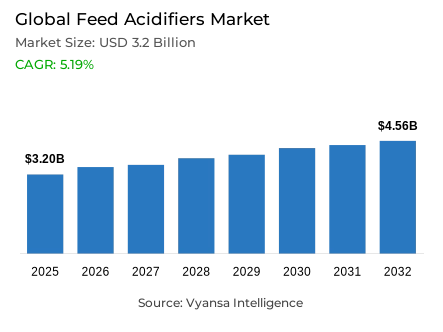
- Feed acidifiers market size in Global was valued at USD 3.2 billion in 2025 and is estimated at USD 3.37 billion in 2026.
- The market size is expected to grow to USD 4.56 billion by 2032.
- Market to register a CAGR of around 5.19% during 2026-32.
- Product Type Shares
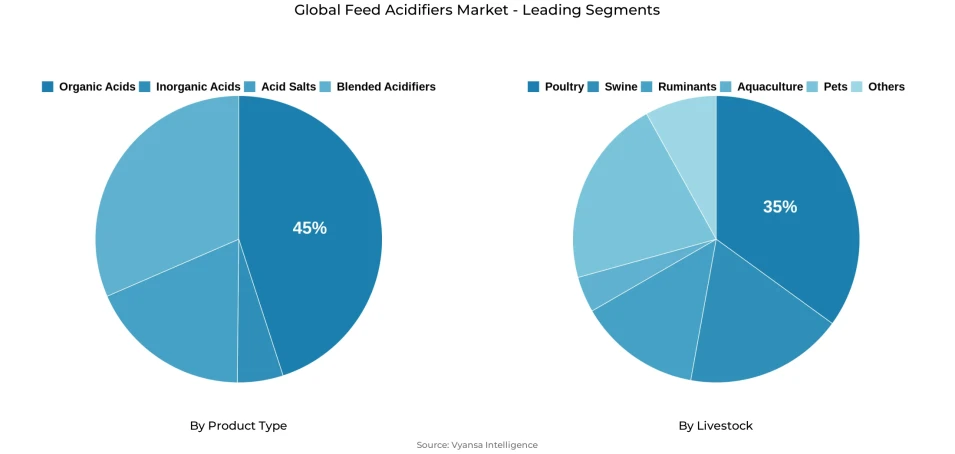
- Organic acids grabbed market share of 45%.
- Competition
- More than 30 companies are actively engaged in producing feed acidifiers.
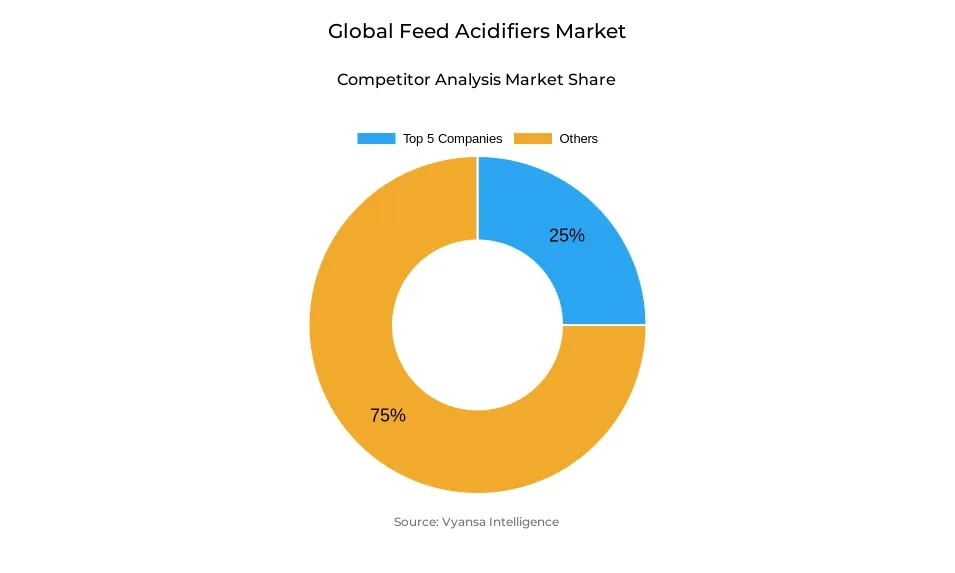
- Top 5 companies acquired around 25% of the market share.
- Novus International, Impextraco, Anpario, Perstorp Animal Nutrition, Selko etc., are few of the top companies.
- Livestock
- Poultry grabbed 35% of the market.
- Region
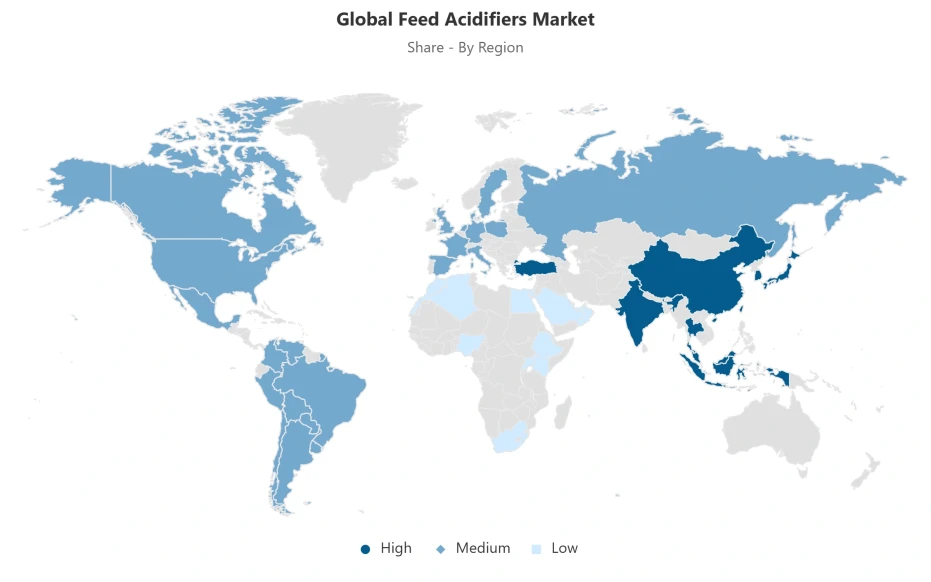
- Asia Pacific leads with a 43% share of the global market.
Global Feed Acidifiers Market Outlook
Rising use of acidifier-based feed additives across commercial livestock nutrition defines the Global Feed Acidifiers Market, which was valued at USD 3.2 billion in 2025 and is projected to grow from USD 3.37 billion in 2026 to USD 4.56 billion by 2032, at a CAGR of 5.19%. Demand is shaped by gut health, feed hygiene, pH control, pathogen pressure management, digestibility support, and feed preservation across poultry, swine, ruminants, aquaculture, and specialty feed programs.
Organic Acids lead Product Type with 45% share, reflecting broad use across compound feed, premixes, liquid feed, silage, water acidification, and phase-specific livestock diets. Formic, propionic, lactic, citric, fumaric, sorbic, and butyric acid products support feed preservation, microbial control, mold inhibition, and digestive stability. This keeps organic acid feed additives tied to practical feed quality needs rather than narrow additive positioning.
Poultry holds 35% share under Livestock, supported by short production cycles, high feed-volume intensity, and sensitivity to feed conversion, liveability, eggshell strength, hatchability, and body-weight gain. OECD-FAO projects global poultry consumption to reach 173 million tonnes ready-to-cook by 2034 and account for 62% of additional meat consumed globally, reinforcing the relevance of poultry feed acidifiers in starter, grower, finisher, layer, breeder, and water acidification programs.
Asia Pacific leads with 43% share, supported by large poultry, swine, aquaculture, and compound feed production across China, India, Indonesia, Vietnam, Thailand, Japan, and South Korea. Regional demand remains tied to commercial livestock intensification, hot and humid feed storage conditions, disease pressure, and feed efficiency requirements. The outlook through 2032 remains anchored in antimicrobial stewardship, feed hygiene discipline, organic acid blends, protected formats, buffered systems, and consistent livestock performance needs across high-volume feed manufacturing environments where dosage control, safety documentation, storage compatibility, and practical handling remain central to daily use in regulated commercial feed systems worldwide across species nutrition programs.
Global Feed Acidifiers Market Growth Driver
Antibiotic Reduction Expands Gut Health Additive Demand
Antimicrobial reduction remains the strongest driver as livestock systems seek practical nutrition tools that support gut stability, feed hygiene, and baseline performance. Non-antibiotic feed additives such as organic acids, protected butyrate, probiotics, enzymes, and hygiene-focused additives are used within broader programs that include vaccination, biosecurity, and feed quality control. WOAH reports that global antimicrobial use in animals declined by 5% between 2020 and 2022, based on data covering 71% of global animal biomass, reinforcing measurable movement toward more disciplined antimicrobial stewardship in animal production systems.
Feed acidifiers support this transition through pH reduction, mold inhibition, microbial pressure management, and digestive stability in feed and water systems. FAO notes that antimicrobials have been used in animal feed for about 70 years to treat disease, support growth, improve feed utilization, increase yields, and reduce morbidity and mortality. As routine antimicrobial use becomes more controlled, gut health feed acidifiers become relevant where poultry and swine producers need consistent digestive conditions without relying only on medication-led intervention. This keeps demand tied to feed hygiene, pH control, phase-specific inclusion, water acidification, and disciplined livestock nutrition programs across commercial production systems where flock and herd performance must remain stable across repeated feed application cycles and farms.
Global Feed Acidifiers Market Challenge
Handling and Dosage Sensitivity Restrict Smooth Use
Handling risk and dosage sensitivity remain the main restraints, as acidifiers require correct selection, storage, mixing, dosing, and delivery. Liquid acids can be corrosive to tanks, pumps, pipes, and feed-mill surfaces when equipment compatibility is weak, while powdered formats still require uniform mixing. Dosage control challenges also affect feed intake and animal response, especially in broiler, piglet, aquaculture, and ruminant diets where palatability, pellet stability, water quality, or rumen fermentation can shift with incorrect application. These conditions make acidifier use more technical than routine additive inclusion.
EFSA states that feed additives are used to enhance feed flavour, meet nutrient needs, or increase performance in healthy animals. Codex guidance also indicates that additives used in feed should be assessed for safety and used under approved conditions. These requirements keep handling and storage risks linked with user safety, species fit, inclusion accuracy, and documentation. Buffered, coated, acid salt, and protected formats reduce some application problems, yet adoption remains dependent on technical guidance, compatibility data, and repeatable use under commercial feed conditions. The constraint is strongest where small farms lack dosing systems or feed mills handle multiple species diets with limited technical oversight and safety training during daily acidifier application in feed mills.
Unlock Market Intelligence
Explore the market potential with our data-driven report
Global Feed Acidifiers Market Trend
Buffered Formats Improve Practical Acidifier Use
The shift toward buffered acidifiers, coated acids, encapsulated systems, protected butyrate, and blended products is reshaping feed acidifier use. Traditional acids can support feed hygiene and pH control, yet corrosiveness, volatility, odor, dosing difficulty, and palatability concerns can restrict practical use. Buffered and protected formats address these limits through improved handling, controlled release, storage stability, processing compatibility, and animal acceptance. This keeps product development increasingly linked with application safety and predictable feed-system performance rather than broader product claims in commercial diets.
European feed authorization records list formic acid within the formal feed additive system, while the 2025 implementing regulation renews authorization for propionic acid and related propionate salts under defined use conditions. These regulatory details support better specified acidifier formats that can be documented, tracked, and applied consistently. Protected organic acids and encapsulated feed acidifiers are therefore gaining relevance in poultry, swine, aquaculture, and ruminant programs where pelleting, water stability, gut release, and dosage discipline matter. The trend keeps acidifier use tied to handling improvement, formulation accuracy, controlled delivery, and feed-mill compatibility. It also reduces practical friction where acidifiers must be used across feed phases, water systems, and storage conditions in daily production operations across multiple species and farms consistently.
Global Feed Acidifiers Market Opportunity
Poultry and Swine Programs Deepen Gut Health Use
Poultry and swine gut health programs create the clearest demand expansion area, as both livestock groups combine large feed volumes, intensive production cycles, and high sensitivity to digestive stability. Poultry feed acidifiers are used across starter, grower, finisher, layer, breeder, and water acidification programs, while swine feed acidifiers are relevant in piglet, nursery, grower-finisher, and sow diets. These applications depend on pH control, feed hygiene, palatability, pathogen pressure management, and consistent digestive conditions across practical feeding systems.
USDA FAS forecasts global chicken meat production to rise by 3% in 2026 to 110.7 million tons. FAO and OECD-FAO also project meat, dairy, and egg output to increase by 17% through 2034, while global livestock inventories expand by 7%. These production trends support feed additives that fit standardized, feed-intensive systems. Feed acidifier additives remain most relevant where compound feed, premixes, water treatment, dosage instructions, and safety documentation are aligned with phase-specific nutrition. The opportunity stays tied to flock and herd health programs where acidifier use is measurable and technically managed. This keeps future demand concentrated in high-volume poultry and swine systems with structured feed practices and routine performance monitoring across production phases and integrated farms globally and regionally over time ahead steadily.
Global Feed Acidifiers Market Regional Analysis
By Region
- North America
- South America
- Europe
- Middle East & Africa
- Asia Pacific
Asia Pacific leads the Global Feed Acidifiers Market with 43% share, supported by large poultry, swine, aquaculture, and compound feed production across China, India, Indonesia, Vietnam, Thailand, Japan, and South Korea. The region’s position reflects livestock intensification, animal protein demand, formulated feed use, and rising attention to gut health and feed hygiene. The Asia Pacific feed acidifiers market remains closely linked with hot and humid storage conditions, disease pressure, feed efficiency needs, and practical water acidification systems across farms and feed mills.
World Bank data cited in the supplied content places East Asia and Pacific growth at 4.5% in 2025 and 4.0% in 2026, while South Asia growth stands at 6.3% and 5.8% respectively. FAO also projects meat, dairy, and egg production to rise by 17% through 2034. These signals support continued feed demand across Asia Pacific, while Europe contributes regulatory discipline and North America adds advanced feed additive use. The regional outlook remains tied to feed scale, acidifier handling, dosage control, and consistent application across commercial livestock systems. Adoption remains most disciplined where compound feed production, premix access, and species-specific guidance are available consistently through local distribution and feed-mill guidance for regional commercial farms.
Unlock Market Intelligence
Explore the market potential with our data-driven report
Global Feed Acidifiers Market Segmentation Analysis
By Product Type
- Organic Acids
- Inorganic Acids
- Acid Salts
- Blended Acidifiers
The segment with the highest share under Product Type is Organic Acids, holding 45% of the Global Feed Acidifiers Market. This leadership reflects broad functionality across feed preservation, pH reduction, microbial control, mold inhibition, gut health support, and water acidification. Formic, propionic, lactic, citric, fumaric, sorbic, and butyric acid products are used across poultry, swine, ruminant, aquaculture, and specialty feed programs. Their relevance comes from multiple practical uses across compound feed, premixes, liquid feed, silage, water systems, and phase-specific diets.
FDA states that animal food ingredients include substances intentionally added to animal food, while additives require approval unless recognized as safe under intended conditions. The European Commission’s Joint Research Centre also developed a 2026 method for determining formic, lactic, propionic, citric, fumaric, malic, and acetic acids and salts in feed matrices. This supports formic acid feed additive, propionic acid feed additive, and related acid systems where dosage accuracy, product identity, and testing consistency matter. The segment remains tied to measurable acid content, safe inclusion, storage discipline, and feed-quality control across commercial production. Organic acids also retain relevance as buffered, coated, protected, and blended formats become more common in poultry, swine, aquaculture, and ruminant feed systems during feed formulation cycles.
By Livestock
- Poultry
- Swine
- Ruminants
- Aquaculture
- Pets
- Others
The segment with the highest share under Livestock is Poultry, holding 35% of the Global Feed Acidifiers Market. Poultry leads due to large feed volume, short production cycles, feed conversion sensitivity, and demand for consistent gut health, feed hygiene, water quality, and microbial control. Broilers, layers, breeders, and chicks use acidifiers across starter, grower, finisher, layer, breeder, and water programs. This makes broiler feed acidifiers and layer acidifier systems important within intensive poultry nutrition.
India’s Department of Animal Husbandry and Dairying reported 142.77 billion eggs in 2023 to 2024, with egg production growing at a 6.87% CAGR over the past 10 years. Poultry’s position is also linked with Organic Acids, which hold 45% share under Product Type. Formic and propionic acid systems support feed hygiene, while butyric acid derivatives are used in gut-health programs. The segment remains tied to flock uniformity, eggshell quality, feed conversion, and repeat feed use across commercial poultry systems. Poultry production density also increases the need for feed hygiene additives, as high-volume flocks require consistent feed quality, water hygiene, and controlled microbial pressure. This keeps poultry demand aligned with practical farm-level application rather than broad livestock expansion across regional commercial poultry markets globally today.
Market Players in Global Feed Acidifiers Market
These market players maintain a significant presence in the Global feed acidifiers market sector and contribute to its ongoing evolution.
- Novus International
- Impextraco
- Anpario
- Perstorp Animal Nutrition
- Selko
- Kemin Industries
- BASF SE
- Adisseo
- Lallemand Animal Nutrition
- Jefo Nutrition
- dsm-firmenich
- Nutrex
- EW Nutrition
- Orffa
- ADDCON
Market News & Updates
- Novus International, 2025:
Novus highlighted ACTIVATE DA and ACTIVATE WD MAX Nutritional Feed Acids in August 2025. The products use organic acids to support gut health and biosecurity programs, while AVIMATRIX Feed Solution uses an organic acid blend for bird gut health. The update strengthens Novus’ acidifier and eubiotic feed solution range.
- Kemin Industries, 2026:
Kemin lists FORMYL as a protected feed acidifier for animal feeds. The product contains calcium formate and citric acid, with encapsulated delivery designed for targeted release in the gastrointestinal tract. The solution supports feed acidification and pathogen-control applications in swine nutrition
Frequently Asked Questions
Related Report
- Market Segmentation
- Research Scope
- Research Methodology
- Definitions and Assumptions
- Executive Summary
- Global Feed Acidifiers Market Policies, Regulations, and Standards
- Global Feed Acidifiers Production (Ton) Trend 2022-2032
- Global Feed Acidifiers Production (Ton) Trend By Product Type
- Organic Acids
- Inorganic Acids
- Acid Salts
- Blended Acidifiers
- Company Wise Production Plants and Statistics
- Installed Production Capacity
- Actual Production
- Planned Production Target
- Global Feed Acidifiers Production (Ton) Trend By Product Type
- Global Feed Acidifiers Pricing Analysis 2022-2032
- Global Feed Acidifiers Trend (USD/Ton) 2022-2032
- Global Feed Acidifiers Trend (USD/Ton) By Regions 2022-2032
- North America
- South America
- Europe
- Middle East & Africa
- Asia Pacific
- Global Feed Acidifiers Trend (USD/Ton) By Product Type 2022-2032
- Organic Acids
- Inorganic Acids
- Acid Salts
- Blended Acidifiers
- Global Feed Acidifiers Market Dynamics
- Growth Factors
- Challenges
- Trends
- Opportunities
- Global Feed Acidifiers Market Statistics, 2022-2032F
- Market Size & Growth Outlook
- By Revenues in USD Million
- By Quantity Sold in Ton
- Market Segmentation & Growth Outlook
- By Product Type
- Organic Acids- Market Insights and Forecast 2022-2032, USD Million
- Inorganic Acids- Market Insights and Forecast 2022-2032, USD Million
- Acid Salts- Market Insights and Forecast 2022-2032, USD Million
- Blended Acidifiers- Market Insights and Forecast 2022-2032, USD Million
- By Acid Type
- Formic Acid- Market Insights and Forecast 2022-2032, USD Million
- Propionic Acid- Market Insights and Forecast 2022-2032, USD Million
- Lactic Acid- Market Insights and Forecast 2022-2032, USD Million
- Citric Acid- Market Insights and Forecast 2022-2032, USD Million
- Fumaric Acid- Market Insights and Forecast 2022-2032, USD Million
- Sorbic Acid- Market Insights and Forecast 2022-2032, USD Million
- Benzoic Acid- Market Insights and Forecast 2022-2032, USD Million
- Butyric Acid- Market Insights and Forecast 2022-2032, USD Million
- Others- Market Insights and Forecast 2022-2032, USD Million
- By Form
- Dry- Market Insights and Forecast 2022-2032, USD Million
- Liquid- Market Insights and Forecast 2022-2032, USD Million
- By Livestock
- Poultry- Market Insights and Forecast 2022-2032, USD Million
- Swine- Market Insights and Forecast 2022-2032, USD Million
- Ruminants- Market Insights and Forecast 2022-2032, USD Million
- Aquaculture- Market Insights and Forecast 2022-2032, USD Million
- Pets- Market Insights and Forecast 2022-2032, USD Million
- Others- Market Insights and Forecast 2022-2032, USD Million
- By Application
- Gut Health- Market Insights and Forecast 2022-2032, USD Million
- Feed Preservation- Market Insights and Forecast 2022-2032, USD Million
- Pathogen Control- Market Insights and Forecast 2022-2032, USD Million
- pH Reduction- Market Insights and Forecast 2022-2032, USD Million
- Digestibility Improvement- Market Insights and Forecast 2022-2032, USD Million
- Mold Inhibition- Market Insights and Forecast 2022-2032, USD Million
- Water Acidification- Market Insights and Forecast 2022-2032, USD Million
- By Sales Channel
- Feed Mills- Market Insights and Forecast 2022-2032, USD Million
- Premix Manufacturers- Market Insights and Forecast 2022-2032, USD Million
- Distributors- Market Insights and Forecast 2022-2032, USD Million
- Direct Sales- Market Insights and Forecast 2022-2032, USD Million
- Integrated Farms- Market Insights and Forecast 2022-2032, USD Million
- Others- Market Insights and Forecast 2022-2032, USD Million
- By Region
- North America
- South America
- Europe
- Middle East & Africa
- Asia Pacific
- By Competitors
- Competition Characteristics
- Market Share & Analysis
- By Product Type
- Market Size & Growth Outlook
- North America Feed Acidifiers Market Statistics, 2022-2032F
- Market Size & Growth Outlook
- By Revenues in USD Million
- By Quantity Sold in Ton
- Market Segmentation & Growth Outlook
- By Product Type- Market Insights and Forecast 2022-2032, USD Million
- By Acid Type- Market Insights and Forecast 2022-2032, USD Million
- By Form- Market Insights and Forecast 2022-2032, USD Million
- By Livestock- Market Insights and Forecast 2022-2032, USD Million
- By Application- Market Insights and Forecast 2022-2032, USD Million
- By Sales Channel- Market Insights and Forecast 2022-2032, USD Million
- By Country
- US
- Canada
- Mexico
- Rest of North America
- US Feed Acidifiers Market Statistics, 2022-2032F
- Market Size & Growth Outlook
- By Revenues in USD Million
- By Quantity Sold in Ton
- Market Segmentation & Growth Outlook
- By Product Type- Market Insights and Forecast 2022-2032, USD Million
- By Acid Type- Market Insights and Forecast 2022-2032, USD Million
- By Form- Market Insights and Forecast 2022-2032, USD Million
- By Livestock- Market Insights and Forecast 2022-2032, USD Million
- By Application- Market Insights and Forecast 2022-2032, USD Million
- By Sales Channel- Market Insights and Forecast 2022-2032, USD Million
- Market Size & Growth Outlook
- Canada Feed Acidifiers Market Statistics, 2022-2032F
- Market Size & Growth Outlook
- By Revenues in USD Million
- By Quantity Sold in Ton
- Market Segmentation & Growth Outlook
- By Product Type- Market Insights and Forecast 2022-2032, USD Million
- By Acid Type- Market Insights and Forecast 2022-2032, USD Million
- By Form- Market Insights and Forecast 2022-2032, USD Million
- By Livestock- Market Insights and Forecast 2022-2032, USD Million
- By Application- Market Insights and Forecast 2022-2032, USD Million
- By Sales Channel- Market Insights and Forecast 2022-2032, USD Million
- Market Size & Growth Outlook
- Mexico Feed Acidifiers Market Statistics, 2022-2032F
- Market Size & Growth Outlook
- By Revenues in USD Million
- By Quantity Sold in Ton
- Market Segmentation & Growth Outlook
- By Product Type- Market Insights and Forecast 2022-2032, USD Million
- By Acid Type- Market Insights and Forecast 2022-2032, USD Million
- By Form- Market Insights and Forecast 2022-2032, USD Million
- By Livestock- Market Insights and Forecast 2022-2032, USD Million
- By Application- Market Insights and Forecast 2022-2032, USD Million
- By Sales Channel- Market Insights and Forecast 2022-2032, USD Million
- Market Size & Growth Outlook
- Market Size & Growth Outlook
- South America Feed Acidifiers Market Statistics, 2022-2032F
- Market Size & Growth Outlook
- By Revenues in USD Million
- By Quantity Sold in Ton
- Market Segmentation & Growth Outlook
- By Product Type- Market Insights and Forecast 2022-2032, USD Million
- By Acid Type- Market Insights and Forecast 2022-2032, USD Million
- By Form- Market Insights and Forecast 2022-2032, USD Million
- By Livestock- Market Insights and Forecast 2022-2032, USD Million
- By Application- Market Insights and Forecast 2022-2032, USD Million
- By Sales Channel- Market Insights and Forecast 2022-2032, USD Million
- By Country
- Brazil
- Argentina
- Colombia
- Chile
- Rest of South America
- Brazil Feed Acidifiers Market Statistics, 2022-2032F
- Market Size & Growth Outlook
- By Revenues in USD Million
- By Quantity Sold in Ton
- Market Segmentation & Growth Outlook
- By Product Type- Market Insights and Forecast 2022-2032, USD Million
- By Acid Type- Market Insights and Forecast 2022-2032, USD Million
- By Form- Market Insights and Forecast 2022-2032, USD Million
- By Livestock- Market Insights and Forecast 2022-2032, USD Million
- By Application- Market Insights and Forecast 2022-2032, USD Million
- By Sales Channel- Market Insights and Forecast 2022-2032, USD Million
- Market Size & Growth Outlook
- Argentina Feed Acidifiers Market Statistics, 2022-2032F
- Market Size & Growth Outlook
- By Revenues in USD Million
- By Quantity Sold in Ton
- Market Segmentation & Growth Outlook
- By Product Type- Market Insights and Forecast 2022-2032, USD Million
- By Acid Type- Market Insights and Forecast 2022-2032, USD Million
- By Form- Market Insights and Forecast 2022-2032, USD Million
- By Livestock- Market Insights and Forecast 2022-2032, USD Million
- By Application- Market Insights and Forecast 2022-2032, USD Million
- By Sales Channel- Market Insights and Forecast 2022-2032, USD Million
- Market Size & Growth Outlook
- Colombia Feed Acidifiers Market Statistics, 2022-2032F
- Market Size & Growth Outlook
- By Revenues in USD Million
- By Quantity Sold in Ton
- Market Segmentation & Growth Outlook
- By Product Type- Market Insights and Forecast 2022-2032, USD Million
- By Acid Type- Market Insights and Forecast 2022-2032, USD Million
- By Form- Market Insights and Forecast 2022-2032, USD Million
- By Livestock- Market Insights and Forecast 2022-2032, USD Million
- By Application- Market Insights and Forecast 2022-2032, USD Million
- By Sales Channel- Market Insights and Forecast 2022-2032, USD Million
- Market Size & Growth Outlook
- Chile Feed Acidifiers Market Statistics, 2022-2032F
- Market Size & Growth Outlook
- By Revenues in USD Million
- By Quantity Sold in Ton
- Market Segmentation & Growth Outlook
- By Product Type- Market Insights and Forecast 2022-2032, USD Million
- By Acid Type- Market Insights and Forecast 2022-2032, USD Million
- By Form- Market Insights and Forecast 2022-2032, USD Million
- By Livestock- Market Insights and Forecast 2022-2032, USD Million
- By Application- Market Insights and Forecast 2022-2032, USD Million
- By Sales Channel- Market Insights and Forecast 2022-2032, USD Million
- Market Size & Growth Outlook
- Market Size & Growth Outlook
- Europe Feed Acidifiers Market Statistics, 2022-2032F
- Market Size & Growth Outlook
- By Revenues in USD Million
- By Quantity Sold in Ton
- Market Segmentation & Growth Outlook
- By Product Type- Market Insights and Forecast 2022-2032, USD Million
- By Acid Type- Market Insights and Forecast 2022-2032, USD Million
- By Form- Market Insights and Forecast 2022-2032, USD Million
- By Livestock- Market Insights and Forecast 2022-2032, USD Million
- By Application- Market Insights and Forecast 2022-2032, USD Million
- By Sales Channel- Market Insights and Forecast 2022-2032, USD Million
- By Country
- Germany
- UK
- France
- Spain
- Italy
- Netherlands
- Rest of Europe
- Germany Feed Acidifiers Market Statistics, 2022-2032F
- Market Size & Growth Outlook
- By Revenues in USD Million
- By Quantity Sold in Ton
- Market Segmentation & Growth Outlook
- By Product Type- Market Insights and Forecast 2022-2032, USD Million
- By Acid Type- Market Insights and Forecast 2022-2032, USD Million
- By Form- Market Insights and Forecast 2022-2032, USD Million
- By Livestock- Market Insights and Forecast 2022-2032, USD Million
- By Application- Market Insights and Forecast 2022-2032, USD Million
- By Sales Channel- Market Insights and Forecast 2022-2032, USD Million
- Market Size & Growth Outlook
- UK Feed Acidifiers Market Statistics, 2022-2032F
- Market Size & Growth Outlook
- By Revenues in USD Million
- By Quantity Sold in Ton
- Market Segmentation & Growth Outlook
- By Product Type- Market Insights and Forecast 2022-2032, USD Million
- By Acid Type- Market Insights and Forecast 2022-2032, USD Million
- By Form- Market Insights and Forecast 2022-2032, USD Million
- By Livestock- Market Insights and Forecast 2022-2032, USD Million
- By Application- Market Insights and Forecast 2022-2032, USD Million
- By Sales Channel- Market Insights and Forecast 2022-2032, USD Million
- Market Size & Growth Outlook
- France Feed Acidifiers Market Statistics, 2022-2032F
- Market Size & Growth Outlook
- By Revenues in USD Million
- By Quantity Sold in Ton
- Market Segmentation & Growth Outlook
- By Product Type- Market Insights and Forecast 2022-2032, USD Million
- By Acid Type- Market Insights and Forecast 2022-2032, USD Million
- By Form- Market Insights and Forecast 2022-2032, USD Million
- By Livestock- Market Insights and Forecast 2022-2032, USD Million
- By Application- Market Insights and Forecast 2022-2032, USD Million
- By Sales Channel- Market Insights and Forecast 2022-2032, USD Million
- Market Size & Growth Outlook
- Spain Feed Acidifiers Market Statistics, 2022-2032F
- Market Size & Growth Outlook
- By Revenues in USD Million
- By Quantity Sold in Ton
- Market Segmentation & Growth Outlook
- By Product Type- Market Insights and Forecast 2022-2032, USD Million
- By Acid Type- Market Insights and Forecast 2022-2032, USD Million
- By Form- Market Insights and Forecast 2022-2032, USD Million
- By Livestock- Market Insights and Forecast 2022-2032, USD Million
- By Application- Market Insights and Forecast 2022-2032, USD Million
- By Sales Channel- Market Insights and Forecast 2022-2032, USD Million
- Market Size & Growth Outlook
- Italy Feed Acidifiers Market Statistics, 2022-2032F
- Market Size & Growth Outlook
- By Revenues in USD Million
- By Quantity Sold in Ton
- Market Segmentation & Growth Outlook
- By Product Type- Market Insights and Forecast 2022-2032, USD Million
- By Acid Type- Market Insights and Forecast 2022-2032, USD Million
- By Form- Market Insights and Forecast 2022-2032, USD Million
- By Livestock- Market Insights and Forecast 2022-2032, USD Million
- By Application- Market Insights and Forecast 2022-2032, USD Million
- By Sales Channel- Market Insights and Forecast 2022-2032, USD Million
- Market Size & Growth Outlook
- Netherlands Feed Acidifiers Market Statistics, 2022-2032F
- Market Size & Growth Outlook
- By Revenues in USD Million
- By Quantity Sold in Ton
- Market Segmentation & Growth Outlook
- By Product Type- Market Insights and Forecast 2022-2032, USD Million
- By Acid Type- Market Insights and Forecast 2022-2032, USD Million
- By Form- Market Insights and Forecast 2022-2032, USD Million
- By Livestock- Market Insights and Forecast 2022-2032, USD Million
- By Application- Market Insights and Forecast 2022-2032, USD Million
- By Sales Channel- Market Insights and Forecast 2022-2032, USD Million
- Market Size & Growth Outlook
- Market Size & Growth Outlook
- Middle East & Africa Feed Acidifiers Market Statistics, 2022-2032F
- Market Size & Growth Outlook
- By Revenues in USD Million
- By Quantity Sold in Ton
- Market Segmentation & Growth Outlook
- By Product Type- Market Insights and Forecast 2022-2032, USD Million
- By Acid Type- Market Insights and Forecast 2022-2032, USD Million
- By Form- Market Insights and Forecast 2022-2032, USD Million
- By Livestock- Market Insights and Forecast 2022-2032, USD Million
- By Application- Market Insights and Forecast 2022-2032, USD Million
- By Sales Channel- Market Insights and Forecast 2022-2032, USD Million
- By Country
- Saudi Arabia
- UAE
- South Africa
- Egypt
- Rest of Middle East & Africa
- Saudi Arabia Feed Acidifiers Market Statistics, 2022-2032F
- Market Size & Growth Outlook
- By Revenues in USD Million
- By Quantity Sold in Ton
- Market Segmentation & Growth Outlook
- By Product Type- Market Insights and Forecast 2022-2032, USD Million
- By Acid Type- Market Insights and Forecast 2022-2032, USD Million
- By Form- Market Insights and Forecast 2022-2032, USD Million
- By Livestock- Market Insights and Forecast 2022-2032, USD Million
- By Application- Market Insights and Forecast 2022-2032, USD Million
- By Sales Channel- Market Insights and Forecast 2022-2032, USD Million
- Market Size & Growth Outlook
- UAE Feed Acidifiers Market Statistics, 2022-2032F
- Market Size & Growth Outlook
- By Revenues in USD Million
- By Quantity Sold in Ton
- Market Segmentation & Growth Outlook
- By Product Type- Market Insights and Forecast 2022-2032, USD Million
- By Acid Type- Market Insights and Forecast 2022-2032, USD Million
- By Form- Market Insights and Forecast 2022-2032, USD Million
- By Livestock- Market Insights and Forecast 2022-2032, USD Million
- By Application- Market Insights and Forecast 2022-2032, USD Million
- By Sales Channel- Market Insights and Forecast 2022-2032, USD Million
- Market Size & Growth Outlook
- South Africa Feed Acidifiers Market Statistics, 2022-2032F
- Market Size & Growth Outlook
- By Revenues in USD Million
- By Quantity Sold in Ton
- Market Segmentation & Growth Outlook
- By Product Type- Market Insights and Forecast 2022-2032, USD Million
- By Acid Type- Market Insights and Forecast 2022-2032, USD Million
- By Form- Market Insights and Forecast 2022-2032, USD Million
- By Livestock- Market Insights and Forecast 2022-2032, USD Million
- By Application- Market Insights and Forecast 2022-2032, USD Million
- By Sales Channel- Market Insights and Forecast 2022-2032, USD Million
- Market Size & Growth Outlook
- Egypt Feed Acidifiers Market Statistics, 2022-2032F
- Market Size & Growth Outlook
- By Revenues in USD Million
- By Quantity Sold in Ton
- Market Segmentation & Growth Outlook
- By Product Type- Market Insights and Forecast 2022-2032, USD Million
- By Acid Type- Market Insights and Forecast 2022-2032, USD Million
- By Form- Market Insights and Forecast 2022-2032, USD Million
- By Livestock- Market Insights and Forecast 2022-2032, USD Million
- By Application- Market Insights and Forecast 2022-2032, USD Million
- By Sales Channel- Market Insights and Forecast 2022-2032, USD Million
- Market Size & Growth Outlook
- Market Size & Growth Outlook
- Asia Pacific Feed Acidifiers Market Statistics, 2022-2032F
- Market Size & Growth Outlook
- By Revenues in USD Million
- By Quantity Sold in Ton
- Market Segmentation & Growth Outlook
- By Product Type- Market Insights and Forecast 2022-2032, USD Million
- By Acid Type- Market Insights and Forecast 2022-2032, USD Million
- By Form- Market Insights and Forecast 2022-2032, USD Million
- By Livestock- Market Insights and Forecast 2022-2032, USD Million
- By Application- Market Insights and Forecast 2022-2032, USD Million
- By Sales Channel- Market Insights and Forecast 2022-2032, USD Million
- By Country
- China
- India
- Japan
- Australia
- South Korea
- Thailand
- Indonesia
- Singapore
- Rest of Asia Pacific
- China Feed Acidifiers Market Statistics, 2022-2032F
- Market Size & Growth Outlook
- By Revenues in USD Million
- By Quantity Sold in Ton
- Market Segmentation & Growth Outlook
- By Product Type- Market Insights and Forecast 2022-2032, USD Million
- By Acid Type- Market Insights and Forecast 2022-2032, USD Million
- By Form- Market Insights and Forecast 2022-2032, USD Million
- By Livestock- Market Insights and Forecast 2022-2032, USD Million
- By Application- Market Insights and Forecast 2022-2032, USD Million
- By Sales Channel- Market Insights and Forecast 2022-2032, USD Million
- Market Size & Growth Outlook
- India Feed Acidifiers Market Statistics, 2022-2032F
- Market Size & Growth Outlook
- By Revenues in USD Million
- By Quantity Sold in Ton
- Market Segmentation & Growth Outlook
- By Product Type- Market Insights and Forecast 2022-2032, USD Million
- By Acid Type- Market Insights and Forecast 2022-2032, USD Million
- By Form- Market Insights and Forecast 2022-2032, USD Million
- By Livestock- Market Insights and Forecast 2022-2032, USD Million
- By Application- Market Insights and Forecast 2022-2032, USD Million
- By Sales Channel- Market Insights and Forecast 2022-2032, USD Million
- Market Size & Growth Outlook
- Japan Feed Acidifiers Market Statistics, 2022-2032F
- Market Size & Growth Outlook
- By Revenues in USD Million
- By Quantity Sold in Ton
- Market Segmentation & Growth Outlook
- By Product Type- Market Insights and Forecast 2022-2032, USD Million
- By Acid Type- Market Insights and Forecast 2022-2032, USD Million
- By Form- Market Insights and Forecast 2022-2032, USD Million
- By Livestock- Market Insights and Forecast 2022-2032, USD Million
- By Application- Market Insights and Forecast 2022-2032, USD Million
- By Sales Channel- Market Insights and Forecast 2022-2032, USD Million
- Market Size & Growth Outlook
- Australia Feed Acidifiers Market Statistics, 2022-2032F
- Market Size & Growth Outlook
- By Revenues in USD Million
- By Quantity Sold in Ton
- Market Segmentation & Growth Outlook
- By Product Type- Market Insights and Forecast 2022-2032, USD Million
- By Acid Type- Market Insights and Forecast 2022-2032, USD Million
- By Form- Market Insights and Forecast 2022-2032, USD Million
- By Livestock- Market Insights and Forecast 2022-2032, USD Million
- By Application- Market Insights and Forecast 2022-2032, USD Million
- By Sales Channel- Market Insights and Forecast 2022-2032, USD Million
- Market Size & Growth Outlook
- South Korea Feed Acidifiers Market Statistics, 2022-2032F
- Market Size & Growth Outlook
- By Revenues in USD Million
- By Quantity Sold in Ton
- Market Segmentation & Growth Outlook
- By Product Type- Market Insights and Forecast 2022-2032, USD Million
- By Acid Type- Market Insights and Forecast 2022-2032, USD Million
- By Form- Market Insights and Forecast 2022-2032, USD Million
- By Livestock- Market Insights and Forecast 2022-2032, USD Million
- By Application- Market Insights and Forecast 2022-2032, USD Million
- By Sales Channel- Market Insights and Forecast 2022-2032, USD Million
- Market Size & Growth Outlook
- Thailand Feed Acidifiers Market Statistics, 2022-2032F
- Market Size & Growth Outlook
- By Revenues in USD Million
- By Quantity Sold in Ton
- Market Segmentation & Growth Outlook
- By Product Type- Market Insights and Forecast 2022-2032, USD Million
- By Acid Type- Market Insights and Forecast 2022-2032, USD Million
- By Form- Market Insights and Forecast 2022-2032, USD Million
- By Livestock- Market Insights and Forecast 2022-2032, USD Million
- By Application- Market Insights and Forecast 2022-2032, USD Million
- By Sales Channel- Market Insights and Forecast 2022-2032, USD Million
- Market Size & Growth Outlook
- Indonesia Feed Acidifiers Market Statistics, 2022-2032F
- Market Size & Growth Outlook
- By Revenues in USD Million
- By Quantity Sold in Ton
- Market Segmentation & Growth Outlook
- By Product Type- Market Insights and Forecast 2022-2032, USD Million
- By Acid Type- Market Insights and Forecast 2022-2032, USD Million
- By Form- Market Insights and Forecast 2022-2032, USD Million
- By Livestock- Market Insights and Forecast 2022-2032, USD Million
- By Application- Market Insights and Forecast 2022-2032, USD Million
- By Sales Channel- Market Insights and Forecast 2022-2032, USD Million
- Market Size & Growth Outlook
- Singapore Feed Acidifiers Market Statistics, 2022-2032F
- Market Size & Growth Outlook
- By Revenues in USD Million
- By Quantity Sold in Ton
- Market Segmentation & Growth Outlook
- By Product Type- Market Insights and Forecast 2022-2032, USD Million
- By Acid Type- Market Insights and Forecast 2022-2032, USD Million
- By Form- Market Insights and Forecast 2022-2032, USD Million
- By Livestock- Market Insights and Forecast 2022-2032, USD Million
- By Application- Market Insights and Forecast 2022-2032, USD Million
- By Sales Channel- Market Insights and Forecast 2022-2032, USD Million
- Market Size & Growth Outlook
- Market Size & Growth Outlook
- Competitive Outlook
- Company Profiles
- Perstorp Animal Nutrition
- Business Description
- Product Portfolio
- Collaborations & Alliances
- Recent Developments
- Financial Details
- Others
- Selko
- Business Description
- Product Portfolio
- Collaborations & Alliances
- Recent Developments
- Financial Details
- Others
- Kemin Industries
- Business Description
- Product Portfolio
- Collaborations & Alliances
- Recent Developments
- Financial Details
- Others
- BASF SE
- Business Description
- Product Portfolio
- Collaborations & Alliances
- Recent Developments
- Financial Details
- Others
- Adisseo
- Business Description
- Product Portfolio
- Collaborations & Alliances
- Recent Developments
- Financial Details
- Others
- Novus International
- Business Description
- Product Portfolio
- Collaborations & Alliances
- Recent Developments
- Financial Details
- Others
- Impextraco
- Business Description
- Product Portfolio
- Collaborations & Alliances
- Recent Developments
- Financial Details
- Others
- Anpario
- Business Description
- Product Portfolio
- Collaborations & Alliances
- Recent Developments
- Financial Details
- Others
- Lallemand Animal Nutrition
- Business Description
- Product Portfolio
- Collaborations & Alliances
- Recent Developments
- Financial Details
- Others
- Jefo Nutrition
- Business Description
- Product Portfolio
- Collaborations & Alliances
- Recent Developments
- Financial Details
- Others
- dsm-firmenich
- Business Description
- Product Portfolio
- Collaborations & Alliances
- Recent Developments
- Financial Details
- Others
- Nutrex
- Business Description
- Product Portfolio
- Collaborations & Alliances
- Recent Developments
- Financial Details
- Others
- EW Nutrition
- Business Description
- Product Portfolio
- Collaborations & Alliances
- Recent Developments
- Financial Details
- Others
- Orffa
- Business Description
- Product Portfolio
- Collaborations & Alliances
- Recent Developments
- Financial Details
- Others
- ADDCON
- Business Description
- Product Portfolio
- Collaborations & Alliances
- Recent Developments
- Financial Details
- Others
- Perstorp Animal Nutrition
- Company Profiles
- Disclaimer
| Segment | Sub-Segment |
|---|---|
| By Product Type |
|
| By Acid Type |
|
| By Form |
|
| By Livestock |
|
| By Application |
|
| By Sales Channel |
|
| By Region |
|
Research Methodology
This study followed a structured approach comprising four key phases to assess the size and scope of the electro-oxidation market. The process began with thorough secondary research to collect data on the target market, related markets, and broader industry context. These findings, along with preliminary assumptions and estimates, were then validated through extensive primary research involving industry experts from across the value chain. To calculate the overall market size, both top-down and bottom-up methodologies were employed. Finally, market segmentation and data triangulation techniques were applied to refine and validate segment-level estimations.
Secondary Research
The secondary research phase involved gathering data from a wide range of credible and published sources. This step helped in identifying industry trends, defining market segmentation, and understanding the market landscape and value chain.
Sources consulted during this phase included:
- Company annual reports, investor presentations, and press releases
- Industry white papers and certified publications
- Trade directories and market-recognized databases
- Articles from authoritative authors and reputable journals
- Gold and silver standard websites
Secondary research was critical in mapping out the industry's value chain and monetary flow, identifying key market segments, understanding regional variations, and tracking significant industry developments.
Other key sources:
- Financial disclosures
- Industry associations and trade bodies
- News outlets and business magazines
- Academic journals and research studies
- Paid industry databases
Primary Research
To validate secondary data and gain deeper market insights, primary research was conducted with key stakeholders across both the supply and demand sides of the market.
On the demand side, participants included decision-makers and influencers from end-user industries—such as CIOs, CTOs, and CSOs—who provided first-hand perspectives on market needs, product usage, and future expectations.
On the supply side, interviews were conducted with manufacturers, industry associations, and institutional participants to gather insights into current offerings, product pipelines, and market challenges.
Primary interviews provided critical inputs such as:
- Market size and revenue data
- Product and service breakdowns
- Market forecasts
- Regional and application-specific trends
Stakeholders consulted included:
- Leading OEM and solution providers
- Channel and distribution partners
- End users across various applications
- Independent consultants and industry specialists
Market Size Estimation and Data Triangulation
- Identifying Key Market Participants (Secondary Research)
- Goal: To identify the major players or companies in the target market. This typically involves using publicly available data sources such as industry reports, market research publications, and financial statements of companies.
- Tools: Reports from firms like Gartner, Forrester, Euromonitor, Statista, IBISWorld, and others. Public financial statements, news articles, and press releases from top market players.
- Extracting Earnings of Key Market Participants
- Goal: To estimate the earnings generated from the product or service being analyzed. This step helps in understanding the revenue potential of each market player in a specific geography.
- Methods: Earnings data can be gathered from:
- Publicly available financial reports (for listed companies).
- Interviews and primary data sources from professionals, such as Directors, VPs, SVPs, etc. This is especially useful for understanding more nuanced, internal data that isn't publicly disclosed.
- Annual reports and investor presentations of key players.
- Data Collation and Development of a Relevant Data Model
- Goal: To collate inputs from both primary and secondary sources into a structured, data-driven model for market estimation. This model will incorporate key market KPIs and any independent variables relevant to the market.
- Key KPIs: These could include:
- Market size, growth rate, and demand drivers.
- Industry-specific metrics like market share, average revenue per customer (ARPC), or average deal size.
- External variables, such as economic growth rates, inflation rates, or commodity prices, that could affect the market.
- Data Modeling: Based on this data, the market forecasts are developed for the next 5 years. A combination of trend analysis, scenario modeling, and statistical regression might be used to generate projections.
- Scenario Analysis
- Goal: To test different assumptions and validate how sensitive the market is to changes in key variables (e.g., market demand, regulatory changes, technological disruptions).
- Types of Scenarios:
- Base Case: Based on current assumptions and historical data.
- Best-Case Scenario: Assuming favorable market conditions, regulatory environments, and technological advancements.
- Worst-Case Scenario: Accounting for adverse factors, such as economic downturns, stricter regulations, or unexpected disruptions.












