Switzerland Sports Nutrition Market Report: Trends, Growth and Forecast (2026-2032)
By Product Type (Sports Protein Products (Protein/Energy Bars, Sports Protein Powder, Sports Protein RTD), Sports Non-Protein Products), By Sales Channel (Retail Offline, Retail Online), By Ingredients (Vitamins and Minerals, Proteins and Amino Acids, Carbohydrates, Probiotics, Botanicals/Herbals, Others), By Functionality (Energy, Muscle growth, Hydration, Weight Management, Others), By End User (Bodybuilders, Athletes, Lifestyle Users) ... Read more

|
Major Players
|
Switzerland Sports Nutrition Market Statistics and Insights, 2026
- Market Size Statistics
- Sports nutrition market size in Switzerland was estimated at USD 65 million in 2025.
- The market size is expected to grow to USD 80 million by 2032.
- Market to register a CAGR of around 3.01% during 2026-32.
- Product Type Shares
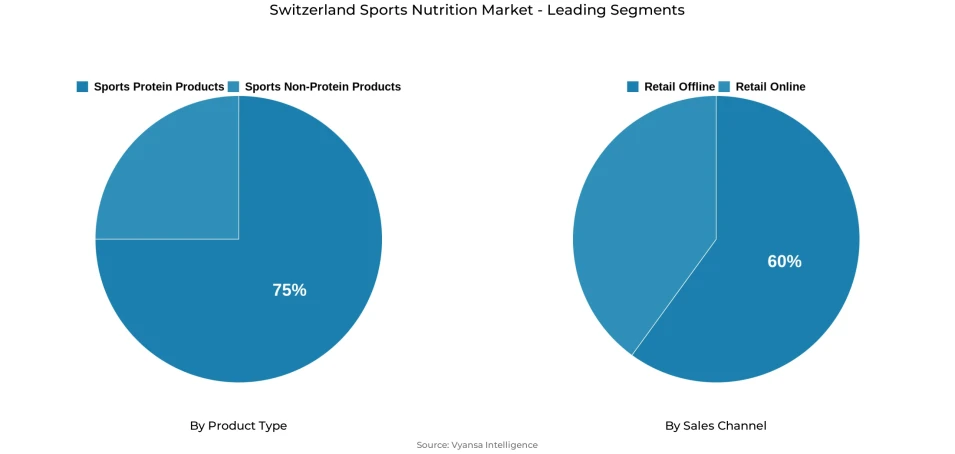
- Sports protein products grabbed market share of 75%.
- Competition
- More than 10 companies are actively engaged in producing sports nutrition in Switzerland.
- Top 5 companies acquired around 75% of the market share.
- nu3 life GmbH, Herbalife International Deutschland GmbH, Migros Genossenschaftsbund eG, Sponser Sport Food AG, Active Nutrition International GmbH etc., are few of the top companies.
- Sales Channel
- Retail offline grabbed 60% of the market.
Switzerland Sports Nutrition Market Outlook
The Switzerland sports nutrition market is valued at USD 65 million in 2025 and is projected to reach USD 80 million by 2032, expanding at a CAGR of around 3.01% during 2026–32. This steady growth is supported by the increasing integration of sports nutrition into everyday wellness routines, as Swiss consumers continue to prioritise physical activity despite busy lifestyles.
Sports nutrition products are increasingly viewed as essential tools for supporting performance, recovery, and stress management. With gyms fully operational and government-led initiatives encouraging outdoor activities such as running and cycling, participation in fitness remains strong. Global sporting events have also reinforced interest in active living, further strengthening demand for sports nutrition products that complement regular exercise habits.
Protein-based products continue to dominate consumption, particularly among consumers engaged in strength training and general fitness. At the same time, non-protein sports nutrition products are gaining visibility as endurance sports such as long-distance running and cycling grow in popularity. Hydration and energy management are becoming as important as muscle recovery in shaping purchase decisions.
Looking ahead, product innovation, plant-based alternatives, and more convenient formats such as bars and ready-to-drink beverages will support market expansion. While online purchasing is gaining traction due to convenience and product bulkiness, offline specialist retailers continue to play an important educational role, ensuring balanced and sustained growth through 2032.

Switzerland Sports Nutrition Market Growth Driver
Growing Physical Activity Among Adults
Switzerland has a high physical activity among adults, which has provided a wide pool of end users whose lifestyles are closely related to sports-nutrition consumption. The Swiss Health Survey MONAM 2025 revealed that 75.7% of adults in Switzerland adhered to national physical-activity guidelines in 2022, highlighting the prevalence of regular exercise among the population. Consistent engagement in moderate to vigorous exercise is one of the primary demand factors of sports nutrition because physically active people are more prone to seeking nutritional assistance in performance improvement, recovery, and hydration.
Organized physical activity also supports this pattern. The membership of fitness-centres in Switzerland in 2024 was 1.37 million people, which is an increase of 4.7% annually. This continued growth in gym enrolment suggests a growing interest in organised exercise settings, where the level of awareness and consumption of sports-nutrition products is generally greater. Combined, high levels of physical activity and increased gym attendance underpin a large, active end-user base that can sustain continued demand of protein supplements, energy products, and rehydration formulations based on fitness goals.
Switzerland Sports Nutrition Market Challenge
Physical Inactivity in Population Subsegments
Although the population is generally active, there are still significant groups in Switzerland that are not active enough, which is a challenge to the expansion of sports-nutrition adoption. A report by WHO reported that about one out of five Swiss adults is not exercising adequately, meaning that a large minority is not exercising in the types of physical activities most closely linked with sports-nutrition use.
This lack of activity is focused within certain demographic segments, including older adults and those with health constraints, and it is more difficult to market growth to go beyond already active end users. The sports-nutrition market may not be able to grow to a broader segment of the population and instead may remain limited to its current core base without specific educational and promotional campaigns to encourage less active people to exercise more often and more intensively.
Unlock Market Intelligence
Explore the market potential with our data-driven report
Switzerland Sports Nutrition Market Trend
Fitness Centre Membership Increase
The growing attendance of fitness centres is an evident trend that favours sports-nutrition adoption in Switzerland. Total gym membership was 1.37 million in 2024, and the trend is on the rise, which indicates increased participation in strength-based and endurance-based physical activities. This growth reflects an increase in adherence to organized physical activities among the citizens.
Fitness centres are also significant settings where supplementation behaviour is formed because members are frequently exposed to nutrition education, performance targets, and peer pressure regarding sports-nutrition products. Gym attendance is a factor that leads to the normalisation of protein supplements, recovery formulations, and energy aids. This increased institutional exposure facilitates more regular and consistent consumption patterns in line with regular exercise habits.
Switzerland Sports Nutrition Market Opportunity
Leveraging Sports Culture and Outdoor Activities
The high involvement in outdoor activities and the highly developed sports culture of Switzerland is a great opportunity to increase the sports-nutrition demand. About 75% of the population are regular sport participants, and hiking and cycling are the most common activities. These outdoor activities generate natural consumption events of hydration, energy, and endurance-support products all year round. This high level of attachment to physical activity allows sports-nutrition brands to expand positioning beyond gym-based use cases.
Ready-to-drink electrolyte drinks to go on long hikes or energy gels to go on cycling trips can be customized to outdoor lifestyles. As active living continues to be promoted at federal and community levels, the opportunity to match product offerings with outdoor sports events is a way to reach new users and expand the overall market engagement.
Unlock Market Intelligence
Explore the market potential with our data-driven report
Switzerland Sports Nutrition Market Segmentation Analysis
By Product Type
- Sports Protein Products
- Protein/Energy Bars
- Sports Protein Powder
- Sports Protein RTD
- Sports Non-Protein Products
The segment with highest market share under product type is sports protein products, which occupy about 75% of the Switzerland sports-nutrition market. This leadership reflects high end user reliance on protein powders, bars, and ready-to-drink shakes to support muscle recovery, strength building, and post-workout nutrition. These products are generally considered necessities among individuals involved in gym training, bodybuilding, and organized fitness programmes.
Beyond workout use, sports protein products have gained popularity as convenient meal replacements in busy daily routines. Their flexibility, convenience, and close association with health and performance continue to support their leadership position. Over the forecast period, the segment’s dominance is expected to be maintained and reinforced through further product-format innovation and rising acceptance of plant-based protein alternatives.
By Sales Channel
- Retail Offline
- Retail Online
Retail offline continues to account for the largest share of sports nutrition sales in Switzerland, positioning it as the leading distribution channel. Specialist health stores, sports retailers, and fitness centres play a critical role in influencing purchasing decisions, particularly among first-time or less experienced end users who value in-person advice.
Offline channels are especially important for explaining product functionality, usage guidelines, and suitability based on individual fitness objectives, thereby building trust and end user confidence. While online channels are expanding due to convenience and competitive pricing, retail offline remains central to brand discovery and end user education. This strong physical retail presence is expected to support sustained demand while complementing the gradual growth of retail online over the forecast period.
List of Companies Covered in Switzerland Sports Nutrition Market
The companies listed below are highly influential in the Switzerland sports nutrition market, with a significant market share and a strong impact on industry developments.
- nu3 life GmbH
- Herbalife International Deutschland GmbH
- Migros Genossenschaftsbund eG
- Sponser Sport Food AG
- Active Nutrition International GmbH
- Wander AG
- Soledor AG
- Mondelez Schweiz GmbH
- Chiefs AG
- Foodspring GmbH
Competitive Landscape
The competitive landscape for sports nutrition in Singapore is becoming increasingly dynamic as rising participation in fitness and endurance activities expands demand across both protein and non-protein products. Protein-based offerings continue to dominate, supported by widespread use for muscle recovery and performance, while non-protein formats such as electrolyte drinks and energy gels are gaining traction alongside the growth of running and cycling events. Brand competition is intensifying as manufacturers broaden portfolios and blur category boundaries by integrating protein into functional beverages and positioning products as meal replacements. This overlap is increasing rivalry with adjacent consumer health categories, requiring continuous innovation, clearer differentiation, and format diversification to secure consumer loyalty in a market shaped by convenience, performance needs, and evolving lifestyle habits.
Frequently Asked Questions
Related Report
1. Market Segmentation
1.1. Research Scope
1.2. Research Methodology
1.3. Definitions and Assumptions
2. Executive Summary
3. Switzerland Sports Nutrition Market Policies, Regulations, and Standards
4. Switzerland Sports Nutrition Market Dynamics
4.1. Growth Factors
4.2. Challenges
4.3. Trends
4.4. Opportunities
5. Switzerland Sports Nutrition Market Statistics, 2022-2032F
5.1. Market Size & Growth Outlook
5.1.1.By Revenues in USD Million
5.2. Market Segmentation & Growth Outlook
5.2.1.By Product Type
5.2.1.1. Sports Protein Products- Market Insights and Forecast 2022-2032, USD Million
5.2.1.1.1. Protein/Energy Bars- Market Insights and Forecast 2022-2032, USD Million
5.2.1.1.2. Sports Protein Powder- Market Insights and Forecast 2022-2032, USD Million
5.2.1.1.3. Sports Protein RTD- Market Insights and Forecast 2022-2032, USD Million
5.2.1.2. Sports Non-Protein Products- Market Insights and Forecast 2022-2032, USD Million
5.2.2.By Sales Channel
5.2.2.1. Retail Offline- Market Insights and Forecast 2022-2032, USD Million
5.2.2.2. Retail Online- Market Insights and Forecast 2022-2032, USD Million
5.2.3.By Ingredients
5.2.3.1. Vitamins and Minerals- Market Insights and Forecast 2022-2032, USD Million
5.2.3.2. Proteins and Amino Acids- Market Insights and Forecast 2022-2032, USD Million
5.2.3.3. Carbohydrates- Market Insights and Forecast 2022-2032, USD Million
5.2.3.4. Probiotics- Market Insights and Forecast 2022-2032, USD Million
5.2.3.5. Botanicals/Herbals- Market Insights and Forecast 2022-2032, USD Million
5.2.3.6. Others- Market Insights and Forecast 2022-2032, USD Million
5.2.4.By Functionality
5.2.4.1. Energy- Market Insights and Forecast 2022-2032, USD Million
5.2.4.2. Muscle growth- Market Insights and Forecast 2022-2032, USD Million
5.2.4.3. Hydration- Market Insights and Forecast 2022-2032, USD Million
5.2.4.4. Weight Management- Market Insights and Forecast 2022-2032, USD Million
5.2.4.5. Others- Market Insights and Forecast 2022-2032, USD Million
5.2.5.By End User
5.2.5.1. Bodybuilders- Market Insights and Forecast 2022-2032, USD Million
5.2.5.2. Athletes- Market Insights and Forecast 2022-2032, USD Million
5.2.5.3. Lifestyle Users- Market Insights and Forecast 2022-2032, USD Million
5.2.6.By Competitors
5.2.6.1. Competition Characteristics
5.2.6.2. Market Share & Analysis
6. Switzerland Protein Products Sports Nutrition Market Statistics, 2022-2032F
6.1. Market Size & Growth Outlook
6.1.1.By Revenues in USD Million
6.2. Market Segmentation & Growth Outlook
6.2.1.By Sales Channel- Market Insights and Forecast 2022-2032, USD Million
6.2.2.By Ingredients- Market Insights and Forecast 2022-2032, USD Million
6.2.3.By Functionality- Market Insights and Forecast 2022-2032, USD Million
6.2.4.By End User- Market Insights and Forecast 2022-2032, USD Million
7. Switzerland Non-Protein Products Sports Nutrition Market Statistics, 2022-2032F
7.1. Market Size & Growth Outlook
7.1.1.By Revenues in USD Million
7.2. Market Segmentation & Growth Outlook
7.2.1.By Sales Channel- Market Insights and Forecast 2022-2032, USD Million
7.2.2.By Ingredients- Market Insights and Forecast 2022-2032, USD Million
7.2.3.By Functionality- Market Insights and Forecast 2022-2032, USD Million
7.2.4.By End User- Market Insights and Forecast 2022-2032, USD Million
8. Competitive Outlook
8.1. Company Profiles
8.1.1.Sponser Sport Food AG
8.1.1.1. Business Description
8.1.1.2. Product Portfolio
8.1.1.3. Collaborations & Alliances
8.1.1.4. Recent Developments
8.1.1.5. Financial Details
8.1.1.6. Others
8.1.2.Active Nutrition International GmbH
8.1.2.1. Business Description
8.1.2.2. Product Portfolio
8.1.2.3. Collaborations & Alliances
8.1.2.4. Recent Developments
8.1.2.5. Financial Details
8.1.2.6. Others
8.1.3.Wander AG
8.1.3.1. Business Description
8.1.3.2. Product Portfolio
8.1.3.3. Collaborations & Alliances
8.1.3.4. Recent Developments
8.1.3.5. Financial Details
8.1.3.6. Others
8.1.4.Soledor AG
8.1.4.1. Business Description
8.1.4.2. Product Portfolio
8.1.4.3. Collaborations & Alliances
8.1.4.4. Recent Developments
8.1.4.5. Financial Details
8.1.4.6. Others
8.1.5.Mondelez Schweiz GmbH
8.1.5.1. Business Description
8.1.5.2. Product Portfolio
8.1.5.3. Collaborations & Alliances
8.1.5.4. Recent Developments
8.1.5.5. Financial Details
8.1.5.6. Others
8.1.6.nu3 life GmbH
8.1.6.1. Business Description
8.1.6.2. Product Portfolio
8.1.6.3. Collaborations & Alliances
8.1.6.4. Recent Developments
8.1.6.5. Financial Details
8.1.6.6. Others
8.1.7.Herbalife International Deutschland GmbH
8.1.7.1. Business Description
8.1.7.2. Product Portfolio
8.1.7.3. Collaborations & Alliances
8.1.7.4. Recent Developments
8.1.7.5. Financial Details
8.1.7.6. Others
8.1.8.Migros Genossenschaftsbund eG
8.1.8.1. Business Description
8.1.8.2. Product Portfolio
8.1.8.3. Collaborations & Alliances
8.1.8.4. Recent Developments
8.1.8.5. Financial Details
8.1.8.6. Others
8.1.9.Chiefs AG
8.1.9.1. Business Description
8.1.9.2. Product Portfolio
8.1.9.3. Collaborations & Alliances
8.1.9.4. Recent Developments
8.1.9.5. Financial Details
8.1.9.6. Others
8.1.10. Foodspring GmbH
8.1.10.1. Business Description
8.1.10.2. Product Portfolio
8.1.10.3. Collaborations & Alliances
8.1.10.4. Recent Developments
8.1.10.5. Financial Details
8.1.10.6. Others
9. Disclaimer
| Segment | Sub-Segment |
|---|---|
| By Product Type |
|
| By Sales Channel |
|
| By Ingredients |
|
| By Functionality |
|
| By End User |
|
Research Methodology
This study followed a structured approach comprising four key phases to assess the size and scope of the electro-oxidation market. The process began with thorough secondary research to collect data on the target market, related markets, and broader industry context. These findings, along with preliminary assumptions and estimates, were then validated through extensive primary research involving industry experts from across the value chain. To calculate the overall market size, both top-down and bottom-up methodologies were employed. Finally, market segmentation and data triangulation techniques were applied to refine and validate segment-level estimations.
Secondary Research
The secondary research phase involved gathering data from a wide range of credible and published sources. This step helped in identifying industry trends, defining market segmentation, and understanding the market landscape and value chain.
Sources consulted during this phase included:
- Company annual reports, investor presentations, and press releases
- Industry white papers and certified publications
- Trade directories and market-recognized databases
- Articles from authoritative authors and reputable journals
- Gold and silver standard websites
Secondary research was critical in mapping out the industry's value chain and monetary flow, identifying key market segments, understanding regional variations, and tracking significant industry developments.
Other key sources:
- Financial disclosures
- Industry associations and trade bodies
- News outlets and business magazines
- Academic journals and research studies
- Paid industry databases
Primary Research
To validate secondary data and gain deeper market insights, primary research was conducted with key stakeholders across both the supply and demand sides of the market.
On the demand side, participants included decision-makers and influencers from end-user industries—such as CIOs, CTOs, and CSOs—who provided first-hand perspectives on market needs, product usage, and future expectations.
On the supply side, interviews were conducted with manufacturers, industry associations, and institutional participants to gather insights into current offerings, product pipelines, and market challenges.
Primary interviews provided critical inputs such as:
- Market size and revenue data
- Product and service breakdowns
- Market forecasts
- Regional and application-specific trends
Stakeholders consulted included:
- Leading OEM and solution providers
- Channel and distribution partners
- End users across various applications
- Independent consultants and industry specialists
Market Size Estimation and Data Triangulation
- Identifying Key Market Participants (Secondary Research)
- Goal: To identify the major players or companies in the target market. This typically involves using publicly available data sources such as industry reports, market research publications, and financial statements of companies.
- Tools: Reports from firms like Gartner, Forrester, Euromonitor, Statista, IBISWorld, and others. Public financial statements, news articles, and press releases from top market players.
- Extracting Earnings of Key Market Participants
- Goal: To estimate the earnings generated from the product or service being analyzed. This step helps in understanding the revenue potential of each market player in a specific geography.
- Methods: Earnings data can be gathered from:
- Publicly available financial reports (for listed companies).
- Interviews and primary data sources from professionals, such as Directors, VPs, SVPs, etc. This is especially useful for understanding more nuanced, internal data that isn't publicly disclosed.
- Annual reports and investor presentations of key players.
- Data Collation and Development of a Relevant Data Model
- Goal: To collate inputs from both primary and secondary sources into a structured, data-driven model for market estimation. This model will incorporate key market KPIs and any independent variables relevant to the market.
- Key KPIs: These could include:
- Market size, growth rate, and demand drivers.
- Industry-specific metrics like market share, average revenue per customer (ARPC), or average deal size.
- External variables, such as economic growth rates, inflation rates, or commodity prices, that could affect the market.
- Data Modeling: Based on this data, the market forecasts are developed for the next 5 years. A combination of trend analysis, scenario modeling, and statistical regression might be used to generate projections.
- Scenario Analysis
- Goal: To test different assumptions and validate how sensitive the market is to changes in key variables (e.g., market demand, regulatory changes, technological disruptions).
- Types of Scenarios:
- Base Case: Based on current assumptions and historical data.
- Best-Case Scenario: Assuming favorable market conditions, regulatory environments, and technological advancements.
- Worst-Case Scenario: Accounting for adverse factors, such as economic downturns, stricter regulations, or unexpected disruptions.












