South Korea Menstrual Care Market Report: Trends, Growth and Forecast (2026-2032)
By Product Type (Pantyliners, Tampons (Applicator Tampons, Digital Tampons), Towels (Standard Towels (Standard Towels with Wings, Standard Towels Without Wings), Slim/Thin/Ultra-Thin Towels (Slim/Thin/Ultra-Thin Towels with Wings, Slim/Thin/Ultra-Thin Towels Without Wings)), Intimate Wipes, Menstrual Cups, Period Underwear), By Nature (Disposable, Reusable), By Age Group (Up to 18 Years, 19-30 Years, 31-40 Years, 40 Years and Above), By Sales Channel (Retail Offline, Retail Online) ... Read more
|
Major Players
|
South Korea Menstrual Care Market Statistics and Insights, 2026
- Market Size Statistics
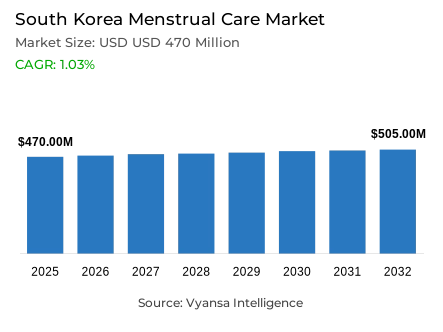
- Menstrual care in South Korea is estimated at USD 470 million in 2025.
- The market size is expected to grow to USD 505 million by 2032.
- Market to register a cagr of around 1.03% during 2026-32.
- Product Type Shares
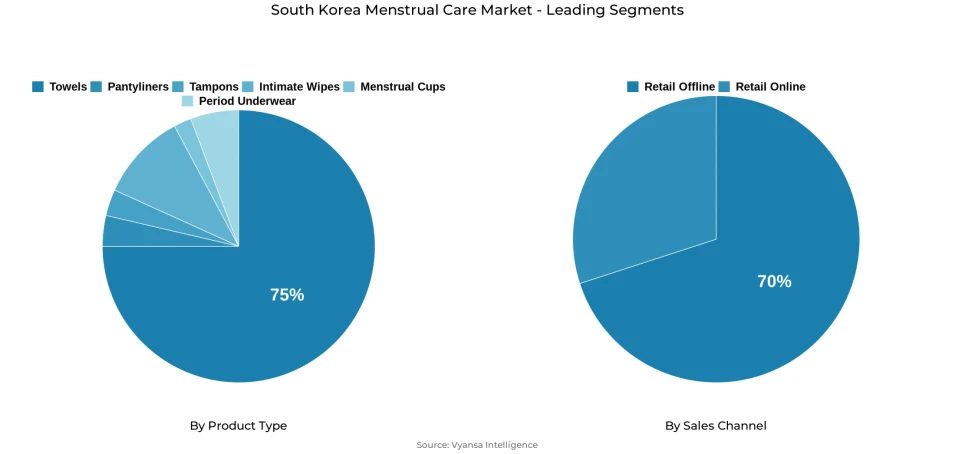
- Towels grabbed market share of 75%.
- Competition
- More than 10 companies are actively engaged in producing menstrual care in South Korea.
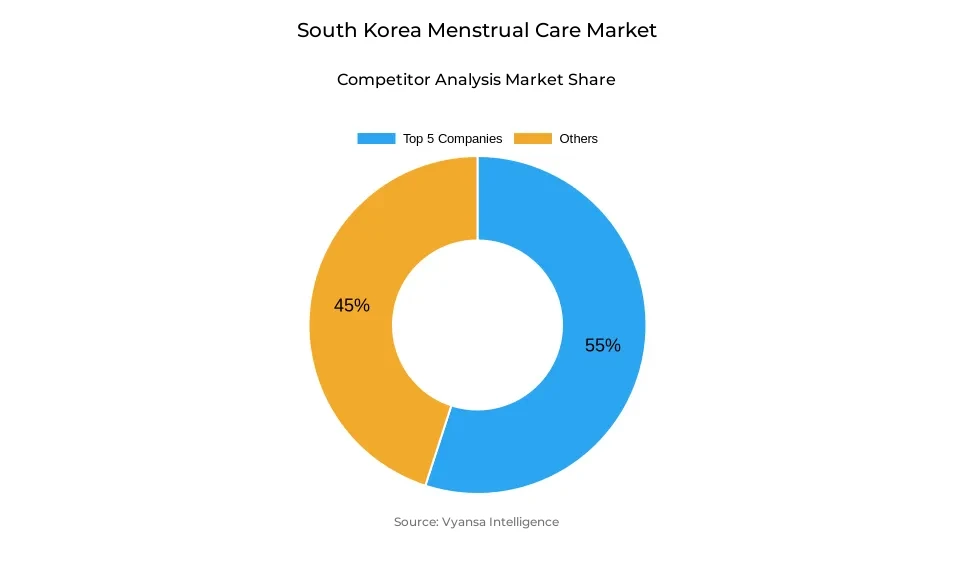
- Top 5 companies acquired around 55% of the market share.
- E-Mart Co Ltd; Homeplus Co Ltd; Lotte Shopping Co Ltd; Yuhan Kimberly Co Ltd; LG Unicharm Co Ltd etc., are few of the top companies.
- Sales Channel
- Retail offline grabbed 70% of the market.
South Korea Menstrual Care Market Outlook
The South Korea menstrual care market is projected to grow to USD 470 million in 2025 and to USD 505 million in 2032 with a low compound annual growth rate of about 1.03% over the forecast period of 2026-2032. The shrinking female population and slowing economy of the country will limit market growth since women between the ages of 12-54 are still decreasing in number. Towels are projected to maintain market leadership with almost 75% market share, with slim, thin, and ultra-thin towels with wings, and tampons are projected to record higher growth rates as more people become familiar with their usage. Nevertheless, the reduction in volume sales due to demographic changes will still constrain the overall growth trend, despite the value sales being supported by premiumisation and product innovation efforts.
Yuhan Kimberly Co. Ltd will retain market leadership with its Kotex brand, which will be supported by good performance in the towels segment, as competitors such as Dong-A Pharmaceutical Co. Ltd Tempo brand will continue to drive growth in the tampons segment due to product accessibility and focused innovation strategies. Many brands are working on quality improvement, comfort maximisation and end user education to boost product adoption, introducing easy-to-use or organic tampon variants, including White Oh! The non-applicator line of My Tampon and Happy Moonday. Overnight and comfortable designs, such as soft-fit menstrual pants and leak-proof overnight pads, will also be in demand in the market as brands focus on enhancing sleep comfort and meeting changing hygiene needs.
The retail offline channels, which constitute about 70% of the market, are also essential because of the convenience of small package formats and emergency access in convenience stores and beauty specialist retailers like Olive Young. Nevertheless, retail retail online is further consolidating its market presence, based on a post-pandemic behavioural change that has become more than half of the total sales volume. Price competitiveness and product range are also provided through online channels, which promote bulk purchasing behaviours among female end user.
Looking ahead, the menstrual care sector in South Korea will be characterized by slow yet stable growth supported by innovation and product diversification strategies. Companies are expected to concentrate on eco-friendly, organic, and premium product offerings to offset demographic challenges. With ongoing product development initiatives and growing end user receptiveness toward modern and sustainable alternatives, the market will continue to evolve despite its limited growth potential.
South Korea Menstrual Care Market Growth Driver
Expanding Awareness of Menstrual Health and Hygiene
The South Korea menstrual care market is experiencing a growth that is driven by increased awareness of menstrual hygiene and the growing demands of comfort among the female end user. end user are also becoming aware of the need to use safe and dermatologically suitable materials, thus they are more likely to use products produced using organic cotton and natural ingredients. The Korean natural cosmetics market, including feminine hygiene products, is recording a stable growth at a compound annual growth rate of 4.05% up to 2035. Brand communication and educational campaigns are promoting increased end user interest in a variety of menstrual care products, such as tampons and pantyliners.
This change of behavior due to awareness is facilitating category premiumisation and encouraging long-term market growth. Brands are focusing on dermatologically tested, breathable, and eco-friendly formulations that are in line with end user expectations of safety and comfort. The South Korea Feminine Hygiene Products Market is estimated at USD 994.33 million in 2023 and is expected to increase to USD 1,951.64 million by 2032 with a CAGR of 7.77%, indicating strong demand of quality-based and innovation-driven menstrual care products.
South Korea Menstrual Care Market Challenge
Declining Female Population and Economic Constraints Limit Growth
The shrinking female population and the economic pressures that are limiting end user spending are a critical challenge facing the South Korea menstrual care market. South Korea has one of the lowest fertility rates in the world at 0.72 children per woman according to data provided by the Organisation for Economic Co-operation and Development (OECD) and Statistics Korea, which is significantly lower than the 2.1 fertility rate needed to stabilise the population. The young population group (19-34 years old) is expected to reduce considerably, as it will drop to around 5.21 million in 2050 compared to 10.21 million in 2020, which directly affects the size of the end user base of menstrual care.
The International Monetary Fund predicts South Korea to grow at 2.5% in 2024 and 2.2% in 2025, which means that the economic growth will be moderate but limited. This two-fold pressure of demographic contraction and average economic growth poses a challenge to volume growth, as many end users shift their attention to low-end necessity products. This means that market players might need to depend on premiumisation policies and niche marketing strategies to remain profitable in an environment where the demand base is shrinking slowly.
Unlock Market Intelligence
Explore the market potential with our data-driven report
South Korea Menstrual Care Market Trend
Shift Toward Organic and Comfortable Menstrual Solutions
The female end user in South Korea are shifting towards organic and high-comfort menstrual care products that are consistent with the health, sustainability, and convenience goals. Companies are focusing on 100% organic cotton covers and dermatologically safe fabrics, which have become very popular with the urban end user groups. The Korean natural cosmetics market, which includes feminine hygiene products, shows a high level of end user interest in the hypoallergenic, dermatologically safe, and environmentally responsible formulations of products. This trend indicates a wider end user shift to ingredient transparency and sustainable, natural product formulations.
The rising popularity of ultra-slim, winged towels and soft-fit pantyliners is evidence of the market shifting towards lifestyle convenience and comfort concerns. This is expected to continue growing as women end user increasingly demand lightweight, breathable, and discreet menstrual products that are both functional and comfortable. The end user research in the area supports the fact that product quality, dermatological safety, and innovation are the major purchase drivers in the menstrual care category.
South Korea Menstrual Care Market Opportunity
Rising Demand for Overnight and Functional Menstrual Products
The growing focus on comfort and health in sleep is opening up opportunities to overnight and functional menstrual care products. The need to have long-term and leak-free nocturnal solutions is growing as more women realise the relationship between quality sleep and reproductive health. The menstrual pants and period underwear market is growing at a very high rate in the world with the Asia-Pacific region, especially South Korea, showing high growth. According to end user research, functionality, comfort, and product innovation are some of the key differentiators that influence purchasing decisions.
This growing end user interest in functional care products like overnight pants and extended-fit towels is poised to drive the next stage of category development. With the increased understanding of menstrual health and the ongoing premiumisation, the brands will probably launch sophisticated, dermatologically tested, and comfort-focused designs that meet the changing end-user needs. The competitive differentiation and market growth in South Korea will continue to focus on innovation in absorbency technologies, fit optimisation, and eco-friendly materials.
Unlock Market Intelligence
Explore the market potential with our data-driven report
South Korea Menstrual Care Market Segmentation Analysis
By Product Type
- Pantyliners
- Tampons
- Towels
- Intimate Wipes
- Menstrual Cups
- Period Underwear
The dominant segment within the product is towels, commanding approximately 75% of the South Korea menstrual care market. Towels remain the most extensively utilized product category, driven by their familiarity, affordability, and variety of options including slim, thin, and ultra-thin towel variants with wings. The majority of female end user continue to prefer these products for their comfort attributes and availability in multiple absorbency levels suitable for both daily and overnight use.
While tampons and menstrual cups are gradually gaining market acceptance, towels maintain categorical dominance due to deeply established user habits and the robust retail presence of premium organic variants. Organic cotton-based towels, marketed as skin-friendly and breathable, continue to attract health-conscious end user segments. The sustained end user preference for high-quality materials and comfort assurance ensures that towels will remain the leading product category throughout the forecast period.
By Sales Channel
- Retail Offline
- Retail Online
The predominant segment within the sales channel classification is retail offline, accounting for approximately 70% of menstrual care sales in South Korea. This channel encompasses convenience stores and health and beauty specialist retailers that remain essential for product accessibility, particularly for immediate or urgent purchase requirements. These retail outlets typically stock popular brand portfolios and smaller package sizes, catering to end users who prioritize convenience and affordability.
Notwithstanding the expansion of online shopping channels, retail offline formats continue to demonstrate strong performance due to frequent promotional discounts, bundle offerings, and the end user confidence placed in in-store purchasing experiences. The tactile shopping experience and immediate product availability reinforce channel relevance, ensuring that retail offline maintains its position as a dominant and stable sales channel within the menstrual care landscape.
List of Companies Covered in South Korea Menstrual Care Market
The companies listed below are highly influential in the South Korea menstrual care market, with a significant market share and a strong impact on industry developments.
- E-Mart Co Ltd
- Homeplus Co Ltd
- Lotte Shopping Co Ltd
- Yuhan Kimberly Co Ltd
- LG Unicharm Co Ltd
- Dong-A Pharmaceutical Co Ltd
- KleanNara Co Ltd
- Welcron Healthcare Corp
- Procter & Gamble Korea Inc
- Boryung Medience Co Ltd
Competitive Landscape
Yuhan-Kimberly Co Ltd maintained its leading position in South Korea’s menstrual care market, driven by the strong performance of its Kotex brand, which continued to generate value sales through a wide range of sanitary towels, while also strengthening its portfolio with innovations such as White Oh! My Tampon, designed for first-time users with an ultra-slim applicator. Dong-A Pharmaceutical Co Ltd followed closely with its Tempo brand, sustaining leadership in tampons through wide availability across convenience stores and health and beauty specialists such as Olive Young. At the same time, niche brands including Happy Moonday and Liberty expanded their visibility via online platforms, appealing to eco-conscious end users with 100% organic cotton tampons and seamless overnight products, while retail e-commerce, as the dominant distribution channel, supported the growth of these specialised brands by enabling access to end users seeking premium and personalised menstrual care options.
Frequently Asked Questions
Related Report
1. Market Segmentation
1.1. Research Scope
1.2. Research Methodology
1.3. Definitions and Assumptions
2. Executive Summary
3. South Korea Menstrual Care Market Policies, Regulations, and Standards
4. South Korea Menstrual Care Market Dynamics
4.1. Growth Factors
4.2. Challenges
4.3. Trends
4.4. Opportunities
5. South Korea Menstrual Care Market Statistics, 2022-2032F
5.1. Market Size & Growth Outlook
5.1.1.By Revenues in USD Million
5.2. Market Segmentation & Growth Outlook
5.2.1.By Product Type
5.2.1.1. Pantyliners- Market Insights and Forecast 2022-2032, USD Million
5.2.1.2. Tampons- Market Insights and Forecast 2022-2032, USD Million
5.2.1.2.1. Applicator Tampons- Market Insights and Forecast 2022-2032, USD Million
5.2.1.2.2. Digital Tampons- Market Insights and Forecast 2022-2032, USD Million
5.2.1.3. Towels- Market Insights and Forecast 2022-2032, USD Million
5.2.1.3.1. Standard Towels- Market Insights and Forecast 2022-2032, USD Million
5.2.1.3.1.1. Standard Towels with Wings- Market Insights and Forecast 2022-2032, USD Million
5.2.1.3.1.2. Standard Towels Without Wings- Market Insights and Forecast 2022-2032, USD Million
5.2.1.3.2. Slim/Thin/Ultra-Thin Towels- Market Insights and Forecast 2022-2032, USD Million
5.2.1.3.2.1. Slim/Thin/Ultra-Thin Towels with Wings- Market Insights and Forecast 2022-2032, USD Million
5.2.1.3.2.2. Slim/Thin/Ultra-Thin Towels Without Wings- Market Insights and Forecast 2022-2032, USD Million
5.2.1.4. Intimate Wipes- Market Insights and Forecast 2022-2032, USD Million
5.2.1.5. Menstrual Cups- Market Insights and Forecast 2022-2032, USD Million
5.2.1.6. Period Underwear- Market Insights and Forecast 2022-2032, USD Million
5.2.2.By Nature
5.2.2.1. Disposable- Market Insights and Forecast 2022-2032, USD Million
5.2.2.2. Reusable- Market Insights and Forecast 2022-2032, USD Million
5.2.3.By Age Group
5.2.3.1. Up to 18 Years- Market Insights and Forecast 2022-2032, USD Million
5.2.3.2. 19-30 Years- Market Insights and Forecast 2022-2032, USD Million
5.2.3.3. 31-40 Years- Market Insights and Forecast 2022-2032, USD Million
5.2.3.4. 40 Years and Above- Market Insights and Forecast 2022-2032, USD Million
5.2.4.By Sales Channel
5.2.4.1. Retail Offline- Market Insights and Forecast 2022-2032, USD Million
5.2.4.2. Retail Online- Market Insights and Forecast 2022-2032, USD Million
5.2.5.By Competitors
5.2.5.1. Competition Characteristics
5.2.5.2. Market Share & Analysis
6. South Korea Pantyliners Menstrual Care Market Statistics, 2022-2032
6.1. Market Size & Growth Outlook
6.1.1.By Revenues in USD Million
6.2. Market Segmentation & Growth Outlook
6.2.1.By Nature- Market Insights and Forecast 2022-2032, USD Million
6.2.2.By Age Group- Market Insights and Forecast 2022-2032, USD Million
6.2.3.By Sales Channel- Market Insights and Forecast 2022-2032, USD Million
7. South Korea Tampons Menstrual Care Market Statistics, 2022-2032
7.1. Market Size & Growth Outlook
7.1.1.By Revenues in USD Million
7.2. Market Segmentation & Growth Outlook
7.2.1.By Product Type- Market Insights and Forecast 2022-2032, USD Million
7.2.2.By Nature- Market Insights and Forecast 2022-2032, USD Million
7.2.3.By Age Group- Market Insights and Forecast 2022-2032, USD Million
7.2.4.By Sales Channel- Market Insights and Forecast 2022-2032, USD Million
8. South Korea Towels Menstrual Care Market Statistics, 2022-2032
8.1. Market Size & Growth Outlook
8.1.1.By Revenues in USD Million
8.2. Market Segmentation & Growth Outlook
8.2.1.By Product Type- Market Insights and Forecast 2022-2032, USD Million
8.2.2.By Nature- Market Insights and Forecast 2022-2032, USD Million
8.2.3.By Age Group- Market Insights and Forecast 2022-2032, USD Million
8.2.4.By Sales Channel- Market Insights and Forecast 2022-2032, USD Million
9. South Korea Intimate Wipes Market Statistics, 2022-2032
9.1. Market Size & Growth Outlook
9.1.1.By Revenues in USD Million
9.2. Market Segmentation & Growth Outlook
9.2.1.By Nature- Market Insights and Forecast 2022-2032, USD Million
9.2.2.By Age Group- Market Insights and Forecast 2022-2032, USD Million
9.2.3.By Sales Channel- Market Insights and Forecast 2022-2032, USD Million
10. South Korea Menstrual Cups Menstrual Care Market Statistics, 2022-2032
10.1. Market Size & Growth Outlook
10.1.1. By Revenues in USD Million
10.2. Market Segmentation & Growth Outlook
10.2.1. By Nature- Market Insights and Forecast 2022-2032, USD Million
10.2.2. By Age Group- Market Insights and Forecast 2022-2032, USD Million
10.2.3. By Sales Channel- Market Insights and Forecast 2022-2032, USD Million
11. South Korea Period Underwear Menstrual Care Market Statistics, 2022-2032
11.1. Market Size & Growth Outlook
11.1.1. By Revenues in USD Million
11.2. Market Segmentation & Growth Outlook
11.2.1. By Nature- Market Insights and Forecast 2022-2032, USD Million
11.2.2. By Age Group- Market Insights and Forecast 2022-2032, USD Million
11.2.3. By Sales Channel- Market Insights and Forecast 2022-2032, USD Million
12. Competitive Outlook
12.1. Company Profiles
12.1.1. Yuhan Kimberly Co Ltd
12.1.1.1. Business Description
12.1.1.2. Product Portfolio
12.1.1.3. Collaborations & Alliances
12.1.1.4. Recent Developments
12.1.1.5. Financial Details
12.1.1.6. Others
12.1.2. LG Unicharm Co Ltd
12.1.2.1. Business Description
12.1.2.2. Product Portfolio
12.1.2.3. Collaborations & Alliances
12.1.2.4. Recent Developments
12.1.2.5. Financial Details
12.1.2.6. Others
12.1.3. Dong-A Pharmaceutical Co Ltd
12.1.3.1. Business Description
12.1.3.2. Product Portfolio
12.1.3.3. Collaborations & Alliances
12.1.3.4. Recent Developments
12.1.3.5. Financial Details
12.1.3.6. Others
12.1.4. KleanNara Co Ltd
12.1.4.1. Business Description
12.1.4.2. Product Portfolio
12.1.4.3. Collaborations & Alliances
12.1.4.4. Recent Developments
12.1.4.5. Financial Details
12.1.4.6. Others
12.1.5. Welcron Healthcare Corp
12.1.5.1. Business Description
12.1.5.2. Product Portfolio
12.1.5.3. Collaborations & Alliances
12.1.5.4. Recent Developments
12.1.5.5. Financial Details
12.1.5.6. Others
12.1.6. E-Mart Co Ltd
12.1.6.1. Business Description
12.1.6.2. Product Portfolio
12.1.6.3. Collaborations & Alliances
12.1.6.4. Recent Developments
12.1.6.5. Financial Details
12.1.6.6. Others
12.1.7. Homeplus Co Ltd
12.1.7.1. Business Description
12.1.7.2. Product Portfolio
12.1.7.3. Collaborations & Alliances
12.1.7.4. Recent Developments
12.1.7.5. Financial Details
12.1.7.6. Others
12.1.8. Lotte Shopping Co Ltd
12.1.8.1. Business Description
12.1.8.2. Product Portfolio
12.1.8.3. Collaborations & Alliances
12.1.8.4. Recent Developments
12.1.8.5. Financial Details
12.1.8.6. Others
12.1.9. Procter & Gamble Korea Inc
12.1.9.1. Business Description
12.1.9.2. Product Portfolio
12.1.9.3. Collaborations & Alliances
12.1.9.4. Recent Developments
12.1.9.5. Financial Details
12.1.9.6. Others
12.1.10. Boryung Medience Co Ltd
12.1.10.1.Business Description
12.1.10.2.Product Portfolio
12.1.10.3.Collaborations & Alliances
12.1.10.4.Recent Developments
12.1.10.5.Financial Details
12.1.10.6.Others
13. Disclaimer
| Segment | Sub-Segment |
|---|---|
| By Product Type |
|
| By Nature |
|
| By Age Group |
|
| By Sales Channel |
|
Research Methodology
This study followed a structured approach comprising four key phases to assess the size and scope of the electro-oxidation market. The process began with thorough secondary research to collect data on the target market, related markets, and broader industry context. These findings, along with preliminary assumptions and estimates, were then validated through extensive primary research involving industry experts from across the value chain. To calculate the overall market size, both top-down and bottom-up methodologies were employed. Finally, market segmentation and data triangulation techniques were applied to refine and validate segment-level estimations.
Secondary Research
The secondary research phase involved gathering data from a wide range of credible and published sources. This step helped in identifying industry trends, defining market segmentation, and understanding the market landscape and value chain.
Sources consulted during this phase included:
- Company annual reports, investor presentations, and press releases
- Industry white papers and certified publications
- Trade directories and market-recognized databases
- Articles from authoritative authors and reputable journals
- Gold and silver standard websites
Secondary research was critical in mapping out the industry's value chain and monetary flow, identifying key market segments, understanding regional variations, and tracking significant industry developments.
Other key sources:
- Financial disclosures
- Industry associations and trade bodies
- News outlets and business magazines
- Academic journals and research studies
- Paid industry databases
Primary Research
To validate secondary data and gain deeper market insights, primary research was conducted with key stakeholders across both the supply and demand sides of the market.
On the demand side, participants included decision-makers and influencers from end-user industries—such as CIOs, CTOs, and CSOs—who provided first-hand perspectives on market needs, product usage, and future expectations.
On the supply side, interviews were conducted with manufacturers, industry associations, and institutional participants to gather insights into current offerings, product pipelines, and market challenges.
Primary interviews provided critical inputs such as:
- Market size and revenue data
- Product and service breakdowns
- Market forecasts
- Regional and application-specific trends
Stakeholders consulted included:
- Leading OEM and solution providers
- Channel and distribution partners
- End users across various applications
- Independent consultants and industry specialists
Market Size Estimation and Data Triangulation
- Identifying Key Market Participants (Secondary Research)
- Goal: To identify the major players or companies in the target market. This typically involves using publicly available data sources such as industry reports, market research publications, and financial statements of companies.
- Tools: Reports from firms like Gartner, Forrester, Euromonitor, Statista, IBISWorld, and others. Public financial statements, news articles, and press releases from top market players.
- Extracting Earnings of Key Market Participants
- Goal: To estimate the earnings generated from the product or service being analyzed. This step helps in understanding the revenue potential of each market player in a specific geography.
- Methods: Earnings data can be gathered from:
- Publicly available financial reports (for listed companies).
- Interviews and primary data sources from professionals, such as Directors, VPs, SVPs, etc. This is especially useful for understanding more nuanced, internal data that isn't publicly disclosed.
- Annual reports and investor presentations of key players.
- Data Collation and Development of a Relevant Data Model
- Goal: To collate inputs from both primary and secondary sources into a structured, data-driven model for market estimation. This model will incorporate key market KPIs and any independent variables relevant to the market.
- Key KPIs: These could include:
- Market size, growth rate, and demand drivers.
- Industry-specific metrics like market share, average revenue per customer (ARPC), or average deal size.
- External variables, such as economic growth rates, inflation rates, or commodity prices, that could affect the market.
- Data Modeling: Based on this data, the market forecasts are developed for the next 5 years. A combination of trend analysis, scenario modeling, and statistical regression might be used to generate projections.
- Scenario Analysis
- Goal: To test different assumptions and validate how sensitive the market is to changes in key variables (e.g., market demand, regulatory changes, technological disruptions).
- Types of Scenarios:
- Base Case: Based on current assumptions and historical data.
- Best-Case Scenario: Assuming favorable market conditions, regulatory environments, and technological advancements.
- Worst-Case Scenario: Accounting for adverse factors, such as economic downturns, stricter regulations, or unexpected disruptions.












