South Korea Digestive Remedies Market Report: Trends, Growth and Forecast (2026-2032)
By Product Type (Paediatric Digestive Remedies (Paediatric Diarrhoeal Remedies, Paediatric Indigestion & Heartburn Remedies, Paediatric Laxatives, Paediatric Motion Sickness Remedies), Diarrhoeal Remedies, IBS Treatments, Indigestion & Heartburn Remedies (Antacids, Antiflatulents, Digestive Enzymes, H2 Blockers, Proton Pump Inhibitors), Laxatives, Motion Sickness Remedies), By Age Group (Children & Adolescents (01-17 years), Adults (18-65 years), Geriatric (65+ years)), By Sales Channel (Retail Online, Retail Offline (Hospitals, Clinics, Pharmacies)) ... Read more
|
Major Players
|
South Korea Digestive Remedies Market Statistics and Insights, 2026
- Market Size Statistics
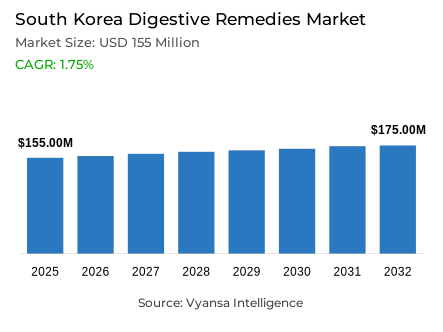
- Digestive remedies market size in South Korea was valued at USD 155 million in 2025 and is estimated at USD 160 Million in 2026.
- The market size is expected to grow to USD 175 million by 2032.
- Market to register a CAGR of around 1.75% during 2026-32.
- Product Type Shares
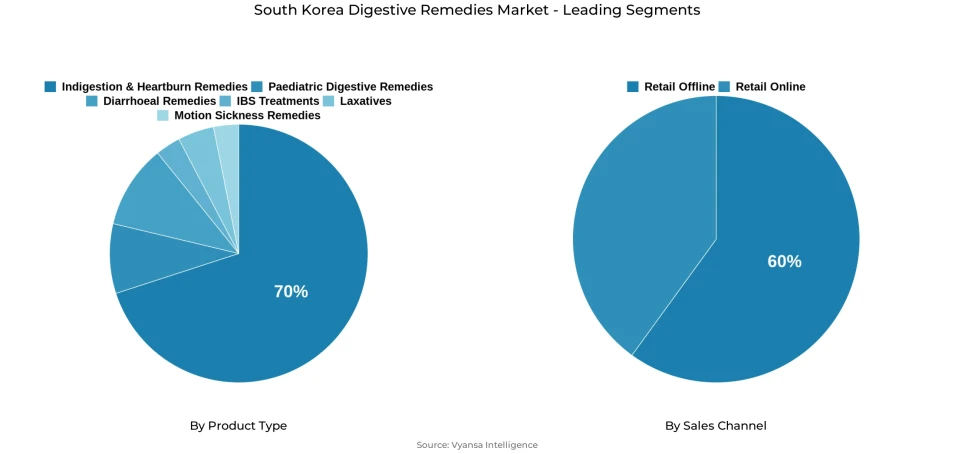
- Indigestion & heartburn remedies grabbed market share of 70%.
- Competition
- More than 15 companies are actively engaged in producing digestive remedies in South Korea.
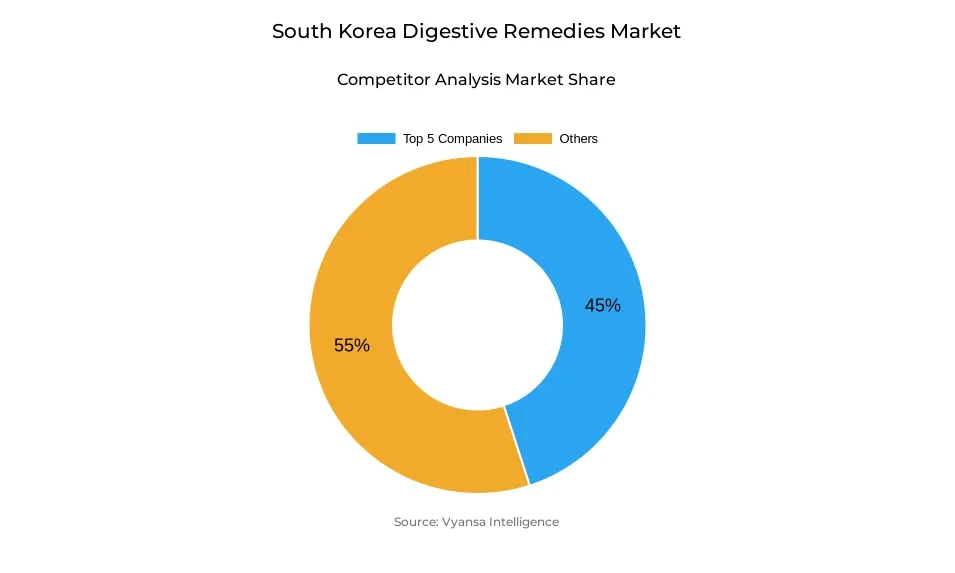
- Top 5 companies acquired around 45% of the market share.
- Daewoong Pharmaceutical Co Ltd, Handok Inc, Sam Sung Pharmaceutical Co Ltd, Dong Wha Pharmaceutical Industrial Co Ltd, Boehringer Ingelheim Korea Ltd etc., are few of the top companies.
- Sales Channel
- Retail offline grabbed 60% of the market.
South Korea Digestive Remedies Market Outlook
South Korea digestive remedies market size was valued at USD 155 million in 2025 and is projected to grow from USD 160 million in 2026 to USD 175 million by 2032, exhibiting a CAGR of 1.75% during the forecast period. The growth remains modest, reflecting the mature nature of the category and stable, routine demand patterns.
Steady reliance on quick meals and eating out continues to support the use of digestive remedies in daily life. In a fast-paced environment, rushed meals, overeating, and irregular food habits frequently lead to indigestion, fullness, and heartburn. This keeps demand consistent, as consumers depend on familiar digestive remedies for regular symptom relief rather than occasional use.
However, pricing pressure remains a key challenge due to strong cross-border shopping and easy online price comparison. Consumers can shift to lower-priced overseas options when product differentiation is limited, making it harder for brands to maintain premium pricing. Despite this, indigestion and heartburn remedies hold the leading position with a 70% share, supported by their relevance in everyday digestive discomfort and preference for fast, trusted solutions.
A gradual shift toward lighter, natural, and wellness-focused options is also shaping the category. Enzyme-based and supplement-style alternatives are gaining interest, especially among younger consumers seeking preventive care. At the same time, retail offline channels account for 60% of sales, as pharmacies and physical stores remain the preferred route for purchasing digestive remedies due to trust, accessibility, and immediate need for relief.
South Korea Digestive Remedies Market Growth DriverFast Meals Keep Everyday Relief Relevant
One of the main reason for growth in South Korea digestive remedies market is the consistent consumption of fast foods and eating out, which keeps digestive problems at a constant baseline. The market is a mature market; however, consumers still require their regular digestive remedy products for consistent digestive comfort. Urban living leads to the frequent occurrence of indigestion, bloating, and acid reflux after quick meals or just over eating and eating at misc times (irregularly). This means that people will continue to require digestion relief products.
According to official household statistic reports, in Q1 2025, the average amount spent monthly on food and non-alcoholic beverages in the home in Korea increased year on year by 2.6%; while the average amount spent in restaurants/hotels during that same time period increased year on year by 2.1%. The continued consumption of food away from prepared at home limits the relevance of digestion symptom relief products everyday.
South Korea Digestive Remedies Market ChallengeCross-Border Buying Pressures Local Brand Pricing
South Korea digestive remedies market faces problem with the pricing pressure that is caused due to international shopping. Import brands such as Cabagin try to maintain pricing to reduce international shopping. This is a challenge for digestive remedy brands because consumers in a slow-moving market can compare prices and look for alternative options at cheaper prices from international sources.
Statistics Korea reports that online overseas direct purchases in South Korea totaled KRW 2.1762 trillion in the second quarter of 2025. This reflects a 5.6% year-over-year increase. Meanwhile, online direct purchases in China totaled KRW 1.4660 trillion. This was the highest share in the online direct purchases by region. This high level of online direct purchases in South Korea makes it difficult for local distributors and import brands to maintain high prices in the mature market.
Unlock Market Intelligence
Explore the market potential with our data-driven report
South Korea Digestive Remedies Market TrendGentle Daily-Wellness Solutions Gain More Attention
South Korea digestive market is seeing the growing preference for digestive health that is light, natural, and easy to incorporate into one’s lifestyle. Dietary supplements have become alternatives to traditional digestive remedies to treat mild symptoms. Enzyme-based dietary supplements containing papain and bromelain have become popular in the market. This is because these products align with the growing preference for gentle, non-prescription, and lifestyle-friendly digestive health.
This growing preference for digestive health is also in alignment with the overall behavior of consumers in the country. Statistics Korea reported that 38.4% of people aged 13 and over experience stress in their daily life. Meanwhile, the 2025 KNHANES framework by the Korean Data Analysis Bureau also continues to monitor dietary supplements and the frequency of eating out as key nutrition behaviors.
South Korea Digestive Remedies Market OpportunityConvenience-Store Expansion Creates Accessible White Space
South Korea can grow with wider access through non-pharmacy retail, especially convenience stores. Only a limited set of emergency-use OTC products can currently be sold outside pharmacies, but digestive aids are already part of this late-hour self-care space. In a mature category, even small channel expansion can help brands improve visibility, trial, and impulse purchase, particularly for mild digestive discomfort that does not require a pharmacist consultation.
The channel potential is meaningful because convenience stores already have a large physical footprint in South Korea’s retail system. Statistics Korea’s preliminary 2024 Franchise Survey shows that convenience stores account for 17.5% of all franchise establishments, the highest share among franchise business types. This gives digestive remedy brands a clear access opportunity if more eligible OTC digestive products are allowed through this route.
Unlock Market Intelligence
Explore the market potential with our data-driven report
South Korea Digestive Remedies Market Segmentation Analysis
By Product Type
- Paediatric Digestive Remedies
- Paediatric Diarrhoeal Remedies
- Paediatric Indigestion & Heartburn Remedies
- Paediatric Laxatives
- Paediatric Motion Sickness Remedies
- Diarrhoeal Remedies
- IBS Treatments
- Indigestion & Heartburn Remedies
- Antacids
- Antiflatulents
- Digestive Enzymes
- H2 Blockers
- Proton Pump Inhibitors
- Laxatives
- Motion Sickness Remedies
The segment has the highest share around segment under the product type of indigestion & heartburn remedies, with a 70% market share. This segment leads because South Korean consumers largely depend on familiar products for routine digestive support, and indigestion-type complaints are the most common occasions for self-medication. In a mature category with limited breakthrough innovation, fast and trusted relief remains the biggest purchase driver.
This dominance also fits current household spending behavior. In the first quarter of 2025, food and non-alcoholic beverages account for 15.1% of monthly household consumption expenditure, while restaurants and hotels account for 14.8%. With food-related spending staying high, remedies linked to post-meal discomfort, heaviness, and acidity continue to hold the strongest position in the category.
By Sales Channel
- Retail Online
- Retail Offline
- Hospitals
- Clinics
- Pharmacies
The segment has the highest share around segment under the sales channel of retail offline, with a 60% market share. This channel leads because digestive remedies in South Korea are still mainly purchased through pharmacies and other physical outlets, where consumers trust store access, pharmacist guidance, and familiar brands. Offline buying remains important for immediate symptom relief and repeat purchases in a category built on routine habits rather than strong innovation.
This offline strength continues even as digital commerce expands. In June 2025, South Korea’s mobile shopping transaction value reaches KRW 17.0339 trillion, up 4.6% year on year, and mobile accounts for 77.8% of online shopping value. Even with this digital scale, MFDS still maintains a separate “safety OTC medicines” framework for limited non-pharmacy sale, which helps preserve the importance of offline pharmacy-led distribution in digestive remedies.
List of Companies Covered in South Korea Digestive Remedies Market
The companies listed below are highly influential in the South Korea digestive remedies market, with a significant market share and a strong impact on industry developments.
- Daewoong Pharmaceutical Co Ltd
- Handok Inc
- Sam Sung Pharmaceutical Co Ltd
- Dong Wha Pharmaceutical Industrial Co Ltd
- Boehringer Ingelheim Korea Ltd
- Dong-A Pharmaceutical Co Ltd
- Boryung Pharmaceutical Co Ltd
- Myung In Pharm Co Ltd
- Dong Sung Bio Pharm Co Ltd
- Kowa Korea Co Ltd
Competitive Landscape
The competitive landscape of digestive remedies in South Korea remains relatively stable and concentrated, characterised by strong brand loyalty and limited disruptive innovation. Leading domestic players such as Dong Wha Pharmaceutical Industrial Co Ltd maintain dominance through well-established brands like Gas Whalmyungsoo-Q, which benefit from long-standing consumer trust and emotional resonance. Meanwhile, imported brands such as Cabegin, distributed by Korea Kowa Co Ltd, are strengthening their position through strategic price adjustments and efforts to curb cross-border purchases. Other players, including Dong-A Pharmaceutical Co Ltd, are focusing on product line extensions and herbal-based formulations to differentiate in a largely homogeneous market. Overall, competition is driven more by brand heritage, pricing strategies, and incremental innovation rather than breakthrough developments, reflecting the mature nature of the category.
Frequently Asked Questions
Related Report
- Market Segmentation
- Research Scope
- Research Methodology
- Definitions and Assumptions
- Executive Summary
- South Korea Digestive Remedies Market Policies, Regulations, and Standards
- South Korea Digestive Remedies Market Dynamics
- Growth Factors
- Challenges
- Trends
- Opportunities
- South Korea Digestive Remedies Market Statistics, 2022-2032F
- Market Size & Growth Outlook
- By Revenues in USD Million
- Market Segmentation & Growth Outlook
- By Product Type
- Paediatric Digestive Remedies- Market Insights and Forecast 2022-2032, USD Million
- Paediatric Diarrhoeal Remedies- Market Insights and Forecast 2022-2032, USD Million
- Paediatric Indigestion & Heartburn Remedies- Market Insights and Forecast 2022-2032, USD Million
- Paediatric Laxatives- Market Insights and Forecast 2022-2032, USD Million
- Paediatric Motion Sickness Remedies- Market Insights and Forecast 2022-2032, USD Million
- Diarrhoeal Remedies- Market Insights and Forecast 2022-2032, USD Million
- IBS Treatments- Market Insights and Forecast 2022-2032, USD Million
- Indigestion & Heartburn Remedies- Market Insights and Forecast 2022-2032, USD Million
- Antacids- Market Insights and Forecast 2022-2032, USD Million
- Antiflatulents- Market Insights and Forecast 2022-2032, USD Million
- Digestive Enzymes- Market Insights and Forecast 2022-2032, USD Million
- H2 Blockers- Market Insights and Forecast 2022-2032, USD Million
- Proton Pump Inhibitors- Market Insights and Forecast 2022-2032, USD Million
- Laxatives- Market Insights and Forecast 2022-2032, USD Million
- Motion Sickness Remedies- Market Insights and Forecast 2022-2032, USD Million
- Paediatric Digestive Remedies- Market Insights and Forecast 2022-2032, USD Million
- By Age Group
- Children & Adolescents (01-17 years)- Market Insights and Forecast 2022-2032, USD Million
- Adults (18-65 years)- Market Insights and Forecast 2022-2032, USD Million
- Geriatric (65+ years)- Market Insights and Forecast 2022-2032, USD Million
- By Sales Channel
- Retail Online- Market Insights and Forecast 2022-2032, USD Million
- Retail Offline- Market Insights and Forecast 2022-2032, USD Million
- Hospitals- Market Insights and Forecast 2022-2032, USD Million
- Clinics- Market Insights and Forecast 2022-2032, USD Million
- Pharmacies- Market Insights and Forecast 2022-2032, USD Million
- By Competitors
- Competition Characteristics
- Market Share & Analysis
- By Product Type
- Market Size & Growth Outlook
- South Korea Paediatric Digestive Remedies Market Statistics, 2022-2032
- Market Size & Growth Outlook
- By Revenues in USD Million
- Market Segmentation & Growth Outlook
- By Age Group- Market Insights and Forecast 2022-2032, USD Million
- By Sales Channel- Market Insights and Forecast 2022-2032, USD Million
- Market Size & Growth Outlook
- South Korea Diarrhoeal Remedies Market Statistics, 2022-2032
- Market Size & Growth Outlook
- By Revenues in USD Million
- Market Segmentation & Growth Outlook
- By Age Group- Market Insights and Forecast 2022-2032, USD Million
- By Sales Channel- Market Insights and Forecast 2022-2032, USD Million
- Market Size & Growth Outlook
- South Korea IBS Treatments Market Statistics, 2022-2032
- Market Size & Growth Outlook
- By Revenues in USD Million
- Market Segmentation & Growth Outlook
- By Age Group- Market Insights and Forecast 2022-2032, USD Million
- By Sales Channel- Market Insights and Forecast 2022-2032, USD Million
- Market Size & Growth Outlook
- South Korea Indigestion & Heartburn Remedies Market Statistics, 2022-2032
- Market Size & Growth Outlook
- By Revenues in USD Million
- Market Segmentation & Growth Outlook
- By Age Group- Market Insights and Forecast 2022-2032, USD Million
- By Sales Channel- Market Insights and Forecast 2022-2032, USD Million
- Market Size & Growth Outlook
- South Korea Laxatives Market Statistics, 2022-2032
- Market Size & Growth Outlook
- By Revenues in USD Million
- Market Segmentation & Growth Outlook
- By Age Group- Market Insights and Forecast 2022-2032, USD Million
- By Sales Channel- Market Insights and Forecast 2022-2032, USD Million
- Market Size & Growth Outlook
- South Korea Motion Sickness Remedies Market Statistics, 2022-2032
- Market Size & Growth Outlook
- By Revenues in USD Million
- Market Segmentation & Growth Outlook
- By Age Group- Market Insights and Forecast 2022-2032, USD Million
- By Sales Channel- Market Insights and Forecast 2022-2032, USD Million
- Market Size & Growth Outlook
- Competitive Outlook
- Company Profiles
- Dong Wha Pharmaceutical Industrial Co Ltd
- Business Description
- Product Portfolio
- Collaborations & Alliances
- Recent Developments
- Financial Details
- Others
- Boehringer Ingelheim Korea Ltd
- Business Description
- Product Portfolio
- Collaborations & Alliances
- Recent Developments
- Financial Details
- Others
- Dong-A Pharmaceutical Co Ltd
- Business Description
- Product Portfolio
- Collaborations & Alliances
- Recent Developments
- Financial Details
- Others
- Boryung Pharmaceutical Co Ltd
- Business Description
- Product Portfolio
- Collaborations & Alliances
- Recent Developments
- Financial Details
- Others
- Myung In Pharm Co Ltd
- Business Description
- Product Portfolio
- Collaborations & Alliances
- Recent Developments
- Financial Details
- Others
- Daewoong Pharmaceutical Co Ltd
- Business Description
- Product Portfolio
- Collaborations & Alliances
- Recent Developments
- Financial Details
- Others
- Handok Inc
- Business Description
- Product Portfolio
- Collaborations & Alliances
- Recent Developments
- Financial Details
- Others
- Sam Sung Pharmaceutical Co Ltd
- Business Description
- Product Portfolio
- Collaborations & Alliances
- Recent Developments
- Financial Details
- Others
- Dong Sung Bio Pharm Co Ltd
- Business Description
- Product Portfolio
- Collaborations & Alliances
- Recent Developments
- Financial Details
- Others
- Kowa Korea Co Ltd
- Business Description
- Product Portfolio
- Collaborations & Alliances
- Recent Developments
- Financial Details
- Others
- Dong Wha Pharmaceutical Industrial Co Ltd
- Company Profiles
- Disclaimer
| Segment | Sub-Segment |
|---|---|
| By Product Type |
|
| By Age Group |
|
| By Sales Channel |
|
Research Methodology
This study followed a structured approach comprising four key phases to assess the size and scope of the electro-oxidation market. The process began with thorough secondary research to collect data on the target market, related markets, and broader industry context. These findings, along with preliminary assumptions and estimates, were then validated through extensive primary research involving industry experts from across the value chain. To calculate the overall market size, both top-down and bottom-up methodologies were employed. Finally, market segmentation and data triangulation techniques were applied to refine and validate segment-level estimations.
Secondary Research
The secondary research phase involved gathering data from a wide range of credible and published sources. This step helped in identifying industry trends, defining market segmentation, and understanding the market landscape and value chain.
Sources consulted during this phase included:
- Company annual reports, investor presentations, and press releases
- Industry white papers and certified publications
- Trade directories and market-recognized databases
- Articles from authoritative authors and reputable journals
- Gold and silver standard websites
Secondary research was critical in mapping out the industry's value chain and monetary flow, identifying key market segments, understanding regional variations, and tracking significant industry developments.
Other key sources:
- Financial disclosures
- Industry associations and trade bodies
- News outlets and business magazines
- Academic journals and research studies
- Paid industry databases
Primary Research
To validate secondary data and gain deeper market insights, primary research was conducted with key stakeholders across both the supply and demand sides of the market.
On the demand side, participants included decision-makers and influencers from end-user industries—such as CIOs, CTOs, and CSOs—who provided first-hand perspectives on market needs, product usage, and future expectations.
On the supply side, interviews were conducted with manufacturers, industry associations, and institutional participants to gather insights into current offerings, product pipelines, and market challenges.
Primary interviews provided critical inputs such as:
- Market size and revenue data
- Product and service breakdowns
- Market forecasts
- Regional and application-specific trends
Stakeholders consulted included:
- Leading OEM and solution providers
- Channel and distribution partners
- End users across various applications
- Independent consultants and industry specialists
Market Size Estimation and Data Triangulation
- Identifying Key Market Participants (Secondary Research)
- Goal: To identify the major players or companies in the target market. This typically involves using publicly available data sources such as industry reports, market research publications, and financial statements of companies.
- Tools: Reports from firms like Gartner, Forrester, Euromonitor, Statista, IBISWorld, and others. Public financial statements, news articles, and press releases from top market players.
- Extracting Earnings of Key Market Participants
- Goal: To estimate the earnings generated from the product or service being analyzed. This step helps in understanding the revenue potential of each market player in a specific geography.
- Methods: Earnings data can be gathered from:
- Publicly available financial reports (for listed companies).
- Interviews and primary data sources from professionals, such as Directors, VPs, SVPs, etc. This is especially useful for understanding more nuanced, internal data that isn't publicly disclosed.
- Annual reports and investor presentations of key players.
- Data Collation and Development of a Relevant Data Model
- Goal: To collate inputs from both primary and secondary sources into a structured, data-driven model for market estimation. This model will incorporate key market KPIs and any independent variables relevant to the market.
- Key KPIs: These could include:
- Market size, growth rate, and demand drivers.
- Industry-specific metrics like market share, average revenue per customer (ARPC), or average deal size.
- External variables, such as economic growth rates, inflation rates, or commodity prices, that could affect the market.
- Data Modeling: Based on this data, the market forecasts are developed for the next 5 years. A combination of trend analysis, scenario modeling, and statistical regression might be used to generate projections.
- Scenario Analysis
- Goal: To test different assumptions and validate how sensitive the market is to changes in key variables (e.g., market demand, regulatory changes, technological disruptions).
- Types of Scenarios:
- Base Case: Based on current assumptions and historical data.
- Best-Case Scenario: Assuming favorable market conditions, regulatory environments, and technological advancements.
- Worst-Case Scenario: Accounting for adverse factors, such as economic downturns, stricter regulations, or unexpected disruptions.












