South Korea Dermatologicals Market Report: Trends, Growth and Forecast (2026-2032)
By Category (Medicated Shampoos, Topical Antifungals, Vaginal Antifungals, Hair Loss Treatments, Nappy (Diaper) Rash Treatments, Antiparasitics/Lice (Head and Body) Treatments, Antipruritics, Cold Sore Treatments, Haemorrhoid Treatments, Paediatric Dermatologicals, Topical Allergy Remedies/Antihistamines, Topical Germicidals/Antiseptics), By Dispensing Status (Prescription-based Drugs, Over-the-counter Drugs), By Route of Administration (Topical Administration, Oral Administration, Parenteral Administration), By Drug Type (Branded, Generics), By Skin Condition (Acne, Dermatitis, Psoriasis, Skin Cancer, Rosacea, Alopecia, Fungal Infections, Others), By End User (Hospitals, Cosmetic Centers, Dermatology Clinics, Homecare, Others), By Sales Channel (Retail Offline, Retail Online) ... Read more

|
Major Players
|
South Korea Dermatologicals Market Statistics and Insights, 2026
- Market Size Statistics
- Dermatologicals in South Korea is estimated at USD 80 million in 2025.
- The market size is expected to grow to USD 85 million by 2032.
- Market to register a cagr of around 0.87% during 2026-32.
- Category Shares
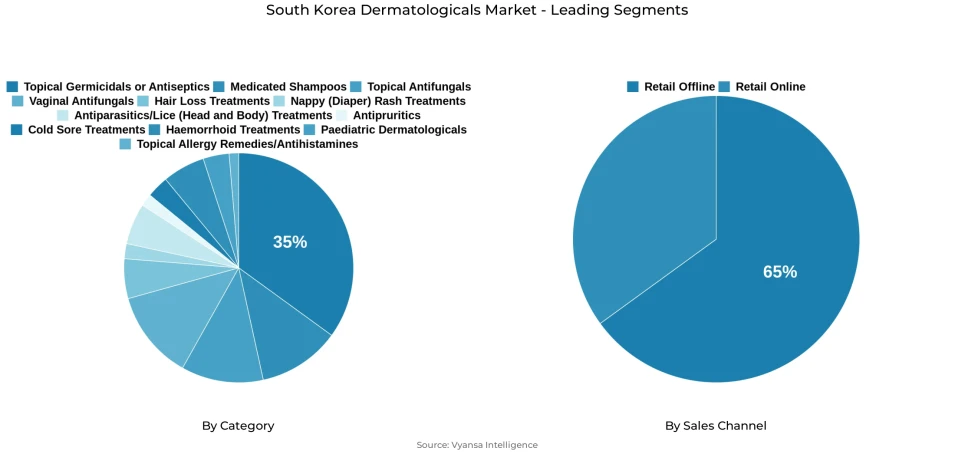
- Topical germicidals/antiseptics grabbed market share of 35%.
- Competition
- More than 15 companies are actively engaged in producing dermatologicals in South Korea.
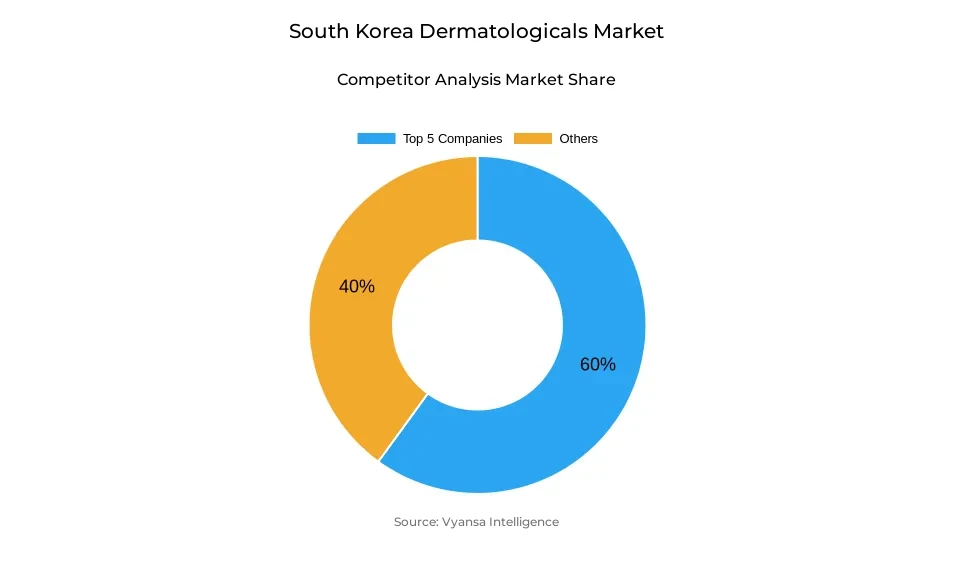
- Top 5 companies acquired around 60% of the market share.
- Huons Co Ltd; Yuhan Corp; A Menarini Korea Ltd; Dong Wha Pharmaceutical Industrial Co Ltd; DongKook Pharmaceutical Co Ltd etc., are few of the top companies.
- Sales Channel
- Retail offline grabbed 65% of the market.
South Korea Dermatologicals Market Outlook
The South Korea dermatologicals market is expected to witness growth through 2026–2032, reflecting continued end user focus on skin care and therapeutic solutions. The market is estimated at nearly USD 80 million in 2025 and is projected to reach USD 85 million by 2032, recording a CAGR of around 0.87% during 2026–2032. Although this indicates a modest trajectory, specific sub-categories like vaginal antifungals have demonstrated resilience due to awareness campaigns that decrease stigma and call for proactive intimate health care.
Educational initiatives-in 2025, for example, major brands' "Y So Serious?" campaign-helped to reposition vaginal health treatments as part of normal self-care. Demand and end user confidence have grown through such programs as a way to manage conditions affecting a large share of women. Conversely, supply issues-for example with medicated shampoo products-highlight the importance of efficient distribution and clear manufacturer communication to maintain product availability.
In South Korea, traditional derm products like topical germicidals and antiseptics continue to be very relevant to help deal with minor skin injuries and infections fostered by climate and lifestyle factors. These products hold a meaningful share of overall category usage and are often first-line choices for everyday dermatological care. Topical Germicidals/Antiseptics hold around 35% of category share, illustrating their continued importance to end users.
Despite this, retail still remains predominantly offline, which captures around 65% of total sales, as the local pharmacy remains a trusted source of professional advice. Many end users, especially for medically oriented products, will take guidance in person for the selection of treatment. While online channels do start to grow in popularity for convenience, the specialized nature of dermatological solutions keeps traditional retail at the forefront. In summary, the market is well-positioned for steady continuity, even while end user behaviour and product positioning will continue to evolve.
South Korea Dermatologicals Market Growth DriverHigh Internet Penetration Supports Health Literacy
The very high degree of digital connectivity in South Korea promotes awareness generally about health and dermatological issues. About 97% use the internet, making this one of the most digitally networked societies worldwide, with almost universal broadband and smartphone adoption.
Pervasive access to the internet now enables end users to share, receive, and discuss various forms of health information online, including skin condition guidance, product reviews, and expert opinion. More people than ever make informed choices regarding dermatological treatments, compare therapeutic options, and learn about product usage before actually going to the pharmacy. Such strong digital infrastructure supports health literacy and shapes patient expectations, embracing preventive skin care and informed choices of products.
South Korea Dermatologicals Market ChallengeAging Population Places Demand on Health Services
The aging trend in the demography of South Korea persists as a structural challenge for the dermatological sector. According to the data provided by WHO, the country has a huge population base of older adults, which contributes to higher prevalence for chronic and age-related skin conditions like eczema and dermatitis.
An aging population generates wide demand for healthcare services but also puts pressure on the medical systems and patient access due to higher needs within most specialties. This may result in some competition for healthcare attention and resources, probably steering such attention away from dermatological care or delaying treatment for minor skin problems. The demographic trend therefore presents both opportunity and resource constraints within the wider health landscape.
Unlock Market Intelligence
Explore the market potential with our data-driven report
South Korea Dermatologicals Market TrendShift Toward Consumer Education over New Product Launches
The key trends in the South Korea dermatologicals market relates to increased end user education rather than frequent product innovations. The players are now investing in campaigns aimed at explaining the correct usage of products-for example, telling when a particular topical treatment is required for a specific skin concern. This educational approach further instills confidence in end users and aids positive outcomes.
It also reflects a broader global health communication trend: end users want clear, reliable information before the purchase or use of any product. As end users become increasingly better educated about skin concerns, transparency regarding ingredients, use, and support for specific skin conditions builds brand credibility. This also captures the high internet engagement of South Korea, where detailed content reaches end users quickly and drives purchase decisions.
South Korea Dermatologicals Market OpportunityBridging Therapeutic and Dermocosmetic Segments
The integration of dermatological science and cosmetic care opens up new opportunities, especially for dermocosmetic products. This is seen in companies developing pharmaceutical dermatological products that have entered the functional skincare market using wound-healing botanicals and clinical extracts to give a therapeutic assurance along with beauty benefits by blending efficacy into daily cosmetic use.
Given South Korea's strong reputation in skin care and cosmetic innovation, the country is well-positioned to capitalize on this trend. Dermocosmetics with dermatologist-approved ingredients and clinical backings can attract end users seeking advanced skin solutions without being framed as strictly clinical. This convergence supports broader category relevance and expands the addressable market beyond traditional therapeutic segments
Unlock Market Intelligence
Explore the market potential with our data-driven report
South Korea Dermatologicals Market Segmentation Analysis
By Category
- Medicated Shampoos
- Topical Antifungals
- Vaginal Antifungals
- Hair Loss Treatments
- Nappy (Diaper) Rash Treatments
- Antiparasitics/Lice (Head and Body) Treatments
- Antipruritics
- Cold Sore Treatments
- Haemorrhoid Treatments
- Paediatric Dermatologicals
- Topical Allergy Remedies/Antihistamines
- Topical Germicidals/Antiseptics
The segment with highest market share under Category is Topical Germicidals/Antiseptics, as it holds nearly 35% of the South Korea dermatologicals market. Products for the care of minor skin injuries, cuts, burns, and bacterial irritations are widely present in average households because these are usually first-aid supplies of wide application and preventive value.
High internet penetration and awareness of health improve self-management of simple skin conditions, whereby end users use antiseptics for early care instead of visiting clinics. Such widespread use across age groups forms the basis for stable demand in this segment, hence reinforcing its leadership position and resilience through the forecast period.
By Sales Channel
- Retail Offline
- Retail Online
The segment with highest market share under Sales Channel is Retail Offline that has captured the maximum share, holding about 65% of the total sales. The main channel for dermatological product purchases continues to be pharmacies, with professional advice sought regarding the therapeutic efficacy of a particular product or its strength and how it should be used.
Guidance by a pharmacist instills confidence, especially in clinical or medicated solutions that need to be carefully selected. While it is gaining momentum, with more people buying their products online through retail online and other digital channels, the nature of skin care requires consultations or reassurance, which keeps the offline retail mode dominant. Other contributors include supermarket chains and drugstores, but they all have to take a backseat to pharmacies, as this will remain the cornerstone in which dermatological retail in South Korea remains credible and well-supported by experts.
List of Companies Covered in South Korea Dermatologicals Market
The companies listed below are highly influential in the South Korea dermatologicals market, with a significant market share and a strong impact on industry developments.
- Huons Co Ltd
- Yuhan Corp
- A Menarini Korea Ltd
- Dong Wha Pharmaceutical Industrial Co Ltd
- DongKook Pharmaceutical Co Ltd
- Bayer Korea Ltd
- Hyundai Pharmaceutical Co Ltd
- Haleon Korea Co Ltd
- Sam A Pharmaceutical Co Ltd
- Whan In Pharm Co Ltd
Competitive Landscape
South Korea’s dermatologicals market in 2025 shows contrasting dynamics, with vaginal antifungals gaining momentum thanks to awareness efforts such as Canesten’s “Y So Serious?” campaign, which normalises intimate-health discussions and reduces stigma. Supply disruption shaped competitive conditions as Nizoral, a leading medicated shampoo, faced months-long shortages following a packaging change and manufacturing shift, limiting availability across pharmacies and online channels. Pharmacies remain the dominant distribution channel, reinforced by consumer reliance on pharmacist guidance and the specialised nature of treatments. Meanwhile, competitive pressure is intensifying within topical antifungals as prescription products like Jublia strengthen their position despite generic erosion, prompting OTC leaders such as Fulcare to refresh packaging to retain visibility. Increasing emphasis on consumer education and the expansion of pharmaceutical companies into beauty also influence competitive dynamics.
Frequently Asked Questions
Related Report
1. Market Segmentation
1.1. Research Scope
1.2. Research Methodology
1.3. Definitions and Assumptions
2. Executive Summary
3. South Korea Dermatologicals Market Policies, Regulations, and Standards
4. South Korea Dermatologicals Market Dynamics
4.1. Growth Factors
4.2. Challenges
4.3. Trends
4.4. Opportunities
5. South Korea Dermatologicals Market Statistics, 2022-2032F
5.1. Market Size & Growth Outlook
5.1.1.By Revenues in USD Million
5.2. Market Segmentation & Growth Outlook
5.2.1.By Category
5.2.1.1. Medicated Shampoos- Market Insights and Forecast 2022-2032, USD Million
5.2.1.2. Topical Antifungals- Market Insights and Forecast 2022-2032, USD Million
5.2.1.3. Vaginal Antifungals- Market Insights and Forecast 2022-2032, USD Million
5.2.1.4. Hair Loss Treatments- Market Insights and Forecast 2022-2032, USD Million
5.2.1.5. Nappy (Diaper) Rash Treatments- Market Insights and Forecast 2022-2032, USD Million
5.2.1.6. Antiparasitics/Lice (Head and Body) Treatments- Market Insights and Forecast 2022-2032, USD Million
5.2.1.7. Antipruritics- Market Insights and Forecast 2022-2032, USD Million
5.2.1.8. Cold Sore Treatments- Market Insights and Forecast 2022-2032, USD Million
5.2.1.9. Haemorrhoid Treatments- Market Insights and Forecast 2022-2032, USD Million
5.2.1.10. Paediatric Dermatologicals- Market Insights and Forecast 2022-2032, USD Million
5.2.1.11. Topical Allergy Remedies/Antihistamines- Market Insights and Forecast 2022-2032, USD Million
5.2.1.12. Topical Germicidals/Antiseptics- Market Insights and Forecast 2022-2032, USD Million
5.2.2.By Dispensing Status
5.2.2.1. Prescription-based Drugs- Market Insights and Forecast 2022-2032, USD Million
5.2.2.2. Over-the-counter Drugs- Market Insights and Forecast 2022-2032, USD Million
5.2.3.By Route of Administration
5.2.3.1. Topical Administration- Market Insights and Forecast 2022-2032, USD Million
5.2.3.2. Oral Administration- Market Insights and Forecast 2022-2032, USD Million
5.2.3.3. Parenteral Administration- Market Insights and Forecast 2022-2032, USD Million
5.2.4.By Drug Type
5.2.4.1. Branded- Market Insights and Forecast 2022-2032, USD Million
5.2.4.2. Generics- Market Insights and Forecast 2022-2032, USD Million
5.2.5.By Skin Condition
5.2.5.1. Acne- Market Insights and Forecast 2022-2032, USD Million
5.2.5.2. Dermatitis- Market Insights and Forecast 2022-2032, USD Million
5.2.5.3. Psoriasis- Market Insights and Forecast 2022-2032, USD Million
5.2.5.4. Skin Cancer- Market Insights and Forecast 2022-2032, USD Million
5.2.5.5. Rosacea- Market Insights and Forecast 2022-2032, USD Million
5.2.5.6. Alopecia- Market Insights and Forecast 2022-2032, USD Million
5.2.5.7. Fungal Infections- Market Insights and Forecast 2022-2032, USD Million
5.2.5.8. Others- Market Insights and Forecast 2022-2032, USD Million
5.2.6.By End User
5.2.6.1. Hospitals- Market Insights and Forecast 2022-2032, USD Million
5.2.6.2. Cosmetic Centers- Market Insights and Forecast 2022-2032, USD Million
5.2.6.3. Dermatology Clinics- Market Insights and Forecast 2022-2032, USD Million
5.2.6.4. Homecare- Market Insights and Forecast 2022-2032, USD Million
5.2.6.5. Others- Market Insights and Forecast 2022-2032, USD Million
5.2.7.By Sales Channel
5.2.7.1. Retail Offline- Market Insights and Forecast 2022-2032, USD Million
5.2.7.2. Retail Online- Market Insights and Forecast 2022-2032, USD Million
5.2.8.By Competitors
5.2.8.1. Competition Characteristics
5.2.8.2. Market Share & Analysis
6. South Korea Medicated Shampoos Market Statistics, 2022-2032
6.1. Market Size & Growth Outlook
6.1.1.By Revenues in USD Million
6.2. Market Segmentation & Growth Outlook
6.2.1.By Dispensing Status- Market Insights and Forecast 2022-2032, USD Million
6.2.2.By Route of Administration- Market Insights and Forecast 2022-2032, USD Million
6.2.3.By Drug Type- Market Insights and Forecast 2022-2032, USD Million
6.2.4.By Skin Condition- Market Insights and Forecast 2022-2032, USD Million
6.2.5.By End User- Market Insights and Forecast 2022-2032, USD Million
6.2.6.By Sales Channel- Market Insights and Forecast 2022-2032, USD Million
7. South Korea Topical Antifungals Market Statistics, 2022-2032
7.1. Market Size & Growth Outlook
7.1.1.By Revenues in USD Million
7.2. Market Segmentation & Growth Outlook
7.2.1.By Dispensing Status- Market Insights and Forecast 2022-2032, USD Million
7.2.2.By Route of Administration- Market Insights and Forecast 2022-2032, USD Million
7.2.3.By Drug Type- Market Insights and Forecast 2022-2032, USD Million
7.2.4.By Skin Condition- Market Insights and Forecast 2022-2032, USD Million
7.2.5.By End User- Market Insights and Forecast 2022-2032, USD Million
7.2.6.By Sales Channel- Market Insights and Forecast 2022-2032, USD Million
8. South Korea Vaginal Antifungals Market Statistics, 2022-2032
8.1. Market Size & Growth Outlook
8.1.1.By Revenues in USD Million
8.2. Market Segmentation & Growth Outlook
8.2.1.By Dispensing Status- Market Insights and Forecast 2022-2032, USD Million
8.2.2.By Route of Administration- Market Insights and Forecast 2022-2032, USD Million
8.2.3.By Drug Type- Market Insights and Forecast 2022-2032, USD Million
8.2.4.By Skin Condition- Market Insights and Forecast 2022-2032, USD Million
8.2.5.By End User- Market Insights and Forecast 2022-2032, USD Million
8.2.6.By Sales Channel- Market Insights and Forecast 2022-2032, USD Million
9. South Korea Hair Loss Treatments Market Statistics, 2022-2032
9.1. Market Size & Growth Outlook
9.1.1.By Revenues in USD Million
9.2. Market Segmentation & Growth Outlook
9.2.1.By Dispensing Status- Market Insights and Forecast 2022-2032, USD Million
9.2.2.By Route of Administration- Market Insights and Forecast 2022-2032, USD Million
9.2.3.By Drug Type- Market Insights and Forecast 2022-2032, USD Million
9.2.4.By Skin Condition- Market Insights and Forecast 2022-2032, USD Million
9.2.5.By End User- Market Insights and Forecast 2022-2032, USD Million
9.2.6.By Sales Channel- Market Insights and Forecast 2022-2032, USD Million
10. South Korea Nappy (Diaper) Rash Treatments Market Statistics, 2022-2032
10.1. Market Size & Growth Outlook
10.1.1. By Revenues in USD Million
10.2. Market Segmentation & Growth Outlook
10.2.1. By Dispensing Status- Market Insights and Forecast 2022-2032, USD Million
10.2.2. By Route of Administration- Market Insights and Forecast 2022-2032, USD Million
10.2.3. By Drug Type- Market Insights and Forecast 2022-2032, USD Million
10.2.4. By Skin Condition- Market Insights and Forecast 2022-2032, USD Million
10.2.5. By End User- Market Insights and Forecast 2022-2032, USD Million
10.2.6. By Sales Channel- Market Insights and Forecast 2022-2032, USD Million
11. South Korea Antiparasitics/Lice (Head and Body) Treatments Market Statistics, 2022-2032
11.1. Market Size & Growth Outlook
11.1.1. By Revenues in USD Million
11.2. Market Segmentation & Growth Outlook
11.2.1. By Dispensing Status- Market Insights and Forecast 2022-2032, USD Million
11.2.2. By Route of Administration- Market Insights and Forecast 2022-2032, USD Million
11.2.3. By Drug Type- Market Insights and Forecast 2022-2032, USD Million
11.2.4. By Skin Condition- Market Insights and Forecast 2022-2032, USD Million
11.2.5. By End User- Market Insights and Forecast 2022-2032, USD Million
11.2.6. By Sales Channel- Market Insights and Forecast 2022-2032, USD Million
12. South Korea Antipruritics Market Statistics, 2022-2032
12.1. Market Size & Growth Outlook
12.1.1. By Revenues in USD Million
12.2. Market Segmentation & Growth Outlook
12.2.1. By Dispensing Status- Market Insights and Forecast 2022-2032, USD Million
12.2.2. By Route of Administration- Market Insights and Forecast 2022-2032, USD Million
12.2.3. By Drug Type- Market Insights and Forecast 2022-2032, USD Million
12.2.4. By Skin Condition- Market Insights and Forecast 2022-2032, USD Million
12.2.5. By End User- Market Insights and Forecast 2022-2032, USD Million
12.2.6. By Sales Channel- Market Insights and Forecast 2022-2032, USD Million
13. South Korea Cold Sore Treatments Market Statistics, 2022-2032
13.1. Market Size & Growth Outlook
13.1.1. By Revenues in USD Million
13.2. Market Segmentation & Growth Outlook
13.2.1. By Dispensing Status- Market Insights and Forecast 2022-2032, USD Million
13.2.2. By Route of Administration- Market Insights and Forecast 2022-2032, USD Million
13.2.3. By Drug Type- Market Insights and Forecast 2022-2032, USD Million
13.2.4. By Skin Condition- Market Insights and Forecast 2022-2032, USD Million
13.2.5. By End User- Market Insights and Forecast 2022-2032, USD Million
13.2.6. By Sales Channel- Market Insights and Forecast 2022-2032, USD Million
14. South Korea Haemorrhoid Treatments Market Statistics, 2022-2032
14.1. Market Size & Growth Outlook
14.1.1. By Revenues in USD Million
14.2. Market Segmentation & Growth Outlook
14.2.1. By Dispensing Status- Market Insights and Forecast 2022-2032, USD Million
14.2.2. By Route of Administration- Market Insights and Forecast 2022-2032, USD Million
14.2.3. By Drug Type- Market Insights and Forecast 2022-2032, USD Million
14.2.4. By Skin Condition- Market Insights and Forecast 2022-2032, USD Million
14.2.5. By End User- Market Insights and Forecast 2022-2032, USD Million
14.2.6. By Sales Channel- Market Insights and Forecast 2022-2032, USD Million
15. South Korea Paediatric Dermatologicals Market Statistics, 2022-2032
15.1. Market Size & Growth Outlook
15.1.1. By Revenues in USD Million
15.2. Market Segmentation & Growth Outlook
15.2.1. By Dispensing Status- Market Insights and Forecast 2022-2032, USD Million
15.2.2. By Route of Administration- Market Insights and Forecast 2022-2032, USD Million
15.2.3. By Drug Type- Market Insights and Forecast 2022-2032, USD Million
15.2.4. By Skin Condition- Market Insights and Forecast 2022-2032, USD Million
15.2.5. By End User- Market Insights and Forecast 2022-2032, USD Million
15.2.6. By Sales Channel- Market Insights and Forecast 2022-2032, USD Million
16. South Korea Topical Allergy Remedies/Antihistamines Market Statistics, 2022-2032
16.1. Market Size & Growth Outlook
16.1.1. By Revenues in USD Million
16.2. Market Segmentation & Growth Outlook
16.2.1. By Dispensing Status- Market Insights and Forecast 2022-2032, USD Million
16.2.2. By Route of Administration- Market Insights and Forecast 2022-2032, USD Million
16.2.3. By Drug Type- Market Insights and Forecast 2022-2032, USD Million
16.2.4. By Skin Condition- Market Insights and Forecast 2022-2032, USD Million
16.2.5. By End User- Market Insights and Forecast 2022-2032, USD Million
16.2.6. By Sales Channel- Market Insights and Forecast 2022-2032, USD Million
17. South Korea Topical Germicidals/Antiseptics Market Statistics, 2022-2032
17.1. Market Size & Growth Outlook
17.1.1. By Revenues in USD Million
17.2. Market Segmentation & Growth Outlook
17.2.1. By Dispensing Status- Market Insights and Forecast 2022-2032, USD Million
17.2.2. By Route of Administration- Market Insights and Forecast 2022-2032, USD Million
17.2.3. By Drug Type- Market Insights and Forecast 2022-2032, USD Million
17.2.4. By Skin Condition- Market Insights and Forecast 2022-2032, USD Million
17.2.5. By End User- Market Insights and Forecast 2022-2032, USD Million
17.2.6. By Sales Channel- Market Insights and Forecast 2022-2032, USD Million
18. Competitive Outlook
18.1. Company Profiles
18.1.1. Dong Wha Pharmaceutical Industrial Co Ltd
18.1.1.1. Business Description
18.1.1.2. Product Portfolio
18.1.1.3. Collaborations & Alliances
18.1.1.4. Recent Developments
18.1.1.5. Financial Details
18.1.1.6. Others
18.1.2. DongKook Pharmaceutical Co Ltd
18.1.2.1. Business Description
18.1.2.2. Product Portfolio
18.1.2.3. Collaborations & Alliances
18.1.2.4. Recent Developments
18.1.2.5. Financial Details
18.1.2.6. Others
18.1.3. Bayer Korea Ltd
18.1.3.1. Business Description
18.1.3.2. Product Portfolio
18.1.3.3. Collaborations & Alliances
18.1.3.4. Recent Developments
18.1.3.5. Financial Details
18.1.3.6. Others
18.1.4. Hyundai Pharmaceutical Co Ltd
18.1.4.1. Business Description
18.1.4.2. Product Portfolio
18.1.4.3. Collaborations & Alliances
18.1.4.4. Recent Developments
18.1.4.5. Financial Details
18.1.4.6. Others
18.1.5. Haleon Korea Co Ltd
18.1.5.1. Business Description
18.1.5.2. Product Portfolio
18.1.5.3. Collaborations & Alliances
18.1.5.4. Recent Developments
18.1.5.5. Financial Details
18.1.5.6. Others
18.1.6. Huons Co Ltd
18.1.6.1. Business Description
18.1.6.2. Product Portfolio
18.1.6.3. Collaborations & Alliances
18.1.6.4. Recent Developments
18.1.6.5. Financial Details
18.1.6.6. Others
18.1.7. Yuhan Corp
18.1.7.1. Business Description
18.1.7.2. Product Portfolio
18.1.7.3. Collaborations & Alliances
18.1.7.4. Recent Developments
18.1.7.5. Financial Details
18.1.7.6. Others
18.1.8. A Menarini Korea Ltd
18.1.8.1. Business Description
18.1.8.2. Product Portfolio
18.1.8.3. Collaborations & Alliances
18.1.8.4. Recent Developments
18.1.8.5. Financial Details
18.1.8.6. Others
18.1.9. Sam A Pharmaceutical Co Ltd
18.1.9.1. Business Description
18.1.9.2. Product Portfolio
18.1.9.3. Collaborations & Alliances
18.1.9.4. Recent Developments
18.1.9.5. Financial Details
18.1.9.6. Others
18.1.10. Whan In Pharm Co Ltd
18.1.10.1.Business Description
18.1.10.2.Product Portfolio
18.1.10.3.Collaborations & Alliances
18.1.10.4.Recent Developments
18.1.10.5.Financial Details
18.1.10.6.Others
19. Disclaimer
| Segment | Sub-Segment |
|---|---|
| By Category |
|
| By Dispensing Status |
|
| By Route of Administration |
|
| By Drug Type |
|
| By Skin Condition |
|
| By End User |
|
| By Sales Channel |
|
Research Methodology
This study followed a structured approach comprising four key phases to assess the size and scope of the electro-oxidation market. The process began with thorough secondary research to collect data on the target market, related markets, and broader industry context. These findings, along with preliminary assumptions and estimates, were then validated through extensive primary research involving industry experts from across the value chain. To calculate the overall market size, both top-down and bottom-up methodologies were employed. Finally, market segmentation and data triangulation techniques were applied to refine and validate segment-level estimations.
Secondary Research
The secondary research phase involved gathering data from a wide range of credible and published sources. This step helped in identifying industry trends, defining market segmentation, and understanding the market landscape and value chain.
Sources consulted during this phase included:
- Company annual reports, investor presentations, and press releases
- Industry white papers and certified publications
- Trade directories and market-recognized databases
- Articles from authoritative authors and reputable journals
- Gold and silver standard websites
Secondary research was critical in mapping out the industry's value chain and monetary flow, identifying key market segments, understanding regional variations, and tracking significant industry developments.
Other key sources:
- Financial disclosures
- Industry associations and trade bodies
- News outlets and business magazines
- Academic journals and research studies
- Paid industry databases
Primary Research
To validate secondary data and gain deeper market insights, primary research was conducted with key stakeholders across both the supply and demand sides of the market.
On the demand side, participants included decision-makers and influencers from end-user industries—such as CIOs, CTOs, and CSOs—who provided first-hand perspectives on market needs, product usage, and future expectations.
On the supply side, interviews were conducted with manufacturers, industry associations, and institutional participants to gather insights into current offerings, product pipelines, and market challenges.
Primary interviews provided critical inputs such as:
- Market size and revenue data
- Product and service breakdowns
- Market forecasts
- Regional and application-specific trends
Stakeholders consulted included:
- Leading OEM and solution providers
- Channel and distribution partners
- End users across various applications
- Independent consultants and industry specialists
Market Size Estimation and Data Triangulation
- Identifying Key Market Participants (Secondary Research)
- Goal: To identify the major players or companies in the target market. This typically involves using publicly available data sources such as industry reports, market research publications, and financial statements of companies.
- Tools: Reports from firms like Gartner, Forrester, Euromonitor, Statista, IBISWorld, and others. Public financial statements, news articles, and press releases from top market players.
- Extracting Earnings of Key Market Participants
- Goal: To estimate the earnings generated from the product or service being analyzed. This step helps in understanding the revenue potential of each market player in a specific geography.
- Methods: Earnings data can be gathered from:
- Publicly available financial reports (for listed companies).
- Interviews and primary data sources from professionals, such as Directors, VPs, SVPs, etc. This is especially useful for understanding more nuanced, internal data that isn't publicly disclosed.
- Annual reports and investor presentations of key players.
- Data Collation and Development of a Relevant Data Model
- Goal: To collate inputs from both primary and secondary sources into a structured, data-driven model for market estimation. This model will incorporate key market KPIs and any independent variables relevant to the market.
- Key KPIs: These could include:
- Market size, growth rate, and demand drivers.
- Industry-specific metrics like market share, average revenue per customer (ARPC), or average deal size.
- External variables, such as economic growth rates, inflation rates, or commodity prices, that could affect the market.
- Data Modeling: Based on this data, the market forecasts are developed for the next 5 years. A combination of trend analysis, scenario modeling, and statistical regression might be used to generate projections.
- Scenario Analysis
- Goal: To test different assumptions and validate how sensitive the market is to changes in key variables (e.g., market demand, regulatory changes, technological disruptions).
- Types of Scenarios:
- Base Case: Based on current assumptions and historical data.
- Best-Case Scenario: Assuming favorable market conditions, regulatory environments, and technological advancements.
- Worst-Case Scenario: Accounting for adverse factors, such as economic downturns, stricter regulations, or unexpected disruptions.












