South Korea Contact Lenses and Solutions Market Report: Trends, Growth and Forecast (2026-2032)
By Product Type (Contact Lenses (Standard Vision Correction Lenses, Myopia Control Lenses), Contact Lens Solutions), By Usage (Contact Lenses (Daily Disposable, Bi-Weekly, Monthly, Quarterly/Annual), Contact Lens Solutions (Daily-Use Care Solutions, Weekly/Periodic Deep-Clean Systems, Travel/Mini Packs)), By Material Type (Contact Lenses (Silicone Hydrogel, Hydrogel (Soft), Rigid Gas Permeable (RGP), Hybrid/Scleral/Specialty), Contact Lens Solutions (Multi-Purpose Solutions, Hydrogen Peroxide Systems, Saline Solutions, Enzymatic & Specialty Cleaners)), By Application (Contact Lenses (Spherical (Myopia/Hyperopia), Toric (Astigmatism), Multifocal (Presbyopia), Myopia Control, Cosmetic/Colored, Therapeutic/Medical), Contact Lens Solutions (Soft Lens Care, RGP Lens Care, Sensitive Eye/Preservative-Free Care)), By Sales Channel (Retail Offline (Optical Stores, Hospitals & Clinics, Others (Pharmacies, Beauty Centres, etc.)), Retail Online (Company-owned Portals, E-commerce Platforms)), By Pack Size (Contact Lenses (Trial Packs, Standard Packs, Bulk/Value Packs), Contact Lens Solutions (Up to 120 mL, 121–360 mL, Above 360 mL, Combo/Twin Packs)) ... Read more
|
Major Players
|
South Korea Contact Lenses and Solutions Market Statistics and Insights, 2026
- Market Size Statistics
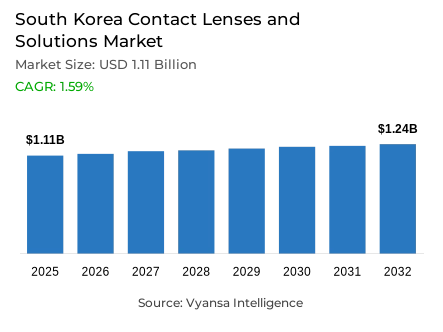
- Contact lenses and solutions market size in South Korea was estimated at USD 1.11 billion in 2025.
- The market size is expected to grow to USD 1.24 billion by 2032.
- Market to register a CAGR of around 1.59% during 2026-32.
- Product Type Shares
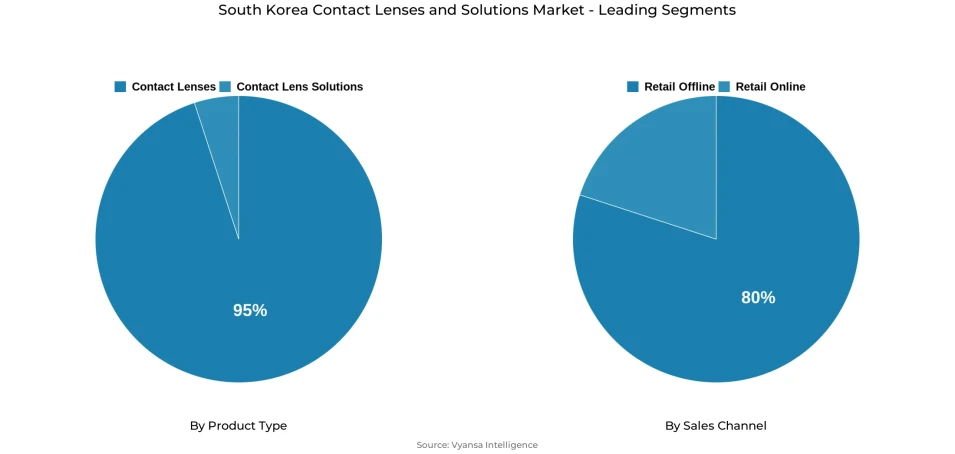
- Contact lenses grabbed market share of 95%.
- Competition
- More than 5 companies are actively engaged in producing contact lenses and solutions in South Korea.
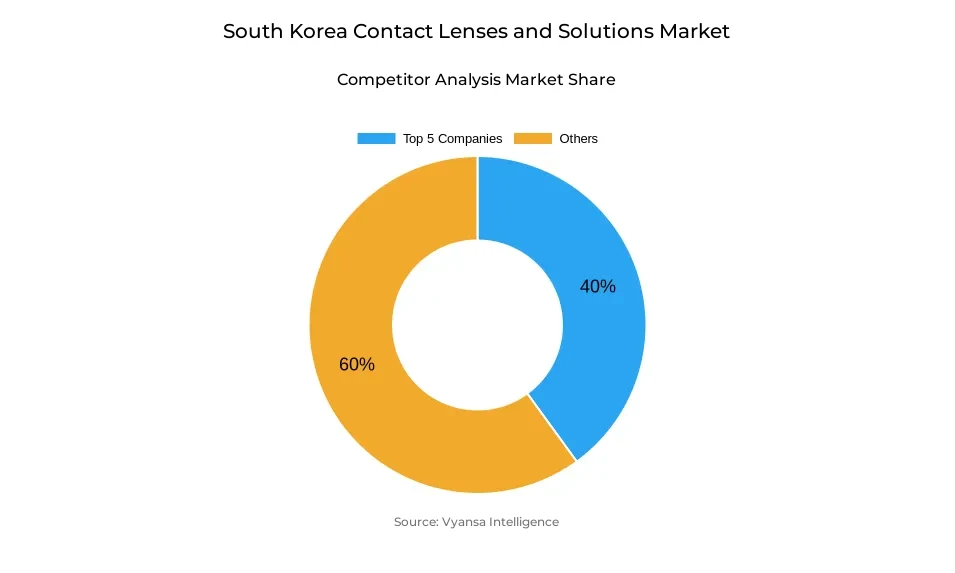
- Top 5 companies acquired around 40% of the market share.
- Bausch & Lomb Korea Inc, Alcon Korea Ltd, Interojo Inc, Johnson & Johnson Korea Co Ltd, CooperVision Korea Inc etc., are few of the top companies.
- Sales Channel
- Retail offline grabbed 80% of the market.
South Korea Contact Lenses and Solutions Market Outlook
The South Korea contact lenses and solutions market is valued at USD 1.11 billion in 2025 and is projected to reach USD 1.24 billion by 2032, registering a CAGR of approximately 1.59% during 2026–2032. The growth is moderate but constant, with high usage of digital-devices. According to the Ministry of Science and ICT (MSIT), internet penetration exceeds 97%, reflecting widespread screen exposure.
Moreover, the Korea Disease Control and Prevention Agency (KDCA) emphasizes the increase in the prevalence of myopia among adolescents. These aspects keep the demand of hygienic and convenient daily disposable lenses that are compatible with digital lifestyles. Contact lenses and solutions remain essential for modern vision care needs shaped by screen-intensive routines.
Nonetheless, category dynamics are influenced by regulatory constraints. At the beginning of 2024, the Constitutional Court supported the ban on online sales of contact lenses, which strengthens the necessity of face-to-face professional advice. This restricts the growth of e-commerce and competition on prices, keeping distribution mostly offline. Retail‑offline accounts for 80 % of sales due to mandatory face‑to‑face consultation.
Development is also affected by product innovation and beauty trends. According to the Korea Customs Service, K-beauty exports remain strong, which contributes to the increased demand of colour and customised lenses. Contact lenses hold 95 % share by product type, driven by preference for convenience and advanced materials. Ongoing enhancements in moisture retention and blue-light filtering are in line with the changing end user expectations up to 2026 and beyond.
South Korea Contact Lenses and Solutions Market Growth Driver
High Digital Device Usage Driving Daily Disposable Adoption
South Korea has one of the highest digital connectivity rates in the world. According to the Ministry of Science and ICT (MSIT), internet penetration exceeds 97 % of the population, reflecting widespread daily exposure to screens. The long-term use of smartphones, tablets, and computers increases the strain on the eyes and the symptoms of dry-eye, which further supports the need to have convenient and hygienic vision-correction solutions.
Daily disposable lenses are closely associated with these lifestyle trends because they offer single-use hygiene, moisture retention, and lower chances of contamination. According to the Korea Disease Control and Prevention Agency (KDCA), another issue is the increasing prevalence of myopia in adolescents during regular health check-ups. This mix of high screen time and growing refractive concerns justifies a long-term need of high-tech daily lens solutions that cater to digital lifestyles.
South Korea Contact Lenses and Solutions Market Challenge
Regulatory Restrictions on Online Sales Limiting Distribution Flexibility
In early 2024, the Constitutional Court of South Korea supported the ban on online sales of contact lenses, citing the safety of patients and the need to receive professional advice in person. The Court observed that contact lenses come into direct contact with the cornea and must be fitted and hygienically educated by licensed opticians. This regulatory climate curtails the growth of e-commerce and constrains price-based competition via the internet.
Although it safeguards end user health, it limits the flexibility of distribution and slows the growth of digital retail compared to other health-product categories. The necessity of face-to-face consultation is also a structural limitation that affects category dynamics.
Unlock Market Intelligence
Explore the market potential with our data-driven report
South Korea Contact Lenses and Solutions Market Trend
Expansion of Colour and Customised Vision Solutions
The trends of eyewear based on beauty are still on the rise. According to the Korea Customs Service, K-beauty exports have been growing steadily, as the world is interested in aesthetic-oriented products. Colour contact lenses are also becoming more in line with this beauty culture, especially among younger end users who are influenced by social media and K-pop endorsements. According to the Korea Customs Service, the exports of K-beauty products have been steadily increasing, which means that the world is interested in aesthetically oriented products.
According to the Ministry of Food and Drug Safety and related export statistics, South Korea’s cosmetics exports reached a record USD 11.43 billion in 2025, up about 12.3 % from the preceding year and marking the highest annual total on record. Colour contact lenses are gaining popularity in this beauty culture, especially among the youth who are social media and K-pop influenced.
South Korea Contact Lenses and Solutions Market Opportunity
Innovation in Premium and Smart Lens Technology
Simultaneously, manufacturers are venturing into toric and astigmatism-correcting colour lenses, combining medical correction with fashion. This merging of functionality and fashion enhances product diversification. The trend underscores the increasing end user demand in customised vision products that meet refractive and cosmetic requirements.
South Korea is still investing in medical-technology innovation. The Ministry of Trade, Industry and Energy (MOTIE, 2025) notes that the development of advanced bio-health and wearable-device is a national strategic priority. This ecosystem encourages the creation of intelligent-lens technology and the creation of new materials. The recent international models with blue-light filters and improved moisture systems appeal to the high-digital-use culture in Korea. Premiumisation opportunities are created by continuous product improvements such as better oxygen permeability and digital-eye-protection capabilities. Differentiation through innovation allows manufacturers to address the changing end user expectations and enhance long-term competitiveness.
Unlock Market Intelligence
Explore the market potential with our data-driven report
South Korea Contact Lenses and Solutions Market Segmentation Analysis
By Product Type
- Contact Lenses
- Contact Lens Solutions
The segment holds the highest market share, with contact lenses accounting for 95 % of the product type share. Contact lenses prevail because end users are highly attracted to convenience, hygiene, and compatibility with digital lifestyles. Frequent replacement and daily disposable formats are still popular due to their convenience.
Traditional lenses are still on the downward trend as customers prefer high-tech materials and enhanced comfort options. The prevailing contribution of contact lenses in the overall category structure is strengthened by product innovation, particularly in digital eye protection and moisture retention.
By Sales Channel
- Retail Offline
- Retail Online
The segment has the highest share in the retail offline sales channel, which accounts for 80 % of the total. The main channel of purchase is still the optical-goods stores because of the necessity of fitting and professional consultation in the store, which is mandatory according to the national regulations.
Licensed opticians are at the center of prescription validation and hygiene education, which enhances the trust in offline retail. While digital commerce influences consumer research behaviour, regulatory restrictions maintain physical stores as the dominant distribution channel for contact lenses and solutions.
List of Companies Covered in South Korea Contact Lenses and Solutions Market
The companies listed below are highly influential in the South Korea contact lenses and solutions market, with a significant market share and a strong impact on industry developments.
- Bausch & Lomb Korea Inc
- Alcon Korea Ltd
- Interojo Inc
- Johnson & Johnson Korea Co Ltd
- CooperVision Korea Inc
- Migwang Contact Lens Co Ltd
- Bescon Co Ltd
Competitive Landscape
The competitive landscape of contact lenses and solutions in South Korea remains consolidated, led by Johnson & Johnson Korea Co Ltd with a 21.3% value share, followed by CooperVision Korea Inc at 12.1%. Johnson & Johnson maintains leadership through its strong daily disposable portfolio, particularly premium offerings such as Acuvue Oasys MAX 1-Day, which integrates blue-light filtering and advanced moisture technologies tailored to digital lifestyles. Its focus on innovation and premiumisation reinforces brand strength in a highly competitive environment.CooperVision Korea Inc continues to strengthen its position through cost-effective brands such as MyDay and Clariti, appealing to value-conscious consumers amid rising living expenses. The company benefits from balanced exposure across daily disposable and frequent replacement lenses. Intensifying product innovation, growing interest in colour and toric lenses, and strict offline regulatory controls continue to shape competition, with differentiation driven by technology, pricing strategy, and brand credibility.
Frequently Asked Questions
Related Report
- Market Segmentation
- Research Scope
- Research Methodology
- Definitions and Assumptions
- Executive Summary
- South Korea Contact Lenses and Solution Market Policies, Regulations, and Standards
- South Korea Contact Lenses and Solution Market Dynamics
- Growth Factors
- Challenges
- Trends
- Opportunities
- South Korea Contact Lenses and Solution Market Statistics, 2022-2032F
- Market Size & Growth Outlook
- By Revenues in USD Million
- By Units Sold in Thousand Units
- Market Segmentation & Growth Outlook
- By Product Type
- Contact Lenses- Market Insights and Forecast 2022-2032, USD Million
- Standard Vision Correction Lenses- Market Insights and Forecast 2022-2032, USD Million
- Myopia Control Lenses- Market Insights and Forecast 2022-2032, USD Million
- Contact Lens Solutions- Market Insights and Forecast 2022-2032, USD Million
- Contact Lenses- Market Insights and Forecast 2022-2032, USD Million
- By Usage
- Contact Lenses- Market Insights and Forecast 2022-2032, USD Million
- Daily Disposable- Market Insights and Forecast 2022-2032, USD Million
- Bi-Weekly- Market Insights and Forecast 2022-2032, USD Million
- Monthly- Market Insights and Forecast 2022-2032, USD Million
- Quarterly/Annual- Market Insights and Forecast 2022-2032, USD Million
- Contact Lens Solutions- Market Insights and Forecast 2022-2032, USD Million
- Daily-Use Care Solutions- Market Insights and Forecast 2022-2032, USD Million
- Weekly/Periodic Deep-Clean Systems- Market Insights and Forecast 2022-2032, USD Million
- Travel/Mini Packs- Market Insights and Forecast 2022-2032, USD Million
- Contact Lenses- Market Insights and Forecast 2022-2032, USD Million
- By Material Type
- Contact Lenses- Market Insights and Forecast 2022-2032, USD Million
- Silicone Hydrogel- Market Insights and Forecast 2022-2032, USD Million
- Hydrogel (Soft)- Market Insights and Forecast 2022-2032, USD Million
- Rigid Gas Permeable (RGP)- Market Insights and Forecast 2022-2032, USD Million
- Hybrid/Scleral/Specialty- Market Insights and Forecast 2022-2032, USD Million
- Contact Lens Solutions- Market Insights and Forecast 2022-2032, USD Million
- Multi-Purpose Solutions- Market Insights and Forecast 2022-2032, USD Million
- Hydrogen Peroxide Systems- Market Insights and Forecast 2022-2032, USD Million
- Saline Solutions- Market Insights and Forecast 2022-2032, USD Million
- Enzymatic & Specialty Cleaners- Market Insights and Forecast 2022-2032, USD Million
- Contact Lenses- Market Insights and Forecast 2022-2032, USD Million
- By Application
- Contact Lenses- Market Insights and Forecast 2022-2032, USD Million
- Spherical (Myopia/Hyperopia)- Market Insights and Forecast 2022-2032, USD Million
- Toric (Astigmatism)- Market Insights and Forecast 2022-2032, USD Million
- Multifocal (Presbyopia)- Market Insights and Forecast 2022-2032, USD Million
- Myopia Control- Market Insights and Forecast 2022-2032, USD Million
- Cosmetic/Colored- Market Insights and Forecast 2022-2032, USD Million
- Therapeutic/Medical- Market Insights and Forecast 2022-2032, USD Million
- Contact Lens Solutions- Market Insights and Forecast 2022-2032, USD Million
- Soft Lens Care- Market Insights and Forecast 2022-2032, USD Million
- RGP Lens Care- Market Insights and Forecast 2022-2032, USD Million
- Sensitive Eye/Preservative-Free Care- Market Insights and Forecast 2022-2032, USD Million
- Contact Lenses- Market Insights and Forecast 2022-2032, USD Million
- By Sales Channel
- Retail Offline- Market Insights and Forecast 2022-2032, USD Million
- Optical Stores- Market Insights and Forecast 2022-2032, USD Million
- Hospitals & Clinics- Market Insights and Forecast 2022-2032, USD Million
- Others (Pharmacies, Beauty Centres, etc.)- Market Insights and Forecast 2022-2032, USD Million
- Retail Online- Market Insights and Forecast 2022-2032, USD Million
- Company-owned Portals- Market Insights and Forecast 2022-2032, USD Million
- E-commerce Platforms- Market Insights and Forecast 2022-2032, USD Million
- Retail Offline- Market Insights and Forecast 2022-2032, USD Million
- By Pack Size
- Contact Lenses- Market Insights and Forecast 2022-2032, USD Million
- Trial Packs- Market Insights and Forecast 2022-2032, USD Million
- Standard Packs- Market Insights and Forecast 2022-2032, USD Million
- Bulk/Value Packs- Market Insights and Forecast 2022-2032, USD Million
- Contact Lens Solutions- Market Insights and Forecast 2022-2032, USD Million
- Up to 120 mL- Market Insights and Forecast 2022-2032, USD Million
- 121–360 mL- Market Insights and Forecast 2022-2032, USD Million
- Above 360 mL- Market Insights and Forecast 2022-2032, USD Million
- Combo/Twin Packs- Market Insights and Forecast 2022-2032, USD Million
- Contact Lenses- Market Insights and Forecast 2022-2032, USD Million
- By Competitors
- Competition Characteristics
- Market Share & Analysis
- By Product Type
- Market Size & Growth Outlook
- South Korea Contact Lenses Market Statistics, 2022-2032
- Market Size & Growth Outlook
- By Revenues in USD Million
- By Units Sold in Thousand Units
- Market Segmentation & Growth Outlook
- By Usage- Market Insights and Forecast 2022-2032, USD Million
- By Material Type- Market Insights and Forecast 2022-2032, USD Million
- By Application- Market Insights and Forecast 2022-2032, USD Million
- By Sales Channel- Market Insights and Forecast 2022-2032, USD Million
- By Pack Size- Market Insights and Forecast 2022-2032, USD Million
- Market Size & Growth Outlook
- South Korea Contact Lens Solutions Market Statistics, 2022-2032
- Market Size & Growth Outlook
- By Revenues in USD Million
- By Units Sold in Thousand Units
- Market Segmentation & Growth Outlook
- By Usage- Market Insights and Forecast 2022-2032, USD Million
- By Material Type- Market Insights and Forecast 2022-2032, USD Million
- By Application- Market Insights and Forecast 2022-2032, USD Million
- By Sales Channel- Market Insights and Forecast 2022-2032, USD Million
- By Pack Size- Market Insights and Forecast 2022-2032, USD Million
- Market Size & Growth Outlook
- Competitive Outlook
- Company Profiles
- Johnson & Johnson Korea Co Ltd
- Business Description
- Product Portfolio
- Collaborations & Alliances
- Recent Developments
- Financial Details
- Others
- CooperVision Korea Inc
- Business Description
- Product Portfolio
- Collaborations & Alliances
- Recent Developments
- Financial Details
- Others
- Bausch & Lomb Korea Inc
- Business Description
- Product Portfolio
- Collaborations & Alliances
- Recent Developments
- Financial Details
- Others
- Alcon Korea Ltd
- Business Description
- Product Portfolio
- Collaborations & Alliances
- Recent Developments
- Financial Details
- Others
- Interojo Inc
- Business Description
- Product Portfolio
- Collaborations & Alliances
- Recent Developments
- Financial Details
- Others
- Migwang Contact Lens Co Ltd
- Business Description
- Product Portfolio
- Collaborations & Alliances
- Recent Developments
- Financial Details
- Others
- Bescon Co Ltd
- Business Description
- Product Portfolio
- Collaborations & Alliances
- Recent Developments
- Financial Details
- Others
- Johnson & Johnson Korea Co Ltd
- Company Profiles
- Disclaimer
| Segment | Sub-Segment |
|---|---|
| By Product Type |
|
| By Usage |
|
| By Material Type |
|
| By Application |
|
| By Sales Channel |
|
| By Pack Size |
|
Research Methodology
This study followed a structured approach comprising four key phases to assess the size and scope of the electro-oxidation market. The process began with thorough secondary research to collect data on the target market, related markets, and broader industry context. These findings, along with preliminary assumptions and estimates, were then validated through extensive primary research involving industry experts from across the value chain. To calculate the overall market size, both top-down and bottom-up methodologies were employed. Finally, market segmentation and data triangulation techniques were applied to refine and validate segment-level estimations.
Secondary Research
The secondary research phase involved gathering data from a wide range of credible and published sources. This step helped in identifying industry trends, defining market segmentation, and understanding the market landscape and value chain.
Sources consulted during this phase included:
- Company annual reports, investor presentations, and press releases
- Industry white papers and certified publications
- Trade directories and market-recognized databases
- Articles from authoritative authors and reputable journals
- Gold and silver standard websites
Secondary research was critical in mapping out the industry's value chain and monetary flow, identifying key market segments, understanding regional variations, and tracking significant industry developments.
Other key sources:
- Financial disclosures
- Industry associations and trade bodies
- News outlets and business magazines
- Academic journals and research studies
- Paid industry databases
Primary Research
To validate secondary data and gain deeper market insights, primary research was conducted with key stakeholders across both the supply and demand sides of the market.
On the demand side, participants included decision-makers and influencers from end-user industries—such as CIOs, CTOs, and CSOs—who provided first-hand perspectives on market needs, product usage, and future expectations.
On the supply side, interviews were conducted with manufacturers, industry associations, and institutional participants to gather insights into current offerings, product pipelines, and market challenges.
Primary interviews provided critical inputs such as:
- Market size and revenue data
- Product and service breakdowns
- Market forecasts
- Regional and application-specific trends
Stakeholders consulted included:
- Leading OEM and solution providers
- Channel and distribution partners
- End users across various applications
- Independent consultants and industry specialists
Market Size Estimation and Data Triangulation
- Identifying Key Market Participants (Secondary Research)
- Goal: To identify the major players or companies in the target market. This typically involves using publicly available data sources such as industry reports, market research publications, and financial statements of companies.
- Tools: Reports from firms like Gartner, Forrester, Euromonitor, Statista, IBISWorld, and others. Public financial statements, news articles, and press releases from top market players.
- Extracting Earnings of Key Market Participants
- Goal: To estimate the earnings generated from the product or service being analyzed. This step helps in understanding the revenue potential of each market player in a specific geography.
- Methods: Earnings data can be gathered from:
- Publicly available financial reports (for listed companies).
- Interviews and primary data sources from professionals, such as Directors, VPs, SVPs, etc. This is especially useful for understanding more nuanced, internal data that isn't publicly disclosed.
- Annual reports and investor presentations of key players.
- Data Collation and Development of a Relevant Data Model
- Goal: To collate inputs from both primary and secondary sources into a structured, data-driven model for market estimation. This model will incorporate key market KPIs and any independent variables relevant to the market.
- Key KPIs: These could include:
- Market size, growth rate, and demand drivers.
- Industry-specific metrics like market share, average revenue per customer (ARPC), or average deal size.
- External variables, such as economic growth rates, inflation rates, or commodity prices, that could affect the market.
- Data Modeling: Based on this data, the market forecasts are developed for the next 5 years. A combination of trend analysis, scenario modeling, and statistical regression might be used to generate projections.
- Scenario Analysis
- Goal: To test different assumptions and validate how sensitive the market is to changes in key variables (e.g., market demand, regulatory changes, technological disruptions).
- Types of Scenarios:
- Base Case: Based on current assumptions and historical data.
- Best-Case Scenario: Assuming favorable market conditions, regulatory environments, and technological advancements.
- Worst-Case Scenario: Accounting for adverse factors, such as economic downturns, stricter regulations, or unexpected disruptions.












