Italy LASIK Eye Surgery Market Research Report: Size, Share, Trends & Forecast (2027-2033)
Italy's myopia prevalence stands at approximately 25%, with projections indicating that nearly 50% of the population could be affected by 2050. Additionally, 78.4% of patients aged 18–45 visiting specialist refractive surgery centres are myopic, with 26.4% experiencing high myopia, strengthening demand for advanced LASIK procedures, personalised treatment pathways and expanded refractive surgery access through 2033.
|
Major Companies of Italy LASIK Eye Surgery Market
|
Italy LASIK Eye Surgery Market Overview
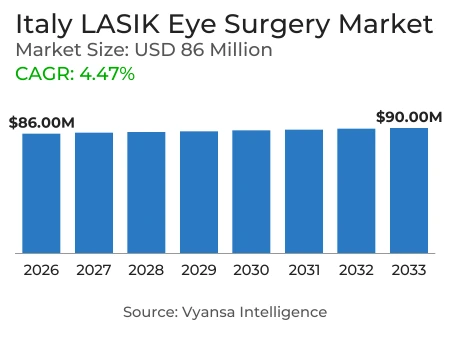
LASIK eye surgery in Italy is a laser procedure in which a femtosecond laser or microkeratome creates a corneal flap and an excimer laser reshapes the cornea to correct refractive error. Adults aged 18 to 45 with myopia or astigmatism mainly self-pay for it, alongside presbyopic patients. The Italy LASIK eye surgery market is forecast to grow at a compound annual growth rate (CAGR) of 4.47% between 2027 and 2033.
Key Highlights of the Italy LASIK Eye Surgery Market
- The Italy LASIK eye surgery market was valued at approximately USD 86 million in 2026. The market is estimated at approximately USD 90 million in 2027 and is projected to reach approximately USD 117 million by 2033.
- The market is forecast to expand at a CAGR of 4.47% between 2027 and 2033.
- By ablation planning technology, Refraction-Based LASIK led the market with a 55% share in 2026.
- Among the ablation planning technology segments, Ray-Tracing-Guided LASIK is the fastest-growing, expanding at a CAGR of 15% between 2027 and 2033.
- By primary treatment indication, Myopia Correction With or Without Myopic Astigmatism led the market with a 75% share in 2026,
- Among the primary treatment indications, Presbyopia Correction is the fastest-growing segment, expanding at a CAGR of 12% between 2027 and 2033.
- The market is fragmented, and the top five companies together hold a combined share of 19% in 2026.
The Italy LASIK eye surgery market is a privately paid, one-off procedure category in transition. Clinics once owned and run by individual surgeons are being combined into multi-site networks that sell laser correction alongside cataract and lens surgery. The end user is an adult who prefers a single payment to years of glasses and contact lenses, and the surgeon decides who qualifies after corneal screening.
Three forces decide how the Italy LASIK eye surgery market develops. A July 2026 review in Frontiers in Ophthalmology reported that 40.56% of Italian children aged 5 to 12 are short-sighted, so each cohort arrives with a larger pool of potential patients. Automated treatment planning is making outcomes more predictable and easier to standardise across sites. Household budgets set the limit, because the full price falls on the patient.
By the end of the forecast period, the Italy LASIK eye surgery market should be more concentrated in chain-operated sites, with growth coming from higher uptake per person and a wider patient age range rather than from more young adults. The Italian National Institute of Statistics (ISTAT) recorded 355,000 births in 2025, down 3.9%, so the younger cohort will not expand. That trajectory holds only if household purchasing power stabilises enough for self-paid surgery to remain affordable.
Market Drivers
Rising Myopia Across Younger Cohorts Enlarges the Pool of Adults Eligible for Laser Correction
Myopia is starting earlier and reaching a larger share of each cohort, and those children become the adults who qualify for laser correction between 18 and 45. For a myopic adult, LASIK ends the recurring cost and daily management of glasses and contact lenses in one procedure.
A February 2025 analysis in the British Journal of Ophthalmology, covering 276 studies and 5.41 million participants, put pooled childhood myopia prevalence at 35.81% and projected 39.80% by 2050. A July 2026 review in Frontiers in Ophthalmology reported 40.56% myopia among Italian children aged 5 to 12, a group that reaches the LASIK age band mainly in the later forecast years. Each additional myopic cohort translates into more eligibility screenings and surgical consultations at Italian refractive centres.
Through 2033, each forecast year adds older members of these cohorts to the 18 to 45 candidate pool, so consultation volumes rise even as the number of young adults falls. The driver stays commercially live because prevalence, not headcount, determines how many patients reach a screening. Together these shifts add eligible patients to the industry's consultation pipeline and support procedure demand across the forecast period.
Market Challenges
Fully Self Paid Surgery Meets a Squeeze on Household Purchasing Power
LASIK is an elective procedure, so the price is typically carried by the patient and every provider competes for the same discretionary household budget. Price-sensitive adults aged 25 to 44, including households with children, carry most of the cost pressure. Providers carry the effect as a lower share of consultations that convert into surgery, which makes the constraint structural rather than temporary.
ISTAT reported that household purchasing power fell 0.9% quarter on quarter in the second quarter of 2026, even as household disposable income rose 0.4%. In its June 2026 outlook, ISTAT projected household consumption growth of 0.6% for 2026, down from 1.1% in 2025. The Organisation for Economic Co-operation and Development (OECD) puts Italian out-of-pocket spending at almost 24% of health expenditure, against 15.5% across the European Union (EU), in its 2025 Country Health Profile.
Multi-site operators that can offer payment plans and package pricing are better placed to convert price-sensitive consultations, while independent practices carry the cost of idle laser capacity. Some price-sensitive demand shifts to postponed surgery, and consumption concentrates among households with stable income in the industry. The effect moderates the pace of growth through 2027 and 2028.
Recent Trends
Investor Backed Ophthalmic Chains Replace Single Practitioner Clinics
Italian refractive surgery was historically delivered by clinics owned by individual practitioners, with LASIK offered as one service within a general ophthalmic practice. Investor-backed networks now acquire independent clinics, standardise equipment and screening, and sell laser correction together with cataract and lens surgery under one brand. The change moves equipment and marketing decisions from the individual surgeon to the network.
In October 2024, Ardian, a private equity firm, completed the acquisition of a majority stake in Vista Vision, a Milan-based provider of laser vision correction and cataract surgery that then operated 12 clinics in Italy. In October 2025, EssilorLuxottica completed its acquisition of Optegra, an integrated platform of more than 70 eye hospitals and diagnostic facilities across five European countries, showing the same consolidation logic at larger scale.
Through 2033, laser and diagnostic suppliers will negotiate increasingly with network headquarters instead of individual surgeons, and patients will meet standardised screening and package pricing. Independent clinics will either join networks or specialise in complex cases. Within the industry, consolidation therefore concentrates demand for integrated laser and planning systems in fewer, larger procurement decisions.
Automated Ray Tracing Planning and AI Corneal Screening Reshape the LASIK Workflow
Conventional LASIK planning relies on a surgeon-selected nomogram built from manifest refraction, with measurements moved by hand between devices. Automated ray-tracing planning builds a three-dimensional optical model of each eye and calculates the ablation profile without manifest refraction. Artificial intelligence (AI) models applied to corneal tomography add a screening step that flags eyes at risk of ectasia.
A randomised fellow-eye study by the Heidelberg and Dresden university eye clinics, published in Ophthalmology in October 2025, treated 30 patients with Alcon Inc.'s automated ray-tracing LASIK in one eye and wavefront-optimized LASIK in the other. At three months, 100% of ray-tracing eyes were within 0.50 dioptres of target against 90%, and 100% reached 20/20 vision or better against 93.3%.
Adoption requires a site to run the vendor's own diagnostic device and laser, because the ray-tracing software depends on measurements from Alcon's Sightmap device. That ties each site to one platform and raises switching costs for single-surgeon practices, while networks with standard pathways can deploy one workflow across clinics. Italian use of ray-tracing LASIK is not yet documented, so near-term demand for these platforms comes first from multi-site operators, and suppliers with integrated planning systems gain differentiation.
Future Opportunities
Combined Laser and Lens Pathways Open Spectacle Independence for Presbyopic Adults
Adults in their late forties to sixties already pay for near-vision correction, but LASIK is marketed mainly to young myopic adults, so presbyopic patients are routed to lens surgery or stay in glasses. The gap persists because corneal presbyopia treatment is a compromise, lens replacement competes as the natural lens ages, and a branded combined pathway is not visible among Italian providers.
ISTAT reported that people aged 65 and over made up 25.1% of Italian residents on 1 January 2026, and the OneSight EssilorLuxottica Foundation Italy found in July 2025 that 95.9% of Italian presbyopes already use corrective tools while 72.3% report visual difficulties. Providers can capture this group through a bundled assessment that quotes laser and lens routes together, optician referral agreements and payment plans.
Execution requires surgeons trained in both corneal and lens procedures, a validated presbyopic ablation profile, and a single patient pathway that keeps people inside the network when a lens is the better option. Multi-service chains and hospital groups that run laser and cataract surgery together are positioned to move first, with pilots in 2027 and 2028 and volume building from 2030, adding a 45-plus patient group to demand in the industry.
Segmentation Analysis
By Ablation Planning Technology:
- Refraction-Based LASIK
- Conventional LASIK
- Wavefront-Optimized and Other Aspheric LASIK
- Wavefront-Guided LASIK
- Topography-Guided LASIK
- Ray-Tracing-Guided LASIK
Refraction-Based Planning Anchors 55% of Ablation Planning Demand
Refraction-Based LASIK leads because it runs on installed excimer platforms without extra diagnostic hardware, and surgeons already know its nomograms. The European Society of Cataract and Refractive Surgeons (ESCRS) Clinical Trends Survey, reported in 2025, found that 25% of more than 3,000 respondents mostly performed standard ablation and 19% wavefront-optimized ablation. Refraction-Based LASIK keeps its lead through 2033 unless industry networks move wholesale to automated planning.
In January 2025, Carl Zeiss Meditec AG received U.S. Food and Drug Administration (FDA) approval for the ZEISS MEL 90 excimer laser, whose single Triple-A ablation profile treats sphero-cylindrical errors and ablates one dioptre in as little as 1.3 seconds at 500 Hz, which keeps aspheric treatment fast and simple to plan.
Ray-Tracing-Guided LASIK is the fastest-growing planning technology at a CAGR of 15% between 2027 and 2033, as networks want repeatable outcomes across sites without a manual refraction step. In September 2026, SCHWIND eye-tech-solutions GmbH launched its Signature Line with ATRIUM Cloud and EASE at the ESCRS congress in London, adding connected laser planning. It grows faster than Refraction-Based LASIK because it expands from a small base each time a network standardizes its workflow.
By Primary Treatment Indication:
- Myopia Correction With or Without Myopic Astigmatism
- Hyperopia Correction With or Without Hyperopic Astigmatism
- Mixed Astigmatism Correction
- Presbyopia Correction
Myopia Correction Carries 75% of Treatment Demand
Myopia Correction leads because myopic adults aged 18 to 45 are the largest group presenting for refractive evaluation. In September 2026, Gruppo Refrattivo Italiano's Observatory on Vision reported, across more than 22,000 patients and 42,530 eyes, that 78.4% of those aged 18 to 45 were myopic, and that 26.4% of refractive surgery candidates had high myopia of at least 6 dioptres, where non-laser alternatives compete. The segment holds through 2033 unless high-myopia routing widens in the industry.
In September 2025, Alcon Inc. launched WaveLight Plus in the United States and Canada, a ray-tracing LASIK treatment for myopia with or without astigmatism, after earlier introduction in China and several European and Asia-Pacific markets, which shows new planning technology is being built first for myopic eyes.
Presbyopia Correction is the fastest-growing indication at a CAGR of 12% between 2027 and 2033, as laser vendors add dedicated presbyopic treatment modules for adults who do not belong to the young myopic pool. In August 2025, SCHWIND eye-tech-solutions GmbH detailed the PresbyMAX module of its AMARIS excimer laser family, which combines objective and subjective patient data and offers symmetric, micro-monovision and hybrid treatment modes. It grows faster than Myopia Correction because it expands from a small base into an older group that Myopia Correction demand does not reach.
Competitive Landscape
The industry is fragmented, with a large number of hospital groups, standalone ophthalmic clinics and single-practitioner centres competing for procedure volume. The top five companies held a combined share of 19% in 2026. The five companies profiled are Gruppo San Donato S.p.A., Neovision Tre Srl, Centro Oculistico Bresciano S.r.l. (Gruppo Refrattivo Italiano), Gruppo Villa Maria S.p.A. (Tiberia Hospital) and Humanitas Mirasole S.p.A. (Humanitas Research Hospital).
Key Companies in the Market
- Gruppo San Donato S.p.A.
- Neovision Tre Srl
- Centro Oculistico Bresciano S.r.l.
- Gruppo Villa Maria S.p.A.
- Humanitas Mirasole S.p.A.
- Fondazione Poliambulanza Istituto Ospedaliero
- SEKAL s.r.l. Micro Chirurgia
- Oculistica Pascotto
- Dott. Francesco Bisantis
Company Profiling
The following five companies are the leading participants in the industry, profiled by market connection, capacity and latest development.
Gruppo San Donato S.p.A. is a private hospital group operating from the Milan area, with ophthalmology linked to the San Raffaele hospital. It participates through the laser correction service at its Milan Respighi outpatient site, which treats refractive defects alongside the San Raffaele ophthalmology department. Capacity is not publicly disclosed, and the nearest verified metric is the Respighi site where the service is listed. No dated 2025 or 2026 LASIK launch has been published. The group acts as a hospital-anchored, referral-led participant.
Neovision Tre Srl operates within Neovision, which describes itself as the first Italian network of ophthalmic clinics, based in Milan. It participates through diagnostic work-ups and eye surgery for myopia, hyperopia, astigmatism and presbyopia at three Milan clinics. Surgical capacity is not publicly disclosed, and the nearest verified metric is those three Milan clinic sites. No dated 2025 or 2026 LASIK launch has been published. Neovision acts as a network-led, clinic-based provider.
Centro OculisticoBrescianoS.r.l. operates the refractive surgery centre of Gruppo Refrattivo Italiano from Via dei Mille 14 in Brescia, with clinical research in collaboration with the University of Brescia. It participates through laser refractive surgery, including Femto-LASIK and Presbyond, together with cataract and implantable lens surgery. Capacity is not publicly disclosed, and the nearest verified metric is its Brescia operating site. No dated 2025 or 2026 launch is published beyond its clinical dataset. It is a research-linked, specialist surgical provider.
Gruppo Villa Maria S.p.A. is a private hospital group whose Villa Tiberia Hospital in Rome runs an ophthalmology service that lists refractive surgery for myopia, hyperopia, astigmatism and presbyopia. It participates through that service, alongside cataract surgery. Capacity is not publicly disclosed, and the nearest verified metric is the Rome hospital site where the service is listed. No dated 2025 or 2026 LASIK launch has been published. The group acts as a hospital-based, regionally concentrated participant.
Humanitas Mirasole S.p.A. operates Humanitas Research Hospital in Rozzano, Milan, home to the Humanitas Centro Oculistico. It participates through laser refractive surgery for myopia, hyperopia, astigmatism and presbyopia on SCHWIND excimer and femtosecond lasers. Capacity is not publicly disclosed, and the nearest verified metric is one eye centre running both laser types. In May 2025, it published a refractive surgery patient guide describing how its lasers integrate several technologies and plan treatment from each eye's own aberration measurements. It acts as a technology-led, hospital-based provider.
News and Recent Developments
- In June 2026, Carl Zeiss Meditec AG and Aier Eye Hospital Group signed a strategic agreement for 25 VISUMAX 800 femtosecond laser systems, to be deployed from late 2026 across Aier's domestic and international networks. The agreement is in China, so it signals direction rather than Italian volume, but it shows a very large operator scaling lenticule extraction, the main non-LASIK substitute for myopic correction. The effect is to raise substitution risk for myopia-led LASIK volumes in the market, particularly among high-myopia candidates.
Frequently Asked Questions
Related Report
- Italy LASIK Eye Surgery Market Segmentation
- Italy LASIK Eye Surgery Market Introduction
- Product Definition
- Research Process
- Assumptions
- Italy LASIK Eye Surgery Market Executive Summary
- Italy LASIK Eye Surgery Market Trends & Developments
- Italy LASIK Eye Surgery Market Dynamics
- Growth Factors
- Challenges
- Impact Analysis
- Italy LASIK Eye Surgery Market Hotspot & Opportunities
- Italy LASIK Eye Surgery Market Outlook (2023-2033)
- Market Size & Outlook
- By Revenues (USD Million)
- Market Segmentation & Outlook
- By Ablation Planning Technology - USD Million (2023-2033)
- Refraction-Based LASIK
- Conventional LASIK
- Wavefront-Optimized and Other Aspheric LASIK
- Wavefront-Guided LASIK
- Topography-Guided LASIK
- Ray-Tracing-Guided LASIK
- Refraction-Based LASIK
- By Flap-Creation Technique - USD Million (2023-2033)
- Femtosecond Laser-Assisted LASIK
- Mechanical Microkeratome-Assisted LASIK
- By Primary Treatment Indication - USD Million (2023-2033)
- Myopia Correction With or Without Myopic Astigmatism
- Hyperopia Correction With or Without Hyperopic Astigmatism
- Mixed Astigmatism Correction
- Presbyopia Correction
- By Service Provider - USD Million (2023-2033)
- Hospitals
- Standalone Ophthalmic Clinics and Surgical Centers
- By Geography
- North-West
- North-East
- Central Italy
- Southern Italy
- By Company
- Competition Characteristics
- Market Shares & Analysis
- By Ablation Planning Technology - USD Million (2023-2033)
- Italy Refraction-Based LASIK Market Outlook (2023-2033)
- Market Size & Outlook
- By Revenues (USD Million)
- Market Segmentation & Outlook
- By Ablation Planning Technology - USD Million (2023-2033)
- By Flap-Creation Technique - USD Million (2023-2033)
- By Primary Treatment Indication - USD Million (2023-2033)
- By Service Provider - USD Million (2023-2033)
- Market Size & Outlook
- Italy Wavefront-Guided LASIK Market Outlook (2023-2033)
- Market Size & Outlook
- By Revenues (USD Million)
- Market Segmentation & Outlook
- By Ablation Planning Technology - USD Million (2023-2033)
- By Flap-Creation Technique - USD Million (2023-2033)
- By Primary Treatment Indication - USD Million (2023-2033)
- By Service Provider - USD Million (2023-2033)
- Market Size & Outlook
- Italy Topography-Guided LASIK Market Outlook (2023-2033)
- Market Size & Outlook
- By Revenues (USD Million)
- Market Segmentation & Outlook
- By Ablation Planning Technology - USD Million (2023-2033)
- By Flap-Creation Technique - USD Million (2023-2033)
- By Primary Treatment Indication - USD Million (2023-2033)
- By Service Provider - USD Million (2023-2033)
- Market Size & Outlook
- Italy Ray-Tracing-Guided LASIK Market Outlook (2023-2033)
- Market Size & Outlook
- By Revenues (USD Million)
- Market Segmentation & Outlook
- By Ablation Planning Technology - USD Million (2023-2033)
- By Flap-Creation Technique - USD Million (2023-2033)
- By Primary Treatment Indication - USD Million (2023-2033)
- By Service Provider - USD Million (2023-2033)
- Market Size & Outlook
- Market Size & Outlook
- Italy LASIK Eye Surgery Market Key Strategic Imperatives for Success & Growth
- Italy LASIK Eye Surgery Market Competitive Outlook
- Gruppo San Donato S.p.A.
- Business Description
- Product Portfolio
- Collaborations & Alliances
- Recent Developments
- Financial Details
- Others
- Neovision Tre Srl
- Business Description
- Product Portfolio
- Collaborations & Alliances
- Recent Developments
- Financial Details
- Others
- Centro Oculistico Bresciano S.r.l.
- Business Description
- Product Portfolio
- Collaborations & Alliances
- Recent Developments
- Financial Details
- Others
- Gruppo Villa Maria S.p.A.
- Business Description
- Product Portfolio
- Collaborations & Alliances
- Recent Developments
- Financial Details
- Others
- Humanitas Mirasole S.p.A.
- Business Description
- Product Portfolio
- Collaborations & Alliances
- Recent Developments
- Financial Details
- Others
- Fondazione Poliambulanza Istituto Ospedaliero
- Business Description
- Product Portfolio
- Collaborations & Alliances
- Recent Developments
- Financial Details
- Others
- SEKAL s.r.l. Micro Chirurgia
- Business Description
- Product Portfolio
- Collaborations & Alliances
- Recent Developments
- Financial Details
- Others
- Oculistica Pascotto
- Business Description
- Product Portfolio
- Collaborations & Alliances
- Recent Developments
- Financial Details
- Others
- Dott. Francesco Bisantis
- Business Description
- Product Portfolio
- Collaborations & Alliances
- Recent Developments
- Financial Details
- Others
- Gruppo San Donato S.p.A.
- Disclaimer
| Segment | Sub-Segment |
|---|---|
| By Ablation Planning Technology |
|
| By Flap-Creation Technique |
|
| By Primary Treatment Indication |
|
| By Service Provider |
|
| By Geography |
|
Research Methodology
This study followed a structured approach comprising four key phases to assess the size and scope of the electro-oxidation market. The process began with thorough secondary research to collect data on the target market, related markets, and broader industry context. These findings, along with preliminary assumptions and estimates, were then validated through extensive primary research involving industry experts from across the value chain. To calculate the overall market size, both top-down and bottom-up methodologies were employed. Finally, market segmentation and data triangulation techniques were applied to refine and validate segment-level estimations.
Secondary Research
The secondary research phase involved gathering data from a wide range of credible and published sources. This step helped in identifying industry trends, defining market segmentation, and understanding the market landscape and value chain.
Sources consulted during this phase included:
- Company annual reports, investor presentations, and press releases
- Industry white papers and certified publications
- Trade directories and market-recognized databases
- Articles from authoritative authors and reputable journals
- Gold and silver standard websites
Secondary research was critical in mapping out the industry's value chain and monetary flow, identifying key market segments, understanding regional variations, and tracking significant industry developments.
Other key sources:
- Financial disclosures
- Industry associations and trade bodies
- News outlets and business magazines
- Academic journals and research studies
- Paid industry databases
Primary Research
To validate secondary data and gain deeper market insights, primary research was conducted with key stakeholders across both the supply and demand sides of the market.
On the demand side, participants included decision-makers and influencers from end-user industries—such as CIOs, CTOs, and CSOs—who provided first-hand perspectives on market needs, product usage, and future expectations.
On the supply side, interviews were conducted with manufacturers, industry associations, and institutional participants to gather insights into current offerings, product pipelines, and market challenges.
Primary interviews provided critical inputs such as:
- Market size and revenue data
- Product and service breakdowns
- Market forecasts
- Regional and application-specific trends
Stakeholders consulted included:
- Leading OEM and solution providers
- Channel and distribution partners
- End users across various applications
- Independent consultants and industry specialists
Market Size Estimation and Data Triangulation
- Identifying Key Market Participants (Secondary Research)
- Goal: To identify the major players or companies in the target market. This typically involves using publicly available data sources such as industry reports, market research publications, and financial statements of companies.
- Tools: Reports from firms like Gartner, Forrester, Euromonitor, Statista, IBISWorld, and others. Public financial statements, news articles, and press releases from top market players.
- Extracting Earnings of Key Market Participants
- Goal: To estimate the earnings generated from the product or service being analyzed. This step helps in understanding the revenue potential of each market player in a specific geography.
- Methods: Earnings data can be gathered from:
- Publicly available financial reports (for listed companies).
- Interviews and primary data sources from professionals, such as Directors, VPs, SVPs, etc. This is especially useful for understanding more nuanced, internal data that isn't publicly disclosed.
- Annual reports and investor presentations of key players.
- Data Collation and Development of a Relevant Data Model
- Goal: To collate inputs from both primary and secondary sources into a structured, data-driven model for market estimation. This model will incorporate key market KPIs and any independent variables relevant to the market.
- Key KPIs: These could include:
- Market size, growth rate, and demand drivers.
- Industry-specific metrics like market share, average revenue per customer (ARPC), or average deal size.
- External variables, such as economic growth rates, inflation rates, or commodity prices, that could affect the market.
- Data Modeling: Based on this data, the market forecasts are developed for the next 5 years. A combination of trend analysis, scenario modeling, and statistical regression might be used to generate projections.
- Scenario Analysis
- Goal: To test different assumptions and validate how sensitive the market is to changes in key variables (e.g., market demand, regulatory changes, technological disruptions).
- Types of Scenarios:
- Base Case: Based on current assumptions and historical data.
- Best-Case Scenario: Assuming favorable market conditions, regulatory environments, and technological advancements.
- Worst-Case Scenario: Accounting for adverse factors, such as economic downturns, stricter regulations, or unexpected disruptions.