South America Two Wheeler Market Report: Trends, Growth and Forecast (2026-2032)
By Type of Fuel (Gasoline, Petrol, Diesel, LPG/CNG, Battery), By Vehicle Type (Moped, Scooter, Motorcycle), By Application (Personal Use, Commercial Use), By Type of Engine Capacity (Up to 125 cc, 126 to 250 cc, 251 to 500 cc, Above 500 cc), By country (Brazil, Colombia, Chile, Peru, Ecuador, Argentina, Bolivia, Rest of South America) ... Read more
|
Major Players
|
South America Two Wheeler Market Statistics and Insights, 2026
- Market Size Statistics
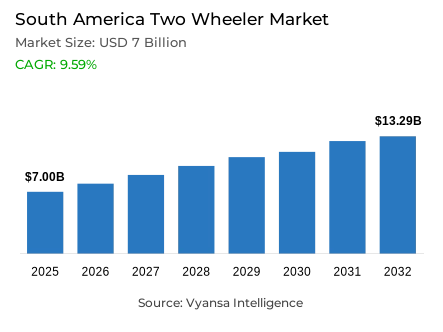
- Two wheeler market size in South America was valued at USD 7 billion in 2025 and is estimated at USD 7.9 billion in 2026.
- The market size is expected to grow to USD 13.29 billion by 2032.
- Market to register a CAGR of around 9.59% during 2026-32.
- Vehicle Type Shares
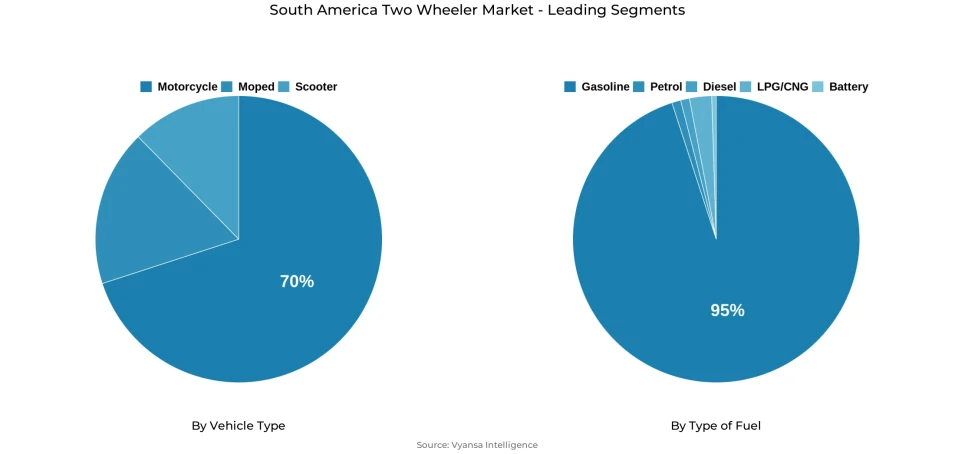
- Motorcycle grabbed market share of 70%.
- Competition
- More than 15 companies are actively engaged in producing two wheeler in South America.
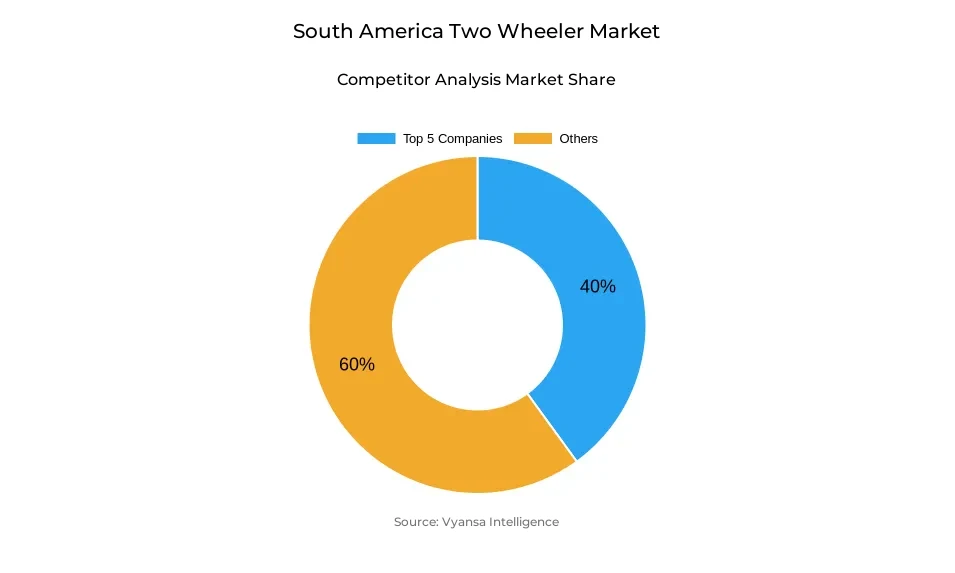
- Top 5 companies acquired around 40% of the market share.
- TVS Motor Company, Hero MotoCorp, Shineray do Brasil, Honda Motor Co., Ltd., Yamaha Motor Co., Ltd. etc., are few of the top companies.
- Type of Fuel
- Gasoline/Petrol grabbed 95% of the market.
- Country
- Brazil leads with a 40% share of the South America market.
South America Two Wheeler Market Outlook
The South America two wheeler market was valued at USD 7 billion in 2025 and is projected to advance from USD 7.9 billion in 2026 to USD 13.29 billion by 2032, registering a CAGR of 9.59% across the forecast period. This exceptional expansion reflects the structural role that motorcycles and scooters play as primary mobility solutions for daily commuting, last-mile delivery, informal work, small business movement, and low-cost personal transport across a region where urban congestion, uneven public transport coverage, and high car ownership costs make commuter motorcycles fundamentally more economically rational than four-wheel alternatives for a substantial proportion of the working population. Growth is not cyclically driven but structurally anchored in the economic utility that two wheelers provide across the region's diverse geographies, income segments, and employment structures.
Motorcycle commands 70% of the vehicle type segment, establishing the South America motorcycle market as overwhelmingly the most commercially significant vehicle format within the regional two wheeler landscape. Motorcycles are preferred over mopeds and scooters across South American conditions because they deliver stronger road suitability, higher load-carrying ability, better intercity range, and wider serviceability across urban, peri-urban, and rural routes, creating a versatile mobility and work-tool proposition that sustains demand across commuting, delivery, courier, and informal work categories simultaneously.
Gasoline and petrol dominate the fuel type segment with a commanding 95% share, reflecting the structural maturity of conventional internal combustion infrastructure across South America's refueling networks, workshop ecosystems, and parts supply chains. Petrol two wheelers retain their dominant position because quick refueling, familiar mechanical serviceability, proven range confidence, lower upfront prices, and deep resale markets collectively align with the practical priorities of daily commuting motorcycles buyers who cannot afford vehicle downtime or uncertain repair access in income-dependent mobility contexts.
Brazil anchors the regional market with a 40% country share, supported by a large domestic motorcycle production base, established dealer networks, high commuter and delivery demand, and an industrial manufacturing footprint that positions the country as both a regional consumption leader and a production hub. As per data published by Abraciclo, motorcycle production in Brazil reached 1.98 million units in 2025 reflecting a 13.3% year-on-year increase, while retail registrations reached 2.19 million units, a 17.1% increase from the prior year, confirming that the Brazil two wheeler market is expanding through genuine demand growth rather than base-period recovery effects across both production and sales dimensions.
South America Two Wheeler Market Growth Driver
Economic Utility and Labour Market Structure Are Building a Structurally Resilient Motorcycle Demand Base
The primary commercial driver within the South America two wheeler market is the fundamental economic utility that motorcycles provide as simultaneously a personal transport vehicle and an income-generating work tool across a labour market characterised by high informality, widespread self-employment, and persistent commuter mobility gaps that four-wheel transport cannot cost-effectively address. As per data published by the International Labour Organization's Labour Overview 2025, labour force participation in Latin America and the Caribbean remained close to 63% in the first half of 2025 while the informal employment rate stood at 46.7%, confirming that nearly one in two employed persons operates outside fully formal employment structures and depends on flexible, low-cost mobility for income access, customer reach, goods delivery, and service fulfilment that last-mile delivery motorcycles and commuter bikes are architecturally well-suited to provide.
Abraciclo data confirming Brazilian motorcycle production of 1,000,749 units in the first half of 2025 alone, a 15.3% year-on-year increase, reflects the commercial translation of this labour structure into sustained manufacturing and retail demand throughout the regional market. The World Bank confirming an urban population of approximately 538.17 million in Latin America and the Caribbean in 2024 at an urbanisation share of 81.27% further establishes that the dense metropolitan environments generating the highest per-capita motorcycle utility value are home to a commercially substantial and growing population base, ensuring that economic utility continues to sustain two wheeler demand resilience across South America even when household budget conditions remain constrained.
South America Two Wheeler Market Challenge
Road Safety Pressure and Rider Vulnerability Are Creating Structural Regulatory and Social Barriers
The most commercially consequential structural challenge within the South America motorcycle market is the rising road safety burden associated with high motorcycle usage that creates regulatory, public health, and insurance-cost pressures capable of constraining faster market expansion despite underlying demand strength. Based on data from the Pan American Health Organization, road traffic crashes caused more than 145,000 deaths in the Americas in 2021 with a regional mortality rate of 14.09 deaths per 100,000 population, while deaths among motorcyclists, pedestrians, and cyclists rose from 39% of road traffic fatalities in 2009 to 47% by 2021, confirming that vulnerable road users are representing a progressively larger share of the region's safety burden in ways that increase regulatory scrutiny, insurance costs, and public policy pressure on the two wheeler industry.
For OEMs, this creates a structurally demanding balance between maintaining the affordable transport two wheelers price positioning that drives volume demand and incorporating safety features including anti-lock braking systems, improved lighting, and rider-assistance technologies that raise unit costs beyond the reach of price-sensitive buyers. The challenge extends to delivery platforms and fleet operators whose higher accident exposure rates create rising insurance costs and regulatory scrutiny, while PAHO's confirmation that more than 4 million people suffered non-fatal road traffic injuries in the Americas in 2021 including 638,620 serious injuries with permanent after-effects confirms that the safety burden is both large enough and institutionally visible enough to shape government policy responses that affect the commercial environment for two wheeler market expansion throughout the forecast period.
Unlock Market Intelligence
Explore the market potential with our data-driven report
South America Two Wheeler Market Trend
Commuter-Focused Product Concentration and Gradual Electrification Are Shaping a Dual-Speed Market Trajectory
The dominant structural trend reshaping the South America two wheeler market is the sustained concentration of product demand around low-displacement, utility-focused commuter motorcycles optimised for fuel efficiency, durability, simple maintenance, broad parts availability, and delivery-compatible ergonomics rather than premium performance or lifestyle positioning. Evidence drawn from public data released by Abraciclo confirms that low-displacement motorcycles accounted for 78.1% of total motorcycle production in 2024 with 1,365,323 units, while street models represented 48.9% of total output at 855,240 units, confirming that the street motorcycle market in South America is overwhelmingly shaped by practical utility demand that sustains product development investment in commuter-optimised rather than aspirationally positioned vehicle formats.
A parallel but distinctly slower-moving electrification trajectory is simultaneously emerging in selected urban corridors without yet challenging petrol dominance across the mainstream market. According to statistics released by the International Energy Agency, global electric two wheeler sales reached 10 million units in 2024, while IEA analysis confirms that South America's strongest electric mobility progress has occurred in cars and buses rather than motorcycles, establishing a dual-speed market dynamic where petrol commuter models dominate near-term volume while electric alternatives develop gradually in urban fleet and premium delivery niches as charging infrastructure, battery reliability, financing support, and proven after-sales service progressively reduce the practical barriers that currently limit broader adoption.
South America Two Wheeler Market Opportunity
Work-Linked Mobility and Urbanisation Are Creating High-Value Product and Service Expansion Windows
The most commercially significant and structurally durable growth opportunity within the South America two wheeler market lies in the convergence of work-linked mobility demand, expanding delivery economy activity, and the large and growing urban population base that creates addressable demand for purpose-designed commuter and delivery motorcycles bundled with financing, insurance, maintenance, and fleet-service solutions tailored to buyers without traditional credit profiles. As per official figures from the International Labour Organization, the informal employment rate in Latin America and the Caribbean stood at 46.7% in the first half of 2025, confirming that the population dependent on flexible low-cost mobility for income generation is structurally large enough to sustain a commercially significant addressable market for bundled affordable mobility ownership models that combine motorcycles with microcredit financing, maintenance packages, delivery-ergonomic accessories, and fleet service plans.
The opportunity is further amplified by the economic resilience that motorcycle utility demand demonstrates within the South America two wheeler market even during periods of modest macroeconomic growth. Evidence drawn from public data released by the Economic Commission for Latin America and the Caribbean confirming regional GDP growth projections of 2.4% in 2025 and 2.3% in 2026 establishes that the South American economic environment remains supportive but not exceptional, making the motorcycle's cost-to-utility ratio especially compelling for households and workers managing limited income growth. For OEMs and financial institutions capable of designing delivery-oriented motorcycle variants, microcredit financing schemes, maintenance subscription packages, and fleet-management platforms, this combination of structural informality, urban density, and economic pragmatism creates a high-value commercial opportunity that extends well beyond standard cash-purchase consumer demand throughout the forecast period.
South America Two Wheeler Market Country Analysis
By country
- Brazil
- Colombia
- Chile
- Peru
- Ecuador
- Argentina
- Bolivia
- Rest of South America
Brazil commands the most commercially influential position within the South America two wheeler market with a 40% country share, a dominance that reflects the exceptional scale of its domestic motorcycle production base, the depth of its dealer and service networks, the breadth of its commuter and delivery demand, and the industrial manufacturing concentration that positions the country simultaneously as the region's largest consumption market and its primary production and export platform. As per data published by Abraciclo, motorcycle retail registrations reached 2.19 million units in 2025 reflecting 17.1% year-on-year growth while exports reached 43,117 units representing a 39.1% increase, confirming that Brazil's commercial leadership within the South America motorcycle market is strengthening across both domestic consumption and regional export dimensions simultaneously. The Manaus Industrial Pole's concentration of major two wheeler manufacturing, generating 18.3 thousand direct jobs and more than 150 thousand jobs across Brazil's two wheeler ecosystem, further confirms that Brazil's regional dominance rests on structurally deep industrial foundations rather than purely demand-side factors.
The broader regional demand structure confirms that South America's two wheeler expansion extends meaningfully across Colombia, Argentina, Peru, Chile, and Ecuador, each contributing distinct demand profiles shaped by local commuter mobility needs, informal employment structures, and delivery economy growth that collectively sustain the market's commercial depth beyond any single-country concentration. Evidence drawn from public data released by the Economic Commission for Latin America and the Caribbean confirming regional GDP growth projections of 2.4% in 2025 and 2.3% in 2026 establishes a macroeconomic environment where motorcycles retain exceptional value as low-cost work assets that help households manage limited income growth, making the Colombia motorcycle demand and neighbouring Andean country markets particularly receptive to commuter motorcycle affordability, flexible financing, and delivery-compatible product design strategies that align with the work-utility demand structure sustaining South America's two wheeler market growth throughout the forecast period.
Unlock Market Intelligence
Explore the market potential with our data-driven report
South America Two Wheeler Market Segmentation Analysis
By Vehicle Type
- Moped
- Scooter
- Motorcycle
Motorcycle commands the highest share within the vehicle type category at 70%, establishing engine-powered two wheelers as the overwhelmingly dominant mobility format within the South America two wheeler market across commuting, delivery, small business transport, rural access, informal work, and personal travel applications. The motorcycle's commercial leadership reflects its superior versatility across South American operating conditions compared with scooters and mopeds, as motorcycles can manage longer intercity distances, uneven road surfaces, heavier rider and cargo loads, and mixed urban-rural daily usage patterns that characterise the mobility needs of the region's large informal and self-employed working population. As per data published by Abraciclo, Brazil's motorcycle production was projected to reach 1.88 million units in 2025 reflecting 7.5% year-on-year growth, with the Manaus Industrial Pole identified as one of the six largest motorcycle manufacturing bases globally, confirming that the supply infrastructure sustaining the motorcycle segment's commercial leadership is both regionally concentrated and internationally significant in production scale.
Its dominance is further reinforced by the aftermarket ecosystem that high motorcycle usage intensity generates, with frequent replacement demand for tires, brake pads, chains, engine oil, filters, and bodywork creating recurring dealer and workshop revenue streams that strengthen brand loyalty, parts network investment, and service infrastructure development in ways that structurally disadvantage alternative vehicle formats with smaller installed bases. The motorcycle segment's 70% share therefore reflects not only initial purchase preference but the self-reinforcing commercial ecosystem that high-utilisation, work-dependent motorcycle ownership creates across South America's most commercially active two wheeler markets throughout the forecast period.
By Type of Fuel
- Gasoline
- Petrol
- Diesel
- LPG/CNG
- Battery
Gasoline and petrol commands the highest share within the fuel type category at 95%, establishing conventional internal combustion as the overwhelmingly dominant propulsion architecture within the South America two wheeler market across both urban and rural operating environments. Petrol two wheelers retain this commanding position because the structural advantages of mature refueling networks, widely accessible mechanical repair expertise, low-cost spare parts availability, proven range reliability, competitive upfront pricing, and deep resale markets collectively align with the practical decision criteria of buyers for whom vehicle downtime or uncertain repair access represents an unacceptable income risk, making gasoline two wheelers the rational default choice across the region's price-sensitive and income-dependent motorcycle demand base.
Brazil's product mix confirms how conventional and flexible-fuel systems continue to define the supply landscape even as electrification discourse intensifies. As per data published by Abraciclo, flex-fuel motorcycles capable of running on ethanol and gasoline grew 14.5% in 2024 and represented 65.3% of motorcycle production, confirming that the region's fuel diversification is occurring within liquid-fuel infrastructure rather than shifting toward battery-electric architectures. The International Energy Agency's confirmation that electric two and three wheeler penetration in Latin America remains significantly below Asia's levels further establishes that petrol motorcycles will sustain their commercial dominance across the South America two wheeler market's mainstream demand base throughout the forecast period while electric models develop gradually in selected urban delivery and premium niches.
Various Market Players in South America Two Wheeler Market
The companies mentioned below are highly active in the South America two wheeler market, occupying a considerable portion of the market and shaping industry progress.
- TVS Motor Company
- Hero MotoCorp
- Shineray do Brasil
- Honda Motor Co., Ltd.
- Yamaha Motor Co., Ltd.
- Italika
- Bajaj Auto Ltd.
- Suzuki Motor Corporation
- Dafra Motos
- Motomel S.A.
- AKT Motos
- Kawasaki Heavy Industries
Market News & Updates
- Yamaha Motor Co., 2026:
Yamaha launched the Factor 2026 line in Brazil in February 2026. The update added a new Titanium Grey option for the Factor DX and retained the 150cc BlueFlex engine with LED headlight, blackout-style panel, ECO function, and combined braking. The launch refreshes Yamaha’s commuter motorcycle range for daily-use riders in Brazil.
- Ltd., 2025:
Honda updated the XRE 300 Sahara 2026 line in Brazil with new colors and continued FlexOne engine compatibility. The model includes full-LED lighting, USB-C port, LCD blackout panel, Emergency Stop Signal, and 21-inch front and 18-inch rear aluminum wheels. The update supports Honda’s dual-purpose motorcycle portfolio in Brazil
Frequently Asked Questions
Related Report
- Market Segmentation
- Research Scope
- Research Methodology
- Definitions and Assumptions
- Executive Summary
- South America Two Wheeler Market Policies, Regulations, and Standards
- South America Two Wheeler Production (Unit) Trend 2022-2032
- South America Two Wheeler Production (Unit) Trend By Type of Fuel
- Gasoline
- Petrol
- Diesel
- LPG/CNG
- Battery
- Company Wise Production Plants and Statistics
- Installed Production Capacity
- Actual Production
- Planned Production Target
- South America Two Wheeler Production (Unit) Trend By Type of Fuel
- South America Two Wheeler Pricing Analysis 2022-2032
- South America Two Wheeler Pricing Trend (USD/Unit) 2022-2032
- South America Two Wheeler Pricing Trend (USD/Unit) By Regions 2022-2032
- Brazil
- Colombia
- Chile
- Peru
- Ecuador
- Argentina
- Bolivia
- South America Two Wheeler Pricing Trend (USD/Unit) By Type of Fuel 2022-2032
- Gasoline
- Petrol
- Diesel
- LPG/CNG
- Battery
- South America Two Wheeler Market Dynamics
- Growth Factors
- Challenges
- Trends
- Opportunities
- South America Two Wheeler Market Statistics, 2022-2032F
- Market Size & Growth Outlook
- By Revenues in USD Million
- By Units Sold (Thousand Units)
- Market Segmentation & Growth Outlook
- By Type of Fuel
- Gasoline- Market Insights and Forecast 2022-2032, USD Million
- Petrol- Market Insights and Forecast 2022-2032, USD Million
- Diesel- Market Insights and Forecast 2022-2032, USD Million
- LPG/CNG- Market Insights and Forecast 2022-2032, USD Million
- Battery- Market Insights and Forecast 2022-2032, USD Million
- By Vehicle Type
- Moped- Market Insights and Forecast 2022-2032, USD Million
- Scooter- Market Insights and Forecast 2022-2032, USD Million
- Motorcycle- Market Insights and Forecast 2022-2032, USD Million
- By Application
- Personal Use- Market Insights and Forecast 2022-2032, USD Million
- Commercial Use- Market Insights and Forecast 2022-2032, USD Million
- By Type of Engine Capacity
- Up to 125 cc- Market Insights and Forecast 2022-2032, USD Million
- 126 to 250 cc- Market Insights and Forecast 2022-2032, USD Million
- 251 to 500 cc- Market Insights and Forecast 2022-2032, USD Million
- Above 500 cc- Market Insights and Forecast 2022-2032, USD Million
- By country
- Brazil
- Colombia
- Chile
- Peru
- Ecuador
- Argentina
- Bolivia
- Rest of South America
- By Competitors
- Competition Characteristics
- Market Share & Analysis
- By Type of Fuel
- Market Size & Growth Outlook
- Brazil Two Wheeler Market Statistics, 2022-2032F
- Market Size & Growth Outlook
- By Revenues in USD Million
- By Units Sold (Thousand Units)
- Market Segmentation & Growth Outlook
- By Type of Fuel- Market Insights and Forecast 2022-2032, USD Million
- By Vehicle Type- Market Insights and Forecast 2022-2032, USD Million
- By Application- Market Insights and Forecast 2022-2032, USD Million
- By Type of Engine Capacity- Market Insights and Forecast 2022-2032, USD Million
- Market Size & Growth Outlook
- Colombia Two Wheeler Market Statistics, 2022-2032F
- Market Size & Growth Outlook
- By Revenues in USD Million
- By Units Sold (Thousand Units)
- Market Segmentation & Growth Outlook
- By Type of Fuel- Market Insights and Forecast 2022-2032, USD Million
- By Vehicle Type- Market Insights and Forecast 2022-2032, USD Million
- By Application- Market Insights and Forecast 2022-2032, USD Million
- By Type of Engine Capacity- Market Insights and Forecast 2022-2032, USD Million
- Market Size & Growth Outlook
- Chile Two Wheeler Market Statistics, 2022-2032F
- Market Size & Growth Outlook
- By Revenues in USD Million
- By Units Sold (Thousand Units)
- Market Segmentation & Growth Outlook
- By Type of Fuel- Market Insights and Forecast 2022-2032, USD Million
- By Vehicle Type- Market Insights and Forecast 2022-2032, USD Million
- By Application- Market Insights and Forecast 2022-2032, USD Million
- By Type of Engine Capacity- Market Insights and Forecast 2022-2032, USD Million
- Market Size & Growth Outlook
- Peru Two Wheeler Market Statistics, 2022-2032F
- Market Size & Growth Outlook
- By Revenues in USD Million
- By Units Sold (Thousand Units)
- Market Segmentation & Growth Outlook
- By Type of Fuel- Market Insights and Forecast 2022-2032, USD Million
- By Vehicle Type- Market Insights and Forecast 2022-2032, USD Million
- By Application- Market Insights and Forecast 2022-2032, USD Million
- By Type of Engine Capacity- Market Insights and Forecast 2022-2032, USD Million
- Market Size & Growth Outlook
- Ecuador Two Wheeler Market Statistics, 2022-2032F
- Market Size & Growth Outlook
- By Revenues in USD Million
- By Units Sold (Thousand Units)
- Market Segmentation & Growth Outlook
- By Type of Fuel- Market Insights and Forecast 2022-2032, USD Million
- By Vehicle Type- Market Insights and Forecast 2022-2032, USD Million
- By Application- Market Insights and Forecast 2022-2032, USD Million
- By Type of Engine Capacity- Market Insights and Forecast 2022-2032, USD Million
- Market Size & Growth Outlook
- Argentina Two Wheeler Market Statistics, 2022-2032F
- Market Size & Growth Outlook
- By Revenues in USD Million
- By Units Sold (Thousand Units)
- Market Segmentation & Growth Outlook
- By Type of Fuel- Market Insights and Forecast 2022-2032, USD Million
- By Vehicle Type- Market Insights and Forecast 2022-2032, USD Million
- By Application- Market Insights and Forecast 2022-2032, USD Million
- By Type of Engine Capacity- Market Insights and Forecast 2022-2032, USD Million
- Market Size & Growth Outlook
- Bolivia Two Wheeler Market Statistics, 2022-2032F
- Market Size & Growth Outlook
- By Revenues in USD Million
- By Units Sold (Thousand Units)
- Market Segmentation & Growth Outlook
- By Type of Fuel- Market Insights and Forecast 2022-2032, USD Million
- By Vehicle Type- Market Insights and Forecast 2022-2032, USD Million
- By Application- Market Insights and Forecast 2022-2032, USD Million
- By Type of Engine Capacity- Market Insights and Forecast 2022-2032, USD Million
- Market Size & Growth Outlook
- Competitive Outlook
- Company Profiles
- Honda Motor Co., Ltd.
- Business Description
- Product Portfolio
- Collaborations & Alliances
- Recent Developments
- Financial Details
- Others
- Yamaha Motor Co., Ltd.
- Business Description
- Product Portfolio
- Collaborations & Alliances
- Recent Developments
- Financial Details
- Others
- Italika
- Business Description
- Product Portfolio
- Collaborations & Alliances
- Recent Developments
- Financial Details
- Others
- Bajaj Auto Ltd.
- Business Description
- Product Portfolio
- Collaborations & Alliances
- Recent Developments
- Financial Details
- Others
- Suzuki Motor Corporation
- Business Description
- Product Portfolio
- Collaborations & Alliances
- Recent Developments
- Financial Details
- Others
- TVS Motor Company
- Business Description
- Product Portfolio
- Collaborations & Alliances
- Recent Developments
- Financial Details
- Others
- Hero MotoCorp
- Business Description
- Product Portfolio
- Collaborations & Alliances
- Recent Developments
- Financial Details
- Others
- Shineray do Brasil
- Business Description
- Product Portfolio
- Collaborations & Alliances
- Recent Developments
- Financial Details
- Others
- Dafra Motos
- Business Description
- Product Portfolio
- Collaborations & Alliances
- Recent Developments
- Financial Details
- Others
- Motomel S.A.
- Business Description
- Product Portfolio
- Collaborations & Alliances
- Recent Developments
- Financial Details
- Others
- AKT Motos
- Business Description
- Product Portfolio
- Collaborations & Alliances
- Recent Developments
- Financial Details
- Others
- Kawasaki Heavy Industries
- Business Description
- Product Portfolio
- Collaborations & Alliances
- Recent Developments
- Financial Details
- Others
- BMW Motorrad
- Business Description
- Product Portfolio
- Collaborations & Alliances
- Recent Developments
- Financial Details
- Others
- Royal Enfield
- Business Description
- Product Portfolio
- Collaborations & Alliances
- Recent Developments
- Financial Details
- Others
- Zongshen/Lifan
- Business Description
- Product Portfolio
- Collaborations & Alliances
- Recent Developments
- Financial Details
- Others
- Honda Motor Co., Ltd.
- Company Profiles
- Disclaimer
| Segment | Sub-Segment |
|---|---|
| By Type of Fuel |
|
| By Vehicle Type |
|
| By Application |
|
| By Type of Engine Capacity |
|
| By country |
|
Research Methodology
This study followed a structured approach comprising four key phases to assess the size and scope of the electro-oxidation market. The process began with thorough secondary research to collect data on the target market, related markets, and broader industry context. These findings, along with preliminary assumptions and estimates, were then validated through extensive primary research involving industry experts from across the value chain. To calculate the overall market size, both top-down and bottom-up methodologies were employed. Finally, market segmentation and data triangulation techniques were applied to refine and validate segment-level estimations.
Secondary Research
The secondary research phase involved gathering data from a wide range of credible and published sources. This step helped in identifying industry trends, defining market segmentation, and understanding the market landscape and value chain.
Sources consulted during this phase included:
- Company annual reports, investor presentations, and press releases
- Industry white papers and certified publications
- Trade directories and market-recognized databases
- Articles from authoritative authors and reputable journals
- Gold and silver standard websites
Secondary research was critical in mapping out the industry's value chain and monetary flow, identifying key market segments, understanding regional variations, and tracking significant industry developments.
Other key sources:
- Financial disclosures
- Industry associations and trade bodies
- News outlets and business magazines
- Academic journals and research studies
- Paid industry databases
Primary Research
To validate secondary data and gain deeper market insights, primary research was conducted with key stakeholders across both the supply and demand sides of the market.
On the demand side, participants included decision-makers and influencers from end-user industries—such as CIOs, CTOs, and CSOs—who provided first-hand perspectives on market needs, product usage, and future expectations.
On the supply side, interviews were conducted with manufacturers, industry associations, and institutional participants to gather insights into current offerings, product pipelines, and market challenges.
Primary interviews provided critical inputs such as:
- Market size and revenue data
- Product and service breakdowns
- Market forecasts
- Regional and application-specific trends
Stakeholders consulted included:
- Leading OEM and solution providers
- Channel and distribution partners
- End users across various applications
- Independent consultants and industry specialists
Market Size Estimation and Data Triangulation
- Identifying Key Market Participants (Secondary Research)
- Goal: To identify the major players or companies in the target market. This typically involves using publicly available data sources such as industry reports, market research publications, and financial statements of companies.
- Tools: Reports from firms like Gartner, Forrester, Euromonitor, Statista, IBISWorld, and others. Public financial statements, news articles, and press releases from top market players.
- Extracting Earnings of Key Market Participants
- Goal: To estimate the earnings generated from the product or service being analyzed. This step helps in understanding the revenue potential of each market player in a specific geography.
- Methods: Earnings data can be gathered from:
- Publicly available financial reports (for listed companies).
- Interviews and primary data sources from professionals, such as Directors, VPs, SVPs, etc. This is especially useful for understanding more nuanced, internal data that isn't publicly disclosed.
- Annual reports and investor presentations of key players.
- Data Collation and Development of a Relevant Data Model
- Goal: To collate inputs from both primary and secondary sources into a structured, data-driven model for market estimation. This model will incorporate key market KPIs and any independent variables relevant to the market.
- Key KPIs: These could include:
- Market size, growth rate, and demand drivers.
- Industry-specific metrics like market share, average revenue per customer (ARPC), or average deal size.
- External variables, such as economic growth rates, inflation rates, or commodity prices, that could affect the market.
- Data Modeling: Based on this data, the market forecasts are developed for the next 5 years. A combination of trend analysis, scenario modeling, and statistical regression might be used to generate projections.
- Scenario Analysis
- Goal: To test different assumptions and validate how sensitive the market is to changes in key variables (e.g., market demand, regulatory changes, technological disruptions).
- Types of Scenarios:
- Base Case: Based on current assumptions and historical data.
- Best-Case Scenario: Assuming favorable market conditions, regulatory environments, and technological advancements.
- Worst-Case Scenario: Accounting for adverse factors, such as economic downturns, stricter regulations, or unexpected disruptions.












