Saudi Arabia Ethnic Wear Market Report: Trends, Growth and Forecast (2026-2032)
By Product Structure (Tops & Tunics, Bottomwear, Dresses, Robes & Draped Garments, Coordinated Sets & Full Outfits, Outerwear & Layering Garments), By End User (Women, Men, Kids), By Fabric Type (Cotton, Silk, Wool, Linen, Synthetic Fabrics, Blended Fabrics, Others), By Price Tier (Economy, Mid-Range, Premium, Luxury), By Product Format (Ready-to-Wear, Customized), By Distribution Channel (Retail Offline, Exclusive Brand Stores, Multi-Brand Stores, Independent/Traditional Retailers, Department Stores, Retail Online, Online Marketplaces, Brand-Owned Online Stores), By Region (East, West, South, Central) ... Read more
|
Major Players
|
Saudi Arabia Ethnic Wear Market Statistics and Insights, 2026
- Market Size Statistics
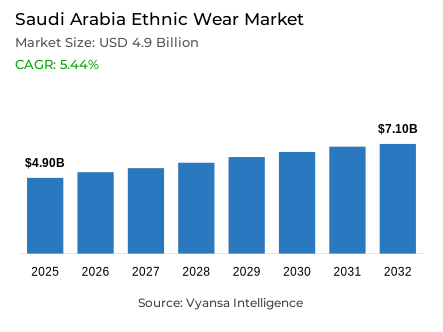
- Ethnic wear market size in Saudi Arabia was valued at USD 4.9 billion in 2025 and is estimated at USD 5.2 billion in 2026.
- The market size is expected to grow to USD 7.1 billion by 2032.
- Market to register a CAGR of around 5.44% during 2026-32.
- Product Structure Shares
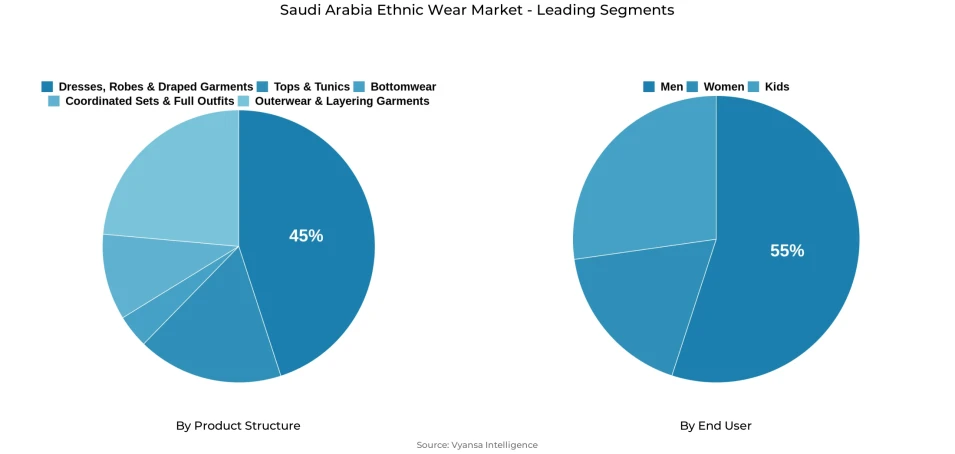
- Dresses, robes & draped garments grabbed market share of 45%.
- Competition
- More than 10 companies are actively engaged in producing ethnic wear in Saudi Arabia.
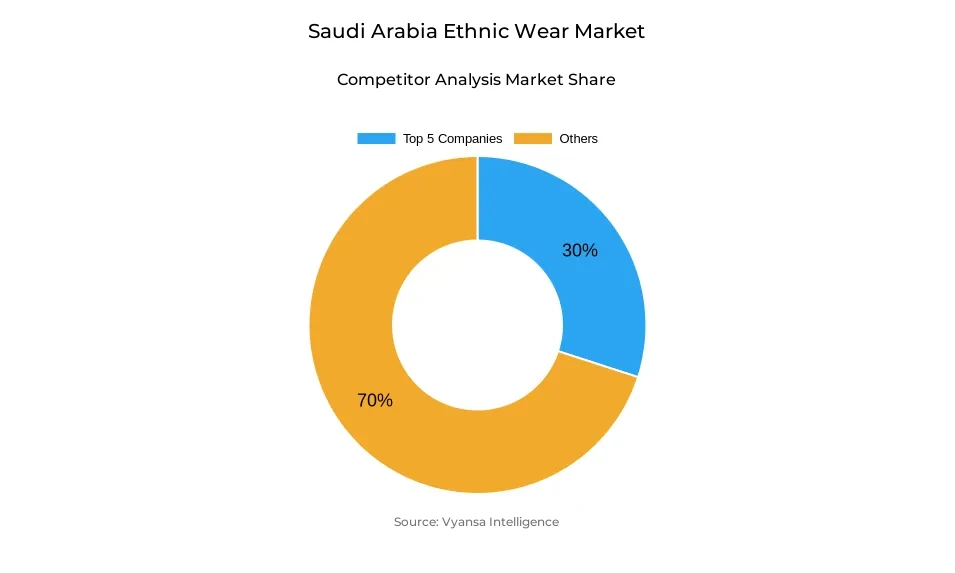
- Top 5 companies acquired around 30% of the market share.
- LIBAS Al Wasamah, Abadia, Leem, Lomar, Alshiaka etc., are few of the top companies.
- End User
- Men grabbed 55% of the market.
Saudi Arabia Ethnic Wear Market Outlook
The Saudi Arabia ethnic wear market size was valued at USD 4.9 billion in 2025 and is projected to grow from USD 5.2 billion in 2026 to USD 7.1 billion by 2032, exhibiting a CAGR of 5.44% during the forecast period. This growth reflects the continued importance of traditional apparel in the country, where daily use and occasion-based dressing continue to support stable demand across different consumer groups and reinforce the role of heritage-led clothing in overall apparel purchasing patterns across the country today.
A strong product mix supports the overall industry structure. Dresses, Robes & Draped Garments account for around 45% of the total product structure share, showing their clear importance in shaping buying patterns. In this setting, ethnic wear remains closely linked with garments that reflect tradition, comfort, and regular usage, making this category an important part of overall sales performance and a key support base for the broader industry outlook during the forecast period.
Consumer demand also remains concentrated around a clearly defined user base. Men hold nearly 55% share of the total end-user segment, highlighting their stronger contribution to overall revenue generation. This indicates that ethnic wear in Saudi Arabia continues to benefit from the regular use of traditional menswear, where everyday dressing habits and formal preferences continue to support category demand across different purchase occasions and usage settings in the country.
The broader outlook remains steady through the forecast period, supported by the strong position of leading product categories and a clear end-user concentration. With Dresses, Robes & Draped Garments holding the leading product share and men accounting for the larger demand base, ethnic wear continues to maintain a firm commercial position in the country, supported by cultural relevance and consistent purchase patterns through 2032 while preserving its strong connection with tradition and practical wear.
Saudi Arabia Ethnic Wear Market Growth Driver
Expanding Consumer Base Sustains Everyday Demand
A steady rise in the resident base continues to support regular apparel demand across the country. According to GASTAT, Saudi Arabia’s population growth rate reached 4.7% in 2024, showing that the local consumer base continues to expand and support repeated clothing purchases across households and daily wear categories.
This demographic support remains important because traditional clothing is closely tied to routine dressing habits in the country. According to GASTAT, the number of Saudi citizens exceeded 19.6 million in 2024, while non-Saudi residents reached approximately 15.7 million. This larger resident base keeps ethnic wear demand steady by supporting everyday use, formal dressing needs, and consistent wardrobe replacement across the Kingdom.
Saudi Arabia Ethnic Wear Market Challenge
Price Pressure Keeps Margin Growth Limited
A key challenge in the industry is the pressure on pricing, which makes it harder for brands to protect value and maintain stronger margins. According to GASTAT, clothing and footwear prices in Saudi Arabia decreased by 1.2% year on year in April 2025, mainly due to a 2.1% drop in ready-made clothing prices. This shows that discount-led competition remains visible in the broader apparel environment.
The same pressure continues across other periods as well, which keeps pricing power under strain for sellers. According to GASTAT, clothing and footwear prices decreased by 0.6% year on year in June 2025, driven by a 1.4% drop in garment prices. For ethnic wear brands, this creates a challenge because maintaining design quality and cultural value becomes harder when the wider apparel space remains highly price sensitive.
Unlock Market Intelligence
Explore the market potential with our data-driven report
Saudi Arabia Ethnic Wear Market Trend
Heritage Styling Gains Modern Visibility
A clear trend in the industry is the stronger visibility of heritage-inspired design through official cultural and fashion platforms. According to the Ministry of Culture, the Year of Handicrafts 2025 participated in Diriyah Date Season with eight Saudi artisans presenting traditional skills linked to local identity. This shows that craft-based styling is gaining a more public and commercially relevant presence.
The same trend is also visible in larger fashion-facing platforms that give local design wider attention. According to SPA, the Fashion Commission showcased Saudi 100 Brands at the Saudi Cup 2025 through a dedicated exhibition highlighting Saudi designers. This supports ethnic wear by helping traditional design language move into more modern presentation, branding, and retail settings across the country.
Saudi Arabia Ethnic Wear Market Opportunity
Visitor Footfall Opens a Wider Retail Opportunity
A strong opportunity is emerging from visitor-led demand, as rising tourism creates more room for traditional apparel sales in cultural, retail, and hospitality settings. According to the Saudi Ministry of Tourism, inbound tourists reached 29.7 million in 2024, setting a new record high for the Kingdom. This expands the addressable customer base for products that reflect local culture and traditional dressing identity.
The opportunity becomes even more meaningful when religious travel is considered alongside broader tourism growth. According to GASTAT, the total number of pilgrims in 2025 reached 1,673,230, including 1,506,576 pilgrims arriving from abroad. This higher visitor flow creates added scope for ethnic wear sales through pilgrimage-linked shopping, gifting, and culturally rooted apparel purchases in high-footfall destinations.
Unlock Market Intelligence
Explore the market potential with our data-driven report
Saudi Arabia Ethnic Wear Market Segmentation Analysis
By Product Structure
- Tops & Tunics
- Bottomwear
- Dresses, Robes & Draped Garments
- Coordinated Sets & Full Outfits
- Outerwear & Layering Garments
The segment has the highest share around 45% under the Product Structure category, with Dresses, Robes & Draped Garments leading the Saudi Arabia ethnic wear market. This strong position reflects the continued preference for clothing styles that carry cultural relevance and everyday practicality. Their leading share shows that traditional garment formats remain central to purchase behavior and continue to shape the broader structure of demand.
The strength of this segment also indicates that buyers continue to prefer styles that balance identity, comfort, and regular use. Dresses, Robes & Draped Garments remain important because they are closely connected with established dressing habits and consistent wardrobe needs. With around 45% share in the product structure landscape, this segment continues to act as a major revenue-supporting category and remains central to the overall development of the industry through the forecast period.
By End User
- Women
- Men
- Kids
The segment has the highest share around 55% under the End User category, with Men leading the Saudi Arabia ethnic wear market. This strong position reflects the important role of male consumers in overall demand generation, supported by regular use of traditional clothing in both everyday and formal settings. The segment’s leadership shows that men continue to account for a larger share of category consumption across the country.
This dominance also highlights the continued commercial importance of menswear within the broader industry structure. Male-focused demand remains significant because traditional attire forms a routine part of dressing patterns and helps support repeat purchases across different occasions. With nearly 55% share in the end-user landscape, the men segment continues to influence revenue flow and remains a key pillar of overall market performance during the forecast period.
List of Companies Covered in Saudi Arabia Ethnic Wear Market
The companies listed below are highly influential in the Saudi Arabia ethnic wear market, with a significant market share and a strong impact on industry developments.
- LIBAS Al Wasamah
- Abadia
- Leem
- Lomar
- Alshiaka
- Mihyar
- Alaseel
- Daffah
- HINDAMME
- Noura Sulaiman
Market News & Updates
- Leem, 2025:
Leem’s official international site shows that the Saudi brand is now shipping internationally, lists a London Westfield Shopping Centre location alongside stores in Dubai, Riyadh, and Jeddah, and also features an official-site quote stating that the label has unveiled a 1,100-square-foot permanent location at Westfield White City. For the Saudi Arabia ethnic wear market, this is a significant strategic development because it demonstrates that a homegrown Saudi modest-fashion brand is not only deepening domestic presence but also building an export-oriented retail footprint, which supports the internationalization of Saudi-designed ethnic and modest wear and raises the visibility of Saudi brands in global fashion retail corridors.
- HINDAMME, 2026:
HINDAMME presents SEASON VI as a travel-inspired collection that introduces five hero silk shirts depicting the five main regions of Saudi Arabia — Riyadh, Jeddah, Eastern Province, Aseer, and Al Ula — and says these pieces were created in collaboration with Saudi tech company NUQTAH, using woven QR-code labels to deliver an immersive discovery journey for each region. For the Saudi Arabia ethnic wear market, this is one of the most distinctive verified updates because it shows a Saudi label blending cultural identity, regional storytelling, and digital product interaction into fashion design, strengthening the premium positioning of locally rooted contemporary ethnic wear and pushing the market toward more experience-led, design-driven differentiation.
Frequently Asked Questions
Related Report
- Market Segmentation
- Research Scope
- Research Methodology
- Definitions and Assumptions
- Executive Summary
- Saudi Arabia Ethnic Wear Market Policies, Regulations, and Standards
- Saudi Arabia Ethnic Wear Market Dynamics
- Growth Factors
- Challenges
- Trends
- Opportunities
- Saudi Arabia Ethnic Wear Market Statistics, 2022-2032F
- Market Size & Growth Outlook
- By Revenues in USD Million
- Market Segmentation & Growth Outlook
- By Product Structure
- Tops & Tunics- Market Insights and Forecast 2022-2032, USD Million
- Bottomwear- Market Insights and Forecast 2022-2032, USD Million
- Dresses, Robes & Draped Garments- Market Insights and Forecast 2022-2032, USD Million
- Coordinated Sets & Full Outfits- Market Insights and Forecast 2022-2032, USD Million
- Outerwear & Layering Garments- Market Insights and Forecast 2022-2032, USD Million
- By End User
- Women- Market Insights and Forecast 2022-2032, USD Million
- Men- Market Insights and Forecast 2022-2032, USD Million
- Kids- Market Insights and Forecast 2022-2032, USD Million
- By Fabric Type
- Cotton- Market Insights and Forecast 2022-2032, USD Million
- Silk- Market Insights and Forecast 2022-2032, USD Million
- Wool- Market Insights and Forecast 2022-2032, USD Million
- Linen- Market Insights and Forecast 2022-2032, USD Million
- Synthetic Fabrics- Market Insights and Forecast 2022-2032, USD Million
- Blended Fabrics- Market Insights and Forecast 2022-2032, USD Million
- Others- Market Insights and Forecast 2022-2032, USD Million
- By Price Tier
- Economy- Market Insights and Forecast 2022-2032, USD Million
- Mid-Range- Market Insights and Forecast 2022-2032, USD Million
- Premium- Market Insights and Forecast 2022-2032, USD Million
- Luxury- Market Insights and Forecast 2022-2032, USD Million
- By Product Format
- Ready-to-Wear- Market Insights and Forecast 2022-2032, USD Million
- Customized- Market Insights and Forecast 2022-2032, USD Million
- By Distribution Channel
- Retail Offline- Market Insights and Forecast 2022-2032, USD Million
- Exclusive Brand Stores- Market Insights and Forecast 2022-2032, USD Million
- Multi-Brand Stores- Market Insights and Forecast 2022-2032, USD Million
- Independent/Traditional Retailers- Market Insights and Forecast 2022-2032, USD Million
- Department Stores- Market Insights and Forecast 2022-2032, USD Million
- Retail Online- Market Insights and Forecast 2022-2032, USD Million
- Online Marketplaces- Market Insights and Forecast 2022-2032, USD Million
- Brand-Owned Online Stores- Market Insights and Forecast 2022-2032, USD Million
- By Region
- East
- West
- South
- Central
- By Competitors
- Competition Characteristics
- Market Share & Analysis
- By Product Structure
- Market Size & Growth Outlook
- Saudi Arabia Tops & Tunics Market Statistics, 2022-2032
- Market Size & Growth Outlook
- By Revenues in USD Million
- Market Segmentation & Growth Outlook
- By End User- Market Insights and Forecast 2022-2032, USD Million
- By Fabric Type- Market Insights and Forecast 2022-2032, USD Million
- By Price Tier- Market Insights and Forecast 2022-2032, USD Million
- By Product Format- Market Insights and Forecast 2022-2032, USD Million
- By Distribution Channel- Market Insights and Forecast 2022-2032, USD Million
- By Region- Market Insights and Forecast 2022-2032, USD Million
- Market Size & Growth Outlook
- Saudi Arabia Bottomwear Market Statistics, 2022-2032
- Market Size & Growth Outlook
- By Revenues in USD Million
- Market Segmentation & Growth Outlook
- By End User- Market Insights and Forecast 2022-2032, USD Million
- By Fabric Type- Market Insights and Forecast 2022-2032, USD Million
- By Price Tier- Market Insights and Forecast 2022-2032, USD Million
- By Product Format- Market Insights and Forecast 2022-2032, USD Million
- By Distribution Channel- Market Insights and Forecast 2022-2032, USD Million
- By Region- Market Insights and Forecast 2022-2032, USD Million
- Market Size & Growth Outlook
- Saudi Arabia Dresses, Robes & Draped Garments Market Statistics, 2022-2032
- Market Size & Growth Outlook
- By Revenues in USD Million
- Market Segmentation & Growth Outlook
- By End User- Market Insights and Forecast 2022-2032, USD Million
- By Fabric Type- Market Insights and Forecast 2022-2032, USD Million
- By Price Tier- Market Insights and Forecast 2022-2032, USD Million
- By Product Format- Market Insights and Forecast 2022-2032, USD Million
- By Distribution Channel- Market Insights and Forecast 2022-2032, USD Million
- By Region- Market Insights and Forecast 2022-2032, USD Million
- Market Size & Growth Outlook
- Saudi Arabia Coordinated Sets & Full Outfits Market Statistics, 2022-2032
- Market Size & Growth Outlook
- By Revenues in USD Million
- Market Segmentation & Growth Outlook
- By End User- Market Insights and Forecast 2022-2032, USD Million
- By Fabric Type- Market Insights and Forecast 2022-2032, USD Million
- By Price Tier- Market Insights and Forecast 2022-2032, USD Million
- By Product Format- Market Insights and Forecast 2022-2032, USD Million
- By Distribution Channel- Market Insights and Forecast 2022-2032, USD Million
- By Region- Market Insights and Forecast 2022-2032, USD Million
- Market Size & Growth Outlook
- Saudi Arabia Outerwear & Layering Garments Market Statistics, 2022-2032
- Market Size & Growth Outlook
- By Revenues in USD Million
- Market Segmentation & Growth Outlook
- By End User- Market Insights and Forecast 2022-2032, USD Million
- By Fabric Type- Market Insights and Forecast 2022-2032, USD Million
- By Price Tier- Market Insights and Forecast 2022-2032, USD Million
- By Product Format- Market Insights and Forecast 2022-2032, USD Million
- By Distribution Channel- Market Insights and Forecast 2022-2032, USD Million
- By Region- Market Insights and Forecast 2022-2032, USD Million
- Market Size & Growth Outlook
- Competitive Outlook
- Company Profiles
- Lomar
- Business Description
- Product Portfolio
- Collaborations & Alliances
- Recent Developments
- Financial Details
- Others
- Alshiaka
- Business Description
- Product Portfolio
- Collaborations & Alliances
- Recent Developments
- Financial Details
- Others
- Mihyar
- Business Description
- Product Portfolio
- Collaborations & Alliances
- Recent Developments
- Financial Details
- Others
- Alaseel
- Business Description
- Product Portfolio
- Collaborations & Alliances
- Recent Developments
- Financial Details
- Others
- Daffah
- Business Description
- Product Portfolio
- Collaborations & Alliances
- Recent Developments
- Financial Details
- Others
- LIBAS Al Wasamah
- Business Description
- Product Portfolio
- Collaborations & Alliances
- Recent Developments
- Financial Details
- Others
- Abadia
- Business Description
- Product Portfolio
- Collaborations & Alliances
- Recent Developments
- Financial Details
- Others
- Leem
- Business Description
- Product Portfolio
- Collaborations & Alliances
- Recent Developments
- Financial Details
- Others
- HINDAMME
- Business Description
- Product Portfolio
- Collaborations & Alliances
- Recent Developments
- Financial Details
- Others
- Noura Sulaiman
- Business Description
- Product Portfolio
- Collaborations & Alliances
- Recent Developments
- Financial Details
- Others
- Lomar
- Company Profiles
- Disclaimer
| Segment | Sub-Segment |
|---|---|
| By Product Structure |
|
| By End User |
|
| By Fabric Type |
|
| By Price Tier |
|
| By Product Format |
|
| By Distribution Channel |
|
| By Region |
|
Research Methodology
This study followed a structured approach comprising four key phases to assess the size and scope of the electro-oxidation market. The process began with thorough secondary research to collect data on the target market, related markets, and broader industry context. These findings, along with preliminary assumptions and estimates, were then validated through extensive primary research involving industry experts from across the value chain. To calculate the overall market size, both top-down and bottom-up methodologies were employed. Finally, market segmentation and data triangulation techniques were applied to refine and validate segment-level estimations.
Secondary Research
The secondary research phase involved gathering data from a wide range of credible and published sources. This step helped in identifying industry trends, defining market segmentation, and understanding the market landscape and value chain.
Sources consulted during this phase included:
- Company annual reports, investor presentations, and press releases
- Industry white papers and certified publications
- Trade directories and market-recognized databases
- Articles from authoritative authors and reputable journals
- Gold and silver standard websites
Secondary research was critical in mapping out the industry's value chain and monetary flow, identifying key market segments, understanding regional variations, and tracking significant industry developments.
Other key sources:
- Financial disclosures
- Industry associations and trade bodies
- News outlets and business magazines
- Academic journals and research studies
- Paid industry databases
Primary Research
To validate secondary data and gain deeper market insights, primary research was conducted with key stakeholders across both the supply and demand sides of the market.
On the demand side, participants included decision-makers and influencers from end-user industries—such as CIOs, CTOs, and CSOs—who provided first-hand perspectives on market needs, product usage, and future expectations.
On the supply side, interviews were conducted with manufacturers, industry associations, and institutional participants to gather insights into current offerings, product pipelines, and market challenges.
Primary interviews provided critical inputs such as:
- Market size and revenue data
- Product and service breakdowns
- Market forecasts
- Regional and application-specific trends
Stakeholders consulted included:
- Leading OEM and solution providers
- Channel and distribution partners
- End users across various applications
- Independent consultants and industry specialists
Market Size Estimation and Data Triangulation
- Identifying Key Market Participants (Secondary Research)
- Goal: To identify the major players or companies in the target market. This typically involves using publicly available data sources such as industry reports, market research publications, and financial statements of companies.
- Tools: Reports from firms like Gartner, Forrester, Euromonitor, Statista, IBISWorld, and others. Public financial statements, news articles, and press releases from top market players.
- Extracting Earnings of Key Market Participants
- Goal: To estimate the earnings generated from the product or service being analyzed. This step helps in understanding the revenue potential of each market player in a specific geography.
- Methods: Earnings data can be gathered from:
- Publicly available financial reports (for listed companies).
- Interviews and primary data sources from professionals, such as Directors, VPs, SVPs, etc. This is especially useful for understanding more nuanced, internal data that isn't publicly disclosed.
- Annual reports and investor presentations of key players.
- Data Collation and Development of a Relevant Data Model
- Goal: To collate inputs from both primary and secondary sources into a structured, data-driven model for market estimation. This model will incorporate key market KPIs and any independent variables relevant to the market.
- Key KPIs: These could include:
- Market size, growth rate, and demand drivers.
- Industry-specific metrics like market share, average revenue per customer (ARPC), or average deal size.
- External variables, such as economic growth rates, inflation rates, or commodity prices, that could affect the market.
- Data Modeling: Based on this data, the market forecasts are developed for the next 5 years. A combination of trend analysis, scenario modeling, and statistical regression might be used to generate projections.
- Scenario Analysis
- Goal: To test different assumptions and validate how sensitive the market is to changes in key variables (e.g., market demand, regulatory changes, technological disruptions).
- Types of Scenarios:
- Base Case: Based on current assumptions and historical data.
- Best-Case Scenario: Assuming favorable market conditions, regulatory environments, and technological advancements.
- Worst-Case Scenario: Accounting for adverse factors, such as economic downturns, stricter regulations, or unexpected disruptions.












