Philippines Sports Nutrition Market Report: Trends, Growth and Forecast (2026-2032)
By Product Type (Sports Protein Products (Protein/Energy Bars, Sports Protein Powder, Sports Protein RTD), Sports Non-Protein Products), By Sales Channel (Retail Offline, Retail Online), By Ingredients (Vitamins and Minerals, Proteins and Amino Acids, Carbohydrates, Probiotics, Botanicals/Herbals, Others), By Functionality (Energy, Muscle growth, Hydration, Weight Management, Others), By End User (Bodybuilders, Athletes, Lifestyle Users) ... Read more
|
Major Players
|
Philippines Sports Nutrition Market Statistics and Insights, 2026
- Market Size Statistics
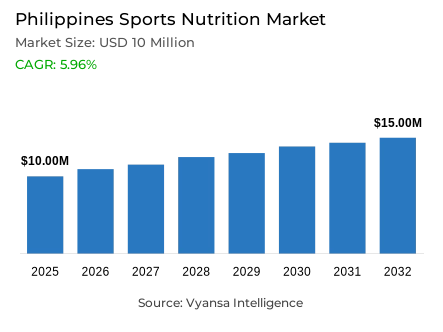
- Sports nutrition in Philippines is estimated at USD 10 million in 2025.
- The market size is expected to grow to USD 15 million by 2032.
- Market to register a cagr of around 5.96% during 2026-32.
- Product Type Shares
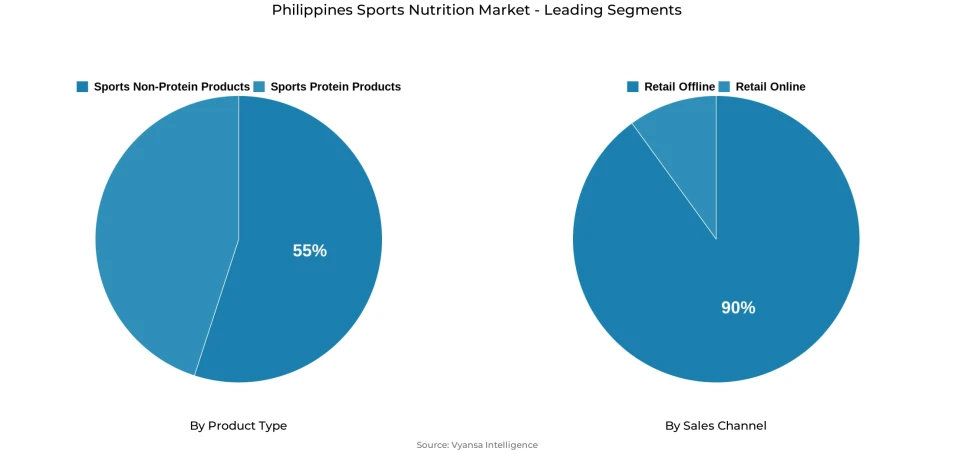
- Sports non-protein products grabbed market share of 55%.
- Competition
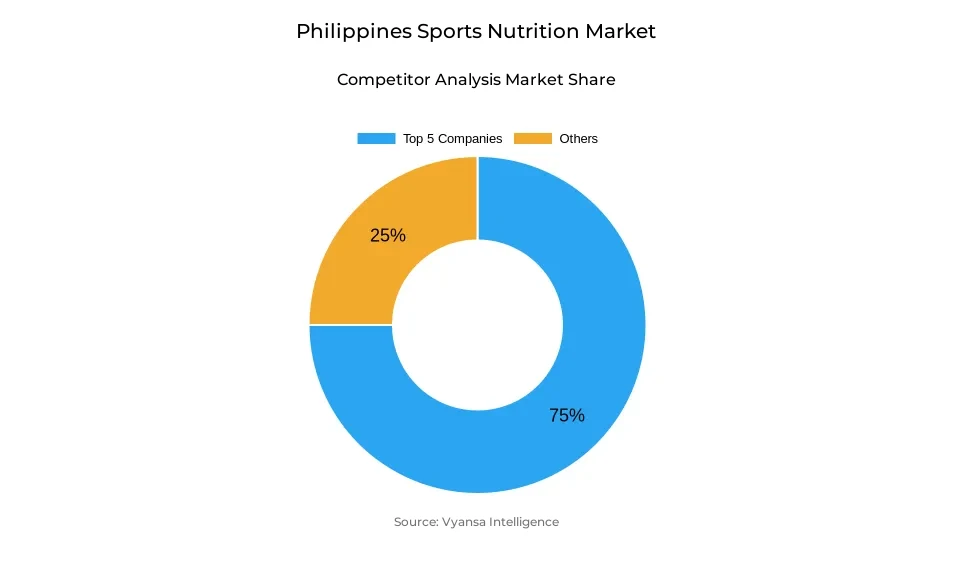
- More than 5 companies are actively engaged in producing sports nutrition in Philippines.
- Top 5 companies acquired around 75% of the market share.
- Wheypower Co; Glanbia Performance Nutrition Ltd; Herbalife International Philippines Inc; United Laboratories Inc; Total Nutrition Corp etc., are few of the top companies.
- Sales Channel
- Retail offline grabbed 90% of the market.
Philippines Sports Nutrition Market Outlook
The Philippines sports nutrition market is projected to reach USD 10 million in 2025 and to reach USD 15 million in 2032, with a compound annual growth rate of about 5.96% in 2026–32. This consistent growth can be attributed to the long-term interest in fitness and wellness that has been gaining momentum over the past few years and is still influencing end user behaviour in the country.
Sports nutrition products are becoming more of a part of a holistic health routine and not just a professional athlete. End users are using these products to not only aid physical performance but also energy maintenance, recovery processes, and mental well-being. Protein supplements, creatine, and functional boosters are commonly viewed as long-term investments in general health, which support the demand among both male and female end users who exercise regularly.
The market is also enjoying the advantage of high institutional and community support of sports and fitness activities. The demand of sports nutrition is being strengthened by government spending on the development of athletes, as well as the increased popularity of running and gymnasium-based activities. The partnerships between sports nutrition companies, fitness centers, and activity-oriented communities are also enhancing product awareness and trial possibilities.
retail online still plays a vital role in influencing the purchasing behaviour especially with the provision of flexible payment and regular promotional activities. Nevertheless, physical retail is also extremely powerful, particularly gymnasium venues and expert shops that provide expert advice and pre-prepared items. All these combine to make the Philippines sports nutrition market poised to grow sustainably and in a balanced manner up to 2032.
Philippines Sports Nutrition Market Growth Driver
Rising physical activity participation supporting functional nutrition demand
The Philippines, growing engagement in structured physical activity and fitness routines remains a key factor supporting demand for sports nutrition products. According to the World Health Organization, 41% of adults in the Philippines are at recommended physical-activity levels, which means that a significant percentage of the population is exercising with the aim of maintaining health and fitness. This continued involvement helps in the daily use of sports nutrition products as a source of energy, endurance and recovery beyond the use of sports products.
This foundation is strengthened by government support. In 2024, the Presidential Communications Office announced that the national sports development will receive an allocation of PHP 1.156 billion, which will enhance access to training facilities, infrastructure, and organized sports programmes. This institutional reinforcement maintains long-term involvement in physical activity and associated nutrition behaviors.
Philippines Sports Nutrition Market Challenge
Household affordability constraints limiting broader adoption
Despite the increased interest, affordability is one of the major limitations to market growth. According to the World Bank, end user-price inflation stood at 6.0% in 2023, and food prices are increasing more rapidly than the general inflation, which lowers the ability to spend discretionally. Such economic climate makes the purchase of sports nutrition more discriminating, especially in the case of lower- and middle-income families.
Market expansion is also limited by income vulnerability. The World Bank Poverty and Equity Brief states that 18.1% of Filipinos are still susceptible to poverty, making them more sensitive to non-essential types of spending. As a result, sports nutrition consumption is not permeating the general population but is still limited to people who are already involved in regular exercise.
Unlock Market Intelligence
Explore the market potential with our data-driven report
Philippines Sports Nutrition Market Trend
Integration of nutrition into holistic physical and mental wellness
Sports nutrition is progressively being integrated into holistic wellness routines, reflecting a shift toward its use for overall health support rather than solely for performance-focused outcomes. The WHO Mental Health Atlas 2023 recognizes mental-health conditions as an emerging public-health issue in the Philippines, which supports the understanding of lifestyle-based interventions, including exercise and nutrition. This setting favors the demand of supplements that are believed to enhance physical energy and mental concentration.
This transition is supported by national health policy. The Department of Health advocates physical activity as a fundamental pillar of mental-health enhancement within the National Mental Health Program, which enhances the population awareness of the connection between exercise, nutrition, and well-being. This stance helps to expand the acceptance of sports nutrition to a wider audience than performance-oriented users.
Philippines Sports Nutrition Market Opportunity
Digital commerce and financial inclusion expanding product accessibility
Retail online opens a significant sports nutrition market. According to the Department of Trade and Industry (DTI), retail online is among the most rapidly expanding retailing channels in the Philippines after the pandemic, enhancing access to health and nutrition products nationwide, especially large ones that can be delivered to homes.
Market accessibility is also supported by financial inclusion. According to the Bangko Sentral ng Pilipinas (BSP), 65% of adults in the Philippines are financially included as of 2022 due to digital payment systems and credit instruments. These processes reduce the barriers to purchase and encourage repeat purchases of sports nutrition products by younger end user groups.
Unlock Market Intelligence
Explore the market potential with our data-driven report
Philippines Sports Nutrition Market Segmentation Analysis
By Product Type
- Sports Protein Products
- Protein/Energy Bars
- Sports Protein Powder
- Sports Protein RTD
- Sports Non-Protein Products
The segment with the largest share in product-type classification is sports non-protein products, which occupy about 55% of the market. This dominance is indicative of high demand of energy boosters, creatine, and endurance-oriented supplements, which attract a wide range of end users beyond the conventional bodybuilders. These products are popular among runners, gymnasium visitors, and those who want to have constant energy and better mental concentration in their everyday life.
Sports non-protein products also enjoy the advantage of versatility and perceived functional advantage. end users are increasingly linking them to stamina boosting, productivity boosting, and overall wellness and not muscle building only. With the trend of running and group fitness activities still on the rise, the demand of non-protein sports nutrition will likely be high, and this segment will be able to maintain its leading role during the forecast period.
By Sales Channel
- Retail Offline
- Retail Online
The retail offline segment has the largest share in the sales channel, with about 90% of the total market sales. Offline distribution channels like gymnasiums, specialty nutrition shops, and health-oriented retailers play a crucial role in shaping the purchase decision as end users often use the advice of staff and face-to-face recommendations when choosing sports nutrition products.
Gyms have become especially significant points of sale, with protein shakes, energy boosters, and other supplements being part of a larger fitness experience. This close association of products with workout routines promotes trial and repeat purchases. Although retail online is growing because of convenience and credit facilities, retail offline is likely to retain its leading role, which is backed by trust, immediacy, and personalized guidance.
List of Companies Covered in Philippines Sports Nutrition Market
The companies listed below are highly influential in the Philippines sports nutrition market, with a significant market share and a strong impact on industry developments.
- Wheypower Co
- Glanbia Performance Nutrition Ltd
- Herbalife International Philippines Inc
- United Laboratories Inc
- Total Nutrition Corp
- MuscleTech Research & Development Inc
- Optimum Nutrition Inc
Competitive Landscape
The competitive landscape of sports nutrition in the Philippines is becoming increasingly dynamic, shaped by brand collaborations, gym partnerships, and strong retail online penetration. Local and international players are intensifying visibility through tie-ups with fitness studios, sports clubs, and gyms, positioning sports nutrition as an integral part of active lifestyles rather than a niche supplement category. Gyms such as Anytime Fitness and Slimmers are acting as important touchpoints by offering product trials and on-site sales, while digital platforms like Lazada and Shopee are lowering purchase barriers through discounts and flexible credit options. This blend of experiential marketing, omnichannel availability, and wellness-led positioning is steadily intensifying competition and expanding category reach.
Frequently Asked Questions
Related Report
1. Market Segmentation
1.1. Research Scope
1.2. Research Methodology
1.3. Definitions and Assumptions
2. Executive Summary
3. Philippines Sports Nutrition Market Policies, Regulations, and Standards
4. Philippines Sports Nutrition Market Dynamics
4.1. Growth Factors
4.2. Challenges
4.3. Trends
4.4. Opportunities
5. Philippines Sports Nutrition Market Statistics, 2022-2032F
5.1. Market Size & Growth Outlook
5.1.1.By Revenues in USD Million
5.2. Market Segmentation & Growth Outlook
5.2.1.By Product Type
5.2.1.1. Sports Protein Products- Market Insights and Forecast 2022-2032, USD Million
5.2.1.1.1. Protein/Energy Bars- Market Insights and Forecast 2022-2032, USD Million
5.2.1.1.2. Sports Protein Powder- Market Insights and Forecast 2022-2032, USD Million
5.2.1.1.3. Sports Protein RTD- Market Insights and Forecast 2022-2032, USD Million
5.2.1.2. Sports Non-Protein Products- Market Insights and Forecast 2022-2032, USD Million
5.2.2.By Sales Channel
5.2.2.1. Retail Offline- Market Insights and Forecast 2022-2032, USD Million
5.2.2.2. Retail Online- Market Insights and Forecast 2022-2032, USD Million
5.2.3.By Ingredients
5.2.3.1. Vitamins and Minerals- Market Insights and Forecast 2022-2032, USD Million
5.2.3.2. Proteins and Amino Acids- Market Insights and Forecast 2022-2032, USD Million
5.2.3.3. Carbohydrates- Market Insights and Forecast 2022-2032, USD Million
5.2.3.4. Probiotics- Market Insights and Forecast 2022-2032, USD Million
5.2.3.5. Botanicals/Herbals- Market Insights and Forecast 2022-2032, USD Million
5.2.3.6. Others- Market Insights and Forecast 2022-2032, USD Million
5.2.4.By Functionality
5.2.4.1. Energy- Market Insights and Forecast 2022-2032, USD Million
5.2.4.2. Muscle growth- Market Insights and Forecast 2022-2032, USD Million
5.2.4.3. Hydration- Market Insights and Forecast 2022-2032, USD Million
5.2.4.4. Weight Management- Market Insights and Forecast 2022-2032, USD Million
5.2.4.5. Others- Market Insights and Forecast 2022-2032, USD Million
5.2.5.By End User
5.2.5.1. Bodybuilders- Market Insights and Forecast 2022-2032, USD Million
5.2.5.2. Athletes- Market Insights and Forecast 2022-2032, USD Million
5.2.5.3. Lifestyle Users- Market Insights and Forecast 2022-2032, USD Million
5.2.6.By Competitors
5.2.6.1. Competition Characteristics
5.2.6.2. Market Share & Analysis
6. Philippines Protein Products Sports Nutrition Market Statistics, 2022-2032F
6.1. Market Size & Growth Outlook
6.1.1.By Revenues in USD Million
6.2. Market Segmentation & Growth Outlook
6.2.1.By Sales Channel- Market Insights and Forecast 2022-2032, USD Million
6.2.2.By Ingredients- Market Insights and Forecast 2022-2032, USD Million
6.2.3.By Functionality- Market Insights and Forecast 2022-2032, USD Million
6.2.4.By End User- Market Insights and Forecast 2022-2032, USD Million
7. Philippines Non-Protein Products Sports Nutrition Market Statistics, 2022-2032F
7.1. Market Size & Growth Outlook
7.1.1.By Revenues in USD Million
7.2. Market Segmentation & Growth Outlook
7.2.1.By Sales Channel- Market Insights and Forecast 2022-2032, USD Million
7.2.2.By Ingredients- Market Insights and Forecast 2022-2032, USD Million
7.2.3.By Functionality- Market Insights and Forecast 2022-2032, USD Million
7.2.4.By End User- Market Insights and Forecast 2022-2032, USD Million
8. Competitive Outlook
8.1. Company Profiles
8.1.1.United Laboratories Inc
8.1.1.1. Business Description
8.1.1.2. Product Portfolio
8.1.1.3. Collaborations & Alliances
8.1.1.4. Recent Developments
8.1.1.5. Financial Details
8.1.1.6. Others
8.1.2.Total Nutrition Corp
8.1.2.1. Business Description
8.1.2.2. Product Portfolio
8.1.2.3. Collaborations & Alliances
8.1.2.4. Recent Developments
8.1.2.5. Financial Details
8.1.2.6. Others
8.1.3.MuscleTech Research & Development Inc
8.1.3.1. Business Description
8.1.3.2. Product Portfolio
8.1.3.3. Collaborations & Alliances
8.1.3.4. Recent Developments
8.1.3.5. Financial Details
8.1.3.6. Others
8.1.4.Optimum Nutrition Inc
8.1.4.1. Business Description
8.1.4.2. Product Portfolio
8.1.4.3. Collaborations & Alliances
8.1.4.4. Recent Developments
8.1.4.5. Financial Details
8.1.4.6. Others
8.1.5.Herbalife International Philippines Inc
8.1.5.1. Business Description
8.1.5.2. Product Portfolio
8.1.5.3. Collaborations & Alliances
8.1.5.4. Recent Developments
8.1.5.5. Financial Details
8.1.5.6. Others
8.1.6.Wheypower Co
8.1.6.1. Business Description
8.1.6.2. Product Portfolio
8.1.6.3. Collaborations & Alliances
8.1.6.4. Recent Developments
8.1.6.5. Financial Details
8.1.6.6. Others
8.1.7.Glanbia Performance Nutrition Ltd
8.1.7.1. Business Description
8.1.7.2. Product Portfolio
8.1.7.3. Collaborations & Alliances
8.1.7.4. Recent Developments
8.1.7.5. Financial Details
8.1.7.6. Others
9. Disclaimer
| Segment | Sub-Segment |
|---|---|
| By Product Type |
|
| By Sales Channel |
|
| By Ingredients |
|
| By Functionality |
|
| By End User |
|
Research Methodology
This study followed a structured approach comprising four key phases to assess the size and scope of the electro-oxidation market. The process began with thorough secondary research to collect data on the target market, related markets, and broader industry context. These findings, along with preliminary assumptions and estimates, were then validated through extensive primary research involving industry experts from across the value chain. To calculate the overall market size, both top-down and bottom-up methodologies were employed. Finally, market segmentation and data triangulation techniques were applied to refine and validate segment-level estimations.
Secondary Research
The secondary research phase involved gathering data from a wide range of credible and published sources. This step helped in identifying industry trends, defining market segmentation, and understanding the market landscape and value chain.
Sources consulted during this phase included:
- Company annual reports, investor presentations, and press releases
- Industry white papers and certified publications
- Trade directories and market-recognized databases
- Articles from authoritative authors and reputable journals
- Gold and silver standard websites
Secondary research was critical in mapping out the industry's value chain and monetary flow, identifying key market segments, understanding regional variations, and tracking significant industry developments.
Other key sources:
- Financial disclosures
- Industry associations and trade bodies
- News outlets and business magazines
- Academic journals and research studies
- Paid industry databases
Primary Research
To validate secondary data and gain deeper market insights, primary research was conducted with key stakeholders across both the supply and demand sides of the market.
On the demand side, participants included decision-makers and influencers from end-user industries—such as CIOs, CTOs, and CSOs—who provided first-hand perspectives on market needs, product usage, and future expectations.
On the supply side, interviews were conducted with manufacturers, industry associations, and institutional participants to gather insights into current offerings, product pipelines, and market challenges.
Primary interviews provided critical inputs such as:
- Market size and revenue data
- Product and service breakdowns
- Market forecasts
- Regional and application-specific trends
Stakeholders consulted included:
- Leading OEM and solution providers
- Channel and distribution partners
- End users across various applications
- Independent consultants and industry specialists
Market Size Estimation and Data Triangulation
- Identifying Key Market Participants (Secondary Research)
- Goal: To identify the major players or companies in the target market. This typically involves using publicly available data sources such as industry reports, market research publications, and financial statements of companies.
- Tools: Reports from firms like Gartner, Forrester, Euromonitor, Statista, IBISWorld, and others. Public financial statements, news articles, and press releases from top market players.
- Extracting Earnings of Key Market Participants
- Goal: To estimate the earnings generated from the product or service being analyzed. This step helps in understanding the revenue potential of each market player in a specific geography.
- Methods: Earnings data can be gathered from:
- Publicly available financial reports (for listed companies).
- Interviews and primary data sources from professionals, such as Directors, VPs, SVPs, etc. This is especially useful for understanding more nuanced, internal data that isn't publicly disclosed.
- Annual reports and investor presentations of key players.
- Data Collation and Development of a Relevant Data Model
- Goal: To collate inputs from both primary and secondary sources into a structured, data-driven model for market estimation. This model will incorporate key market KPIs and any independent variables relevant to the market.
- Key KPIs: These could include:
- Market size, growth rate, and demand drivers.
- Industry-specific metrics like market share, average revenue per customer (ARPC), or average deal size.
- External variables, such as economic growth rates, inflation rates, or commodity prices, that could affect the market.
- Data Modeling: Based on this data, the market forecasts are developed for the next 5 years. A combination of trend analysis, scenario modeling, and statistical regression might be used to generate projections.
- Scenario Analysis
- Goal: To test different assumptions and validate how sensitive the market is to changes in key variables (e.g., market demand, regulatory changes, technological disruptions).
- Types of Scenarios:
- Base Case: Based on current assumptions and historical data.
- Best-Case Scenario: Assuming favorable market conditions, regulatory environments, and technological advancements.
- Worst-Case Scenario: Accounting for adverse factors, such as economic downturns, stricter regulations, or unexpected disruptions.












