North America Advanced Energy Storage Systems Market Report: Trends, Growth and Forecast (2026-2032)
By Technology (Batteries, Thermal Energy Storage, Pumped Hydro Storage, Compressed Air Energy Storage, Flywheel Energy Storage, Hydrogen Energy Storage, Others), By Application (Grid Balancing and Ancillary Services, Renewable Energy Firming and Time Shifting, Backup Power and Energy Resilience, Microgrid and Off-Grid Power Systems, Transportation and Mobility, Industrial Process Energy Management, Others), By End Use (Residential, Commercial, Industrial, Utility), By Storage Duration (Short-Duration Storage, Medium-Duration Storage, Long-Duration Storage), By Country (The US, Canada, Mexico) ... Read more
|
Major Players
|
North America Advanced Energy Storage Systems Market Overview
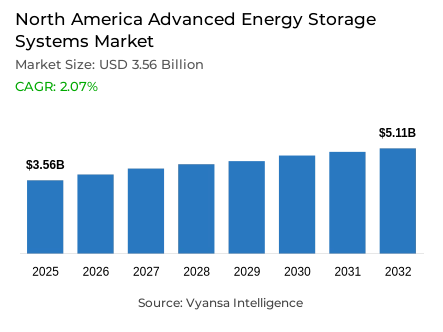
Advanced Energy Storage Systems (AESS) are integrated solutions that store and deliver electricity using advanced technologies such as lithium-ion, sodium-ion, flow batteries, hydrogen, thermal, and compressed air energy storage, enabling reliable power supply, renewable energy integration, and grid stability. Their adoption is particularly significant in North America due to the region's expanding renewable energy capacity, aging power infrastructure, rising electricity demand, and increasing investments in grid modernization and energy resilience. Consequently, the advanced energy storage systems market in North America is projected to grow at a CAGR of 2.07% during 2026–2032.
Key highlights of the North America Advanced Energy Storage Systems Market:
- The North America advanced energy storage systems market was valued at USD 3.56 Billion in 2025 and is estimated at USD 4.52 Billion in 2026.
- Market value is projected to reach USD 5.11 Billion by 2032, reflecting a 2.07% CAGR during the 2026-2032 forecast period.
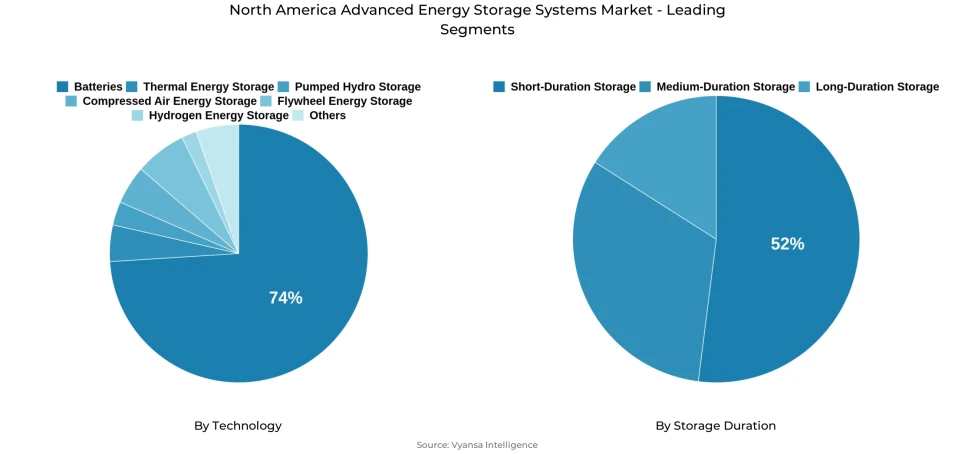
- Batteries led the technology category with a 74% share in 2026.
- However, pumped hydro storage is growing at a CAGR of 3.87% during 2026-2032.
- Short-Duration Storage accounted for a 52% share in 2026.
- Meanwhile, long-duration storage is the fastest-growing duration category, advancing at a 10.51% CAGR during 2026-2032.
- The US held the leading country position with an 81% share in 2026 and is projected to record a 2.47% CAGR during 2026-2032, reflecting the region’s strongest country-level growth trajectory.
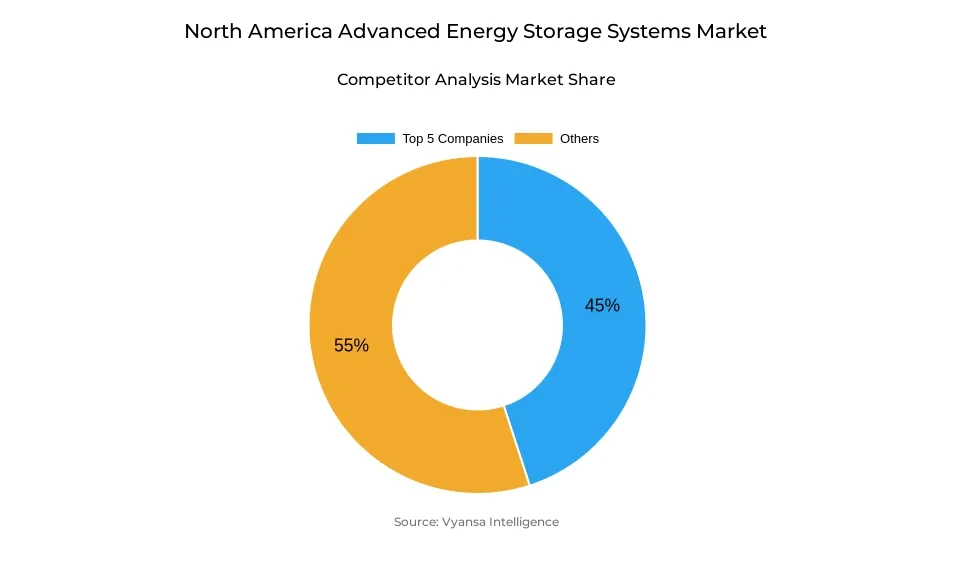
- The top five companies collectively accounted for 45% of the market, indicating a moderately fragmented competitive structure.
The North America advanced energy storage systems market is experiencing sustained growth as utilities, renewable energy developers, commercial enterprises, and technology companies accelerate investments in resilient and flexible power infrastructure. The largest demand originates from utility-scale power grids, where battery energy storage systems are increasingly deployed to enhance grid stability, manage peak demand, and integrate variable renewable energy sources. In 2026, the U.S. plans to add a record 86 GW of new utility-scale generating capacity, of which 43.4 GW will be solar and 24 GW will be battery storage, demonstrating the growing integration of advanced energy storage with renewable energy projects.
Beyond the utility sector, the rapid expansion of AI-powered data centers is significantly increasing electricity demand and accelerating investments in long-duration and distributed energy storage solutions. The U.S. installed a record 9.7 GWh of energy storage capacity during the first quarter of 2026 alone, driven primarily by data center expansion, volatile electricity prices, and growing electricity demand. In parallel, commercial and industrial facilities, including manufacturing plants, hospitals, warehouses, and airports, are increasingly adopting battery energy storage systems to improve energy resilience and reduce peak demand charges.
The transportation sector is also strengthening market demand through the expansion of high-power EV charging infrastructure, while the residential sector continues to adopt battery storage alongside rooftop solar installations. Furthermore, the growing deployment of Virtual Power Plants (VPPs), with U.S. capacity reaching 37.5 GW in 2025 and supported by initiatives such as Google's 100 MW VPP project, is reinforcing the role of distributed battery storage in modernizing North America's electricity network and supporting long-term market growth.
Government Regulations Shaping the North America Advanced Energy Storage Systems Market
United States: FERC Order No. 841
FERC Order No. 841 requires Regional Transmission Organizations (RTOs) and Independent System Operators (ISOs) to establish market rules that enable energy storage resources to participate in wholesale energy, capacity, and ancillary service markets. By removing barriers to market participation, the regulation allows battery storage systems to generate revenue through frequency regulation, capacity services, and peak demand management. This has significantly improved the commercial viability of utility-scale energy storage projects and accelerated private investment across the United States.
Mexico: General Administrative Provisions for the Integration of Electricity Storage Systems into the National Electric System
Mexico's Energy Regulatory Commission (CRE) introduced the General Administrative Provisions for the Integration of Electricity Storage Systems into the National Electric System, establishing regulatory requirements for permitting, grid interconnection, operation, safety, and market participation of energy storage projects. The framework recognizes both standalone and hybrid storage installations, providing greater regulatory certainty for developers and facilitating investments that enhance renewable energy integration and grid reliability.
North America Advanced Energy Storage Systems Market Drivers
Grid Modernization and Rising Electricity Demand Accelerate Advanced Energy Storage Deployment
The modernization of North America's electricity grid, combined with rapidly rising electricity demand, is emerging as a key driver of the advanced energy storage systems market. Aging transmission infrastructure, increasing electrification, AI-driven data center expansion, and higher peak electricity loads are placing unprecedented pressure on grid reliability, compelling utilities to invest in flexible energy storage solutions. Unlike conventional generation assets, advanced energy storage systems provide fast-response capacity that supports frequency regulation, peak load management, voltage stabilization, transmission congestion relief, and backup power without requiring new fossil-fuel generation.
This growing need for grid flexibility is translating into large-scale storage deployments across the region. According to the U.S. Energy Information Administration (EIA), 5.9 GW of battery storage capacity was deployed during the first half of 2025, accounting for approximately 26% of all new utility-scale electricity generating capacity additions, while Texas alone planned to install around 7 GW of additional battery storage during the year. As utilities continue strengthening grid resilience and accommodating rapidly growing electricity consumption, investments in advanced energy storage technologies are expected to accelerate, creating sustained demand for battery systems, power conversion equipment, energy management software, and system integration services.
North America Advanced Energy Storage Systems Market Restraints
Stringent Battery Safety Standards and Evolving Fire Safety Compliance
The rapid deployment of advanced energy storage systems across North America is accompanied by increasingly stringent battery safety regulations and fire protection requirements, creating a significant challenge for project developers and manufacturers. Large-scale battery energy storage systems must comply with multiple technical standards, including UL 9540 for energy storage system safety, UL 9540A for thermal runaway fire testing, and NFPA 855, which establishes installation requirements for stationary energy storage systems. In addition to these national standards, developers must satisfy state, provincial, utility, and local Authority Having Jurisdiction (AHJ) requirements, resulting in complex approval processes and project-specific engineering modifications.
These evolving compliance requirements increase project development costs, extend commissioning timelines, and delay commercial deployment, particularly for utility-scale battery storage installations. As battery system capacities continue to increase and deployments expand near commercial and residential areas, developers are expected to invest further in advanced fire suppression technologies, thermal management systems, battery monitoring software, and enhanced safety testing, making regulatory compliance a critical challenge for the sustained growth of the North America advanced energy storage systems market.
North America Advanced Energy Storage Systems Market Recent Trends
AI-Enabled Energy Management Systems and Intelligent Battery Optimization
Artificial intelligence (AI)-enabled energy management systems are emerging as a defining trend in the North America advanced energy storage systems market, as utilities, independent power producers, and commercial energy users increasingly prioritize software-driven optimization over hardware expansion. Rather than operating battery energy storage systems using fixed dispatch schedules, asset owners are deploying AI and machine learning platforms that continuously analyze electricity prices, renewable generation forecasts, weather conditions, battery state-of-charge, degradation patterns, and grid service opportunities to optimize charging and discharging decisions in real time.
These intelligent platforms enhance battery utilization, extend asset lifespan, improve participation in ancillary service markets, and maximize project revenues while reducing operational costs. The trend is gaining momentum as rising electricity demand from AI-driven data centers and renewable energy integration increases the need for flexible and autonomous battery management. The International Energy Agency (IEA) identifies AI-enabled optimization as a key technology for improving the efficiency, reliability, and flexibility of modern electricity systems.
Industry participants are accelerating investments in AI-powered battery optimization platforms. Wärtsilä's GEMS Pulse, introduced in 2025, applies predictive analytics and cell-level monitoring to improve battery health, detect anomalies, and recover unused storage capacity, helping operators maximize system availability and long-term returns. At the same time, the rapid expansion of battery deployments is creating a larger installed base requiring intelligent software management. According to the U.S. Energy Information Administration (EIA), developers plan to install a record 24 GW of utility-scale battery storage capacity in 2026, further strengthening demand for AI-enabled energy management and battery optimization platforms across North America.
North America Advanced Energy Storage Systems Market Future Opportunities
Growing Data Center Expansion Creates New Growth Avenues
The rapid expansion of AI-driven hyperscale data centers across North America is creating a significant long-term opportunity for advanced energy storage systems industry. As cloud service providers and AI developers continue expanding digital infrastructure, battery energy storage systems are increasingly being deployed to support staged energization, maintain power quality, provide backup power, and manage fluctuating electricity loads before permanent grid upgrades are completed. Unlike conventional utility-scale storage projects, demand from hyperscale data centers is driven by stringent uptime requirements, accelerated deployment schedules, and privately financed infrastructure investments, creating opportunities for companies to deliver integrated battery storage systems, microgrid controls, energy management software, and long-term operations and maintenance services.
The opportunity is reinforced by the unprecedented expansion of North America's data center industry. According to CBRE, primary North American data center supply expanded by 36% year-over-year in 2025 to approximately 9,432 MW, while record net absorption reached 2,497.6 MW, reflecting sustained hyperscale and AI-driven demand. In addition, 74.3% of data center capacity under construction had already been preleased to cloud and AI providers, highlighting robust future infrastructure development.
Meanwhile, the U.S. Department of Energy (DOE) estimates that data centers accounted for approximately 4.4% of U.S. electricity consumption in 2023, with demand projected to increase to 6.7%–12% by 2028. Furthermore, new hyperscale campuses frequently require 300 MW to 1,000 MW of grid connection capacity, creating opportunities for advanced energy storage providers to supply modular battery systems, black-start capability, onsite energy management, and long-term service agreements that accelerate project commissioning while improving power reliability across North America.
Unlock Market Intelligence
Explore the market potential with our data-driven report
North America Advanced Energy Storage Systems Market Segmentation Analysis
By Technology
- Batteries
- Thermal Energy Storage
- Pumped Hydro Storage
- Compressed Air Energy Storage
- Flywheel Energy Storage
- Hydrogen Energy Storage
- Others
Battery Scale and Replicability Sustain Technology Leadership
Batteries lead the technology segment with 74% share in 2026 because they offer rapid response, modular deployment, scalable sizing, and broad suitability across utility, commercial, industrial, residential, and microgrid applications. Operators prefer batteries where standardized systems, warranties, service support, and shorter installation timelines reduce procurement complexity. Their leadership is also supported by wider supplier availability and stronger fit with solar integration, grid flexibility, and distributed energy storage projects.
Meanwhile, pumped hydro storage is growing at a CAGR of 3.87% during 2026-2032. Growth is supported by long-duration discharge, grid-balancing capability, and bulk storage suitability for renewable-heavy power systems. Compared with batteries, pumped hydro remains more site-specific and capital-intensive due to reservoir availability, permitting, civil construction, and longer development timelines. However, it continues gaining relevance where utilities need large-scale storage, system stability, and extended-duration energy shifting.
By Storage Duration
- Short-Duration Storage
- Medium-Duration Storage
- Long-Duration Storage
Short-Duration Leadership Gives Way to Extended Discharge Growth
Short-Duration Storage led the North America advanced energy storage systems industry with a 52% share in 2026. Leadership reflects established use in frequency regulation, renewable smoothing, peak shaving, reserve services, and behind-the-meter demand management. These projects benefit from standardized battery configurations, shorter development timelines, clearer revenue models, lower initial capital requirements, and familiar financing structures. Their fast response and repeated cycling capability support broad utility and commercial procurement compared with extended-duration alternatives requiring less standardized designs and longer qualification periods.
Long-Duration Storage is the fastest-growing duration segment, advancing at a 10.51% CAGR during 2026-2032. Expansion is supported by longer renewable shifting windows, transmission congestion, resilience planning, capacity adequacy, and multiday reliability requirements. Unlike short-duration systems optimized for rapid cycling, long-duration technologies target sustained discharge and reduced dependence on fuel-based backup. Utility pilots, flow batteries, thermal systems, compressed air, and advanced electro chemistries are improving commercial readiness and widening addressable applications for utilities, developers, industrial sites, and remote communities across North America.
Unlock Market Intelligence
Explore the market potential with our data-driven report
North America Advanced Energy Storage Systems Market Regional Analysis
The United States dominates the North America Advanced Energy Storage Systems Market, accounting for approximately 81% of the regional market in 2026. The country's leadership is primarily driven by its unmatched installed base of utility-scale battery energy storage systems and its position as North America's largest electricity market. Large-scale renewable energy deployment, organized wholesale electricity markets operated by regional transmission organizations (RTOs), and widespread participation of battery storage in energy, capacity, and ancillary service markets have accelerated commercial adoption. In addition, the U.S. has the region's most mature project development ecosystem, supported by established engineering, procurement, financing, system integration, and long-term operations and maintenance capabilities. This extensive industry infrastructure enables faster project execution and reinforces the country's dominant share in advanced energy storage deployment across utility, commercial, and industrial applications.
The United States is also expected to register the fastest growth during the forecast period, supported by an expanding pipeline of battery storage projects and rising electricity demand from AI-driven data centers, electrification, and renewable energy integration. Federal incentives under the Inflation Reduction Act, including the Section 48E Clean Electricity Investment Tax Credit and domestic content incentives, continue to stimulate private investment in storage manufacturing and deployment. At the same time, utilities across major markets are procuring additional storage capacity to improve grid reliability and accommodate increasing renewable generation. Compared with Canada and Mexico, the United States benefits from a larger investment pipeline, stronger private-sector participation, greater manufacturing capacity, and broader commercial deployment opportunities, positioning it to maintain the highest growth rate in the regional market throughout the forecast period.
North America Advanced Energy Storage Systems Market Competitive Landscape
The North America advanced energy storage systems industry appears moderately fragmented, with the top five companies collectively accounting for 45% of the market. The top five companies include, Tesla Inc., Fluence Energy LLC, Canadian Solar Inc., LG Energy Solution Vertech Inc., and Sungrow USA Corporation.
Key Companies in the North America Advanced Energy Storage Systems Market
- Tesla Inc.
- Fluence Energy LLC
- Canadian Solar Inc.
- LG Energy Solution Vertech Inc.
- Sungrow USA Corporation
- FlexGen Power Systems LLC
- Wärtsilä Energy Storage Inc.
- SAMSUNG SDI America Inc.
- BYD North America LLC (BYD Energy Storage)
- Enphase Energy Inc.
- GE Vernova Inc.
- Hitachi Energy USA Inc.
Company Profiles
This section examines how leading companies shape the North America advanced energy storage systems industry through technology innovation and manufacturing expansion. It highlights each participant's contribution to advancing storage deployment, strengthening supply chains, and supporting grid modernization across the region.
Tesla Inc.
Tesla Inc., headquartered in Austin, Texas, participates through Megapack for utility-scale storage and Powerwall for residential and commercial applications. Megapack combines battery modules, power conversion, thermal management, and controls for grid stabilization, renewable integration, and outage support. Tesla’s Lathrop, California Megafactory can produce 10,000 Megapacks annually, equivalent to 40 GWh. Its vertically integrated hardware, software, manufacturing, and remote-operations capabilities position Tesla as a scale-oriented supplier serving utilities, developers, businesses, and distributed-energy customers across North America.
Fluence Energy LLC
Fluence Energy LLC operates from Arlington, Virginia and was established by Siemens and AES to provide storage products, services, and optimization software. Its portfolio includes Smartstack, Gridstack Pro, Gridstack, Mosaic bidding software, and Nispera asset-performance management. As of March 31, 2026, Fluence reported 7.4 GW deployed and 10.1 GW of contracted backlog across 33 markets in 25 countries. Its integration, commissioning, service, and digital capabilities position the company as a technology-led supplier for utility, renewable, and large-load projects.
Canadian Solar Inc.
Canadian Solar Inc., headquartered in Kitchener, Ontario, participates through e-STORAGE, which designs, manufactures, and integrates utility-scale battery systems. Its portfolio includes SolBank and FlexBank platforms, EPC execution, commissioning, and long-term services. Canadian Solar reported that e-STORAGE had shipped more than 18 GWh globally by December 31, 2025, with a USD 3.6 billion contracted backlog by March 13, 2026. The company competes as an integrated equipment, engineering, delivery, and lifecycle-services supplier.
LG Energy Solution Vertech Inc.
LG Energy Solution Vertech Inc., based in Westborough, Massachusetts, is the US energy-storage integration subsidiary of LG Energy Solution. It combines battery supply, system integration, software, warranties, field support, and long-term services under turnkey contracts. Its LFP-based systems are designed for North American safety requirements, including large-scale fire testing aligned with UL 9540A, NFPA 855, and the International Fire Code. Regional manufacturing access and utility relationships support its position as a vertically integrated, compliance-focused supplier.
Sungrow USA Corporation
Sungrow USA Corporation serves North American utility, commercial, and residential customers as the US operating arm of Sungrow Power Supply Co., Ltd. Its storage portfolio includes PowerTitan utility-scale systems and PowerStack commercial solutions, supported by power-conversion equipment, controls, commissioning, and service capabilities. The company combines liquid-cooled storage architecture, grid-forming functionality, and power-electronics expertise across configurable applications. Sungrow competes as a technology-led participant focused on compact integration, renewable support, grid stability, and lifecycle operating performance.
Recent Developments in the North America Advanced Energy Storage Systems Industry
- May 2026: LG Energy Solution Vertech announced a 6 GWh supply agreement with DTE Energy covering eight Michigan battery-storage projects delivered over two years. The portfolio will use cells from US and Canadian facilities, strengthening regional manufacturing alignment, utility-scale deployment, supply security, and long-term grid reliability.
- March 2026: Canadian Solar’s e-STORAGE signed a 500 MW/2,493 MWh supply agreement with a major US utility for approximately 500 SolBank 3.0 containers. Shipments are scheduled from March through July 2027, supporting data-center grid infrastructure, regional resilience, and contracted North American project execution.
Frequently Asked Questions
Related Report
- Market Segmentation
- Research Scope
- Research Methodology
- Definitions and Assumptions
- Executive Summary
- North America Advanced Energy Storage Systems Market Policies, Regulations, and Standards
- North America Advanced Energy Storage Systems Market Dynamics
- Growth Factors
- Challenges
- Trends
- Opportunities
- North America Advanced Energy Storage Systems Market Statistics, 2022-2032F
- Market Size & Growth Outlook
- By Revenues in USD Million
- Market Segmentation & Growth Outlook
- By Technology
- Batteries- Market Insights and Forecast 2022-2032, USD Million
- Thermal Energy Storage- Market Insights and Forecast 2022-2032, USD Million
- Pumped Hydro Storage- Market Insights and Forecast 2022-2032, USD Million
- Compressed Air Energy Storage- Market Insights and Forecast 2022-2032, USD Million
- Flywheel Energy Storage- Market Insights and Forecast 2022-2032, USD Million
- Hydrogen Energy Storage- Market Insights and Forecast 2022-2032, USD Million
- Others- Market Insights and Forecast 2022-2032, USD Million
- By Application
- Grid Balancing and Ancillary Services- Market Insights and Forecast 2022-2032, USD Million
- Renewable Energy Firming and Time Shifting- Market Insights and Forecast 2022-2032, USD Million
- Backup Power and Energy Resilience- Market Insights and Forecast 2022-2032, USD Million
- Microgrid and Off-Grid Power Systems- Market Insights and Forecast 2022-2032, USD Million
- Transportation and Mobility- Market Insights and Forecast 2022-2032, USD Million
- Industrial Process Energy Management- Market Insights and Forecast 2022-2032, USD Million
- Others- Market Insights and Forecast 2022-2032, USD Million
- By End Use
- Residential- Market Insights and Forecast 2022-2032, USD Million
- Commercial- Market Insights and Forecast 2022-2032, USD Million
- Industrial- Market Insights and Forecast 2022-2032, USD Million
- Utility- Market Insights and Forecast 2022-2032, USD Million
- By Storage Duration
- Short-Duration Storage- Market Insights and Forecast 2022-2032, USD Million
- Medium-Duration Storage- Market Insights and Forecast 2022-2032, USD Million
- Long-Duration Storage- Market Insights and Forecast 2022-2032, USD Million
- By Country
- The US
- Canada
- Mexico
- By Competitors
- Competition Characteristics
- Market Share & Analysis
- By Technology
- Market Size & Growth Outlook
- The US Advanced Energy Storage Systems Market Statistics, 2022-2032F
- Market Size & Growth Outlook
- By Revenues in USD Million
- Market Segmentation & Growth Outlook
- By Technology- Market Insights and Forecast 2022-2032, USD Million
- By Application- Market Insights and Forecast 2022-2032, USD Million
- By End Use- Market Insights and Forecast 2022-2032, USD Million
- By Storage Duration- Market Insights and Forecast 2022-2032, USD Million
- Market Size & Growth Outlook
- Canada Advanced Energy Storage Systems Market Statistics, 2022-2032F
- Market Size & Growth Outlook
- By Revenues in USD Million
- Market Segmentation & Growth Outlook
- By Technology- Market Insights and Forecast 2022-2032, USD Million
- By Application- Market Insights and Forecast 2022-2032, USD Million
- By End Use- Market Insights and Forecast 2022-2032, USD Million
- By Storage Duration- Market Insights and Forecast 2022-2032, USD Million
- Market Size & Growth Outlook
- Mexico Advanced Energy Storage Systems Market Statistics, 2022-2032F
- Market Size & Growth Outlook
- By Revenues in USD Million
- Market Segmentation & Growth Outlook
- By Technology- Market Insights and Forecast 2022-2032, USD Million
- By Application- Market Insights and Forecast 2022-2032, USD Million
- By End Use- Market Insights and Forecast 2022-2032, USD Million
- By Storage Duration- Market Insights and Forecast 2022-2032, USD Million
- Market Size & Growth Outlook
- Competitive Outlook
- Company Profiles
- Tesla Inc.
- Business Description
- Product Portfolio
- Collaborations & Alliances
- Recent Developments
- Financial Details
- Others
- Fluence Energy LLC
- Business Description
- Product Portfolio
- Collaborations & Alliances
- Recent Developments
- Financial Details
- Others
- Canadian Solar Inc.
- Business Description
- Product Portfolio
- Collaborations & Alliances
- Recent Developments
- Financial Details
- Others
- LG Energy Solution Vertech Inc.
- Business Description
- Product Portfolio
- Collaborations & Alliances
- Recent Developments
- Financial Details
- Others
- Sungrow USA Corporation
- Business Description
- Product Portfolio
- Collaborations & Alliances
- Recent Developments
- Financial Details
- Others
- FlexGen Power Systems LLC
- Business Description
- Product Portfolio
- Collaborations & Alliances
- Recent Developments
- Financial Details
- Others
- Wärtsilä Energy Storage Inc.
- Business Description
- Product Portfolio
- Collaborations & Alliances
- Recent Developments
- Financial Details
- Others
- SAMSUNG SDI America Inc.
- Business Description
- Product Portfolio
- Collaborations & Alliances
- Recent Developments
- Financial Details
- Others
- BYD North America LLC (BYD Energy Storage)
- Business Description
- Product Portfolio
- Collaborations & Alliances
- Recent Developments
- Financial Details
- Others
- Enphase Energy Inc.
- Business Description
- Product Portfolio
- Collaborations & Alliances
- Recent Developments
- Financial Details
- Others
- GE Vernova Inc.
- Business Description
- Product Portfolio
- Collaborations & Alliances
- Recent Developments
- Financial Details
- Others
- Hitachi Energy USA Inc.
- Business Description
- Product Portfolio
- Collaborations & Alliances
- Recent Developments
- Financial Details
- Others
- Tesla Inc.
- Company Profiles
- Disclaimer
| Segment | Sub-Segment |
|---|---|
| By Technology |
|
| By Application |
|
| By End Use |
|
| By Storage Duration |
|
| By Country |
|
Research Methodology
This study followed a structured approach comprising four key phases to assess the size and scope of the electro-oxidation market. The process began with thorough secondary research to collect data on the target market, related markets, and broader industry context. These findings, along with preliminary assumptions and estimates, were then validated through extensive primary research involving industry experts from across the value chain. To calculate the overall market size, both top-down and bottom-up methodologies were employed. Finally, market segmentation and data triangulation techniques were applied to refine and validate segment-level estimations.
Secondary Research
The secondary research phase involved gathering data from a wide range of credible and published sources. This step helped in identifying industry trends, defining market segmentation, and understanding the market landscape and value chain.
Sources consulted during this phase included:
- Company annual reports, investor presentations, and press releases
- Industry white papers and certified publications
- Trade directories and market-recognized databases
- Articles from authoritative authors and reputable journals
- Gold and silver standard websites
Secondary research was critical in mapping out the industry's value chain and monetary flow, identifying key market segments, understanding regional variations, and tracking significant industry developments.
Other key sources:
- Financial disclosures
- Industry associations and trade bodies
- News outlets and business magazines
- Academic journals and research studies
- Paid industry databases
Primary Research
To validate secondary data and gain deeper market insights, primary research was conducted with key stakeholders across both the supply and demand sides of the market.
On the demand side, participants included decision-makers and influencers from end-user industries—such as CIOs, CTOs, and CSOs—who provided first-hand perspectives on market needs, product usage, and future expectations.
On the supply side, interviews were conducted with manufacturers, industry associations, and institutional participants to gather insights into current offerings, product pipelines, and market challenges.
Primary interviews provided critical inputs such as:
- Market size and revenue data
- Product and service breakdowns
- Market forecasts
- Regional and application-specific trends
Stakeholders consulted included:
- Leading OEM and solution providers
- Channel and distribution partners
- End users across various applications
- Independent consultants and industry specialists
Market Size Estimation and Data Triangulation
- Identifying Key Market Participants (Secondary Research)
- Goal: To identify the major players or companies in the target market. This typically involves using publicly available data sources such as industry reports, market research publications, and financial statements of companies.
- Tools: Reports from firms like Gartner, Forrester, Euromonitor, Statista, IBISWorld, and others. Public financial statements, news articles, and press releases from top market players.
- Extracting Earnings of Key Market Participants
- Goal: To estimate the earnings generated from the product or service being analyzed. This step helps in understanding the revenue potential of each market player in a specific geography.
- Methods: Earnings data can be gathered from:
- Publicly available financial reports (for listed companies).
- Interviews and primary data sources from professionals, such as Directors, VPs, SVPs, etc. This is especially useful for understanding more nuanced, internal data that isn't publicly disclosed.
- Annual reports and investor presentations of key players.
- Data Collation and Development of a Relevant Data Model
- Goal: To collate inputs from both primary and secondary sources into a structured, data-driven model for market estimation. This model will incorporate key market KPIs and any independent variables relevant to the market.
- Key KPIs: These could include:
- Market size, growth rate, and demand drivers.
- Industry-specific metrics like market share, average revenue per customer (ARPC), or average deal size.
- External variables, such as economic growth rates, inflation rates, or commodity prices, that could affect the market.
- Data Modeling: Based on this data, the market forecasts are developed for the next 5 years. A combination of trend analysis, scenario modeling, and statistical regression might be used to generate projections.
- Scenario Analysis
- Goal: To test different assumptions and validate how sensitive the market is to changes in key variables (e.g., market demand, regulatory changes, technological disruptions).
- Types of Scenarios:
- Base Case: Based on current assumptions and historical data.
- Best-Case Scenario: Assuming favorable market conditions, regulatory environments, and technological advancements.
- Worst-Case Scenario: Accounting for adverse factors, such as economic downturns, stricter regulations, or unexpected disruptions.












