Nigeria Menstrual Care Market Report: Trends, Growth and Forecast (2026-2032)
Product Type (Pantyliners, Tampons (Applicator Tampons, Digital Tampons), Towels (Standard Towels (Standard Towels with Wings, Standard Towels Without Wings), Slim/Thin/Ultra-Thin Towels (Slim/Thin/Ultra-Thin Towels with Wings, Slim/Thin/Ultra-Thin Towels Without Wings)), Intimate Wipes, Menstrual Cups, Period Underwear), Nature (Disposable, Reusable), Age Group (Up to 18 Years, 19-30 Years, 31-40 Years, 40 Years and Above), Sales Channel (Retail Offline, Retail Online) ... Read more
|
Major Players
|
Nigeria Menstrual Care Market Statistics and Insights, 2026
- Market Size Statistics
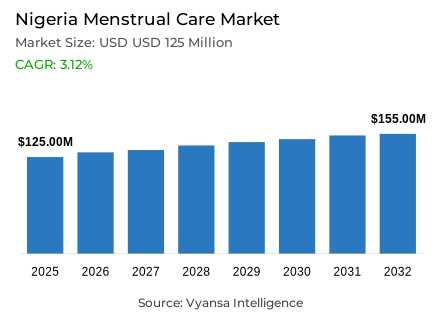
- Menstrual care in Nigeria is estimated at USD 125 million in 2025.
- The market size is expected to grow to USD 155 million by 2032.
- Market to register a cagr of around 3.12% during 2026-32.
- Product Type Shares
- Towels grabbed market share of 95%.
- Competition
- More than 15 companies are actively engaged in producing menstrual care in Nigeria.
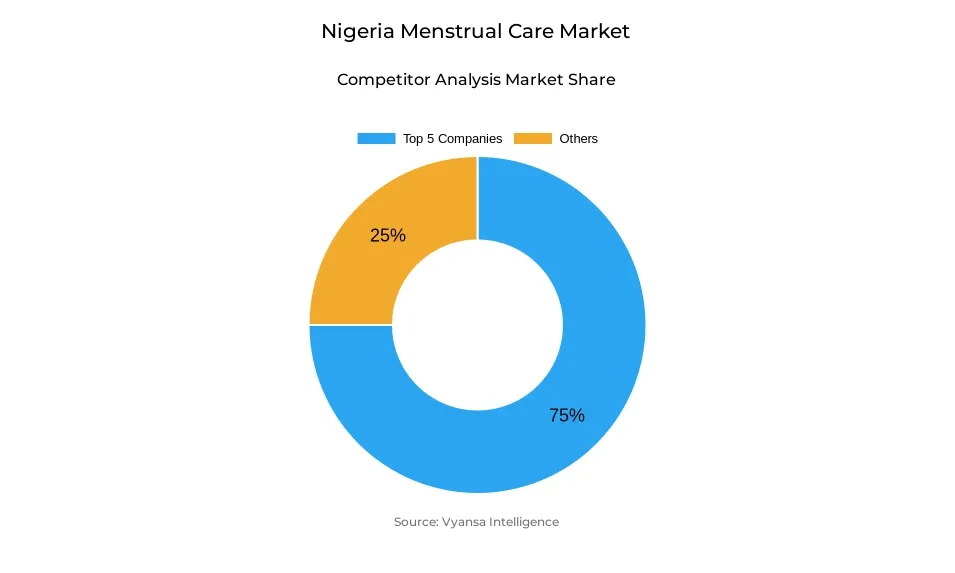
- Top 5 companies acquired around 75% of the market share.
- Sankin Industries Ltd; Bordar Group; Kimberly-Clark Corp; Mallinson Group; Hayat Kimya Nigeria Ltd etc., are few of the top companies.
- Sales Channel
- Retail offline grabbed 75% of the market.
Nigeria Menstrual Care Market Outlook
The Nigeria menstrual care market is expected to increase steadily within the 2026-2032 period with an estimated market value of USD 125 million in 2025 projected to reach USD 155 million in 2032 with a compound annual growth rate of about 3.12%. The necessity of menstrual care products and the long-term demand will support market growth despite the inflationary pressures and declining purchasing power. A significant percentage of end-users still prefer disposable sanitary pads to reusable ones due to the perceived issues of hygiene and convenience. However, the price-sensitive consumers are also shifting towards affordable or reusable products, which slightly limits the growth of the volume.
The market is dominated by towels, which have a 95% share, with slim/thin/ultra-thin towels with wings being the most sold. Their comfort, discreet fit, and broad availability are appreciated, which is why these products are especially popular among younger women, especially Generation Z. The increasing popularity of these new and comfortable alternatives is likely to continue the value growth, despite the ongoing economic difficulties. Furthermore, the diversity of designs and the growing presence of such products in various retail outlets only contribute to their popularity on the market.
The offline retail channels constitute 75% of the total sales, and they continue to be the most important channel of product distribution. Supermarkets, local stores, and open markets still prevail because of their accessibility and preference by consumers to have them immediately. Online sales are still small but they are slowly increasing with the increase in digital access and convenience in urban locations.
The manufacturer of Softcare, Mallinson Group, dominates the market after the withdrawal of local manufacturing activities of Procter and Gamble. The effective marketing, promotional offers, and appealing packaging have enabled Softcare to gain a dominant position because of its strong performance. In the next few years, the innovation of the brand, low cost, and strategic marketing will continue to be the key to the further development of the menstrual care market in Nigeria.
Nigeria Menstrual Care Market Growth Driver
Increasing Female Workforce Participation Enhances Market Demand
The Nigeria Menstrual Care Market is growing because of the rising number of women in the labor force, which has resulted in increased disposable income and stable demand of the product. The World Bank Gender Data Portal indicates that female labour force participation is 80.7% in 2024, which is a good indicator of economic involvement of women in the Nigerian economy. This figure is similar to that of males at 84.4%, which indicates almost equal involvement in the workforce and a significant contribution of women to the economy. The increased participation of the workforce has increased hygiene awareness and motivated women to find good menstrual care products that make them comfortable in their day to day activities.
Also, flexible and comfortable pads that are slim, ultra-thin, and winged are gaining popularity among working women, which contributes to the increase in the volume of the menstrual care market. The growing female labour force base is one of the primary reasons why menstrual care consumption is still maintained in Nigeria as more women have independent incomes and focus on personal hygiene products. Employment in urban areas is still a factor in product adoption because women in urban areas have more access to a variety of menstrual care. This population change is a key growth engine to manufacturers and retailers in the Nigerian menstrual care market.
Nigeria Menstrual Care Market Challenge
Financial Limitations and Falling Buying Power
The ongoing inflation and depreciation of the local currency in Nigeria still undermine the purchasing power, which restricts access to quality menstrual products. The National Bureau of Statistics (NBS) reported that headline inflation stood at 34.80% in December 2024, which is a major blow to the affordability of most households. This high inflation has increased faster than the wage increment among most workers especially in the lower income groups where women have low income. Consequently, an increasing proportion of women, especially in rural regions, have moved to less expensive or reusable alternatives, lowering the total volume of the products sold in the high-end market.
According to the Central Bank of Nigeria, the naira fell by 40.9% against the USD in 2024, and the cumulative depreciation stood at 129.23% throughout the entire year, which increased the cost of imports of raw materials and packaging. This has added production costs to manufacturers leading to high retail prices and low profit margins. Collectively, these economic issues limit consumer access and deter large-scale local production investments, which continues to be a barrier to market growth. The synergies between currency weakness and inflationary pressure have made the operating environment to be difficult to all the market players.
Unlock Market Intelligence
Explore the market potential with our data-driven report
Nigeria Menstrual Care Market Trend
Shift to Reusable and Locally Sourced Menstrual Products
The increasing environmental consciousness and cost-effectiveness are pushing Nigerian women to use reusable menstrual items and locally available options. Non-governmental and government efforts have introduced hygiene programmes in the country that encourage the use of washable pads as affordable and environmentally friendly alternatives, with the Renewed Hope Initiative delivering about 370,000 sanitary pads nationwide by October 2025. These programmes target women and girls living in underserved communities, both in terms of menstrual poverty and environmental sustainability. This is in line with the increasing demand of sustainable materials and local production programs that generate local employment and minimize reliance on imports.
Also, according to World Bank data, the intensity of imports in the Nigerian economy remains fluctuating, which is a sign of slow replacement of local products by foreign ones as the local producers gain capacity. With the domestic textile and hygiene producers gaining momentum, the market is experiencing more innovation in reusable fabric pads and cotton-based products produced in Nigeria. These trends emphasize the shift of Nigeria to sustainability and decreased reliance on imports, which is facilitated by the increasing consumer interest in environmentally friendly products. Local producers are also better placed to win market share through focus on sustainable production and low prices.
Nigeria Menstrual Care Market Opportunity
Innovation to Focus on Comfort and Skincare Benefits
The future innovation in the menstrual care market in Nigeria is likely to be aimed at improving the comfort and skin protection by improving the materials to fit the climate conditions in Nigeria. As the climate in Nigeria is tropical with high humidity and heat, soft and breathable pads that cause minimal irritation are becoming a subject of interest among both manufacturers and consumers.
It is reported that improper menstrual hygiene practices may cause skin infections and dermatological problems, which is why products that are skin-health conscious are urgently needed. Local manufacturers are reacting to this need by coming up with formulations that consider comfort and safety as the key concerns to end-users.
Unlock Market Intelligence
Explore the market potential with our data-driven report
Nigeria Menstrual Care Market Segmentation Analysis
By Product Type
- Pantyliners
- Tampons
- Towels
- Intimate Wipes
- Menstrual Cups
- Period Underwear
The segment with the highest market share under Product Type is towels, accounting for 95% of the Nigeria menstrual care market. Slim/thin/ultra-thin towels with wings dominate this segment, driven by their comfort, convenience, and discreet nature under clothing. These products are particularly preferred by younger women, especially Generation Z, who value variety, softness, and flexibility. Despite inflationary pressures and reduced purchasing power affecting sales volumes, the category maintained strong value growth as towels remain essential products for most women.
The segment continues to benefit from product innovations, attractive packaging, and strong availability across retail outlets. Consumers consider towels a necessary purchase, with many perceiving reusable pads as impractical due to hygiene concerns and washing requirements. This consistent demand for disposable options reinforces the dominance of towels within Nigeria’s menstrual care market.

By Sales Channel
- Retail Offline
- Retail Online
The segment with the highest market share under Sales Channel is retail offline, capturing 75% of the Nigeria menstrual care market. This channel remains dominant as menstrual care products are primarily purchased through supermarkets, convenience stores, and open markets, where consumers can access a wide range of brands and sizes. Price-sensitive buyers also rely on offline stores to compare prices and benefit from promotional offers and discounts.
In addition, the availability of leading brands such as Softcare and Always through offline networks supports steady product visibility. The familiarity and trust associated with in-person shopping continue to influence buying decisions, particularly in urban and semi-urban regions. While online sales channels are gradually emerging, limited digital access and payment barriers mean that offline retail will remain the key distribution mode for menstrual care products in Nigeria.
List of Companies Covered in Nigeria Menstrual Care Market
The companies listed below are highly influential in the Nigeria menstrual care market, with a significant market share and a strong impact on industry developments.
- Sankin Industries Ltd
- Bordar Group
- Kimberly-Clark Corp
- Mallinson Group
- Hayat Kimya Nigeria Ltd
- Procter & Gamble Nigeria Ltd
- Guangzhou Livi Import & Export Co Ltd
- Goonite Hygiene FZE
- Femina Hygenic Industries Ltd
- Globe Spinning Mills Nigeria Ltd
Frequently Asked Questions
Related Report
1. Market Segmentation
1.1. Research Scope
1.2. Research Methodology
1.3. Definitions and Assumptions
2. Executive Summary
3. Nigeria Menstrual Care Market Policies, Regulations, and Standards
4. Nigeria Menstrual Care Market Dynamics
4.1. Growth Factors
4.2. Challenges
4.3. Trends
4.4. Opportunities
5. Nigeria Menstrual Care Market Statistics, 2022-2032F
5.1. Market Size & Growth Outlook
5.1.1.By Revenues in USD Million
5.2. Market Segmentation & Growth Outlook
5.2.1.By Product Type
5.2.1.1. Pantyliners- Market Insights and Forecast 2022-2032, USD Million
5.2.1.2. Tampons- Market Insights and Forecast 2022-2032, USD Million
5.2.1.2.1. Applicator Tampons- Market Insights and Forecast 2022-2032, USD Million
5.2.1.2.2. Digital Tampons- Market Insights and Forecast 2022-2032, USD Million
5.2.1.3. Towels- Market Insights and Forecast 2022-2032, USD Million
5.2.1.3.1. Standard Towels- Market Insights and Forecast 2022-2032, USD Million
5.2.1.3.1.1. Standard Towels with Wings- Market Insights and Forecast 2022-2032, USD Million
5.2.1.3.1.2. Standard Towels Without Wings- Market Insights and Forecast 2022-2032, USD Million
5.2.1.3.2. Slim/Thin/Ultra-Thin Towels- Market Insights and Forecast 2022-2032, USD Million
5.2.1.3.2.1. Slim/Thin/Ultra-Thin Towels with Wings- Market Insights and Forecast 2022-2032, USD Million
5.2.1.3.2.2. Slim/Thin/Ultra-Thin Towels Without Wings- Market Insights and Forecast 2022-2032, USD Million
5.2.1.4. Intimate Wipes- Market Insights and Forecast 2022-2032, USD Million
5.2.1.5. Menstrual Cups- Market Insights and Forecast 2022-2032, USD Million
5.2.1.6. Period Underwear- Market Insights and Forecast 2022-2032, USD Million
5.2.2.By Nature
5.2.2.1. Disposable- Market Insights and Forecast 2022-2032, USD Million
5.2.2.2. Reusable- Market Insights and Forecast 2022-2032, USD Million
5.2.3.By Age Group
5.2.3.1. Up to 18 Years- Market Insights and Forecast 2022-2032, USD Million
5.2.3.2. 19-30 Years- Market Insights and Forecast 2022-2032, USD Million
5.2.3.3. 31-40 Years- Market Insights and Forecast 2022-2032, USD Million
5.2.3.4. 40 Years and Above- Market Insights and Forecast 2022-2032, USD Million
5.2.4.By Sales Channel
5.2.4.1. Retail Offline- Market Insights and Forecast 2022-2032, USD Million
5.2.4.2. Retail Online- Market Insights and Forecast 2022-2032, USD Million
5.2.5.By Competitors
5.2.5.1. Competition Characteristics
5.2.5.2. Market Share & Analysis
6. Nigeria Pantyliners Menstrual Care Market Statistics, 2022-2032
6.1. Market Size & Growth Outlook
6.1.1.By Revenues in USD Million
6.2. Market Segmentation & Growth Outlook
6.2.1.By Nature- Market Insights and Forecast 2022-2032, USD Million
6.2.2.By Age Group- Market Insights and Forecast 2022-2032, USD Million
6.2.3.By Sales Channel- Market Insights and Forecast 2022-2032, USD Million
7. Nigeria Tampons Menstrual Care Market Statistics, 2022-2032
7.1. Market Size & Growth Outlook
7.1.1.By Revenues in USD Million
7.2. Market Segmentation & Growth Outlook
7.2.1.By Product Type- Market Insights and Forecast 2022-2032, USD Million
7.2.2.By Nature- Market Insights and Forecast 2022-2032, USD Million
7.2.3.By Age Group- Market Insights and Forecast 2022-2032, USD Million
7.2.4.By Sales Channel- Market Insights and Forecast 2022-2032, USD Million
8. Nigeria Towels Menstrual Care Market Statistics, 2022-2032
8.1. Market Size & Growth Outlook
8.1.1.By Revenues in USD Million
8.2. Market Segmentation & Growth Outlook
8.2.1.By Product Type- Market Insights and Forecast 2022-2032, USD Million
8.2.2.By Nature- Market Insights and Forecast 2022-2032, USD Million
8.2.3.By Age Group- Market Insights and Forecast 2022-2032, USD Million
8.2.4.By Sales Channel- Market Insights and Forecast 2022-2032, USD Million
9. Nigeria Intimate Wipes Market Statistics, 2022-2032
9.1. Market Size & Growth Outlook
9.1.1.By Revenues in USD Million
9.2. Market Segmentation & Growth Outlook
9.2.1.By Nature- Market Insights and Forecast 2022-2032, USD Million
9.2.2.By Age Group- Market Insights and Forecast 2022-2032, USD Million
9.2.3.By Sales Channel- Market Insights and Forecast 2022-2032, USD Million
10. Nigeria Menstrual Cups Menstrual Care Market Statistics, 2022-2032
10.1. Market Size & Growth Outlook
10.1.1. By Revenues in USD Million
10.2. Market Segmentation & Growth Outlook
10.2.1. By Nature- Market Insights and Forecast 2022-2032, USD Million
10.2.2. By Age Group- Market Insights and Forecast 2022-2032, USD Million
10.2.3. By Sales Channel- Market Insights and Forecast 2022-2032, USD Million
11. Nigeria Period Underwear Menstrual Care Market Statistics, 2022-2032
11.1. Market Size & Growth Outlook
11.1.1. By Revenues in USD Million
11.2. Market Segmentation & Growth Outlook
11.2.1. By Nature- Market Insights and Forecast 2022-2032, USD Million
11.2.2. By Age Group- Market Insights and Forecast 2022-2032, USD Million
11.2.3. By Sales Channel- Market Insights and Forecast 2022-2032, USD Million
12. Competitive Outlook
12.1. Company Profiles
12.1.1. Mallinson Group
12.1.1.1. Business Description
12.1.1.2. Product Portfolio
12.1.1.3. Collaborations & Alliances
12.1.1.4. Recent Developments
12.1.1.5. Financial Details
12.1.1.6. Others
12.1.2. Hayat Kimya Nigeria Ltd
12.1.2.1. Business Description
12.1.2.2. Product Portfolio
12.1.2.3. Collaborations & Alliances
12.1.2.4. Recent Developments
12.1.2.5. Financial Details
12.1.2.6. Others
12.1.3. Procter & Gamble Nigeria Ltd
12.1.3.1. Business Description
12.1.3.2. Product Portfolio
12.1.3.3. Collaborations & Alliances
12.1.3.4. Recent Developments
12.1.3.5. Financial Details
12.1.3.6. Others
12.1.4. Guangzhou Livi Import & Export Co Ltd
12.1.4.1. Business Description
12.1.4.2. Product Portfolio
12.1.4.3. Collaborations & Alliances
12.1.4.4. Recent Developments
12.1.4.5. Financial Details
12.1.4.6. Others
12.1.5. Goonite Hygiene FZE
12.1.5.1. Business Description
12.1.5.2. Product Portfolio
12.1.5.3. Collaborations & Alliances
12.1.5.4. Recent Developments
12.1.5.5. Financial Details
12.1.5.6. Others
12.1.6. Sankin Industries Ltd
12.1.6.1. Business Description
12.1.6.2. Product Portfolio
12.1.6.3. Collaborations & Alliances
12.1.6.4. Recent Developments
12.1.6.5. Financial Details
12.1.6.6. Others
12.1.7. Bordar Group
12.1.7.1. Business Description
12.1.7.2. Product Portfolio
12.1.7.3. Collaborations & Alliances
12.1.7.4. Recent Developments
12.1.7.5. Financial Details
12.1.7.6. Others
12.1.8. Kimberly-Clark Corp
12.1.8.1. Business Description
12.1.8.2. Product Portfolio
12.1.8.3. Collaborations & Alliances
12.1.8.4. Recent Developments
12.1.8.5. Financial Details
12.1.8.6. Others
12.1.9. Femina Hygenic Industries Ltd
12.1.9.1. Business Description
12.1.9.2. Product Portfolio
12.1.9.3. Collaborations & Alliances
12.1.9.4. Recent Developments
12.1.9.5. Financial Details
12.1.9.6. Others
12.1.10. Globe Spinning Mills Nigeria Ltd
12.1.10.1.Business Description
12.1.10.2.Product Portfolio
12.1.10.3.Collaborations & Alliances
12.1.10.4.Recent Developments
12.1.10.5.Financial Details
12.1.10.6.Others
13. Disclaimer
| Segment | Sub-Segment |
|---|---|
| By Product Type |
|
| By Nature |
|
| By Age Group |
|
| By Sales Channel |
|
Research Methodology
This study followed a structured approach comprising four key phases to assess the size and scope of the electro-oxidation market. The process began with thorough secondary research to collect data on the target market, related markets, and broader industry context. These findings, along with preliminary assumptions and estimates, were then validated through extensive primary research involving industry experts from across the value chain. To calculate the overall market size, both top-down and bottom-up methodologies were employed. Finally, market segmentation and data triangulation techniques were applied to refine and validate segment-level estimations.
Secondary Research
The secondary research phase involved gathering data from a wide range of credible and published sources. This step helped in identifying industry trends, defining market segmentation, and understanding the market landscape and value chain.
Sources consulted during this phase included:
- Company annual reports, investor presentations, and press releases
- Industry white papers and certified publications
- Trade directories and market-recognized databases
- Articles from authoritative authors and reputable journals
- Gold and silver standard websites
Secondary research was critical in mapping out the industry's value chain and monetary flow, identifying key market segments, understanding regional variations, and tracking significant industry developments.
Other key sources:
- Financial disclosures
- Industry associations and trade bodies
- News outlets and business magazines
- Academic journals and research studies
- Paid industry databases
Primary Research
To validate secondary data and gain deeper market insights, primary research was conducted with key stakeholders across both the supply and demand sides of the market.
On the demand side, participants included decision-makers and influencers from end-user industries—such as CIOs, CTOs, and CSOs—who provided first-hand perspectives on market needs, product usage, and future expectations.
On the supply side, interviews were conducted with manufacturers, industry associations, and institutional participants to gather insights into current offerings, product pipelines, and market challenges.
Primary interviews provided critical inputs such as:
- Market size and revenue data
- Product and service breakdowns
- Market forecasts
- Regional and application-specific trends
Stakeholders consulted included:
- Leading OEM and solution providers
- Channel and distribution partners
- End users across various applications
- Independent consultants and industry specialists
Market Size Estimation and Data Triangulation
- Identifying Key Market Participants (Secondary Research)
- Goal: To identify the major players or companies in the target market. This typically involves using publicly available data sources such as industry reports, market research publications, and financial statements of companies.
- Tools: Reports from firms like Gartner, Forrester, Euromonitor, Statista, IBISWorld, and others. Public financial statements, news articles, and press releases from top market players.
- Extracting Earnings of Key Market Participants
- Goal: To estimate the earnings generated from the product or service being analyzed. This step helps in understanding the revenue potential of each market player in a specific geography.
- Methods: Earnings data can be gathered from:
- Publicly available financial reports (for listed companies).
- Interviews and primary data sources from professionals, such as Directors, VPs, SVPs, etc. This is especially useful for understanding more nuanced, internal data that isn't publicly disclosed.
- Annual reports and investor presentations of key players.
- Data Collation and Development of a Relevant Data Model
- Goal: To collate inputs from both primary and secondary sources into a structured, data-driven model for market estimation. This model will incorporate key market KPIs and any independent variables relevant to the market.
- Key KPIs: These could include:
- Market size, growth rate, and demand drivers.
- Industry-specific metrics like market share, average revenue per customer (ARPC), or average deal size.
- External variables, such as economic growth rates, inflation rates, or commodity prices, that could affect the market.
- Data Modeling: Based on this data, the market forecasts are developed for the next 5 years. A combination of trend analysis, scenario modeling, and statistical regression might be used to generate projections.
- Scenario Analysis
- Goal: To test different assumptions and validate how sensitive the market is to changes in key variables (e.g., market demand, regulatory changes, technological disruptions).
- Types of Scenarios:
- Base Case: Based on current assumptions and historical data.
- Best-Case Scenario: Assuming favorable market conditions, regulatory environments, and technological advancements.
- Worst-Case Scenario: Accounting for adverse factors, such as economic downturns, stricter regulations, or unexpected disruptions.












