Netherlands Bottled Water Market Report: Trends, Growth and Forecast (2026-2032)
By Type of Water (Carbonated Bottled Water, Flavoured Bottled Water, Functional Bottled Water, Still Bottled Water), By Sub Types (Purified (Desalinated, Atmospheric Generated, Others), Mineral, Other (Spring, Alkaline, Other)), By Packaging Material (Flexible Packaging (Aluminium, Pouches), Glass, Rigid Plastic (PET Bottles, Thin Wall Plastic Containers, Others)), By Price Category (Budget, Economy, Premium), By Pack Size (100 ml, 125 ml, 200 ml, 250 ml, 330 ml, 370 ml, 450 ml, 500 ml, 591 ml, 750 ml, 1,000 ml, 1,500 ml, 4,000 ml, 5,000 ml, Others), By Sales Channel (On Trade (Restaurants, Hotels, Cafes, Others), Off Trade (Grocery Retailers (Convenience Retail, Supermarkets, Hypermarkets, Small Local Grocer), Non-Grocery Retailers (General Merchandise Stores, Health and Beauty Specialists), Vending, E-commerce)) ... Read more
|
Major Players
|
Netherlands Bottled Water Market Statistics and Insights, 2026
- Market Size Statistics
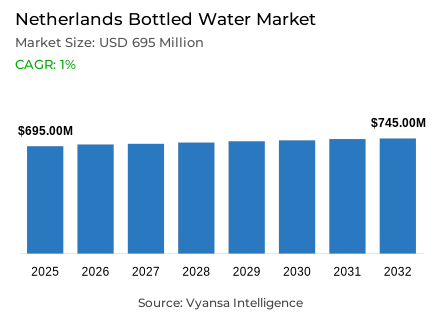
- Bottled water market size in Netherlands was estimated at USD 695 million in 2025.
- The market size is expected to grow to USD 745 million by 2032.
- Market to register a CAGR of around 1% during 2026-32.
- Type of Water Shares
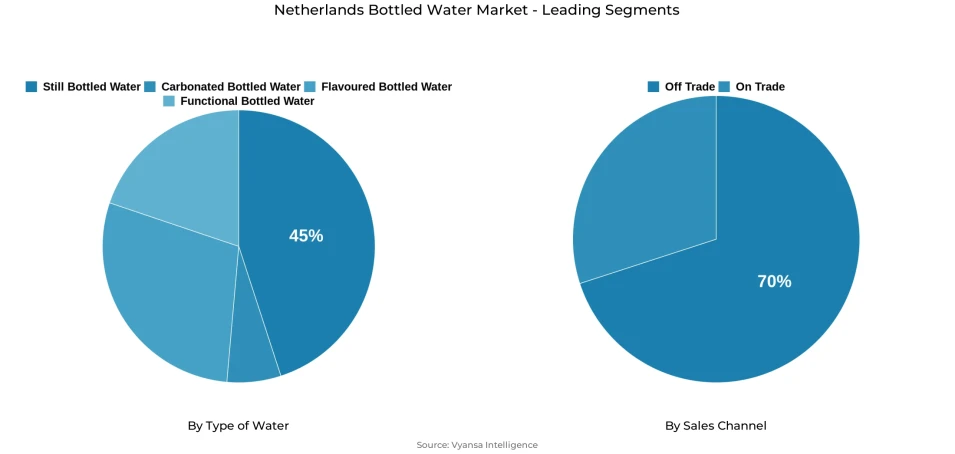
- Still bottled water grabbed market share of 45%.
- Competition
- More than 10 companies are actively engaged in producing bottled water in Netherlands.
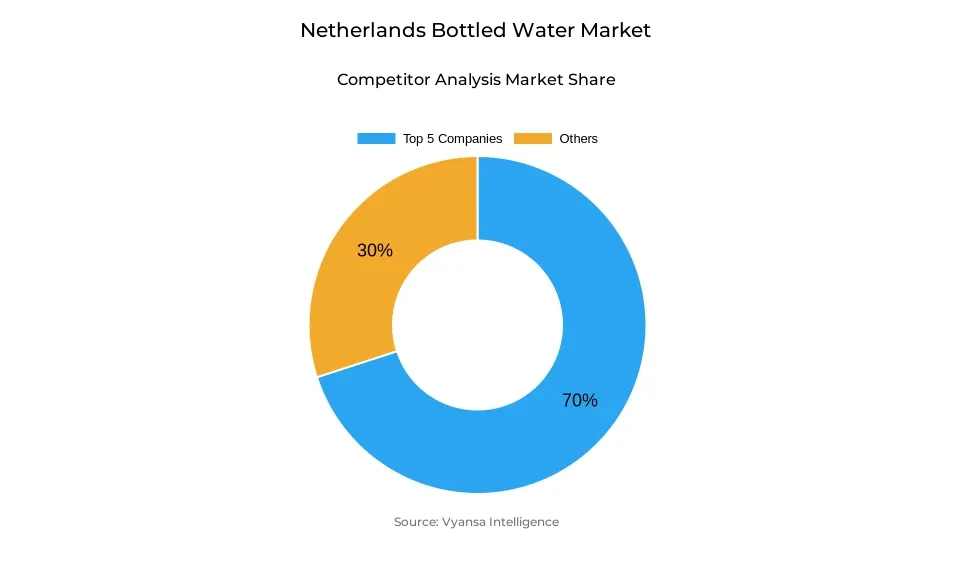
- Top 5 companies acquired around 70% of the market share.
- D-Drinks BV, Danone Nederland BV, Lidl Nederland GmbH, Spadel Nederland BV, Albert Heijn BV etc., are few of the top companies.
- Sales Channel
- Off trade grabbed 70% of the market.
Netherlands Bottled Water Market Outlook
The market of Netherlands bottled water was estimated to be USD 695 million in 2025 and is expected to increase to USD 745 million by 2032 with a CAGR of about 1% between 2026 and 2032. This small increase is an indication of the maturity of the market, whereby the demand is motivated by convenience-based consumption as opposed to necessity. Despite the high confidence of the Dutch consumers in the quality of tap water, bottled water is still used in mobility, travelling, outdoor activities, and social environments. The market is strong because of the established consumption patterns and strong retail presence.
Largest share in the type of water category was still bottled water with about 45% of the market. Its superiority can be explained by its flavorless nature, convenience, and the ability to use it on a daily basis to stay hydrated in various situations. Still bottled water is more favored by end users at home, work and travel because it fits well into daily activities. Although there are carbonated and functional water alternatives, still bottled water is the most acceptable product, which will be the center of the bottled water demand during the forecast period.
In terms of distribution, the off-trade sales channel dominates the market with a 70% share, which means that most of the sales are made in supermarkets, grocery stores and convenience stores. These channels are more accessible, offer bulk buying, and are competitive in price, which makes them the choice of consumption in the routine. The dominance of retailers guarantees a wide range of products in both urban and non-urban areas.
In the future, the market perspective up to 2032 is not high-growth but stable. Good tap water supply and increased sustainability consciousness limit the fast growth, but bottled water still has a place in the market because of convenience, portability, and well-established retail channels, which will facilitate the gradual increase in value within the forecast period.
Netherlands Bottled Water Market Growth DriverHigh trust in tap water quality increases sustainable hydration choices
The Dutch end users are generally confident in tap water because it is legally monitored and treated to make it safe to drink. Dutch environmental statistics show that tap water is inspected at various levels between source and distribution and is widely used in drinking, cooking, and daily needs due to its quality and safety. As a result, people are advised to use tap water instead of bottled water where possible, which strengthens sustainable hydration habits.
The availability of basic safe water services in the Netherlands is practically universal, as WHO data show that 100% of the population in 2025 had access to safe water. High trust in the quality of tap water is the foundation of reduced dependence on bottled water as a daily source of hydration, especially among the environmentally aware end users who value the benefits of using the local water sources.
Netherlands Bottled Water Market ChallengeLimited plastic packaging reuse slows sustainability progress
Plastic waste remains a major sustainability issue in the consumption of bottled water. A study by the Dutch government shows that only 7% of plastic packaging is reused as a material to make other products, thus showing a significant gap in the circular use of packaging that includes water bottles. Such imbalance highlights the challenge of controlling the environmental footprint of bottled water packaging despite a highly regulated market.
The low reuse rate highlights the need to have stronger recycling infrastructure and consumer and producer behavioural change. Without these improvements, the continued use of single-use plastic bottles will undermine the fight against pollution and will not be aligned with the national goals of a circular economy.
Unlock Market Intelligence
Explore the market potential with our data-driven report
Netherlands Bottled Water Market TrendDrinking water conservation becomes a public and policy focus
Water-use efficiency is becoming a national priority as climate change and rising demand continue to put a strain on water resources. An audit of Dutch water policy in 2025 suggests that the security of drinking-water is strained, and that by 2030 the Netherlands will need much more water, unless current consumption trends are changed. This is a trend that is transforming the awareness of the people in regard to responsible water use.
The current government targets aim at decreasing household water use to less than 119 litres per capita per day (2023 baseline) to lower the household water use. With conservation messaging becoming more popular, more end users and organisations are implementing conservation strategies like conscious water consumption and encouraging alternatives to wasteful behaviors, which is contributing to a wider trend of sustainable water management.
Netherlands Bottled Water Market OpportunityTap water sustainability messaging fosters reduced reliance on bottled water
There is a strong potential to continue marketing tap water as a viable alternative to bottled water in the Netherlands. Because 100% of the population already has access to safe drinking water and tap water is strictly tested according to the Dutch laws, the public campaigns can use the existing trust to emphasize the benefits of the environment compared to bottled water.
End user shifts toward single-use bottled water can be encouraged through the promotion of refill stations, reusable bottles, and environmentally oriented messages. By leveraging on the high level of public satisfaction and safety rating given to tap water, the chances of adoption are increased, thus, aligning with the overall sustainability goals and reducing plastic waste.
Unlock Market Intelligence
Explore the market potential with our data-driven report
Netherlands Bottled Water Market Segmentation Analysis
By Type of Water
- Carbonated Bottled Water
- Flavoured Bottled Water
- Functional Bottled Water
- Still Bottled Water
The segment has the largest market share in the type of water category, with still bottled water leading with about 45% market share. This leadership is an indication of its strong adoption as a traditional hydration choice by end users.
Unfiltered water is widely used in everyday drinking due to its neutral taste, convenience, and applicability in various consumption environments, such as home, work, and travel environments.
By Sales Channel
- On Trade
- Restaurants
- Hotels
- Cafes
- Others
- Off Trade
- Grocery Retailers
- Convenience Retail
- Supermarkets
- Hypermarkets
- Small Local Grocer
- Non-Grocery Retailers
- General Merchandise Stores
- Health and Beauty Specialists
- Vending
- E-commerce
- Grocery Retailers
The segment has the largest share in the sales channel category, with off-trade distribution evidently leading the pack with 70% of the market. This implies that most of the bottled-water sales are made in retail stores like supermarkets, convenience stores, and grocery stores where end users would buy water to use at home and in their daily activities.The advantages of the off-trade channels are that they are more accessible, have a wider range of products, and can be bought in bulk. These channels are often chosen by end users to stock bottled water due to their affordability and convenience.
The fact that off-trade sales prevail highlights the significance of retail distribution in maintaining the supply of bottled-water in both urban and non-urban regions. With the trend of purchasing behaviour still leaning towards retail stores, the off-trade channel will be the main channel to market bottled water during the 2026-32 period.
List of Companies Covered in Netherlands Bottled Water Market
The companies listed below are highly influential in the Netherlands bottled water market, with a significant market share and a strong impact on industry developments.
- D-Drinks BV
- Danone Nederland BV
- Lidl Nederland GmbH
- Spadel Nederland BV
- Albert Heijn BV
- Vrumona BV
- Coca-Cola Enterprises Nederland BV
- United Soft Drinks BV
- Aldi Nederland BV
- Charlie's Natural BV
Competitive Landscape
Spadel remains the dominant player in the Netherlands’ bottled water market and continues to hold a leading position in 2025, despite a slight decline in volume share. The Spa brand’s strength is deeply rooted in consumer behaviour, having become synonymous with bottled water over decades. In everyday language, end users often refer to bottled water simply as “Spa,” even when purchasing other brands, particularly in the on-trade. Competitors such as United Soft Drinks and Vrumona trail significantly behind, and none pose a serious challenge to Spadel’s leadership. The company is expected to retain its market position in 2025, supported by strong brand recognition and entrenched end user loyalty.Meanwhile, D-Drinks stands out as the most dynamic company, driven by the rapid growth of its Vitamin Well brand. Rising demand for healthier, low-sugar alternatives to carbonated drinks and juice supports this momentum. Vitamin Well’s clean design and fitness-oriented positioning resonate strongly with health-conscious and younger end users, while expanded grocery retail distribution further accelerates growth.
Frequently Asked Questions
Related Report
- Market Segmentation
- Research Scope
- Research Methodology
- Definitions and Assumptions
- Executive Summary
- Netherlands Bottled Water Market Policies, Regulations, and Standards
- Netherlands Bottled Water Market Dynamics
- Growth Factors
- Challenges
- Trends
- Opportunities
- Netherlands Bottled Water Market Statistics, 2022-2032F
- Market Size & Growth Outlook
- By Revenues in USD Million
- By Volume (Million Litres)
- Market Segmentation & Growth Outlook
- By Type of Water
- Carbonated Bottled Water- Market Insights and Forecast 2022-2032, USD Million
- Flavoured Bottled Water- Market Insights and Forecast 2022-2032, USD Million
- Functional Bottled Water- Market Insights and Forecast 2022-2032, USD Million
- Still Bottled Water- Market Insights and Forecast 2022-2032, USD Million
- By Sub Types
- Purified- Market Insights and Forecast 2022-2032, USD Million
- Desalinated- Market Insights and Forecast 2022-2032, USD Million
- Atmospheric Generated- Market Insights and Forecast 2022-2032, USD Million
- Others- Market Insights and Forecast 2022-2032, USD Million
- Mineral- Market Insights and Forecast 2022-2032, USD Million
- Other (Spring, Alkaline, Other) - Market Insights and Forecast 2022-2032, USD Million
- Purified- Market Insights and Forecast 2022-2032, USD Million
- By Packaging Material
- Flexible Packaging- Market Insights and Forecast 2022-2032, USD Million
- Aluminium- Market Insights and Forecast 2022-2032, USD Million
- Pouches- Market Insights and Forecast 2022-2032, USD Million
- Glass- Market Insights and Forecast 2022-2032, USD Million
- Rigid Plastic- Market Insights and Forecast 2022-2032, USD Million
- PET Bottles- Market Insights and Forecast 2022-2032, USD Million
- Thin Wall Plastic Containers- Market Insights and Forecast 2022-2032, USD Million
- Others- Market Insights and Forecast 2022-2032, USD Million
- Flexible Packaging- Market Insights and Forecast 2022-2032, USD Million
- By Price Category
- Budget- Market Insights and Forecast 2022-2032, USD Million
- Economy- Market Insights and Forecast 2022-2032, USD Million
- Premium- Market Insights and Forecast 2022-2032, USD Million
- By Pack Size
- 100 ml- Market Insights and Forecast 2022-2032, USD Million
- 125 ml- Market Insights and Forecast 2022-2032, USD Million
- 200 ml- Market Insights and Forecast 2022-2032, USD Million
- 250 ml- Market Insights and Forecast 2022-2032, USD Million
- 330 ml- Market Insights and Forecast 2022-2032, USD Million
- 370 ml- Market Insights and Forecast 2022-2032, USD Million
- 450 ml- Market Insights and Forecast 2022-2032, USD Million
- 500 ml- Market Insights and Forecast 2022-2032, USD Million
- 591 ml- Market Insights and Forecast 2022-2032, USD Million
- 750 ml- Market Insights and Forecast 2022-2032, USD Million
- 1,000 ml- Market Insights and Forecast 2022-2032, USD Million
- 1,500 ml- Market Insights and Forecast 2022-2032, USD Million
- 4,000 ml- Market Insights and Forecast 2022-2032, USD Million
- 5,000 ml- Market Insights and Forecast 2022-2032, USD Million
- Others- Market Insights and Forecast 2022-2032, USD Million
- By Sales Channel
- On Trade- Market Insights and Forecast 2022-2032, USD Million
- Restaurants- Market Insights and Forecast 2022-2032, USD Million
- Hotels- Market Insights and Forecast 2022-2032, USD Million
- Cafes- Market Insights and Forecast 2022-2032, USD Million
- Others- Market Insights and Forecast 2022-2032, USD Million
- Off Trade- Market Insights and Forecast 2022-2032, USD Million
- Grocery Retailers- Market Insights and Forecast 2022-2032, USD Million
- Convenience Retail- Market Insights and Forecast 2022-2032, USD Million
- Supermarkets- Market Insights and Forecast 2022-2032, USD Million
- Hypermarkets- Market Insights and Forecast 2022-2032, USD Million
- Small Local Grocer- Market Insights and Forecast 2022-2032, USD Million
- Non-Grocery Retailers- Market Insights and Forecast 2022-2032, USD Million
- General Merchandise Stores- Market Insights and Forecast 2022-2032, USD Million
- Health and Beauty Specialists- Market Insights and Forecast 2022-2032, USD Million
- Vending- Market Insights and Forecast 2022-2032, USD Million
- E-commerce- Market Insights and Forecast 2022-2032, USD Million
- Grocery Retailers- Market Insights and Forecast 2022-2032, USD Million
- On Trade- Market Insights and Forecast 2022-2032, USD Million
- By Competitors
- Competition Characteristics
- Market Share & Analysis
- By Type of Water
- Market Size & Growth Outlook
- Netherlands Carbonated Bottled Water Market Statistics, 2022-2032
- Market Size & Growth Outlook
- By Revenues in USD Million
- By Volume (Million Litres)
- Market Segmentation & Growth Outlook
- By Sub Types- Market Insights and Forecast 2022-2032, USD Million
- By Packaging Material- Market Insights and Forecast 2022-2032, USD Million
- By Pack Size- Market Insights and Forecast 2022-2032, USD Million
- By Price Category- Market Insights and Forecast 2022-2032, USD Million
- By Sales Channel- Market Insights and Forecast 2022-2032, USD Million
- Market Size & Growth Outlook
- Netherlands Flavoured Bottled Water Market Statistics, 2022-2032
- Market Size & Growth Outlook
- By Revenues in USD Million
- By Volume (Million Litres)
- Market Segmentation & Growth Outlook
- By Sub Types- Market Insights and Forecast 2022-2032, USD Million
- By Packaging Material- Market Insights and Forecast 2022-2032, USD Million
- By Pack Size- Market Insights and Forecast 2022-2032, USD Million
- By Price Category- Market Insights and Forecast 2022-2032, USD Million
- By Sales Channel- Market Insights and Forecast 2022-2032, USD Million
- Market Size & Growth Outlook
- Netherlands Functional Bottled Water Market Statistics, 2022-2032
- Market Size & Growth Outlook
- By Revenues in USD Million
- By Volume (Million Litres)
- Market Segmentation & Growth Outlook
- By Sub Types- Market Insights and Forecast 2022-2032, USD Million
- By Packaging Material- Market Insights and Forecast 2022-2032, USD Million
- By Pack Size- Market Insights and Forecast 2022-2032, USD Million
- By Price Category- Market Insights and Forecast 2022-2032, USD Million
- By Sales Channel- Market Insights and Forecast 2022-2032, USD Million
- Market Size & Growth Outlook
- Netherlands Still Bottled Water Market Statistics, 2022-2032
- Market Size & Growth Outlook
- By Revenues in USD Million
- By Volume (Million Litres)
- Market Segmentation & Growth Outlook
- By Sub Types- Market Insights and Forecast 2022-2032, USD Million
- By Packaging Material- Market Insights and Forecast 2022-2032, USD Million
- By Pack Size- Market Insights and Forecast 2022-2032, USD Million
- By Price Category- Market Insights and Forecast 2022-2032, USD Million
- By Sales Channel- Market Insights and Forecast 2022-2032, USD Million
- Market Size & Growth Outlook
- Competitive Outlook
- Company Profiles
- Spadel Nederland BV
- Business Description
- Product Portfolio
- Collaborations & Alliances
- Recent Developments
- Financial Details
- Others
- Albert Heijn BV
- Business Description
- Product Portfolio
- Collaborations & Alliances
- Recent Developments
- Financial Details
- Others
- Vrumona BV
- Business Description
- Product Portfolio
- Collaborations & Alliances
- Recent Developments
- Financial Details
- Others
- Coca-Cola Enterprises Nederland BV
- Business Description
- Product Portfolio
- Collaborations & Alliances
- Recent Developments
- Financial Details
- Others
- United Soft Drinks BV
- Business Description
- Product Portfolio
- Collaborations & Alliances
- Recent Developments
- Financial Details
- Others
- D-Drinks BV
- Business Description
- Product Portfolio
- Collaborations & Alliances
- Recent Developments
- Financial Details
- Others
- Danone Nederland BV
- Business Description
- Product Portfolio
- Collaborations & Alliances
- Recent Developments
- Financial Details
- Others
- Lidl Nederland GmbH
- Business Description
- Product Portfolio
- Collaborations & Alliances
- Recent Developments
- Financial Details
- Others
- Aldi Nederland BV
- Business Description
- Product Portfolio
- Collaborations & Alliances
- Recent Developments
- Financial Details
- Others
- Charlie's Natural BV
- Business Description
- Product Portfolio
- Collaborations & Alliances
- Recent Developments
- Financial Details
- Others
- Spadel Nederland BV
- Company Profiles
- Disclaimer
| Segment | Sub-Segment |
|---|---|
| By Type of Water |
|
| By Sub Types |
|
| By Packaging Material |
|
| By Price Category |
|
| By Pack Size |
|
| By Sales Channel |
|
Research Methodology
This study followed a structured approach comprising four key phases to assess the size and scope of the electro-oxidation market. The process began with thorough secondary research to collect data on the target market, related markets, and broader industry context. These findings, along with preliminary assumptions and estimates, were then validated through extensive primary research involving industry experts from across the value chain. To calculate the overall market size, both top-down and bottom-up methodologies were employed. Finally, market segmentation and data triangulation techniques were applied to refine and validate segment-level estimations.
Secondary Research
The secondary research phase involved gathering data from a wide range of credible and published sources. This step helped in identifying industry trends, defining market segmentation, and understanding the market landscape and value chain.
Sources consulted during this phase included:
- Company annual reports, investor presentations, and press releases
- Industry white papers and certified publications
- Trade directories and market-recognized databases
- Articles from authoritative authors and reputable journals
- Gold and silver standard websites
Secondary research was critical in mapping out the industry's value chain and monetary flow, identifying key market segments, understanding regional variations, and tracking significant industry developments.
Other key sources:
- Financial disclosures
- Industry associations and trade bodies
- News outlets and business magazines
- Academic journals and research studies
- Paid industry databases
Primary Research
To validate secondary data and gain deeper market insights, primary research was conducted with key stakeholders across both the supply and demand sides of the market.
On the demand side, participants included decision-makers and influencers from end-user industries—such as CIOs, CTOs, and CSOs—who provided first-hand perspectives on market needs, product usage, and future expectations.
On the supply side, interviews were conducted with manufacturers, industry associations, and institutional participants to gather insights into current offerings, product pipelines, and market challenges.
Primary interviews provided critical inputs such as:
- Market size and revenue data
- Product and service breakdowns
- Market forecasts
- Regional and application-specific trends
Stakeholders consulted included:
- Leading OEM and solution providers
- Channel and distribution partners
- End users across various applications
- Independent consultants and industry specialists
Market Size Estimation and Data Triangulation
- Identifying Key Market Participants (Secondary Research)
- Goal: To identify the major players or companies in the target market. This typically involves using publicly available data sources such as industry reports, market research publications, and financial statements of companies.
- Tools: Reports from firms like Gartner, Forrester, Euromonitor, Statista, IBISWorld, and others. Public financial statements, news articles, and press releases from top market players.
- Extracting Earnings of Key Market Participants
- Goal: To estimate the earnings generated from the product or service being analyzed. This step helps in understanding the revenue potential of each market player in a specific geography.
- Methods: Earnings data can be gathered from:
- Publicly available financial reports (for listed companies).
- Interviews and primary data sources from professionals, such as Directors, VPs, SVPs, etc. This is especially useful for understanding more nuanced, internal data that isn't publicly disclosed.
- Annual reports and investor presentations of key players.
- Data Collation and Development of a Relevant Data Model
- Goal: To collate inputs from both primary and secondary sources into a structured, data-driven model for market estimation. This model will incorporate key market KPIs and any independent variables relevant to the market.
- Key KPIs: These could include:
- Market size, growth rate, and demand drivers.
- Industry-specific metrics like market share, average revenue per customer (ARPC), or average deal size.
- External variables, such as economic growth rates, inflation rates, or commodity prices, that could affect the market.
- Data Modeling: Based on this data, the market forecasts are developed for the next 5 years. A combination of trend analysis, scenario modeling, and statistical regression might be used to generate projections.
- Scenario Analysis
- Goal: To test different assumptions and validate how sensitive the market is to changes in key variables (e.g., market demand, regulatory changes, technological disruptions).
- Types of Scenarios:
- Base Case: Based on current assumptions and historical data.
- Best-Case Scenario: Assuming favorable market conditions, regulatory environments, and technological advancements.
- Worst-Case Scenario: Accounting for adverse factors, such as economic downturns, stricter regulations, or unexpected disruptions.












