Morocco Construction Equipment Rental Market Report: Trends, Growth and Forecast (2026-2032)
By Equipment Type (Earthmoving Equipment, Material Handling Equipment, Other Construction Equipment), By Propulsion (Diesel, Gas, CNG, LPG, Electric), By Application (Power & Utilities, Mining, Hospitality, Residential, Healthcare & Educational, Roads & Highway, Manufacturing Units, Others), By Engine Capacity (< 5L, 5–10L, 10L), By Power Output (< 100 HP, 101–200 HP, 201–400 HP, 400 HP) ... Read more
|
Major Players
|
Morocco Construction Equipment Rental Market Statistics and Insights, 2026
- Market Size Statistics
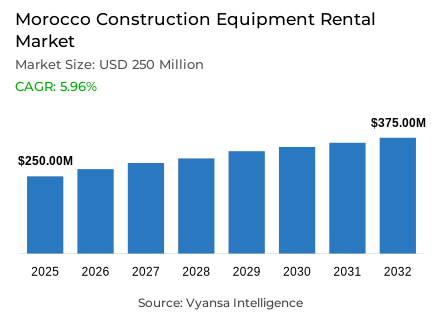
- Construction equipment rental market size in Morocco was valued at USD 250 million in 2025 and is estimated at USD 265 million in 2026.
- The market size is expected to grow to USD 375 million by 2032.
- Market to register a CAGR of around 5.96% during 2026-32.
- Equipment Type Shares
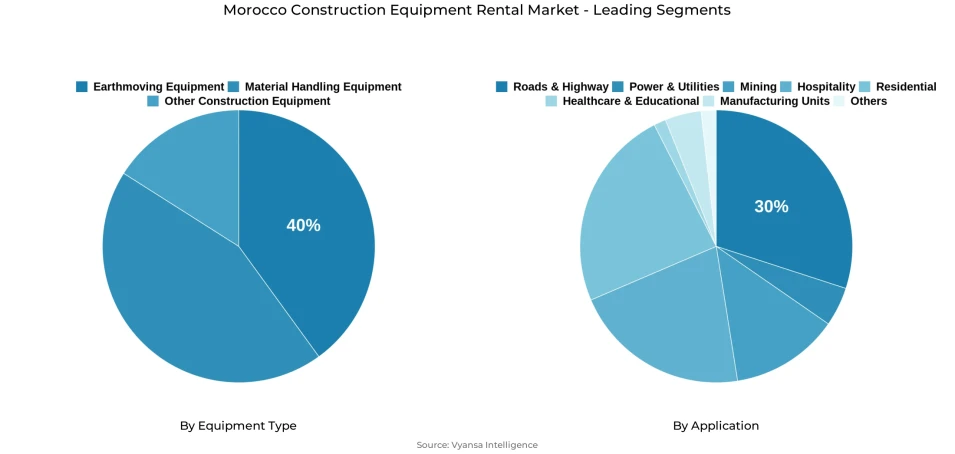
- Earthmoving equipment grabbed market share of 40%.
- Competition
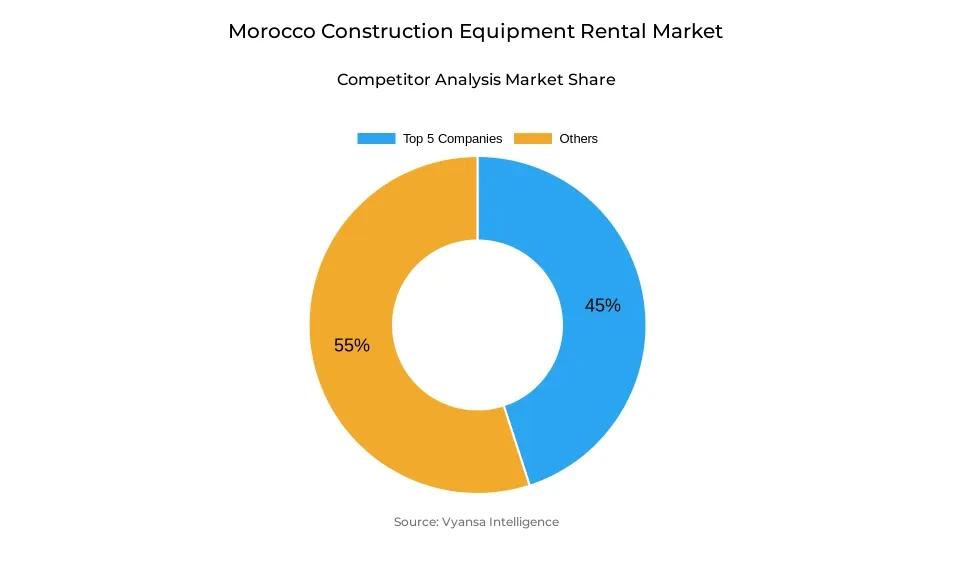
- More than 10 companies are actively engaged in producing construction equipment rental in Morocco.
- Top 5 companies acquired around 45% of the market share.
- TOTALOC, ULMA Construction, Manitou Group, Caterpillar Inc., Loxam etc., are few of the top companies.
- Application
- Roads & highway grabbed 30% of the market.
Morocco Construction Equipment Rental Market Outlook
The Morocco construction equipment rental market was valued at USD 250 million in 2025 and is projected to advance from USD 265 million in 2026 to USD 375 million by 2032, registering a CAGR of 5.96% across the forecast period. This sustained and infrastructure-anchored expansion reflects a commercially dependable growth environment within the Morocco construction equipment rental market, where road corridors, rail upgrades, airport expansion, port modernisation, utilities, hospitality projects, mining activity, and urban construction are collectively generating recurring and phase-variable demand for excavators, loaders, bulldozers, motor graders, cranes, tippers, compactors, forklifts, and diesel generators across a project cycle that strongly favours flexible rental access over capital-intensive ownership. As per data published by the IMF, real GDP growth reached an estimated 4.9% in 2025 and is projected at 4.4% in 2026, with continued infrastructure investment Morocco remaining one of the primary structural growth supports.
Morocco's public investment pipeline provides the market with a particularly strong and well-defined commercial foundation. According to statistics released by the Ministère des Finances, the 2026 public investment envelope is planned at MAD 380 billion, directed toward regional development, infrastructure access, and structural projects, creating direct and geographically distributed demand for rented equipment as public works contractors require flexible machine availability across excavation, grading, lifting, paving, utility installation, and finishing phases simultaneously. The International Trade Administration further identifies a USD 37 billion infrastructure investment gap through 2040, listing construction engineering, Morocco infrastructure equipment rental, and services as major opportunity areas that reinforce long-term fleet demand.
Earthmoving equipment rental commands the leading 40% share within the equipment type segment, reflecting the structural reality that nearly every active project in Morocco's pipeline begins with land preparation, trenching, excavation, levelling, and material movement before any other equipment category becomes operationally relevant. Roads and highway construction Morocco applications lead the application segment at 30%, supported by ITA-identified highway investments of USD 1.3 billion from 2025 to 2032, including the Continental Rabat-Casablanca Highway, Tit Mellil-Berrechid Highway, and junction upgrades connecting major host cities.
The market's trajectory through 2032 remains stable and commercially well-supported as both macroeconomic momentum and project complexity reinforce rental demand simultaneously. As per data published by the IMF, imports of goods are projected to rise 12.2% in 2026, reflecting higher investment-related demand, while nonagricultural GDP growth is projected at 4.1%, confirming that Morocco heavy equipment rental market activity is being sustained by structural investment forces rather than cyclical construction fluctuations. As Morocco advances roads, railways, airports, ports, water systems, and energy-linked infrastructure across its national development agenda, construction machinery rental Morocco becomes an increasingly important cost-control mechanism for contractors seeking access to specialised machines without absorbing full purchase, storage, depreciation, and utilisation risks.
Morocco Construction Equipment Rental Market Growth Driver
Infrastructure Scale and Macroeconomic Momentum Are Building a Structurally Durable Rental Demand Base
Morocco's expanding public infrastructure pipeline is the most commercially significant demand driver within the Morocco construction equipment rental market, sustaining fleet utilisation across earthmoving, road, transport, and utilities project categories with a consistency that ownership-heavy procurement models cannot efficiently serve. As per data published by the World Bank, real GDP growth accelerated to 4.7% in 2025 from 3.8% in 2024, with nonagricultural growth reaching 4.8% and strong contributions from tourism, mining, and construction, while the Ministère des Finances confirms a MAD 380 billion public investment envelope for 2026 that is pushing equipment rental for infrastructure projects demand beyond Casablanca and Rabat into a wider geographic base requiring mobile, phase-aligned fleet access across road, utility, housing, hospitality, and transport projects simultaneously.
ITA data reinforces the project-level depth of this driver with sector-specific investment commitments that translate directly into machine hours. According to statistics released by Trade.gov, USD 1.3 billion in highway projects, USD 9.6 billion in railway modernisation by 2030, and approximately USD 2.8 billion in airport infrastructure are all advancing through Morocco's development pipeline, each requiring rotating fleet combinations of excavators, motor graders, cranes, dump trucks, compactors, generators, and tippers across sequential project phases that rental providers are structurally better positioned to serve than individual contractors managing owned and underutilised assets.
Morocco Construction Equipment Rental Market Challenge
Fleet Financing Costs and Project Execution Uncertainty Are Compressing Rental Margin Reliability
The most commercially consequential structural challenge within the Morocco heavy machinery rental industry is the capital intensity of fleet expansion in an environment where rental income depends on project award timing, utilisation rates, payment cycles, and maintenance uptime rather than guaranteed forward demand. Based on data from Bank Al-Maghrib, the key interest rate was held unchanged at 2.25% in March 2026, signalling monetary stability but leaving rental firms exposed to borrowing costs when financing imported machinery or expanding fleets ahead of project mobilisation, while IMF data confirms that Morocco's current account deficit widened to 2.1% of GDP in 2025 as imports rose with high equipment ownership cost and investment-linked demand that has high import content across equipment, parts, and attachments.
Project execution uncertainty compounds this financing pressure by creating gaps between large headline investment commitments and continuous fleet deployment. As indicated by authoritative sources at the IMF, domestic downside risk includes weaker-than-expected gains from public infrastructure investment that would reduce growth and employment, while World Bank analysis confirms that financing challenges within Morocco's private sector, including administrative procedures, skills gaps, and regulatory constraints, affect rental providers' ability to scale fleets, access credit, secure trained operators, and maintain reliable service networks across geographically distributed project corridors.
Unlock Market Intelligence
Explore the market potential with our data-driven report
Morocco Construction Equipment Rental Market Trend
Project-Based Rental Behaviour and Transport Modernisation Are Reshaping Fleet Demand Composition
A well-defined and commercially consequential structural trend is reshaping equipment procurement behaviour across Morocco's construction industry, as contractors progressively shift from ownership-heavy acquisition toward short-term equipment leasing arrangements that align machine availability precisely with specific project phases rather than maintaining underutilised owned fleets between contracts. Evidence drawn from public data released by Trade.gov confirms that USD 9.6 billion in railway modernisation investment is advancing by 2030, including USD 5.3 billion for the Kenitra-Marrakech high-speed rail line and USD 1.4 billion for approximately 40 railway stations, each generating long-cycle rental demand for earthmoving equipment, cranes, generators, forklifts, concrete equipment, aerial work platforms, and site support vehicles across embankment, station, access road, and utility corridor works.
The same project-based rental dynamic is accelerating across port and airport infrastructure segments. In line with findings from Trade.gov, approximately USD 2.8 billion in airport infrastructure and USD 7.5 billion under Morocco's 2030 National Port Strategy, including Nador West Med Port at USD 1.5 billion and Dakhla Atlantic Port at USD 1.7 billion, are creating coordinated site productivity requirements that reward rental providers capable of supplying GPS-enabled construction equipment, mixed fleet bundles, rapid replacement machines, and maintenance support across phased terminal, logistics yard, access road, and drainage works simultaneously.
Morocco Construction Equipment Rental Market Opportunity
World Cup Infrastructure and Water Resilience Investment Are Creating High-Value Multi-Sector Rental Windows
The most commercially compelling growth opportunity within the Morocco construction equipment rental market lies in the concentrated infrastructure investment cycle linked to Morocco's 2030 FIFA World Cup preparation, where roads, airport terminals, rail links, hotels, stadiums, utilities, and city access systems must advance simultaneously on fixed delivery timelines. As per official figures from Trade.gov, USD 1.3 billion in highway projects, USD 9.6 billion in rail modernisation, USD 2.8 billion in airport infrastructure, and USD 7.5 billion in port construction equipment rental Morocco strategy investments are all advancing within overlapping execution windows that create sustained and geographically distributed demand for crane rental Morocco, compaction machines, power generators, tippers, forklifts, and roadwork equipment across host-city construction corridors connecting Rabat, Tangier, Marrakech, Agadir, Fès, and Casablanca.
Water and climate-resilience infrastructure independently creates a structurally significant and durable secondary demand layer. Data compiled from internationally recognised public authorities at the World Bank confirms that approximately USD 78 billion in investment is needed to place Morocco on a resilient, low-carbon pathway by the 2050s, while a USD 500 million World Bank financing package approved in April 2026 supports jobs, green growth, clean energy, and improved business conditions that strengthen the credit, fleet expansion, and project-access capacity of equipment rental for water infrastructure and renewable energy construction contractors across Morocco's expanding regional development base.
Unlock Market Intelligence
Explore the market potential with our data-driven report
Morocco Construction Equipment Rental Market Segmentation Analysis
By Equipment Type
- Earthmoving Equipment
- Material Handling Equipment
- Other Construction Equipment
Earthmoving Equipment commands the highest share within the equipment type category at 40%, reflecting the foundational and sequentially non-negotiable role of excavation, grading, trenching, loading, and material movement machinery at the earliest and most capital-intensive phases of every major infrastructure project within the Morocco construction equipment rental market. Contractors across highway, railway, airport, port, and urban construction projects consistently require excavator rental Morocco, bulldozers, wheel loaders, motor graders, crawler loaders, trenchers, and dump trucks before any other equipment category becomes operationally relevant, creating a demand pattern that is structurally front-loaded across project timelines and commercially reinforced by ITA-identified investments of USD 1.3 billion in highways, USD 9.6 billion in rail, and USD 2.8 billion in airports all advancing through Morocco's active project pipeline simultaneously.
The segment's commercial durability is further reinforced by Morocco's macroeconomic investment momentum. Evidence drawn from public data released by the World Bank confirms that gross fixed capital formation expanded by approximately 16.8% in 2025, directly supporting land development and civil works demand that favours Morocco earthmoving equipment rental over ownership among contractors managing phase-variable machine requirements across dust-intensive, rough-terrain operating conditions that demand strong rental provider uptime, maintenance response, spare parts availability, and field service capability rather than simply competitive day-rate pricing.
By Application
- Power & Utilities
- Mining
- Hospitality
- Residential
- Healthcare & Educational
- Roads & Highway
- Manufacturing Units
- Others
Roads and Highway commands the highest share within the application category at 30%, establishing transport infrastructure construction as the most equipment-intensive and commercially dependable end-use context within the Morocco construction equipment rental market. Contractors executing highway and junction projects consistently generate multi-category equipment demand across sequential phases, from bulldozer rental Morocco and excavators during bulk earthworks, through motor graders, compactors, rollers, and water tankers during subgrade and pavement preparation, to cranes, concrete equipment, generators, and tippers during bridge, culvert, and interchange works, creating a phase-variable fleet rotation pattern that rental construction machinery for road projects in Morocco arrangements serve more efficiently than contractor-owned single-category fleets.
The segment's structural durability is reinforced by the depth and breadth of Morocco's highway investment pipeline. Validated reports from Trade.gov confirm USD 1.3 billion in highway projects advancing from 2025 to 2032, while IMF data positions infrastructure investment as a core support for Morocco's projected 4.4% GDP growth in 2026, with the Roads and Highway segment benefiting additionally from its role as a connectivity enabler for ports, airports, industrial zones, tourism hubs, and regional development corridors that sustain recurring motor grader rental Morocco and road construction equipment demand well beyond any single project's execution window throughout the forecast period.
List of Companies Covered in Morocco Construction Equipment Rental Market
The companies listed below are highly influential in the Morocco construction equipment rental market, with a significant market share and a strong impact on industry developments.
- TOTALOC
- ULMA Construction
- Manitou Group
- Caterpillar Inc.
- Loxam
- Vemat Group LTD
- SAVEM (Miladia Invest)
- Layher Maroc
- BEKS Group
- Byrne Equipment Rental
Market News & Updates
- Vemat Group LTD, 2026:
Vemat Group listed the JLG DaVinci AE1932 all-electric scissor lift in its Morocco and Africa equipment portfolio. The product offers 7.62 m working height, 275 kg platform capacity, and online quote support. The listing adds an electric aerial access option for construction, lifting, and industrial worksite requirements in Morocco.
- Layher Maroc Échafaudage, 2025:
Layher Maroc Échafaudage participated in Préventica Maroc 2025 with UM6P-TECHNIX on a joint stand focused on safety and work-at-height training. The update highlighted scaffolding best practices, local skills development, and practical demonstrations for construction professionals. The activity supports safer scaffolding use across Moroccan BTP worksites
Frequently Asked Questions
Related Report
- Market Segmentation
- Research Scope
- Research Methodology
- Definitions and Assumptions
- Executive Summary
- Morocco Construction Equipment Rental Market Policies, Regulations, and Standards
- Morocco Construction Equipment Rental Cost Trends, 2022-2032
- Earthmoving Equipment
- Excavators
- Loaders
- Bulldozers
- Skid Steer Loaders
- Motor Graders
- Crawler Loaders
- Trenchers
- Dump Trucks
- Others
- Material Handling Equipment
- Cranes
- Forklifts
- Tippers
- Others
- Other Construction Equipment
- Road Rollers
- Diesel Generators
- Others
- Earthmoving Equipment
- Morocco Construction Equipment Rental Market Dynamics
- Growth Factors
- Challenges
- Trends
- Opportunities
- Morocco Construction Equipment Rental Market Statistics, 2022-2032F
- Market Size & Growth Outlook
- By Revenues in USD Million
- Market Segmentation & Growth Outlook
- By Equipment Type
- Earthmoving Equipment- Market Insights and Forecast 2022-2032, USD Million
- Excavators- Market Insights and Forecast 2022-2032, USD Million
- Loaders- Market Insights and Forecast 2022-2032, USD Million
- Bulldozers- Market Insights and Forecast 2022-2032, USD Million
- Skid Steer Loaders- Market Insights and Forecast 2022-2032, USD Million
- Motor Graders- Market Insights and Forecast 2022-2032, USD Million
- Crawler Loaders- Market Insights and Forecast 2022-2032, USD Million
- Trenchers- Market Insights and Forecast 2022-2032, USD Million
- Dump Trucks- Market Insights and Forecast 2022-2032, USD Million
- Others- Market Insights and Forecast 2022-2032, USD Million
- Material Handling Equipment- Market Insights and Forecast 2022-2032, USD Million
- Cranes- Market Insights and Forecast 2022-2032, USD Million
- Forklifts- Market Insights and Forecast 2022-2032, USD Million
- Tippers- Market Insights and Forecast 2022-2032, USD Million
- Others- Market Insights and Forecast 2022-2032, USD Million
- Other Construction Equipment- Market Insights and Forecast 2022-2032, USD Million
- Road Rollers- Market Insights and Forecast 2022-2032, USD Million
- Diesel Generators- Market Insights and Forecast 2022-2032, USD Million
- Others- Market Insights and Forecast 2022-2032, USD Million
- Earthmoving Equipment- Market Insights and Forecast 2022-2032, USD Million
- By Propulsion
- Diesel- Market Insights and Forecast 2022-2032, USD Million
- Gas- Market Insights and Forecast 2022-2032, USD Million
- CNG- Market Insights and Forecast 2022-2032, USD Million
- LPG- Market Insights and Forecast 2022-2032, USD Million
- Electric- Market Insights and Forecast 2022-2032, USD Million
- By Application
- Power & Utilities- Market Insights and Forecast 2022-2032, USD Million
- Mining- Market Insights and Forecast 2022-2032, USD Million
- Hospitality- Market Insights and Forecast 2022-2032, USD Million
- Residential- Market Insights and Forecast 2022-2032, USD Million
- Healthcare & Educational- Market Insights and Forecast 2022-2032, USD Million
- Roads & Highway- Market Insights and Forecast 2022-2032, USD Million
- Manufacturing Units- Market Insights and Forecast 2022-2032, USD Million
- Others- Market Insights and Forecast 2022-2032, USD Million
- By Engine Capacity
- < 5L- Market Insights and Forecast 2022-2032, USD Million
- 5–10L- Market Insights and Forecast 2022-2032, USD Million
- 10L- Market Insights and Forecast 2022-2032, USD Million
- By Power Output
- < 100 HP- Market Insights and Forecast 2022-2032, USD Million
- 101–200 HP- Market Insights and Forecast 2022-2032, USD Million
- 201–400 HP- Market Insights and Forecast 2022-2032, USD Million
- 400 HP- Market Insights and Forecast 2022-2032, USD Million
- By Competitors
- Competition Characteristics
- Market Share & Analysis
- By Equipment Type
- Market Size & Growth Outlook
- Morocco Earthmoving Equipment Market Statistics, 2022-2032
- Market Size & Growth Outlook
- By Revenues in USD Million
- Market Segmentation & Growth Outlook
- By Propulsion- Market Insights and Forecast 2022-2032, USD Million
- By Application- Market Insights and Forecast 2022-2032, USD Million
- By Engine Capacity- Market Insights and Forecast 2022-2032, USD Million
- By Power Output- Market Insights and Forecast 2022-2032, USD Million
- Market Size & Growth Outlook
- Morocco Material Handling Equipment Market Statistics, 2022-2032
- Market Size & Growth Outlook
- By Revenues in USD Million
- Market Segmentation & Growth Outlook
- By Propulsion- Market Insights and Forecast 2022-2032, USD Million
- By Application- Market Insights and Forecast 2022-2032, USD Million
- By Engine Capacity- Market Insights and Forecast 2022-2032, USD Million
- By Power Output- Market Insights and Forecast 2022-2032, USD Million
- Market Size & Growth Outlook
- Morocco Other Construction Equipment Market Statistics, 2022-2032
- Market Size & Growth Outlook
- By Revenues in USD Million
- Market Segmentation & Growth Outlook
- By Propulsion- Market Insights and Forecast 2022-2032, USD Million
- By Application- Market Insights and Forecast 2022-2032, USD Million
- By Engine Capacity- Market Insights and Forecast 2022-2032, USD Million
- By Power Output- Market Insights and Forecast 2022-2032, USD Million
- Market Size & Growth Outlook
- Competitive Outlook
- Company Profiles
- Caterpillar Inc.
- Business Description
- Product Portfolio
- Collaborations & Alliances
- Recent Developments
- Financial Details
- Others
- Loxam
- Business Description
- Product Portfolio
- Collaborations & Alliances
- Recent Developments
- Financial Details
- Others
- Vemat Group LTD
- Business Description
- Product Portfolio
- Collaborations & Alliances
- Recent Developments
- Financial Details
- Others
- SAVEM (Miladia Invest)
- Business Description
- Product Portfolio
- Collaborations & Alliances
- Recent Developments
- Financial Details
- Others
- Layher Maroc
- Business Description
- Product Portfolio
- Collaborations & Alliances
- Recent Developments
- Financial Details
- Others
- TOTALOC
- Business Description
- Product Portfolio
- Collaborations & Alliances
- Recent Developments
- Financial Details
- Others
- ULMA Construction
- Business Description
- Product Portfolio
- Collaborations & Alliances
- Recent Developments
- Financial Details
- Others
- Manitou Group
- Business Description
- Product Portfolio
- Collaborations & Alliances
- Recent Developments
- Financial Details
- Others
- BEKS Group
- Business Description
- Product Portfolio
- Collaborations & Alliances
- Recent Developments
- Financial Details
- Others
- Byrne Equipment Rental
- Business Description
- Product Portfolio
- Collaborations & Alliances
- Recent Developments
- Financial Details
- Others
- Caterpillar Inc.
- Company Profiles
- Disclaimer
| Segment | Sub-Segment |
|---|---|
| By Equipment Type |
|
| By Propulsion |
|
| By Application |
|
| By Engine Capacity |
|
| By Power Output |
|
Research Methodology
This study followed a structured approach comprising four key phases to assess the size and scope of the electro-oxidation market. The process began with thorough secondary research to collect data on the target market, related markets, and broader industry context. These findings, along with preliminary assumptions and estimates, were then validated through extensive primary research involving industry experts from across the value chain. To calculate the overall market size, both top-down and bottom-up methodologies were employed. Finally, market segmentation and data triangulation techniques were applied to refine and validate segment-level estimations.
Secondary Research
The secondary research phase involved gathering data from a wide range of credible and published sources. This step helped in identifying industry trends, defining market segmentation, and understanding the market landscape and value chain.
Sources consulted during this phase included:
- Company annual reports, investor presentations, and press releases
- Industry white papers and certified publications
- Trade directories and market-recognized databases
- Articles from authoritative authors and reputable journals
- Gold and silver standard websites
Secondary research was critical in mapping out the industry's value chain and monetary flow, identifying key market segments, understanding regional variations, and tracking significant industry developments.
Other key sources:
- Financial disclosures
- Industry associations and trade bodies
- News outlets and business magazines
- Academic journals and research studies
- Paid industry databases
Primary Research
To validate secondary data and gain deeper market insights, primary research was conducted with key stakeholders across both the supply and demand sides of the market.
On the demand side, participants included decision-makers and influencers from end-user industries—such as CIOs, CTOs, and CSOs—who provided first-hand perspectives on market needs, product usage, and future expectations.
On the supply side, interviews were conducted with manufacturers, industry associations, and institutional participants to gather insights into current offerings, product pipelines, and market challenges.
Primary interviews provided critical inputs such as:
- Market size and revenue data
- Product and service breakdowns
- Market forecasts
- Regional and application-specific trends
Stakeholders consulted included:
- Leading OEM and solution providers
- Channel and distribution partners
- End users across various applications
- Independent consultants and industry specialists
Market Size Estimation and Data Triangulation
- Identifying Key Market Participants (Secondary Research)
- Goal: To identify the major players or companies in the target market. This typically involves using publicly available data sources such as industry reports, market research publications, and financial statements of companies.
- Tools: Reports from firms like Gartner, Forrester, Euromonitor, Statista, IBISWorld, and others. Public financial statements, news articles, and press releases from top market players.
- Extracting Earnings of Key Market Participants
- Goal: To estimate the earnings generated from the product or service being analyzed. This step helps in understanding the revenue potential of each market player in a specific geography.
- Methods: Earnings data can be gathered from:
- Publicly available financial reports (for listed companies).
- Interviews and primary data sources from professionals, such as Directors, VPs, SVPs, etc. This is especially useful for understanding more nuanced, internal data that isn't publicly disclosed.
- Annual reports and investor presentations of key players.
- Data Collation and Development of a Relevant Data Model
- Goal: To collate inputs from both primary and secondary sources into a structured, data-driven model for market estimation. This model will incorporate key market KPIs and any independent variables relevant to the market.
- Key KPIs: These could include:
- Market size, growth rate, and demand drivers.
- Industry-specific metrics like market share, average revenue per customer (ARPC), or average deal size.
- External variables, such as economic growth rates, inflation rates, or commodity prices, that could affect the market.
- Data Modeling: Based on this data, the market forecasts are developed for the next 5 years. A combination of trend analysis, scenario modeling, and statistical regression might be used to generate projections.
- Scenario Analysis
- Goal: To test different assumptions and validate how sensitive the market is to changes in key variables (e.g., market demand, regulatory changes, technological disruptions).
- Types of Scenarios:
- Base Case: Based on current assumptions and historical data.
- Best-Case Scenario: Assuming favorable market conditions, regulatory environments, and technological advancements.
- Worst-Case Scenario: Accounting for adverse factors, such as economic downturns, stricter regulations, or unexpected disruptions.












