Indonesia Waste Sorting Equipment Market Report: Trends, Growth and Forecast (2026-2032)
By Waste Type (Plastic Waste, Paper & Cardboard, Metal Waste, Organic Waste, Glass Waste, Construction & Demolition Waste, E Waste, Others), By Technology (Mechanical Sorting, Sensor-Based Sorting (Optical, NIR, X ray), Magnetic & Eddy Current Separation, Air Classification, Robotic & AI Based Sorting, Others), By Application (Municipal Waste Management, Industrial Waste Management, Commercial Recycling, Construction & Demolition Waste Processing, Waste to Energy Pre Processing, Material Recovery Facilities (MRFs)), By Operation Mode (Manual, Semi Automatic, Fully Automatic), By Region (Sumatra, Java, Kalimantan, Sulawesi, Others) ... Read more
|
Major Players
|
Indonesia Waste Sorting Equipment Market Statistics and Insights, 2026
- Market Size Statistics
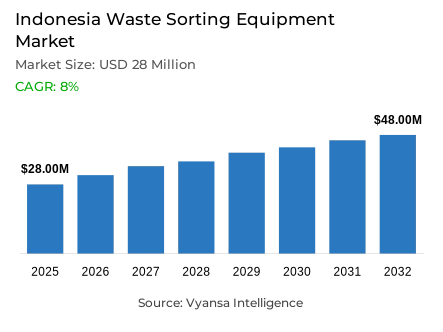
- Waste sorting equipment market size in Indonesia was valued at USD 28 million in 2025 and is estimated at USD 30 million in 2026.
- The market size is expected to grow to USD 48 million by 2032.
- Market to register a CAGR of around 8% during 2026-32.
- Waste Type Shares
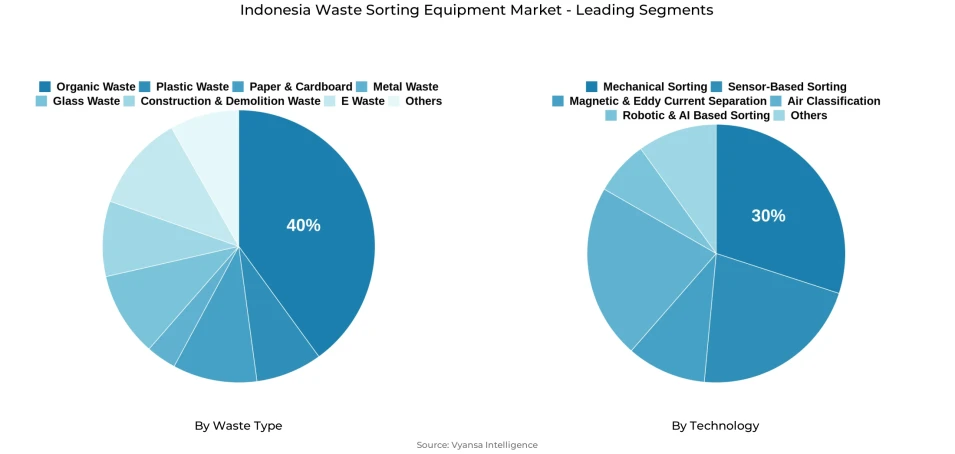
- Organic waste grabbed market share of 40%.
- Competition
- More than 10 companies are actively engaged in producing waste sorting equipment in Indonesia.
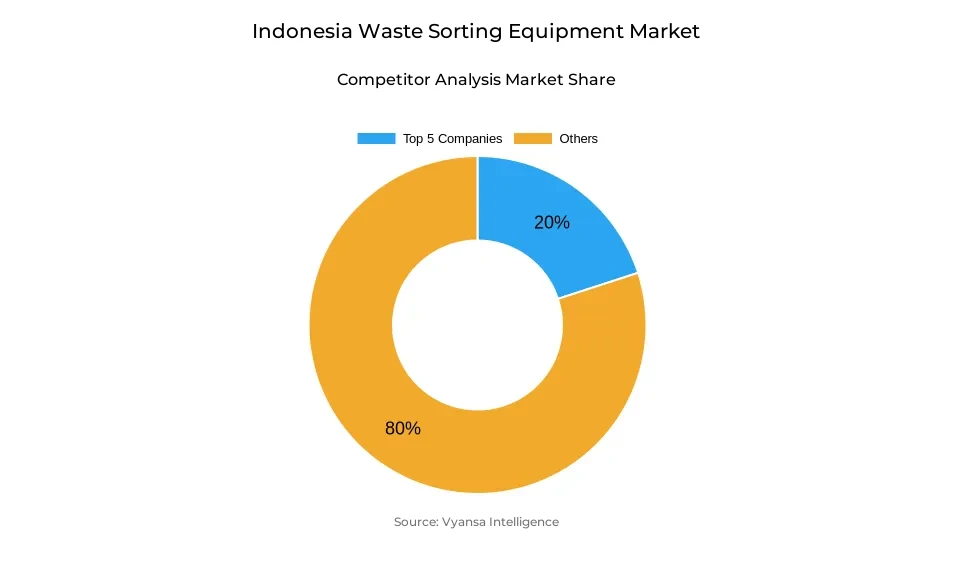
- Top 5 companies acquired around 20% of the market share.
- PT Daur Ulang Industri Terpadu, PT Multi Hanna Kreasindo, PT Teknotama Lingkungan Internusa, Reciki, PT Innofab Ekotekno Solusi etc., are few of the top companies.
- Technology
- Mechanical sorting grabbed 30% of the market.
Indonesia Waste Sorting Equipment Market Outlook
Valued at USD 28 million in 2025, Indonesia waste sorting equipment market is advancing from USD 30 million in 2026 toward USD 48 million by 2032, representing 8% compound annual growth rate throughout the forecast window. This steady expansion trajectory reflects rising demand for better waste handling systems as country focuses increasingly on material recovery, waste flow control, and stronger processing support across municipal operations. Market momentum remains underpinned by rapidly expanding waste generation and limited waste handling capacity creating persistent equipment demand, policy-driven source segregation reforms emphasizing waste diversion, and substantial infrastructure investment supporting waste system modernization.
Higher waste generation and expanding unmanaged waste volumes establish foundational market driver sustaining consistent demand for waste sorting equipment throughout Indonesia's waste management infrastructure. evidence from National Waste Management Information System (SIPSN) reveals waste generation reaches 29,069,030.30 tons annually in 2025 across 274 districts and cities, with only 30.84% handled equal to 8,964,139.40 tons annually. This substantial waste expansion and significant handling gap directly translates into heightened market relevance for waste sorting equipment supporting faster separation and better recovery. Published data from SIPSN indicates only 32.98% of waste classified as managed in 2025 with 67.02% remaining unmanaged, establishing substantial opportunity for sorting systems improving waste flow control and reducing mixed dumping dependence.
Source segregation reform and performance-based infrastructure funding reshape Indonesia waste sorting equipment market toward structured waste diversion and facility discipline. Data from World Bank's December 2025 project release indicates Indonesia's national reforms aim to improve source segregation, waste minimization, and diversion while promoting professionalized service providers with better cost recovery. Published evidence from World Bank reveals performance-based grants introduced at scale in solid waste sector helping local governments fund priorities from waste plans. This policy-driven momentum supports market expansion for waste sorting equipment requiring dependable material separation and process consistency throughout local waste systems.
Market segmentation demonstrates pronounced demand concentration within organic waste applications and mechanical sorting technologies supporting established waste processing infrastructure. Organic waste commands 40% market share through alignment with high daily volumes requiring early separation before composting and biological treatment, while mechanical sorting accounts for 30% of technology demand reflecting preference for practical systems supporting mixed municipal waste. This Indonesia waste sorting equipment market structure indicates operators increasingly prioritize proven mechanical systems and organic-waste focused applications supporting consistent operational performance and material recovery optimization.
Indonesia Waste Sorting Equipment Market Growth Driver
Rising Waste Pressure Keeps Sorting Demand Strong
Rapidly expanding waste generation and expanding unmanaged waste volumes establish sustained demand for waste sorting equipment throughout Indonesia's municipal waste management systems. Statistics from SIPSN confirm waste generation reaches 29,069,030.30 tons annually across 274 districts and cities in 2025, with only 30.84% handled establishing substantial handling gap. This waste volume expansion and limited handling capacity directly translates into heightened market relevance for waste sorting equipment supporting faster separation and improved recovery. Growing waste load ensures persistent demand for professional waste sorting infrastructure supporting improved handling and reduced dumping dependence throughout extended forecast period.
Large unmanaged waste volume and recovery opportunity strengthen commercial foundation for comprehensive waste sorting equipment deployment. Published evidence from SIPSN indicates only 32.98% of waste classified as managed in 2025 with 67.02% remaining unmanaged across reporting areas, establishing substantial opportunity space. This significant management gap creates market opportunity for equipment suppliers developing scalable solutions addressing waste flow control and recovery improvement. Unmanaged waste expansion ensures sustained equipment demand supporting structured waste diversion and improved facility operations throughout Indonesia.
Indonesia Waste Sorting Equipment Market Challenge
Unmanaged Flows Keep System Economics Difficult
Indonesia waste sorting equipment market faces substantial challenge from large volume of waste escaping proper management affecting sorting economics and equipment utilization. Official records from SIPSN indicate 19,481,479.58 tons waste remain unmanaged in 2025 across reporting districts and cities, establishing massive unmanaged waste volume. This scale of unmanaged material makes it harder building efficient sorting economics because valuable waste often remains mixed, contaminated, or lost before reaching formal recovery systems. Service providers must develop cost-effective solutions addressing contamination challenges and variable feedstock quality.
Open dumping dependence and weak recovery infrastructure intensify operational burden for waste sorting equipment market development. Evidence from SIPSN reveals 8,401,046.81 tons annually sent to open dumping sites in 2025 compared with 4,306,117.49 tons handled through controlled or sanitary landfill, establishing weak recovery chain. This disposal pattern weakens recovery chain and raises difficulty achieving stable equipment utilization and cleaner material streams. Equipment manufacturers must develop adaptive sorting solutions addressing mixed contaminated waste streams and supporting stronger returns on sorting investments across Indonesia.
Unlock Market Intelligence
Explore the market potential with our data-driven report
Indonesia Waste Sorting Equipment Market Trend
Source Segregation Moves to the Center
Indonesia waste sorting equipment market demonstrates pronounced shift toward source segregation and diversion-led waste reform emphasizing structured material recovery systems. Market data from World Bank's December 2025 project release indicates Indonesia's national reforms aim to improve source segregation, waste minimization, and diversion while promoting professionalized service providers. This reform momentum directly supports market expansion for waste sorting equipment supporting better segregation and diversion targets. Published evidence establishes industry shift beyond collection-focused approaches toward more structured sorting and recovery systems.
Performance-based grants and facility discipline requirements strengthen industry-wide adoption of standardized waste management solutions. Published data from World Bank reveals Indonesia introducing performance-based grants at scale in solid waste sector helping local governments fund priorities from waste plans. This funding mechanism supports market expansion for waste sorting equipment enabling better segregation and diversion performance. Service providers developing compliant sorting systems incorporating measurable performance capabilities position themselves advantageously to capture growth opportunities throughout Indonesia waste sorting equipment market.
Indonesia Waste Sorting Equipment Market Opportunity
Reform Funding Opens a Wider Upgrade Pipeline
Strong opportunities emerge from substantial World Bank-funded infrastructure investment supporting waste system modernization and service reform throughout Indonesia. Official records from World Bank reveal US$350 million local service delivery improvement project approved in December 2025 strengthening solid waste services and infrastructure. This major investment creates broader room for equipment upgrades in municipal waste systems across reporting territories. Infrastructure investment directly enables accelerated waste sorting equipment adoption throughout Indonesia waste management modernization.
Long-term reform alignment and climate resilience benefits strengthen commercial foundation for waste sorting equipment deployment. Evidence from World Bank indicates project has potential creating stable green jobs, cutting methane emissions, and advancing circular economy future with more than 15 million Indonesians gaining cleaner environments. This transformational approach supports broader opportunity for sorting equipment suppliers serving transfer stations, recovery facilities, and upgraded local waste-processing operations. Substantial climate and development benefits ensure sustained investment opportunity for waste sorting equipment providers throughout extended forecast period.
Unlock Market Intelligence
Explore the market potential with our data-driven report
Indonesia Waste Sorting Equipment Market Segmentation Analysis
By Waste Type
- Plastic Waste
- Paper & Cardboard
- Metal Waste
- Organic Waste
- Glass Waste
- Construction & Demolition Waste
- E Waste
- Others
Organic waste commands market leadership at 40% share within Indonesia waste sorting equipment market, establishing dominant waste-type positioning through high daily volumes requiring early separation before composting and biological treatment. This market segment maintains leading position due to operator prioritization of organic waste streams appearing in high volumes and requiring better separation improving recovery quality, generating sustained demand for organic-waste focused sorting solutions. Organic waste sorting equipment delivers accessible positioning supporting routine processing while enabling downstream treatment optimization, establishing broad appeal across municipal operators and recovery facilities.
This market leadership position reflects operators' continued selection of organic waste applications supporting efficient recovery and waste management improvement. Organic waste remains important because mixed handling lowers recovery quality and makes overall waste management less efficient, requiring specialized processing. The 40% market share indicates this segment continues shaping equipment demand, plant configuration, and broader direction of sorting-system deployment throughout Indonesia waste sorting equipment market. Equipment manufacturers maintaining organic waste sorting leadership develop competitive advantages enabling customer retention and sustained market growth supporting category expansion.
By Technology
- Mechanical Sorting
- Sensor-Based Sorting
- Optical
- NIR
- X ray
- Magnetic & Eddy Current Separation
- Air Classification
- Robotic & AI Based Sorting
- Others
Mechanical sorting commands market leadership at 30% share within Indonesia waste sorting equipment market, establishing dominant technology positioning through familiarity and practical suitability for processing mixed municipal waste at larger operating volumes. This market segment maintains leading position due to operator preference for systems supporting established facility workflows and regular separation activity, generating sustained demand for mechanical sorting solutions. Mechanical sorting equipment delivers accessible positioning supporting routine waste processing while enabling operational consistency, establishing broad appeal across facility types and processing scales.
This market leadership position reflects operators' continued selection of mechanical sorting technologies supporting practical operational performance and facility integration. Mechanical sorting remains important because it forms base of many waste-processing lines and helps prepare materials for further recovery or treatment, providing dependable support across facility operations. The 30% market share indicates this segment continues influencing equipment choice, facility layouts, and operational planning throughout Indonesia waste sorting equipment market. Equipment manufacturers maintaining mechanical sorting leadership develop competitive advantages enabling customer retention and sustainable market growth supporting category expansion throughout extended forecast period.
List of Companies Covered in Indonesia Waste Sorting Equipment Market
The companies listed below are highly influential in the Indonesia waste sorting equipment market, with a significant market share and a strong impact on industry developments.
- PT Daur Ulang Industri Terpadu
- PT Multi Hanna Kreasindo
- PT Teknotama Lingkungan Internusa
- Reciki
- PT Innofab Ekotekno Solusi
- PT Mountrash Avatar Indonesia
- PT Wasteforchange Alam Indonesia
- PT Prasadha Pamunah Limbah Industri
- PT Hijau Indah Selaras
- PT Re>Pal Indonesia
Market News & Updates
- PT Innofab Ekotekno Solusi, 2026:
PT Innofab Ekotekno Solusi presents a current MRF solution for Indonesia’s waste-sorting needs. Its official site states it imports and integrates Material Recovery Facility technologies locally. The system includes bag openers, disc screening, manual sorting, turbo separation, shredding, RDF machinery, and quality control. Its MRF solution processes up to 100 tons per shift, supporting municipal-scale recovery. This development strengthens Indonesia’s waste sorting equipment market through localized, integrated plant deployment. It also supports RDF, SRF, PET bale, and paper bale output streams. Market impact is significant because buyers need complete sorting lines, not standalone machines. Innofab’s 40% local content also supports domestic equipment adaptation and project affordability.
- PT Wasteforchange Alam Indonesia, 2025:
PT Wasteforchange Alam Indonesia released its 2024 Impact Report in September 2025. The official report highlights integrated collection, recycling, education, consulting, and technology-based waste management. Waste4Change reported 8.1 million kilograms of recycled materials during 2024. It also produced nearly 700,000 kilograms of refuse-derived fuel during 2024 operations. This update is product-centric because it validates scalable sorting-to-recovery outputs in Indonesia. The company’s model strengthens demand for equipment supporting segregation, recovery, RDF production, and traceability. Market impact remains strong because Indonesian facilities need higher processing capacity and verified output quality. Waste4Change’s 19-location footprint also supports wider adoption of structured sorting infrastructure.
Frequently Asked Questions
Related Report
- Market Segmentation
- Research Scope
- Research Methodology
- Definitions and Assumptions
- Executive Summary
- Indonesia Waste Sorting Equipment Market Policies, Regulations, and Standards
- Indonesia Waste Sorting Equipment Market Dynamics
- Growth Factors
- Challenges
- Trends
- Opportunities
- Indonesia Waste Sorting Equipment Market Statistics, 2022-2032F
- Market Size & Growth Outlook
- By Revenues in USD Million
- Market Segmentation & Growth Outlook
- By Waste Type
- Plastic Waste- Market Insights and Forecast 2022-2032, USD Million
- Paper & Cardboard- Market Insights and Forecast 2022-2032, USD Million
- Metal Waste- Market Insights and Forecast 2022-2032, USD Million
- Organic Waste- Market Insights and Forecast 2022-2032, USD Million
- Glass Waste- Market Insights and Forecast 2022-2032, USD Million
- Construction & Demolition Waste- Market Insights and Forecast 2022-2032, USD Million
- E Waste- Market Insights and Forecast 2022-2032, USD Million
- Others- Market Insights and Forecast 2022-2032, USD Million
- By Technology
- Mechanical Sorting- Market Insights and Forecast 2022-2032, USD Million
- Sensor-Based Sorting - Market Insights and Forecast 2022-2032, USD Million
- Optical - Market Insights and Forecast 2022-2032, USD Million
- NIR - Market Insights and Forecast 2022-2032, USD Million
- X ray- Market Insights and Forecast 2022-2032, USD Million
- Magnetic & Eddy Current Separation- Market Insights and Forecast 2022-2032, USD Million
- Air Classification- Market Insights and Forecast 2022-2032, USD Million
- Robotic & AI Based Sorting- Market Insights and Forecast 2022-2032, USD Million
- Others- Market Insights and Forecast 2022-2032, USD Million
- By Application
- Municipal Waste Management- Market Insights and Forecast 2022-2032, USD Million
- Industrial Waste Management- Market Insights and Forecast 2022-2032, USD Million
- Commercial Recycling- Market Insights and Forecast 2022-2032, USD Million
- Construction & Demolition Waste Processing- Market Insights and Forecast 2022-2032, USD Million
- Waste to Energy Pre Processing- Market Insights and Forecast 2022-2032, USD Million
- Material Recovery Facilities (MRFs)- Market Insights and Forecast 2022-2032, USD Million
- By Operation Mode
- Manual- Market Insights and Forecast 2022-2032, USD Million
- Semi Automatic- Market Insights and Forecast 2022-2032, USD Million
- Fully Automatic- Market Insights and Forecast 2022-2032, USD Million
- By Region
- Sumatra- Market Insights and Forecast 2022-2032, USD Million
- Java- Market Insights and Forecast 2022-2032, USD Million
- Kalimantan- Market Insights and Forecast 2022-2032, USD Million
- Sulawesi- Market Insights and Forecast 2022-2032, USD Million
- Others- Market Insights and Forecast 2022-2032, USD Million
- By Competitors
- Competition Characteristics
- Market Share & Analysis
- By Waste Type
- Market Size & Growth Outlook
- Indonesia Plastic Waste Market Statistics, 2022-2032
- Market Size & Growth Outlook
- By Revenues in USD Million
- Market Segmentation & Growth Outlook
- By Technology - Market Insights and Forecast 2022-2032, USD Million
- By Application - Market Insights and Forecast 2022-2032, USD Million
- By Operation Mode - Market Insights and Forecast 2022-2032, USD Million
- By Region - Market Insights and Forecast 2022-2032, USD Million
- Market Size & Growth Outlook
- Indonesia Paper & Cardboard Market Statistics, 2022-2032
- Market Size & Growth Outlook
- By Revenues in USD Million
- Market Segmentation & Growth Outlook
- By Technology - Market Insights and Forecast 2022-2032, USD Million
- By Application - Market Insights and Forecast 2022-2032, USD Million
- By Operation Mode - Market Insights and Forecast 2022-2032, USD Million
- By Region - Market Insights and Forecast 2022-2032, USD Million
- Market Size & Growth Outlook
- Indonesia Metal Waste Market Statistics, 2022-2032
- Market Size & Growth Outlook
- By Revenues in USD Million
- Market Segmentation & Growth Outlook
- By Technology - Market Insights and Forecast 2022-2032, USD Million
- By Application - Market Insights and Forecast 2022-2032, USD Million
- By Operation Mode - Market Insights and Forecast 2022-2032, USD Million
- By Region - Market Insights and Forecast 2022-2032, USD Million
- Market Size & Growth Outlook
- Indonesia Organic Waste Market Statistics, 2022-2032
- Market Size & Growth Outlook
- By Revenues in USD Million
- Market Segmentation & Growth Outlook
- By Technology - Market Insights and Forecast 2022-2032, USD Million
- By Application - Market Insights and Forecast 2022-2032, USD Million
- By Operation Mode - Market Insights and Forecast 2022-2032, USD Million
- By Region - Market Insights and Forecast 2022-2032, USD Million
- Market Size & Growth Outlook
- Indonesia Glass Waste Market Statistics, 2022-2032
- Market Size & Growth Outlook
- By Revenues in USD Million
- Market Segmentation & Growth Outlook
- By Technology - Market Insights and Forecast 2022-2032, USD Million
- By Application - Market Insights and Forecast 2022-2032, USD Million
- By Operation Mode - Market Insights and Forecast 2022-2032, USD Million
- By Region - Market Insights and Forecast 2022-2032, USD Million
- Market Size & Growth Outlook
- Indonesia Construction & Demolition Waste Market Statistics, 2022-2032
- Market Size & Growth Outlook
- By Revenues in USD Million
- Market Segmentation & Growth Outlook
- By Technology - Market Insights and Forecast 2022-2032, USD Million
- By Application - Market Insights and Forecast 2022-2032, USD Million
- By Operation Mode - Market Insights and Forecast 2022-2032, USD Million
- By Region - Market Insights and Forecast 2022-2032, USD Million
- Market Size & Growth Outlook
- Indonesia E Waste Market Statistics, 2022-2032
- Market Size & Growth Outlook
- By Revenues in USD Million
- Market Segmentation & Growth Outlook
- By Technology - Market Insights and Forecast 2022-2032, USD Million
- By Application - Market Insights and Forecast 2022-2032, USD Million
- By Operation Mode - Market Insights and Forecast 2022-2032, USD Million
- By Region - Market Insights and Forecast 2022-2032, USD Million
- Market Size & Growth Outlook
- Competitive Outlook
- Company Profiles
- Reciki
- Business Description
- Product Portfolio
- Collaborations & Alliances
- Recent Developments
- Financial Details
- Others
- PT Innofab Ekotekno Solusi
- Business Description
- Product Portfolio
- Collaborations & Alliances
- Recent Developments
- Financial Details
- Others
- PT Mountrash Avatar Indonesia
- Business Description
- Product Portfolio
- Collaborations & Alliances
- Recent Developments
- Financial Details
- Others
- PT Wasteforchange Alam Indonesia
- Business Description
- Product Portfolio
- Collaborations & Alliances
- Recent Developments
- Financial Details
- Others
- PT Prasadha Pamunah Limbah Industri
- Business Description
- Product Portfolio
- Collaborations & Alliances
- Recent Developments
- Financial Details
- Others
- PT Daur Ulang Industri Terpadu
- Business Description
- Product Portfolio
- Collaborations & Alliances
- Recent Developments
- Financial Details
- Others
- PT Multi Hanna Kreasindo
- Business Description
- Product Portfolio
- Collaborations & Alliances
- Recent Developments
- Financial Details
- Others
- PT Teknotama Lingkungan Internusa
- Business Description
- Product Portfolio
- Collaborations & Alliances
- Recent Developments
- Financial Details
- Others
- PT Hijau Indah Selaras
- Business Description
- Product Portfolio
- Collaborations & Alliances
- Recent Developments
- Financial Details
- Others
- PT Re>Pal Indonesia
- Business Description
- Product Portfolio
- Collaborations & Alliances
- Recent Developments
- Financial Details
- Others
- Reciki
- Company Profiles
- Disclaimer
| Segment | Sub-Segment |
|---|---|
| By Waste Type |
|
| By Technology |
|
| By Application |
|
| By Operation Mode |
|
| By Region |
|
Research Methodology
This study followed a structured approach comprising four key phases to assess the size and scope of the electro-oxidation market. The process began with thorough secondary research to collect data on the target market, related markets, and broader industry context. These findings, along with preliminary assumptions and estimates, were then validated through extensive primary research involving industry experts from across the value chain. To calculate the overall market size, both top-down and bottom-up methodologies were employed. Finally, market segmentation and data triangulation techniques were applied to refine and validate segment-level estimations.
Secondary Research
The secondary research phase involved gathering data from a wide range of credible and published sources. This step helped in identifying industry trends, defining market segmentation, and understanding the market landscape and value chain.
Sources consulted during this phase included:
- Company annual reports, investor presentations, and press releases
- Industry white papers and certified publications
- Trade directories and market-recognized databases
- Articles from authoritative authors and reputable journals
- Gold and silver standard websites
Secondary research was critical in mapping out the industry's value chain and monetary flow, identifying key market segments, understanding regional variations, and tracking significant industry developments.
Other key sources:
- Financial disclosures
- Industry associations and trade bodies
- News outlets and business magazines
- Academic journals and research studies
- Paid industry databases
Primary Research
To validate secondary data and gain deeper market insights, primary research was conducted with key stakeholders across both the supply and demand sides of the market.
On the demand side, participants included decision-makers and influencers from end-user industries—such as CIOs, CTOs, and CSOs—who provided first-hand perspectives on market needs, product usage, and future expectations.
On the supply side, interviews were conducted with manufacturers, industry associations, and institutional participants to gather insights into current offerings, product pipelines, and market challenges.
Primary interviews provided critical inputs such as:
- Market size and revenue data
- Product and service breakdowns
- Market forecasts
- Regional and application-specific trends
Stakeholders consulted included:
- Leading OEM and solution providers
- Channel and distribution partners
- End users across various applications
- Independent consultants and industry specialists
Market Size Estimation and Data Triangulation
- Identifying Key Market Participants (Secondary Research)
- Goal: To identify the major players or companies in the target market. This typically involves using publicly available data sources such as industry reports, market research publications, and financial statements of companies.
- Tools: Reports from firms like Gartner, Forrester, Euromonitor, Statista, IBISWorld, and others. Public financial statements, news articles, and press releases from top market players.
- Extracting Earnings of Key Market Participants
- Goal: To estimate the earnings generated from the product or service being analyzed. This step helps in understanding the revenue potential of each market player in a specific geography.
- Methods: Earnings data can be gathered from:
- Publicly available financial reports (for listed companies).
- Interviews and primary data sources from professionals, such as Directors, VPs, SVPs, etc. This is especially useful for understanding more nuanced, internal data that isn't publicly disclosed.
- Annual reports and investor presentations of key players.
- Data Collation and Development of a Relevant Data Model
- Goal: To collate inputs from both primary and secondary sources into a structured, data-driven model for market estimation. This model will incorporate key market KPIs and any independent variables relevant to the market.
- Key KPIs: These could include:
- Market size, growth rate, and demand drivers.
- Industry-specific metrics like market share, average revenue per customer (ARPC), or average deal size.
- External variables, such as economic growth rates, inflation rates, or commodity prices, that could affect the market.
- Data Modeling: Based on this data, the market forecasts are developed for the next 5 years. A combination of trend analysis, scenario modeling, and statistical regression might be used to generate projections.
- Scenario Analysis
- Goal: To test different assumptions and validate how sensitive the market is to changes in key variables (e.g., market demand, regulatory changes, technological disruptions).
- Types of Scenarios:
- Base Case: Based on current assumptions and historical data.
- Best-Case Scenario: Assuming favorable market conditions, regulatory environments, and technological advancements.
- Worst-Case Scenario: Accounting for adverse factors, such as economic downturns, stricter regulations, or unexpected disruptions.












