Middle East & Africa Water & Wastewater Pump Market Report: Trends, Growth and Forecast (2026-2032)
By Pump Type (Centrifugal Pumps (End Suction, Split Case, Vertical (Turbine, Axial Pump, Mixed Flow Pump), Submersible Pump), Positive Displacement Pumps (Progressing Cavity, Diaphragm, Gear Pump, Others)), By Application (Water, Wastewater), By End User (Industrial Water & Wastewater, Municipal Water & Wastewater), By Country (The UAE, Saudi Arabia, South Africa, Qatar, Rest of Middle East & Africa) ... Read more

|
Major Players
|
Middle East & Africa Water & Wastewater Pump Market Statistics and Insights, 2026
- Market Size Statistics
- Middle East & Africa water & wastewater pump market is estimated at USD 625 million in 2025.
- The market size is expected to grow to USD 715 million by 2032.
- Market to register a cagr of around 1.94% during 2026-32.
- Pump Type Shares
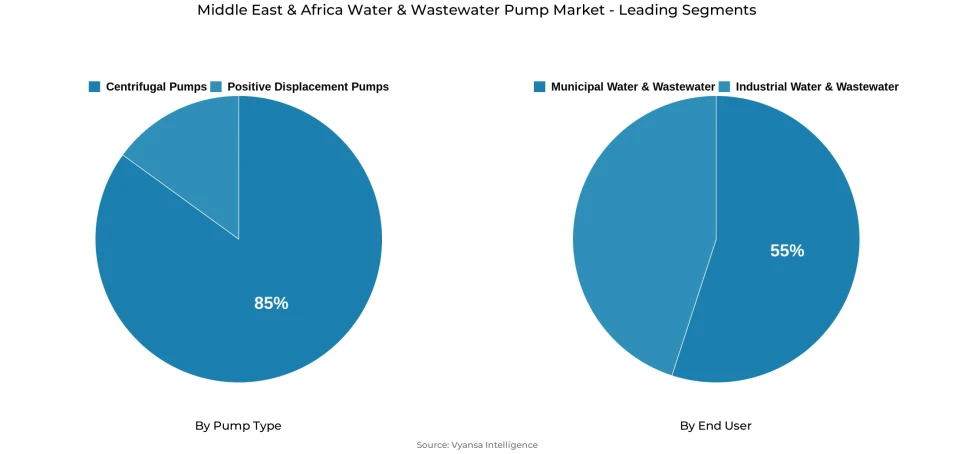
- Centrifugal pumps grabbed market share of 85%.
- Competition
- More than 10 companies are actively engaged in producing water & wastewater pump in Middle East & Africa.
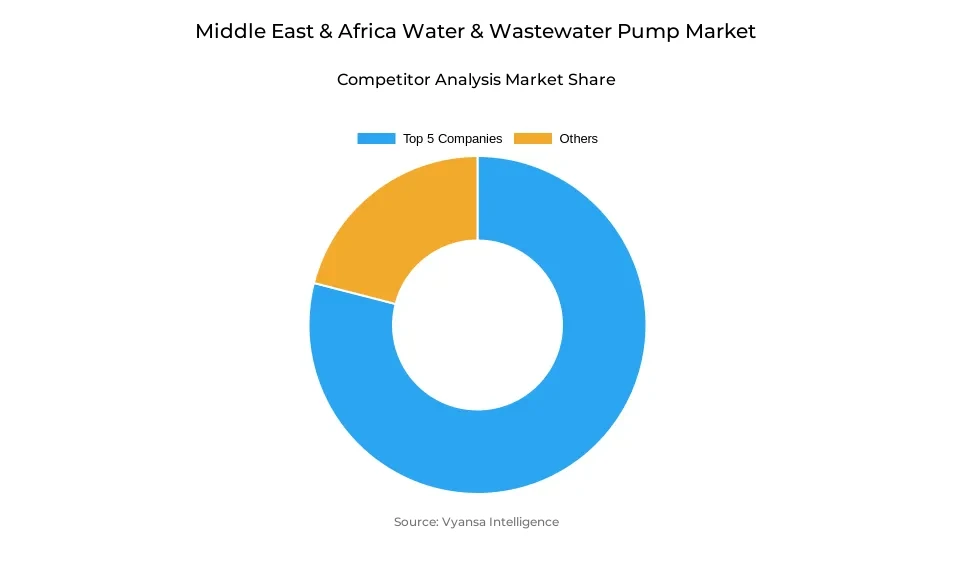
- Top 5 companies acquired the maximum share of the market.
- Xylem Inc.; KSB SE & Co. KGaA; Kirloskar Brothers Limited (KBL); Flowserve Corporation; Ebara Corporation etc., are few of the top companies.
- End User
- Municipal Water & Wastewater grabbed 55% of the market.
- Country
- Saudi Arabia leads with a 15% share of the Middle East & Africa market.
Middle East & Africa Water & Wastewater Pump Market Outlook
The Middle East & Africa Water & Wastewater Pump Market, with an estimated value of USD 625 million in 2025, is expected to reach approximately USD 715 million by 2032 with a growth rate of almost 1.94% from 2026–2032. Urbanization and industry development are putting tremendous pressure on current water and wastewater pumping facilities. Governments across the region are introducing stricter quality and efficiency standards, prompting utilities to adopt advanced, energy-efficient pump systems that ensure reliable water supply and support sustainability goals.
Centrifugal pumps command the sector with an 85% share, thanks mainly to their high efficiency, durability, and simplicity of maintenance. Their heavy-duty construction and capacity for high-capacity operation make them the favorite for municipal and industrial applications. Ongoing innovations like corrosion-proof materials and better impeller designs have also increased their performance and energy efficiency, enabling utilities to reduce power losses and maintenance expenses.
The municipal water and wastewater market is the largest end-user market, with approximately 55% of total installations. Governments and development agencies spend more than USD 2 billion per year in upgrading treatment plants and distribution systems, furthering the demand for efficient pumping systems. The industrial market, such as the oil & gas industry and manufacturing, is also growing increasingly as operators invest in pumps with capabilities to handle sophisticated and corrosive fluids.
Saudi Arabia dominates the local market with a 15% share, thanks to massive desalination and water-reuse schemes under the National Water Strategy. Public–private partnerships and stringent efficiency requirements remain key drivers of investment in cutting-edge pump technology, securing the nation's position as the Middle East and Africa's top sustainable water manager.
Middle East & Africa Water & Wastewater Pump Market Growth Driver
Infrastructure Expansion Driving Demand for Reliable Pump Systems
Increased urbanization and industrial development throughout the Middle East and Africa are putting enormous stress on the existing water and wastewater pumping infrastructure. Providing continuity of water supply to millions of inhabitants has made system reliability a paramount issue for network operators. Aging equipment, coupled with rising demand from growing urban areas and industry sectors, is pushing utilities and private operators to invest in new pumping solutions. These investments are intended to increase operational effectiveness, decrease unscheduled downtime, and provide for the long-term integrity of municipal and industrial water systems.
Moreover, Regulatory environments within the region are also changing, with governments implementing tighter performance and energy efficiency requirements for pumping systems. Utilities are required to perform periodic audits and implement internationally accepted energy-saving techniques. The emphasis on sustainability and operational excellence is compelling the use of high-efficiency and intelligent pumping technologies that reduce energy loss, maximize equipment life, and enable more sustainable water and wastewater management practices across the Middle East and Africa.
Middle East & Africa Water & Wastewater Pump Market Challenge
Escalating Energy Burden in Pumping Operations
Low energy efficiency is a major challenge facing pumping infrastructure in the region, with operations representing close to 10% of all electricity consumed in municipal water treatment plants. The level of demand greatly increases utility operating expenses, particularly for networks that are already under pressure from rising consumption and financial restrictions.
Ageing pump systems and suboptimal operating modes further exacerbate inefficiencies. Unplanned shutdowns and aged components result in increased energy wastage and high maintenance costs. Operators have to operate ageing equipment at variable loads, which degrades energy performance as well as mechanical lifespan. Solutions for these inefficiencies have become the core of utility strategies for cost savings and service reliability improvement.
Unlock Market Intelligence
Explore the market potential with our data-driven report
Middle East & Africa Water & Wastewater Pump Market Trend
Integration of Smart and Predictive Pumping Technologies
Technological upgrading is transforming pump operation as utilities adopt IoT-based and digitally monitored pumps. Real-time sensors and predictive analytics enable operators to spot developing faults before they lead to unplanned outages, with pilot schemes showing reductions of as much as 40% in downtime. Such smart solutions promote equipment reliability while facilitating proactive maintenance programs that maximize operational life.
Manufacturers also use AI-based data models to better match pumping schedules and levelize energy consumption throughout the day. As smart-grid systems continue to proliferate, utilities have the potential to incorporate pump station data into centralized management systems, enhancing network visibility, forecasting, and asset planning. Such innovation is a critical step toward digitally enabled, sustainable water management.
Middle East & Africa Water & Wastewater Pump Market Opportunity
Infrastructure Expansion Creating New Market Prospects
Urgent population growth and urbanization keep pushing massive overhauls of water and wastewater networks in the region. Municipal infrastructure projects are being financed by international development institutions, which together provide more than USD 2 billion every year to finance water management and treatment schemes. These efforts facilitate the building and upgrading of treatment works, distribution systems, and sophisticated pumping plants.
A growing emphasis on decentralized recycling of wastewater similarly drives demand for high-performance, compact pump systems. New developments throughout Gulf Cooperation Council countries have enhanced treated effluent capacity by almost 25%, supporting efforts to reduce water shortage issues. This shift towards distributed infrastructure is expanding opportunities for both international and regional pump makers to supply emerging municipal and semi-urban developments.
Middle East & Africa Water & Wastewater Pump Market Country Analysis
By Country
- The UAE
- Saudi Arabia
- South Africa
- Qatar
- Rest of Middle East & Africa
Saudi Arabia possesses a dominant 15% share of the Middle East and Africa's pump demand, led by its large-scale desalination and water-reuse schemes. National large-scale efforts to obtain drinking water from seawater and treated effluent have required high levels of investment in advanced pumping schemes. This development of infrastructure supports national goals for resilient water management and sustainability.
The government's National Water Strategy substantiates this leadership through rigorous efficiency requirements and enabling public–private partnerships. These regulatory and financial platforms facilitate the deployment of next-generation pumping technologies throughout municipal and industrial applications, serving as a model for operational excellence and sustainability across the larger region.
Unlock Market Intelligence
Explore the market potential with our data-driven report
Middle East & Africa Water & Wastewater Pump Market Segmentation Analysis
By Pump Type
- Centrifugal Pumps
- Positive Displacement Pumps
Centrifugal pumps is the largest segment with share around 85% in total installations, reflecting the aptness in the high-flow and high-capacity applications of the region. Their simplicity in design, minimum maintenance requirements, and availability of spare parts facilitate them becoming the utilities' first choice in managing constant operations in municipal and industrial plants. This prevalence speaks volumes about their contribution to constant supply of water and wastewater transfer.
Ongoing design enhancements have fortified the performance benefit of centrifugal pumps. Producers are adding corrosion-resistant alloys and improved impeller geometries that increase efficiency and minimize energy consumption by as much as 10% over previous generations. Centrifugal pumps maintain their dominance through these advances, offering the industry's most cost-efficient and dependable solution.
By End User
- Industrial Water & Wastewater
- Municipal Water & Wastewater
The city water and wastewater industry commands the single-largest percentage-about 55%-of all pump installations in the Middle East and Africa. Government-supported investment in urban water supply and sanitation infrastructure continues to drive mass deployments of high-capacity pumps in treatment and distribution networks. These projects are consistent with national water security objectives and underpin growing population hubs.
At the same time, the industrial end user segment is the most rapidly expanding segment and is expected to grow at a CAGR of about 2.97%, driven by oil & gas, petrochemical, and manufacturing processes. These end users are increasingly demanding pumps designed to handle corrosive and pressure fluids under aggressive operating conditions. The simultaneous expansion in industrial demand complements municipal upgrade, solidifying the overall regional market direction.
Various Market Players in Middle East & Africa Water & Wastewater Pump Market
The companies mentioned below are highly active in the Middle East & Africa water & wastewater pump market, occupying a considerable portion of the market and shaping industry progress.
- Xylem Inc.
- KSB SE & Co. KGaA
- Kirloskar Brothers Limited (KBL)
- Flowserve Corporation
- Ebara Corporation
- WILO SE
- Sulzer Limited
- Grundfos Holding A/S
- Franklin Electric
- Pentair PLC
Frequently Asked Questions
Related Report
1. Market Segmentation
1.1. Research Scope
1.2. Research Methodology
1.3. Definitions and Assumptions
2. Executive Summary
3. Middle East & Africa Water & Wastewater Pump Market Policies, Regulations, and Standards
4. Middle East & Africa Water & Wastewater Pump Market Dynamics
4.1. Growth Factors
4.2. Challenges
4.3. Trends
4.4. Opportunities
5. Middle East & Africa Water & Wastewater Pump Market Statistics, 2022-2032F
5.1. Market Size & Growth Outlook
5.1.1.By Revenues in US$ Million
5.2. Market Segmentation & Growth Outlook
5.2.1.By Pump Type
5.2.1.1. Centrifugal Pumps- Market Insights and Forecast 2022-2032, USD Million
5.2.1.1.1. End Suction- Market Insights and Forecast 2022-2032, USD Million
5.2.1.1.2. Split Case- Market Insights and Forecast 2022-2032, USD Million
5.2.1.1.3. Vertical- Market Insights and Forecast 2022-2032, USD Million
5.2.1.1.3.1. Turbine- Market Insights and Forecast 2022-2032, USD Million
5.2.1.1.3.2. Axial Pump- Market Insights and Forecast 2022-2032, USD Million
5.2.1.1.3.3. Mixed Flow Pump- Market Insights and Forecast 2022-2032, USD Million
5.2.1.1.4. Submersible Pump- Market Insights and Forecast 2022-2032, USD Million
5.2.1.2. Positive Displacement Pumps- Market Insights and Forecast 2022-2032, USD Million
5.2.1.2.1. Progressing Cavity- Market Insights and Forecast 2022-2032, USD Million
5.2.1.2.2. Diaphragm- Market Insights and Forecast 2022-2032, USD Million
5.2.1.2.3. Gear Pump- Market Insights and Forecast 2022-2032, USD Million
5.2.1.2.4. Others- Market Insights and Forecast 2022-2032, USD Million
5.2.2.By Application
5.2.2.1. Water- Market Insights and Forecast 2022-2032, USD Million
5.2.2.2. Wastewater- Market Insights and Forecast 2022-2032, USD Million
5.2.3.By End User
5.2.3.1. Industrial Water & Wastewater- Market Insights and Forecast 2022-2032, USD Million
5.2.3.2. Municipal Water & Wastewater- Market Insights and Forecast 2022-2032, USD Million
5.2.4.By Country
5.2.4.1. The UAE
5.2.4.2. Saudi Arabia
5.2.4.3. South Africa
5.2.4.4. Qatar
5.2.4.5. Rest of Middle East & Africa
5.2.5.By Competitors
5.2.5.1. Competition Characteristics
5.2.5.2. Market Share & Analysis
6. UAE Water & Wastewater Pump Market Statistics, 2022-2032F
6.1. Market Size & Growth Outlook
6.1.1.By Revenues in US$ Million
6.2. Market Segmentation & Growth Outlook
6.2.1.By Pump Type- Market Insights and Forecast 2022-2032, USD Million
6.2.2.By Application- Market Insights and Forecast 2022-2032, USD Million
6.2.3.By End User- Market Insights and Forecast 2022-2032, USD Million
7. Saudi Arabia Water & Wastewater Pump Market Statistics, 2022-2032F
7.1. Market Size & Growth Outlook
7.1.1.By Revenues in US$ Million
7.2. Market Segmentation & Growth Outlook
7.2.1.By Pump Type- Market Insights and Forecast 2022-2032, USD Million
7.2.2.By Application- Market Insights and Forecast 2022-2032, USD Million
7.2.3.By End User- Market Insights and Forecast 2022-2032, USD Million
8. South Africa Water & Wastewater Pump Market Statistics, 2022-2032F
8.1. Market Size & Growth Outlook
8.1.1.By Revenues in US$ Million
8.2. Market Segmentation & Growth Outlook
8.2.1.By Pump Type- Market Insights and Forecast 2022-2032, USD Million
8.2.2.By Application- Market Insights and Forecast 2022-2032, USD Million
8.2.3.By End User- Market Insights and Forecast 2022-2032, USD Million
9. Qatar Water & Wastewater Pump Market Statistics, 2022-2032F
9.1. Market Size & Growth Outlook
9.1.1.By Revenues in US$ Million
9.2. Market Segmentation & Growth Outlook
9.2.1.By Pump Type- Market Insights and Forecast 2022-2032, USD Million
9.2.2.By Application- Market Insights and Forecast 2022-2032, USD Million
9.2.3.By End User- Market Insights and Forecast 2022-2032, USD Million
10. Competitive Outlook
10.1. Company Profiles
10.1.1. Flowserve Corporation
10.1.1.1. Business Description
10.1.1.2. Product Portfolio
10.1.1.3. Collaborations & Alliances
10.1.1.4. Recent Developments
10.1.1.5. Financial Details
10.1.1.6. Others
10.1.2. Ebara Corporation
10.1.2.1. Business Description
10.1.2.2. Product Portfolio
10.1.2.3. Collaborations & Alliances
10.1.2.4. Recent Developments
10.1.2.5. Financial Details
10.1.2.6. Others
10.1.3. WILO SE
10.1.3.1. Business Description
10.1.3.2. Product Portfolio
10.1.3.3. Collaborations & Alliances
10.1.3.4. Recent Developments
10.1.3.5. Financial Details
10.1.3.6. Others
10.1.4. Sulzer Limited
10.1.4.1. Business Description
10.1.4.2. Product Portfolio
10.1.4.3. Collaborations & Alliances
10.1.4.4. Recent Developments
10.1.4.5. Financial Details
10.1.4.6. Others
10.1.5. Grundfos Holding A/S
10.1.5.1. Business Description
10.1.5.2. Product Portfolio
10.1.5.3. Collaborations & Alliances
10.1.5.4. Recent Developments
10.1.5.5. Financial Details
10.1.5.6. Others
10.1.6. Xylem Inc.
10.1.6.1. Business Description
10.1.6.2. Product Portfolio
10.1.6.3. Collaborations & Alliances
10.1.6.4. Recent Developments
10.1.6.5. Financial Details
10.1.6.6. Others
10.1.7. KSB SE & Co. KGaA
10.1.7.1. Business Description
10.1.7.2. Product Portfolio
10.1.7.3. Collaborations & Alliances
10.1.7.4. Recent Developments
10.1.7.5. Financial Details
10.1.7.6. Others
10.1.8. Kirloskar Brothers Limited (KBL)
10.1.8.1. Business Description
10.1.8.2. Product Portfolio
10.1.8.3. Collaborations & Alliances
10.1.8.4. Recent Developments
10.1.8.5. Financial Details
10.1.8.6. Others
10.1.9. Franklin Electric
10.1.9.1. Business Description
10.1.9.2. Product Portfolio
10.1.9.3. Collaborations & Alliances
10.1.9.4. Recent Developments
10.1.9.5. Financial Details
10.1.9.6. Others
10.1.10. Pentair PLC
10.1.10.1.Business Description
10.1.10.2.Product Portfolio
10.1.10.3.Collaborations & Alliances
10.1.10.4.Recent Developments
10.1.10.5.Financial Details
10.1.10.6.Others
11. Disclaimer
| Segment | Sub-Segment |
|---|---|
| By Pump Type |
|
| By Application |
|
| By End User |
|
| By Country |
|
Research Methodology
This study followed a structured approach comprising four key phases to assess the size and scope of the electro-oxidation market. The process began with thorough secondary research to collect data on the target market, related markets, and broader industry context. These findings, along with preliminary assumptions and estimates, were then validated through extensive primary research involving industry experts from across the value chain. To calculate the overall market size, both top-down and bottom-up methodologies were employed. Finally, market segmentation and data triangulation techniques were applied to refine and validate segment-level estimations.
Secondary Research
The secondary research phase involved gathering data from a wide range of credible and published sources. This step helped in identifying industry trends, defining market segmentation, and understanding the market landscape and value chain.
Sources consulted during this phase included:
- Company annual reports, investor presentations, and press releases
- Industry white papers and certified publications
- Trade directories and market-recognized databases
- Articles from authoritative authors and reputable journals
- Gold and silver standard websites
Secondary research was critical in mapping out the industry's value chain and monetary flow, identifying key market segments, understanding regional variations, and tracking significant industry developments.
Other key sources:
- Financial disclosures
- Industry associations and trade bodies
- News outlets and business magazines
- Academic journals and research studies
- Paid industry databases
Primary Research
To validate secondary data and gain deeper market insights, primary research was conducted with key stakeholders across both the supply and demand sides of the market.
On the demand side, participants included decision-makers and influencers from end-user industries—such as CIOs, CTOs, and CSOs—who provided first-hand perspectives on market needs, product usage, and future expectations.
On the supply side, interviews were conducted with manufacturers, industry associations, and institutional participants to gather insights into current offerings, product pipelines, and market challenges.
Primary interviews provided critical inputs such as:
- Market size and revenue data
- Product and service breakdowns
- Market forecasts
- Regional and application-specific trends
Stakeholders consulted included:
- Leading OEM and solution providers
- Channel and distribution partners
- End users across various applications
- Independent consultants and industry specialists
Market Size Estimation and Data Triangulation
- Identifying Key Market Participants (Secondary Research)
- Goal: To identify the major players or companies in the target market. This typically involves using publicly available data sources such as industry reports, market research publications, and financial statements of companies.
- Tools: Reports from firms like Gartner, Forrester, Euromonitor, Statista, IBISWorld, and others. Public financial statements, news articles, and press releases from top market players.
- Extracting Earnings of Key Market Participants
- Goal: To estimate the earnings generated from the product or service being analyzed. This step helps in understanding the revenue potential of each market player in a specific geography.
- Methods: Earnings data can be gathered from:
- Publicly available financial reports (for listed companies).
- Interviews and primary data sources from professionals, such as Directors, VPs, SVPs, etc. This is especially useful for understanding more nuanced, internal data that isn't publicly disclosed.
- Annual reports and investor presentations of key players.
- Data Collation and Development of a Relevant Data Model
- Goal: To collate inputs from both primary and secondary sources into a structured, data-driven model for market estimation. This model will incorporate key market KPIs and any independent variables relevant to the market.
- Key KPIs: These could include:
- Market size, growth rate, and demand drivers.
- Industry-specific metrics like market share, average revenue per customer (ARPC), or average deal size.
- External variables, such as economic growth rates, inflation rates, or commodity prices, that could affect the market.
- Data Modeling: Based on this data, the market forecasts are developed for the next 5 years. A combination of trend analysis, scenario modeling, and statistical regression might be used to generate projections.
- Scenario Analysis
- Goal: To test different assumptions and validate how sensitive the market is to changes in key variables (e.g., market demand, regulatory changes, technological disruptions).
- Types of Scenarios:
- Base Case: Based on current assumptions and historical data.
- Best-Case Scenario: Assuming favorable market conditions, regulatory environments, and technological advancements.
- Worst-Case Scenario: Accounting for adverse factors, such as economic downturns, stricter regulations, or unexpected disruptions.












