Malaysia Construction Equipment Market Report: Trends, Growth and Forecast (2026-2032)
By Type of Equipment (Earthmoving Equipment (Excavator, Loaders, Bulldozers, Skid Steer Loaders, Motor Graders, Crawler Loader, Trenchers, Dump Trucks, Others), Material Handling Equipment (Cranes, Forklift, Tipper, Others), Other construction equipment (Road Roller, Diesel Generator, Others)), By Propulsion (Diesel, Gas, CNG, LPG, Electric), By Application (Power & Utilities, Mining, Hospitality, Residential, Healthcare & Educational, Roads & Highway, Manufacturing Units, Others), By Engine Capacity (< 5 L, 5–10 L, 10 L), By Power Output (< 100 HP, 101–200 HP, 201–400 HP, >400 HP) ... Read more
|
Major Players
|
Malaysia Construction Equipment Market Statistics and Insights, 2026
- Market Size Statistics
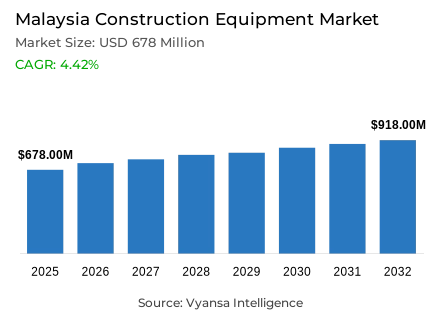
- Construction equipment market size in Malaysia was valued at USD 678 million in 2025 and is estimated at USD 692 million in 2026.
- The market size is expected to grow to USD 918 million by 2032.
- Market to register a CAGR of around 4.42% during 2026-32.
- Type of Equipment Shares
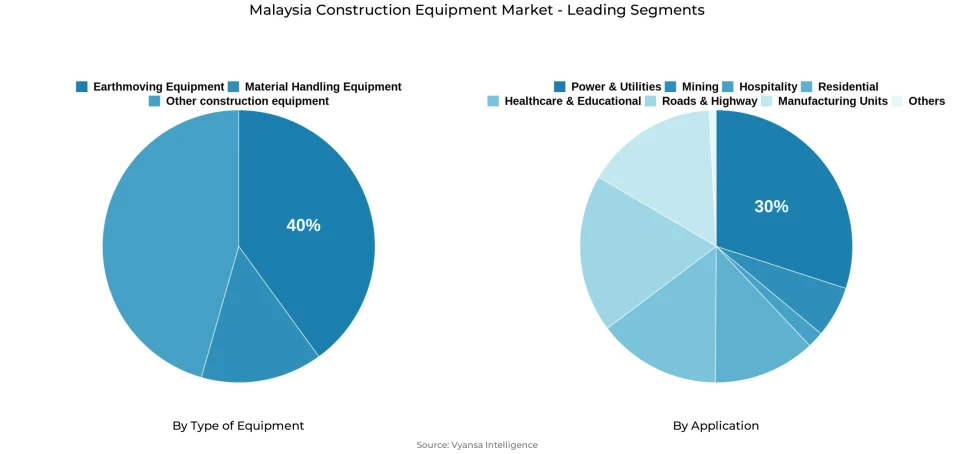
- Earthmoving equipment grabbed market share of 40%.
- Competition
- More than 10 companies are actively engaged in producing construction equipment in Malaysia.
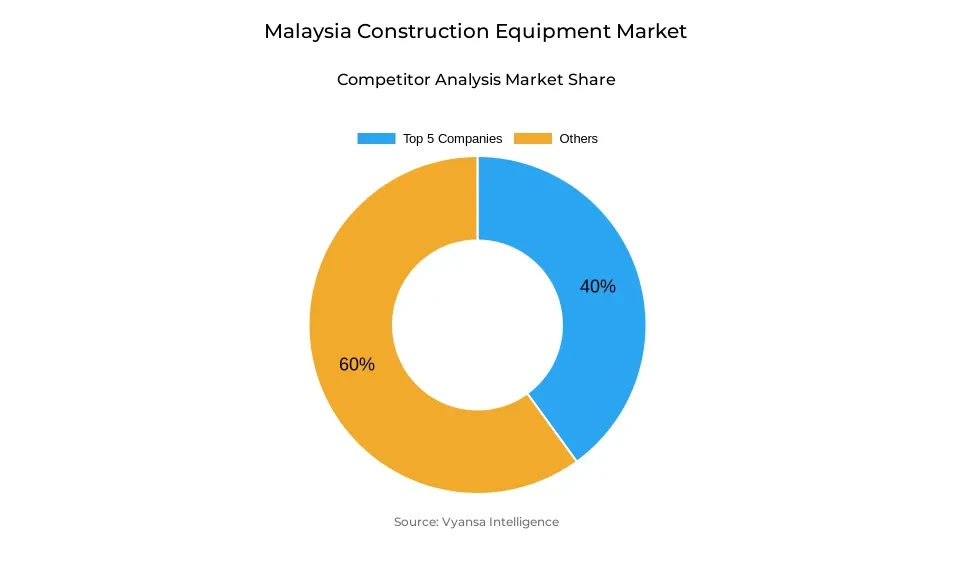
- Top 5 companies acquired around 40% of the market share.
- XCMG (Xuzhou Construction Machinery Group), Zoomlion Heavy Industry, Kobelco Construction Machinery, Caterpillar Inc., Komatsu Ltd. etc., are few of the top companies.
- Application
- Power & utilities grabbed 30% of the market.
Malaysia Construction Equipment Market Outlook
The Malaysia construction equipment market was valued at USD 678 million in 2025 and is projected to advance from USD 692 million in 2026 to USD 918 million by 2032, registering a CAGR of 4.42% across the forecast period. This measured and structurally grounded expansion reflects the practical project-based demand that sustains the Malaysia construction equipment market across infrastructure, utilities, industrial facilities, data centre development, and public works, where contractors and developers require machinery that improves work speed, reduces manual labour dependency, and enables large-scale construction execution across complex site conditions. Growth is not speculative but physically driven by project mobilisation across civil engineering, utility corridors, road construction, and commercial development activities that collectively keep heavy machinery utilisation consistent throughout the forecast period.
Earthmoving Equipment commands 40% of the equipment type segment, establishing the Malaysia earthmoving equipment market as the most commercially significant machinery category within the national construction landscape. Excavators, loaders, bulldozers, motor graders, skid steer loaders, crawler loaders, and dump trucks collectively serve the land clearing, excavation, grading, trenching, material movement, and site preparation functions that must precede every other construction activity, making this category the operational foundation from which road, utility, industrial, and structural works derive their physical progression. Its 40% share reflects not only project volume but the multi-stage deployment profile that sustains earthmoving fleet utilisation across extended project timelines.
Power and Utilities holds 30% of the market by application, establishing utility infrastructure as the most equipment-intensive and commercially significant end-use context within the Malaysia construction equipment market . Transmission-line foundations, substation construction, underground cabling, water systems, drainage networks, and energy-related civil works collectively require excavators for trenching, cranes for lifting, compactors for ground stabilisation, generators for site power, and loaders for material handling across wide project areas and long execution timelines that sustain multi-machine fleet demand through multiple construction phases simultaneously.
The overall market trajectory through 2032 benefits from the convergence of public infrastructure investment, private-sector construction activity, and energy transition spending that collectively diversifies the demand base beyond any single project category. As per data published by the Department of Statistics Malaysia, civil engineering contributed RM16.5 billion representing 36.4% of total construction work done in Q3 2025, including RM8.9 billion from utility projects and RM5.7 billion from roads and railways, confirming that the active project pipeline sustaining heavy machinery market Malaysia demand is both large in scale and operationally distributed across the utility, transport, and civil works categories that anchor equipment procurement decisions throughout the forecast period.
Malaysia Construction Equipment Market Growth Driver
Active Civil Engineering Pipeline and Budgetary Infrastructure Commitment Are Sustaining Construction Equipment Procurement
The primary commercial driver within the Malaysia construction equipment market is the confirmed mobilisation of civil engineering and infrastructure projects that translate directly into machinery procurement demand rather than representing only pipeline aspirations awaiting approval. As per data published by the Department of Statistics Malaysia, construction work done in Q3 2025 reached RM45.4 billion, with civil engineering contributing RM16.5 billion including RM8.9 billion from utility projects and RM5.7 billion from roads and railways, confirming that the power and utilities equipment and road construction machinery categories are generating real and measurable procurement demand from actively executing projects rather than from anticipated future work. Budgetary support reinforces this driver with institutional depth, as Malaysia's Budget 2026 provides RM81 billion in development expenditure with approximately 2,300 newly approved programmes and projects, including RM17.5 billion for the transport subsector covering road construction from Kalabakan to Simanggaris and new interchanges on the North-South Expressway.
Private-sector activity adds a commercially significant parallel demand layer that sustains equipment procurement independently of public infrastructure timing. According to statistics released by the Department of Statistics Malaysia, the private sector contributed RM29.5 billion representing 65.0% of total construction work done in Q3 2025, confirming that industrial builders, logistics park developers, data centre constructors, and commercial contractors are generating equipment demand that complements public infrastructure procurement and creates a more balanced and resilient demand base for excavators, wheel loaders, cranes, forklifts, diesel generators, and telehandlers across the Malaysia construction equipment market .
Malaysia Construction Equipment Market Challenge
Input Cost Volatility and Fiscal Consolidation Are Compressing Contractor Margins and Procurement Timing
The most commercially consequential structural challenge within the Malaysia heavy equipment market is the combination of construction material price pressure, fiscal discipline constraints, and external supply-chain risk that collectively narrow contractor margins, encourage selective equipment procurement, and create uneven order timing across the market's civil engineering, utility, and industrial construction demand pillars. Based on data from the Department of Statistics Malaysia for September 2025, steel unit price indices rose month-on-month by 0.4% to 1.9% across selected locations while year-on-year cement indices increased between 0.5% and 3.9% across Peninsular Malaysia, Sabah, and Sarawak, confirming that construction material inflation is creating a more cost-conscious procurement environment that pushes contractors toward rental arrangements, extended replacement cycles, and fleet composition adjustments rather than straightforward new equipment purchases.
Fiscal consolidation adds a structural layer to this challenge by reducing the development expenditure available to sustain public-sector project mobilisation. Budget 2026 allocates RM81 billion for development expenditure compared with RM86 billion in 2025, while the fiscal deficit is projected to narrow from 3.8% to 3.5% of GDP in 2026, and the IMF's 2026 Article IV analysis highlights that Malaysia's growth risks are tilted to the downside due to global trade tensions, supply-chain disruption, and tariff uncertainty that affect the cross-border machinery, components, hydraulic systems, and electronics supply chains on which construction equipment Malaysia procurement and maintenance depend.
Unlock Market Intelligence
Explore the market potential with our data-driven report
Malaysia Construction Equipment Market Trend
Construction 4.0 Adoption and Digital Fleet Management Are Reshaping Equipment Procurement Priorities
A well-defined and commercially consequential structural trend is reshaping how contractors and developers evaluate and specify machinery within the Malaysia construction equipment market , as the national construction sector's progression toward Construction 4.0 frameworks progressively elevates telematics, GPS-enabled grading, fuel-consumption monitoring, preventive maintenance integration, and machine-control attachment compatibility from premium features into baseline procurement expectations across large infrastructure, utility, and industrial construction projects. Evidence drawn from public data released by the Construction Industry Development Board Malaysia confirms that digital tools including Building Information Modelling and Industrialised Building System adoption are actively shaping Malaysia's construction industry, with the Construction 4.0 Strategic Plan guiding the sector toward digitalisation, sustainability, productivity improvement, and lower reliance on low-skilled labour in ways that directly increase the commercial value of telematics-enabled fleet management and connected construction machinery within the national market.
The competitive implications of this trend extend beyond product specifications into after-sales service positioning, where equipment providers offering fleet management platforms, operator training, predictive maintenance, and rapid spare-part delivery are progressively differentiating themselves from suppliers competing on machine price alone. Civil engineering project complexity is reinforcing this differentiation imperative, as the Department of Statistics Malaysia confirming RM8.9 billion in utility project work done in Q3 2025 confirms that underground utilities, drainage coordination, power corridors, and transmission infrastructure require precision equipment, coordinated fleet management, and digital site planning capabilities that Construction 4.0 machinery suppliers are architecturally better positioned to provide than conventional equipment distributors focused on volume-based machine supply.
Malaysia Construction Equipment Market Opportunity
Energy Infrastructure Modernisation and Grid Investment Are Creating High-Value Equipment Demand Pockets
The most commercially significant and structurally durable growth opportunity within the Malaysia construction equipment market lies in the convergence of grid modernisation investment, renewable energy infrastructure development, and climate-resilient utility construction that collectively generate broad and multi-machine equipment demand across foundation works, transmission corridors, substation construction, solar-farm preparation, underground cabling, and flood-control systems throughout Peninsular Malaysia and East Malaysia. Validated reports from Tenaga Nasional Berhad confirm a RM43 billion commitment to modernise and strengthen the national power grid including AI and battery energy storage system integration, confirming that the physical construction activities supporting this grid investment programme will generate sustained demand for flood mitigation equipment, earthmoving machinery, cranes, trenchers, compactors, generators, and specialist access equipment across an expanding geographic project footprint throughout the forecast period.
Renewable energy policy alignment creates a separately compelling and long-horizon demand layer that extends equipment market opportunity well beyond the current budget cycle. Malaysia's energy transition roadmap targeting 70% renewable energy installed capacity by 2050 and 31% renewable energy share in national capacity by 2025, combined with Budget 2026's RM3.8 billion allocation to the environment subsector covering flood mitigation projects in Kedah, Terengganu, Johor, Negeri Sembilan, Kelantan, Kuala Lumpur, and other regions, confirms that the utility and climate-resilience construction pipeline sustaining power and utilities equipment demand is both institutionally funded and geographically distributed across multiple states in ways that support sustained multi-year equipment deployment rather than concentrated single-project procurement cycles.
Unlock Market Intelligence
Explore the market potential with our data-driven report
Malaysia Construction Equipment Market Segmentation Analysis
By Type of Equipment
- Earthmoving Equipment
- Excavator
- Loaders
- Bulldozers
- Skid Steer Loaders
- Motor Graders
- Crawler Loader
- Trenchers
- Dump Trucks
- Others
- Material Handling Equipment
- Cranes
- Forklift
- Tipper
- Others
- Other construction equipment
- Road Roller
- Diesel Generator
- Others
Earthmoving Equipment commands the highest share within the equipment type category at approximately 40%, reflecting the operational necessity of site clearing, excavation, grading, trenching, loading, and hauling as the physical prerequisite from which every road, utility, industrial, and structural construction project in Malaysia must begin. Excavators Malaysia serve foundation preparation, drainage trenching, utility-line installation, road cuts, demolition support, and material movement simultaneously; loaders handle soil, aggregates, sand, and construction debris across project sites; bulldozers support clearing and embankment preparation; motor graders are critical in road base shaping and surface levelling; and skid steer loaders serve compact urban and industrial sites, collectively creating a product family whose multi-phase project relevance sustains commercial leadership within the Malaysia construction equipment market throughout the forecast period.
The segment's dominance is further reinforced by the geographic concentration of active construction activity across states that generate the highest earthmoving fleet utilisation. The Department of Statistics Malaysia confirming that Selangor, Johor, Sarawak, and Wilayah Persekutuan together accounted for 62.1% of Q3 2025 construction work done, with Selangor recording RM10.5 billion and Johor contributing RM8.2 billion, confirms that the industrial parks, data centre developments, transport works, residential projects, ports, and utility corridors generating the most intensive earthmoving demand are concentrated in precisely the states where contractor fleet investment and rental market activity are most commercially active within the Malaysia construction machinery market.
By Application
- Power & Utilities
- Mining
- Hospitality
- Residential
- Healthcare & Educational
- Roads & Highway
- Manufacturing Units
- Others
Power and Utilities commands the highest share within the application category at approximately 30%, establishing utility infrastructure construction as the most equipment-intensive and commercially significant end-use context within the Malaysia construction equipment market . Utility projects require a broader machinery combination per project than most building-category works, with transmission-line construction demanding foundation drilling, access-road preparation, crane lifting, and material movement; substation development requiring excavation, concrete placement, backfilling, and heavy component handling; and water and drainage infrastructure requiring trenchers, compactors, excavators, and pumping support, all deployed simultaneously across wide project areas with long execution timelines that sustain multi-machine fleet demand across successive construction phases. The Department of Statistics Malaysia confirming that utility projects generated RM8.9 billion within the civil engineering subsector in Q3 2025, exceeding the RM5.7 billion recorded for roads and railways in the same period, confirms this application's commercial primacy within the Malaysia construction equipment market .
Grid modernisation and renewable energy investment are deepening the segment's commercial sustainability in structurally meaningful ways that extend demand visibility well beyond the current budget cycle. Tenaga Nasional Berhad's RM43 billion grid modernisation commitment requiring new substations, expanded transmission corridors, underground cabling routes, battery storage compounds, and access infrastructure, combined with Budget 2026's RM3.8 billion for climate-resilience and flood mitigation works across multiple states, confirms that power utility construction equipment Malaysia demand is supported by both private energy investment and public climate-infrastructure spending that collectively sustain the segment's leadership position as the most strategically significant application category within the Malaysia construction equipment market through 2032.
List of Companies Covered in Malaysia Construction Equipment Market
The companies listed below are highly influential in the Malaysia construction equipment market, with a significant market share and a strong impact on industry developments.
- XCMG (Xuzhou Construction Machinery Group)
- Zoomlion Heavy Industry
- Kobelco Construction Machinery
- Caterpillar Inc.
- Komatsu Ltd.
- Volvo Construction Equipment
- Hitachi Construction Machinery
- SANY Heavy Industry
- Tadano Ltd.
- Kato Works Co. Ltd.
Market News & Updates
- Hitachi Construction Machinery, 2025:
Hitachi Construction Machinery Asia Pacific launched the EX70-5G and EX210LC Prime models for Southeast Asia in January 2025, with HMAP’s territory including Malaysia. The EX70-5G includes a Yanmar fuel-efficient engine, while the EX210LC Prime offers precision control, high fuel efficiency, and advanced technology. The models expand excavator options for regional construction customers.
- Hitachi Construction Machinery, 2025:
Hitachi Construction Machinery Asia and Pacific launched the Z-Attachment Series in August 2025 across its regional markets, including Malaysia. The lineup introduces a unified attachment range led by the ZC Quick Coupler for 1-ton to 40-ton machines. The update supports quicker attachment changes and broader excavator functionality for construction applications.
Frequently Asked Questions
Related Report
- Market Segmentation
- Research Scope
- Research Methodology
- Definitions and Assumptions
- Executive Summary
- Malaysia Construction Equipment Market Policies, Regulations, and Standards
- Malaysia Construction Equipment Market Dynamics
- Growth Factors
- Challenges
- Trends
- Opportunities
- Malaysia Construction Equipment Market Statistics, 2022-2032F
- Market Size & Growth Outlook
- By Revenues in USD Million
- By Unit Sold (Thousand Units)
- Market Segmentation & Growth Outlook
- By Type of Equipment
- Earthmoving Equipment- Market Insights and Forecast 2022-2032, USD Million
- Excavator- Market Insights and Forecast 2022-2032, USD Million
- Loaders- Market Insights and Forecast 2022-2032, USD Million
- Bulldozers- Market Insights and Forecast 2022-2032, USD Million
- Skid Steer Loaders- Market Insights and Forecast 2022-2032, USD Million
- Motor Graders- Market Insights and Forecast 2022-2032, USD Million
- Crawler Loader- Market Insights and Forecast 2022-2032, USD Million
- Trenchers- Market Insights and Forecast 2022-2032, USD Million
- Dump Trucks- Market Insights and Forecast 2022-2032, USD Million
- Others- Market Insights and Forecast 2022-2032, USD Million
- Material Handling Equipment- Market Insights and Forecast 2022-2032, USD Million
- Cranes- Market Insights and Forecast 2022-2032, USD Million
- Forklift- Market Insights and Forecast 2022-2032, USD Million
- Tipper- Market Insights and Forecast 2022-2032, USD Million
- Others- Market Insights and Forecast 2022-2032, USD Million
- Other construction equipment- Market Insights and Forecast 2022-2032, USD Million
- Road Roller- Market Insights and Forecast 2022-2032, USD Million
- Diesel Generator- Market Insights and Forecast 2022-2032, USD Million
- Others- Market Insights and Forecast 2022-2032, USD Million
- Earthmoving Equipment- Market Insights and Forecast 2022-2032, USD Million
- By Propulsion
- Diesel- Market Insights and Forecast 2022-2032, USD Million
- Gas- Market Insights and Forecast 2022-2032, USD Million
- CNG- Market Insights and Forecast 2022-2032, USD Million
- LPG- Market Insights and Forecast 2022-2032, USD Million
- Electric- Market Insights and Forecast 2022-2032, USD Million
- By Application
- Power & Utilities- Market Insights and Forecast 2022-2032, USD Million
- Mining- Market Insights and Forecast 2022-2032, USD Million
- Hospitality- Market Insights and Forecast 2022-2032, USD Million
- Residential- Market Insights and Forecast 2022-2032, USD Million
- Healthcare & Educational- Market Insights and Forecast 2022-2032, USD Million
- Roads & Highway- Market Insights and Forecast 2022-2032, USD Million
- Manufacturing Units- Market Insights and Forecast 2022-2032, USD Million
- Others- Market Insights and Forecast 2022-2032, USD Million
- By Engine Capacity
- < 5 L- Market Insights and Forecast 2022-2032, USD Million
- 5–10 L- Market Insights and Forecast 2022-2032, USD Million
- 10 L- Market Insights and Forecast 2022-2032, USD Million
- By Power Output
- < 100 HP- Market Insights and Forecast 2022-2032, USD Million
- 101–200 HP- Market Insights and Forecast 2022-2032, USD Million
- 201–400 HP- Market Insights and Forecast 2022-2032, USD Million
- >400 HP- Market Insights and Forecast 2022-2032, USD Million
- By Competitors
- Competition Characteristics
- Market Share & Analysis
- By Type of Equipment
- Market Size & Growth Outlook
- Malaysia Earthmoving Equipment Market Statistics, 2022-2032
- Market Size & Growth Outlook
- By Revenues in USD Million
- By Unit Sold (Thousand Units)
- Market Segmentation & Growth Outlook
- By Propulsion- Market Insights and Forecast 2022-2032, USD Million
- By Application- Market Insights and Forecast 2022-2032, USD Million
- By Engine Capacity- Market Insights and Forecast 2022-2032, USD Million
- By Power Output- Market Insights and Forecast 2022-2032, USD Million
- Market Size & Growth Outlook
- Malaysia Material Handling Equipment Market Statistics, 2022-2032
- Market Size & Growth Outlook
- By Revenues in USD Million
- By Unit Sold (Thousand Units)
- Market Segmentation & Growth Outlook
- By Propulsion- Market Insights and Forecast 2022-2032, USD Million
- By Application- Market Insights and Forecast 2022-2032, USD Million
- By Engine Capacity- Market Insights and Forecast 2022-2032, USD Million
- By Power Output- Market Insights and Forecast 2022-2032, USD Million
- Market Size & Growth Outlook
- Malaysia Other Construction Equipment Market Statistics, 2022-2032
- Market Size & Growth Outlook
- By Revenues in USD Million
- By Unit Sold (Thousand Units)
- Market Segmentation & Growth Outlook
- By Propulsion- Market Insights and Forecast 2022-2032, USD Million
- By Application- Market Insights and Forecast 2022-2032, USD Million
- By Engine Capacity- Market Insights and Forecast 2022-2032, USD Million
- By Power Output- Market Insights and Forecast 2022-2032, USD Million
- Market Size & Growth Outlook
- Competitive Outlook
- Company Profiles
- Caterpillar Inc.
- Business Description
- Product Portfolio
- Collaborations & Alliances
- Recent Developments
- Financial Details
- Others
- Komatsu Ltd.
- Business Description
- Product Portfolio
- Collaborations & Alliances
- Recent Developments
- Financial Details
- Others
- Volvo Construction Equipment
- Business Description
- Product Portfolio
- Collaborations & Alliances
- Recent Developments
- Financial Details
- Others
- Hitachi Construction Machinery
- Business Description
- Product Portfolio
- Collaborations & Alliances
- Recent Developments
- Financial Details
- Others
- SANY Heavy Industry
- Business Description
- Product Portfolio
- Collaborations & Alliances
- Recent Developments
- Financial Details
- Others
- XCMG (Xuzhou Construction Machinery Group)
- Business Description
- Product Portfolio
- Collaborations & Alliances
- Recent Developments
- Financial Details
- Others
- Zoomlion Heavy Industry
- Business Description
- Product Portfolio
- Collaborations & Alliances
- Recent Developments
- Financial Details
- Others
- Kobelco Construction Machinery
- Business Description
- Product Portfolio
- Collaborations & Alliances
- Recent Developments
- Financial Details
- Others
- Tadano Ltd.
- Business Description
- Product Portfolio
- Collaborations & Alliances
- Recent Developments
- Financial Details
- Others
- Kato Works Co. Ltd.
- Business Description
- Product Portfolio
- Collaborations & Alliances
- Recent Developments
- Financial Details
- Others
- Caterpillar Inc.
- Company Profiles
- Disclaimer
| Segment | Sub-Segment |
|---|---|
| By Type of Equipment |
|
| By Propulsion |
|
| By Application |
|
| By Engine Capacity |
|
| By Power Output |
|
Research Methodology
This study followed a structured approach comprising four key phases to assess the size and scope of the electro-oxidation market. The process began with thorough secondary research to collect data on the target market, related markets, and broader industry context. These findings, along with preliminary assumptions and estimates, were then validated through extensive primary research involving industry experts from across the value chain. To calculate the overall market size, both top-down and bottom-up methodologies were employed. Finally, market segmentation and data triangulation techniques were applied to refine and validate segment-level estimations.
Secondary Research
The secondary research phase involved gathering data from a wide range of credible and published sources. This step helped in identifying industry trends, defining market segmentation, and understanding the market landscape and value chain.
Sources consulted during this phase included:
- Company annual reports, investor presentations, and press releases
- Industry white papers and certified publications
- Trade directories and market-recognized databases
- Articles from authoritative authors and reputable journals
- Gold and silver standard websites
Secondary research was critical in mapping out the industry's value chain and monetary flow, identifying key market segments, understanding regional variations, and tracking significant industry developments.
Other key sources:
- Financial disclosures
- Industry associations and trade bodies
- News outlets and business magazines
- Academic journals and research studies
- Paid industry databases
Primary Research
To validate secondary data and gain deeper market insights, primary research was conducted with key stakeholders across both the supply and demand sides of the market.
On the demand side, participants included decision-makers and influencers from end-user industries—such as CIOs, CTOs, and CSOs—who provided first-hand perspectives on market needs, product usage, and future expectations.
On the supply side, interviews were conducted with manufacturers, industry associations, and institutional participants to gather insights into current offerings, product pipelines, and market challenges.
Primary interviews provided critical inputs such as:
- Market size and revenue data
- Product and service breakdowns
- Market forecasts
- Regional and application-specific trends
Stakeholders consulted included:
- Leading OEM and solution providers
- Channel and distribution partners
- End users across various applications
- Independent consultants and industry specialists
Market Size Estimation and Data Triangulation
- Identifying Key Market Participants (Secondary Research)
- Goal: To identify the major players or companies in the target market. This typically involves using publicly available data sources such as industry reports, market research publications, and financial statements of companies.
- Tools: Reports from firms like Gartner, Forrester, Euromonitor, Statista, IBISWorld, and others. Public financial statements, news articles, and press releases from top market players.
- Extracting Earnings of Key Market Participants
- Goal: To estimate the earnings generated from the product or service being analyzed. This step helps in understanding the revenue potential of each market player in a specific geography.
- Methods: Earnings data can be gathered from:
- Publicly available financial reports (for listed companies).
- Interviews and primary data sources from professionals, such as Directors, VPs, SVPs, etc. This is especially useful for understanding more nuanced, internal data that isn't publicly disclosed.
- Annual reports and investor presentations of key players.
- Data Collation and Development of a Relevant Data Model
- Goal: To collate inputs from both primary and secondary sources into a structured, data-driven model for market estimation. This model will incorporate key market KPIs and any independent variables relevant to the market.
- Key KPIs: These could include:
- Market size, growth rate, and demand drivers.
- Industry-specific metrics like market share, average revenue per customer (ARPC), or average deal size.
- External variables, such as economic growth rates, inflation rates, or commodity prices, that could affect the market.
- Data Modeling: Based on this data, the market forecasts are developed for the next 5 years. A combination of trend analysis, scenario modeling, and statistical regression might be used to generate projections.
- Scenario Analysis
- Goal: To test different assumptions and validate how sensitive the market is to changes in key variables (e.g., market demand, regulatory changes, technological disruptions).
- Types of Scenarios:
- Base Case: Based on current assumptions and historical data.
- Best-Case Scenario: Assuming favorable market conditions, regulatory environments, and technological advancements.
- Worst-Case Scenario: Accounting for adverse factors, such as economic downturns, stricter regulations, or unexpected disruptions.












