Japan Paediatric Consumer Health Market Report: Trends, Growth and Forecast (2026-2032)
By Product Type (Paediatric Analgesics (Paediatric Acetaminophen, Paediatric Aspirin, Paediatric Combination Products Analgesics, Paediatric Dipyrone, Paediatric Ibuprofen, Paediatric Naproxen), Paediatric Cough, Cold and Allergy Remedies (Paediatric Allergy Remedies, Paediatric Cough/Cold Remedies), Paediatric Digestive Remedies (Paediatric Diarrhoeal Remedies, Paediatric Indigestion and Heartburn Remedies, Paediatric Laxatives, Paediatric Motion Sickness Remedies), Paediatric Dermatologicals, Nappy (Diaper) Rash Treatments, Paediatric Vitamins and Dietary Supplements), By Dosage Form (Liquid Syrups, Chewable Tablets, Drops, Powders/Sachets, Gummies, Topical Creams & Ointments), By Age Group (Infants & Toddlers (0-3 Years), Children (4-12 Years), Adolescents (13-18 Years)), By Treatment Type (Acute Treatment, Chronic Condition Management, Genetic & Rare Disease Management), By Sales Channel (Retail Online (Online Pharmacies, E-commerce Platforms, Brand Websites), Retail Offline (Hospital Pharmacies, Retail Pharmacies / Drugstores, Supermarkets & Hypermarkets, Specialty Baby Stores)) ... Read more

|
Major Players
|
Japan Paediatric Consumer Health Market Statistics and Insights, 2026
- Market Size Statistics
- Paediatric consumer health market size in Japan was valued at USD 235 million in 2025 and is estimated at USD 239.51 million in 2026.
- The market size is expected to grow to USD 255 million by 2032.
- Market to register a CAGR of around 1.17% during 2026-32.
- Product Type Shares
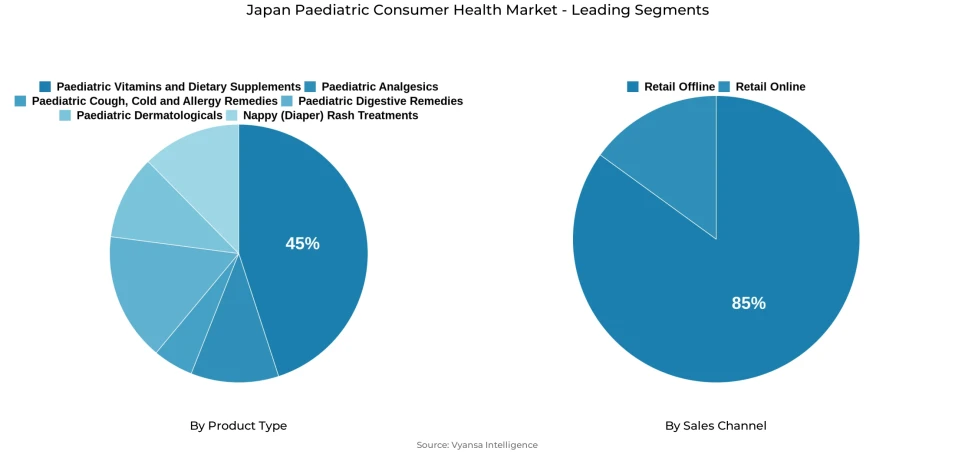
- Paediatric vitamins and dietary supplements grabbed market share of 45%.
- Competition
- More than 15 companies are actively engaged in producing paediatric consumer health in Japan.
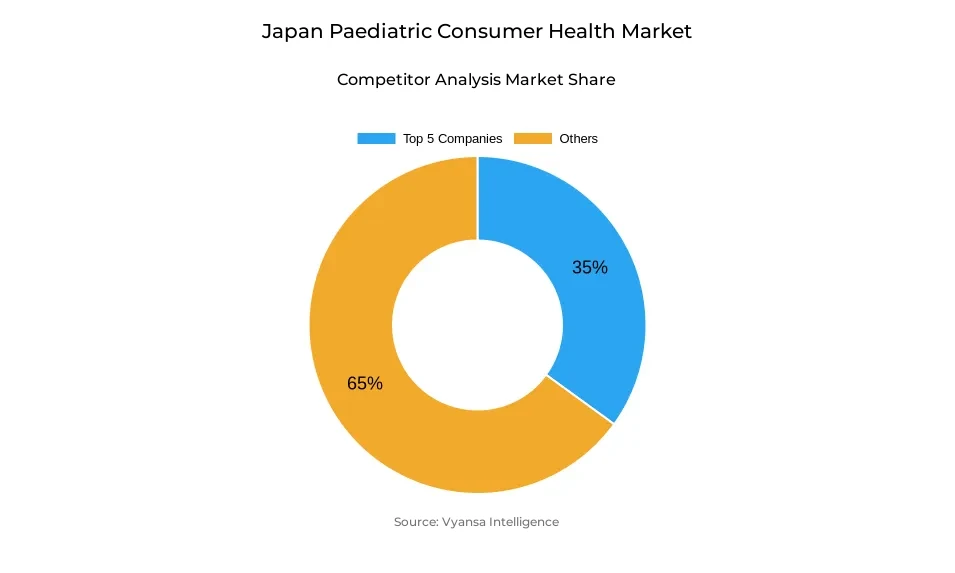
- Top 5 companies acquired around 35% of the market share.
- Lion Corp, Uzu Kyumeigan Co Ltd, Nu Skin Japan Co Ltd, Taisho Pharmaceutical Co Ltd, Kawai Pharmaceutical Co Ltd etc., are few of the top companies.
- Sales Channel
- Retail offline grabbed 85% of the market.
Japan Paediatric Consumer Health Market Outlook
The Japan Paediatric consumer Health Market size was valued at USD 235 million in 2025 and is projected to grow from USD 239.51 million in 2026 to USD 255 million by 2032, exhibiting a CAGR of 1.17% during the forecast period. While structural growth is tempered by a declining birth rate and medical subsidies, the market is sustained by the internalisation of primary care within households. Parents are increasingly proactive, seeking everyday preparedness against minor health fluctuations while prioritizing reliable solutions that support long-term development.
A major driver of value in this sector is the shift toward proactive nutrition, as paediatric vitamins and dietary supplements grabbed market share of 45%. Brands are moving away from generic formulas toward purpose-driven designs that target iron, calcium, and protein deficiencies. This focus on paediatric end user health is further strengthened by the "Pharmacy Select" initiative, where pharmacist recommendations help build trust for products like Fancl’s iron supplements and allergen-conscious calcium options for children.
Physical retail remains the cornerstone of the industry, as retail offline grabbed 85% of the market. Trust-based purchasing is highly prevalent, with parents looking for expert validation through in-store labels and professional supervision marks. These offline channels allow for cross-merchandising of paediatric end user health products, such as junior protein powders found in sports retailers, making it easier for families to integrate functional nutrition into their daily household routines.
Moving forward, innovation will focus on "nutritional gap filling" and digital engagement strategies that foster an everyday medicine mindset. Educational apps and lifestyle surveys are being used to reposition digestive care as essential lifestyle infrastructure rather than a reactive fix. As the market transitions toward proactive lifestyle support, maintaining product reliability and clear safety communication will be vital for any paediatric end user health brand navigating Japan’s evolving regulatory landscape.
Japan Paediatric Consumer Health Market Growth DriverPreventive Nutrition Strengthens Supplement Demand
Preventive nutrition is becoming a growing influence on the end user health demand of the paediatric population, with parents becoming more concerned about the proper intake of nutrients in children instead of addressing deficiencies once they manifest. Iron, calcium, and other nutritional supplements are commonly administered as a regular dietary supplement to supplement daily meals. Supplements are becoming a viable option among caregivers to enhance growth, immunity, and general development in early childhood.
The significance of this preventive measure is supported by public health data. A 2025 survey of Japanese children aged 1–5 years indicates that approximately 3%–8% are suspected to have anemia based on World Health Organization haemoglobin thresholds. This implies that iron deficiency is still a topical nutritional issue even in high-income nations. Consequently, iron-based supplements and fortified nutritional products are becoming a common preventive measure used on a daily basis to promote the health of children.
Japan Paediatric Consumer Health Market ChallengeDeclining Birth Rates Reduce Market Growth Potential
The falling birth rate in Japan is a structural limitation to the paediatric end user health market. As the number of children born per year declines, the number of households buying child-specific medicines and supplements declines, which restricts the natural market growth.
The Ministry of Health, Labour and Welfare reported that in 2024, Japan had 686,061 births, the first time the number of births per year was below 700,000. Demographic pressure is still evident in population trends. According to government statistics, the natural population decline is estimated at about 497,538 individuals in the period between January and June 2025, which indicates an increasing disparity between births and deaths. With the declining child population, companies are increasingly concentrating on raising the amount of money spent per child by product innovation and premium positioning as opposed to demographic growth.
Unlock Market Intelligence
Explore the market potential with our data-driven report
Japan Paediatric Consumer Health Market TrendPharmacist Guidance and Child-Friendly Formats Influence Purchases
The choice of paediatric health products by parents in Japan is increasingly being influenced by professional recommendations and convenient product formats. Pharmacists can also be influential in product selection, and labelling schemes based on trust, like pharmacist-endorsed product programmes, can be used to reassure caregivers when choosing supplements or medicines to use with children.
Meanwhile, manufacturers are increasing child-friendly delivery formats that simplify the consumption of products. The category is becoming increasingly popular with chewable pills, gummies, flavoured powders, and ready-to-drink nutritional beverages. These formats enhance conformity among children and ease the daily routine of parents. Consequently, families will be more inclined to integrate supplements and mild remedies into daily wellness routines, which will support the continuation of regular buying behaviour outside the seasonal illness treatment.
Japan Paediatric Consumer Health Market OpportunityTargeted Nutritional Supplements Address Lifestyle Needs
Specific nutritional supplements that fill particular nutritional deficiencies are a major opportunity in the Japanese paediatric end user health market. Bone-building, immunity, cognitive, or dietary deficiency products appeal to parents who want to find a personalized wellness solution to their children.
Nutrient-based supplements, like iron, calcium, protein, and essential vitamins, are being positioned to overcome lifestyle issues such as picky eating, dietary limitations, or excessive academic pressure. Engagement strategies are also being extended by brands to enhance long-term adoption. The integration of supplements into family life is being assisted by subscription models, loyalty programmes and educational programs aimed at children health awareness. This approach is also supported by digital campaigns and school-related wellness messages, which promote regular supplement use as a component of wider child wellbeing initiatives.
Unlock Market Intelligence
Explore the market potential with our data-driven report
Japan Paediatric Consumer Health Market Segmentation Analysis
By Product Type
- Paediatric Analgesics
- Paediatric Acetaminophen
- Paediatric Aspirin
- Paediatric Combination Products Analgesics
- Paediatric Dipyrone
- Paediatric Ibuprofen
- Paediatric Naproxen
- Paediatric Cough, Cold and Allergy Remedies
- Paediatric Allergy Remedies
- Paediatric Cough/Cold Remedies
- Paediatric Digestive Remedies
- Paediatric Diarrhoeal Remedies
- Paediatric Indigestion and Heartburn Remedies
- Paediatric Laxatives
- Paediatric Motion Sickness Remedies
- Paediatric Dermatologicals
- Nappy (Diaper) Rash Treatments
- Paediatric Vitamins and Dietary Supplements
The segment with highest market share under Product Type is Paediatric Vitamins and Dietary Supplements, accounting for approximately 45% of the market based on the provided segmentation data. This hegemony is indicative of the growing focus of parents on daily nutrition support as opposed to the use of medicines only when they fall ill.
Growth, immunity, and cognitive development products are especially popular, such as iron-enriched supplements, calcium-enriched snacks, and multivitamin gummies. To support premium positioning, manufacturers frequently focus on superior absorption, specific nutritional advantages, and formulations that are child-friendly. These aspects support supplements as the main value driver in the Japanese paediatric end user health market.
By Sales Channel
- Retail Online
- Online Pharmacies
- E-commerce Platforms
- Brand Websites
- Retail Offline
- Hospital Pharmacies
- Retail Pharmacies / Drugstores
- Supermarkets & Hypermarkets
- Specialty Baby Stores
Under the Sales Channel segmentation, Retail Offline (pharmacies and drugstores) holds the leading share with approximately 85% of total sales based on the provided data. Physical pharmacies are the buying place of choice since parents appreciate expert advice and instant access to products when choosing medicines to use on children.
The presence of a large number of pharmacies and drugstores in Japan contributes to the easy availability of paediatric products in the country. Face-to-face interaction with pharmacists also enhances end user trust in the selection of supplements or OTC remedies. Although online shopping is slowly gaining ground in making regular purchases, particularly supplements, most paediatric health products are still being bought in the offline retail stores that are trusted.
List of Companies Covered in Japan Paediatric Consumer Health Market
The companies listed below are highly influential in the Japan paediatric consumer health market, with a significant market share and a strong impact on industry developments.
- Lion Corp
- Uzu Kyumeigan Co Ltd
- Nu Skin Japan Co Ltd
- Taisho Pharmaceutical Co Ltd
- Kawai Pharmaceutical Co Ltd
- BioGaia Japan Inc
- Sato Pharmaceutical Co Ltd
- Pigeon Corp
- Amway Japan Ltd
- Eisai Co Ltd
Competitive Landscape
Japan’s paediatric consumer health market in 2025 shows a competitive landscape shaped by supplement innovation, pharmacist endorsement, and trusted domestic brands. Fancl Corporation strengthens its position through products such as Oyako de Tetsubun, which benefit from pharmacist recommendations and strong parental trust. Meanwhile, Fine Co Ltd competes in children’s nutrition with products like Bone Kids Calcium Lemon Flavour designed for allergen-conscious families. Retailer-led innovation is also visible, with TIGORA introducing junior protein supplements that position protein intake as part of everyday nutrition for children. In digestive care, Taiko Pharmaceutical Co Ltd maintains relevance through its well-known Seirogan, supported by digital campaigns and educational initiatives that reinforce everyday health management within Japanese households.
Frequently Asked Questions
Related Report
- Market Segmentation
- Research Scope
- Research Methodology
- Definitions and Assumptions
- Executive Summary
- Japan Paediatric Consumer Health Market Policies, Regulations, and Standards
- Japan Paediatric Consumer Health Market Dynamics
- Growth Factors
- Challenges
- Trends
- Opportunities
- Japan Paediatric Consumer Health Market Statistics, 2022-2032F
- Market Size & Growth Outlook
- By Revenues in USD Million
- Market Segmentation & Growth Outlook
- By Product Type
- Paediatric Analgesics- Market Insights and Forecast 2022-2032, USD Million
- Paediatric Acetaminophen- Market Insights and Forecast 2022-2032, USD Million
- Paediatric Aspirin- Market Insights and Forecast 2022-2032, USD Million
- Paediatric Combination Products Analgesics- Market Insights and Forecast 2022-2032, USD Million
- Paediatric Dipyrone- Market Insights and Forecast 2022-2032, USD Million
- Paediatric Ibuprofen- Market Insights and Forecast 2022-2032, USD Million
- Paediatric Naproxen- Market Insights and Forecast 2022-2032, USD Million
- Paediatric Cough, Cold and Allergy Remedies- Market Insights and Forecast 2022-2032, USD Million
- Paediatric Allergy Remedies- Market Insights and Forecast 2022-2032, USD Million
- Paediatric Cough/Cold Remedies- Market Insights and Forecast 2022-2032, USD Million
- Paediatric Digestive Remedies- Market Insights and Forecast 2022-2032, USD Million
- Paediatric Diarrhoeal Remedies- Market Insights and Forecast 2022-2032, USD Million
- Paediatric Indigestion and Heartburn Remedies- Market Insights and Forecast 2022-2032, USD Million
- Paediatric Laxatives- Market Insights and Forecast 2022-2032, USD Million
- Paediatric Motion Sickness Remedies- Market Insights and Forecast 2022-2032, USD Million
- Paediatric Dermatologicals- Market Insights and Forecast 2022-2032, USD Million
- Nappy (Diaper) Rash Treatments- Market Insights and Forecast 2022-2032, USD Million
- Paediatric Vitamins and Dietary Supplements- Market Insights and Forecast 2022-2032, USD Million
- Paediatric Analgesics- Market Insights and Forecast 2022-2032, USD Million
- By Dosage Form
- Liquid Syrups- Market Insights and Forecast 2022-2032, USD Million
- Chewable Tablets- Market Insights and Forecast 2022-2032, USD Million
- Drops- Market Insights and Forecast 2022-2032, USD Million
- Powders/Sachets- Market Insights and Forecast 2022-2032, USD Million
- Gummies- Market Insights and Forecast 2022-2032, USD Million
- Topical Creams & Ointments- Market Insights and Forecast 2022-2032, USD Million
- By Age Group
- Infants & Toddlers (0-3 Years)- Market Insights and Forecast 2022-2032, USD Million
- Children (4-12 Years)- Market Insights and Forecast 2022-2032, USD Million
- Adolescents (13-18 Years)- Market Insights and Forecast 2022-2032, USD Million
- By Treatment Type
- Acute Treatment- Market Insights and Forecast 2022-2032, USD Million
- Chronic Condition Management- Market Insights and Forecast 2022-2032, USD Million
- Genetic & Rare Disease Management- Market Insights and Forecast 2022-2032, USD Million
- By Sales Channel
- Retail Online- Market Insights and Forecast 2022-2032, USD Million
- Online Pharmacies- Market Insights and Forecast 2022-2032, USD Million
- E-commerce Platforms- Market Insights and Forecast 2022-2032, USD Million
- Brand Websites- Market Insights and Forecast 2022-2032, USD Million
- Retail Offline- Market Insights and Forecast 2022-2032, USD Million
- Hospital Pharmacies- Market Insights and Forecast 2022-2032, USD Million
- Retail Pharmacies / Drugstores- Market Insights and Forecast 2022-2032, USD Million
- Supermarkets & Hypermarkets- Market Insights and Forecast 2022-2032, USD Million
- Specialty Baby Stores
- Retail Online- Market Insights and Forecast 2022-2032, USD Million
- By Competitors
- Competition Characteristics
- Market Share & Analysis
- By Product Type
- Market Size & Growth Outlook
- Japan Paediatric Analgesics Market Statistics, 2022-2032
- Market Size & Growth Outlook
- By Revenues in USD Million
- Market Segmentation & Growth Outlook
- By Dosage Form- Market Insights and Forecast 2022-2032, USD Million
- By Age Group- Market Insights and Forecast 2022-2032, USD Million
- By Treatment Type- Market Insights and Forecast 2022-2032, USD Million
- By Sales Channel- Market Insights and Forecast 2022-2032, USD Million
- Market Size & Growth Outlook
- Japan Paediatric Cough, Cold and Allergy Remedies Market Statistics, 2022-2032
- Market Size & Growth Outlook
- By Revenues in USD Million
- Market Segmentation & Growth Outlook
- By Dosage Form- Market Insights and Forecast 2022-2032, USD Million
- By Age Group- Market Insights and Forecast 2022-2032, USD Million
- By Treatment Type- Market Insights and Forecast 2022-2032, USD Million
- By Sales Channel- Market Insights and Forecast 2022-2032, USD Million
- Market Size & Growth Outlook
- Japan Paediatric Digestive Remedies Market Statistics, 2022-2032
- Market Size & Growth Outlook
- By Revenues in USD Million
- Market Segmentation & Growth Outlook
- By Dosage Form- Market Insights and Forecast 2022-2032, USD Million
- By Age Group- Market Insights and Forecast 2022-2032, USD Million
- By Treatment Type- Market Insights and Forecast 2022-2032, USD Million
- By Sales Channel- Market Insights and Forecast 2022-2032, USD Million
- Market Size & Growth Outlook
- Japan Paediatric Dermatologicals Market Statistics, 2022-2032
- Market Size & Growth Outlook
- By Revenues in USD Million
- Market Segmentation & Growth Outlook
- By Dosage Form- Market Insights and Forecast 2022-2032, USD Million
- By Age Group- Market Insights and Forecast 2022-2032, USD Million
- By Treatment Type- Market Insights and Forecast 2022-2032, USD Million
- By Sales Channel- Market Insights and Forecast 2022-2032, USD Million
- Market Size & Growth Outlook
- Japan Nappy (Diaper) Rash Treatments Market Statistics, 2022-2032
- Market Size & Growth Outlook
- By Revenues in USD Million
- Market Segmentation & Growth Outlook
- By Dosage Form- Market Insights and Forecast 2022-2032, USD Million
- By Age Group- Market Insights and Forecast 2022-2032, USD Million
- By Treatment Type- Market Insights and Forecast 2022-2032, USD Million
- By Sales Channel- Market Insights and Forecast 2022-2032, USD Million
- Market Size & Growth Outlook
- Japan Paediatric Vitamins and Dietary Supplements Market Statistics, 2022-2032
- Market Size & Growth Outlook
- By Revenues in USD Million
- Market Segmentation & Growth Outlook
- By Dosage Form- Market Insights and Forecast 2022-2032, USD Million
- By Age Group- Market Insights and Forecast 2022-2032, USD Million
- By Treatment Type- Market Insights and Forecast 2022-2032, USD Million
- By Sales Channel- Market Insights and Forecast 2022-2032, USD Million
- Market Size & Growth Outlook
- Competitive Outlook
- Company Profiles
- Taisho Pharmaceutical Co Ltd
- Business Description
- Product Portfolio
- Collaborations & Alliances
- Recent Developments
- Financial Details
- Others
- Kawai Pharmaceutical Co Ltd
- Business Description
- Product Portfolio
- Collaborations & Alliances
- Recent Developments
- Financial Details
- Others
- BioGaia Japan Inc
- Business Description
- Product Portfolio
- Collaborations & Alliances
- Recent Developments
- Financial Details
- Others
- Sato Pharmaceutical Co Ltd
- Business Description
- Product Portfolio
- Collaborations & Alliances
- Recent Developments
- Financial Details
- Others
- Pigeon Corp
- Business Description
- Product Portfolio
- Collaborations & Alliances
- Recent Developments
- Financial Details
- Others
- Lion Corp
- Business Description
- Product Portfolio
- Collaborations & Alliances
- Recent Developments
- Financial Details
- Others
- Uzu Kyumeigan Co Ltd
- Business Description
- Product Portfolio
- Collaborations & Alliances
- Recent Developments
- Financial Details
- Others
- Nu Skin Japan Co Ltd
- Business Description
- Product Portfolio
- Collaborations & Alliances
- Recent Developments
- Financial Details
- Others
- Amway Japan Ltd
- Business Description
- Product Portfolio
- Collaborations & Alliances
- Recent Developments
- Financial Details
- Others
- Eisai Co Ltd
- Business Description
- Product Portfolio
- Collaborations & Alliances
- Recent Developments
- Financial Details
- Others
- Taisho Pharmaceutical Co Ltd
- Company Profiles
- Disclaimer
| Segment | Sub-Segment |
|---|---|
| By Product Type |
|
| By Dosage Form |
|
| By Age Group |
|
| By Treatment Type |
|
| By Sales Channel |
|
Research Methodology
This study followed a structured approach comprising four key phases to assess the size and scope of the electro-oxidation market. The process began with thorough secondary research to collect data on the target market, related markets, and broader industry context. These findings, along with preliminary assumptions and estimates, were then validated through extensive primary research involving industry experts from across the value chain. To calculate the overall market size, both top-down and bottom-up methodologies were employed. Finally, market segmentation and data triangulation techniques were applied to refine and validate segment-level estimations.
Secondary Research
The secondary research phase involved gathering data from a wide range of credible and published sources. This step helped in identifying industry trends, defining market segmentation, and understanding the market landscape and value chain.
Sources consulted during this phase included:
- Company annual reports, investor presentations, and press releases
- Industry white papers and certified publications
- Trade directories and market-recognized databases
- Articles from authoritative authors and reputable journals
- Gold and silver standard websites
Secondary research was critical in mapping out the industry's value chain and monetary flow, identifying key market segments, understanding regional variations, and tracking significant industry developments.
Other key sources:
- Financial disclosures
- Industry associations and trade bodies
- News outlets and business magazines
- Academic journals and research studies
- Paid industry databases
Primary Research
To validate secondary data and gain deeper market insights, primary research was conducted with key stakeholders across both the supply and demand sides of the market.
On the demand side, participants included decision-makers and influencers from end-user industries—such as CIOs, CTOs, and CSOs—who provided first-hand perspectives on market needs, product usage, and future expectations.
On the supply side, interviews were conducted with manufacturers, industry associations, and institutional participants to gather insights into current offerings, product pipelines, and market challenges.
Primary interviews provided critical inputs such as:
- Market size and revenue data
- Product and service breakdowns
- Market forecasts
- Regional and application-specific trends
Stakeholders consulted included:
- Leading OEM and solution providers
- Channel and distribution partners
- End users across various applications
- Independent consultants and industry specialists
Market Size Estimation and Data Triangulation
- Identifying Key Market Participants (Secondary Research)
- Goal: To identify the major players or companies in the target market. This typically involves using publicly available data sources such as industry reports, market research publications, and financial statements of companies.
- Tools: Reports from firms like Gartner, Forrester, Euromonitor, Statista, IBISWorld, and others. Public financial statements, news articles, and press releases from top market players.
- Extracting Earnings of Key Market Participants
- Goal: To estimate the earnings generated from the product or service being analyzed. This step helps in understanding the revenue potential of each market player in a specific geography.
- Methods: Earnings data can be gathered from:
- Publicly available financial reports (for listed companies).
- Interviews and primary data sources from professionals, such as Directors, VPs, SVPs, etc. This is especially useful for understanding more nuanced, internal data that isn't publicly disclosed.
- Annual reports and investor presentations of key players.
- Data Collation and Development of a Relevant Data Model
- Goal: To collate inputs from both primary and secondary sources into a structured, data-driven model for market estimation. This model will incorporate key market KPIs and any independent variables relevant to the market.
- Key KPIs: These could include:
- Market size, growth rate, and demand drivers.
- Industry-specific metrics like market share, average revenue per customer (ARPC), or average deal size.
- External variables, such as economic growth rates, inflation rates, or commodity prices, that could affect the market.
- Data Modeling: Based on this data, the market forecasts are developed for the next 5 years. A combination of trend analysis, scenario modeling, and statistical regression might be used to generate projections.
- Scenario Analysis
- Goal: To test different assumptions and validate how sensitive the market is to changes in key variables (e.g., market demand, regulatory changes, technological disruptions).
- Types of Scenarios:
- Base Case: Based on current assumptions and historical data.
- Best-Case Scenario: Assuming favorable market conditions, regulatory environments, and technological advancements.
- Worst-Case Scenario: Accounting for adverse factors, such as economic downturns, stricter regulations, or unexpected disruptions.












