Japan Medical Device Cleaning Market Report: Trends, Growth and Forecast (2026-2032)
By Product Type (Cleaning Chemicals (Enzymatic Cleaners, Non-Enzymatic Detergents, Disinfectants, Sterilants, Pre-Cleaning Products), Cleaning Consumables (Cleaning Wipes, Cleaning Brushes, Sponges & Swabs, Cleaning Cloths, Others), Cleaning Equipment (Ultrasonic Cleaners, Washer-Disinfectors, Automated Endoscope Reprocessors (AERs), Drying Cabinets, Others)), By Device Type (Surgical Instruments, Endoscopes, Dental Instruments, Orthopedic Instruments, Laparoscopic Instruments, Diagnostic Instruments, Ultrasound Probes, Ophthalmic Instruments, Others), By Cleaning Method (Manual Cleaning, Automated Cleaning, Ultrasonic Cleaning, Washer-Disinfector Cleaning, Clean-in-Place (CIP), Others), By Application (Cleaning, Disinfection, Decontamination, Sterilization Support, Reprocessing Preparation, Others), By End User (Hospitals, Ambulatory Surgical Centers, Diagnostic Centers, Dental Clinics, Specialty Clinics, Medical Device Reprocessing Centers, Others) ... Read more
|
Major Players
|
Japan Medical Device Cleaning Market Statistics and Insights, 2026
- Market Size Statistics
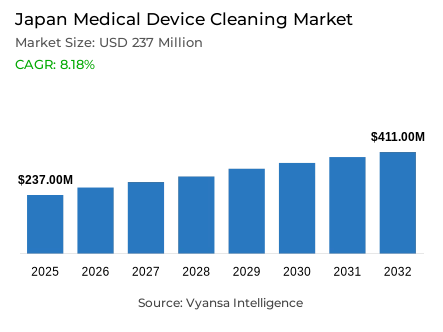
- Medical device cleaning market size in Japan was valued at USD 237 million in 2025 and is estimated at USD 253 million in 2026.
- The market size is expected to grow to USD 411 million by 2032.
- Market to register a CAGR of around 8.18% during 2026-32.
- Product Type Shares
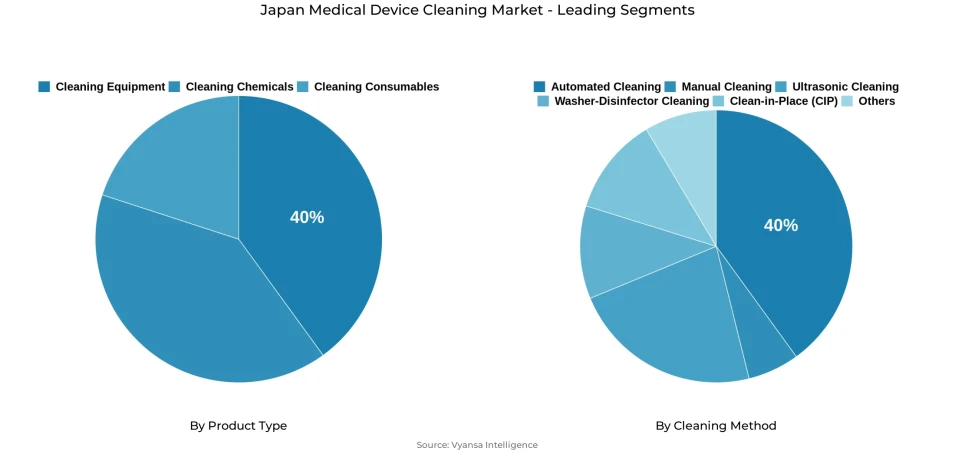
- Cleaning equipment grabbed market share of 40%.
- Competition
- More than 10 companies are actively engaged in producing medical device cleaning in Japan.
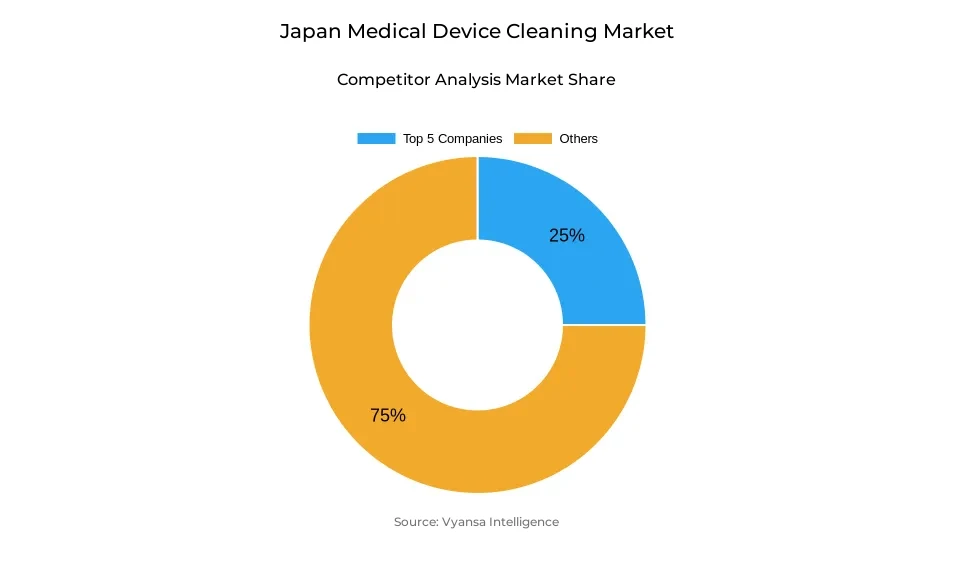
- Top 5 companies acquired around 25% of the market share in 2026.
- ASP Japan G.K., Ecolab G.K., SAKURA SEIKI Co. Ltd., Getinge Group Japan K.K., STERIS Japan K.K. etc., are few of the top companies.
- Cleaning Method
- Automated cleaning grabbed 40% of the market.
Japan Medical Device Cleaning Market Outlook
The japan medical device cleaning market is expanding as reusable medical device cleaning in Japan becomes a mandatory control point before disinfection, sterilization, drying, storage, and safe clinical reuse. Valued at USD 237 million in 2025, the market is projected to reach USD 411 million by 2032, reflecting 8.18% CAGR. Growth is supported by endoscope reprocessing, surgical instrument cleaning, infection prevention, and traceable reprocessing workflows across Japanese healthcare providers.
Demand in the japan medical device cleaning market is supported by hospital infrastructure, procedure intensity, and a large medical device base. The U.S. International Trade Administration, using MHLW data, states Japan’s medical device market reached USD 32 billion in 2024. The Statistics Bureau reports 8,122 hospitals and 1,481,183 beds as of October 2023, creating repeated cleaning needs across operating rooms, endoscopy units, outpatient departments, clinics, and sterile processing departments.
Cleaning Equipment holds a supplied 40% share in the Japanese medical instrument cleaning market, while automated cleaning also holds a supplied 40% share by method. WHO states medical-device decontamination includes cleaning, disinfection, or sterilization and requires infrastructure, equipment, sequential steps, and quality-control validation. This supports demand for automated washer-disinfectors, ultrasonic cleaners, drying cabinets, detergents, transport systems, documentation tools, and trained workflows for reusable medical devices.
Endoscopy provides the clearest procedure-linked demand signal for medical device cleaning in Japan. JGES states the Japan Endoscopy Database collected 597,707 upper GI procedures, 279,486 colon procedures, and 30,206 ERCPs in 2020, while a 2025 study analyzed 9,940,870 procedures from 2015 to 2023. This procedure intensity sustains point-of-use cleaning, flushing, brushing, leakage testing, disinfection, rinsing, drying, documentation, and correct storage before the next patient case.
Japan Medical Device Cleaning Market Growth Driver
Reusable Procedure Volumes Strengthen Demand
Reusable procedure volume is the main driver for the japan medical device cleaning market because each endoscope, surgical instrument, dental instrument, diagnostic instrument, and accessory requires cleaning before safe reuse. JGES procedure data confirms high endoscopy intensity, while the 2025 JED study covering 9,940,870 procedures shows recurring endoscope reprocessing demand. This supports enzymatic cleaners, washer-disinfectors, AERs, drying systems, tracking tools, and trained staff capacity.
Hospital infrastructure converts procedure volume into recurring reusable device reprocessing demand. The Statistics Bureau reports 8,122 hospitals and 1,481,183 beds, while The U.S. International Trade Administration places Japan’s medical device base at USD 32 billion in 2024. Reusable medical devices circulate through operating rooms, endoscopy suites, emergency care, and specialty departments, requiring collection, transport, manual cleaning, automated washing, inspection, drying, storage, and documented release before reuse.
Japan Medical Device Cleaning Market Challenge
Validation Complexity Raises Operating Burden
Validation complexity is the main challenge for the japan medical device cleaning market because cleaning failures can weaken infection prevention even when hospitals own advanced equipment. WHO states decontamination prevents healthcare-associated infections, includes cleaning, disinfection, or sterilization, and requires infrastructure, equipment, sequential steps, and quality-control validation. This raises pressure around biofilm removal, organic residue removal, material compatibility, staff training, reprocessing errors, and compliance burden.
Endoscope workflows show why cleaning validation is technically demanding. Japanese endoscope-cleaning guidance says staff should begin bedside point-of-use cleaning immediately after removal, wipe external surfaces, suction and flush 200 ml of enzyme detergent solution, perform leakage testing, clean accessories, and brush suction and forceps channels. Since contamination becomes harder to remove after drying, manual discipline, audit records, and device-specific protocols remain critical before automated cleaning begins.
Unlock Market Intelligence
Explore the market potential with our data-driven report
Japan Medical Device Cleaning Market Trend
Traceable Automation Reshapes Reprocessing
Traceable automation is the strongest trend in the japan medical device cleaning market, but it should be understood as workflow support rather than a replacement for manual preparation. WHO emphasizes sequential decontamination steps and validation, while CDC says central processing helps control quality when cleaning, disinfecting, and sterilizing patient-care supplies. This supports automated cleaning, washer-disinfector cleaning, ultrasonic cleaning, validated cleaning workflows, digital tracking systems, and documented release readiness.
Supplier evidence confirms the direction, while neutral guidance explains the operational need. Getinge states its washer automation supports 3 to 10 washer-disinfectors and documents cart movement for traceability. Olympus offers automated endoscope reprocessors, reprocessing chemicals, and workflow software. Japanese guidance still emphasizes bedside cleaning, flushing, leakage testing, brushing, rinsing, and drying, showing that machines, chemicals, staff protocols, and quality controls must work together inside reprocessing workflows.
Japan Medical Device Cleaning Market Opportunity
CSSD Modernization Opens Equipment Upside
The strongest opportunity in the japan medical device cleaning market lies in CSSD and endoscopy-room modernization, where hospitals can improve throughput, segregation, documentation, and quality control. CDC says most cleaning, disinfecting, and sterilizing of patient-care supplies should occur in central processing to better control quality, protect patients, reduce staff risks, and preserve reprocessed items. This supports sterile processing departments, point-of-use cleaning, automated reprocessing, and stronger sterilization workflow compliance.
Japan’s hospital and device base makes modernization relevant for reusable medical device cleaning in Japan. The Statistics Bureau reports 8,122 hospitals and 1,481,183 beds, while The U.S. International Trade Administration places Japan’s medical device base at USD 32 billion in 2024. Equipment, consumables, validation, training, and records can strengthen controlled reprocessing infrastructure, improving audit readiness, instrument availability, staff productivity, and department-level turnover in surgery and endoscopy units.
Unlock Market Intelligence
Explore the market potential with our data-driven report
Japan Medical Device Cleaning Market Segmentation Analysis
By Product Type
- Cleaning Chemicals
- Enzymatic Cleaners
- Non-Enzymatic Detergents
- Disinfectants
- Sterilants
- Pre-Cleaning Products
- Cleaning Consumables
- Cleaning Wipes
- Cleaning Brushes
- Sponges & Swabs
- Cleaning Cloths
- Others
- Cleaning Equipment
- Ultrasonic Cleaners
- Washer-Disinfectors
- Automated Endoscope Reprocessors (AERs)
- Drying Cabinets
- Others
Cleaning Equipment leads the japan medical device cleaning market by product type, holding a supplied 40% share. This share is internal, but the leadership logic is strong because reusable-device workflows require equipment before safe disinfection, sterilization, storage, or reuse. WHO states decontamination needs specific infrastructure and equipment across sequential steps, supporting automated washer-disinfectors, ultrasonic cleaners, AERs, drying cabinets, leak testers, transport trolleys, and inspection systems.
Product evidence supports the equipment-heavy structure without being treated as share proof. Getinge offers washer automation for 3 to 10 washer-disinfectors with documented cart movement, while Olympus offers automated endoscope reprocessors and reprocessing chemicals. Japanese guidance describes leakage testing, accessory cleaning, channel brushing, enzyme detergent immersion, rinsing, disinfection, drying, and storage, explaining equipment demand across hospitals, endoscopy units, and sterile processing departments.
By Cleaning Method
- Manual Cleaning
- Automated Cleaning
- Ultrasonic Cleaning
- Washer-Disinfector Cleaning
- Clean-in-Place (CIP)
- Others
Automated Cleaning leads the japan medical device cleaning market by cleaning method, holding a supplied 40% share. This leadership is supported by repeatable cycles, lower handling variation, documentation, and faster throughput. Automated cleaning fits Japanese hospitals managing endoscopes and surgical instruments at scale because washer-disinfector cleaning and AER cycles help standardize conditions, monitor process status, and support release records under procedure pressure.
Technical balance remains essential because automated cleaning does not remove manual cleaning or point-of-use cleaning. Japanese guidance says bedside cleaning should start immediately, external surfaces should be wiped, 200 ml of enzyme detergent should be suctioned and flushed, leakage testing should be performed, and channels should be brushed. Therefore, automated cleaning leads when combined with disciplined pre-cleaning, trained staff, material-compatible cleaners, and device-specific protocols.
List of Companies Covered in Japan Medical Device Cleaning Market
The companies listed below are highly influential in the Japan medical device cleaning market, with a significant market share and a strong impact on industry developments.
- ASP Japan G.K.
- Ecolab G.K.
- SAKURA SEIKI Co. Ltd.
- Getinge Group Japan K.K.
- STERIS Japan K.K.
- Olympus Corporation
- Saraya Co. Ltd.
- Miele Japan Corp.
- FUJIFILM Corporation
- HOYA Corporation
Market News & Updates
- Saraya Co., Ltd., 2025:
In June 2025, Saraya launched Salative PA-V, a peracetic-acid-based cleaning and disinfection agent for dialysis equipment. The product is designed for dialysis machines and piping, with improved descaling, reduced odor, enhanced rust removal, and packaging changes to avoid mix-ups with chlorine-based cleaners. The launch adds a new cleaning chemical for medical equipment maintenance in Japan.
- FUJIFILM Corporation, 2025:
In November 2025, Fujifilm listed ENDOSTREAM, its endoscope cleaning and disinfection system, among products exhibited at the Japan Gastroenterological Endoscopy Technicians Society brush-up seminar. The display also included ELUXEO 8000 and endoscopy accessories. The update reflects Fujifilm’s continued promotion of automated endoscope cleaning and disinfection systems in Japan.
Frequently Asked Questions
Related Report
- Market Segmentation
- Research Scope
- Research Methodology
- Definitions and Assumptions
- Executive Summary
- Japan Medical Device Cleaning Market Policies, Regulations, and Standards
- Japan Medical Device Cleaning Market Dynamics
- Growth Factors
- Challenges
- Trends
- Opportunities
- Japan Medical Device Cleaning Market Statistics, 2022-2032F
- Market Size & Growth Outlook
- By Revenues in USD Million
- Market Segmentation & Growth Outlook
- By Product Type
- Cleaning Chemicals- Market Insights and Forecast 2022-2032, USD Million
- Enzymatic Cleaners- Market Insights and Forecast 2022-2032, USD Million
- Non-Enzymatic Detergents- Market Insights and Forecast 2022-2032, USD Million
- Disinfectants- Market Insights and Forecast 2022-2032, USD Million
- Sterilants- Market Insights and Forecast 2022-2032, USD Million
- Pre-Cleaning Products- Market Insights and Forecast 2022-2032, USD Million
- Cleaning Consumables- Market Insights and Forecast 2022-2032, USD Million
- Cleaning Wipes- Market Insights and Forecast 2022-2032, USD Million
- Cleaning Brushes- Market Insights and Forecast 2022-2032, USD Million
- Sponges & Swabs- Market Insights and Forecast 2022-2032, USD Million
- Cleaning Cloths- Market Insights and Forecast 2022-2032, USD Million
- Others- Market Insights and Forecast 2022-2032, USD Million
- Cleaning Equipment- Market Insights and Forecast 2022-2032, USD Million
- Ultrasonic Cleaners- Market Insights and Forecast 2022-2032, USD Million
- Washer-Disinfectors- Market Insights and Forecast 2022-2032, USD Million
- Automated Endoscope Reprocessors (AERs)- Market Insights and Forecast 2022-2032, USD Million
- Drying Cabinets- Market Insights and Forecast 2022-2032, USD Million
- Others- Market Insights and Forecast 2022-2032, USD Million
- Cleaning Chemicals- Market Insights and Forecast 2022-2032, USD Million
- By Device Type
- Surgical Instruments- Market Insights and Forecast 2022-2032, USD Million
- Endoscopes- Market Insights and Forecast 2022-2032, USD Million
- Dental Instruments- Market Insights and Forecast 2022-2032, USD Million
- Orthopedic Instruments- Market Insights and Forecast 2022-2032, USD Million
- Laparoscopic Instruments- Market Insights and Forecast 2022-2032, USD Million
- Diagnostic Instruments- Market Insights and Forecast 2022-2032, USD Million
- Ultrasound Probes- Market Insights and Forecast 2022-2032, USD Million
- Ophthalmic Instruments- Market Insights and Forecast 2022-2032, USD Million
- Others - Market Insights and Forecast 2022-2032, USD Million
- By Cleaning Method
- Manual Cleaning- Market Insights and Forecast 2022-2032, USD Million
- Automated Cleaning- Market Insights and Forecast 2022-2032, USD Million
- Ultrasonic Cleaning- Market Insights and Forecast 2022-2032, USD Million
- Washer-Disinfector Cleaning- Market Insights and Forecast 2022-2032, USD Million
- Clean-in-Place (CIP)- Market Insights and Forecast 2022-2032, USD Million
- Others - Market Insights and Forecast 2022-2032, USD Million
- By Application
- Cleaning- Market Insights and Forecast 2022-2032, USD Million
- Disinfection- Market Insights and Forecast 2022-2032, USD Million
- Decontamination- Market Insights and Forecast 2022-2032, USD Million
- Sterilization Support- Market Insights and Forecast 2022-2032, USD Million
- Reprocessing Preparation- Market Insights and Forecast 2022-2032, USD Million
- Others- Market Insights and Forecast 2022-2032, USD Million
- By End User
- Hospitals- Market Insights and Forecast 2022-2032, USD Million
- Ambulatory Surgical Centers- Market Insights and Forecast 2022-2032, USD Million
- Diagnostic Centers- Market Insights and Forecast 2022-2032, USD Million
- Dental Clinics- Market Insights and Forecast 2022-2032, USD Million
- Specialty Clinics- Market Insights and Forecast 2022-2032, USD Million
- Medical Device Reprocessing Centers- Market Insights and Forecast 2022-2032, USD Million
- Others- Market Insights and Forecast 2022-2032, USD Million
- By Competitors
- Competition Characteristics
- Market Share & Analysis
- By Product Type
- Market Size & Growth Outlook
- Japan Cleaning Chemicals Market Statistics, 2022-2032
- Market Size & Growth Outlook
- By Revenues in USD Million
- Market Segmentation & Growth Outlook
- By Device Type- Market Insights and Forecast 2022-2032, USD Million
- By Cleaning Method- Market Insights and Forecast 2022-2032, USD Million
- By Application- Market Insights and Forecast 2022-2032, USD Million
- By End User- Market Insights and Forecast 2022-2032, USD Million
- Market Size & Growth Outlook
- Japan Enzymatic Cleaners Market Statistics, 2022-2032
- Market Size & Growth Outlook
- By Revenues in USD Million
- Market Segmentation & Growth Outlook
- By Device Type- Market Insights and Forecast 2022-2032, USD Million
- By Cleaning Method- Market Insights and Forecast 2022-2032, USD Million
- By Application- Market Insights and Forecast 2022-2032, USD Million
- By End User- Market Insights and Forecast 2022-2032, USD Million
- Market Size & Growth Outlook
- Japan Non-Enzymatic Detergents Market Statistics, 2022-2032
- Market Size & Growth Outlook
- By Revenues in USD Million
- Market Segmentation & Growth Outlook
- By Device Type- Market Insights and Forecast 2022-2032, USD Million
- By Cleaning Method- Market Insights and Forecast 2022-2032, USD Million
- By Application- Market Insights and Forecast 2022-2032, USD Million
- By End User- Market Insights and Forecast 2022-2032, USD Million
- Market Size & Growth Outlook
- Japan Disinfectants Market Statistics, 2022-2032
- Market Size & Growth Outlook
- By Revenues in USD Million
- Market Segmentation & Growth Outlook
- By Device Type- Market Insights and Forecast 2022-2032, USD Million
- By Cleaning Method- Market Insights and Forecast 2022-2032, USD Million
- By Application- Market Insights and Forecast 2022-2032, USD Million
- By End User- Market Insights and Forecast 2022-2032, USD Million
- Market Size & Growth Outlook
- Japan Sterilants Market Statistics, 2022-2032
- Market Size & Growth Outlook
- By Revenues in USD Million
- Market Segmentation & Growth Outlook
- By Device Type- Market Insights and Forecast 2022-2032, USD Million
- By Cleaning Method- Market Insights and Forecast 2022-2032, USD Million
- By Application- Market Insights and Forecast 2022-2032, USD Million
- By End User- Market Insights and Forecast 2022-2032, USD Million
- Market Size & Growth Outlook
- Japan Pre-Cleaning Products Market Statistics, 2022-2032
- Market Size & Growth Outlook
- By Revenues in USD Million
- Market Segmentation & Growth Outlook
- By Device Type- Market Insights and Forecast 2022-2032, USD Million
- By Cleaning Method- Market Insights and Forecast 2022-2032, USD Million
- By Application- Market Insights and Forecast 2022-2032, USD Million
- By End User- Market Insights and Forecast 2022-2032, USD Million
- Market Size & Growth Outlook
- Japan Cleaning Consumables Market Statistics, 2022-2032
- Market Size & Growth Outlook
- By Revenues in USD Million
- Market Segmentation & Growth Outlook
- By Device Type- Market Insights and Forecast 2022-2032, USD Million
- By Cleaning Method- Market Insights and Forecast 2022-2032, USD Million
- By Application- Market Insights and Forecast 2022-2032, USD Million
- By End User- Market Insights and Forecast 2022-2032, USD Million
- Market Size & Growth Outlook
- Japan Cleaning Wipes Market Statistics, 2022-2032
- Market Size & Growth Outlook
- By Revenues in USD Million
- Market Segmentation & Growth Outlook
- By Device Type- Market Insights and Forecast 2022-2032, USD Million
- By Cleaning Method- Market Insights and Forecast 2022-2032, USD Million
- By Application- Market Insights and Forecast 2022-2032, USD Million
- By End User- Market Insights and Forecast 2022-2032, USD Million
- Market Size & Growth Outlook
- Japan Cleaning Brushes Market Statistics, 2022-2032
- Market Size & Growth Outlook
- By Revenues in USD Million
- Market Segmentation & Growth Outlook
- By Device Type- Market Insights and Forecast 2022-2032, USD Million
- By Cleaning Method- Market Insights and Forecast 2022-2032, USD Million
- By Application- Market Insights and Forecast 2022-2032, USD Million
- By End User- Market Insights and Forecast 2022-2032, USD Million
- Market Size & Growth Outlook
- Japan Sponges & Swabs Market Statistics, 2022-2032
- Market Size & Growth Outlook
- By Revenues in USD Million
- Market Segmentation & Growth Outlook
- By Device Type- Market Insights and Forecast 2022-2032, USD Million
- By Cleaning Method- Market Insights and Forecast 2022-2032, USD Million
- By Application- Market Insights and Forecast 2022-2032, USD Million
- By End User- Market Insights and Forecast 2022-2032, USD Million
- Market Size & Growth Outlook
- Japan Cleaning Cloths Market Statistics, 2022-2032
- Market Size & Growth Outlook
- By Revenues in USD Million
- Market Segmentation & Growth Outlook
- By Device Type- Market Insights and Forecast 2022-2032, USD Million
- By Cleaning Method- Market Insights and Forecast 2022-2032, USD Million
- By Application- Market Insights and Forecast 2022-2032, USD Million
- By End User- Market Insights and Forecast 2022-2032, USD Million
- Market Size & Growth Outlook
- Competitive Outlook
- Company Profiles
- Getinge Group Japan K.K.
- Business Description
- Product Portfolio
- Collaborations & Alliances
- Recent Developments
- Financial Details
- Others
- STERIS Japan K.K.
- Business Description
- Product Portfolio
- Collaborations & Alliances
- Recent Developments
- Financial Details
- Others
- Olympus Corporation
- Business Description
- Product Portfolio
- Collaborations & Alliances
- Recent Developments
- Financial Details
- Others
- Saraya Co., Ltd.
- Business Description
- Product Portfolio
- Collaborations & Alliances
- Recent Developments
- Financial Details
- Others
- Miele Japan Corp.
- Business Description
- Product Portfolio
- Collaborations & Alliances
- Recent Developments
- Financial Details
- Others
- ASP Japan G.K.
- Business Description
- Product Portfolio
- Collaborations & Alliances
- Recent Developments
- Financial Details
- Others
- Ecolab G.K.
- Business Description
- Product Portfolio
- Collaborations & Alliances
- Recent Developments
- Financial Details
- Others
- SAKURA SEIKI Co., Ltd.
- Business Description
- Product Portfolio
- Collaborations & Alliances
- Recent Developments
- Financial Details
- Others
- FUJIFILM Corporation
- Business Description
- Product Portfolio
- Collaborations & Alliances
- Recent Developments
- Financial Details
- Others
- HOYA Corporation
- Business Description
- Product Portfolio
- Collaborations & Alliances
- Recent Developments
- Financial Details
- Others
- Getinge Group Japan K.K.
- Company Profiles
- Disclaimer
| Segment | Sub-Segment |
|---|---|
| By Product Type |
|
| By Device Type |
|
| By Cleaning Method |
|
| By Application |
|
| By End User |
|
Research Methodology
This study followed a structured approach comprising four key phases to assess the size and scope of the electro-oxidation market. The process began with thorough secondary research to collect data on the target market, related markets, and broader industry context. These findings, along with preliminary assumptions and estimates, were then validated through extensive primary research involving industry experts from across the value chain. To calculate the overall market size, both top-down and bottom-up methodologies were employed. Finally, market segmentation and data triangulation techniques were applied to refine and validate segment-level estimations.
Secondary Research
The secondary research phase involved gathering data from a wide range of credible and published sources. This step helped in identifying industry trends, defining market segmentation, and understanding the market landscape and value chain.
Sources consulted during this phase included:
- Company annual reports, investor presentations, and press releases
- Industry white papers and certified publications
- Trade directories and market-recognized databases
- Articles from authoritative authors and reputable journals
- Gold and silver standard websites
Secondary research was critical in mapping out the industry's value chain and monetary flow, identifying key market segments, understanding regional variations, and tracking significant industry developments.
Other key sources:
- Financial disclosures
- Industry associations and trade bodies
- News outlets and business magazines
- Academic journals and research studies
- Paid industry databases
Primary Research
To validate secondary data and gain deeper market insights, primary research was conducted with key stakeholders across both the supply and demand sides of the market.
On the demand side, participants included decision-makers and influencers from end-user industries—such as CIOs, CTOs, and CSOs—who provided first-hand perspectives on market needs, product usage, and future expectations.
On the supply side, interviews were conducted with manufacturers, industry associations, and institutional participants to gather insights into current offerings, product pipelines, and market challenges.
Primary interviews provided critical inputs such as:
- Market size and revenue data
- Product and service breakdowns
- Market forecasts
- Regional and application-specific trends
Stakeholders consulted included:
- Leading OEM and solution providers
- Channel and distribution partners
- End users across various applications
- Independent consultants and industry specialists
Market Size Estimation and Data Triangulation
- Identifying Key Market Participants (Secondary Research)
- Goal: To identify the major players or companies in the target market. This typically involves using publicly available data sources such as industry reports, market research publications, and financial statements of companies.
- Tools: Reports from firms like Gartner, Forrester, Euromonitor, Statista, IBISWorld, and others. Public financial statements, news articles, and press releases from top market players.
- Extracting Earnings of Key Market Participants
- Goal: To estimate the earnings generated from the product or service being analyzed. This step helps in understanding the revenue potential of each market player in a specific geography.
- Methods: Earnings data can be gathered from:
- Publicly available financial reports (for listed companies).
- Interviews and primary data sources from professionals, such as Directors, VPs, SVPs, etc. This is especially useful for understanding more nuanced, internal data that isn't publicly disclosed.
- Annual reports and investor presentations of key players.
- Data Collation and Development of a Relevant Data Model
- Goal: To collate inputs from both primary and secondary sources into a structured, data-driven model for market estimation. This model will incorporate key market KPIs and any independent variables relevant to the market.
- Key KPIs: These could include:
- Market size, growth rate, and demand drivers.
- Industry-specific metrics like market share, average revenue per customer (ARPC), or average deal size.
- External variables, such as economic growth rates, inflation rates, or commodity prices, that could affect the market.
- Data Modeling: Based on this data, the market forecasts are developed for the next 5 years. A combination of trend analysis, scenario modeling, and statistical regression might be used to generate projections.
- Scenario Analysis
- Goal: To test different assumptions and validate how sensitive the market is to changes in key variables (e.g., market demand, regulatory changes, technological disruptions).
- Types of Scenarios:
- Base Case: Based on current assumptions and historical data.
- Best-Case Scenario: Assuming favorable market conditions, regulatory environments, and technological advancements.
- Worst-Case Scenario: Accounting for adverse factors, such as economic downturns, stricter regulations, or unexpected disruptions.












