Japan Industrial Gases Market Report: Trends, Growth and Forecast (2026-2032)
By Gas Type (Nitrogen Gas, Oxygen Gas, Carbon Dioxide Gas, Argon Gas, Helium Gas, Hydrogen Gas, Other), By Supply Mode (Cylinders, Bulk, On-Site Production, Captive, Other), By Application (Combustion and Process Oxygen, Welding and Metal Fabrication, Inerting Blanketing and Heat Treating, Cryogenics and liquefaction, Chemical Synthesis and Hydrogenation, Purging and Purifications, Analytical and Calibration), By End User Industry (General Manufacturing, Food, Metallurgy, Chemicals, Healthcare, Electronics, Refining & Energy, Glass, Pulp & Paper, Others) ... Read more

|
Major Players
|
Japan Industrial Gases Market Statistics and Insights, 2026
- Market Size Statistics
- Industrial gases market size in Japan was estimated at USD 5.19 billion in 2025.
- The market size is expected to grow to USD 6.17 billion by 2032.
- Market to register a CAGR of around 2.5% during 2026-32.
- Gas Type Shares
- Oxygen gas grabbed market share of 30%.
- Competition
- More than 10 companies are actively engaged in producing industrial gases in Japan.
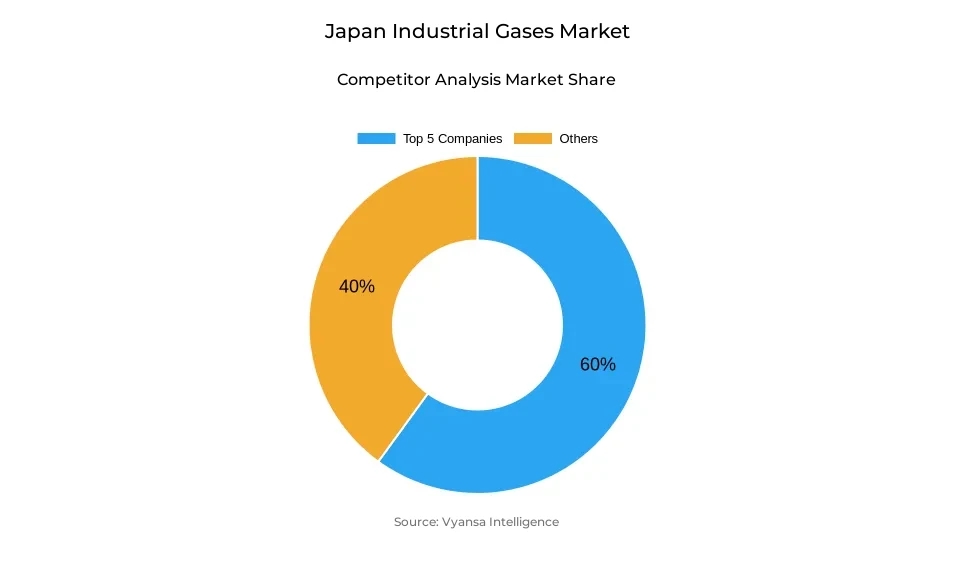
- Top 5 companies acquired around 60% of the market share.
- Air Products, Tokyo Gas Chemicals Co., Ltd., SOL Group, Nippon Sanso Holdings Corporation (NSHD), Air Liquide Japan Ltd. (Air Liquide S.A.) etc., are few of the top companies.
- Supply Mode
- On-site production (osp) grabbed 40% of the market.
Japan Industrial Gases Market Outlook
The Japan industrial gases market is steadily growing, with the growth of semiconductor and high-tech manufacturing industries. The demand of ultra-high-purity gases like nitrogen, oxygen, and specialty gases is increasing due to government-supported projects, such as USD 25.4 billion of METI investments in semiconductor manufacturing, and new production lines by large manufacturers, such as TSMC and Toshiba. The wider electronics industry consumes almost 30% of industrial gas, and the market is projected to reach USD 5.19 billion in 2025, with a projected growth of USD 6.17 billion in 2032, at a compound annual growth rate of approximately 2.5% between 2026 and 2032. This expansion is indicative of long-term demand by high-tech industries and conventional manufacturing applications.
Gas producers are faced with structural constraints such as high reliance on imported energy and unstable LNG imports. The processes that consume a lot of energy like the cryogenic air separation demand stable and cheap electricity and fluctuations in the efficiency of production can put strain on profitability. The suppliers of industrial gases need to deal with the cost of energy, the utilisation of the capacity and the reliability of the supply to satisfy the increasing demands of steel, chemical and electronic industries at competitive prices in a volatile market environment.
New opportunities in industrial gas use are being developed through emerging hydrogen projects. The Basic Hydrogen Strategy of METI, which aims at 3 million tonnes per year by 2030, and investments in electrolysis and hydrogen-based steelmaking increase the demand on industrial gases other than oxygen and nitrogen. Suppliers have become part of the support of hydrogen infrastructure, fuel cells, and decarbonisation initiatives. This shift is complementary to the current demand in semiconductor, electronics, and medical markets, which places the market in a long-term stable position.
The gas type segment is dominated by oxygen with a market share of 30% because of its essentiality in steelmaking, chemical processing, healthcare, and green steel technologies. On-site production (OSP) is the most dominant in the supply mode segment with 40% market share because large industrial end users favor direct gas production as a cost-effective, reliable supply, and control of operations. All these factors guarantee that the Japan Industrial Gases Market will be resilient and strategically significant during 2026-2032.
Japan Industrial Gases Market Growth Driver
Expanding Semiconductor and High-Tech Manufacturing Driving Industrial Gas Demand
The semiconductor and high-technology manufacturing industries in Japan are undergoing a massive growth, with the government-supported programs aimed at strengthening the local production and technological dominance. In 2023, the Ministry of Economy, Trade and Industry (METI) allocated about USD 25.4 billion to assist semiconductor manufacturing, and additional investments are planned in 2024 to enable expansion and innovation of facilities. Large-scale producers, such as TSMC and Toshiba, are setting up new production lines, which has increased the demand of ultra-high-purity industrial gases, including nitrogen, oxygen, and specialty gases, which are needed in chip fabrication. The semiconductor market is expected to grow to USD 61.6 billion by 2033 with a compound annual growth rate of 4.8% between 2025 and 2033, which highlights the long-term industrial gas demand.
The electronics industry, including semiconductor and display, represents almost 30% of the industrial gas used in Japan, and its growth rates are approximately 18% per year. The incentives by the government to retain technological competitiveness, coupled with the increasing production volumes, guarantee strong demand in the key industrial applications. This continued growth of high-tech production is one of the main sources of industrial gas demand and supports the strategic value of the market.
Japan Industrial Gases Market Challenge
Energy Dependence and Rising Production Costs Limiting Market Expansion
The production of industrial gases in Japan is structurally constrained by the high dependence on imported energy sources, such as oil (99.7%), liquefied natural gas (97.7%), and coal (99.6%), which exposes manufacturers to price fluctuations and supply shocks. In 2023, LNG imports amounted to 67,000 tonnes, which is a 34% drop due to nuclear restarts and the use of renewable energy. The production of industrial gases, especially through energy-intensive cryogenic air-separation facilities, needs constant and low-cost electricity and thermal energy to ensure efficient operation and low prices.
Although industrial production increased 2.6% year-on-year in January 2025, capacity utilisation declined by 2.3% in August, indicating underutilisation and cost pressures. The unpredictability of energy prices, reliance on imports, and the unpredictability of production efficiency continue to present a challenge in ensuring profitability. The suppliers of industrial gases have to negotiate these limitations to maintain a steady supply and competitive positioning in the domestic market.
Unlock Market Intelligence
Explore the market potential with our data-driven report
Japan Industrial Gases Market Trend
Hydrogen Adoption and Decarbonization Reshaping Industrial Gas Applications
The hydrogen economy projects in Japan are creating a paradigm shift in the industrial gas demand and usage. The updated Basic Hydrogen Strategy of METI (June 2023) aims to achieve 3 million tonnes per year by 2030 and 12 million tonnes per year by 2040, with USD 165 billion of investment in the projects of the public and the private sector. By 2030, the capacity of electrolyser is expected to be 15 gigawatts. The suppliers of industrial gases are critical in helping to sustain hydrogen production, distribution infrastructure, and electrolysis processes, especially in steelmaking, power generation, and fuel-cell implementation.
The introduction of hydrogen in steel production by firms like Nippon Steel and JFE Steel, and the power generation initiatives aiming at 3 million fuel-cell installations by 2030, create new market segments. The adoption is boosted by regulatory incentives and government subsidies, which give industrial gas providers a chance to grow beyond the traditional uses of oxygen, nitrogen, and specialty gases. This change makes the sector a key facilitator of the decarbonisation trajectory and long-term industrial sustainability of Japan.
Japan Industrial Gases Market Opportunity
Aging Population Driving Growth in Healthcare-Related Gas Applications
The ageing population in Japan is posing an increasing demand on medical gases including oxygen and nitrous oxide. Medical gas consumption is growing in surgical procedures, respiratory care, and home healthcare services with 36.25 million people aged 65 and above, which is 29.3% of the population. The Japan Industrial Gases Market is projected to reach USD 922.60 million in 2024 and will continue to rise with the ageing population, as more medical gases are adopted in hospitals, clinics, and home healthcare services.
The increase in home healthcare services leads to the need to deliver gas in a portable manner and tailored infrastructure, and the development of automation and gas-management technologies increases the efficiency of operations. Together with government healthcare programs and demographic changes in the structure, these elements provide a strong and growing market to industrial gas suppliers. The Japan Industrial Gases Market is stable and growing due to sustained demand in medical applications.
Unlock Market Intelligence
Explore the market potential with our data-driven report
Japan Industrial Gases Market Segmentation Analysis
By Gas Type
- Nitrogen Gas & Quantity in Tons
- Oxygen Gas & Quantity in Tons
- Carbon Dioxide Gas & Quantity in Tons
- Argon Gas & Quantity in Tons
- Helium Gas & Quantity in Tons
- Hydrogen Gas & Quantity in Tons
- Other & Quantity in Tons
The segment with highest market share under Gas Type is Oxygen, capturing a 30% market share due to its critical applications across steelmaking, chemical processing, food and beverage, wastewater treatment, and emerging green steel technologies utilizing hydrogen reduction. In healthcare, rising oxygen consumption supports hospital, clinic, and home healthcare requirements, further strengthening the segment’s market position. Oxygen’s versatility and essential role across multiple high-demand industries make it the largest revenue-generating gas type in the country.
The combination of traditional industrial applications and emerging hydrogen-based processes ensures oxygen’s sustained dominance. Industrial suppliers benefit from predictable demand across diverse sectors, with the growing semiconductor, healthcare, and steel industries reinforcing the segment’s strategic importance. Oxygen’s widespread adoption and integration into evolving technologies secure its status as the primary driver of market revenues.

By Supply Mode
- Cylinders & Quantity in Tons
- Bulk & Quantity in Tons
- On-Site Production & Quantity in Tons
- Captive & Quantity in Tons
- Other & Quantity in Tons
The segment with highest market share under Supply Mode is On-site production (OSP), representing 40% of Japan’s industrial gases supply mode segment. This approach is widely adopted by large industrial end users seeking operational control, cost optimization, and supply chain reliability. Steel, chemical, electronics, and petroleum refining facilities increasingly utilize on-site gas generation technologies, including air separation units (ASUs), to meet their production needs efficiently. Leading providers such as Taiyo Nippon Sanso continue to advance on-site engineering capabilities, strengthening the segment’s market leadership.
Adoption of OSP helps in reducing complexities in logistics, tackling disruptions in supply chain, and improving cost management for end users. This aligns with the focus of Japan on operational efficiency and productivity enhancements. Large-scale industrial consumers will benefit from direct gas generation and production sites, thereby ensuring higher reliability and lower transportation costs. On-site production is expected to remain the principal mode of supply, thereby solidifying its importance in the Japan Industrial Gases Market.
List of Companies Covered in Japan Industrial Gases Market
The companies listed below are highly influential in the Japan industrial gases market, with a significant market share and a strong impact on industry developments.
- Air Products
- Tokyo Gas Chemicals Co., Ltd.
- SOL Group
- Nippon Sanso Holdings Corporation (NSHD)
- Air Liquide Japan Ltd. (Air Liquide S.A.)
- Iwatani Corporation
- Air Water Inc.
- Linde plc
- Messer Group GmbH
- StealthGas Inc
Market News & Updates
- Nippon Sanso Holdings Corporation, 2025:
Acquiring Resonac’s exhaust gas abatement business to expand semiconductor gas solutions and unify global brand as “Nippon Sanso.”
- Iwatani Corporation, 2025:
Introduced Japan’s first hydrogen fuel-cell passenger ship at Expo 2025 Osaka, reinforcing its 70% hydrogen market leadership.
Frequently Asked Questions
Related Report
- Market Segmentation
- Research Scope
- Research Methodology
- Definitions and Assumptions
- Executive Summary
- Japan Industrial Gases Market Policies, Regulations, and Standards
- Japan Industrial Gases Market Dynamics
- Growth Factors
- Challenges
- Trends
- Opportunities
- Japan Industrial Gases Market Statistics, 2022-2032F
- Market Size & Growth Outlook
- By Revenues in USD Million
- By Quantity Sold in Tons
- Market Segmentation & Growth Outlook
- By Gas Type
- Nitrogen Gas- Market Insights and Forecast 2022-2032, USD Million & Quantity in Tons
- Oxygen Gas- Market Insights and Forecast 2022-2032, USD Million & Quantity in Tons
- Carbon Dioxide Gas- Market Insights and Forecast 2022-2032, USD Million & Quantity in Tons
- Argon Gas- Market Insights and Forecast 2022-2032, USD Million & Quantity in Tons
- Helium Gas- Market Insights and Forecast 2022-2032, USD Million & Quantity in Tons
- Hydrogen Gas- Market Insights and Forecast 2022-2032, USD Million & Quantity in Tons
- Other- Market Insights and Forecast 2022-2032, USD Million & Quantity in Tons
- By Supply Mode
- Cylinders- Market Insights and Forecast 2022-2032, USD Million & Quantity in Tons
- Bulk- Market Insights and Forecast 2022-2032, USD Million & Quantity in Tons
- On-Site Production- Market Insights and Forecast 2022-2032, USD Million & Quantity in Tons
- Captive- Market Insights and Forecast 2022-2032, USD Million & Quantity in Tons
- Other- Market Insights and Forecast 2022-2032, USD Million & Quantity in Tons
- By Application
- Combustion and Process Oxygen- Market Insights and Forecast 2022-2032, USD Million & Quantity in Tons
- Welding and Metal Fabrication- Market Insights and Forecast 2022-2032, USD Million & Quantity in Tons
- Inerting Blanketing and Heat Treating- Market Insights and Forecast 2022-2032, USD Million & Quantity in Tons
- Cryogenics and liquefaction- Market Insights and Forecast 2022-2032, USD Million & Quantity in Tons
- Chemical Synthesis and Hydrogenation- Market Insights and Forecast 2022-2032, USD Million & Quantity in Tons
- Purging and Purifications- Market Insights and Forecast 2022-2032, USD Million & Quantity in Tons
- Analytical and Calibration- Market Insights and Forecast 2022-2032, USD Million & Quantity in Tons
- By End User Industry
- General Manufacturing- Market Insights and Forecast 2022-2032, USD Million & Quantity in Tons
- Food- Market Insights and Forecast 2022-2032, USD Million & Quantity in Tons
- Metallurgy- Market Insights and Forecast 2022-2032, USD Million & Quantity in Tons
- Chemicals- Market Insights and Forecast 2022-2032, USD Million & Quantity in Tons
- Healthcare- Market Insights and Forecast 2022-2032, USD Million & Quantity in Tons
- Electronics- Market Insights and Forecast 2022-2032, USD Million & Quantity in Tons
- Refining & Energy- Market Insights and Forecast 2022-2032, USD Million & Quantity in Tons
- Glass- Market Insights and Forecast 2022-2032, USD Million & Quantity in Tons
- Pulp & Paper- Market Insights and Forecast 2022-2032, USD Million & Quantity in Tons
- Others- Market Insights and Forecast 2022-2032, USD Million & Quantity in Tons
- By Competitors
- Competition Characteristics
- Market Share & Analysis
- By Gas Type
- Market Size & Growth Outlook
- Japan Nitrogen Gas Market Statistics, 2022-2032
- Market Size & Growth Outlook
- By Revenues in USD Million
- By Quantity Sold in Tons
- Market Segmentation & Growth Outlook
- By Supply Mode- Market Insights and Forecast 2022-2032, USD Million & Quantity in Tons
- By Application- Market Insights and Forecast 2022-2032, USD Million & Quantity in Tons
- By End User Industry- Market Insights and Forecast 2022-2032, USD Million & Quantity in Tons
- Market Size & Growth Outlook
- Japan Oxygen Gas Market Statistics, 2022-2032
- Market Size & Growth Outlook
- By Revenues in USD Million
- By Quantity Sold in Tons
- Market Segmentation & Growth Outlook
- By Supply Mode- Market Insights and Forecast 2022-2032, USD Million & Quantity in Tons
- By Application- Market Insights and Forecast 2022-2032, USD Million & Quantity in Tons
- By End User Industry- Market Insights and Forecast 2022-2032, USD Million & Quantity in Tons
- Market Size & Growth Outlook
- Japan Carbon Dioxide Gas Market Statistics, 2022-2032
- Market Size & Growth Outlook
- By Revenues in USD Million
- By Quantity Sold in Tons
- Market Segmentation & Growth Outlook
- By Supply Mode- Market Insights and Forecast 2022-2032, USD Million & Quantity in Tons
- By Application- Market Insights and Forecast 2022-2032, USD Million & Quantity in Tons
- By End User Industry- Market Insights and Forecast 2022-2032, USD Million & Quantity in Tons
- Market Size & Growth Outlook
- Japan Argon Gas Market Statistics, 2022-2032
- Market Size & Growth Outlook
- By Revenues in USD Million
- By Quantity Sold in Tons
- Market Segmentation & Growth Outlook
- By Supply Mode- Market Insights and Forecast 2022-2032, USD Million & Quantity in Tons
- By Application- Market Insights and Forecast 2022-2032, USD Million & Quantity in Tons
- By End User Industry- Market Insights and Forecast 2022-2032, USD Million & Quantity in Tons
- Market Size & Growth Outlook
- Japan Helium Gas Market Statistics, 2022-2032
- Market Size & Growth Outlook
- By Revenues in USD Million
- By Quantity Sold in Tons
- Market Segmentation & Growth Outlook
- By Supply Mode- Market Insights and Forecast 2022-2032, USD Million & Quantity in Tons
- By Application- Market Insights and Forecast 2022-2032, USD Million & Quantity in Tons
- By End User Industry- Market Insights and Forecast 2022-2032, USD Million & Quantity in Tons
- Market Size & Growth Outlook
- Japan Hydrogen Gas Market Statistics, 2022-2032
- Market Size & Growth Outlook
- By Revenues in USD Million
- By Quantity Sold in Tons
- Market Segmentation & Growth Outlook
- By Supply Mode- Market Insights and Forecast 2022-2032, USD Million & Quantity in Tons
- By Application- Market Insights and Forecast 2022-2032, USD Million & Quantity in Tons
- By End User Industry- Market Insights and Forecast 2022-2032, USD Million & Quantity in Tons
- Market Size & Growth Outlook
- Competitive Outlook
- Company Profiles
- Nippon Sanso Holdings Corporation (NSHD)
- Business Description
- Product Portfolio
- Collaborations & Alliances
- Recent Developments
- Financial Details
- Others
- Air Liquide Japan Ltd. (Air Liquide S.A.)
- Business Description
- Product Portfolio
- Collaborations & Alliances
- Recent Developments
- Financial Details
- Others
- Iwatani Corporation
- Business Description
- Product Portfolio
- Collaborations & Alliances
- Recent Developments
- Financial Details
- Others
- Air Water Inc.
- Business Description
- Product Portfolio
- Collaborations & Alliances
- Recent Developments
- Financial Details
- Others
- Linde plc
- Business Description
- Product Portfolio
- Collaborations & Alliances
- Recent Developments
- Financial Details
- Others
- Air Products
- Business Description
- Product Portfolio
- Collaborations & Alliances
- Recent Developments
- Financial Details
- Others
- Tokyo Gas Chemicals Co., Ltd.
- Business Description
- Product Portfolio
- Collaborations & Alliances
- Recent Developments
- Financial Details
- Others
- SOL Group
- Business Description
- Product Portfolio
- Collaborations & Alliances
- Recent Developments
- Financial Details
- Others
- Messer Group GmbH
- Business Description
- Product Portfolio
- Collaborations & Alliances
- Recent Developments
- Financial Details
- Others
- StealthGas Inc
- Business Description
- Product Portfolio
- Collaborations & Alliances
- Recent Developments
- Financial Details
- Others
- Nippon Sanso Holdings Corporation (NSHD)
- Company Profiles
- Disclaimer
| Segment | Sub-Segment |
|---|---|
| By Gas Type |
|
| By Supply Mode |
|
| By Application |
|
| By End User Industry |
|
Research Methodology
This study followed a structured approach comprising four key phases to assess the size and scope of the electro-oxidation market. The process began with thorough secondary research to collect data on the target market, related markets, and broader industry context. These findings, along with preliminary assumptions and estimates, were then validated through extensive primary research involving industry experts from across the value chain. To calculate the overall market size, both top-down and bottom-up methodologies were employed. Finally, market segmentation and data triangulation techniques were applied to refine and validate segment-level estimations.
Secondary Research
The secondary research phase involved gathering data from a wide range of credible and published sources. This step helped in identifying industry trends, defining market segmentation, and understanding the market landscape and value chain.
Sources consulted during this phase included:
- Company annual reports, investor presentations, and press releases
- Industry white papers and certified publications
- Trade directories and market-recognized databases
- Articles from authoritative authors and reputable journals
- Gold and silver standard websites
Secondary research was critical in mapping out the industry's value chain and monetary flow, identifying key market segments, understanding regional variations, and tracking significant industry developments.
Other key sources:
- Financial disclosures
- Industry associations and trade bodies
- News outlets and business magazines
- Academic journals and research studies
- Paid industry databases
Primary Research
To validate secondary data and gain deeper market insights, primary research was conducted with key stakeholders across both the supply and demand sides of the market.
On the demand side, participants included decision-makers and influencers from end-user industries—such as CIOs, CTOs, and CSOs—who provided first-hand perspectives on market needs, product usage, and future expectations.
On the supply side, interviews were conducted with manufacturers, industry associations, and institutional participants to gather insights into current offerings, product pipelines, and market challenges.
Primary interviews provided critical inputs such as:
- Market size and revenue data
- Product and service breakdowns
- Market forecasts
- Regional and application-specific trends
Stakeholders consulted included:
- Leading OEM and solution providers
- Channel and distribution partners
- End users across various applications
- Independent consultants and industry specialists
Market Size Estimation and Data Triangulation
- Identifying Key Market Participants (Secondary Research)
- Goal: To identify the major players or companies in the target market. This typically involves using publicly available data sources such as industry reports, market research publications, and financial statements of companies.
- Tools: Reports from firms like Gartner, Forrester, Euromonitor, Statista, IBISWorld, and others. Public financial statements, news articles, and press releases from top market players.
- Extracting Earnings of Key Market Participants
- Goal: To estimate the earnings generated from the product or service being analyzed. This step helps in understanding the revenue potential of each market player in a specific geography.
- Methods: Earnings data can be gathered from:
- Publicly available financial reports (for listed companies).
- Interviews and primary data sources from professionals, such as Directors, VPs, SVPs, etc. This is especially useful for understanding more nuanced, internal data that isn't publicly disclosed.
- Annual reports and investor presentations of key players.
- Data Collation and Development of a Relevant Data Model
- Goal: To collate inputs from both primary and secondary sources into a structured, data-driven model for market estimation. This model will incorporate key market KPIs and any independent variables relevant to the market.
- Key KPIs: These could include:
- Market size, growth rate, and demand drivers.
- Industry-specific metrics like market share, average revenue per customer (ARPC), or average deal size.
- External variables, such as economic growth rates, inflation rates, or commodity prices, that could affect the market.
- Data Modeling: Based on this data, the market forecasts are developed for the next 5 years. A combination of trend analysis, scenario modeling, and statistical regression might be used to generate projections.
- Scenario Analysis
- Goal: To test different assumptions and validate how sensitive the market is to changes in key variables (e.g., market demand, regulatory changes, technological disruptions).
- Types of Scenarios:
- Base Case: Based on current assumptions and historical data.
- Best-Case Scenario: Assuming favorable market conditions, regulatory environments, and technological advancements.
- Worst-Case Scenario: Accounting for adverse factors, such as economic downturns, stricter regulations, or unexpected disruptions.












