Japan Healthy Biscuits Market Report: Trends, Growth and Forecast (2026-2032)
By Product Type (Digestive & High-Fibre Biscuits, Reduced-Fat & Low-Calorie Biscuits, Gluten-Free Biscuits, Protein-Enriched Biscuits, Others), By Ingredient (Whole Grain-Based, Oat-Based, Multigrain-Based, Nut & Seed-Based, Plant-Based, Fruit-Based, Others), By Consumers (Children, Teenagers, Adults, Seniors), By Dietary Preference (Vegan, Vegetarian, Gluten-Free, Keto-Friendly, Low-Carb, Allergy-Friendly, Conventional), By Sales Channel (Retail Offline (Supermarkets & Hypermarkets, Convenience Stores, Traditional Grocery & Independent Retailers, Specialty Food & Health Stores), Retail Online (E-commerce Marketplaces, Online Grocery & Quick-Commerce Platforms, Brand-Owned Direct-to-Consumer Websites)), By Packaging Format (Flexible Packs & Pouches, Cartons & Boxes, Tins & Canisters, Others), By Nature (Conventional, Certified Organic) ... Read more
|
Major Players
|
Japan Healthy Biscuits Market Overview
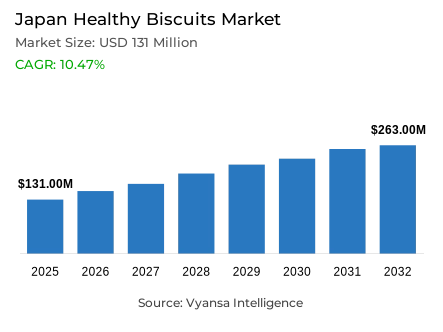
Healthy biscuits are nutritionally enhanced baked products formulated with whole grains, dietary fiber, protein, reduced sugar, and functional ingredients to support healthier snacking. In Japan, they are widely consumed as breakfast substitutes, on-the-go snacks, lunchbox additions, and portion-controlled refreshments across all age groups. The healthy biscuits industry in Japan is projected to expand at a 10.47% CAGR during 2026-2032 as healthy snacking shifts from occasional diet products toward convenient nutrition supported by functional biscuits and compliant food labelling.
Key Highlights of the Japan Healthy Biscuits Market:
- Japan healthy biscuits market stood at 131 million in 2025 and reached 138 million in 2026, with value expected to reach 263 million by 2032.
- The market is forecast to grow at a 10.47% CAGR during 2026-2032.
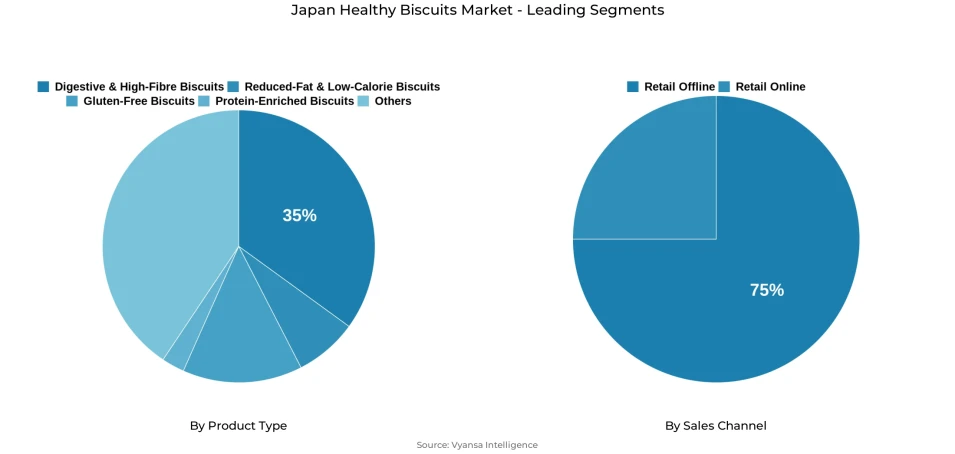
- Based on product type, the digestive & high-fibre biscuits lead the industry with 35% share in 2026.
- However, the protein-enriched biscuits are the fastest-growing product type, with a 15.78% CAGR during 2026-2032.
- By distribution channel, the retail offline leads with 75% share in 2026.
- Meanwhile, retail online is considered as the fastest-growing sales channel, with a 15.91% CAGR during 2026-2032.
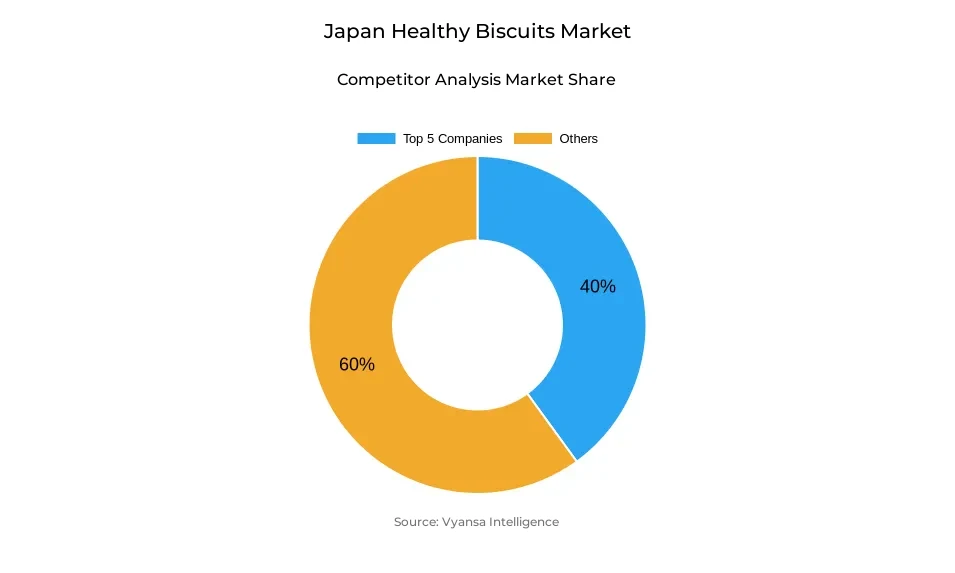
- Top-five company share is 40%, indicating that Industry remains moderately fragmented across national FMCG brands and specialist biscuit manufacturers.
The market is gaining commercial significance as healthy biscuits transform traditional snacking into a convenient source of everyday nutrition. Their shelf stability, portability, affordability, and familiarity make them well-suited for daily consumption while enabling healthy biscuit companies to incorporate value-added claims such as high fiber, protein enrichment, reduced sugar, whole grains, and digestive health. As a result, healthy biscuits are increasingly positioned as functional alternatives to conventional biscuits rather than niche dietary products.
Additionally, the healthy biscuits market growth in Japan is significantly supported by a broad consumer base, including working professionals seeking convenient nutrition during busy schedules, parents purchasing healthier snacks for children, elderly consumers preferring easy-to-store food products, and health-conscious individuals managing sugar, carbohydrate, gluten, or allergen intake. These diverse consumption occasions extend beyond snacking to include breakfast replacements, between-meal nourishment, pantry stocking, wellness gifting, and portion-controlled consumption.
Among product categories, digestive and high-fiber biscuits account for the largest demand, as their health benefits are widely recognized and align well with Japanese dietary preferences. Looking ahead, growth will be supported by the extensive reach of offline retail alongside the rapid expansion of online grocery platforms. This omnichannel availability is expected to improve product accessibility, accelerate consumer trial, and sustain market growth as healthier snacking becomes an integral part of daily lifestyles.
Japan Healthy Biscuits Market: Surveys and Key Insights
The Ministry of Health, Labour and Welfare's 2024 National Health and Nutrition Survey reported average daily vegetable intake of 258.7 g, comprising 268.6 g for men and 250.3 g for women, well below the 350 g daily target established under Health Japan 21. This nutritional gap is encouraging demand for high-fiber, whole-grain, and digestive biscuits as convenient snack options that help consumers incorporate functional nutrition into their daily diets when time or access limits the consumption of fresh foods.
Japan's Food Regulations and Labeling Standards Driving Healthy Biscuits Adoption
Japan's healthy biscuits market operates within a stringent regulatory framework that governs product formulation, labeling, health claims, and quality assurance. The Consumer Affairs Agency (CAA) mandates comprehensive food labeling requirements, including nutritional information, allergen declarations, ingredient disclosure, and usage instructions for products such as reduced-fat, low-calorie, gluten-free, and allergy-friendly biscuits. Manufacturers seeking to market products under the Foods with Function Claims (FFC) system must submit scientific evidence supporting functional benefits, establish robust production and quality management systems, maintain adverse event reporting mechanisms, and complete regulatory notifications prior to commercialization.
In addition, Japan requires mandatory declaration of specified allergens, including shrimp, crab, walnut, wheat, buckwheat, egg, milk, and peanut, while products marketed as organic must comply with Organic JAS certification standards and labeling requirements. These regulations directly influence product development, ingredient selection, packaging design, health claim substantiation, and retail market access. Consequently, manufacturers with validated formulations, stringent quality controls, and scientifically supported nutritional claims are better positioned to strengthen consumer trust and achieve sustainable growth than brands relying on unverified functional or clean-label claims.
Japan Healthy Biscuits Market Drivers
Rising Demand for Functional and Convenient Nutrition Driving Healthy Biscuits Consumption
Japan's growing preference for functional, convenient, and health-oriented foods is the primary driver of the healthy biscuits market. As consumers increasingly seek products that combine nutrition with convenience, healthy biscuits are evolving from occasional diet snacks into everyday functional foods. Their portability, long shelf life, and ability to deliver benefits such as high fiber, whole grains, reduced sugar, protein enrichment, and digestive support make them well-suited to Japan's fast-paced lifestyles.
Demographic and lifestyle changes further support market expansion. More than 29% of Japan's population is aged 65 years or above, increasing demand for easy-to-consume, nutrient-dense foods that promote healthy aging. At the same time, busy urban professionals and smaller households are increasingly purchasing convenient, portion-controlled snacks that align with wellness goals. The broader Japanese health and wellness foods market is also expanding steadily, reflecting sustained consumer preference for functional and better-for-you food products. These structural consumption trends are expected to continue driving demand for healthy biscuits across the country.
Restraints
Balancing Product Affordability, Taste, and Regulatory Compliance Remains a Key Market Challenge
One of the primary challenges in Japan healthy biscuits market is balancing affordability, taste, and regulatory compliance while meeting rising consumer demand for weight management and wellbeing in Japan. Healthy biscuits are expected to deliver the taste and texture of conventional biscuits while incorporating premium ingredients such as whole grains, dietary fiber, plant proteins, alternative sweeteners, and reduced-sugar formulations. These ingredients increase production costs and often require extensive formulation and sensory testing to maintain product quality and consumer acceptance. As taste remains a decisive factor in repeat purchases, manufacturers must continuously optimize formulations without compromising nutritional value.
The challenge is further intensified by Japan's stringent food labeling and compliance requirements. Products carrying functional, reduced-sugar, gluten-free, or allergen-friendly claims must adhere to rigorous labeling standards and provide scientifically substantiated nutritional information. In addition, mandatory allergen declarations and regulatory review frequently necessitate packaging revisions, additional testing, and higher quality assurance costs. Rising raw material, transportation, and manufacturing expenses further pressure profit margins, particularly for small and mid-sized manufacturers.
Consequently, companies with advanced formulation capabilities, robust quality management systems, reliable ingredient traceability, and strong regulatory expertise are better positioned to successfully commercialize healthy biscuits and secure long-term retail distribution across Japan.
Recent Trends
Clean-Label and Functional Snacking Move Mainstream
Clean-label biscuits are moving from niche health shelves into everyday functional snacking. Consumers increasingly expect low-sugar biscuits, plant-based biscuits, reduced-fat biscuits, and whole grain biscuits to deliver acceptable taste, not medicinal texture. The trend differs from earlier diet biscuits because benefits now sit inside mainstream occasions such as morning commuting, school snacks, and office breaks. This expands healthy biscuits in Japan from occasional restriction-led consumption to routine better-for-you snacks for adults, teenagers, and urban households seeking healthier routines and wellness.
Companies are responding with portfolios that combine familiar flavours with visible nutrition cues. Asahi Group Foods announced in 2024 that Cream Genmai Bran products provide protein, vitamins, dietary fibre, calcium, and iron, while Morinaga’s 2025 NATURIS launch emphasized no white sugar, no margarine or shortening, and no animal-derived ingredients. These formats improve shelf differentiation and push Japan Healthy Biscuits Industry positioning toward benefit-led functional biscuits.
Fibre, Protein, and Sugar-Control Formulation Advances
The technical trend is formulation engineering that protects biscuit texture while adding high fibre content, protein enrichment, reduced sugar, or low fat. Producers use wheat bran, corn-derived dietary fibre, inulin, wheat protein, whole grains, oats, seeds, and fermented butter to balance crunch, satiety, and claim credibility. This matters because the adoption for healthy biscuits weakens when healthier recipes taste dry, brittle, or medicinal compared with conventional better-for-you biscuits sold through convenience stores during repeat consumption occasions.
Bourbon’s 2026 Oyatsu de Eiyo Shukan launch shows this shift through products designed with dietary fibre, protein, calcium, individual packaging, and controlled sugar positioning. Its chocolate-chip cookie contains 4.6g sugar per two-piece pack and uses fibre and protein enrichment to support portion-controlled snacking. These formulation choices create protein-rich biscuits, low-sugar biscuits, premium positioning, and stronger retail online storytelling for functional biscuits across Japan.
Future Opportunities
Senior-Friendly Functional Multipacks and Online Replenishment
Elderly consumer demand for functional biscuits is a major opportunity because Japan’s ageing households need portable, readable, easy-to-chew, and portion-controlled snacks. Products combining digestive health, protein enrichment, calcium, iron, reduced sugar, and clear allergen information can serve breakfast gaps, medication-adjacent snacking, and small-meal occasions. The opportunity is strongest where seniors and caregivers seek convenient nutrition without medicalized claims, cooking requirements, or large pack sizes that create waste in single-person households across urban Japan, and snacking routines.
The Cabinet Office reported in its FY2025 ageing report that Japan had 36.24 million people aged 65 and over as of October 1, 2024, accounting for 29.3% of the population. Companies can capture this opportunity through softer textures, resealable pouches, readable labels, pharmacy-adjacent retail offline placement, and online grocery platforms serving elderly consumers, working adults, and smaller households beyond nearby stores.
Unlock Market Intelligence
Explore the market potential with our data-driven report
Japan Healthy Biscuits Market Segmentation Analysis
By Product Type
- Digestive & High-Fibre Biscuits
- Reduced-Fat & Low-Calorie Biscuits
- Gluten-Free Biscuits
- Protein-Enriched Biscuits
- Others
Digestive & High-Fibre Biscuits Dominate, While Protein-Enriched Variants Record the Fastest Growth
Digestive and high-fibre biscuits are projected to account for the largest share of the Japan healthy biscuits market, capturing 35% of total revenue in 2026. Their market leadership is driven by a combination of familiar taste, broad consumer acceptance, and well-recognized digestive and nutritional benefits. Formulated with ingredients such as whole grains, wheat bran, oats, multigrains, and added dietary fiber, these products appeal to adults, seniors, and health-conscious consumers seeking convenient ways to improve daily nutrition. Their widespread availability across supermarkets, convenience stores, and other retail outlets further strengthens category penetration and repeat purchases.
Meanwhile, protein-enriched biscuits are expected to emerge as the fastest-growing product segment, registering a CAGR of 15.78% during 2026–2032. Rising demand for convenient protein intake, sustained satiety, healthy ageing, and meal replacement options is accelerating adoption among working professionals, fitness-oriented consumers, and younger demographics. Continued innovation in plant- and dairy-based protein formulations, coupled with premium packaging and omnichannel retail expansion, is expected to further strengthen the segment's growth trajectory.
By Sales Channel
- Retail Offline
- Supermarkets & Hypermarkets
- Convenience Stores
- Traditional Grocery & Independent Retailers
- Specialty Food & Health Stores
- Retail Online
- E-commerce Marketplaces
- Online Grocery & Quick-Commerce Platforms
- Brand-Owned Direct-to-Consumer Websites
Offline Retail Dominates While E-Commerce Accelerates Category Expansion
Retail offline is expected to remain the leading distribution channel in the Japan healthy biscuits market, accounting for 75% of total sales in 2026. The channel benefits from strong consumer preference for in-store product evaluation, price comparison, and impulse purchases, particularly across supermarkets, hypermarkets, and convenience stores. The widespread availability of healthy biscuits in these outlets enhances product visibility and supports routine household replenishment. According to the USDA Foreign Agricultural Service (FAS), convenience stores represented a significant share of Japan's retail food and beverage sales in 2024, with the number of convenience store outlets continuing to expand, reinforcing the accessibility of healthy biscuit products.
In contrast, retail online is projected to register the fastest growth, expanding at a CAGR of 15.91% during 2026–2032. E-commerce platforms provide consumers with a wider assortment of healthy biscuits, including specialized high-fiber, protein-enriched, and gluten-free products that may have limited shelf space in physical stores. Moreover, the growing adoption of online grocery shopping enables brands to leverage subscription models, personalized recommendations, product education, and promotional bundles, further accelerating consumer adoption and market penetration across Japan.
Unlock Market Intelligence
Explore the market potential with our data-driven report
Japan Healthy Biscuits Market Competitive Landscape
The Japan healthy biscuits industry is moderately fragmented, with the top five companies including Otsuka Pharmaceutical Co., Ltd., Asahi Group Foods, Ltd., Ezaki Glico Co., Ltd., Morinaga & Co., Ltd., and Bourbon Corporation, holding 40% share and a long tail of biscuit, snack, and confectionery producers serving mainstream and niche health positions.
Key Companies in the Japan Healthy Biscuits Market
- Otsuka Pharmaceutical Co., Ltd.
- Asahi Group Foods, Ltd.
- Ezaki Glico Co., Ltd.
- Morinaga & Co., Ltd.
- Bourbon Corporation
- YAMAZAKI-BISCUITS Co., Ltd.
- Calbee, Inc.
- ITO BISCUITS CO., LTD.
- Shoei Delicy Corporation
- SANRITSU CONFECTIONERY CO., LTD.
Company Profiling
The profiles below provide a comparative assessment of the leading companies in the Japan healthy biscuits market, focusing on their healthy biscuit portfolios, distribution reach, innovation capabilities, and competitive strengths.
Otsuka Pharmaceutical Co., Ltd.
Otsuka Pharmaceutical Co., Ltd. participates in nutrition-oriented snacking through Calorie Mate, a nutritionally balanced food positioned around five major nutrients. Otsuka’s 2024 release described Calorie Mate as available in block, jelly, and liquid forms and used when regular meals are not available, during sports, studying, or working. The block format fits shelf-stable meal-gap consumption for adults, students, and working adults. Otsuka’s research-led nutrition credibility and national brand recognition make it a science-positioned participant rather than a conventional biscuit-only manufacturer.
Asahi Group Foods, Ltd.
Asahi Group Foods, Ltd., based in Sumida-ku, Tokyo, was founded in 2015, and operates as part of Asahi Group Japan, Ltd. Its relevant product family is Cream Genmai Bran, a cream-sand nutrition-adjusted food. Asahi’s 2024 release says the series provides protein, ten vitamins, dietary fibre, calcium, and iron, while using brown rice and wheat bran in the biscuit dough. Nationwide launch activity, individual two-pack portions, and Asahi’s health-food operations position the company as a distribution-led and nutrition-portfolio participant.
Ezaki Glico Co., Ltd.
Ezaki Glico Co., Ltd. participates through SUNAO biscuits, a sugar-control biscuit platform positioned toward health-conscious snacking. Glico’s official SUNAO biscuit page supports the product’s role in Japan’s better-for-you biscuit category, while the company’s food-business profile confirms its participation in confectionery and food products. The line serves adults seeking lower-carbohydrate indulgence without abandoning biscuit taste, cream sandwich formats, or butter flavour cues. Glico’s confectionery R&D, formulation balance, and brand trust make it a product-innovation specialist in healthy biscuits in Japan.
Morinaga & Co., Ltd.
Morinaga & Co., Ltd. is a long-established Japanese confectionery company and participates through NATURIS, a biscuit series launched in 2025. Morinaga’s release describes NATURIS Almond & Cranberry and NATURIS Hazelnut & Cacao as biscuits using almonds, cranberries, sunflower seeds, oat flakes, domestic wholegrain flour, and beet sugar, while avoiding white sugar, margarine, shortening, and animal-derived ingredients. The range targets adults seeking clean-label biscuits and guilt-reduced snacking. Morinaga’s biscuit heritage, national retail presence, and ingredient-led renewal make it a mainstream premium participant.
Bourbon Corporation
Bourbon Corporation participates through its Oyatsu de Eiyo Shukan chocolate-chip cookie, a functional biscuit aligned with sugar-control and portion-controlled snack demand. Bourbon’s official product page states that the cookie contains dietary fibre, protein, calcium, inulin, and wheat protein, with 4.6g sugar and 4.4g dietary fibre per two-piece pack. The product supports snack-time wellness and controlled household consumption. Bourbon’s broad cookie portfolio, scale, and value-oriented nutrition formats position it as a volume producer with functional reformulation capability.
Recent Developments and Updates
- In March 2026, Bourbon Corporation announced the launch of its Oyatsu de Eiyo Shukan series, including a chocolate-chip cookie with dietary fibre, protein, calcium, individual packaging, and 4.6g sugar per two-piece pack. This development strengthens Japan Healthy Biscuits Industry innovation around reduced sugar, portion-controlled snacks, and functional biscuits.
- In September 2025, Morinaga & Co., Ltd. launched NATURIS Almond & Cranberry and NATURIS Hazelnut & Cacao nationwide. The clean-label biscuits use ingredients such as almonds, oats, domestic wholegrain flour, beet sugar, seeds, and fruit while avoiding white sugar, margarine, shortening, and animal-derived ingredients. This supports plant-based biscuits, premium healthy snacks, and better-for-you positioning.
Frequently Asked Questions
Related Report
- Market Segmentation
- Research Scope
- Research Methodology
- Definitions and Assumptions
- Executive Summary
- Japan Healthy Biscuits Market Policies, Regulations, and Standards
- Japan Healthy Biscuits Production Trend 2022-2032
- Japan Healthy Biscuits Production Trend By Product Type
- Digestive & High-Fibre Biscuits
- Reduced-Fat & Low-Calorie Biscuits
- Gluten-Free Biscuits
- Protein-Enriched Biscuits
- Others
- Company Wise Production Plants and Statistics
- Installed Production Capacity
- Actual Production
- Planned Production Target
- Japan Healthy Biscuits Production Trend By Product Type
- Japan Healthy Biscuits Pricing Analysis 2022-2032
- Japan Healthy Biscuits Pricing Trend (USD) 2022-2032
- Japan Healthy Biscuits Pricing Trend (USD) By Product Type 2022-2032
- Digestive & High-Fibre Biscuits
- Reduced-Fat & Low-Calorie Biscuits
- Gluten-Free Biscuits
- Protein-Enriched Biscuits
- Others
- Japan Healthy Biscuits Market Dynamics
- Growth Factors
- Challenges
- Trends
- Opportunities
- Japan Healthy Biscuits Market Statistics, 2022-2032
- Market Size & Growth Outlook
- By Revenues in USD Million
- Market Segmentation & Growth Outlook
- By Product Type
- Digestive & High-Fibre Biscuits- Market Insights and Forecast 2022-2032, USD Million
- Reduced-Fat & Low-Calorie Biscuits- Market Insights and Forecast 2022-2032, USD Million
- Gluten-Free Biscuits- Market Insights and Forecast 2022-2032, USD Million
- Protein-Enriched Biscuits- Market Insights and Forecast 2022-2032, USD Million
- Others- Market Insights and Forecast 2022-2032, USD Million
- By Ingredient
- Wheat-Based- Market Insights and Forecast 2022-2032, USD Million
- Oat-Based- Market Insights and Forecast 2022-2032, USD Million
- Multigrain-Based- Market Insights and Forecast 2022-2032, USD Million
- Millet-Based- Market Insights and Forecast 2022-2032, USD Million
- Nut & Seed-Based- Market Insights and Forecast 2022-2032, USD Million
- Fruit-Based- Market Insights and Forecast 2022-2032, USD Million
- Others- Market Insights and Forecast 2022-2032, USD Million
- By Consumers
- Children- Market Insights and Forecast 2022-2032, USD Million
- Teenagers- Market Insights and Forecast 2022-2032, USD Million
- Adults- Market Insights and Forecast 2022-2032, USD Million
- Seniors- Market Insights and Forecast 2022-2032, USD Million
- By Dietary Preference
- Vegan- Market Insights and Forecast 2022-2032, USD Million
- Gluten-Free- Market Insights and Forecast 2022-2032, USD Million
- Keto-Friendly- Market Insights and Forecast 2022-2032, USD Million
- Low-Carb- Market Insights and Forecast 2022-2032, USD Million
- High-Protein- Market Insights and Forecast 2022-2032, USD Million
- Sugar-Free/Diabetic-Friendly- Market Insights and Forecast 2022-2032, USD Million
- Others- Market Insights and Forecast 2022-2032, USD Million
- By Sales Channel
- Retail Offline- Market Insights and Forecast 2022-2032, USD Million
- Supermarkets & Hypermarkets- Market Insights and Forecast 2022-2032, USD Million
- Convenience Stores- Market Insights and Forecast 2022-2032, USD Million
- Traditional Grocery & Independent Retailers- Market Insights and Forecast 2022-2032, USD Million
- Specialty Food & Health Stores- Market Insights and Forecast 2022-2032, USD Million
- Retail Online- Market Insights and Forecast 2022-2032, USD Million
- E-commerce Marketplaces- Market Insights and Forecast 2022-2032, USD Million
- Online Grocery & Quick-Commerce Platforms- Market Insights and Forecast 2022-2032, USD Million
- Brand-Owned Direct-to-Consumer Websites- Market Insights and Forecast 2022-2032, USD Million
- Retail Offline- Market Insights and Forecast 2022-2032, USD Million
- By Packaging Format
- Flexible Packs & Pouches- Market Insights and Forecast 2022-2032, USD Million
- Cartons & Boxes- Market Insights and Forecast 2022-2032, USD Million
- Tins & Canisters- Market Insights and Forecast 2022-2032, USD Million
- Others- Market Insights and Forecast 2022-2032, USD Million
- By Nature
- Conventional- Market Insights and Forecast 2022-2032, USD Million
- Certified Organic- Market Insights and Forecast 2022-2032, USD Million
- By Competitors
- Competition Characteristics
- Market Share & Analysis
- By Product Type
- Market Size & Growth Outlook
- Japan Digestive & High-Fibre Biscuits Market Statistics, 2022-2032
- Market Size & Growth Outlook
- By Revenues in USD Million
- Market Segmentation & Growth Outlook
- By Ingredient- Market Insights and Forecast 2022-2032, USD Million
- By Consumers- Market Insights and Forecast 2022-2032, USD Million
- By Dietary Preference- Market Insights and Forecast 2022-2032, USD Million
- By Sales Channel- Market Insights and Forecast 2022-2032, USD Million
- By Packaging Format- Market Insights and Forecast 2022-2032, USD Million
- By Nature- Market Insights and Forecast 2022-2032, USD Million
- Market Size & Growth Outlook
- Japan Reduced-Fat & Low-Calorie Biscuits Market Statistics, 2022-2032
- Market Size & Growth Outlook
- By Revenues in USD Million
- Market Segmentation & Growth Outlook
- By Ingredient- Market Insights and Forecast 2022-2032, USD Million
- By Consumers- Market Insights and Forecast 2022-2032, USD Million
- By Dietary Preference- Market Insights and Forecast 2022-2032, USD Million
- By Sales Channel- Market Insights and Forecast 2022-2032, USD Million
- By Packaging Format- Market Insights and Forecast 2022-2032, USD Million
- By Nature- Market Insights and Forecast 2022-2032, USD Million
- Market Size & Growth Outlook
- Japan Gluten-Free Biscuits Market Statistics, 2022-2032
- Market Size & Growth Outlook
- By Revenues in USD Million
- Market Segmentation & Growth Outlook
- By Ingredient- Market Insights and Forecast 2022-2032, USD Million
- By Consumers- Market Insights and Forecast 2022-2032, USD Million
- By Dietary Preference- Market Insights and Forecast 2022-2032, USD Million
- By Sales Channel- Market Insights and Forecast 2022-2032, USD Million
- By Packaging Format- Market Insights and Forecast 2022-2032, USD Million
- By Nature- Market Insights and Forecast 2022-2032, USD Million
- Market Size & Growth Outlook
- Japan Protein-Enriched Biscuits Market Statistics, 2022-2032
- Market Size & Growth Outlook
- By Revenues in USD Million
- Market Segmentation & Growth Outlook
- By Ingredient- Market Insights and Forecast 2022-2032, USD Million
- By Consumers- Market Insights and Forecast 2022-2032, USD Million
- By Dietary Preference- Market Insights and Forecast 2022-2032, USD Million
- By Sales Channel- Market Insights and Forecast 2022-2032, USD Million
- By Packaging Format- Market Insights and Forecast 2022-2032, USD Million
- By Nature- Market Insights and Forecast 2022-2032, USD Million
- Market Size & Growth Outlook
- Japan Others Market Statistics, 2022-2032
- Market Size & Growth Outlook
- By Revenues in USD Million
- Market Segmentation & Growth Outlook
- By Ingredient- Market Insights and Forecast 2022-2032, USD Million
- By Consumers- Market Insights and Forecast 2022-2032, USD Million
- By Dietary Preference- Market Insights and Forecast 2022-2032, USD Million
- By Sales Channel- Market Insights and Forecast 2022-2032, USD Million
- By Packaging Format- Market Insights and Forecast 2022-2032, USD Million
- By Nature- Market Insights and Forecast 2022-2032, USD Million
- Market Size & Growth Outlook
- Competitive Outlook
- Company Profiles
- Otsuka Pharmaceutical Co., Ltd.
- Business Description
- Product Portfolio
- Collaborations & Alliances
- Recent Developments
- Financial Details
- Others
- Asahi Group Foods Ltd.
- Business Description
- Product Portfolio
- Collaborations & Alliances
- Recent Developments
- Financial Details
- Others
- Ezaki Glico Co., Ltd.
- Business Description
- Product Portfolio
- Collaborations & Alliances
- Recent Developments
- Financial Details
- Others
- Morinaga & Co., Ltd.
- Business Description
- Product Portfolio
- Collaborations & Alliances
- Recent Developments
- Financial Details
- Others
- Bourbon Corporation
- Business Description
- Product Portfolio
- Collaborations & Alliances
- Recent Developments
- Financial Details
- Others
- YAMAZAKI-BISCUITS Co., Ltd.
- Business Description
- Product Portfolio
- Collaborations & Alliances
- Recent Developments
- Financial Details
- Others
- Calbee, Inc.
- Business Description
- Product Portfolio
- Collaborations & Alliances
- Recent Developments
- Financial Details
- Others
- ITO BISCUITS CO., LTD.
- Business Description
- Product Portfolio
- Collaborations & Alliances
- Recent Developments
- Financial Details
- Others
- Shoei Delicy Corporation
- Business Description
- Product Portfolio
- Collaborations & Alliances
- Recent Developments
- Financial Details
- Others
- SANRITSU CONFECTIONERY CO., LTD.
- Business Description
- Product Portfolio
- Collaborations & Alliances
- Recent Developments
- Financial Details
- Others
- Otsuka Pharmaceutical Co., Ltd.
- Company Profiles
- Disclaimer
| Segment | Sub-Segment |
|---|---|
| By Product Type |
|
| By Ingredient |
|
| By Consumers |
|
| By Dietary Preference |
|
| By Sales Channel |
|
| By Packaging Format |
|
| By Nature |
|
Research Methodology
This study followed a structured approach comprising four key phases to assess the size and scope of the electro-oxidation market. The process began with thorough secondary research to collect data on the target market, related markets, and broader industry context. These findings, along with preliminary assumptions and estimates, were then validated through extensive primary research involving industry experts from across the value chain. To calculate the overall market size, both top-down and bottom-up methodologies were employed. Finally, market segmentation and data triangulation techniques were applied to refine and validate segment-level estimations.
Secondary Research
The secondary research phase involved gathering data from a wide range of credible and published sources. This step helped in identifying industry trends, defining market segmentation, and understanding the market landscape and value chain.
Sources consulted during this phase included:
- Company annual reports, investor presentations, and press releases
- Industry white papers and certified publications
- Trade directories and market-recognized databases
- Articles from authoritative authors and reputable journals
- Gold and silver standard websites
Secondary research was critical in mapping out the industry's value chain and monetary flow, identifying key market segments, understanding regional variations, and tracking significant industry developments.
Other key sources:
- Financial disclosures
- Industry associations and trade bodies
- News outlets and business magazines
- Academic journals and research studies
- Paid industry databases
Primary Research
To validate secondary data and gain deeper market insights, primary research was conducted with key stakeholders across both the supply and demand sides of the market.
On the demand side, participants included decision-makers and influencers from end-user industries—such as CIOs, CTOs, and CSOs—who provided first-hand perspectives on market needs, product usage, and future expectations.
On the supply side, interviews were conducted with manufacturers, industry associations, and institutional participants to gather insights into current offerings, product pipelines, and market challenges.
Primary interviews provided critical inputs such as:
- Market size and revenue data
- Product and service breakdowns
- Market forecasts
- Regional and application-specific trends
Stakeholders consulted included:
- Leading OEM and solution providers
- Channel and distribution partners
- End users across various applications
- Independent consultants and industry specialists
Market Size Estimation and Data Triangulation
- Identifying Key Market Participants (Secondary Research)
- Goal: To identify the major players or companies in the target market. This typically involves using publicly available data sources such as industry reports, market research publications, and financial statements of companies.
- Tools: Reports from firms like Gartner, Forrester, Euromonitor, Statista, IBISWorld, and others. Public financial statements, news articles, and press releases from top market players.
- Extracting Earnings of Key Market Participants
- Goal: To estimate the earnings generated from the product or service being analyzed. This step helps in understanding the revenue potential of each market player in a specific geography.
- Methods: Earnings data can be gathered from:
- Publicly available financial reports (for listed companies).
- Interviews and primary data sources from professionals, such as Directors, VPs, SVPs, etc. This is especially useful for understanding more nuanced, internal data that isn't publicly disclosed.
- Annual reports and investor presentations of key players.
- Data Collation and Development of a Relevant Data Model
- Goal: To collate inputs from both primary and secondary sources into a structured, data-driven model for market estimation. This model will incorporate key market KPIs and any independent variables relevant to the market.
- Key KPIs: These could include:
- Market size, growth rate, and demand drivers.
- Industry-specific metrics like market share, average revenue per customer (ARPC), or average deal size.
- External variables, such as economic growth rates, inflation rates, or commodity prices, that could affect the market.
- Data Modeling: Based on this data, the market forecasts are developed for the next 5 years. A combination of trend analysis, scenario modeling, and statistical regression might be used to generate projections.
- Scenario Analysis
- Goal: To test different assumptions and validate how sensitive the market is to changes in key variables (e.g., market demand, regulatory changes, technological disruptions).
- Types of Scenarios:
- Base Case: Based on current assumptions and historical data.
- Best-Case Scenario: Assuming favorable market conditions, regulatory environments, and technological advancements.
- Worst-Case Scenario: Accounting for adverse factors, such as economic downturns, stricter regulations, or unexpected disruptions.












