Indonesia Sleep Aids Market Report: Trends, Growth and Forecast (2026-2032)
By Product (Single Ingredient (Doxylamine Succinate, Diphenhydramine, Melatonin), Combination Ingredient (Diphenhydramine + Acetaminophen, Other Antihistamine-Based Combinations), Herbal & Traditional Sleep Aids (Valerian root, Passionflower, Chamomile, Kava, Multi-Herbal Sleep Blends)), By Sleep Disorder (Insomnia, Sleep Apnea, Restless Legs Syndrome, Narcolepsy, Sleep Walking, Others), By Age Group (Young to Mid Adults (25-44 Years), Middle-Aged Adults (45-64 Years), Geriatric Population (65+ Years)), By Sales Channel (Retail Online, Retail Offline), By End User (Homecare/Individual Consumers, Hospitals, Sleep Centers & Clinics), By Formulation (Tablets, Gummies, Capsules, Liquid, Sublingual), By Region (Sumatra, Java, Kalimantan, Sulawesi, Others) ... Read more
|
Major Players
|
Indonesia Sleep Aids Market Statistics and Insights, 2026
- Market Size Statistics
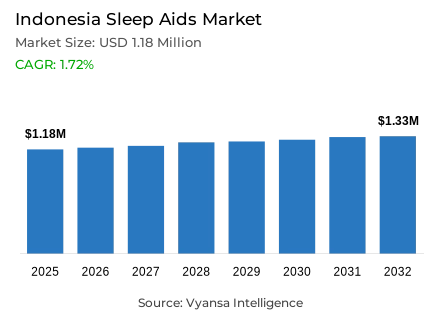
- Sleep aids market size in Indonesia was estimated at USD 1.18 million in 2025
- The market size is expected to grow to USD 1.33 million by 2032.
- Market to register a CAGR of around 1.72% during 2026-32.
- Product Shares
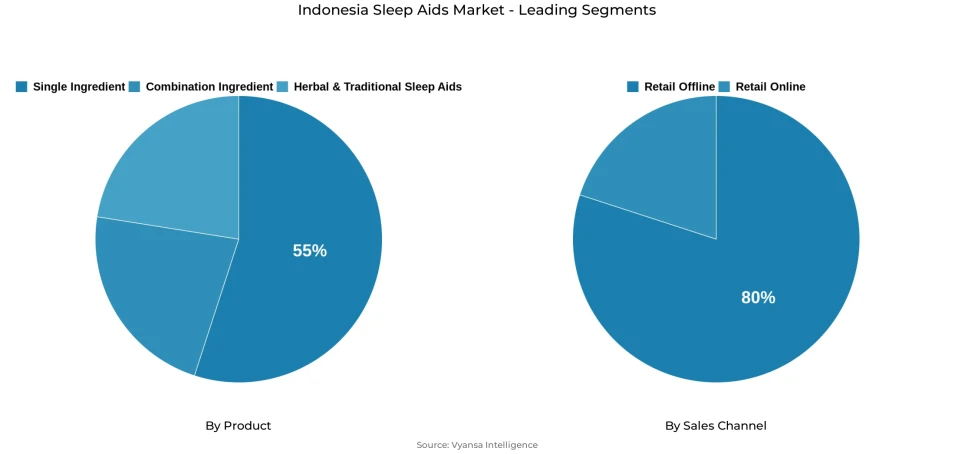
- Single ingredient grabbed market share of 55%.
- Competition
- More than 5 companies are actively engaged in producing sleep aids in Indonesia.
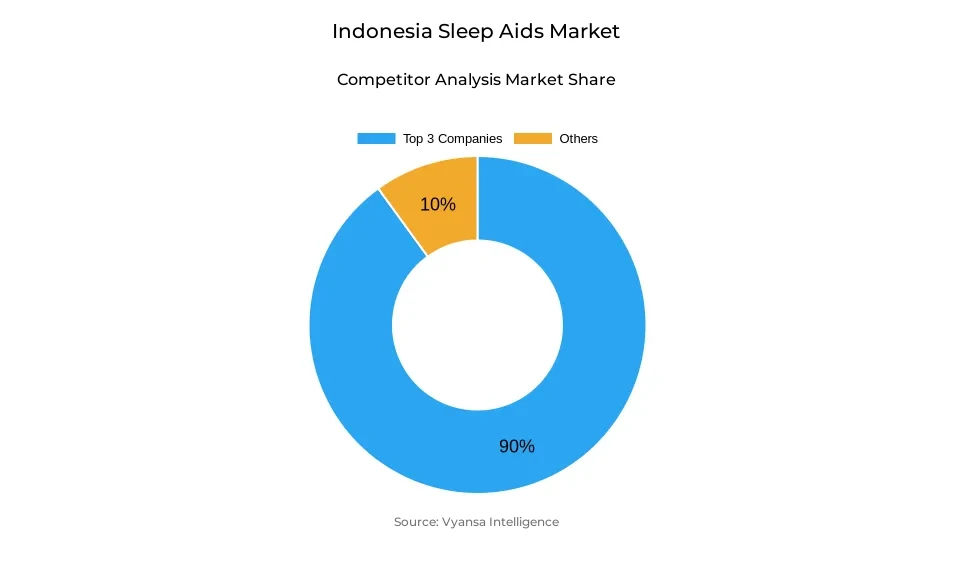
- Top 3 companies acquired around 90% of the market share.
- Sido Muncul PT, Soho Industri Pharmasi PT, Jamu Borobudur PT etc., are few of the top companies.
- Sales channel
- Retail offline grabbed 80% of the market.
Indonesia Sleep Aids Market Outlook
The Indonesia sleep aids market is projected to maintain moderate yet stable expansion through 2032, supported by lifestyle-driven sleep disruption and evolving wellness awareness. The market is valued at USD 1.18 million in 2025 and is expected to reach USD 1.33 million by 2032, reflecting a CAGR of 1.72%. Rising stress among working professionals and adolescents, alongside irregular sleep hygiene patterns, continues to underpin structural demand.
Natural positioning remains central to category identity, shaped by regulatory stringency that favors herbal formulations. Single-ingredient products lead with 55% market share, supported by domestic brands such as Lelap that are perceived as effective and low risk in terms of side effects and dependency. Ingredients including valerian, nutmeg, and ginseng maintain familiarity and trust.
Retail Offline channels command 80% of market distribution, although digital behavior is reshaping discovery patterns. Social media-driven awareness of relaxation practices and adaptogenic ingredients is encouraging experimentation with alternative formats such as sleep patches.
Looking ahead, growth will be anchored in holistic wellness integration. As sleep aids become embedded within broader self-care routines rather than viewed as last-resort solutions, demand for herbal, accessible, and innovative delivery systems is expected to sustain gradual value expansion through 2032.
Indonesia Sleep Aids Market Growth DriverLifestyle Disruption Normalises Sleep Support Across Demographics
Sleep disturbance is increasingly normalized across Indonesian households, driven by sedentary routines and irregular daily habits. According to the Ministry of Health of Indonesia, results from the Free Health Check programme reported in November 2025 indicate that 95.8% of adults are insufficiently physically active. Low activity levels are commonly associated with extended screen exposure and inconsistent circadian rhythms, both of which elevate sleep-onset difficulties.
This structural lifestyle pattern sustains demand for convenient, occasional-use sleep aids positioned around herbal safety and low dependency risk. Small pack formats further support trial behavior among end users whose sleep issues are intermittent rather than chronic, reinforcing steady baseline consumption during 2026–2032.
Indonesia Sleep Aids Market ChallengeRegulatory Stringency Limits OTC Innovation Pipeline
Stringent registration procedures constrain the pace at which new over-the-counter sleep formulations reach the Indonesian market. The National Agency of Drug and Food Control reported that as of June 2025, its directorate overseeing traditional medicine and health supplements processed 33,196 submissions, with 26,553 cases completed. This volume reflects substantial oversight intensity and procedural complexity.
While rigorous review strengthens safety standards, it extends approval timelines and concentrates competition around established botanical ingredients. Innovation in alternative delivery systems or novel active compounds faces longer lead times, limiting rapid diversification of the sleep-aid pipeline.
Unlock Market Intelligence
Explore the market potential with our data-driven report
Indonesia Sleep Aids Market TrendDigital Relaxation Behaviours Embed into Bedtime Routines
Non-pharmacological digital tools are increasingly integrated into Indonesian bedtime behavior. According to Statistics Indonesia, internet penetration reached 72.78% of the population in 2024, while 68.65% owned mobile phones. Broad connectivity enables widespread access to sleep-tracking apps, guided relaxation audio, and short-form wellness content.
As adolescents and working-age adults adopt these digital aids, product comparison becomes more informed and ingredient-focused. This behavioral shift reinforces preference for natural, low-friction sleep solutions that complement lifestyle-based routines rather than replace them, strengthening demand for mild, occasional-use formulations.
Indonesia Sleep Aids Market OpportunityPatch Formats Scale via Expanding Digital Payments and Retail Online
Transdermal sleep patches represent a differentiated growth avenue within Indonesia’s predominantly oral herbal landscape. Retail online infrastructure provides the necessary visibility and distribution reach for this non-invasive format, which appeals to end users seeking sustained-release, non-addictive support.
According to Bank Indonesia, digital payment transactions reached 4.44 billion in July 2025, rising 45.30% year-on-year, supported by mobile and QRIS systems. Frictionless checkout experiences strengthen scalability for alternative sleep-support products, enabling subscription models, bundled wellness offerings, and broader consumer experimentation via online channels.
Unlock Market Intelligence
Explore the market potential with our data-driven report
Indonesia Sleep Aids Market Segmentation Analysis
By Product
- Single Ingredient
- Combination Ingredient
- Herbal & Traditional Sleep Aids
The segment with highest market share under Product is Single-ingredient formulations dominate the product landscape with 55% market share. This leadership reflects strong end-user preference for simple herbal preparations perceived as safe and suitable for occasional use. Clear labeling and single-active positioning reduce complexity, supporting confident purchase decisions in a tightly regulated market environment.
The segment benefits from compact packaging formats that encourage first-time trial and repeat purchasing. Familiar domestic brands maintain trust through consistent botanical positioning, making single-ingredient products the primary entry point for new category participants while coexistence with emerging formats such as transdermal patches gradually expands the overall market scope.
By Sales Channel
- Retail Online
- Retail Offline
Retail Offline accounts for 80% of total market share and remains the dominant distribution channel for sleep aid products in Indonesia. This leadership reflects the importance of reassurance and immediacy in sleep-related purchase decisions. End users frequently prefer face-to-face consultation in pharmacies and drugstores, particularly when evaluating herbal claims and safety profiles. Immediate product access at the point of need—often during acute sleep disruption—reinforces the relevance of physical retail.
Established health-category shopping habits further anchor offline dominance. Sleep aids are typically merchandised alongside daily wellness products, encouraging routine replenishment and brand familiarity. While retail online platforms are expanding visibility for patch formats and niche wellness propositions, they currently complement rather than replace offline purchases of routine oral herbal products. Physical retail therefore continues to drive both impulse-based and repeat consumption patterns.
List of Companies Covered in Indonesia Sleep Aids Market
The companies listed below are highly influential in the Indonesia sleep aids market, with a significant market share and a strong impact on industry developments.
- Sido Muncul PT
- Soho Industri Pharmasi PT
- Jamu Borobudur PT
Competitive Landscape
Indonesia sleep aids market is dominated by local herbal brands, with Soho Industri Pharmasi’s Lelap leading through patented formulations, small pack formats, and strong above-the-line promotion. Jamu Borobudur and Sido Muncul follow, leveraging traditional jamu positioning and perceptions of efficacy with minimal addiction risk. Regulatory barriers limit multinational penetration, reinforcing domestic dominance. Competition is intensifying from emerging formats such as Sleepfit and Lunafore sleep patches, which offer sustained-release alternatives via e-commerce, and from adaptogen-focused supplements featuring ashwagandha and rhodiola that blur lines between stress relief and sleep support. Indirect competition from digital relaxation trends such as ASMR is also rising. Differentiation opportunities lie in clinically supported adaptogen blends, teen-focused solutions, transdermal delivery innovation, and omnichannel digital engagement strategies.
Frequently Asked Questions
Related Report
- Market Segmentation
- Research Scope
- Research Methodology
- Definitions and Assumptions
- Executive Summary
- Indonesia Sleep Aids Market Policies, Regulations, and Standards
- Indonesia Sleep Aids Market Dynamics
- Growth Factors
- Challenges
- Trends
- Opportunities
- Indonesia Sleep Aids Market Statistics, 2022-2032F
- Market Size & Growth Outlook
- By Revenues in USD Million
- Market Segmentation & Growth Outlook
- By Product
- Single Ingredient- Market Insights and Forecast 2022-2032, USD Million
- Doxylamine Succinate- Market Insights and Forecast 2022-2032, USD Million
- Diphenhydramine- Market Insights and Forecast 2022-2032, USD Million
- Melatonin- Market Insights and Forecast 2022-2032, USD Million
- Combination Ingredient- Market Insights and Forecast 2022-2032, USD Million
- Diphenhydramine + Acetaminophen- Market Insights and Forecast 2022-2032, USD Million
- Other Antihistamine-Based Combinations- Market Insights and Forecast 2022-2032, USD Million
- Herbal & Traditional Sleep Aids- Market Insights and Forecast 2022-2032, USD Million
- Valerian root- Market Insights and Forecast 2022-2032, USD Million
- Passionflower- Market Insights and Forecast 2022-2032, USD Million
- Chamomile- Market Insights and Forecast 2022-2032, USD Million
- Kava- Market Insights and Forecast 2022-2032, USD Million
- Multi-Herbal Sleep Blends- Market Insights and Forecast 2022-2032, USD Million
- Single Ingredient- Market Insights and Forecast 2022-2032, USD Million
- By Sleep Disorder
- Insomnia- Market Insights and Forecast 2022-2032, USD Million
- Sleep Apnea- Market Insights and Forecast 2022-2032, USD Million
- Restless Legs Syndrome- Market Insights and Forecast 2022-2032, USD Million
- Narcolepsy- Market Insights and Forecast 2022-2032, USD Million
- Sleep Walking- Market Insights and Forecast 2022-2032, USD Million
- Others- Market Insights and Forecast 2022-2032, USD Million
- By Age Group
- Young to Mid Adults (25-44 Years)- Market Insights and Forecast 2022-2032, USD Million
- Middle-Aged Adults (45-64 Years)- Market Insights and Forecast 2022-2032, USD Million
- Geriatric Population (65+ Years)- Market Insights and Forecast 2022-2032, USD Million
- By Sales Channel
- Retail Online- Market Insights and Forecast 2022-2032, USD Million
- Retail Offline- Market Insights and Forecast 2022-2032, USD Million
- By End User
- Homecare/Individual Consumers- Market Insights and Forecast 2022-2032, USD Million
- Hospitals- Market Insights and Forecast 2022-2032, USD Million
- Sleep Centers & Clinics- Market Insights and Forecast 2022-2032, USD Million
- By Formulation
- Tablets- Market Insights and Forecast 2022-2032, USD Million
- Gummies- Market Insights and Forecast 2022-2032, USD Million
- Capsules- Market Insights and Forecast 2022-2032, USD Million
- Liquid- Market Insights and Forecast 2022-2032, USD Million
- Sublingual- Market Insights and Forecast 2022-2032, USD Million
- By Region
- Sumatra
- Java
- Kalimantan
- Sulawesi
- Others
- By Competitors
- Competition Characteristics
- Market Share & Analysis
- By Product
- Market Size & Growth Outlook
- Indonesia Single Ingredient Sleep Aids Market Statistics, 2022-2032
- Market Size & Growth Outlook
- By Revenues in USD Million
- Market Segmentation & Growth Outlook
- By Sleep Disorder- Market Insights and Forecast 2022-2032, USD Million
- By Age Group- Market Insights and Forecast 2022-2032, USD Million
- By Sales Channel- Market Insights and Forecast 2022-2032, USD Million
- By End User- Market Insights and Forecast 2022-2032, USD Million
- By Formulation- Market Insights and Forecast 2022-2032, USD Million
- By Region- Market Insights and Forecast 2022-2032, USD Million
- Market Size & Growth Outlook
- Indonesia Combination Ingredient Sleep Aids Market Statistics, 2022-2032
- Market Size & Growth Outlook
- By Revenues in USD Million
- Market Segmentation & Growth Outlook
- By Sleep Disorder- Market Insights and Forecast 2022-2032, USD Million
- By Age Group- Market Insights and Forecast 2022-2032, USD Million
- By Sales Channel- Market Insights and Forecast 2022-2032, USD Million
- By End User- Market Insights and Forecast 2022-2032, USD Million
- By Formulation- Market Insights and Forecast 2022-2032, USD Million
- By Region- Market Insights and Forecast 2022-2032, USD Million
- Market Size & Growth Outlook
- Indonesia Herbal & Traditional Sleep Aids Market Statistics, 2022-2032
- Market Size & Growth Outlook
- By Revenues in USD Million
- Market Segmentation & Growth Outlook
- By Sleep Disorder- Market Insights and Forecast 2022-2032, USD Million
- By Age Group- Market Insights and Forecast 2022-2032, USD Million
- By Sales Channel- Market Insights and Forecast 2022-2032, USD Million
- By End User- Market Insights and Forecast 2022-2032, USD Million
- By Formulation- Market Insights and Forecast 2022-2032, USD Million
- By Region- Market Insights and Forecast 2022-2032, USD Million
- Market Size & Growth Outlook
- Competitive Outlook
- Company Profiles
- Soho Industri Pharmasi PT
- Business Description
- Product Portfolio
- Collaborations & Alliances
- Recent Developments
- Financial Details
- Others
- Jamu Borobudur PT
- Business Description
- Product Portfolio
- Collaborations & Alliances
- Recent Developments
- Financial Details
- Others
- Sido Muncul PT
- Business Description
- Product Portfolio
- Collaborations & Alliances
- Recent Developments
- Financial Details
- Others
- Others
- Business Description
- Product Portfolio
- Collaborations & Alliances
- Recent Developments
- Financial Details
- Others
- Soho Industri Pharmasi PT
- Company Profiles
- Disclaimer
| Segment | Sub-Segment |
|---|---|
| By Product |
|
| By Sleep Disorder |
|
| By Age Group |
|
| By Sales Channel |
|
| By End User |
|
| By Formulation |
|
| By Region |
|
Research Methodology
This study followed a structured approach comprising four key phases to assess the size and scope of the electro-oxidation market. The process began with thorough secondary research to collect data on the target market, related markets, and broader industry context. These findings, along with preliminary assumptions and estimates, were then validated through extensive primary research involving industry experts from across the value chain. To calculate the overall market size, both top-down and bottom-up methodologies were employed. Finally, market segmentation and data triangulation techniques were applied to refine and validate segment-level estimations.
Secondary Research
The secondary research phase involved gathering data from a wide range of credible and published sources. This step helped in identifying industry trends, defining market segmentation, and understanding the market landscape and value chain.
Sources consulted during this phase included:
- Company annual reports, investor presentations, and press releases
- Industry white papers and certified publications
- Trade directories and market-recognized databases
- Articles from authoritative authors and reputable journals
- Gold and silver standard websites
Secondary research was critical in mapping out the industry's value chain and monetary flow, identifying key market segments, understanding regional variations, and tracking significant industry developments.
Other key sources:
- Financial disclosures
- Industry associations and trade bodies
- News outlets and business magazines
- Academic journals and research studies
- Paid industry databases
Primary Research
To validate secondary data and gain deeper market insights, primary research was conducted with key stakeholders across both the supply and demand sides of the market.
On the demand side, participants included decision-makers and influencers from end-user industries—such as CIOs, CTOs, and CSOs—who provided first-hand perspectives on market needs, product usage, and future expectations.
On the supply side, interviews were conducted with manufacturers, industry associations, and institutional participants to gather insights into current offerings, product pipelines, and market challenges.
Primary interviews provided critical inputs such as:
- Market size and revenue data
- Product and service breakdowns
- Market forecasts
- Regional and application-specific trends
Stakeholders consulted included:
- Leading OEM and solution providers
- Channel and distribution partners
- End users across various applications
- Independent consultants and industry specialists
Market Size Estimation and Data Triangulation
- Identifying Key Market Participants (Secondary Research)
- Goal: To identify the major players or companies in the target market. This typically involves using publicly available data sources such as industry reports, market research publications, and financial statements of companies.
- Tools: Reports from firms like Gartner, Forrester, Euromonitor, Statista, IBISWorld, and others. Public financial statements, news articles, and press releases from top market players.
- Extracting Earnings of Key Market Participants
- Goal: To estimate the earnings generated from the product or service being analyzed. This step helps in understanding the revenue potential of each market player in a specific geography.
- Methods: Earnings data can be gathered from:
- Publicly available financial reports (for listed companies).
- Interviews and primary data sources from professionals, such as Directors, VPs, SVPs, etc. This is especially useful for understanding more nuanced, internal data that isn't publicly disclosed.
- Annual reports and investor presentations of key players.
- Data Collation and Development of a Relevant Data Model
- Goal: To collate inputs from both primary and secondary sources into a structured, data-driven model for market estimation. This model will incorporate key market KPIs and any independent variables relevant to the market.
- Key KPIs: These could include:
- Market size, growth rate, and demand drivers.
- Industry-specific metrics like market share, average revenue per customer (ARPC), or average deal size.
- External variables, such as economic growth rates, inflation rates, or commodity prices, that could affect the market.
- Data Modeling: Based on this data, the market forecasts are developed for the next 5 years. A combination of trend analysis, scenario modeling, and statistical regression might be used to generate projections.
- Scenario Analysis
- Goal: To test different assumptions and validate how sensitive the market is to changes in key variables (e.g., market demand, regulatory changes, technological disruptions).
- Types of Scenarios:
- Base Case: Based on current assumptions and historical data.
- Best-Case Scenario: Assuming favorable market conditions, regulatory environments, and technological advancements.
- Worst-Case Scenario: Accounting for adverse factors, such as economic downturns, stricter regulations, or unexpected disruptions.












